Learning Objectives
• Atthe end of this session , the student is expected to be able to :
Understand the concept of the pharmaceutical analysis
Discuss scope of pharmaceutical analysis
Describe different aspects of quality control and quality assurance
Describe official Methods of Standardization
Describe steps in atypical quantitative analysis
Discuss methods of quantitative Analysis
Describe an analytical errors and their control
Discuss validation of analytical methods
2
3.
3
Definitions
Analysis: A processthat provides chemical or physical information
about the constituents in the sample or the sample itself.
Pharmaceutical analysis:
is a science which deals with identification and quantification
of drugs in raw materials, dosage forms and biological fluids.
Or
An applied science that insures the safety, efficacy and
stability of pharmaceutical products by using physical,
chemical, biological, pharmacological and
biopharmaceutical methods.
And it is also a technique that is used in elucidation of drug
entities from natural products.
4.
Pharmaceutical analysis cont...
What to test? the drug product
Why to test? ensures the safety, efficacy and quality of
pharmaceutical products
How to test? compendial and non-compendial methods presented in
regulatory documents
4
6
Why analyzing drugs?
–It is one way (and often the only way) to judge
quality.
– Any hazards associated with the drug can be
ascertained and the necessary correction made
before marketing
7.
7
Qualitative Analysis(identification) provides information
about the identity of species or functional groups in the
sample (an analyte can be identified).
Quantitative Analysis provides numerical information of
analyte (quantitate the exact amount or concentration).
8.
8
Generally, pharmaceutical analysisprocedures may be used
to answer any of the following questions:
1. Is the identity of the drug in the formulated product
correct?
2. What is the percentage of the stated content of a drug
present in a formulation?
3. Does this formulation contain solely the active
ingredient or are additional impurities present?
4. What is the stability of a drug in the formulation and
hence the shelf–life of the product?
5. At what rate is the drug released from its formulation
so that it can be absorbed by the body.
9.
9
6. Do theidentity and purity of a pure drug substance to be
used in the preparation of a formulation meet specification?
7. Do the identity and purity of excipients to be used in the
preparation of a formulation meet specification?
8. What are the concentrations of specified impurities in the
pure drug substance?
9. What is the concentration of the drug in a sample of tissue
or biological fluid?
10. What are the Pka value (s), partition coefficients,
solubilities, and stability of a drug substance under
development?
10.
10
Scope of pharmaceuticalanalysis:
Pharmaceutical industry
– Raw material control
– In-process control
– Dosage form control
Government drug control laboratory (regulatory
agencies) …FMHACA
11.
11
Pharmaceutical research labs
Advanced research
• Development of analytical method
• Process development
– Dosage form evaluation
– Stability studies
Basic research
• Separation
• Identification
• Quantization
• Medicinal characterization
12.
Introduction to qualitycontrol and quality assurance
12
What is Quality?
ISO definition:
"The totality of features and characteristics of a product or
service that bear on its ability to satisfy stated or implied
needs".
When projected on analytical work, quality can be defined as
"delivery of reliable information within an agreed span of time
under agreed conditions, at agreed costs, and with
necessary aftercare".
13.
Quality Assurance
"the assemblyof all planned and systematic actions necessary to
provide adequate confidence that a product, process, or service will
satisfy given quality requirements."
.
Quality Control:
A major part of the quality assurance
"the operational techniques and activities that are used to satisfy
quality requirements.
Quality of drugs should meet the standards related to safety,
potency, and efficacy.
- evaluated by various quality control methods.
13
14.
14
A QCprogram for drug industry involves with
– batch-to-batch uniformity of a product
QC is concerned with
Sampling,
specification and testing
documentation and release procedures
Aim of QC
To evaluate whether the sample of drug complies with the
appropriate specifications, based on various tests
Types of tests for QC
– Physico-chemical methods
– Biological methods
15.
15
Objectives of QualityControl:
Make sure that
proper sampling and analytical test are done
products are made which demonstrate that all the
required sampling, inspecting and testing
procedures were actually carried out.
the finished products contain active ingredients and
enclosed within their proper container and
correctly labeled.
–
16.
16
Objectives of QualityControl…
• Make sure that
– no batch of product is released to sale of supply
prior to certification by qualified person.
– sufficient reference sample of starting materials
and products are retained to permit future
examination of the product if necessary.
17.
Official Methods ofStandardization
17
Official methods of standardization i.e. monographs of
pharmaceutical chemicals and formulated products are
descriptive
informative
Contain limits of purity,
standards of the product and
storage conditions.
18.
18
Monograph:
A writtendescription of the principal features of the substance
and the ways these features can be determined.
Pharmacopoeia:
Monographs of pharmaceutical substances when collected
together.
Pharmacopoeias are official documents that provide guidelines,
specifications, and analytical procedures for various drug
substances.
A book containing the official standards for drug quality,
Published by the authority of a government or a medical or
pharmaceutical society.
19.
19
Quality ofpharmaceuticals is based on pharmacopoeia
specifications.
Drug manufacturers must comply with these pharmacopoeias
according to the regulations of different countries.
The pharmacopeia of today is a quality standard for the
pharmaceutical industry and contains monographs, procedures
for general tests and assays, and a section on reagents and
solutions for drug substances, drug products, nutritional
supplements, and excipients.
20.
20
The mostreferenced pharmacopeias are the British
Pharmacopoeia (BP), the European Pharmacopoeia (EP), the
Japanese Pharmacopoeia (JP), and the United States
Pharmacopeia (USP).
21.
“Pharmacopoeia” meansa legal enforceable document issued or
accepted by the government containing
the particulars of medical drug preparation,
physical aspects of medicinal and non-medicinal substances,
preoperational aspect, content, intensity and standards and
criteria’s to be fulfilled related to such particulars ( EFMHACA).
21
22.
22
To protectthe user (patient, pharmacist,
manufacturer, government office, health
authority) against drugs of poor quality.
To guarantee /ensure that the analytical
methods used are
standard, keep breast of recent developments
Reasons for having a standard:
23.
23
1. Description
2. Minimumstandard of purity
3. Identification tests
4. Limit tests to exclude excessive impurities
5. Physical constants
6. Storage conditions and packaging
7. Labeling
8. Dosage
9. Therapeutic category
10. Quantitative assays
Contents of Official monographs
24.
24
Contents of Officialmonographs…………..cont’ d
Titles:
Main titles
Subsidiary titles or synonyms
Molecular formula and
molecular weights
Chemical names have also been provided
Identification:
Tests for identity are provided only as an aid to identification.
25.
25
Dosage:
• Dosesmentioned in monographs are intended for general
guidance
Minimum standards of purity and Assay Tolerance:
• Upper limit is not stated, the upper limit is not more than the
equivalent of 100.5%.
• The range is inclusive of the two limits and values outside the
range is not acceptable
• allow for
– analytical errors
– variations in manufacture and compounding
26.
26
Description:
• Is relativelygeneral in nature
• It is provided to indicate the properties of the chemicals.
• The properties are not in themselves standards or
tests for purity though they may help in the
preliminary evaluation of chemical.
Solubility:
• are provided primarily as information.
• However, where quantitative solubility test is given
under standards the drug should comply with all
these requirements.
E.g. Very soluble
Freely soluble
27.
27
Packaging, storage andlabeling:
The container should
– not interact physically or chemically with the chemical
– be sight sensitive,
– well-closed, etc…
Storage conditions;
Cold: any TO not exceeding 8O and usually between 2O and 8O
C.
Cool: Any TO between 8O and 25O
C.
Room Temperature: TO prevailing in working area
Warm: Any TO between 20O and 40O
C.
Excessive heat: Any To above 40O
C.
28.
28
Where nospecific conditions are indicated it is to be
understood that storage conditions includes protection
from moisture, freezing and excessive heat.
In general labeling of drugs and pharmaceuticals is
governed by Dugs and Cosmetic Act.
Additional information which must be stated on label is
mentioned in the monograph.
29.
29
Physical constants:
are characteristic properties useful for both identification and
maintenance of standards of purity
included in monograph for the standardization of pharmaceuticals.
These are:-
o melting point,
o boiling point,
o refractive index,
o optical rotation,
o light absorption,
o solubility etc..
30.
30
Quantitative Assays:
• Anothertest commonly performed in the QC
laboratory is the assay.
• This test is used to determine the purity of an
active substance or the amount of an active
ingredient present in a dosage form.
Assay methods
specific for the chemical
stability determination
31.
Quantitative analysis
31
Theprocedures of quantitative analytical chemistry are applied to the
analysis of materials used in pharmaceuticals.
In analytical chemistry , there are mainly two types of analytical methods
based upon the determination type. They are as follows:
– Qualitative analysis (what a substance is composed of
)
the presence or absence of one or more components and
– Quantitative analysis (exactly how much)
how much of the pure component is present
There are various methods of quantitative analysis.
32.
32
Steps in atypicalquantitative analysis
1. Formulating the questions to be answered through chemical
measurement
2. Selecting analytical procedures
– search the chemical literature
– developing original procedure
3. Sampling
– bulk sample
33.
33
4. Sample preparation
1.homogenous laboratory sample
2. converting lab. sample to the one suitable for analysis
– dissolving, making concentration prior to analysis
3. extraction–to remove mask species or interferences.
5. Analysis
– clear written report with limitations.
6. Reporting and interpretation
– conclusions should be consistent with the data.
34.
Various methods ofquantitative analysis
Analytical method used to achieve Qualitative and
quantitative analysis include :
1. Chemical methods
a) volumetric methods:
– Assay is based on the measurement of volume of
solution of known strength that is required to react
completely with the substance to be analyzed.
– preferred to gravimetric processes especially because of speed
and convenience. 34
35.
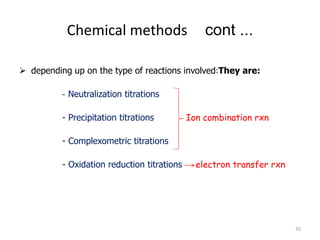
Chemical methods cont...
depending up on the type of reactions involved:They are:
- Neutralization titrations
- Precipitation titrations Ion combination rxn
- Complexometric titrations
- Oxidation reduction titrations electron transfer rxn
35
36.
Various methods Cont’
b)Gravimetric methods:
Gravimetric analysis is a quantitative analysis by weight
it is a process of isolating and weighting the compound of
known composition
The separation of compound is affected by number of ways
like precipitation, volatilization, etc
36
37.
37
C. Gasometric methods:
involve measurement of the volume of gases.
They measure the:
– volume of gas librated in the given chemical reaction
under the conditions that are described in the process
38.
Various methods Cont’
2.Instrumental methods
Based on the relation between the content and corresponding
physicochemical properties of the substance being analyzed.
The changes in the properties of the system are generally
detected through the measurement of
current,
potential,
electrical conductivity,
optical density,
refractive index etc. with suitable and sensitive instruments.
38
39.
A/ Electrochemical method:
It measures current, potential, electrical conductivity, etc. with
suitable and sensitive instruments.
E.g. Potential – potentiometery.
current – amperometry
Voltametry, conductometry etc
39
40.
Various methods Cont’
B/The chromatographic methods:
Chromatography is a separation technique or a device
by which a mixture of substances is separated into its
various components.
Used for identification & quantification of different
pharmaceuticals.
E.g. column, paper, thin layer, gas, ion exchange,
HPLC, etc.
40
41.
Various methods Cont’
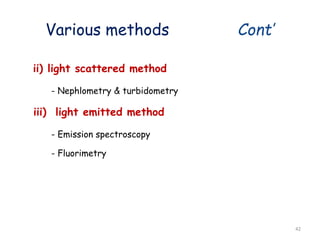
C/Optical method
- measures the amount of light absorbed, scattered, emitted or
transmitted by the sample solution. - it include:
i) light absorption method
- UV/visible spectrophotometry
- IR spectrometry
- AA spectroscopy
41
Various methods Cont’
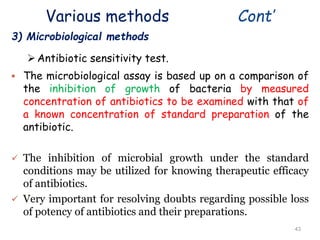
3)Microbiological methods
Antibiotic sensitivity test.
The microbiological assay is based up on a comparison of
the inhibition of growth of bacteria by measured
concentration of antibiotics to be examined with that of
a known concentration of standard preparation of the
antibiotic.
The inhibition of microbial growth under the standard
conditions may be utilized for knowing therapeutic efficacy
of antibiotics.
Very important for resolving doubts regarding possible loss
of potency of antibiotics and their preparations.
43
Selecting an analyticalmethod
In order to select an analytical method intelligently, it is
essential to define clearly the nature of the analytical
problem.
In general, the following points should be considered when
choosing an instrument for any measurement.
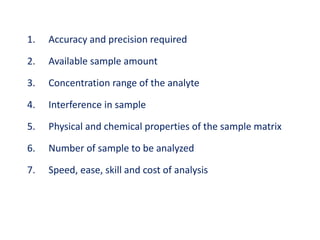
46.
1. Accuracy andprecision required
2. Available sample amount
3. Concentration range of the analyte
4. Interference in sample
5. Physical and chemical properties of the sample matrix
6. Number of sample to be analyzed
7. Speed, ease, skill and cost of analysis