
Introduction to the
REGULATORY AFFAIRSBy,CHANDRAMOHAN
INTRODUCTION
• HISTORY
• WHAT IS RA
• WHY IS RA
HISTORY
Historical Overview of Pharmaceutical Industry
During 1950s, multiple tragedies have resulted in substantial increase
of legislations for drug products quality, safety and efficacy.
Origin
Regulation has stemmed from avoiding the repetition of disasters
Diphtheria disaster
Publication of The Jungle.
Elixir of Sulfanilamide
Thalidomide disaster
Dalkon Shield
Bjork-Shiley heart Valves
In the USA, this regulation is largely written directly into law and codified in Title 21 of the Code of Federal Regulations
Diphtheria disaster
Diphtheria Epidemic led to 1902 Biologics control act –
An Act to regulate the sale of viruses, serums, toxins, and analogous products in the District of Columbia;
• When the large scale production of vaccines began, the
United States had no government regulations to control
medicinal products.
• In 1901, a 5-year-old girl died of tetanus after being given a
diphtheria-antitoxin.
• Investigations found that the St. Louis Board of Health
produced the contaminated vaccine using the blood of a
horse infected with tetanus bacilli.
• It was later discovered that 12 other children had died from
the same contaminated vaccines in St. Louis. That same
year, 9 children in New Jersey died from contaminated
smallpox vaccines.
• These incidents led to form Biologics Control Act, On July
1, 1902.
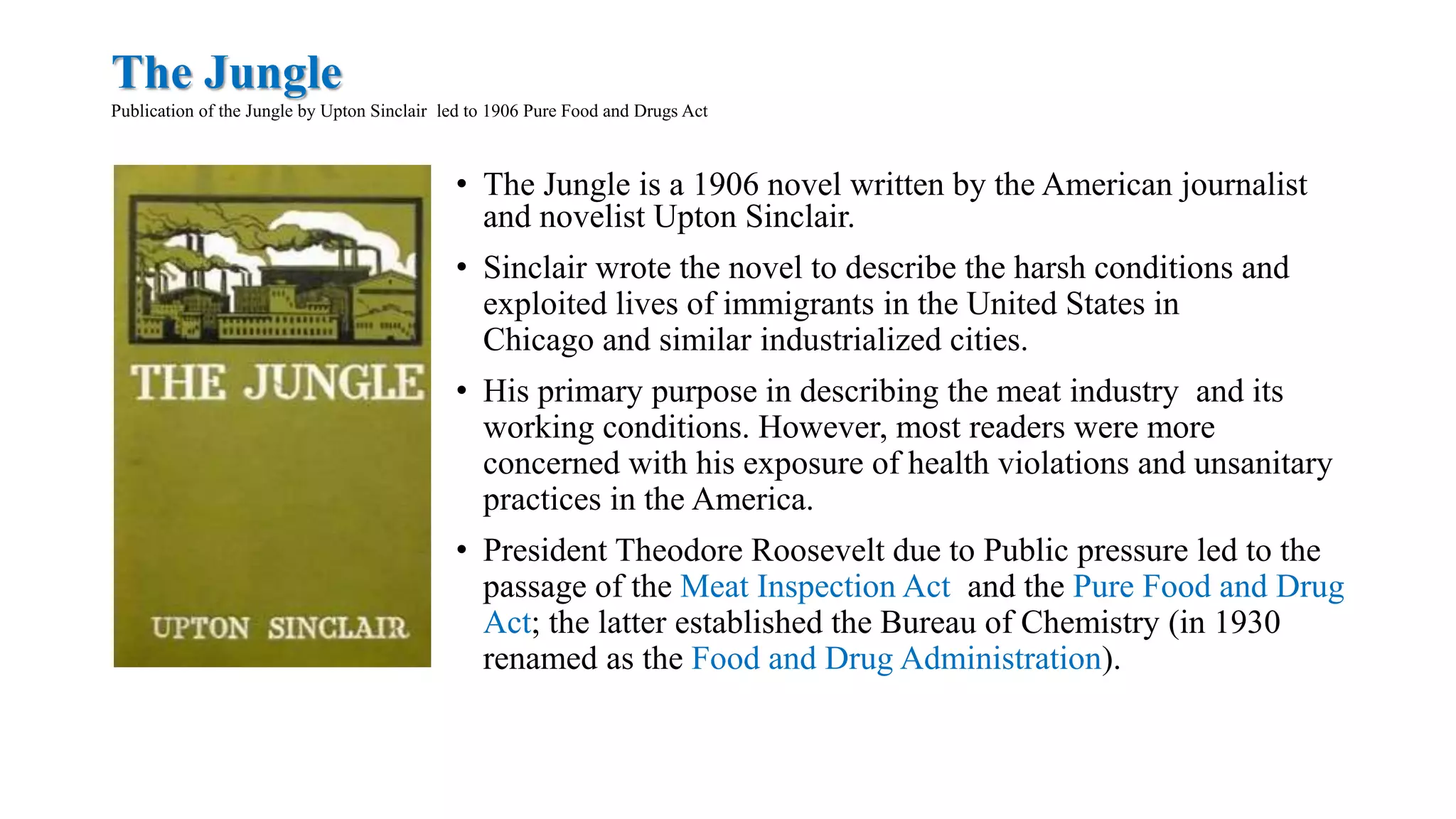
The Jungle
Publication of the Jungle by Upton Sinclair led to 1906 Pure Food and Drugs Act
• The Jungle is a 1906 novel written by the American journalist
and novelist Upton Sinclair.
• Sinclair wrote the novel to describe the harsh conditions and
exploited lives of immigrants in the United States in
Chicago and similar industrialized cities.
• His primary purpose in describing the meat industry and its
working conditions. However, most readers were more
concerned with his exposure of health violations and unsanitary
practices in the America.
• President Theodore Roosevelt due to Public pressure led to the
passage of the Meat Inspection Act and the Pure Food and Drug
Act; the latter established the Bureau of Chemistry (in 1930
renamed as the Food and Drug Administration).
Elixer of Sulfanilamide
led to the 1938 food Drug and Cosmetic Act
• Elixir sulfanilamide was an improperly prepared
Sulfanilamide medicine that caused mass poisoning in the United
States in 1937. It caused the deaths of more than 100 people.
• The public outcry caused by this incident and other similar
disasters led to the passing of the 1938 federal Food, Drug, and
Cosmetic Act
• In 1937, a pharmaceutical manufacturer prepared Sulfanilamide
using diethylene glycol (DEG) as a solvent, DEG is poisonous to
humans and other mammals, but the company was not aware of
this. DEG could cause kidney damage or failure.
Thalidomide disaster
led to the 1962 Kefauver Harris Amendments
• In the 1950s and the early 1960s, thalidomide was used to treat morning sickness during
pregnancy. But it was found to cause severe birth defects. approximately 2,000 babies
born with defects, around half died within a few months.
• Now, decades later, thalidomide is being used to treat a skin condition and cancer. It's
being investigated as a treatment for many other disorders.
• Thalidomide kills or stops the growth of myeloma cells. It also blocks the development of
new blood vessels. Cancer cells need to make new blood vessels so they can grow and
spread.
THALIDOMIDE DISASTER
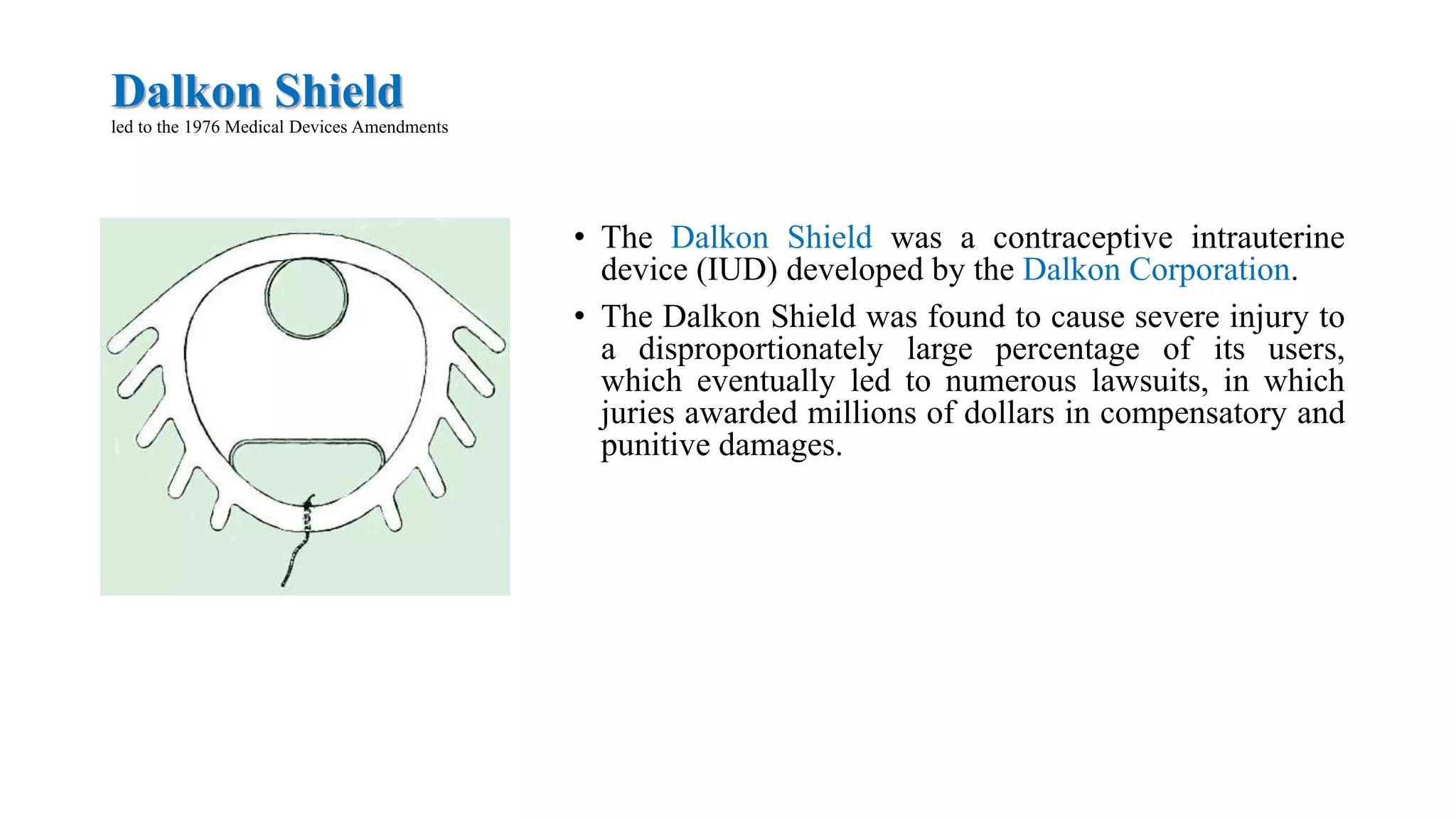
Dalkon Shield
led to the 1976 Medical Devices Amendments
• The Dalkon Shield was a contraceptive intrauterine
device (IUD) developed by the Dalkon Corporation.
• The Dalkon Shield was found to cause severe injury to
a disproportionately large percentage of its users,
which eventually led to numerous lawsuits, in which
juries awarded millions of dollars in compensatory and
punitive damages.
Bjork-Shiley Heart Valves
led to the 1990Safety Medical Devices Act
• The Björk–Shiley valve is a mechanical prosthetic
heart valve.
• Beginning in 1971, it has been used to replace aortic
valves and mitral valves. It was the first successful
tilting-disc valve. It was manufactured first by Shiley
Laboratories, then later by Pfizer after that company
purchased Shiley. One model of the Bjork–Shiley
valve became the subject of a famous lawsuit and
recall after it was shown to malfunction.
WHAT IS RA?
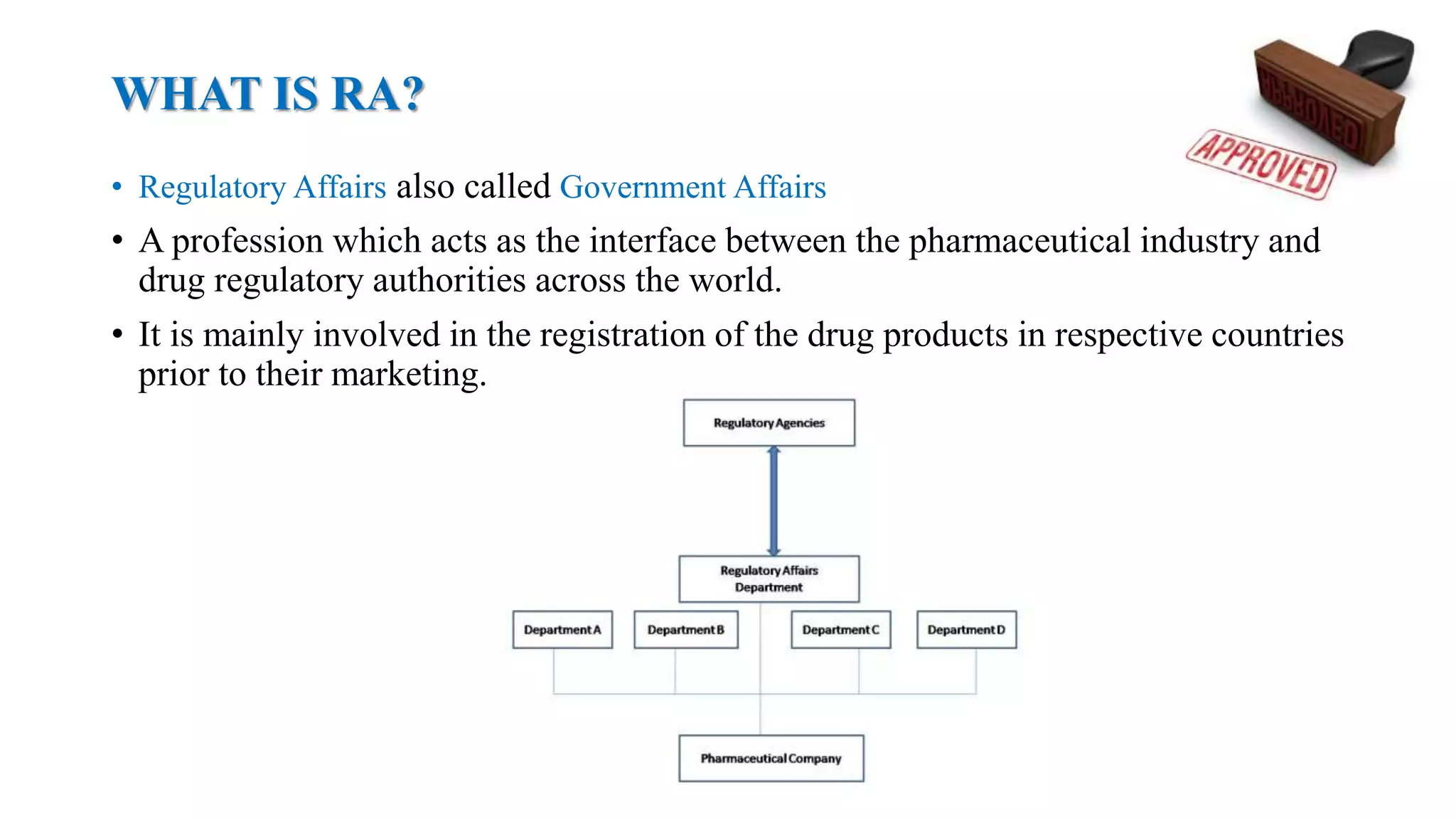
• Regulatory Affairs also called Government Affairs
• A profession which acts as the interface between the pharmaceutical industry and
drug regulatory authorities across the world.
• It is mainly involved in the registration of the drug products in respective countries
prior to their marketing.
WHAT IS RA?
WHAT IS RA?
• The main goals of a regulatory professional:
- Protection of human health
- Ensuring safety, efficacy and quality of drugs
- Ensuring accuracy of product information.
WHY IS RA?
• Regulatory affairs ensure that pharmaceutical products to meet legislative requirements.
• Key duties:
- Studying scientific and legal documents.
- Gathering, evaluating, organising, managing of submission documents and
- Collating information in a variety of formats.
Introduction to the regulatory affairs

Introduction to the regulatory affairs

  • 1.
    Introduction to the REGULATORYAFFAIRSBy,CHANDRAMOHAN
  • 2.
  • 3.
    HISTORY Historical Overview ofPharmaceutical Industry During 1950s, multiple tragedies have resulted in substantial increase of legislations for drug products quality, safety and efficacy. Origin Regulation has stemmed from avoiding the repetition of disasters Diphtheria disaster Publication of The Jungle. Elixir of Sulfanilamide Thalidomide disaster Dalkon Shield Bjork-Shiley heart Valves In the USA, this regulation is largely written directly into law and codified in Title 21 of the Code of Federal Regulations
  • 4.
    Diphtheria disaster Diphtheria Epidemicled to 1902 Biologics control act – An Act to regulate the sale of viruses, serums, toxins, and analogous products in the District of Columbia; • When the large scale production of vaccines began, the United States had no government regulations to control medicinal products. • In 1901, a 5-year-old girl died of tetanus after being given a diphtheria-antitoxin. • Investigations found that the St. Louis Board of Health produced the contaminated vaccine using the blood of a horse infected with tetanus bacilli. • It was later discovered that 12 other children had died from the same contaminated vaccines in St. Louis. That same year, 9 children in New Jersey died from contaminated smallpox vaccines. • These incidents led to form Biologics Control Act, On July 1, 1902.
  • 5.
    The Jungle Publication ofthe Jungle by Upton Sinclair led to 1906 Pure Food and Drugs Act • The Jungle is a 1906 novel written by the American journalist and novelist Upton Sinclair. • Sinclair wrote the novel to describe the harsh conditions and exploited lives of immigrants in the United States in Chicago and similar industrialized cities. • His primary purpose in describing the meat industry and its working conditions. However, most readers were more concerned with his exposure of health violations and unsanitary practices in the America. • President Theodore Roosevelt due to Public pressure led to the passage of the Meat Inspection Act and the Pure Food and Drug Act; the latter established the Bureau of Chemistry (in 1930 renamed as the Food and Drug Administration).
  • 6.
    Elixer of Sulfanilamide ledto the 1938 food Drug and Cosmetic Act • Elixir sulfanilamide was an improperly prepared Sulfanilamide medicine that caused mass poisoning in the United States in 1937. It caused the deaths of more than 100 people. • The public outcry caused by this incident and other similar disasters led to the passing of the 1938 federal Food, Drug, and Cosmetic Act • In 1937, a pharmaceutical manufacturer prepared Sulfanilamide using diethylene glycol (DEG) as a solvent, DEG is poisonous to humans and other mammals, but the company was not aware of this. DEG could cause kidney damage or failure.
  • 7.
    Thalidomide disaster led tothe 1962 Kefauver Harris Amendments • In the 1950s and the early 1960s, thalidomide was used to treat morning sickness during pregnancy. But it was found to cause severe birth defects. approximately 2,000 babies born with defects, around half died within a few months. • Now, decades later, thalidomide is being used to treat a skin condition and cancer. It's being investigated as a treatment for many other disorders. • Thalidomide kills or stops the growth of myeloma cells. It also blocks the development of new blood vessels. Cancer cells need to make new blood vessels so they can grow and spread.
  • 8.
  • 9.
  • 10.
  • 11.
    Dalkon Shield led tothe 1976 Medical Devices Amendments • The Dalkon Shield was a contraceptive intrauterine device (IUD) developed by the Dalkon Corporation. • The Dalkon Shield was found to cause severe injury to a disproportionately large percentage of its users, which eventually led to numerous lawsuits, in which juries awarded millions of dollars in compensatory and punitive damages.
  • 12.
    Bjork-Shiley Heart Valves ledto the 1990Safety Medical Devices Act • The Björk–Shiley valve is a mechanical prosthetic heart valve. • Beginning in 1971, it has been used to replace aortic valves and mitral valves. It was the first successful tilting-disc valve. It was manufactured first by Shiley Laboratories, then later by Pfizer after that company purchased Shiley. One model of the Bjork–Shiley valve became the subject of a famous lawsuit and recall after it was shown to malfunction.
  • 13.
    WHAT IS RA? •Regulatory Affairs also called Government Affairs • A profession which acts as the interface between the pharmaceutical industry and drug regulatory authorities across the world. • It is mainly involved in the registration of the drug products in respective countries prior to their marketing.
  • 14.
  • 15.
    WHAT IS RA? •The main goals of a regulatory professional: - Protection of human health - Ensuring safety, efficacy and quality of drugs - Ensuring accuracy of product information.
  • 16.
    WHY IS RA? •Regulatory affairs ensure that pharmaceutical products to meet legislative requirements. • Key duties: - Studying scientific and legal documents. - Gathering, evaluating, organising, managing of submission documents and - Collating information in a variety of formats.