Corrective and Preventive Action (CAPA)
BY:
PRAKHAR RAI
M.PHARM. (PHARMACEUTICAL QUALITY ASSURANCE)
1
Department of Pharmaceutical Sciences & Technology
Birla Institute of Technology, Mesra
Ranchi – 835 215 (Jharkhand)
Contents
What is CAPA?
Objectives
Corrective Action vs Preventive Action
CAPA processes
Differences between corrective and preventive action
Steps of CAPA
Elements of inception
Benefits of CAPA
Applications
Conclusion
References
2
What is CAPA?
Corrective and Preventative Action (CAPA) is a system of quality
procedures required to eliminate the causes of an existing
nonconformity and to prevent recurrence of nonconforming product,
processes, and other quality problems.
Corrective Action: A corrective action is to eliminate the cause of
a detected non-conformity or other undesirable situation.
Preventive Action: A preventive action is a process to eliminate
the cause of a potential non-conformity or other undesirable
situation.
Note: The ultimate purpose of CAPA is to assure the problem can
never be experienced again.
3
Objectives of CAPA
The primary objective behind corrective action and preventive
action (CAPA) in any pharmaceutical or medical device industry is
to determine the weakness, deviation or failures and to carry out its
investigation with appropriate actions so that such problems are not
repeated again.
It is a part of overall Quality Management System (QMS) and also
a regulatory requirement in a pharmaceutical company.
4
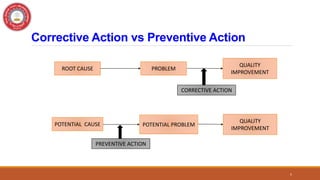
Corrective Action vs Preventive Action
5
ROOT CAUSE PROBLEM
QUALITY
IMPROVEMENT
POTENTIAL PROBLEM
POTENTIAL CAUSE
QUALITY
IMPROVEMENT
PREVENTIVE ACTION
CORRECTIVE ACTION
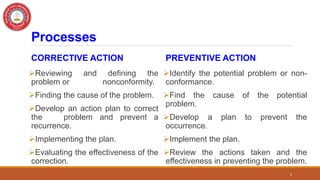
Processes
CORRECTIVE ACTION
Reviewing and defining the
problem or nonconformity.
Finding the cause of the problem.
Develop an action plan to correct
the problem and prevent a
recurrence.
Implementing the plan.
Evaluating the effectiveness of the
correction.
PREVENTIVE ACTION
Identify the potential problem or non-
conformance.
Find the cause of the potential
problem.
Develop a plan to prevent the
occurrence.
Implement the plan.
Review the actions taken and the
effectiveness in preventing the problem.
6
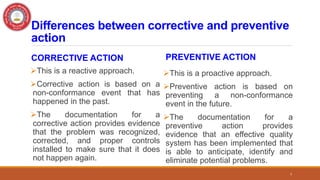
Differences between corrective and preventive
action
CORRECTIVE ACTION
This is a reactive approach.
Corrective action is based on a
non-conformance event that has
happened in the past.
The documentation for a
corrective action provides evidence
that the problem was recognized,
corrected, and proper controls
installed to make sure that it does
not happen again.
PREVENTIVE ACTION
This is a proactive approach.
Preventive action is based on
preventing a non-conformance
event in the future.
The documentation for a
preventive action provides
evidence that an effective quality
system has been implemented that
is able to anticipate, identify and
eliminate potential problems.
7
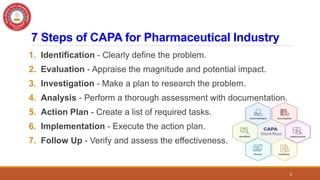
7 Steps of CAPA for Pharmaceutical Industry
1. Identification - Clearly define the problem.
2. Evaluation - Appraise the magnitude and potential impact.
3. Investigation - Make a plan to research the problem.
4. Analysis - Perform a thorough assessment with documentation.
5. Action Plan - Create a list of required tasks.
6. Implementation - Execute the action plan.
7. Follow Up - Verify and assess the effectiveness.
8
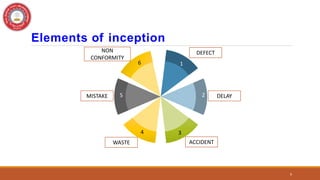
Elements of inception
9
1
6
5 2
4 3
DEFECT
NON
CONFORMITY
DELAY
MISTAKE
WASTE ACCIDENT
Benefits of CAPA
To improve quality.
To recognize existing or potential quality issues.
To make sure that the same issues do not reoccur.
Reduce risk to patients.
Increase quality suppliers and components.
Products designed and tested to meet customer requirements.
Waste elimination.
10
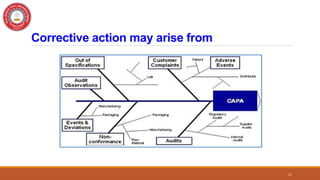
Corrective action may arise from
11
Applications of CAPA in Pharma Industry
CAPA application in pharmaceutical development.
CAPA application in technology transfer.
CAPA application in commercial manufacturing.
CAPA application in product discontinuation.
12
Conclusion
CAPA is one of the many important tools that ensure quality and
continuous improvement for any product and services. It gives a
high degree of assurance that the product or services always meet
the regulatory and quality requirements throughout. Implementation
of CAPA in industry will help in identifying the root cause of non-
conformity and prevent further risk in the future as it plays an
important role in quality risk management.
13
References
Abhishek, R. (2016). A review on corrective action and preventive
action (CAPA). African Journal of Pharmacy and Pharmacology,
10(1), 1–6. doi:10.5897/ajpp2015.4390
https://1library.net/document/zx2gvrnq-corrective-preventive-
management-applications-pharmaceutical-industry-venkatesh-
gangadharappa.html
https://www.scc-co.com/blog/bid/63890/Quality-Management-
System-Corrective-Action-Software
14
15
Thank you

corrective and preventive action (CAPA)

  • 1.
    Corrective and PreventiveAction (CAPA) BY: PRAKHAR RAI M.PHARM. (PHARMACEUTICAL QUALITY ASSURANCE) 1 Department of Pharmaceutical Sciences & Technology Birla Institute of Technology, Mesra Ranchi – 835 215 (Jharkhand)
  • 2.
    Contents What is CAPA? Objectives CorrectiveAction vs Preventive Action CAPA processes Differences between corrective and preventive action Steps of CAPA Elements of inception Benefits of CAPA Applications Conclusion References 2
  • 3.
    What is CAPA? Correctiveand Preventative Action (CAPA) is a system of quality procedures required to eliminate the causes of an existing nonconformity and to prevent recurrence of nonconforming product, processes, and other quality problems. Corrective Action: A corrective action is to eliminate the cause of a detected non-conformity or other undesirable situation. Preventive Action: A preventive action is a process to eliminate the cause of a potential non-conformity or other undesirable situation. Note: The ultimate purpose of CAPA is to assure the problem can never be experienced again. 3
  • 4.
    Objectives of CAPA Theprimary objective behind corrective action and preventive action (CAPA) in any pharmaceutical or medical device industry is to determine the weakness, deviation or failures and to carry out its investigation with appropriate actions so that such problems are not repeated again. It is a part of overall Quality Management System (QMS) and also a regulatory requirement in a pharmaceutical company. 4
  • 5.
    Corrective Action vsPreventive Action 5 ROOT CAUSE PROBLEM QUALITY IMPROVEMENT POTENTIAL PROBLEM POTENTIAL CAUSE QUALITY IMPROVEMENT PREVENTIVE ACTION CORRECTIVE ACTION
  • 6.
    Processes CORRECTIVE ACTION Reviewing anddefining the problem or nonconformity. Finding the cause of the problem. Develop an action plan to correct the problem and prevent a recurrence. Implementing the plan. Evaluating the effectiveness of the correction. PREVENTIVE ACTION Identify the potential problem or non- conformance. Find the cause of the potential problem. Develop a plan to prevent the occurrence. Implement the plan. Review the actions taken and the effectiveness in preventing the problem. 6
  • 7.
    Differences between correctiveand preventive action CORRECTIVE ACTION This is a reactive approach. Corrective action is based on a non-conformance event that has happened in the past. The documentation for a corrective action provides evidence that the problem was recognized, corrected, and proper controls installed to make sure that it does not happen again. PREVENTIVE ACTION This is a proactive approach. Preventive action is based on preventing a non-conformance event in the future. The documentation for a preventive action provides evidence that an effective quality system has been implemented that is able to anticipate, identify and eliminate potential problems. 7
  • 8.
    7 Steps ofCAPA for Pharmaceutical Industry 1. Identification - Clearly define the problem. 2. Evaluation - Appraise the magnitude and potential impact. 3. Investigation - Make a plan to research the problem. 4. Analysis - Perform a thorough assessment with documentation. 5. Action Plan - Create a list of required tasks. 6. Implementation - Execute the action plan. 7. Follow Up - Verify and assess the effectiveness. 8
  • 9.
    Elements of inception 9 1 6 52 4 3 DEFECT NON CONFORMITY DELAY MISTAKE WASTE ACCIDENT
  • 10.
    Benefits of CAPA Toimprove quality. To recognize existing or potential quality issues. To make sure that the same issues do not reoccur. Reduce risk to patients. Increase quality suppliers and components. Products designed and tested to meet customer requirements. Waste elimination. 10
  • 11.
    Corrective action mayarise from 11
  • 12.
    Applications of CAPAin Pharma Industry CAPA application in pharmaceutical development. CAPA application in technology transfer. CAPA application in commercial manufacturing. CAPA application in product discontinuation. 12
  • 13.
    Conclusion CAPA is oneof the many important tools that ensure quality and continuous improvement for any product and services. It gives a high degree of assurance that the product or services always meet the regulatory and quality requirements throughout. Implementation of CAPA in industry will help in identifying the root cause of non- conformity and prevent further risk in the future as it plays an important role in quality risk management. 13
  • 14.
    References Abhishek, R. (2016).A review on corrective action and preventive action (CAPA). African Journal of Pharmacy and Pharmacology, 10(1), 1–6. doi:10.5897/ajpp2015.4390 https://1library.net/document/zx2gvrnq-corrective-preventive- management-applications-pharmaceutical-industry-venkatesh- gangadharappa.html https://www.scc-co.com/blog/bid/63890/Quality-Management- System-Corrective-Action-Software 14
  • 15.