Quality Assurance
&
Quality Management concepts
Dr Bindiya Chauhan
Pharmaceutical Quality Assurance
SGT University
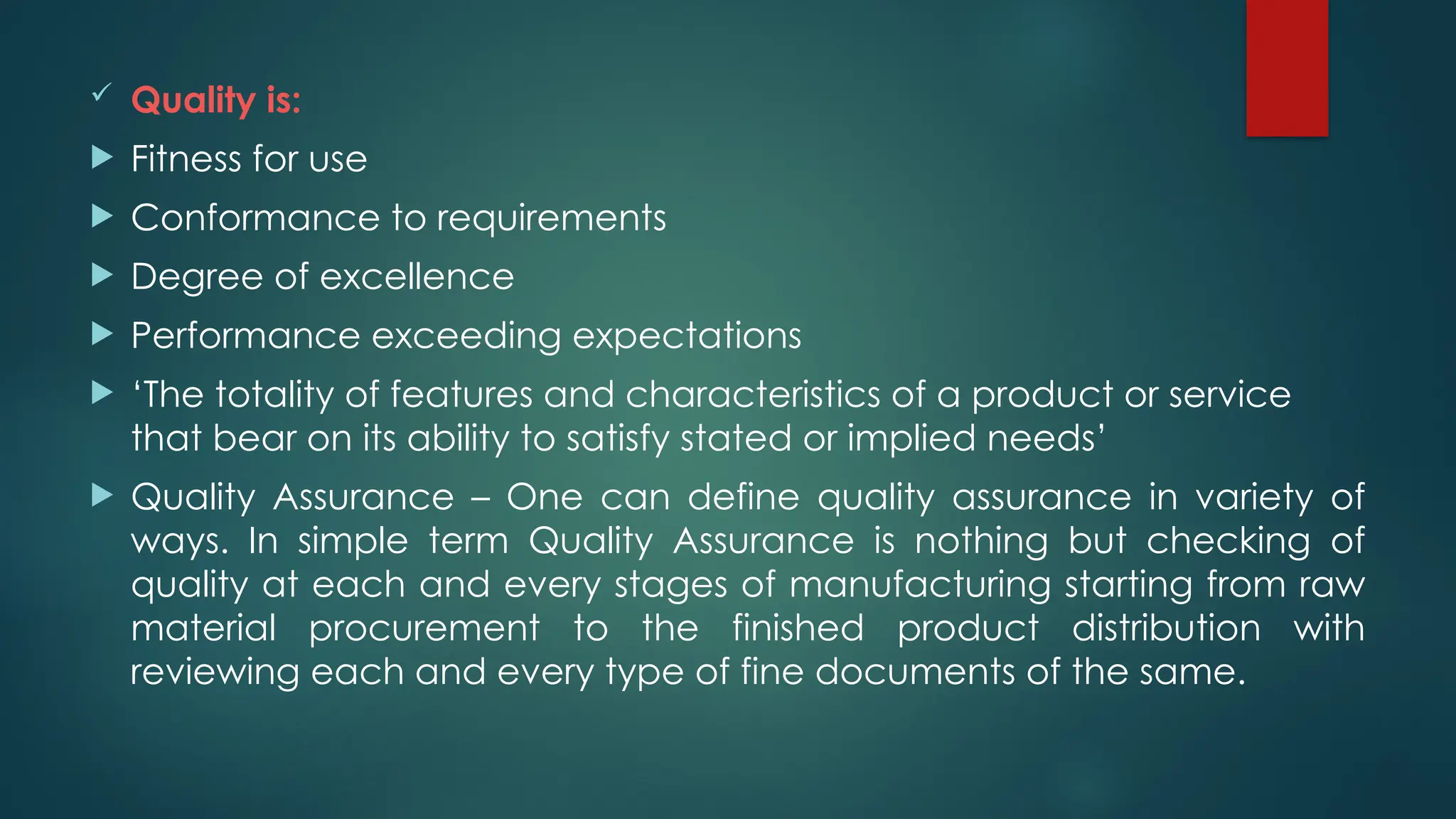
 Quality is:
 Fitness for use
 Conformance to requirements
 Degree of excellence
 Performance exceeding expectations
 ‘The totality of features and characteristics of a product or service
that bear on its ability to satisfy stated or implied needs’
 Quality Assurance – One can define quality assurance in variety of
ways. In simple term Quality Assurance is nothing but checking of
quality at each and every stages of manufacturing starting from raw
material procurement to the finished product distribution with
reviewing each and every type of fine documents of the same.
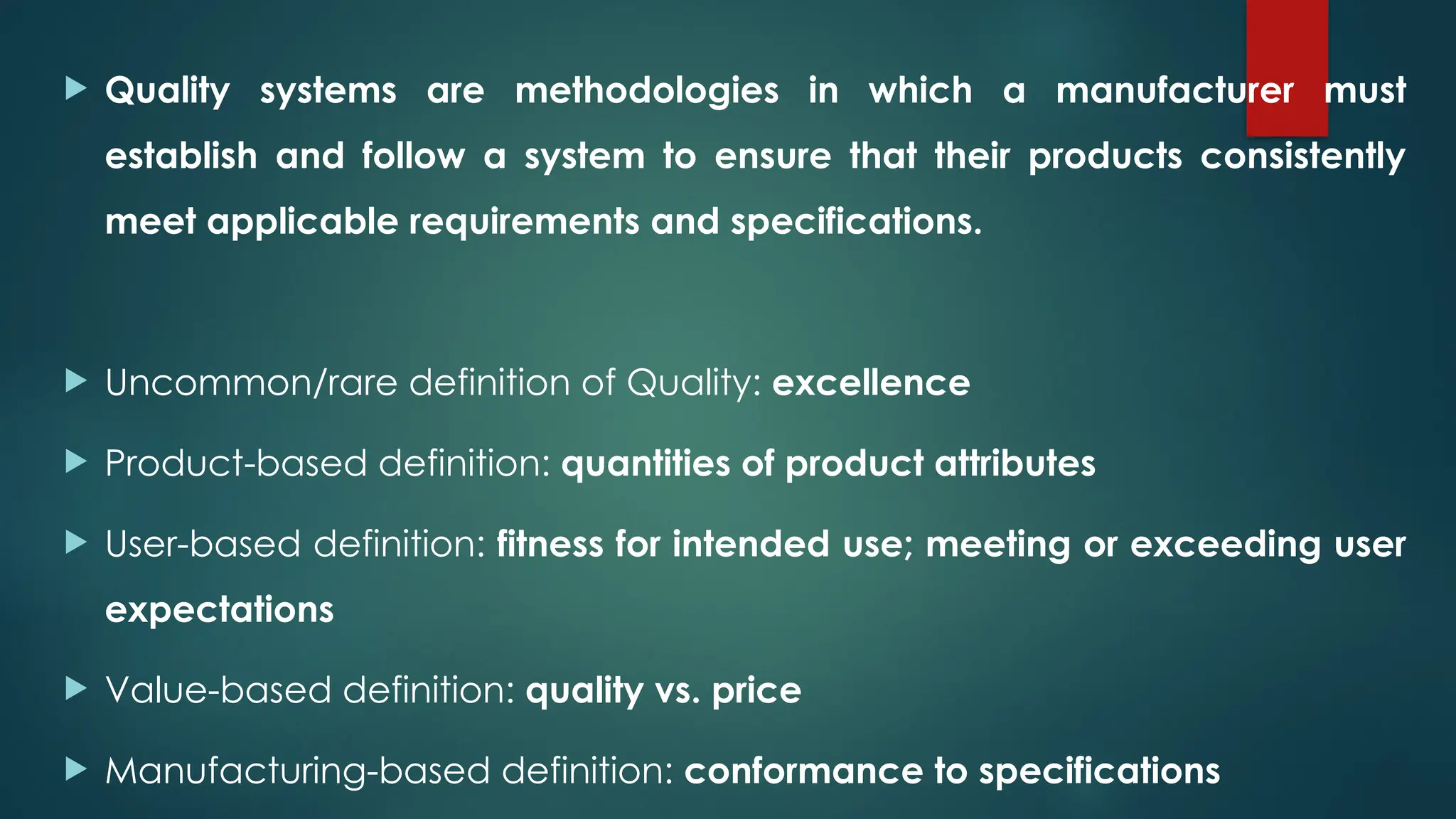
 Quality systems are methodologies in which a manufacturer must
establish and follow a system to ensure that their products consistently
meet applicable requirements and specifications.
 Uncommon/rare definition of Quality: excellence
 Product-based definition: quantities of product attributes
 User-based definition: fitness for intended use; meeting or exceeding user
expectations
 Value-based definition: quality vs. price
 Manufacturing-based definition: conformance to specifications
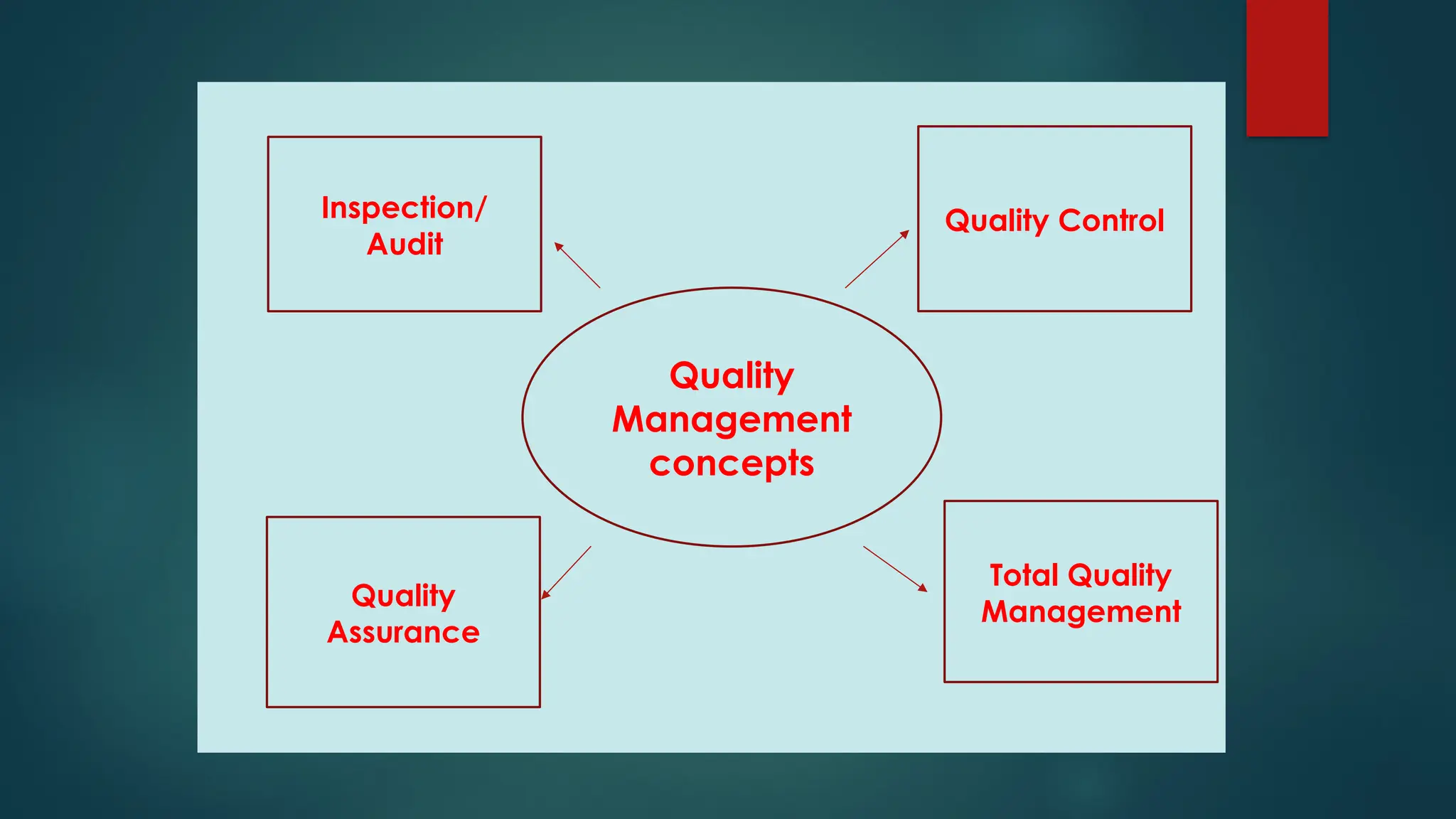
Quality
Management
concepts
Quality Control
Quality
Assurance
Inspection/
Audit
Total Quality
Management
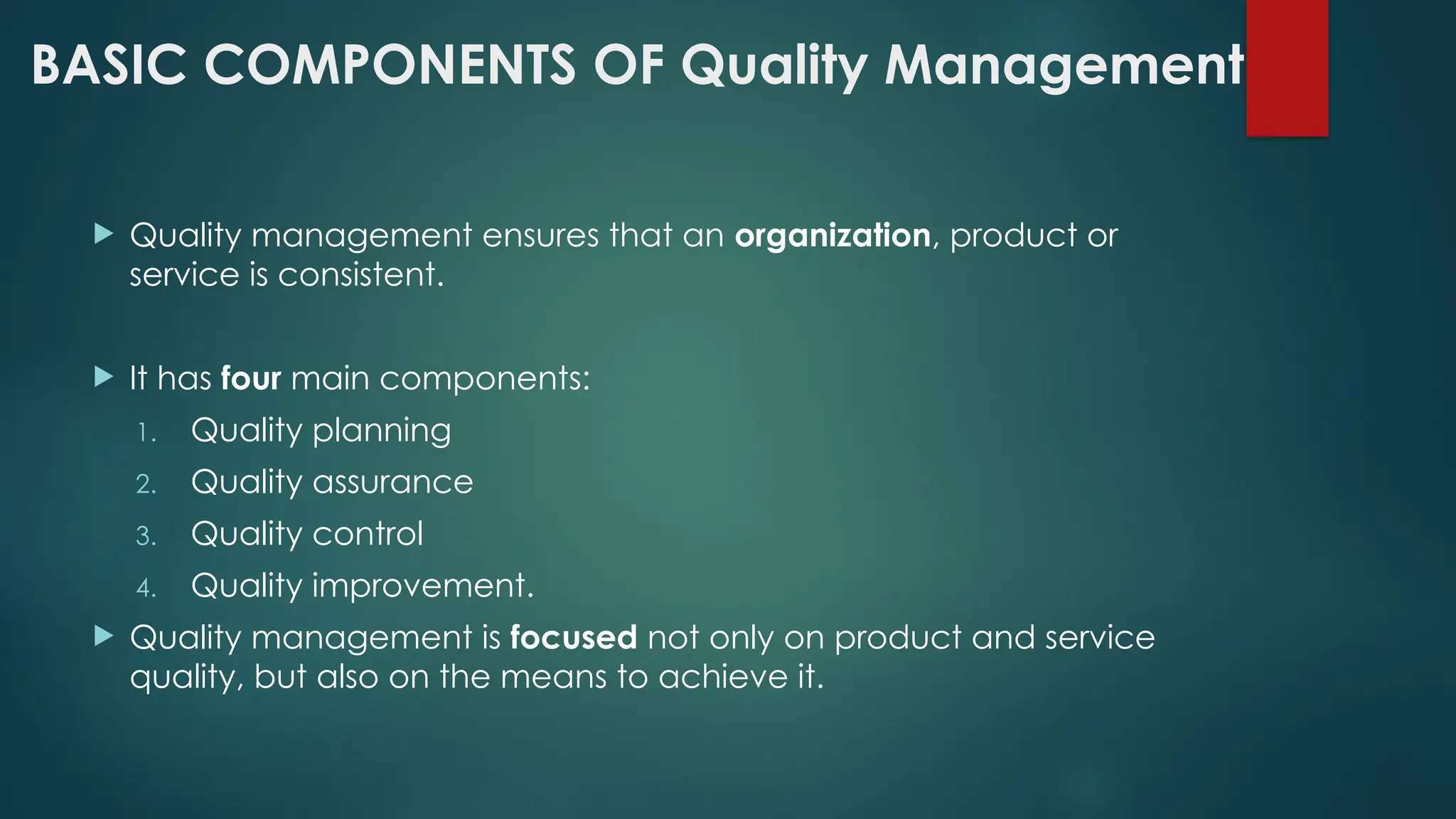
BASIC COMPONENTS OF Quality Management
 Quality management ensures that an organization, product or
service is consistent.
 It has four main components:
1. Quality planning
2. Quality assurance
3. Quality control
4. Quality improvement.
 Quality management is focused not only on product and service
quality, but also on the means to achieve it.
Total Quality Management (TQM)
BASIC CONCEPTS OF TOTAL QUALITY MANAGEMENT
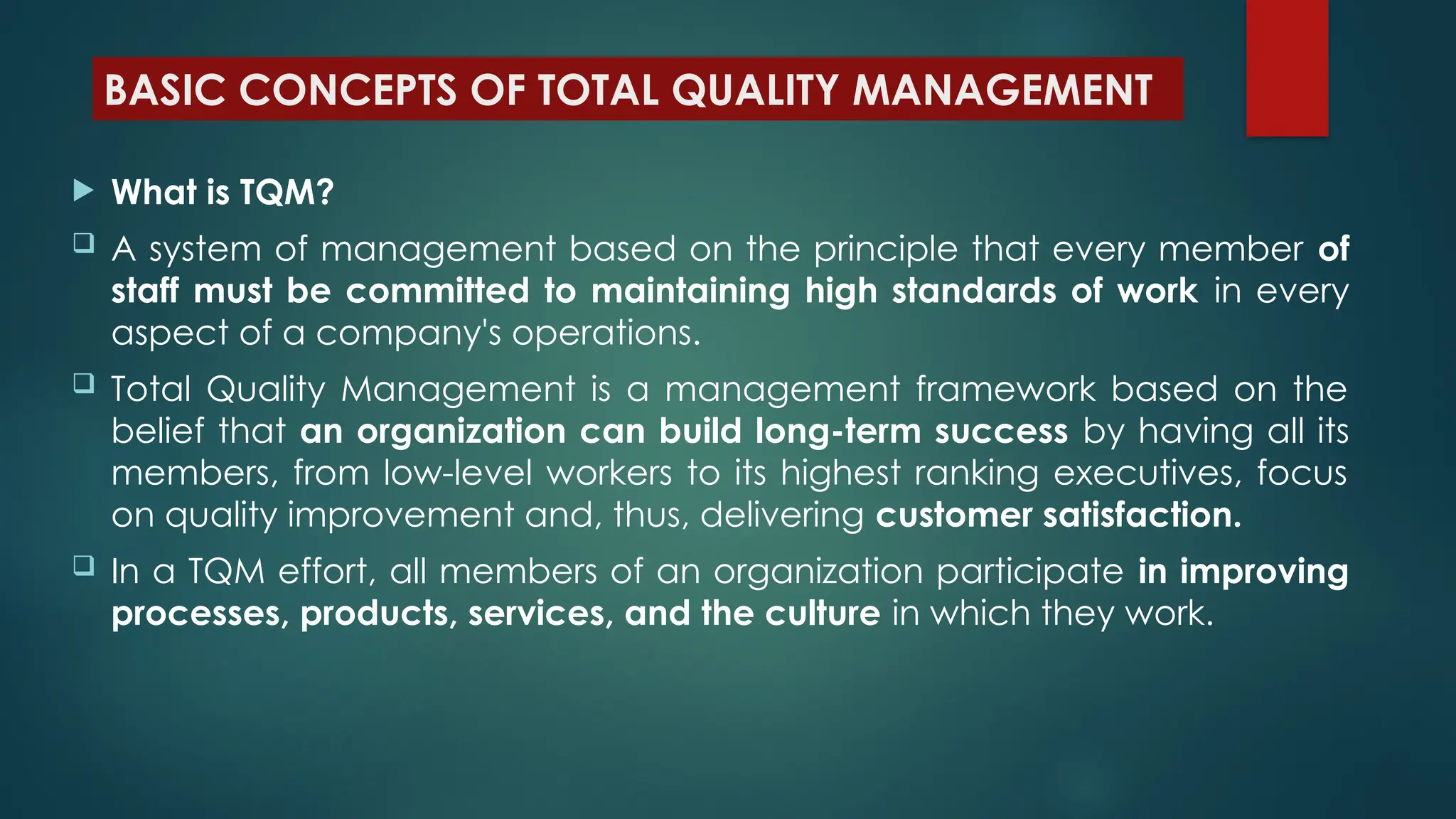
 What is TQM?
 A system of management based on the principle that every member of
staff must be committed to maintaining high standards of work in every
aspect of a company's operations.
 Total Quality Management is a management framework based on the
belief that an organization can build long-term success by having all its
members, from low-level workers to its highest ranking executives, focus
on quality improvement and, thus, delivering customer satisfaction.
 In a TQM effort, all members of an organization participate in improving
processes, products, services, and the culture in which they work.
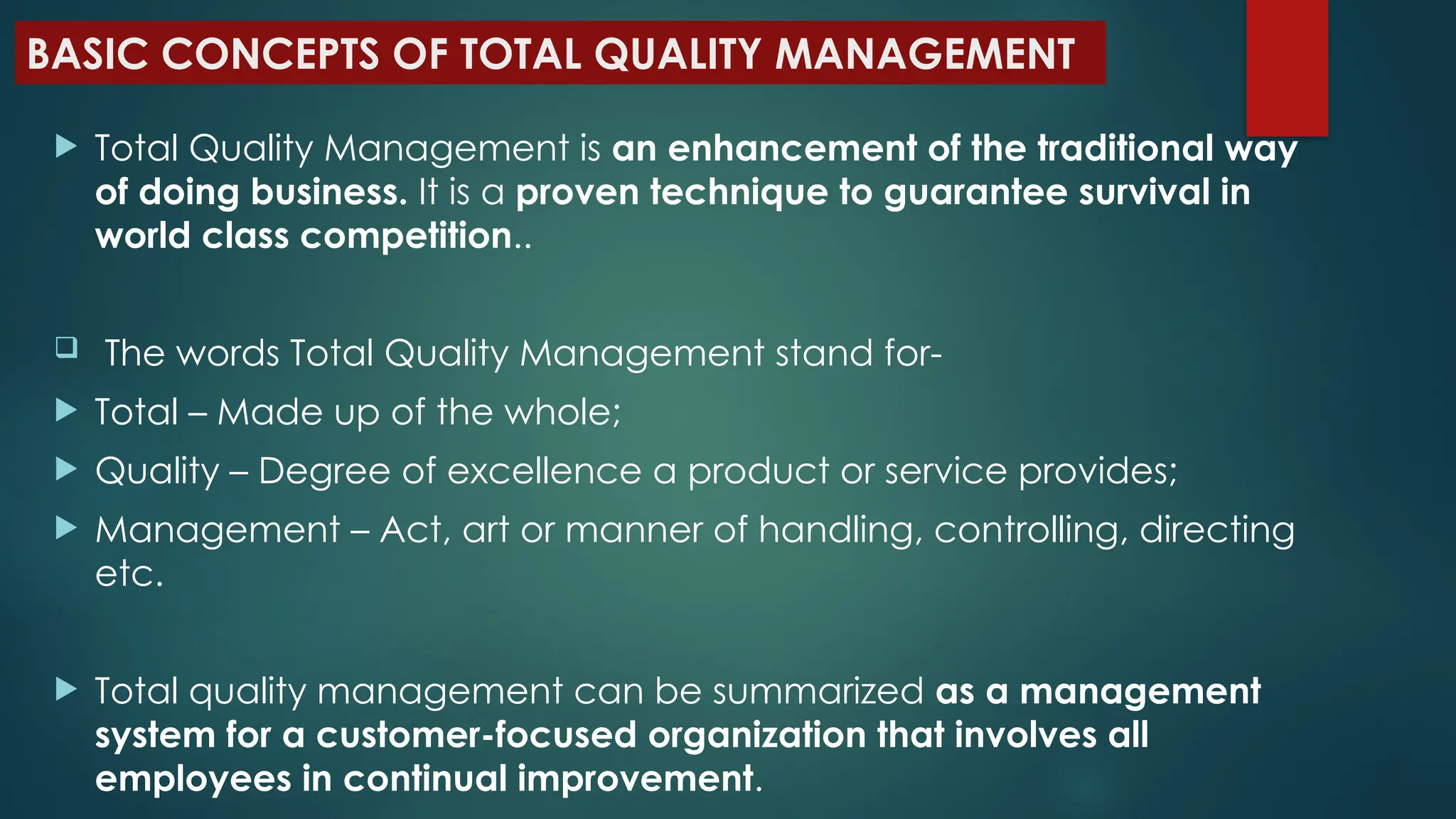
 Total Quality Management is an enhancement of the traditional way
of doing business. It is a proven technique to guarantee survival in
world class competition..
 The words Total Quality Management stand for-
 Total – Made up of the whole;
 Quality – Degree of excellence a product or service provides;
 Management – Act, art or manner of handling, controlling, directing
etc.
 Total quality management can be summarized as a management
system for a customer-focused organization that involves all
employees in continual improvement.
BASIC CONCEPTS OF TOTAL QUALITY MANAGEMENT
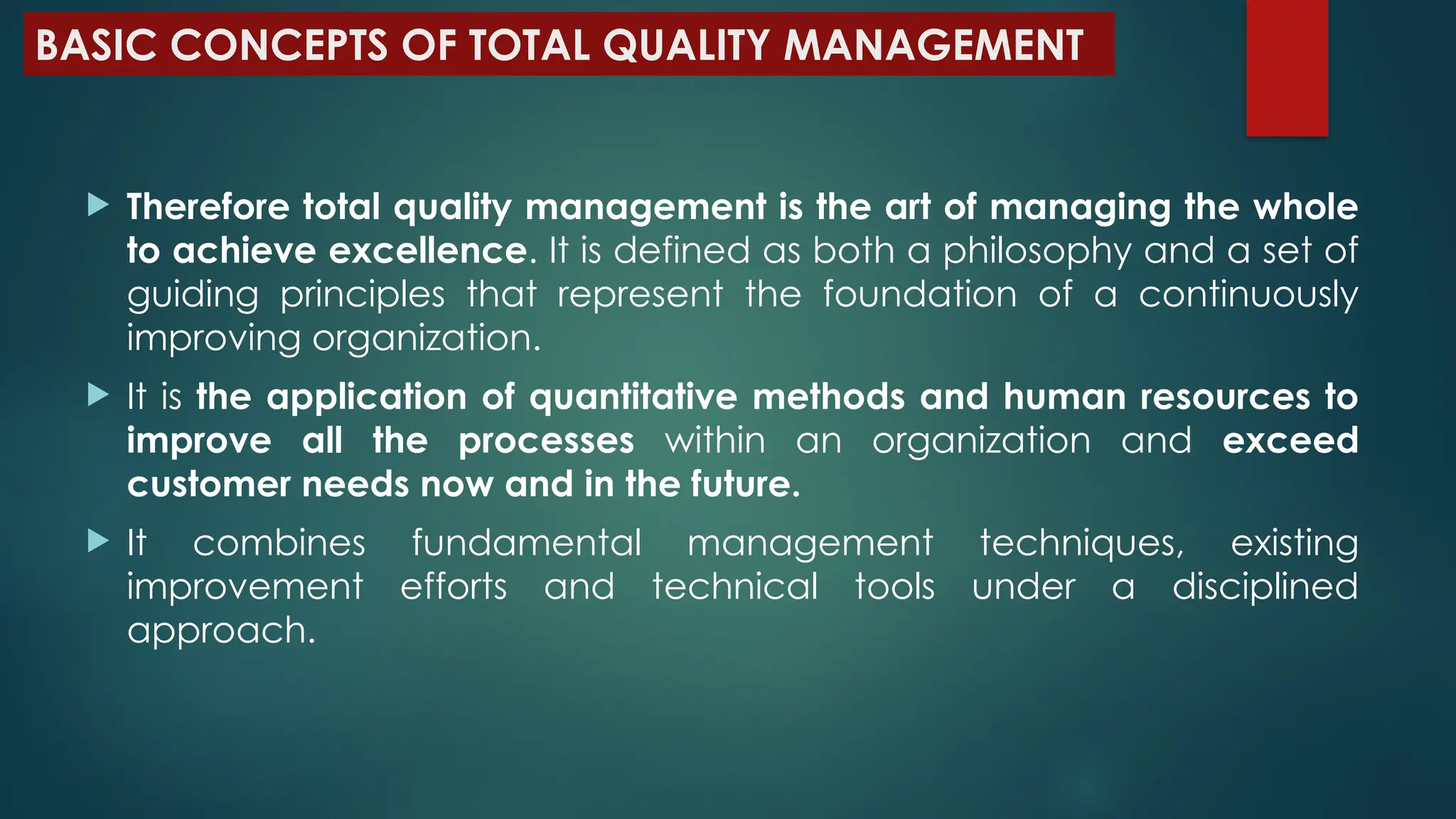
 Therefore total quality management is the art of managing the whole
to achieve excellence. It is defined as both a philosophy and a set of
guiding principles that represent the foundation of a continuously
improving organization.
 It is the application of quantitative methods and human resources to
improve all the processes within an organization and exceed
customer needs now and in the future.
 It combines fundamental management techniques, existing
improvement efforts and technical tools under a disciplined
approach.
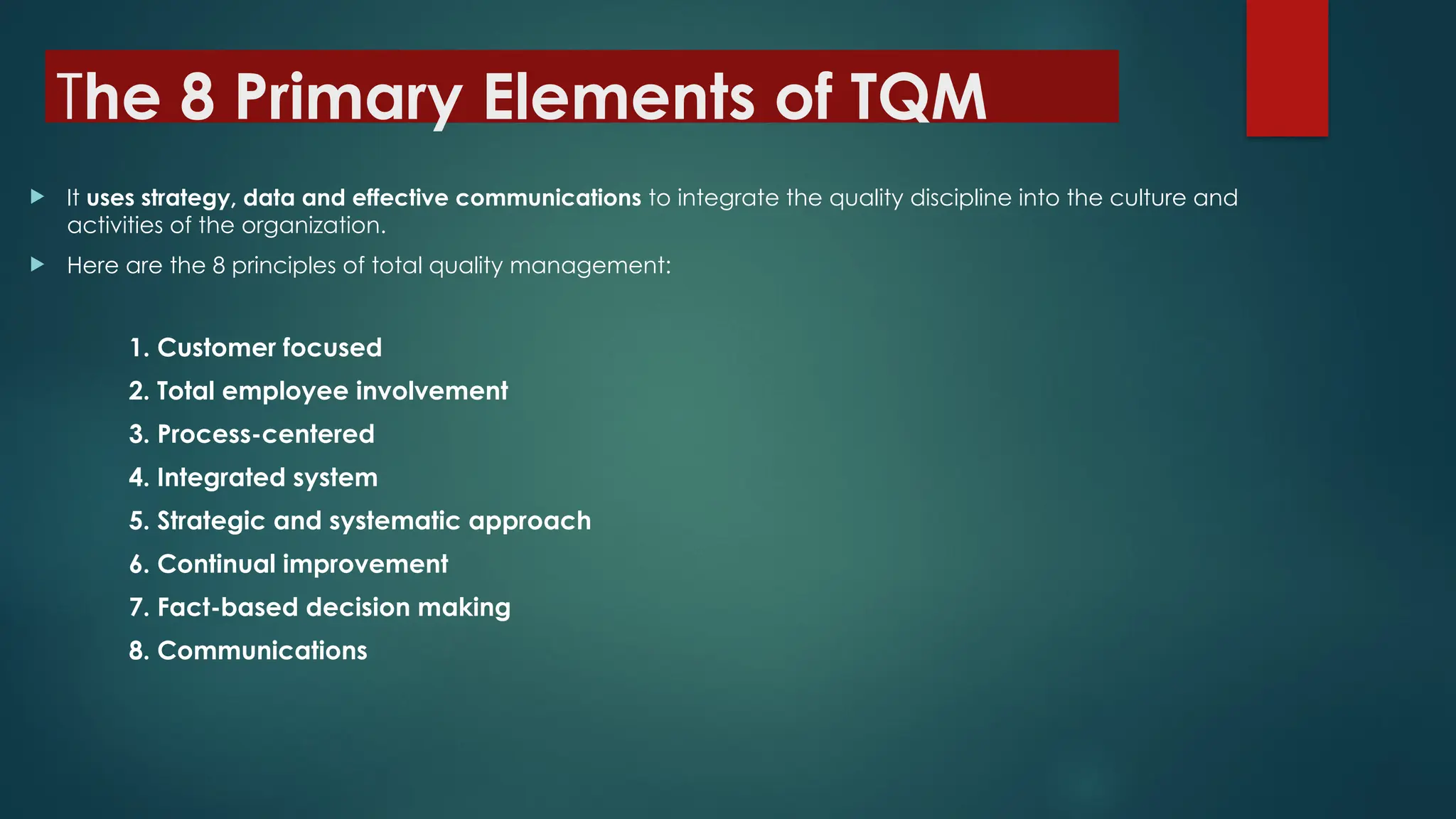
The 8 Primary Elements of TQM
 It uses strategy, data and effective communications to integrate the quality discipline into the culture and
activities of the organization.
 Here are the 8 principles of total quality management:
1. Customer focused
2. Total employee involvement
3. Process-centered
4. Integrated system
5. Strategic and systematic approach
6. Continual improvement
7. Fact-based decision making
8. Communications
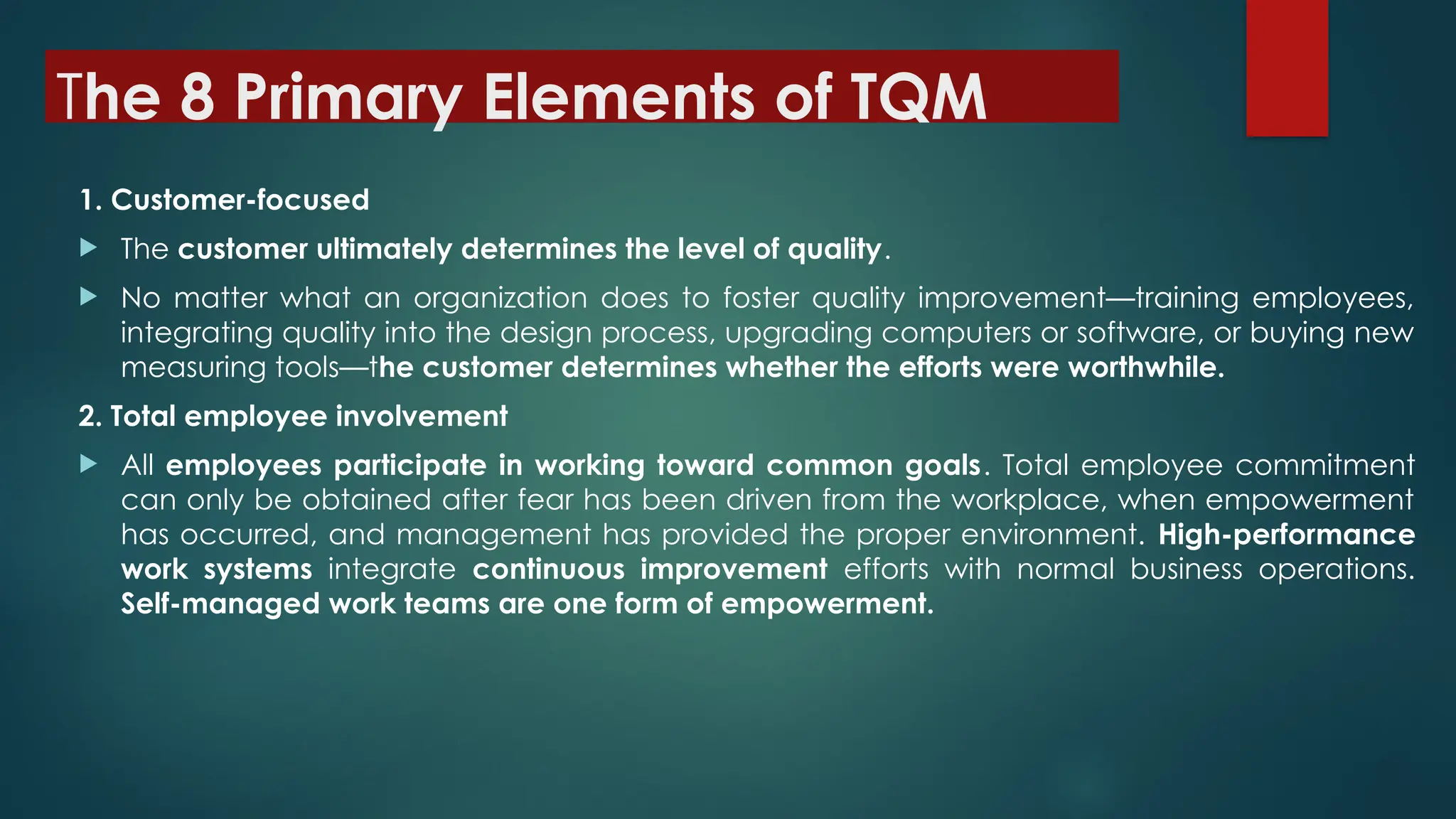
The 8 Primary Elements of TQM
1. Customer-focused
 The customer ultimately determines the level of quality.
 No matter what an organization does to foster quality improvement—training employees,
integrating quality into the design process, upgrading computers or software, or buying new
measuring tools—the customer determines whether the efforts were worthwhile.
2. Total employee involvement
 All employees participate in working toward common goals. Total employee commitment
can only be obtained after fear has been driven from the workplace, when empowerment
has occurred, and management has provided the proper environment. High-performance
work systems integrate continuous improvement efforts with normal business operations.
Self-managed work teams are one form of empowerment.
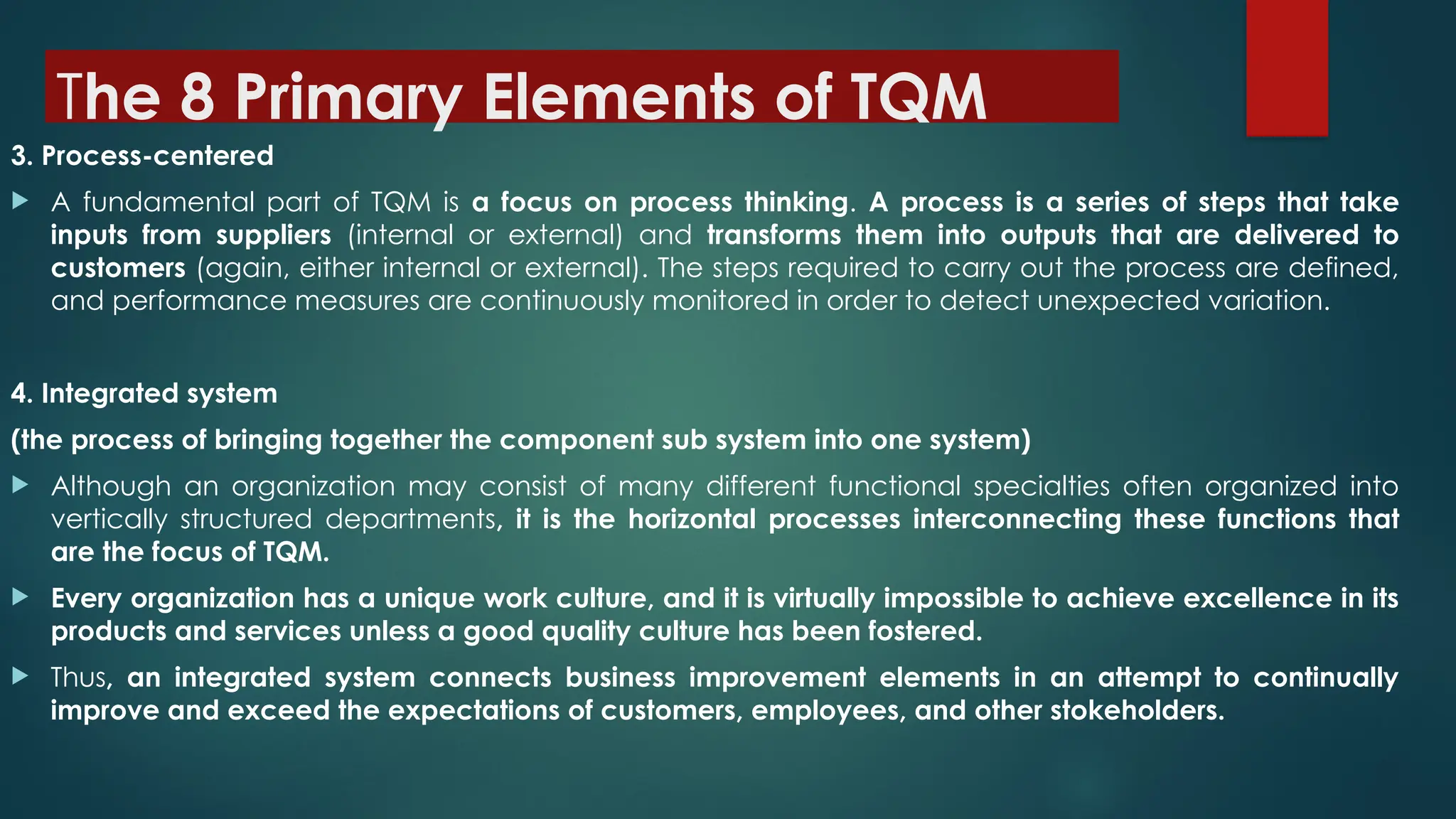
The 8 Primary Elements of TQM
3. Process-centered
 A fundamental part of TQM is a focus on process thinking. A process is a series of steps that take
inputs from suppliers (internal or external) and transforms them into outputs that are delivered to
customers (again, either internal or external). The steps required to carry out the process are defined,
and performance measures are continuously monitored in order to detect unexpected variation.
4. Integrated system
(the process of bringing together the component sub system into one system)
 Although an organization may consist of many different functional specialties often organized into
vertically structured departments, it is the horizontal processes interconnecting these functions that
are the focus of TQM.
 Every organization has a unique work culture, and it is virtually impossible to achieve excellence in its
products and services unless a good quality culture has been fostered.
 Thus, an integrated system connects business improvement elements in an attempt to continually
improve and exceed the expectations of customers, employees, and other stokeholders.
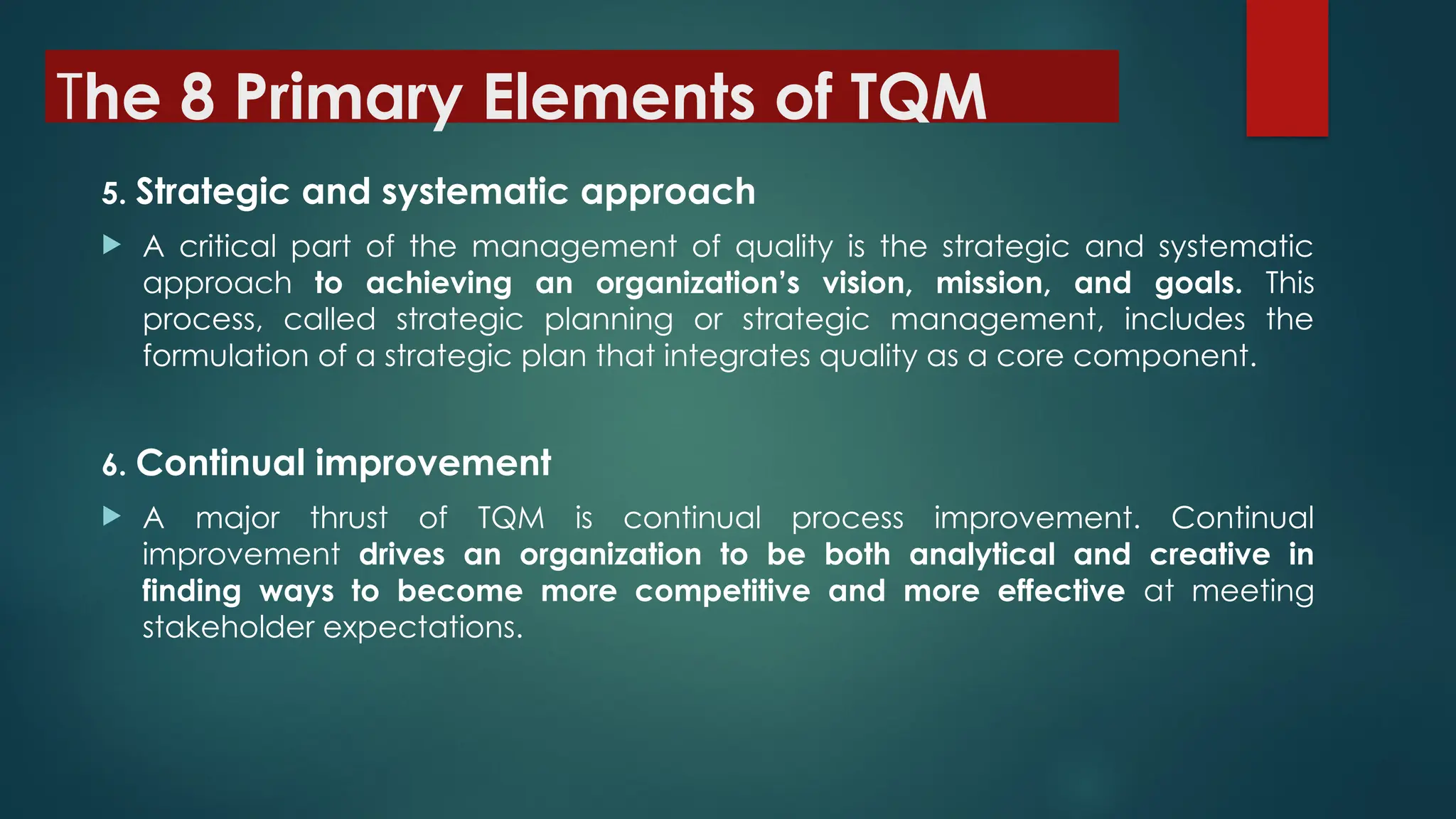
The 8 Primary Elements of TQM
5. Strategic and systematic approach
 A critical part of the management of quality is the strategic and systematic
approach to achieving an organization’s vision, mission, and goals. This
process, called strategic planning or strategic management, includes the
formulation of a strategic plan that integrates quality as a core component.
6. Continual improvement
 A major thrust of TQM is continual process improvement. Continual
improvement drives an organization to be both analytical and creative in
finding ways to become more competitive and more effective at meeting
stakeholder expectations.
The 8 Primary Elements of TQM
7. Fact-based decision making
 In order to know how well an organization is performing, data on performance measures are
necessary. TQM requires that an organization continually collect and analyze data in order to
improve decision making accuracy, achieve consensus, and allow prediction based on past
history.
8. Communications
 During times of organizational change, as well as part of day-to-day operation, effective
communications plays a large part in maintaining morale and in motivating employees at all
levels.
 Communications involve strategies, method, and timeliness.
These elements are considered so essential to TQM
7 PRINCIPLES OF TQM
1. Quality can and must be managed
 The base of TQM is quality that intern affect customer satisfaction. The quality must be
managed throughout the process.
2. Processes, not people, are the problem
 If your process is causing problems, it won’t matter how many times you hire new employees
or how many training sessions you put them through. Correct the process and then train your
people on these new procedures.
3. Don’t treat symptoms, look for the cure
 If you just patch over the underlying problems in the process, you will never be able to fully reach
your potential. If, for example, your shipping department is falling behind, you may find that it is
because of holdups in manufacturing. Go for the source to correct the problem.
7 PRINCIPLES OF TQM
4. Every employee is responsible for quality
Everyone in the company, from the workers on the line to the upper management, must
realize that they have an important part to play in ensuring high levels of quality in their
products and services. Everyone has a customer to delight, and they must all step up and
take responsibility for them.
5. Quality must be measurable
A quality management system is only effective when you can quantify the results. You need
to see how the process is implemented and if it is having the desired effect. This will help
you set your goals for the future and ensure that every department is working toward the
same result.
7 PRINCIPLES OF TQM
6. Quality improvements must be continuous
Total Quality Management is not something that can be done once and then
forgotten. It’s not a management “phase” that will end after a problem has been
corrected. Real improvements must occur frequently and continually in order to
increase customer satisfaction and loyalty.
7. Quality is a long-term investment
Quality management is not a quick fix. You can purchase QMS software that will help
you get things started, but you should understand that real results won’t occur
immediately. TQM is a long-term investment, and it is designed to help you find long-
term success.
Quality Assurance and Quality Management concepts: Definition and concept of Quality control, Quality assurance and GMP

  • 1.
    Quality Assurance & Quality Managementconcepts Dr Bindiya Chauhan Pharmaceutical Quality Assurance SGT University
  • 2.
     Quality is: Fitness for use  Conformance to requirements  Degree of excellence  Performance exceeding expectations  ‘The totality of features and characteristics of a product or service that bear on its ability to satisfy stated or implied needs’  Quality Assurance – One can define quality assurance in variety of ways. In simple term Quality Assurance is nothing but checking of quality at each and every stages of manufacturing starting from raw material procurement to the finished product distribution with reviewing each and every type of fine documents of the same.
  • 3.
     Quality systemsare methodologies in which a manufacturer must establish and follow a system to ensure that their products consistently meet applicable requirements and specifications.  Uncommon/rare definition of Quality: excellence  Product-based definition: quantities of product attributes  User-based definition: fitness for intended use; meeting or exceeding user expectations  Value-based definition: quality vs. price  Manufacturing-based definition: conformance to specifications
  • 4.
  • 6.
    BASIC COMPONENTS OFQuality Management  Quality management ensures that an organization, product or service is consistent.  It has four main components: 1. Quality planning 2. Quality assurance 3. Quality control 4. Quality improvement.  Quality management is focused not only on product and service quality, but also on the means to achieve it.
  • 7.
  • 8.
    BASIC CONCEPTS OFTOTAL QUALITY MANAGEMENT  What is TQM?  A system of management based on the principle that every member of staff must be committed to maintaining high standards of work in every aspect of a company's operations.  Total Quality Management is a management framework based on the belief that an organization can build long-term success by having all its members, from low-level workers to its highest ranking executives, focus on quality improvement and, thus, delivering customer satisfaction.  In a TQM effort, all members of an organization participate in improving processes, products, services, and the culture in which they work.
  • 9.
     Total QualityManagement is an enhancement of the traditional way of doing business. It is a proven technique to guarantee survival in world class competition..  The words Total Quality Management stand for-  Total – Made up of the whole;  Quality – Degree of excellence a product or service provides;  Management – Act, art or manner of handling, controlling, directing etc.  Total quality management can be summarized as a management system for a customer-focused organization that involves all employees in continual improvement. BASIC CONCEPTS OF TOTAL QUALITY MANAGEMENT
  • 10.
    BASIC CONCEPTS OFTOTAL QUALITY MANAGEMENT  Therefore total quality management is the art of managing the whole to achieve excellence. It is defined as both a philosophy and a set of guiding principles that represent the foundation of a continuously improving organization.  It is the application of quantitative methods and human resources to improve all the processes within an organization and exceed customer needs now and in the future.  It combines fundamental management techniques, existing improvement efforts and technical tools under a disciplined approach.
  • 11.
    The 8 PrimaryElements of TQM  It uses strategy, data and effective communications to integrate the quality discipline into the culture and activities of the organization.  Here are the 8 principles of total quality management: 1. Customer focused 2. Total employee involvement 3. Process-centered 4. Integrated system 5. Strategic and systematic approach 6. Continual improvement 7. Fact-based decision making 8. Communications
  • 12.
    The 8 PrimaryElements of TQM 1. Customer-focused  The customer ultimately determines the level of quality.  No matter what an organization does to foster quality improvement—training employees, integrating quality into the design process, upgrading computers or software, or buying new measuring tools—the customer determines whether the efforts were worthwhile. 2. Total employee involvement  All employees participate in working toward common goals. Total employee commitment can only be obtained after fear has been driven from the workplace, when empowerment has occurred, and management has provided the proper environment. High-performance work systems integrate continuous improvement efforts with normal business operations. Self-managed work teams are one form of empowerment.
  • 13.
    The 8 PrimaryElements of TQM 3. Process-centered  A fundamental part of TQM is a focus on process thinking. A process is a series of steps that take inputs from suppliers (internal or external) and transforms them into outputs that are delivered to customers (again, either internal or external). The steps required to carry out the process are defined, and performance measures are continuously monitored in order to detect unexpected variation. 4. Integrated system (the process of bringing together the component sub system into one system)  Although an organization may consist of many different functional specialties often organized into vertically structured departments, it is the horizontal processes interconnecting these functions that are the focus of TQM.  Every organization has a unique work culture, and it is virtually impossible to achieve excellence in its products and services unless a good quality culture has been fostered.  Thus, an integrated system connects business improvement elements in an attempt to continually improve and exceed the expectations of customers, employees, and other stokeholders.
  • 14.
    The 8 PrimaryElements of TQM 5. Strategic and systematic approach  A critical part of the management of quality is the strategic and systematic approach to achieving an organization’s vision, mission, and goals. This process, called strategic planning or strategic management, includes the formulation of a strategic plan that integrates quality as a core component. 6. Continual improvement  A major thrust of TQM is continual process improvement. Continual improvement drives an organization to be both analytical and creative in finding ways to become more competitive and more effective at meeting stakeholder expectations.
  • 15.
    The 8 PrimaryElements of TQM 7. Fact-based decision making  In order to know how well an organization is performing, data on performance measures are necessary. TQM requires that an organization continually collect and analyze data in order to improve decision making accuracy, achieve consensus, and allow prediction based on past history. 8. Communications  During times of organizational change, as well as part of day-to-day operation, effective communications plays a large part in maintaining morale and in motivating employees at all levels.  Communications involve strategies, method, and timeliness. These elements are considered so essential to TQM
  • 16.
    7 PRINCIPLES OFTQM 1. Quality can and must be managed  The base of TQM is quality that intern affect customer satisfaction. The quality must be managed throughout the process. 2. Processes, not people, are the problem  If your process is causing problems, it won’t matter how many times you hire new employees or how many training sessions you put them through. Correct the process and then train your people on these new procedures. 3. Don’t treat symptoms, look for the cure  If you just patch over the underlying problems in the process, you will never be able to fully reach your potential. If, for example, your shipping department is falling behind, you may find that it is because of holdups in manufacturing. Go for the source to correct the problem.
  • 17.
    7 PRINCIPLES OFTQM 4. Every employee is responsible for quality Everyone in the company, from the workers on the line to the upper management, must realize that they have an important part to play in ensuring high levels of quality in their products and services. Everyone has a customer to delight, and they must all step up and take responsibility for them. 5. Quality must be measurable A quality management system is only effective when you can quantify the results. You need to see how the process is implemented and if it is having the desired effect. This will help you set your goals for the future and ensure that every department is working toward the same result.
  • 18.
    7 PRINCIPLES OFTQM 6. Quality improvements must be continuous Total Quality Management is not something that can be done once and then forgotten. It’s not a management “phase” that will end after a problem has been corrected. Real improvements must occur frequently and continually in order to increase customer satisfaction and loyalty. 7. Quality is a long-term investment Quality management is not a quick fix. You can purchase QMS software that will help you get things started, but you should understand that real results won’t occur immediately. TQM is a long-term investment, and it is designed to help you find long- term success.