I -mode was launched in Japan on
22 february 1999 by the mobile operator
NTT DOCOMO.
Further Developments:
Dec. 1999 i-mode compatible handsets
with color screens were marketed
Jan. 2001 i-appli service launched
Jul. 2001 i-area service launched
dominates other network operators.(eg .kddi
network which use wap)
ntt docomo decides its own formats..ie.,e-
mail,web access and picture exchange…
that was a big success. more than 30 million
users in three years….
info:”it dominates wap” wap was a failure
Packet PDC-P) Personal Digital Cellular-
Packet
 i-mode provides Internet service using Personal
Digital Cellular-Packet (PDC-P) and a subset of
HTML 3.0 for content description.
 i-mode allows application/content providers to
distribute software (Java applets) to cellular phones
and also allows users to download applets (e.g.,
games)
 the communication and is carried over TCP/IP for
the wired part of the communication.
ARQ: special service transport layer protocol
with stop-and-go control.
Tcp/ip: within the operator’s network and
operator’s gateway and a content
provider…ie.,(within different layer1 and layer
http: known as www.imode application to
display web pages , e-mail services which is a
compact html(chtml).
i-mode was a big hit in japan y not wap????
Simple to use…
As a pc replacement for e-mail chatting etc.
Because of attractive color display images…(gif
format)
For attractive purpose subset of html ie., chtml
used….
 Popularity of i-mode in japan is due to the following reason.
i-mode service is used by 30% of japanese population more
than 10 times each day to check e-mail ,book tickets for trains or
theatre ,check the whether ,internet banking and for variety of
rich uses.
Japanese people adopt technologies mainly for their
convenience ,which is what the i-mode offers.
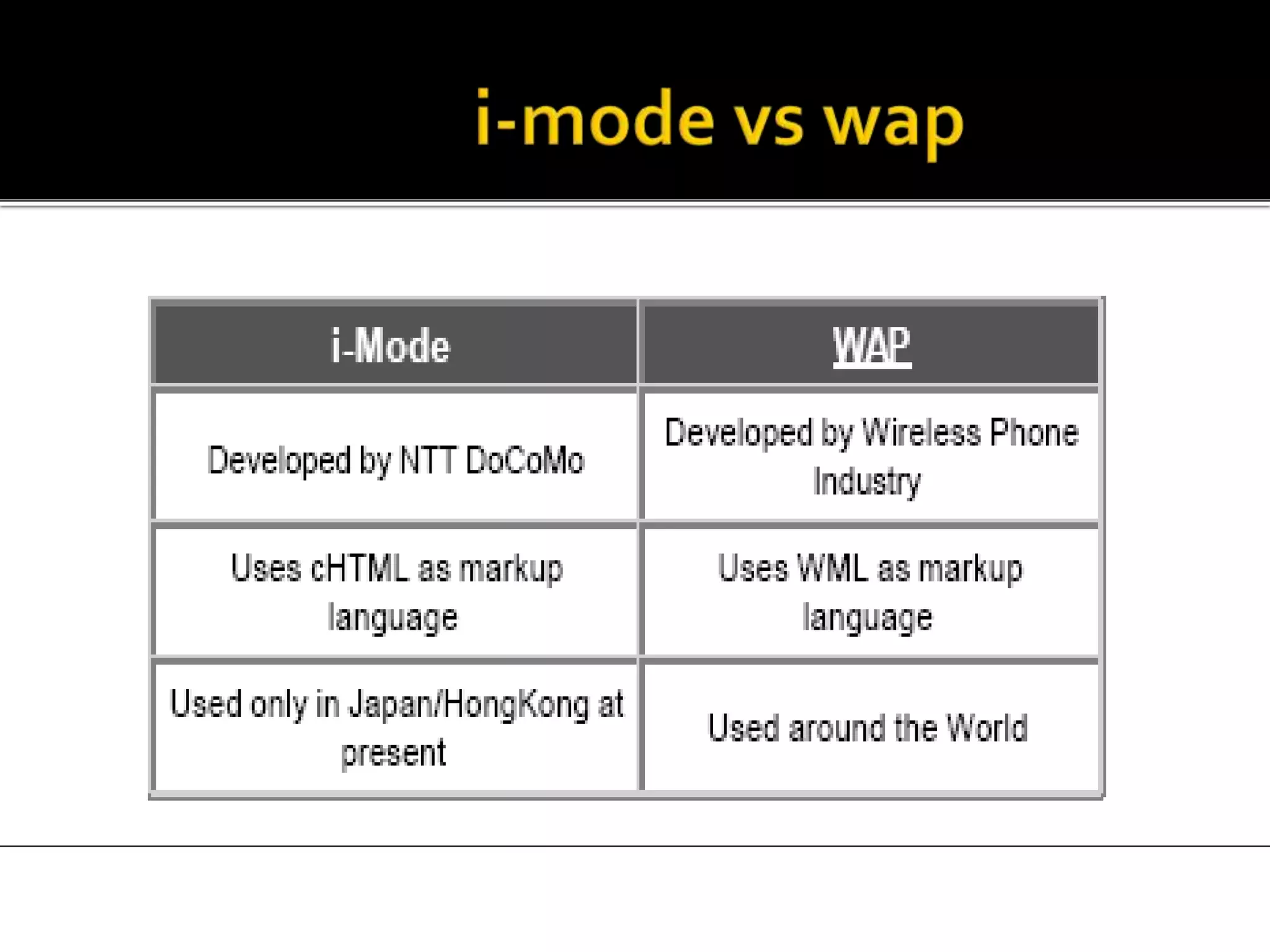
one big difference:
 i-mode packet oriented bearer..
 Wap started with connection oriented bearer(gsm).
 in i-mode,Stack is used for sending an sms indicating
new e-mail is arrived….
 Wap had to either permanantly open to support
interactive web browsing…
 It was a draw back takes long time,expensive..
 i-mode includes images, animated images and color .
 WAP implementations only use text and no images
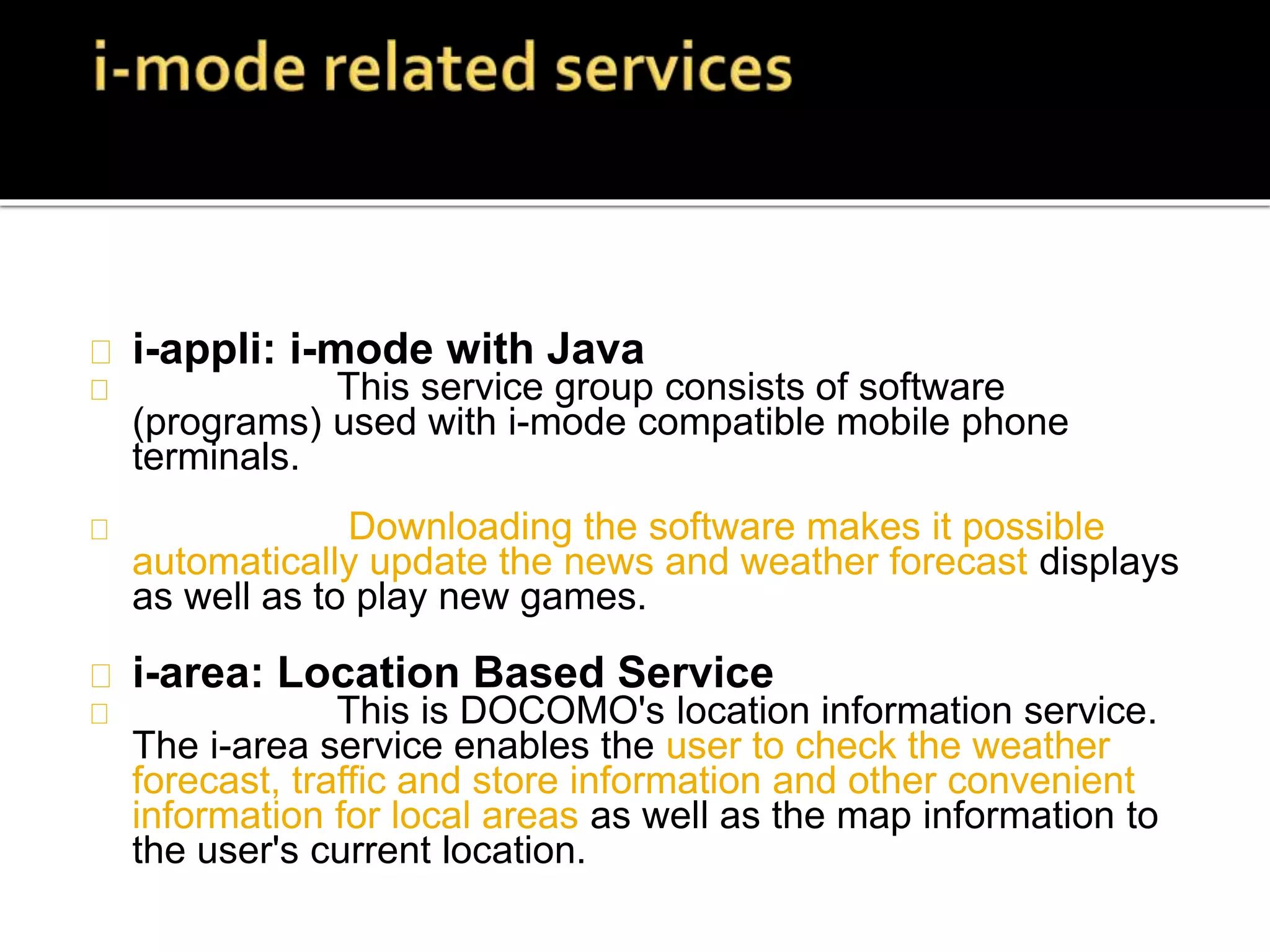
i-appli: i-mode with Java
This service group consists of software
(programs) used with i-mode compatible mobile phone
terminals.
Downloading the software makes it possible
automatically update the news and weather forecast displays
as well as to play new games.
i-area: Location Based Service
This is DOCOMO's location information service.
The i-area service enables the user to check the weather
forecast, traffic and store information and other convenient
information for local areas as well as the map information to
the user's current location.
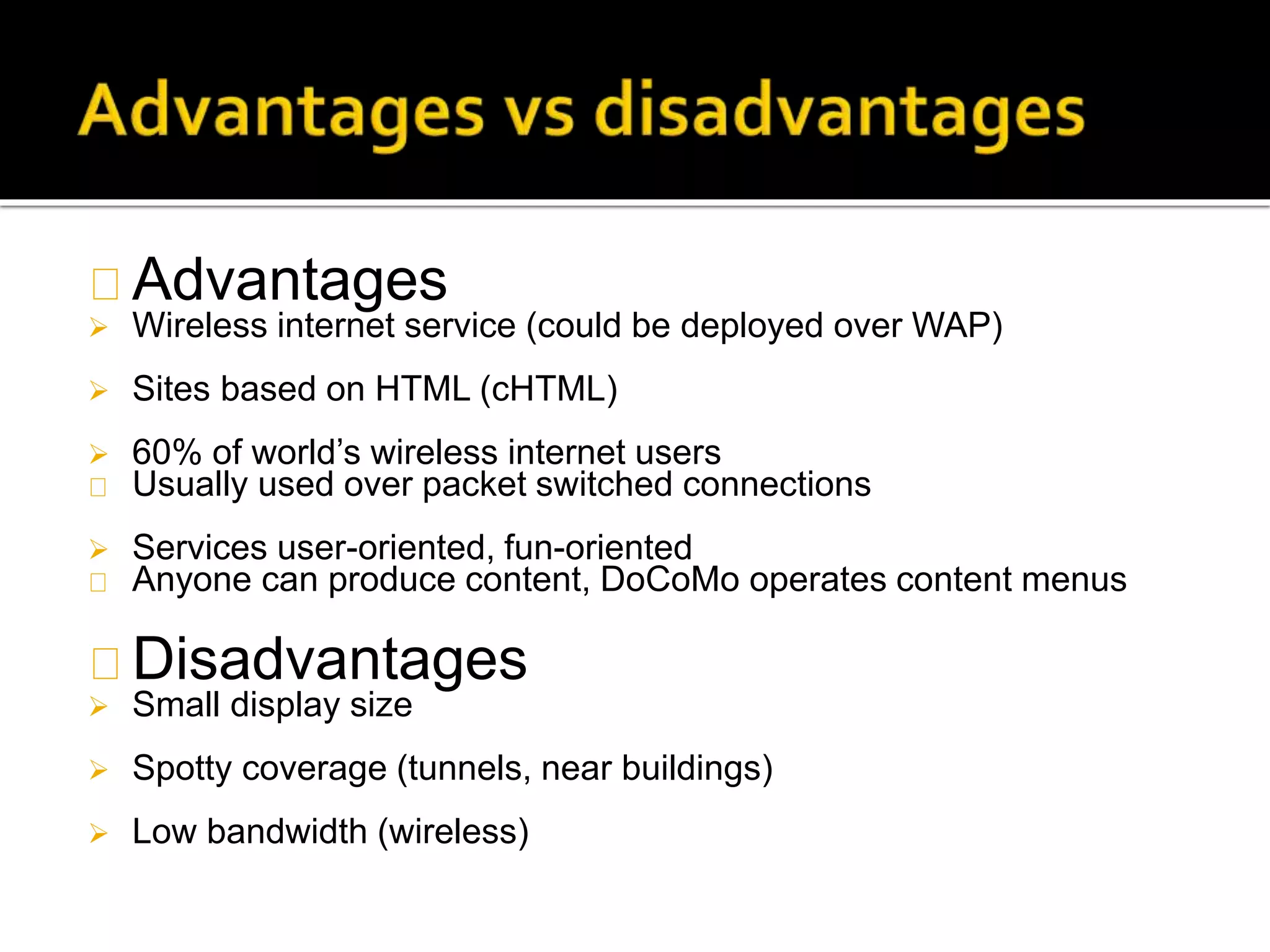
Advantages
 Wireless internet service (could be deployed over WAP)
 Sites based on HTML (cHTML)
 60% of world’s wireless internet users
Usually used over packet switched connections
 Services user-oriented, fun-oriented
Anyone can produce content, DoCoMo operates content menus
Disadvantages
 Small display size
 Spotty coverage (tunnels, near buildings)
 Low bandwidth (wireless)
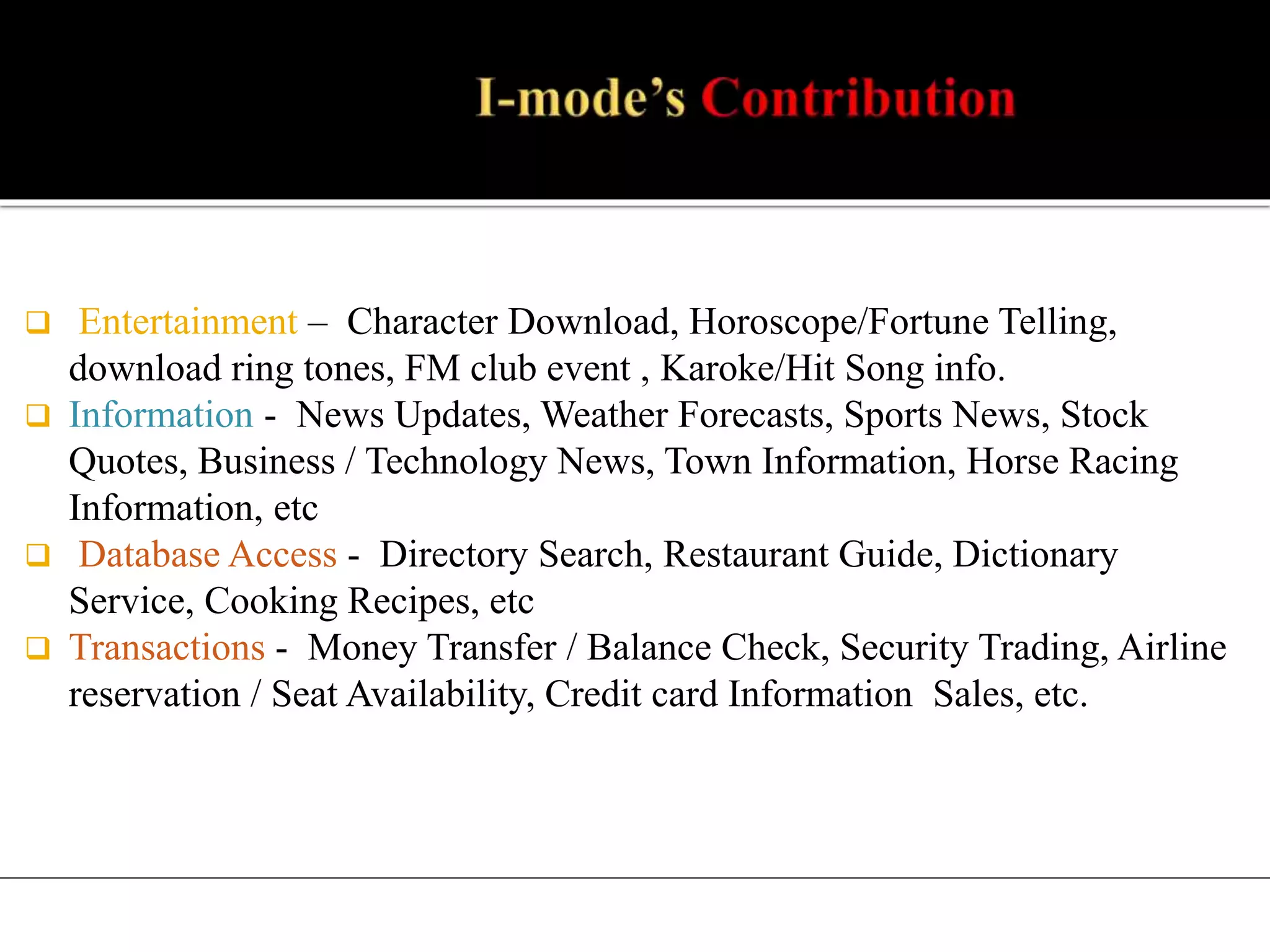
 Entertainment – Character Download, Horoscope/Fortune Telling,
download ring tones, FM club event , Karoke/Hit Song info.
 Information - News Updates, Weather Forecasts, Sports News, Stock
Quotes, Business / Technology News, Town Information, Horse Racing
Information, etc
 Database Access - Directory Search, Restaurant Guide, Dictionary
Service, Cooking Recipes, etc
 Transactions - Money Transfer / Balance Check, Security Trading, Airline
reservation / Seat Availability, Credit card Information Sales, etc.
 i-mode phones are very good features,in
future,using i-mode phones we can
always connect internet
 The packet data transmission techonology
allows for constant connectively therefore
users are not charged for how long they
are online,since this time is unlimited
SyncML
A set of protocols and a mark up language for
synchronisation of data in mobile sceanrios
provided by the Syncml framework..
Supported by companies like
nokia,openware,panasonic,starfish.
Vendor independent mechanisms for the
administration of devices and applications
Simplifies application designs and usage of
synchronisation mechanisms.
Agents:
 Sync server agents:
 Sync client agents:
Server also as a
 Sync engine
Synchronisation run over http,wsp also on
smtp,tcp/ip..
Syncml do not make any assumption data..
 Each data has a unique identifier..
 Clients and servers map to the individual
identifiers…
 Servers knows the mappping details…
Two way synchronisation:
 Exchange change logs between server and
client…
Example:
 A client crashed and has a lost all information
a special slow synchronisation is used..
First transfers all data from the client to
server.
Server then compares all data and sends the
necessary changes back to client…
 One party is interested:
Either client or server..
 Messages exchanged based on xml.
 Tags used:
 <add>,<copy>,<delete>,<replace>
 <atomic>:
 Either all changes or no changes occur.
 If a conflict occurs the data is roll back…
Thank
You….

i-mode ppt and syncml

  • 2.
    I -mode waslaunched in Japan on 22 february 1999 by the mobile operator NTT DOCOMO. Further Developments: Dec. 1999 i-mode compatible handsets with color screens were marketed Jan. 2001 i-appli service launched Jul. 2001 i-area service launched
  • 3.
    dominates other networkoperators.(eg .kddi network which use wap) ntt docomo decides its own formats..ie.,e- mail,web access and picture exchange… that was a big success. more than 30 million users in three years…. info:”it dominates wap” wap was a failure
  • 4.
    Packet PDC-P) PersonalDigital Cellular- Packet  i-mode provides Internet service using Personal Digital Cellular-Packet (PDC-P) and a subset of HTML 3.0 for content description.  i-mode allows application/content providers to distribute software (Java applets) to cellular phones and also allows users to download applets (e.g., games)  the communication and is carried over TCP/IP for the wired part of the communication.
  • 5.
    ARQ: special servicetransport layer protocol with stop-and-go control. Tcp/ip: within the operator’s network and operator’s gateway and a content provider…ie.,(within different layer1 and layer http: known as www.imode application to display web pages , e-mail services which is a compact html(chtml).
  • 6.
    i-mode was abig hit in japan y not wap???? Simple to use… As a pc replacement for e-mail chatting etc. Because of attractive color display images…(gif format) For attractive purpose subset of html ie., chtml used….
  • 7.
     Popularity ofi-mode in japan is due to the following reason. i-mode service is used by 30% of japanese population more than 10 times each day to check e-mail ,book tickets for trains or theatre ,check the whether ,internet banking and for variety of rich uses. Japanese people adopt technologies mainly for their convenience ,which is what the i-mode offers.
  • 8.
    one big difference: i-mode packet oriented bearer..  Wap started with connection oriented bearer(gsm).  in i-mode,Stack is used for sending an sms indicating new e-mail is arrived….  Wap had to either permanantly open to support interactive web browsing…  It was a draw back takes long time,expensive..  i-mode includes images, animated images and color .  WAP implementations only use text and no images
  • 9.
    i-appli: i-mode withJava This service group consists of software (programs) used with i-mode compatible mobile phone terminals. Downloading the software makes it possible automatically update the news and weather forecast displays as well as to play new games. i-area: Location Based Service This is DOCOMO's location information service. The i-area service enables the user to check the weather forecast, traffic and store information and other convenient information for local areas as well as the map information to the user's current location.
  • 10.
    Advantages  Wireless internetservice (could be deployed over WAP)  Sites based on HTML (cHTML)  60% of world’s wireless internet users Usually used over packet switched connections  Services user-oriented, fun-oriented Anyone can produce content, DoCoMo operates content menus Disadvantages  Small display size  Spotty coverage (tunnels, near buildings)  Low bandwidth (wireless)
  • 11.
     Entertainment –Character Download, Horoscope/Fortune Telling, download ring tones, FM club event , Karoke/Hit Song info.  Information - News Updates, Weather Forecasts, Sports News, Stock Quotes, Business / Technology News, Town Information, Horse Racing Information, etc  Database Access - Directory Search, Restaurant Guide, Dictionary Service, Cooking Recipes, etc  Transactions - Money Transfer / Balance Check, Security Trading, Airline reservation / Seat Availability, Credit card Information Sales, etc.
  • 13.
     i-mode phonesare very good features,in future,using i-mode phones we can always connect internet  The packet data transmission techonology allows for constant connectively therefore users are not charged for how long they are online,since this time is unlimited
  • 14.
  • 15.
    A set ofprotocols and a mark up language for synchronisation of data in mobile sceanrios provided by the Syncml framework.. Supported by companies like nokia,openware,panasonic,starfish. Vendor independent mechanisms for the administration of devices and applications
  • 16.
    Simplifies application designsand usage of synchronisation mechanisms. Agents:  Sync server agents:  Sync client agents: Server also as a  Sync engine
  • 17.
    Synchronisation run overhttp,wsp also on smtp,tcp/ip.. Syncml do not make any assumption data..  Each data has a unique identifier..  Clients and servers map to the individual identifiers…  Servers knows the mappping details…
  • 18.
    Two way synchronisation: Exchange change logs between server and client… Example:  A client crashed and has a lost all information a special slow synchronisation is used..
  • 19.
    First transfers alldata from the client to server. Server then compares all data and sends the necessary changes back to client…
  • 20.
     One partyis interested: Either client or server..  Messages exchanged based on xml.  Tags used:  <add>,<copy>,<delete>,<replace>  <atomic>:  Either all changes or no changes occur.  If a conflict occurs the data is roll back…
  • 21.

Editor's Notes

  • #3 FURTHER MORE…. Nov. 2001 i-motion service launched Jun. 2002 i-shot service launched Jan. 2003 i-motion mail service launched Sep. 2005 i-channel service launched Oct. 2006 keyword search service for i-mode launched