

A Technical Paper presentation
on
Presented by,
G.Naveenkumar
TALK-FLOW
• Introduction
• History
• Key technologies
• Operation
• Push-to-talk service
• Ip radio services
• Advantages
• Next Generation
• Conclusion
Introduction
• iDEN is a mobile telecommunication technology,
developed by Motorola.
• It places more users in given spectral space.
• iDEN operates on 25KHz channels.
History
• The iDEN project originally began as MIRS (Motorola Integrated
Radio System)in the early 1991.
• First introduced in 1994, Motorola's Integrated Digital Enhanced
Network (iDEN™).
• iDEN brought to the market by NEXT GENERATION WIRELESS
SOLUTIONS designed for a variety of vertical market mobile
business applications.
Key technologies
• TDMA (Time Division Multiple Access)
• VSELP (Vector Sum Excited Linear Prediction)
• QAM (Quad Amplitude Modulation)
TDMA
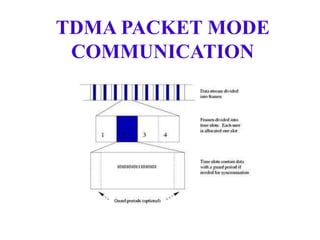
• iDEN's digital technology divides a channel into different
"slots". Each slot can carry one voice or data
transmission.
• TDMA uses the IS-54 & IS-136.
• This capacity increase is accomplished using a state-of-
the-art technology called TDMA.
TDMA PACKET MODE
COMMUNICATION
VSELP
• It digitally codes and significantly compresses the voice
signals.
• This speech decoding used in IS-54 standard.
• It was used earlier in the first version of Real Audio for audio
over the internet.
• The IS-54 VSELP standard was published by the TELE
COMMUNICATION INDUSTRY ASSOCIATION in 1989.
• IS-54 is also known as ANSI/TIA/EIA-624
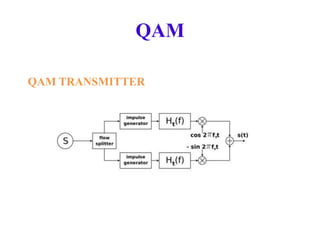
QAM
QAM TRANSMITTER
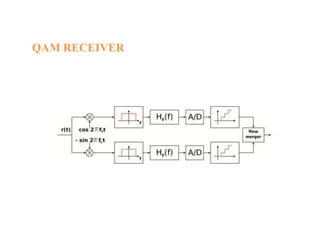
QAM RECEIVER
OPERATION
iDEN mobile operations includes
• Control Channel Acquisition
• Mobile Synchronization
• Mobile Registration
• International Mobile Subscriber Identity (IMSI)
• International Mobile Equipment Identity (IMEI)
• Mobile Assisted Handovers
PUSH-TO-TALK SERVICES
• What is push-to-talk?
• How Does iDEN Work in PTT ?
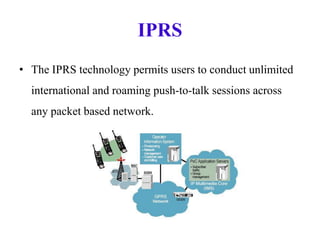
IPRS
• The IPRS technology permits users to conduct unlimited
international and roaming push-to-talk sessions across
any packet based network.
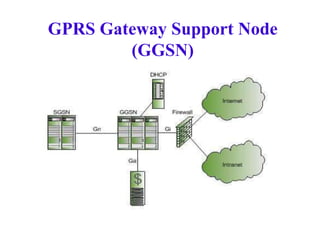
GPRS Gateway Support Node
(GGSN)
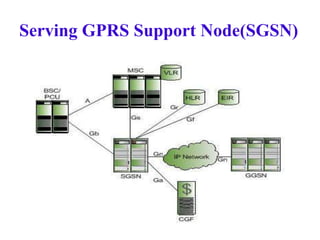
Serving GPRS Support Node(SGSN)
BTS & BSC
• Base Transceiver Station. Technical term for a mobile
phone base station.
• A BTS contains the transmit and receive technology and
also the aerials to supply a radio cell.
• In radio communications a Base station is a two-way
radio installation in a fixed location, used to communicate
with one or more mobile or portable radio transceivers.
ADVANTAGES
• Dynamic management & High speed data connectivity.
• A-GPS feature enabled by FCC.
• Radiation less compared to other.
• Superior voice technology.
• Improved security and privacy.
NEXT GENERATION
• The newest phones-like the i570 BOCA CHICA-feature
innovative J2ME™ technology enabling Reversed
polarized external display equipped with PTT,A-GPS,
Browser v4.x as well as a new design language.
iDEN Technology
iDEN Technology
iDEN Technology

iDEN Technology

  • 1.
    A Technical Paperpresentation on Presented by, G.Naveenkumar
  • 2.
    TALK-FLOW • Introduction • History •Key technologies • Operation • Push-to-talk service • Ip radio services • Advantages • Next Generation • Conclusion
  • 3.
    Introduction • iDEN isa mobile telecommunication technology, developed by Motorola. • It places more users in given spectral space. • iDEN operates on 25KHz channels.
  • 4.
    History • The iDENproject originally began as MIRS (Motorola Integrated Radio System)in the early 1991. • First introduced in 1994, Motorola's Integrated Digital Enhanced Network (iDEN™). • iDEN brought to the market by NEXT GENERATION WIRELESS SOLUTIONS designed for a variety of vertical market mobile business applications.
  • 5.
    Key technologies • TDMA(Time Division Multiple Access) • VSELP (Vector Sum Excited Linear Prediction) • QAM (Quad Amplitude Modulation)
  • 6.
    TDMA • iDEN's digitaltechnology divides a channel into different "slots". Each slot can carry one voice or data transmission. • TDMA uses the IS-54 & IS-136. • This capacity increase is accomplished using a state-of- the-art technology called TDMA.
  • 7.
  • 8.
    VSELP • It digitallycodes and significantly compresses the voice signals. • This speech decoding used in IS-54 standard. • It was used earlier in the first version of Real Audio for audio over the internet. • The IS-54 VSELP standard was published by the TELE COMMUNICATION INDUSTRY ASSOCIATION in 1989. • IS-54 is also known as ANSI/TIA/EIA-624
  • 9.
  • 10.
  • 11.
    OPERATION iDEN mobile operationsincludes • Control Channel Acquisition • Mobile Synchronization • Mobile Registration • International Mobile Subscriber Identity (IMSI) • International Mobile Equipment Identity (IMEI) • Mobile Assisted Handovers
  • 12.
    PUSH-TO-TALK SERVICES • Whatis push-to-talk? • How Does iDEN Work in PTT ?
  • 13.
    IPRS • The IPRStechnology permits users to conduct unlimited international and roaming push-to-talk sessions across any packet based network.
  • 14.
  • 15.
  • 16.
    BTS & BSC •Base Transceiver Station. Technical term for a mobile phone base station. • A BTS contains the transmit and receive technology and also the aerials to supply a radio cell. • In radio communications a Base station is a two-way radio installation in a fixed location, used to communicate with one or more mobile or portable radio transceivers.
  • 17.
    ADVANTAGES • Dynamic management& High speed data connectivity. • A-GPS feature enabled by FCC. • Radiation less compared to other. • Superior voice technology. • Improved security and privacy.
  • 18.
    NEXT GENERATION • Thenewest phones-like the i570 BOCA CHICA-feature innovative J2ME™ technology enabling Reversed polarized external display equipped with PTT,A-GPS, Browser v4.x as well as a new design language.