Silent Sound
Technology
…Talking Without
Talking
What will happen when...
Let’s make
it
possible
Contents
• INTRODUCTION
• NEED FOR SILENT SOUND
• ORIGINATION
• SENSORS NEEDED
• METHODS
• EMG
• IMAGE PROCESSING
• SILENT FEATURES
• APPLICATION
• CONCLUSION
Introduction
Silent Sound is a technology which makes it possible to
make calls/transmit information without using vocal
cords just in 4 steps.
 Monitoring muscular & lip movements
 Transforming them into a computer generated sound
 Transmit them over a phone
 Receiver receives the information in audio
Need for Silent
Sound To overcome with embarrassed situation such as-
 To reply urgent call while meeting
 For a better way of communication in noisy place
 To be helpful for-
 Vocally challenged People
 Sharing secret information
Origination
 Origination of idea
1968- Stanley Kubrick science-fiction film 2001 – A Space Odyssey
 First demonstration
2010 -At CeBIT(Centrum fiir Biiroautomation, Informationstechnologie
und Telekommunikation)
 Under development
scientists of Karlsruhe Institute Of Technology (KIT), Germany
Sensors Needed
These are the sensors that are used in Silent Sound Technology :
 Pressure sensor
 Vibration sensors
 Motion sensor
 Electromagnetic sensor
Methods
Silent Sound Technology is mainly processed through following methods. They are :
Electromyography (EMG) Image Processing
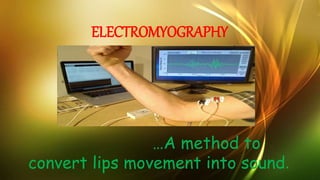
ELECTROMYOGRAPHY
…A method to
convert lips movement into sound.
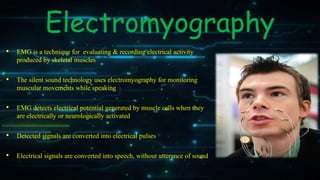
Electromyography
• EMG is a technique for evaluating & recording electrical activity
produced by skeletal muscles
• The silent sound technology uses electromyography for monitoring
muscular movements while speaking
• EMG detects electrical potential generated by muscle cells when they
are electrically or neurologically activated
• Detected signals are converted into electrical pulses
• Electrical signals are converted into speech, without utterance of sound
History of EMG
YEAR OBSERVER OBSERVATION
1666 First documented experiments dealing with EMG started
1666 Francesco Redi
Highly specialized muscle of the Electric Eel
generates electricity
1849 Dubois-Raymond
It’s possible to record electrical activity during a
voluntary muscle contraction
1890 Marey
Recorded the first actual muscular activity
Coined the term “Electromyography”
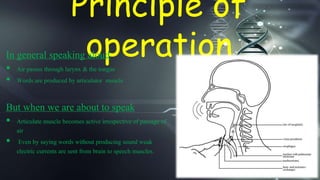
Principle of
operationIn general speaking aloud
 Air passes through larynx & the tongue
 Words are produced by articulator muscle
But when we are about to speak
 Articulate muscle becomes active irrespective of passage of
air
 Even by saying words without producing sound weak
electric currents are sent from brain to speech muscles.
EMG -
Procedure– A Needle electrode is inserted through the skin into the
muscle tissue.
– Valuable information about the state of the muscle and its
innervating nerve is observed
– The electrical activity when the muscle is at rest is
observed.
– Because skeletal muscles differ in the inner structure,
the electrode has to be placed at various locations to
obtain an accurate signal
– Shape, size, and frequency of the resulting motor unit are
judged.
EMG - Techniques
ELECTRODE
AMPLIFIER
Functioning
STEPS UNITS FUNCTIONS
I
Monitoring Unit Monitors tiny muscular movements
II
Electromyographic Sensors Records electric signals produced by the facial muscles
III
Transducers Converts the pulses into electric signals .
IV
Vocoder Converts electrical signal into speech pattern
V
Matching Unit
Compare them with pre recorded signal pattern of spoken words
Image Processing
Image Processing
• Converting digital data tape into a film image with minimal correction
& calibrations
• In silent sound technology its output is an audio record
Image Processing
techniques
Analysis of remotely sensed data is done using various
image processing techniques and methods that includes:
Analog image processing
Digital image processing
Data collection&
processingStimuli and Procedure
A list of frequently used sentences were prepared
Electromagnetic articulograph AG500 is used to register 3-D MOVEMENTS of the
tongue, lip and jaw when subject was talking
 Articulograph records the movement by establishing calibrated electromagnetic
field
Data processing
Head movements were subtracted from tongue and lip locations
A zero phase low pass filter is applied for removing signal
noise
All sequences were segmented and annoted with sentences
EMA based silence
speech interface
Electromagnetic
Articulograph
Trained mode (SVM)
Online recognition
Sound database
Sound playback
Recognition
Data
segment
Probable
Sentences
Data
acquisition
Lip
movem
ent
Output
request
Sound
waveform
Senten
ce
sequenc
e
Speech
Acoustic
s
Silent Features
• Allow people to make silent calls without
bothering others.
• Helps to interpret foreign language
Applications
• In Military for communicating secret/confidential matters
• A hope for people who have lost their voice due to illness
or accident
• Sharing secrets like pin, password to trusted one
Conclusion
Thus Silent Sound Technology,
one of the recent trends in the
field of Information technology
implements ‘Talking Without
Talking’.
It will be one of the innovative
and useful technology and in
mere future this technology will
Silent sound technology_powerpoint

Silent sound technology_powerpoint

  • 1.
  • 2.
    What will happenwhen... Let’s make it possible
  • 3.
    Contents • INTRODUCTION • NEEDFOR SILENT SOUND • ORIGINATION • SENSORS NEEDED • METHODS • EMG • IMAGE PROCESSING • SILENT FEATURES • APPLICATION • CONCLUSION
  • 4.
    Introduction Silent Sound isa technology which makes it possible to make calls/transmit information without using vocal cords just in 4 steps.  Monitoring muscular & lip movements  Transforming them into a computer generated sound  Transmit them over a phone  Receiver receives the information in audio
  • 5.
    Need for Silent SoundTo overcome with embarrassed situation such as-  To reply urgent call while meeting  For a better way of communication in noisy place  To be helpful for-  Vocally challenged People  Sharing secret information
  • 6.
    Origination  Origination ofidea 1968- Stanley Kubrick science-fiction film 2001 – A Space Odyssey  First demonstration 2010 -At CeBIT(Centrum fiir Biiroautomation, Informationstechnologie und Telekommunikation)  Under development scientists of Karlsruhe Institute Of Technology (KIT), Germany
  • 7.
    Sensors Needed These arethe sensors that are used in Silent Sound Technology :  Pressure sensor  Vibration sensors  Motion sensor  Electromagnetic sensor
  • 8.
    Methods Silent Sound Technologyis mainly processed through following methods. They are : Electromyography (EMG) Image Processing
  • 9.
    ELECTROMYOGRAPHY …A method to convertlips movement into sound.
  • 10.
    Electromyography • EMG isa technique for evaluating & recording electrical activity produced by skeletal muscles • The silent sound technology uses electromyography for monitoring muscular movements while speaking • EMG detects electrical potential generated by muscle cells when they are electrically or neurologically activated • Detected signals are converted into electrical pulses • Electrical signals are converted into speech, without utterance of sound
  • 11.
    History of EMG YEAROBSERVER OBSERVATION 1666 First documented experiments dealing with EMG started 1666 Francesco Redi Highly specialized muscle of the Electric Eel generates electricity 1849 Dubois-Raymond It’s possible to record electrical activity during a voluntary muscle contraction 1890 Marey Recorded the first actual muscular activity Coined the term “Electromyography”
  • 12.
    Principle of operationIn generalspeaking aloud  Air passes through larynx & the tongue  Words are produced by articulator muscle But when we are about to speak  Articulate muscle becomes active irrespective of passage of air  Even by saying words without producing sound weak electric currents are sent from brain to speech muscles.
  • 13.
    EMG - Procedure– ANeedle electrode is inserted through the skin into the muscle tissue. – Valuable information about the state of the muscle and its innervating nerve is observed – The electrical activity when the muscle is at rest is observed. – Because skeletal muscles differ in the inner structure, the electrode has to be placed at various locations to obtain an accurate signal – Shape, size, and frequency of the resulting motor unit are judged.
  • 14.
  • 15.
    Functioning STEPS UNITS FUNCTIONS I MonitoringUnit Monitors tiny muscular movements II Electromyographic Sensors Records electric signals produced by the facial muscles III Transducers Converts the pulses into electric signals . IV Vocoder Converts electrical signal into speech pattern V Matching Unit Compare them with pre recorded signal pattern of spoken words
  • 16.
  • 17.
    Image Processing • Convertingdigital data tape into a film image with minimal correction & calibrations • In silent sound technology its output is an audio record
  • 18.
    Image Processing techniques Analysis ofremotely sensed data is done using various image processing techniques and methods that includes: Analog image processing Digital image processing
  • 19.
    Data collection& processingStimuli andProcedure A list of frequently used sentences were prepared Electromagnetic articulograph AG500 is used to register 3-D MOVEMENTS of the tongue, lip and jaw when subject was talking  Articulograph records the movement by establishing calibrated electromagnetic field
  • 20.
    Data processing Head movementswere subtracted from tongue and lip locations A zero phase low pass filter is applied for removing signal noise All sequences were segmented and annoted with sentences
  • 21.
    EMA based silence speechinterface Electromagnetic Articulograph Trained mode (SVM) Online recognition Sound database Sound playback Recognition Data segment Probable Sentences Data acquisition Lip movem ent Output request Sound waveform Senten ce sequenc e Speech Acoustic s
  • 22.
    Silent Features • Allowpeople to make silent calls without bothering others. • Helps to interpret foreign language
  • 23.
    Applications • In Militaryfor communicating secret/confidential matters • A hope for people who have lost their voice due to illness or accident • Sharing secrets like pin, password to trusted one
  • 24.
    Conclusion Thus Silent SoundTechnology, one of the recent trends in the field of Information technology implements ‘Talking Without Talking’. It will be one of the innovative and useful technology and in mere future this technology will