
Activated charcoal is produced from charcoal using steam or air at high temperatures. It has a large surface area and small pore size, allowing it to adsorb thousands of times its own weight in toxins and poisons. Activated charcoal is used as an antidote for drug and chemical overdoses, poisonings, and to treat conditions like ulcers or infections by binding toxins in the digestive system. It works by adsorbing substances through chemical bonding to its carbon surface. Activated charcoal can be administered orally or topically and is considered safe, with no serious side effects.
In this document
Powered by AI
Introduction to activated charcoal, its properties, and its importance as an antidote.
The objective is to discuss the various uses and the mechanism of action of activated charcoal.
Activated charcoal is used for treating ailments, poison antidote, and in water purification.
General characteristics include large surface area and high adsorption ability.
Explains how activated charcoal adsorbs substances through its carbon structure, listing substances absorbed.
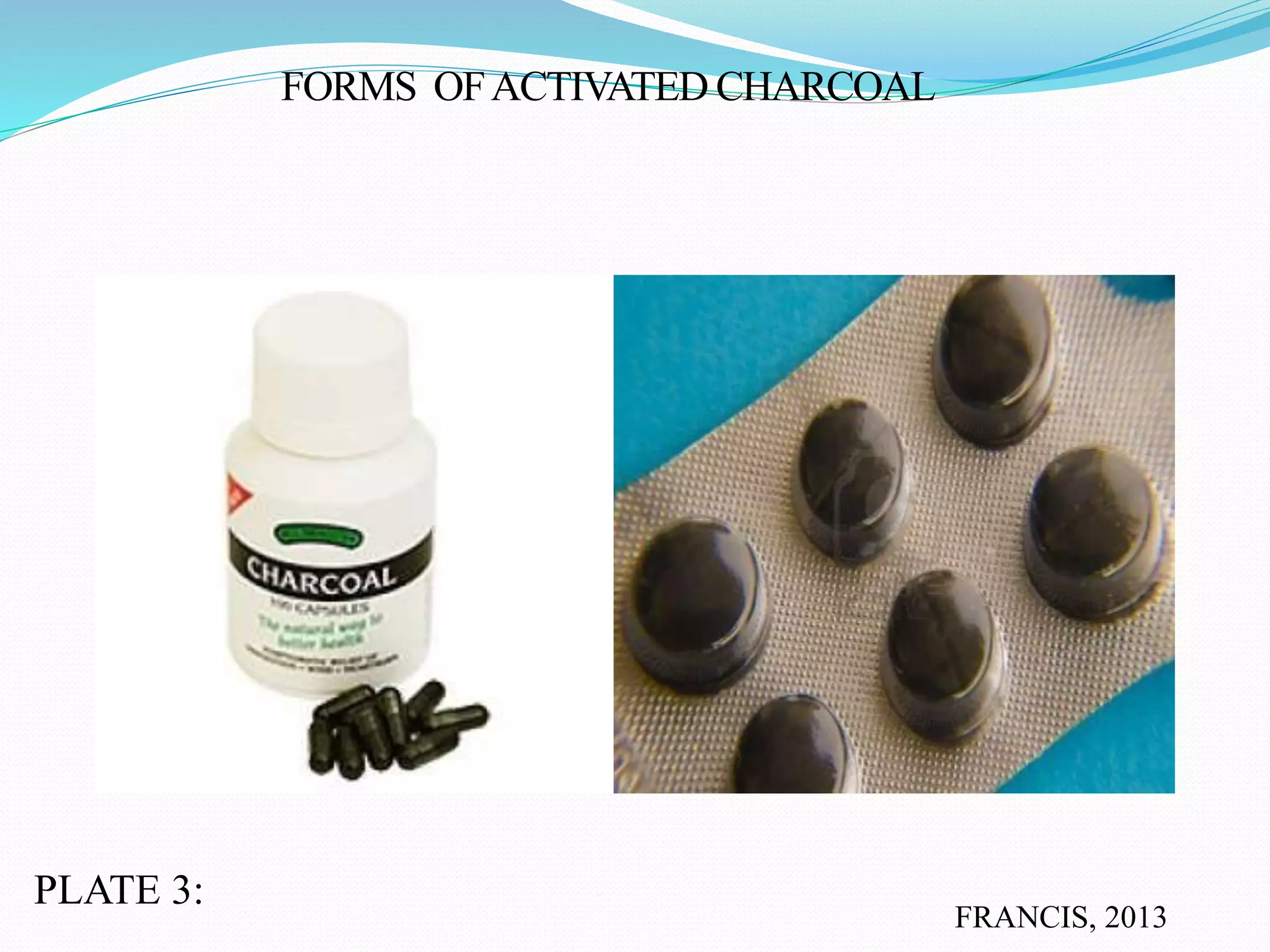
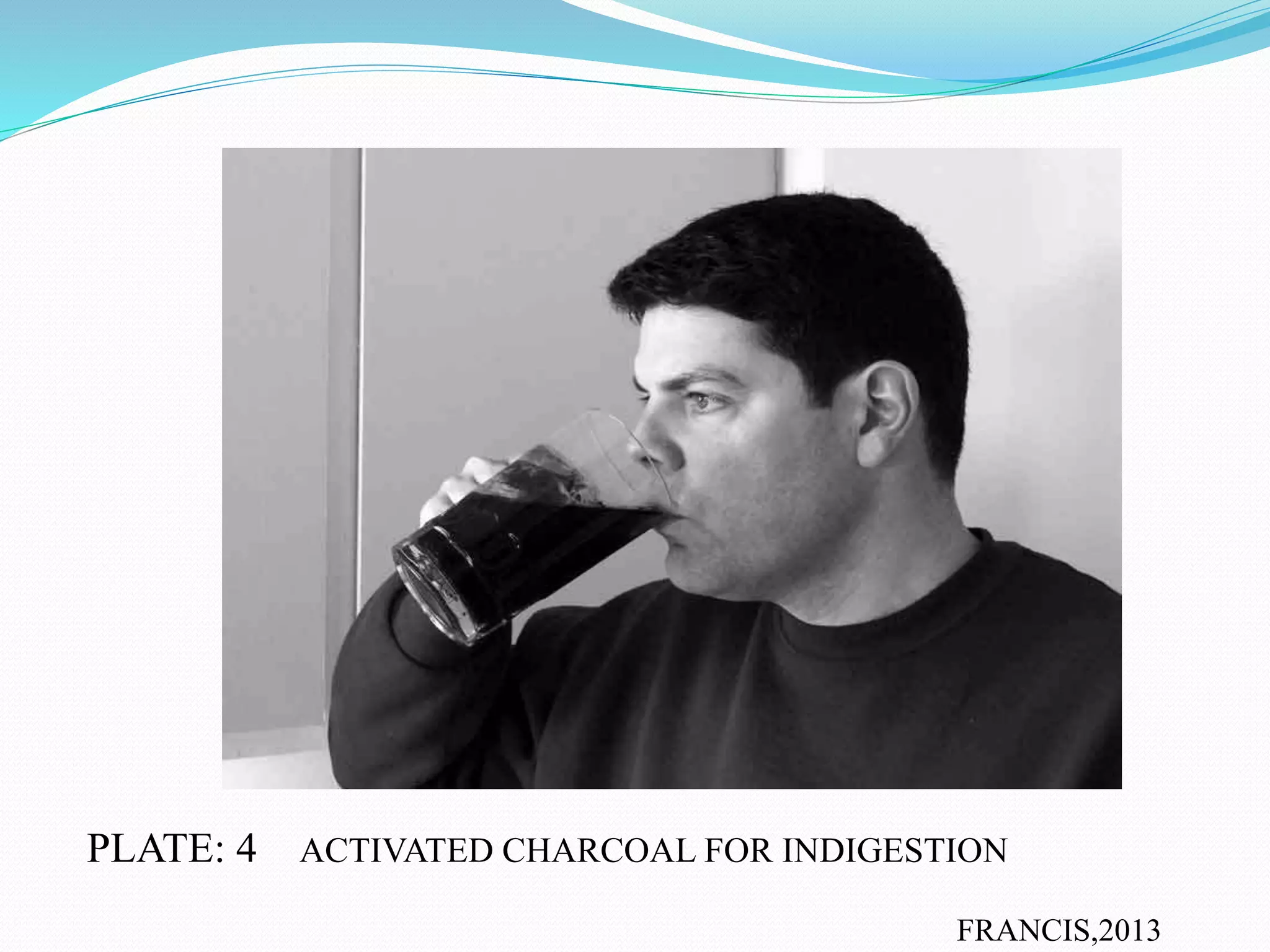
Different forms of activated charcoal and its modes of administration including oral and topical.
Activated charcoal is safe with no dangerous side effects and serves as an effective natural remedy.Summary of activated charcoal's benefits and recommendation for its inclusion in first aid kits.
Citations of literature that supports the information presented about activated charcoal.
Appreciation expressed to the audience for their attention.
USES AND MODEOF ACTION OF ACTIVATED
CHARCOAL
SEMINAR PRESENTED
BY
ONASANYA, IDOWU FRANCIS
MATRIC NO: 115042086
SCIENCE LABORATORY TECHNOLOGY
(HND II ENVIRONMENTAL BIOLOGY)
SUPERVISED BY:
MRS. V.T SANYAOLU
2.
OUTLINE
Introduction
Objective
Uses of activated charcoal
General characteristics of activated charcoal
Mode of action of activated charcoal
Mechanism of absorption
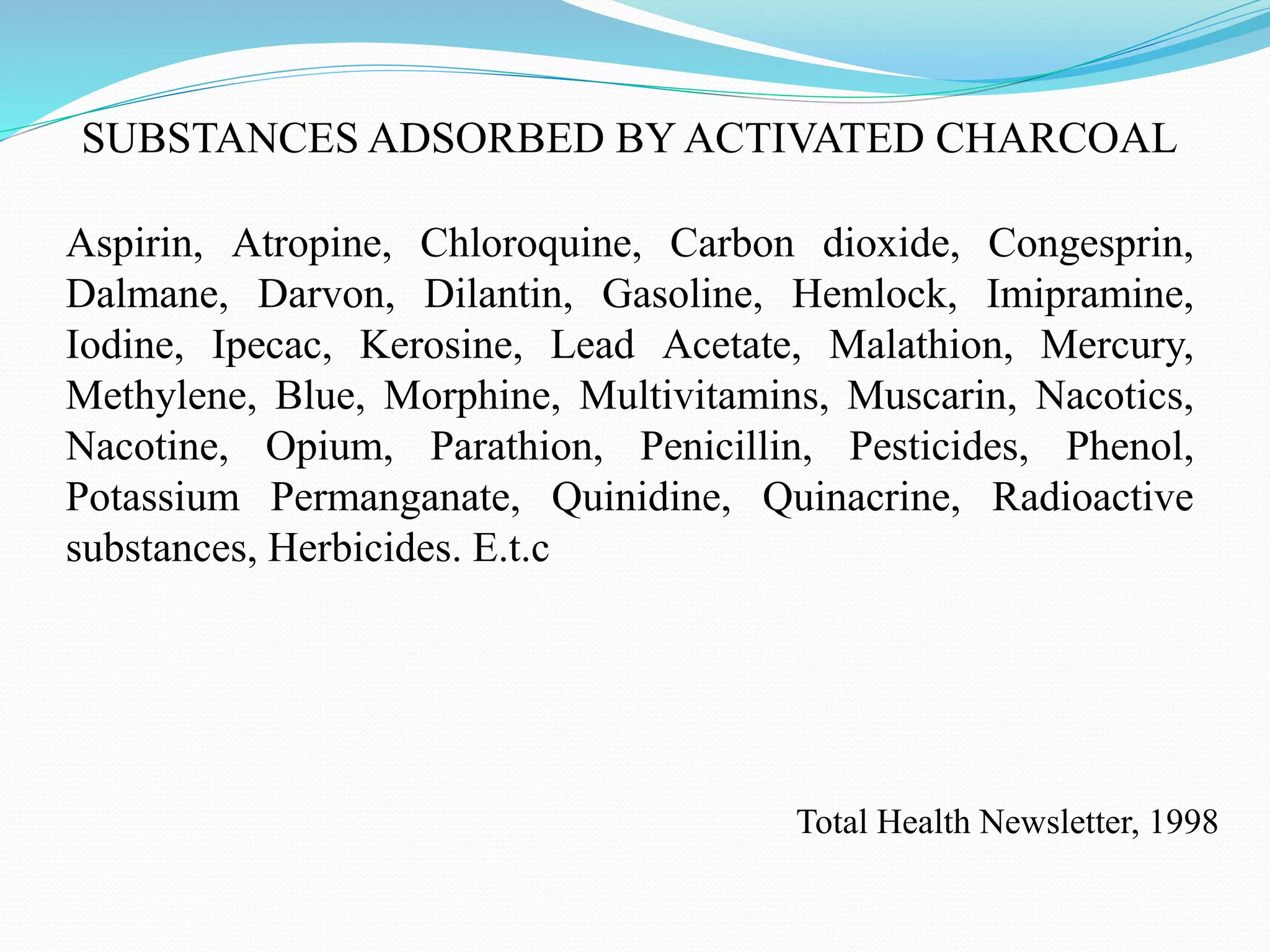
Substances absorb by activated charcoal
Forms of activated charcoal
Mode of Administration
Safety of activated charcoal
Conclusion
Recommendation
References
3.
INTRODUCTION
Activated charcoal isa dark grey residue consisting of carbon
and ash obtained by slow pyrolysis. (Timber, 2012)
Activated charcoal is not the same as the regular charcoal.
Activated charcoal is produced using steam or air at high
temperature to oxidize charcoal in a controlled environment.
(NHR, 2012)
4.
Activated charcoal canadsorb thousands of its own weight in
gases, toxic metals, poisons and other chemicals, thus making them
ineffective or harmless. (Thrash et al, 1998)
Today, Activated charcoal has been recommended by the poison
control centers of America, including the animal poison control
center because of its high value as a universal antidote (Bradberry
and Vale, 1995)
USES OF ACTIVATEDCHARCOAL
TREATMENT OF AILMENTS SUCH AS
•LIVER CANCER
•HEART BURN stomach acid and irritating sub from food
•PEPTIC ULCER(stomach acid(gastrin) )
•DENTAL INFECTION
TREATMENT OF WOUNDS (INJURY)
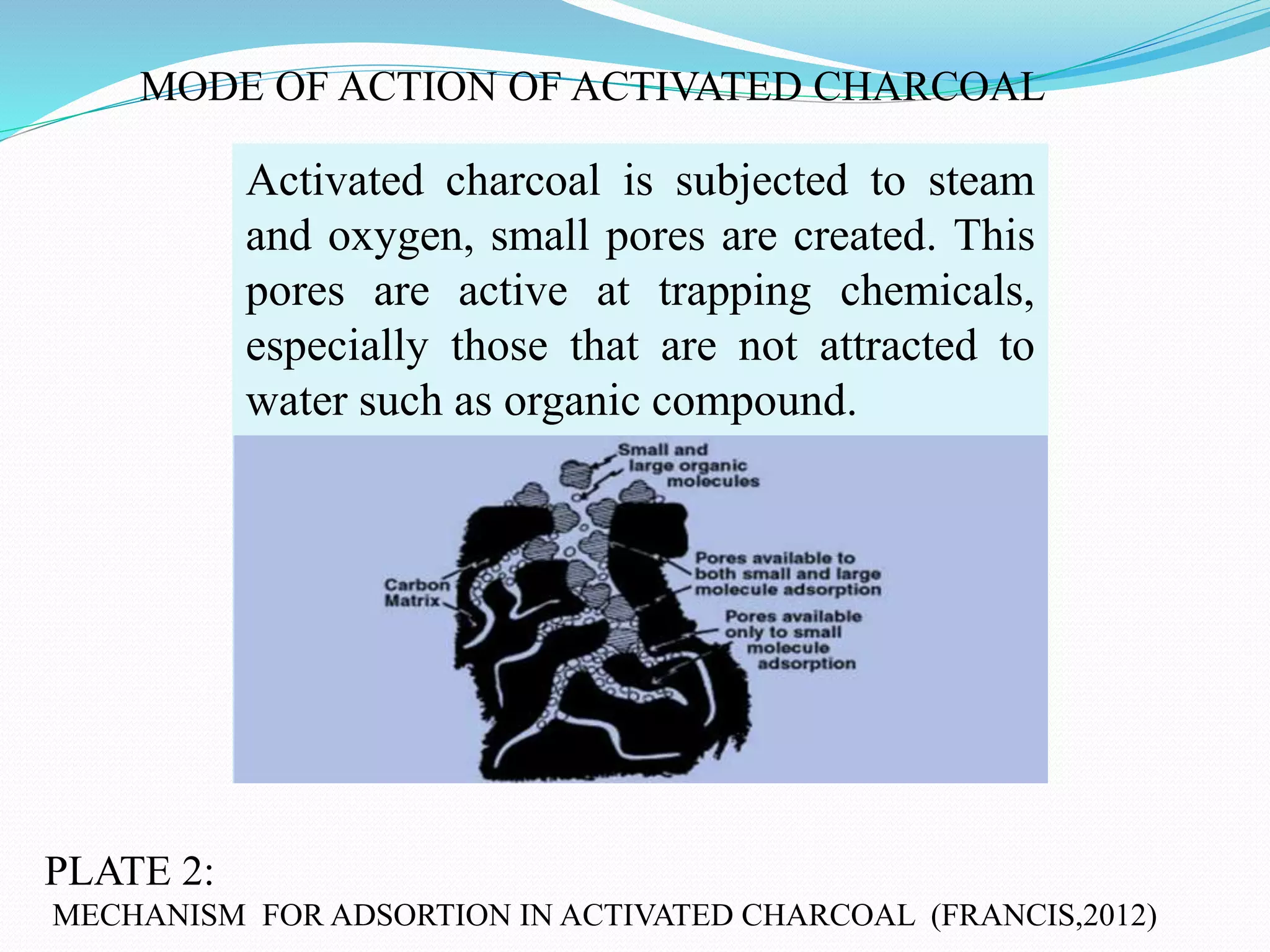
PLATE 2:
MECHANISM FORADSORTION IN ACTIVATED CHARCOAL (FRANCIS,2012)
Activated charcoal is subjected to steam
and oxygen, small pores are created. This
pores are active at trapping chemicals,
especially those that are not attracted to
water such as organic compound.
MODE OF ACTION OF ACTIVATED CHARCOAL
11.
MECHANISM OF ABSORPTION
Mostxenobiotics are carbon based that may adhere to
carbon compounds by chemical forces.
By supplying a large area of carbon surrounding the
xenobiotics, are attracted to the carbon and the
xenobiotics bind at a number of sites, effectively
sticking to the charcoal.
(American Academy of Clinical Toxicology, 1997)
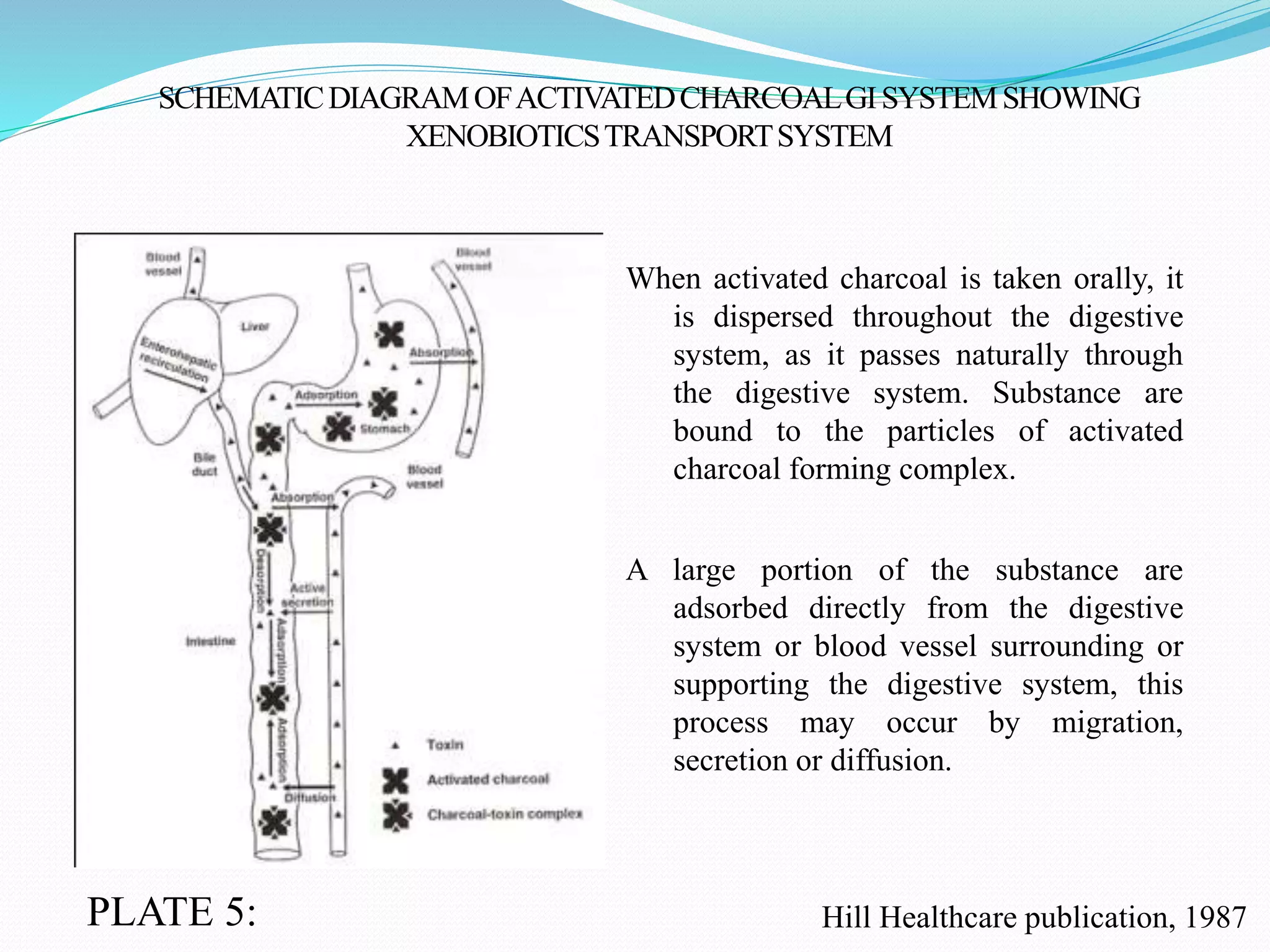
SCHEMATICDIAGRAMOFACTIVATEDCHARCOALGISYSTEMSHOWING
XENOBIOTICSTRANSPORTSYSTEM
Hill Healthcare publication,1987
When activated charcoal is taken orally, it
is dispersed throughout the digestive
system, as it passes naturally through
the digestive system. Substance are
bound to the particles of activated
charcoal forming complex.
A large portion of the substance are
adsorbed directly from the digestive
system or blood vessel surrounding or
supporting the digestive system, this
process may occur by migration,
secretion or diffusion.
PLATE 5:
17.
SAFETY OF ACTIVATEDCHARCOAL
Activated charcoal is simple to use and is a time-tested natural
remedy that has many valuable uses
It has no dangerous side effects or contraindications,
It is a very efficient cleaner of the body when taken orally and
it also helps to purify the blood. (Kaufman, 2005)
It is an odourless, tasteless, flavourless, powder but it texture
is less appealing. (Medical world news, 1967)
RECOMMENDATION
I join thepediatrician to recommend that every household
should have some activated charcoal in their chest for first
aid measure
20.
REFRENCES
Richard C.Kaufman, Ph.D. THE UNIVERSAL ANTIDOTE AND DETOXIFIER THAT EXTENDS LIFE:
ACTIVATED , Mega Health Society - July 1989.
Thrash, Agatha & Calvin Rx: Charcoal, New Lifestyle Books, 1998.
Tom Harrelson (Revised 4/17/08)An Article by HHR's Charles L. Church Published in Countryside
Magazine
Donovan (1987) McGraw- Hill Healthcare publication
Palatnick W, Tenenbein M. Activated charcoal in the treatment of drug overdose. An update. Drug Safety
1992;7:3-7.
Bradberry SM, Vale JA. Multiple-dose activated charcoal: a review of relevant clinical studies. Journal of
Toxicology - Clinical Toxicology 1995;33:407-416.
Chyka PA, Seger D. Position statement: single-dose activated charcoal. American Academy of Clinical
Toxicology; European Association of Poisons Centres and Clinical Toxicologists. J Toxicol Clin Toxicol
1997; 35(7):721-741.
Position statement and practice guidelines on the use of multi-dose activated charcoal in the treatment of
acute poisoning. American Academy of Clinical Toxicology, European Association of Poisons Centres and
Clinical Toxicologists. J Toxicol Clin Toxicol 1999; 37(6):731-751.
Bond GR. The role of activated charcoal and gastric emptying in gastrointestinal decontamination: a state-
of-the-art review. Ann Emerg Med 2002; 39(3):273-286.