머신러닝의 자연어 처리기술(I)
2016. 7.
김홍배
“言語と画像の表現学習“, 慶應義塾大学, 野口裕貴
“Word2vec from scratch”, KAIST, 이진표
1
1. 개요
2. 분산표현의 개요
3. 자연어처리의 개요
4. 언어의 벡터표현
5. encoder-decoder 모델
6. 멀티모달모델
목차
2
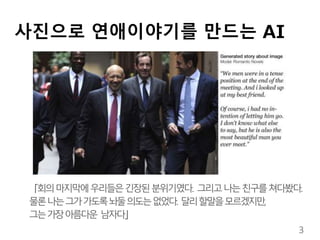
사진으로 연애이야기를 만드는 AI
「회의마지막에우리들은긴장된분위기였다. 그리고나는친구를쳐다봤다.
물론나는그가가도록놔둘의도는없었다. 달리할말을모르겠지만,
그는가장아름다운 남자다」
3
Neural Storyteller에서 사용되는 기술
단어
표현
문장과
사진의 결합
사진으로부터
설명문을 작성
Kiros 2015.11
뉴럴넷(NN)이 기반
[Mikolov+ 13] [Kiros+ 15]
[Kiros+ 14]문장
표현
사진
표현
4
오늘의 주제
• NN이 파워풀한 이유중 하나:분산표현
• NN에 언어 및 사진을 학습시키는 방법
5
분산표현 [Hinton+ 1986]
분산표현
1986년、Geoffrey Hinton이 뉴론이 어떻게 개념을
나 타 내 는 가 를 설 명 하 기 위 해 서 분 산 표 현
(distributed representation)을 제안
6
목차
1. 개요
2. 분산표현의 개요
3. 자연어처리의 개요
4. 언어의 벡터표현
5. encoder-decoder 모델
6. 멀티모달모델
7
국소표현 vs 분산표현
8
국소표현
1개 뉴론의 작동으로 1개의 개념을 나타냄
벡터형태로 나타내서 one-hot vector
[1, 0, 0, 0, 0]
[0, 1, 0, 0, 0]
[0, 0, 1, 0, 0]
...
...
9
분산표현
복수 뉴론의 작동으로 1개의 개념을 나타냄.
[0.5, 0.0, 1.0, 1.0, 0.3]
[0.5, 0.0, 1.0, 1.0, 0.0]
[0.2, 0.9, 0.5, 0.0, 1.0]
...
... 10
분산표현
개념을 특징의 조합으로 나타냄.
= 1·펫 + 1 · 멍멍 + 0 · 야옹 + 0.1 · 타는것 + 0.1 · 바다
= 1·펫 + 0 · 멍멍 + 1 · 야옹 + 0 .0· 타는것 + 0 · 바다
= 0·펫 + 0 · 멍멍 + 0 · 야옹 + 0.9 · 타는것 + 0.8 · 바다
특징
계수
11
개념의 유사
국소표현 분산표현
비슷하다!
전혀 다름
12
문자인식의 분산표현
...+ 0.9 + 0.1
...+ 0.5 + 0.6
≈ 0.8
계수
≈ 0.7
특징
13
딥뉴럴네트웍
음성인식과 사진인식을 시작으로 다양한 분야에서
성과를 만들어내고 있다.
최근에는 자연어처리에도 활용되고 있다.
14
1. 개요
2. 분산표현의 개요
3. 자연어처리의 개요
4. 언어의 벡터표현
5. encoder-decoder 모델
6. 멀티모달모델
목차
15
자연어처리(NLP)
컴퓨터과학, 인공지능과 언어학이 합쳐진 분야
컴퓨터 과학 인공지능
자연어처리
언어학
16
자연어 처리 업무
쉬움 중간 어려움
• 스펠링 체크
• 키워드 검사
• 유사어 감지
• 웹사이트 및 서류의
형태 해석
• 구문해석 etc.
• 기계번역
• 감정분석
• 질의응답시스템
17
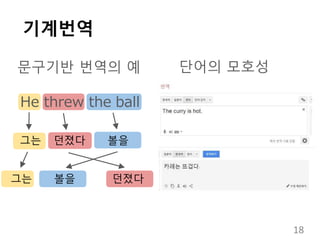
기계번역
문구기반 번역의 예
He threw the ball
단어의 모호성
그는 던졌다 볼을
그는 볼을 던졌다
18
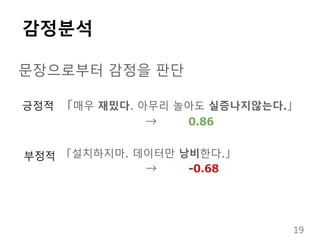
감정분석
문장으로부터 감정을 판단
「매우 재밌다. 아무리 놀아도 실증나지않는다.」
→ 0.86
「설치하지마. 데이터만 낭비한다.」
→ -0.68
긍정적
부정적
19
질문응답시스템(QA 시스템)
closed-domain – 정해진 분야의 질문에 응답
「라마는 무슨 과?」 → 「낙타과」
open-domain – 어떠한 질문에도 응답
「왜 나는 결혼을 못하나 ?」 → 「...」
20
자연어 처리의 어려움
언어・상황・환경・지각 지식의 학습 및 표현의 복잡함
→ Rule 기반만으로는 무리인가 ?
DNN은 분산표현의 장점으로 인해
모호하지만 풍부한 정보를 얻을 수 있다.
→ 단어의 벡터화로부터 시작
21
1. 개요
2. 분산표현의 개요
3. 자연어처리의 개요
4. 언어의 벡터표현
5. encoder-decoder 모델
6. 멀티모달모델
목차
22
단어의 국소표현
[1, 0, 0, 0, 0]
[0, 1, 0, 0, 0]
[0, 0, 1, 0, 0]
...
고양이
개
사람
이것만 가지고는 단어의 의미를 전혀 알 수 없다.
→ 단어의 의미를 파악하는 벡터를 갖고 싶다.
...
23
분포가설 [Harris 1954, Firth 1957]
“You shall know a word by the company it keeps”
- J. R. Firth
비슷한 문맥을 가진 단어는 비슷한 의미를 갖는다.
현대의 통계적 자연어 처리에서 획기적인 발상
24
Count-based vs Predictive methods
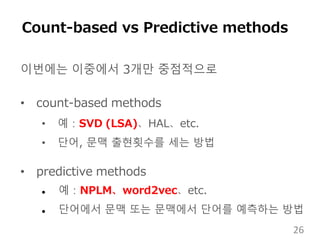
분포가설에 기반한 방법은 크게 2종류로 나눈다.
• count-based methods
• 예:SVD (LSA)、HAL、etc.
• 단어, 문맥 출현횟수를 세는 방법
• predictive methods
 예:NPLM、word2vec、etc.
 단어에서 문맥 또는 문맥에서 단어를 예측하는 방법
25
이번에는 이중에서 3개만 중점적으로
• count-based methods
• 예:SVD (LSA)、HAL、etc.
• 단어, 문맥 출현횟수를 세는 방법
• predictive methods
 예:NPLM、word2vec、etc.
 단어에서 문맥 또는 문맥에서 단어를 예측하는 방법
Count-based vs Predictive methods
26
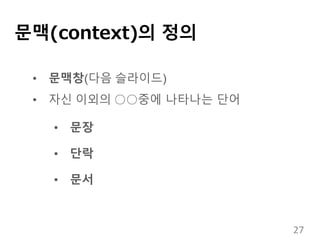
문맥(context)의 정의
• 문맥창(다음 슬라이드)
• 자신 이외의 ○○중에 나타나는 단어
• 문장
• 단락
• 문서
27
문맥창
크기 2k+1의 단어열에 대해
기준단어(April)주변의 단어가 문맥
k=4 의 예
It was a bright cold day in April, and the clocks were strikingthirteen.
전 4 단어 후 4 단어
기준
문맥
28
단어문맥행렬(co-occurance matrix)
예:k=1 의
문맥창으로 한 경우
|V| 는 어휘수
I enjoy technology.
I like eating.
I like to sleep.
I enjoy technology like eating to sleep .
I 0 1 0 2 0 0 0 0
enjoy 1 0 1 0 0 0 0 0
technology 0 1 0 0 0 0 0 1
like 2 0 0 0 1 1 0 0
eating 0 0 0 1 0 0 0 1
to 0 0 0 1 0 0 1 0
sleep 0 0 0 0 0 1 0 1
. 0 0 1 0 1 0 1 0
|V|
|V|
“like” 앞에 “I”가 두번 출현
“like” 뒤에 “eating”이 한번 출현
29
단어문맥행렬
각행을 단어벡터로 사용
그러나 단어가 많아지면,
벡터도 커진다(수십만 차원도 됨)
technology 0 1 0 0 0 0 0 1
like 2 0 0 0 1 1 0 0
eating 0 0 0 1 0 0 0 1
어휘수
30
조밀한 벡터
고차원 벡터의「가장 중요한 정보」를 유지하면서
저차원・조밀한 벡터로 압축하고 싶다.
(e.g. 수십만 차원 → 수백 차원)
→ 특이치분해(Singular Value Decomposition, SVD)
31
특이치분해(SVD)
X U VT
단어문맥행렬
각열은 XXT 의
고유벡터
각행은 XTX 의
고유벡터
대각선 값은 XXT 와 XTX 의 고유치
(크기순)
대응하는 고유치
의 크기순으로
나열됨.
|V|
|V|
Σ
𝝈 𝟏
𝝈 𝟐
⋱
𝝈 𝒏
𝝈 𝟏>𝝈 𝟐> ….. >𝝈 𝒏
∑ = 앞쪽이 중요하고
뒤로 갈 수록 중요도가 낮아짐 32
단어벡터
- U 의 각행을 단어벡터로 사용하되
- 중요도가 높은 앞쪽 고유치(N개)에 해당하는
U 의 앞쪽 N열까지 사용
U
단어벡터
사용하지않음
N
33
처음 2열까지 가시화 예
x y
-0.5 0.6
-0.6 -0.6
-0.2 -0.2
U
like
I
enjoy
단어벡터
단어벡터
34
K = 2 K = 3
단어벡터 예
35
좀더 본격적으로
다음은 Brown Corpus 를 사용해보자
• 단어수:약 100만
• 어휘수:공간으로 나눈 결과, 약 8만
• 우선 단어문맥행렬을 만들어 보려는데….
36
어휘수 줄이기
단어문맥행렬이 너무 크다
(어휘수 8만 → 80,000x80,000)
→ 발생빈도로 1,000번 이하의 단어를 정리
(어휘수 1,000 → 행렬 1,001x1,001)
37
단어벡터의 가시화
100차원의 벡터
(U의 100열까지 사용)
38
유사한(similarity, correlation, 관련성) 단어
유사도=
w1과 w2가 유사하면  1
w1과 w2가 관련없으면  0
39
계산량 문제
새로운 텍스트 데이터를 사용할 경우,
단어문맥 행렬을 새롭게 만들어 SVD을 다시 계산
SVD 계산량은 n×m행렬의 경우, O(mn2) (n < m)
→ 즉 어휘수에 한계
실제 어휘수를 늘려본 결과
100000
몇일 소요
40
뉴럴 확률 언어 모델 [Bengio+ 2003]
NN으로 만들어내는 언어모델
→ 언어모델은 또 뭐야 ?
41
언어모델
단어열의 문법과 의미가 올바른 정도를 나타내는 확률을 계산하는 모델
PLM(밥을 먹다) > PLM(먹다 밥을)
응용예 : 단어입력, 스펠링 체크, 기계번역 및 음성인식에 있어서 복수 문
장후보의 평가에 사용
우리 인류의 궁극적인 꿈
0.023%
우리 여기에 공급적인 com
0.002%
?
음성인식의 예
김성훈 교수님 강의 중
42
n-gram 언어모델
계산량의 한계로 조건을 붙여 확률을 근사화
어떤 단어의 출현확률은 이전 (n-1)개의 단어에 의존한다.
n=4 의경우
...man stood still as they slowly walked through the...
이것을 n-1차 마코프 과정이라고 함.
조건
43
n-gram 언어모델
unigram(n=1)
P(He plays tennis.)=P(He)*P(plays)*P(tennis)*P(.)
bigram(n=2)
P(He plays tennis.) = P(He)*P(plays|He)*P(tennis|plays)*P(.|tennis)
trigram(n=3)
P(He plays tennis.) = P(He)*P(plays|He)*P(tennis|He plays)*P(.|plays tennis)
...
순서를 전혀 고려하지 않음
44
n-gram로 언어모델링
이와 같이 n-gram의 n을 증가시킨다.
n 을 증가시켜도, 데이터가 충분하면 성능은 좋아진다.
그러나 단어가 가질 수 있는 조합이 |V|n 로 지수적으로 커진다.
→ 지수적으로 학습데이터가 필요해짐.
45
n-gram에 있어서 문제점
Brown Corpus를 3-gram으로 언어모델을 만들어보면
“he was happy”는 6건 나옴
46
“she was joyful”은 “0”
→ n-gram 모델이라면 확률 0%
→ Smoothing 등의 처리를 하는 경우가 있음.
그러나 문제는 완전히 해결되지 않음.
간단한 예
(add-one smoothing)
n-gram에 있어서 문제점
47
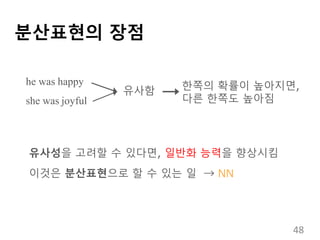
분산표현의 장점
유사성을 고려할 수 있다면, 일반화 능력을 향상시킴
이것은 분산표현으로 할 수 있는 일 → NN
유사함
he was happy
she was joyful
한쪽의 확률이 높아지면,
다른 한쪽도 높아짐
48
임베드행렬(embedding matrix)
이행렬을 NN으로 훈련시키면 ?
i 행렬이
단어 i 의 백터
단어벡터(임베드 벡터)의 집합
|V|
m 은 임베드벡터의 크기
(임의값)
m
49
뉴럴 확률언어모델(NPLM)
단어열로부터 다음 단어를 예측
(e.g. Apples are )
50
NPLM과 단어벡터
NPLM의 임베드행렬 C의 각행을 단어벡터로서 사용
그러나, NPLM의 첫번째 목적은 언어 모델
단어벡터는 부산물
단어벡터를 얻어내는 것에 적합한 방법이 있다면 ?
51
word2vec [Mikolov+ 2013]
CBOW(연속 bag-of-words)모델
• 문맥으로부터 단어를 예측
• 소규모 데이터 셋에 대하여 성능이 좋음
skip-gram 모델
• 단어로부터 문맥을 예측
• 대규모 데이터 셋에 사용됨
skip-gram은 성능이 좋고 빨라서 인기
52
CBOW (Original)
• Continuous-Bag-of-word model
• Idea: Using context words, we can predict center word
i.e. Probability( “It is ( ? ) to finish”  “time” )
• Present word as distributed vector of probability  Low dimension
• Goal: Train weight-matrix(W ) satisfies below
• Loss-function (using cross-entropy method)
argmax 𝑊 {𝑀𝑖𝑛𝑖𝑚𝑖𝑧𝑒 𝒕𝒊𝒎𝒆 − 𝑠𝑜𝑓𝑡𝑚𝑎𝑥 𝑝𝑟 time 𝒊𝒕, 𝒊𝒔, 𝒕𝒐, 𝒇𝒊𝒏𝒊𝒔𝒉 ; 𝑊 }
* Softmax(): K-dim vector of x∈ℝ  K-dim vector that has (0,1)∈ℝ
𝐸 = − log 𝑝(𝑤𝑡|𝑤𝑡−𝐶.. 𝑤𝑡+𝐶)
context words (window_size=2)
53
CBOW (Original)
• Continuous-Bag-of-word model
• Input
• “one-hot” word vector
• Remove nonlinear hidden layer
• Back-propagate error from
output layer to Weight matrix
(Adjust W s)
It
is
finish
to
time
[
0
1
0
0
0
]
Wout T∙h =
𝒚(predicted)
[0 0 1 0 0]T
Win
∙
h
Win ∙ x i
[0 0 0 0 1]T
Win
∙
y(true) =
Backpropagate to
Minimize error
vs
Win(old) Wout(old)
Win(new) Wout(new)
Win, Wout ∈ ℝ 𝑛×|𝑉|: Input, output Weight
-matrix, n is dimension for word embedding
x 𝑖, 𝑦 𝑖: input, output word vector
(one-hot) from vocabulary V
ℎ: hidden vector, avg of W*x
[NxV]*[Vx1]  [Nx1] [VxN]*[Nx1]  [Vx1]
Initial input, not results
54
• Skip-gram model
• Idea: With center word,
we can predict context words
• Mirror of CBOW (vice versa)
i.e. Probability( “time”  “It is ( ? ) to finish” )
• Loss-function:
Skip-Gram (Original)
𝐸 = − log 𝑝(𝑤𝑡−𝐶. . 𝑤𝑡+𝐶|𝑤𝑡)
time
It
is
to
finish
Win ∙ x i
h
y i
Win(old) Wout(old)
Win(new) Wout(new)
[NxV]*[Vx1]  [Nx1] [VxN]*[Nx1]  [Vx1]
CBOW: 𝐸 = − log 𝑝(𝑤𝑡|𝑤𝑡−𝐶.. 𝑤𝑡+𝐶)
55
• Hierarchical Soft-max function
• To train weight matrix in every step, we need to pass the
calculated vector into Loss-Function
• Soft-max function
• Before calculate loss function
calculated vector should normalized as real-number in
(0,1)
Extension of Skip-Gram(1)
𝑻: 𝑤ℎ𝑜𝑙𝑒 𝑠𝑡𝑒𝑝
𝒄: 𝑠𝑖𝑧𝑒 𝑜𝑓 𝑡𝑟𝑎𝑖𝑛𝑖𝑛𝑔 𝑐𝑜𝑛𝑡𝑒𝑥𝑡 𝑤𝑖𝑛𝑑𝑜𝑤
𝒘 𝒕, 𝒘 𝒕+𝒋: 𝑐𝑢𝑟𝑒𝑛𝑡 𝑠𝑡𝑒𝑝′ 𝑠 𝑤𝑜𝑟𝑑 𝑎𝑛𝑑 𝑗 − 𝑡ℎ 𝑤𝑜𝑟𝑑 𝒘𝒕
(𝑬 = − 𝐥𝐨𝐠 𝒑 𝒘 𝒕−𝑪. . 𝒘 𝒕+𝑪 𝒘 𝒕 )
56
• Hierarchical Soft-max function (cont.)
• Soft-max function
(I have already calculated, it’s boring …….…)
Extension of Skip-Gram(1)
Original soft-max function
of skip-gram model
57
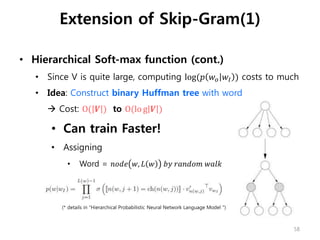
• Hierarchical Soft-max function (cont.)
• Since V is quite large, computing log(𝑝 𝑤𝑜 𝑤𝐼 ) costs to much
• Idea: Construct binary Huffman tree with word
 Cost: O( 𝑽 ) to O(lo g 𝑽 )
• Can train Faster!
• Assigning
• Word = 𝑛𝑜𝑑𝑒 𝑤, 𝐿 𝑤 𝑏𝑦 𝑟𝑎𝑛𝑑𝑜𝑚 𝑤𝑎𝑙𝑘
(* details in “Hierarchical Probabilistic Neural Network Language Model ")
Extension of Skip-Gram(1)
58
• Negative Sampling (similar to NCE)
• Size(Vocabulary) is computationally huge!  Slow for train
• Idea: Just sample several negative examples!
• Do not loop full vocabulary, only use neg. sample  fast
• Change the target word as negative sample and learn
negative examples  get more accuracy
• Objective function
Extension of Skip-Gram(2)
i.e. “Stock boil fish is toy” ????  negative sample
Noise Constrastive Estimation
𝐸 = − log 𝑝(𝑤𝑡−𝐶. . 𝑤𝑡+𝐶|𝑤𝑡)
59
• Subsampling
• (“Korea”, ”Seoul”) is helpful, but (“Korea”, ”the”) isn’t helpful
• Idea: Frequent word vectors (i.e. “the”) should not change
significantly after training on several million examples.
• Each word 𝑤𝑖 in the training set is discarded with below
probability
• It aggressively subsamples frequent words while preserve
ranking of the frequencies
• But, this formula was chosen heuristically…
Extension of Skip-Gram(3)
f wi : 𝑓𝑟𝑒𝑞𝑢𝑛𝑐𝑦 𝑜𝑓 𝑤𝑜𝑟𝑑 𝑤𝑖
𝑡: 𝑐ℎ𝑜𝑠𝑒𝑛 𝑡ℎ𝑟𝑒𝑠ℎ𝑜𝑙𝑑, 𝑎𝑟𝑜𝑢𝑛𝑑 10−5
60
• Evaluation
• Task: Analogical reasoning
• Accuracy test using cosine similarity determine how the model
answer correctly.
i.e. vec(X) = vec(“Berlin”) – vec(“Germany”) + vec(“France”)
Accuracy = cosine_similarity( vec(X), vec(“Paris”) )
• Model: skip-gram model(Word-embedding dimension = 300)
• Data Set: News article (Google dataset with 1 billion words)
• Comparing Method (w/ or w/o 10-5subsampling)
• NEG(Negative Sampling)-5, 15
• Hierarchical Softmax-Huffman
• NCE-5(Noise Contrastive Estimation)
Extension of Skip-Gram
61
• Empirical Results
• Model w/ NEG outperforms the HS on the analogical reasoning task
(even slightly better than NCE)
• The subsampling improves the training speed several times and
makes the word representations more accurate
Extension of Skip-Gram
62
• Word base model can not represent idiomatic word
• i.e. “Newyork Times”, “Larry Page”
• Simple data driven approach
• If phrases are formed based on 1-gram, 2-gram counts
• Target words that has high score would meaningful phrase
Learning Phrases
𝛿: 𝑑𝑖𝑠𝑐𝑜𝑢𝑛𝑡𝑖𝑛𝑔 𝑐𝑜𝑒𝑓𝑓𝑖𝑐𝑖𝑒𝑛𝑡
(P𝑟𝑒𝑣𝑒𝑛𝑡 𝑡𝑜𝑜 𝑚𝑎𝑛𝑦 𝑝ℎ𝑟𝑎𝑠𝑒𝑠 𝑐𝑜𝑛𝑠𝑖𝑠𝑡𝑖𝑛𝑔 𝑜𝑓 𝑖𝑛𝑓𝑟𝑒𝑞𝑢𝑒𝑛𝑡 𝑤𝑜𝑟𝑑𝑠)
63
• Evaluation
• Task: Analogical reasoning
• Accuracy test using cosine similarity determine how the model
answer correctly with phrase
• i.e. vec(X) = vec(“Steve Ballmer”) – vec(“Microsoft”) + vec(“Larry Page”)
Accuracy = cosine_similarity( vec(x), vec(“Google”) )
• Model: skip-gram model(Word-embedding dimension = 300)
• Data Set: News article (Google dataset with 1 billion words)
• Comparing Method (w/ or w/o 10-5subsampling)
• NEG-5
• NEG-15
• HS-Huffman
Learning Phrases
64
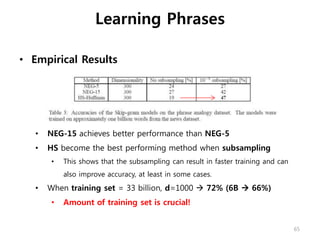
• Empirical Results
• NEG-15 achieves better performance than NEG-5
• HS become the best performing method when subsampling
• This shows that the subsampling can result in faster training and can
also improve accuracy, at least in some cases.
• When training set = 33 billion, d=1000  72% (6B  66%)
• Amount of training set is crucial!
Learning Phrases
65
• Simple vector addition (on Skip-gram model)
• Previous experiments shows Analogical reasoning (A+B-C)
• Vector’s values are related logarithmically to the probabilities
 Sum of two vector is related to product of context distribution
• Interesting!
Additive Compositionality
66
• Contributions
• Showed detailed process of training distributed
representation of words and phrases
• Can be more accurate and faster model than previous
word2vec model by sub-sampling
• Negative Sampling: Extremely simple and accurate for
frequent words. (not frequent like phrase, HS was better)
• Word vectors can be meaningful by simple vector
addition
• Made a code and dataset as open-source project
Conclusion
67
• Compare to other Neural network model
<Find most similar word>
• Skip-gram model trained on large corpus outperforms all
to other paper’s models.
Conclusion
68

머신러닝의 자연어 처리기술(I)

  • 1.
    머신러닝의 자연어 처리기술(I) 2016.7. 김홍배 “言語と画像の表現学習“, 慶應義塾大学, 野口裕貴 “Word2vec from scratch”, KAIST, 이진표 1
  • 2.
    1. 개요 2. 분산표현의개요 3. 자연어처리의 개요 4. 언어의 벡터표현 5. encoder-decoder 모델 6. 멀티모달모델 목차 2
  • 3.
    사진으로 연애이야기를 만드는AI 「회의마지막에우리들은긴장된분위기였다. 그리고나는친구를쳐다봤다. 물론나는그가가도록놔둘의도는없었다. 달리할말을모르겠지만, 그는가장아름다운 남자다」 3
  • 4.
    Neural Storyteller에서 사용되는기술 단어 표현 문장과 사진의 결합 사진으로부터 설명문을 작성 Kiros 2015.11 뉴럴넷(NN)이 기반 [Mikolov+ 13] [Kiros+ 15] [Kiros+ 14]문장 표현 사진 표현 4
  • 5.
    오늘의 주제 • NN이파워풀한 이유중 하나:분산표현 • NN에 언어 및 사진을 학습시키는 방법 5
  • 6.
    분산표현 [Hinton+ 1986] 분산표현 1986년、GeoffreyHinton이 뉴론이 어떻게 개념을 나 타 내 는 가 를 설 명 하 기 위 해 서 분 산 표 현 (distributed representation)을 제안 6
  • 7.
    목차 1. 개요 2. 분산표현의개요 3. 자연어처리의 개요 4. 언어의 벡터표현 5. encoder-decoder 모델 6. 멀티모달모델 7
  • 8.
  • 9.
    국소표현 1개 뉴론의 작동으로1개의 개념을 나타냄 벡터형태로 나타내서 one-hot vector [1, 0, 0, 0, 0] [0, 1, 0, 0, 0] [0, 0, 1, 0, 0] ... ... 9
  • 10.
    분산표현 복수 뉴론의 작동으로1개의 개념을 나타냄. [0.5, 0.0, 1.0, 1.0, 0.3] [0.5, 0.0, 1.0, 1.0, 0.0] [0.2, 0.9, 0.5, 0.0, 1.0] ... ... 10
  • 11.
    분산표현 개념을 특징의 조합으로나타냄. = 1·펫 + 1 · 멍멍 + 0 · 야옹 + 0.1 · 타는것 + 0.1 · 바다 = 1·펫 + 0 · 멍멍 + 1 · 야옹 + 0 .0· 타는것 + 0 · 바다 = 0·펫 + 0 · 멍멍 + 0 · 야옹 + 0.9 · 타는것 + 0.8 · 바다 특징 계수 11
  • 12.
  • 13.
    문자인식의 분산표현 ...+ 0.9+ 0.1 ...+ 0.5 + 0.6 ≈ 0.8 계수 ≈ 0.7 특징 13
  • 14.
    딥뉴럴네트웍 음성인식과 사진인식을 시작으로다양한 분야에서 성과를 만들어내고 있다. 최근에는 자연어처리에도 활용되고 있다. 14
  • 15.
    1. 개요 2. 분산표현의개요 3. 자연어처리의 개요 4. 언어의 벡터표현 5. encoder-decoder 모델 6. 멀티모달모델 목차 15
  • 16.
    자연어처리(NLP) 컴퓨터과학, 인공지능과 언어학이합쳐진 분야 컴퓨터 과학 인공지능 자연어처리 언어학 16
  • 17.
    자연어 처리 업무 쉬움중간 어려움 • 스펠링 체크 • 키워드 검사 • 유사어 감지 • 웹사이트 및 서류의 형태 해석 • 구문해석 etc. • 기계번역 • 감정분석 • 질의응답시스템 17
  • 18.
    기계번역 문구기반 번역의 예 Hethrew the ball 단어의 모호성 그는 던졌다 볼을 그는 볼을 던졌다 18
  • 19.
    감정분석 문장으로부터 감정을 판단 「매우재밌다. 아무리 놀아도 실증나지않는다.」 → 0.86 「설치하지마. 데이터만 낭비한다.」 → -0.68 긍정적 부정적 19
  • 20.
    질문응답시스템(QA 시스템) closed-domain –정해진 분야의 질문에 응답 「라마는 무슨 과?」 → 「낙타과」 open-domain – 어떠한 질문에도 응답 「왜 나는 결혼을 못하나 ?」 → 「...」 20
  • 21.
    자연어 처리의 어려움 언어・상황・환경・지각지식의 학습 및 표현의 복잡함 → Rule 기반만으로는 무리인가 ? DNN은 분산표현의 장점으로 인해 모호하지만 풍부한 정보를 얻을 수 있다. → 단어의 벡터화로부터 시작 21
  • 22.
    1. 개요 2. 분산표현의개요 3. 자연어처리의 개요 4. 언어의 벡터표현 5. encoder-decoder 모델 6. 멀티모달모델 목차 22
  • 23.
    단어의 국소표현 [1, 0,0, 0, 0] [0, 1, 0, 0, 0] [0, 0, 1, 0, 0] ... 고양이 개 사람 이것만 가지고는 단어의 의미를 전혀 알 수 없다. → 단어의 의미를 파악하는 벡터를 갖고 싶다. ... 23
  • 24.
    분포가설 [Harris 1954,Firth 1957] “You shall know a word by the company it keeps” - J. R. Firth 비슷한 문맥을 가진 단어는 비슷한 의미를 갖는다. 현대의 통계적 자연어 처리에서 획기적인 발상 24
  • 25.
    Count-based vs Predictivemethods 분포가설에 기반한 방법은 크게 2종류로 나눈다. • count-based methods • 예:SVD (LSA)、HAL、etc. • 단어, 문맥 출현횟수를 세는 방법 • predictive methods  예:NPLM、word2vec、etc.  단어에서 문맥 또는 문맥에서 단어를 예측하는 방법 25
  • 26.
    이번에는 이중에서 3개만중점적으로 • count-based methods • 예:SVD (LSA)、HAL、etc. • 단어, 문맥 출현횟수를 세는 방법 • predictive methods  예:NPLM、word2vec、etc.  단어에서 문맥 또는 문맥에서 단어를 예측하는 방법 Count-based vs Predictive methods 26
  • 27.
    문맥(context)의 정의 • 문맥창(다음슬라이드) • 자신 이외의 ○○중에 나타나는 단어 • 문장 • 단락 • 문서 27
  • 28.
    문맥창 크기 2k+1의 단어열에대해 기준단어(April)주변의 단어가 문맥 k=4 의 예 It was a bright cold day in April, and the clocks were strikingthirteen. 전 4 단어 후 4 단어 기준 문맥 28
  • 29.
    단어문맥행렬(co-occurance matrix) 예:k=1 의 문맥창으로한 경우 |V| 는 어휘수 I enjoy technology. I like eating. I like to sleep. I enjoy technology like eating to sleep . I 0 1 0 2 0 0 0 0 enjoy 1 0 1 0 0 0 0 0 technology 0 1 0 0 0 0 0 1 like 2 0 0 0 1 1 0 0 eating 0 0 0 1 0 0 0 1 to 0 0 0 1 0 0 1 0 sleep 0 0 0 0 0 1 0 1 . 0 0 1 0 1 0 1 0 |V| |V| “like” 앞에 “I”가 두번 출현 “like” 뒤에 “eating”이 한번 출현 29
  • 30.
    단어문맥행렬 각행을 단어벡터로 사용 그러나단어가 많아지면, 벡터도 커진다(수십만 차원도 됨) technology 0 1 0 0 0 0 0 1 like 2 0 0 0 1 1 0 0 eating 0 0 0 1 0 0 0 1 어휘수 30
  • 31.
    조밀한 벡터 고차원 벡터의「가장중요한 정보」를 유지하면서 저차원・조밀한 벡터로 압축하고 싶다. (e.g. 수십만 차원 → 수백 차원) → 특이치분해(Singular Value Decomposition, SVD) 31
  • 32.
    특이치분해(SVD) X U VT 단어문맥행렬 각열은XXT 의 고유벡터 각행은 XTX 의 고유벡터 대각선 값은 XXT 와 XTX 의 고유치 (크기순) 대응하는 고유치 의 크기순으로 나열됨. |V| |V| Σ 𝝈 𝟏 𝝈 𝟐 ⋱ 𝝈 𝒏 𝝈 𝟏>𝝈 𝟐> ….. >𝝈 𝒏 ∑ = 앞쪽이 중요하고 뒤로 갈 수록 중요도가 낮아짐 32
  • 33.
    단어벡터 - U 의각행을 단어벡터로 사용하되 - 중요도가 높은 앞쪽 고유치(N개)에 해당하는 U 의 앞쪽 N열까지 사용 U 단어벡터 사용하지않음 N 33
  • 34.
    처음 2열까지 가시화예 x y -0.5 0.6 -0.6 -0.6 -0.2 -0.2 U like I enjoy 단어벡터 단어벡터 34
  • 35.
    K = 2K = 3 단어벡터 예 35
  • 36.
    좀더 본격적으로 다음은 BrownCorpus 를 사용해보자 • 단어수:약 100만 • 어휘수:공간으로 나눈 결과, 약 8만 • 우선 단어문맥행렬을 만들어 보려는데…. 36
  • 37.
    어휘수 줄이기 단어문맥행렬이 너무크다 (어휘수 8만 → 80,000x80,000) → 발생빈도로 1,000번 이하의 단어를 정리 (어휘수 1,000 → 행렬 1,001x1,001) 37
  • 38.
  • 39.
    유사한(similarity, correlation, 관련성)단어 유사도= w1과 w2가 유사하면  1 w1과 w2가 관련없으면  0 39
  • 40.
    계산량 문제 새로운 텍스트데이터를 사용할 경우, 단어문맥 행렬을 새롭게 만들어 SVD을 다시 계산 SVD 계산량은 n×m행렬의 경우, O(mn2) (n < m) → 즉 어휘수에 한계 실제 어휘수를 늘려본 결과 100000 몇일 소요 40
  • 41.
    뉴럴 확률 언어모델 [Bengio+ 2003] NN으로 만들어내는 언어모델 → 언어모델은 또 뭐야 ? 41
  • 42.
    언어모델 단어열의 문법과 의미가올바른 정도를 나타내는 확률을 계산하는 모델 PLM(밥을 먹다) > PLM(먹다 밥을) 응용예 : 단어입력, 스펠링 체크, 기계번역 및 음성인식에 있어서 복수 문 장후보의 평가에 사용 우리 인류의 궁극적인 꿈 0.023% 우리 여기에 공급적인 com 0.002% ? 음성인식의 예 김성훈 교수님 강의 중 42
  • 43.
    n-gram 언어모델 계산량의 한계로조건을 붙여 확률을 근사화 어떤 단어의 출현확률은 이전 (n-1)개의 단어에 의존한다. n=4 의경우 ...man stood still as they slowly walked through the... 이것을 n-1차 마코프 과정이라고 함. 조건 43
  • 44.
    n-gram 언어모델 unigram(n=1) P(He playstennis.)=P(He)*P(plays)*P(tennis)*P(.) bigram(n=2) P(He plays tennis.) = P(He)*P(plays|He)*P(tennis|plays)*P(.|tennis) trigram(n=3) P(He plays tennis.) = P(He)*P(plays|He)*P(tennis|He plays)*P(.|plays tennis) ... 순서를 전혀 고려하지 않음 44
  • 45.
    n-gram로 언어모델링 이와 같이n-gram의 n을 증가시킨다. n 을 증가시켜도, 데이터가 충분하면 성능은 좋아진다. 그러나 단어가 가질 수 있는 조합이 |V|n 로 지수적으로 커진다. → 지수적으로 학습데이터가 필요해짐. 45
  • 46.
    n-gram에 있어서 문제점 BrownCorpus를 3-gram으로 언어모델을 만들어보면 “he was happy”는 6건 나옴 46
  • 47.
    “she was joyful”은“0” → n-gram 모델이라면 확률 0% → Smoothing 등의 처리를 하는 경우가 있음. 그러나 문제는 완전히 해결되지 않음. 간단한 예 (add-one smoothing) n-gram에 있어서 문제점 47
  • 48.
    분산표현의 장점 유사성을 고려할수 있다면, 일반화 능력을 향상시킴 이것은 분산표현으로 할 수 있는 일 → NN 유사함 he was happy she was joyful 한쪽의 확률이 높아지면, 다른 한쪽도 높아짐 48
  • 49.
    임베드행렬(embedding matrix) 이행렬을 NN으로훈련시키면 ? i 행렬이 단어 i 의 백터 단어벡터(임베드 벡터)의 집합 |V| m 은 임베드벡터의 크기 (임의값) m 49
  • 50.
    뉴럴 확률언어모델(NPLM) 단어열로부터 다음단어를 예측 (e.g. Apples are ) 50
  • 51.
    NPLM과 단어벡터 NPLM의 임베드행렬C의 각행을 단어벡터로서 사용 그러나, NPLM의 첫번째 목적은 언어 모델 단어벡터는 부산물 단어벡터를 얻어내는 것에 적합한 방법이 있다면 ? 51
  • 52.
    word2vec [Mikolov+ 2013] CBOW(연속bag-of-words)모델 • 문맥으로부터 단어를 예측 • 소규모 데이터 셋에 대하여 성능이 좋음 skip-gram 모델 • 단어로부터 문맥을 예측 • 대규모 데이터 셋에 사용됨 skip-gram은 성능이 좋고 빨라서 인기 52
  • 53.
    CBOW (Original) • Continuous-Bag-of-wordmodel • Idea: Using context words, we can predict center word i.e. Probability( “It is ( ? ) to finish”  “time” ) • Present word as distributed vector of probability  Low dimension • Goal: Train weight-matrix(W ) satisfies below • Loss-function (using cross-entropy method) argmax 𝑊 {𝑀𝑖𝑛𝑖𝑚𝑖𝑧𝑒 𝒕𝒊𝒎𝒆 − 𝑠𝑜𝑓𝑡𝑚𝑎𝑥 𝑝𝑟 time 𝒊𝒕, 𝒊𝒔, 𝒕𝒐, 𝒇𝒊𝒏𝒊𝒔𝒉 ; 𝑊 } * Softmax(): K-dim vector of x∈ℝ  K-dim vector that has (0,1)∈ℝ 𝐸 = − log 𝑝(𝑤𝑡|𝑤𝑡−𝐶.. 𝑤𝑡+𝐶) context words (window_size=2) 53
  • 54.
    CBOW (Original) • Continuous-Bag-of-wordmodel • Input • “one-hot” word vector • Remove nonlinear hidden layer • Back-propagate error from output layer to Weight matrix (Adjust W s) It is finish to time [ 0 1 0 0 0 ] Wout T∙h = 𝒚(predicted) [0 0 1 0 0]T Win ∙ h Win ∙ x i [0 0 0 0 1]T Win ∙ y(true) = Backpropagate to Minimize error vs Win(old) Wout(old) Win(new) Wout(new) Win, Wout ∈ ℝ 𝑛×|𝑉|: Input, output Weight -matrix, n is dimension for word embedding x 𝑖, 𝑦 𝑖: input, output word vector (one-hot) from vocabulary V ℎ: hidden vector, avg of W*x [NxV]*[Vx1]  [Nx1] [VxN]*[Nx1]  [Vx1] Initial input, not results 54
  • 55.
    • Skip-gram model •Idea: With center word, we can predict context words • Mirror of CBOW (vice versa) i.e. Probability( “time”  “It is ( ? ) to finish” ) • Loss-function: Skip-Gram (Original) 𝐸 = − log 𝑝(𝑤𝑡−𝐶. . 𝑤𝑡+𝐶|𝑤𝑡) time It is to finish Win ∙ x i h y i Win(old) Wout(old) Win(new) Wout(new) [NxV]*[Vx1]  [Nx1] [VxN]*[Nx1]  [Vx1] CBOW: 𝐸 = − log 𝑝(𝑤𝑡|𝑤𝑡−𝐶.. 𝑤𝑡+𝐶) 55
  • 56.
    • Hierarchical Soft-maxfunction • To train weight matrix in every step, we need to pass the calculated vector into Loss-Function • Soft-max function • Before calculate loss function calculated vector should normalized as real-number in (0,1) Extension of Skip-Gram(1) 𝑻: 𝑤ℎ𝑜𝑙𝑒 𝑠𝑡𝑒𝑝 𝒄: 𝑠𝑖𝑧𝑒 𝑜𝑓 𝑡𝑟𝑎𝑖𝑛𝑖𝑛𝑔 𝑐𝑜𝑛𝑡𝑒𝑥𝑡 𝑤𝑖𝑛𝑑𝑜𝑤 𝒘 𝒕, 𝒘 𝒕+𝒋: 𝑐𝑢𝑟𝑒𝑛𝑡 𝑠𝑡𝑒𝑝′ 𝑠 𝑤𝑜𝑟𝑑 𝑎𝑛𝑑 𝑗 − 𝑡ℎ 𝑤𝑜𝑟𝑑 𝒘𝒕 (𝑬 = − 𝐥𝐨𝐠 𝒑 𝒘 𝒕−𝑪. . 𝒘 𝒕+𝑪 𝒘 𝒕 ) 56
  • 57.
    • Hierarchical Soft-maxfunction (cont.) • Soft-max function (I have already calculated, it’s boring …….…) Extension of Skip-Gram(1) Original soft-max function of skip-gram model 57
  • 58.
    • Hierarchical Soft-maxfunction (cont.) • Since V is quite large, computing log(𝑝 𝑤𝑜 𝑤𝐼 ) costs to much • Idea: Construct binary Huffman tree with word  Cost: O( 𝑽 ) to O(lo g 𝑽 ) • Can train Faster! • Assigning • Word = 𝑛𝑜𝑑𝑒 𝑤, 𝐿 𝑤 𝑏𝑦 𝑟𝑎𝑛𝑑𝑜𝑚 𝑤𝑎𝑙𝑘 (* details in “Hierarchical Probabilistic Neural Network Language Model ") Extension of Skip-Gram(1) 58
  • 59.
    • Negative Sampling(similar to NCE) • Size(Vocabulary) is computationally huge!  Slow for train • Idea: Just sample several negative examples! • Do not loop full vocabulary, only use neg. sample  fast • Change the target word as negative sample and learn negative examples  get more accuracy • Objective function Extension of Skip-Gram(2) i.e. “Stock boil fish is toy” ????  negative sample Noise Constrastive Estimation 𝐸 = − log 𝑝(𝑤𝑡−𝐶. . 𝑤𝑡+𝐶|𝑤𝑡) 59
  • 60.
    • Subsampling • (“Korea”,”Seoul”) is helpful, but (“Korea”, ”the”) isn’t helpful • Idea: Frequent word vectors (i.e. “the”) should not change significantly after training on several million examples. • Each word 𝑤𝑖 in the training set is discarded with below probability • It aggressively subsamples frequent words while preserve ranking of the frequencies • But, this formula was chosen heuristically… Extension of Skip-Gram(3) f wi : 𝑓𝑟𝑒𝑞𝑢𝑛𝑐𝑦 𝑜𝑓 𝑤𝑜𝑟𝑑 𝑤𝑖 𝑡: 𝑐ℎ𝑜𝑠𝑒𝑛 𝑡ℎ𝑟𝑒𝑠ℎ𝑜𝑙𝑑, 𝑎𝑟𝑜𝑢𝑛𝑑 10−5 60
  • 61.
    • Evaluation • Task:Analogical reasoning • Accuracy test using cosine similarity determine how the model answer correctly. i.e. vec(X) = vec(“Berlin”) – vec(“Germany”) + vec(“France”) Accuracy = cosine_similarity( vec(X), vec(“Paris”) ) • Model: skip-gram model(Word-embedding dimension = 300) • Data Set: News article (Google dataset with 1 billion words) • Comparing Method (w/ or w/o 10-5subsampling) • NEG(Negative Sampling)-5, 15 • Hierarchical Softmax-Huffman • NCE-5(Noise Contrastive Estimation) Extension of Skip-Gram 61
  • 62.
    • Empirical Results •Model w/ NEG outperforms the HS on the analogical reasoning task (even slightly better than NCE) • The subsampling improves the training speed several times and makes the word representations more accurate Extension of Skip-Gram 62
  • 63.
    • Word basemodel can not represent idiomatic word • i.e. “Newyork Times”, “Larry Page” • Simple data driven approach • If phrases are formed based on 1-gram, 2-gram counts • Target words that has high score would meaningful phrase Learning Phrases 𝛿: 𝑑𝑖𝑠𝑐𝑜𝑢𝑛𝑡𝑖𝑛𝑔 𝑐𝑜𝑒𝑓𝑓𝑖𝑐𝑖𝑒𝑛𝑡 (P𝑟𝑒𝑣𝑒𝑛𝑡 𝑡𝑜𝑜 𝑚𝑎𝑛𝑦 𝑝ℎ𝑟𝑎𝑠𝑒𝑠 𝑐𝑜𝑛𝑠𝑖𝑠𝑡𝑖𝑛𝑔 𝑜𝑓 𝑖𝑛𝑓𝑟𝑒𝑞𝑢𝑒𝑛𝑡 𝑤𝑜𝑟𝑑𝑠) 63
  • 64.
    • Evaluation • Task:Analogical reasoning • Accuracy test using cosine similarity determine how the model answer correctly with phrase • i.e. vec(X) = vec(“Steve Ballmer”) – vec(“Microsoft”) + vec(“Larry Page”) Accuracy = cosine_similarity( vec(x), vec(“Google”) ) • Model: skip-gram model(Word-embedding dimension = 300) • Data Set: News article (Google dataset with 1 billion words) • Comparing Method (w/ or w/o 10-5subsampling) • NEG-5 • NEG-15 • HS-Huffman Learning Phrases 64
  • 65.
    • Empirical Results •NEG-15 achieves better performance than NEG-5 • HS become the best performing method when subsampling • This shows that the subsampling can result in faster training and can also improve accuracy, at least in some cases. • When training set = 33 billion, d=1000  72% (6B  66%) • Amount of training set is crucial! Learning Phrases 65
  • 66.
    • Simple vectoraddition (on Skip-gram model) • Previous experiments shows Analogical reasoning (A+B-C) • Vector’s values are related logarithmically to the probabilities  Sum of two vector is related to product of context distribution • Interesting! Additive Compositionality 66
  • 67.
    • Contributions • Showeddetailed process of training distributed representation of words and phrases • Can be more accurate and faster model than previous word2vec model by sub-sampling • Negative Sampling: Extremely simple and accurate for frequent words. (not frequent like phrase, HS was better) • Word vectors can be meaningful by simple vector addition • Made a code and dataset as open-source project Conclusion 67
  • 68.
    • Compare toother Neural network model <Find most similar word> • Skip-gram model trained on large corpus outperforms all to other paper’s models. Conclusion 68

Editor's Notes

  • #60 - Instead of looping over entire vocabulary, just sample several negative examples! & Good model can distinguish bad samples - build a new objective function that tries to maximize the probability of a word and context being in the corpus data if it indeed is, and maximize the probability of a word and context not being in the corpus data if it indeed is not.