BERT: Pre-training of Deep
Bidirectional Transformers for
Language Understanding
Devlin et al., 2018 (Google AI Language)
Presenter
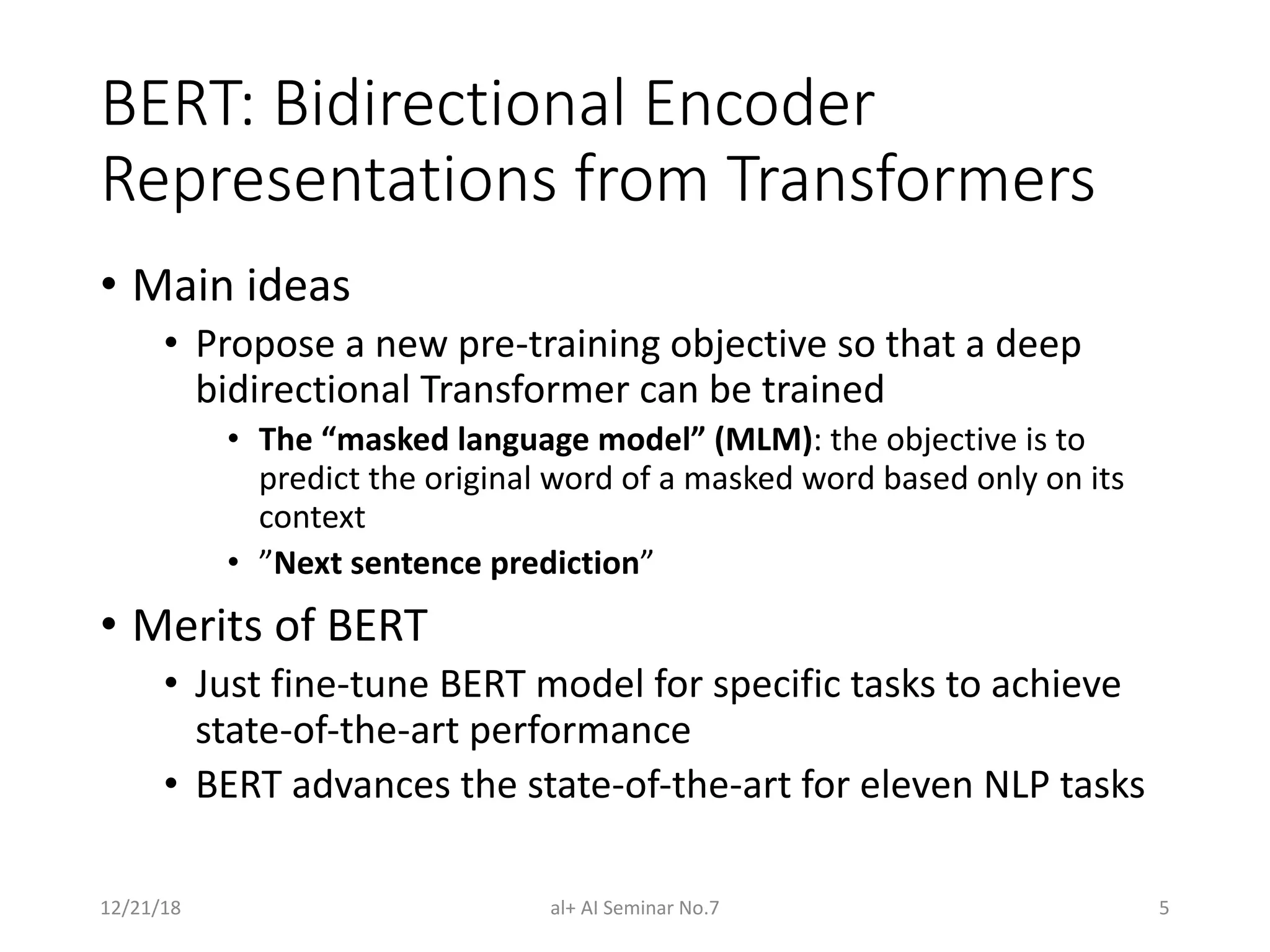
Phạm Quang Nhật Minh
NLP Researcher
Alt Vietnam
al+ AI Seminar No. 7
2018/12/21
Outline
• Research context
• Main ideas
• BERT
• Experiments
• Conclusions
12/21/18 al+ AI Seminar No.7 2
Research context
• Language model pre-training has been used to
improve many NLP tasks
• ELMo (Peters et al., 2018)
• OpenAI GPT (Radford et al., 2018)
• ULMFit (Howard and Rudder, 2018)
• Two existing strategies for applying pre-trained
language representations to downstream tasks
• Feature-based: include pre-trained representations as
additional features (e.g., ELMo)
• Fine-tunning: introduce task-specific parameters and
fine-tune the pre-trained parameters (e.g., OpenAI GPT,
ULMFit)
12/21/18 al+ AI Seminar No.7 3
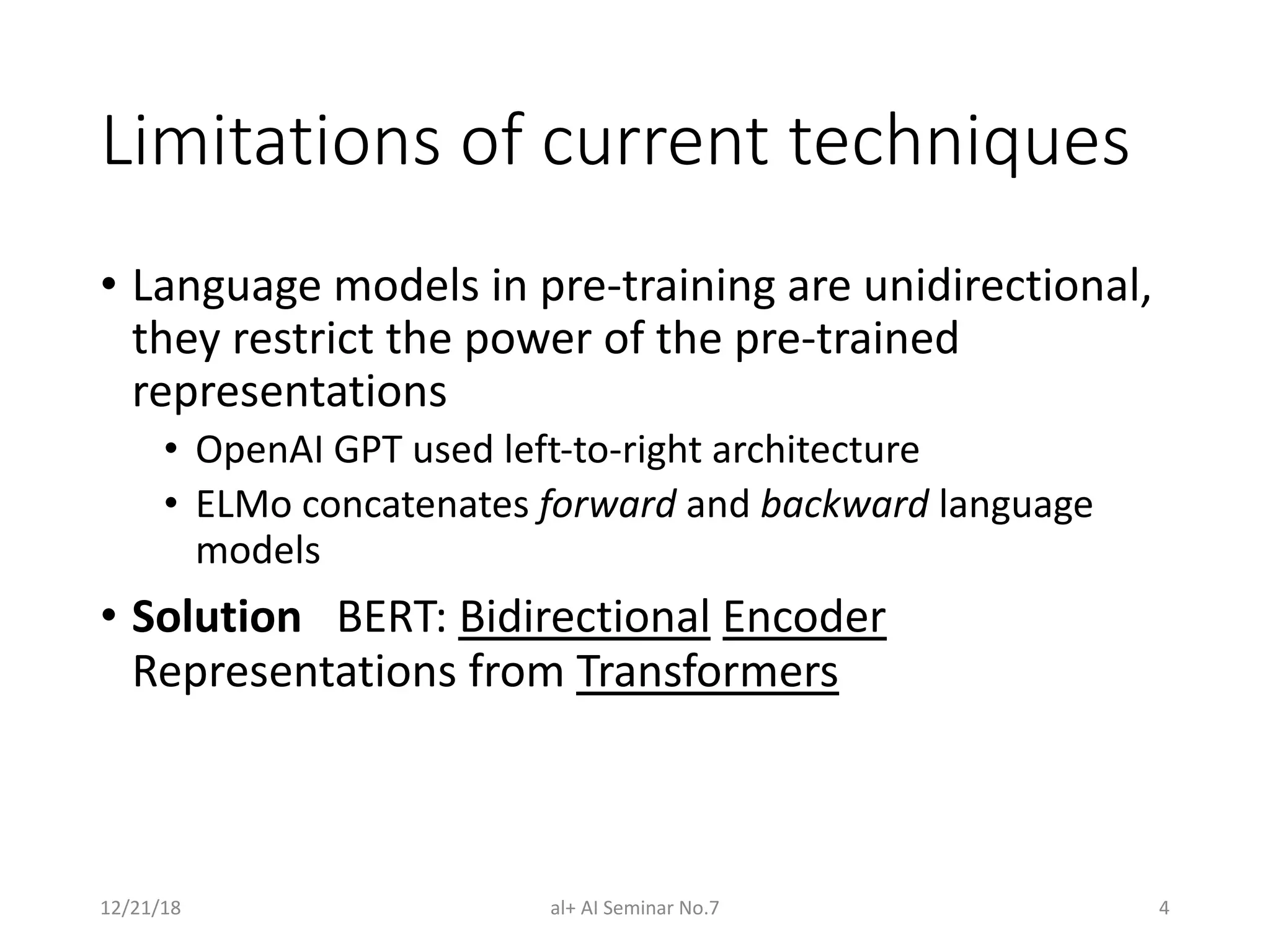
Limitations of current techniques
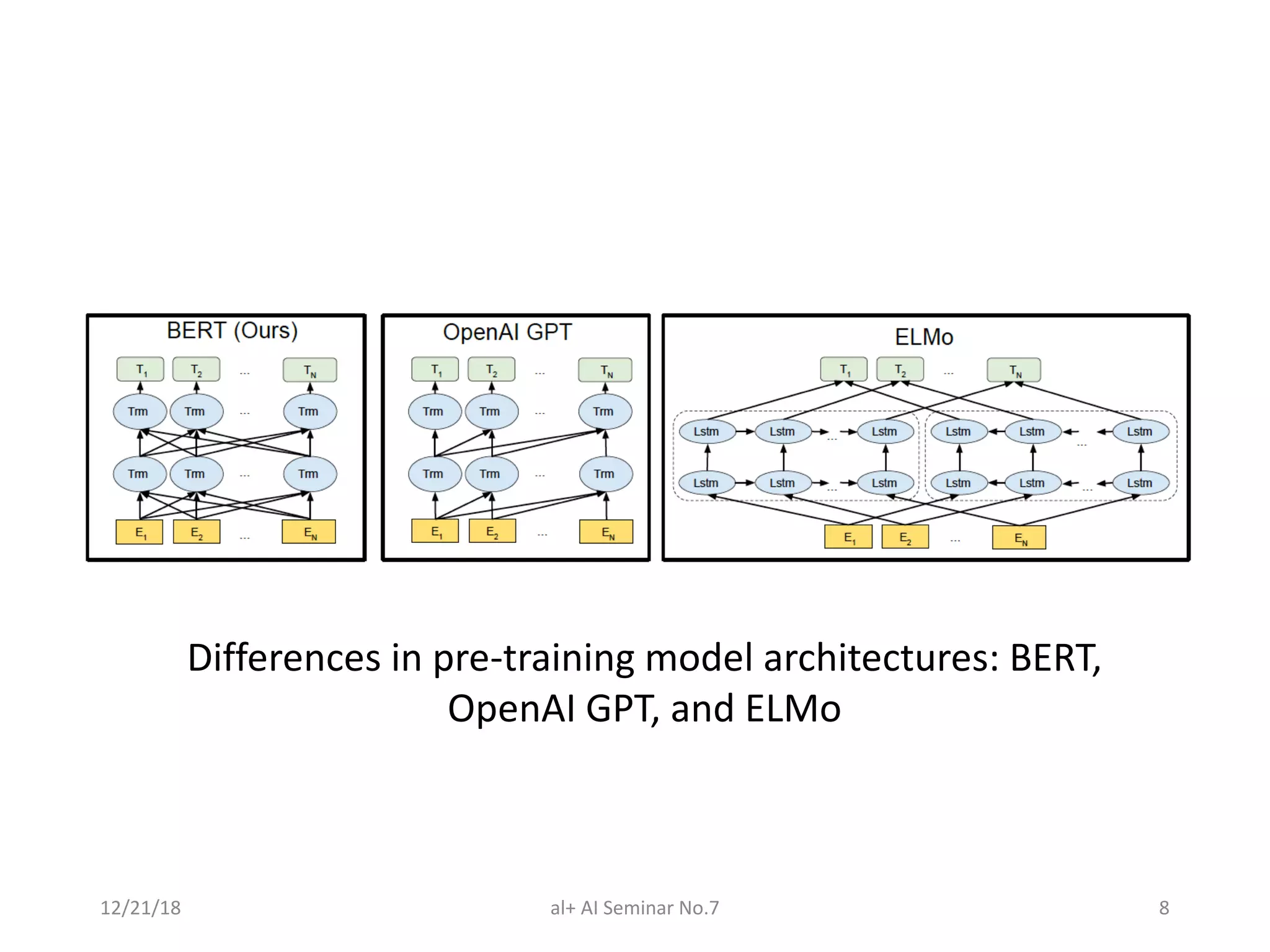
• Language models in pre-training are unidirectional,
they restrict the power of the pre-trained
representations
• OpenAI GPT used left-to-right architecture
• ELMo concatenates forward and backward language
models
• Solution BERT: Bidirectional Encoder
Representations from Transformers
12/21/18 al+ AI Seminar No.7 4
BERT: Bidirectional Encoder
Representations from Transformers
• Main ideas
• Propose a new pre-training objective so that a deep
bidirectional Transformer can be trained
• The “masked language model” (MLM): the objective is to
predict the original word of a masked word based only on its
context
• ”Next sentence prediction”
• Merits of BERT
• Just fine-tune BERT model for specific tasks to achieve
state-of-the-art performance
• BERT advances the state-of-the-art for eleven NLP tasks
12/21/18 al+ AI Seminar No.7 5
12/21/18 al+ AI Seminar No.7 6
BERT: Bidirectional Encoder
Representations from Transformers
Model architecture
• BERT’s model architecture is a multi-layer
bidirectional Transformer encoder
• (Vaswani et al., 2017) “Attention is all you need”
• Two models with different sizes were investigated
• BERTBASE: L=12, H=768, A=12, Total Parameters=110M
• (L: number of layers (Transformer blocks), H is the hidden size,
A: the number of self-attention heads)
• BERTLARGE: L=24, H=1024, A=16, Total Parameters=340M
12/21/18 al+ AI Seminar No.7 7
12/21/18 al+ AI Seminar No.7 8
Differences in pre-training model architectures: BERT,
OpenAI GPT, and ELMo
Transformer Encoders
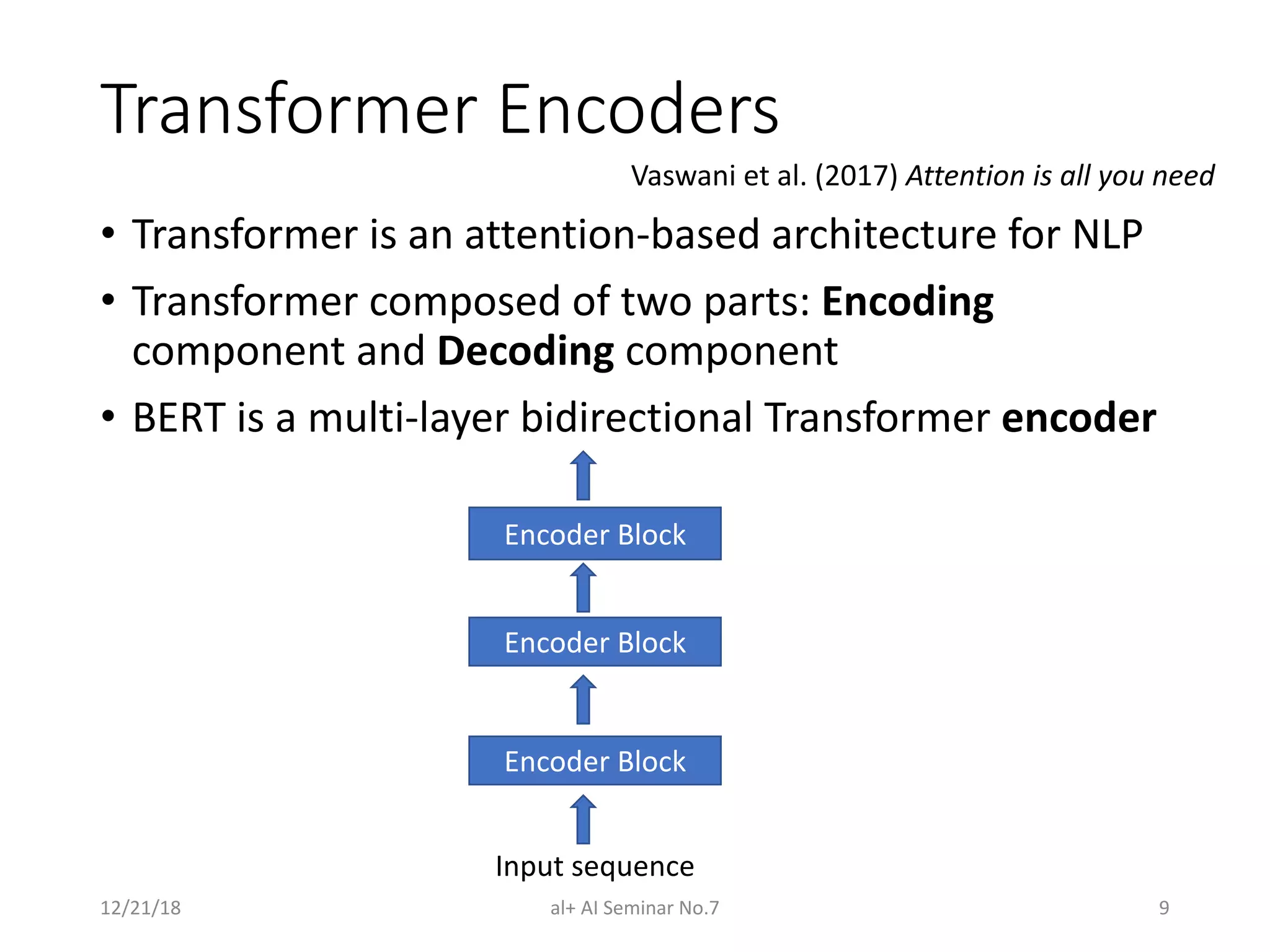
• Transformer is an attention-based architecture for NLP
• Transformer composed of two parts: Encoding
component and Decoding component
• BERT is a multi-layer bidirectional Transformer encoder
12/21/18 al+ AI Seminar No.7 9
Vaswani et al. (2017) Attention is all you need
Encoder Block
Encoder Block
Encoder Block
Input sequence
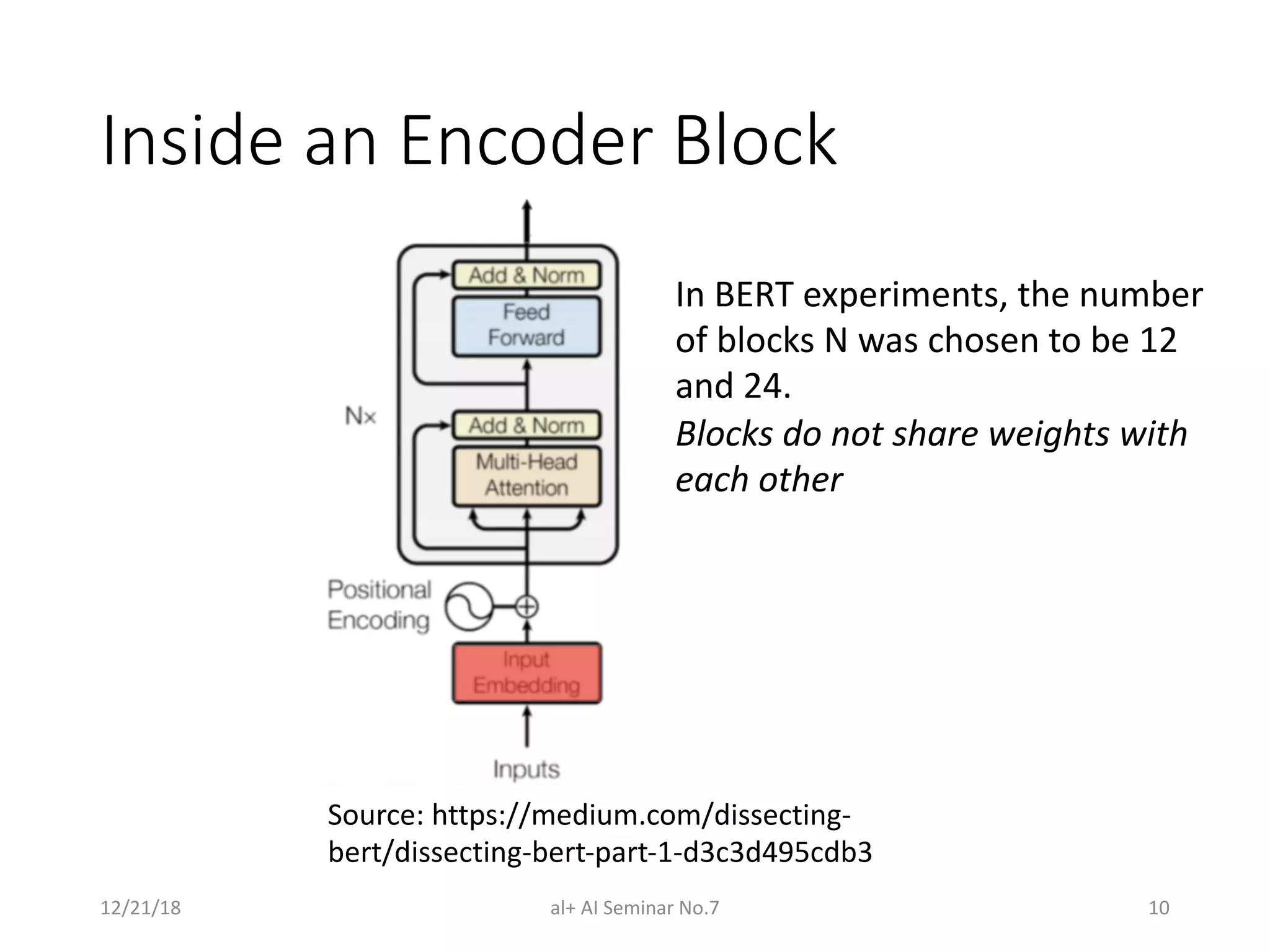
Inside an Encoder Block
12/21/18 al+ AI Seminar No.7 10
Source: https://medium.com/dissecting-
bert/dissecting-bert-part-1-d3c3d495cdb3
In BERT experiments, the number
of blocks N was chosen to be 12
and 24.
Blocks do not share weights with
each other
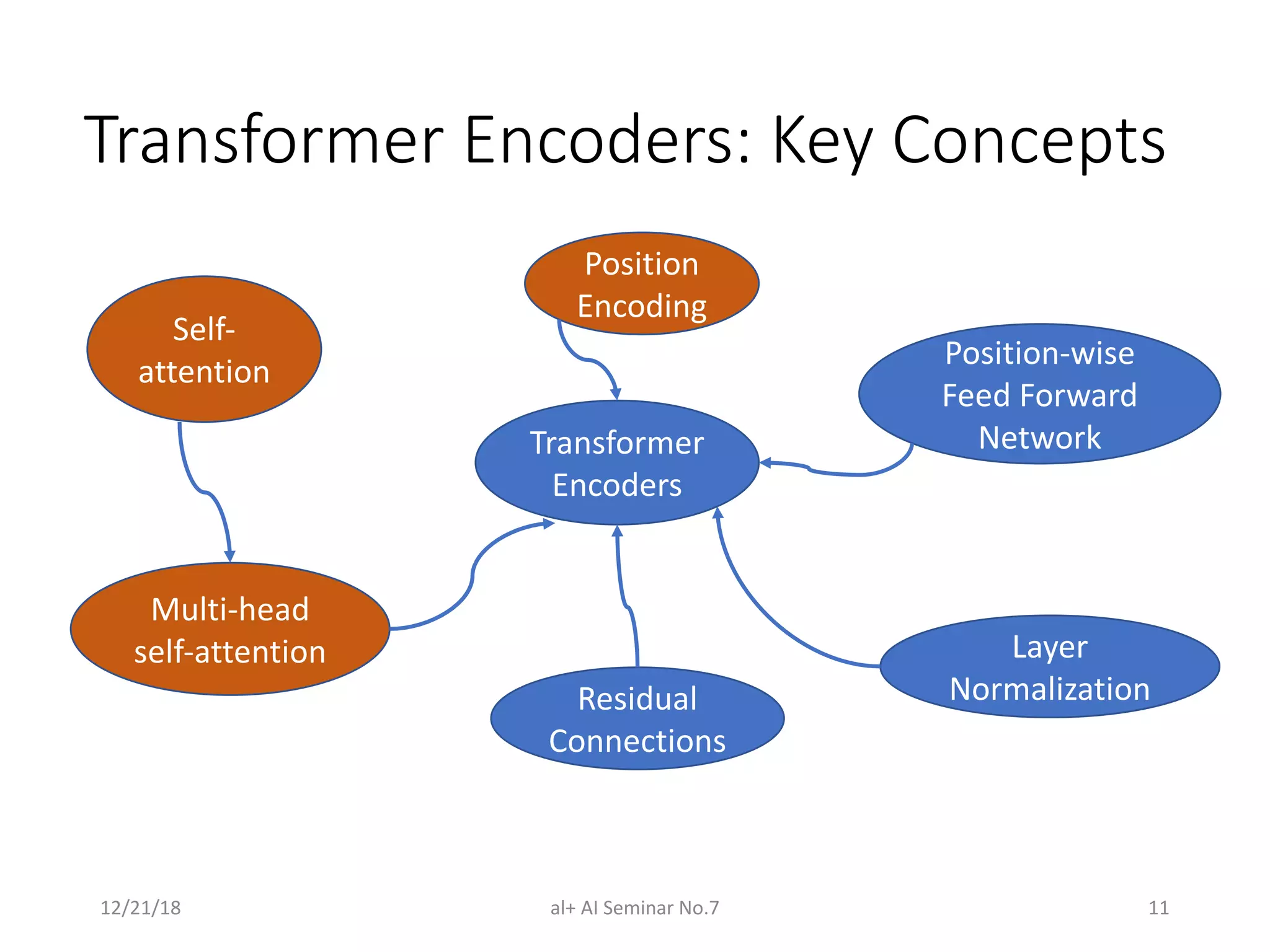
Transformer Encoders: Key Concepts
12/21/18 al+ AI Seminar No.7 11
Multi-head
self-attention
Self-
attention
Transformer
Encoders
Position
Encoding
Layer
NormalizationResidual
Connections
Position-wise
Feed Forward
Network
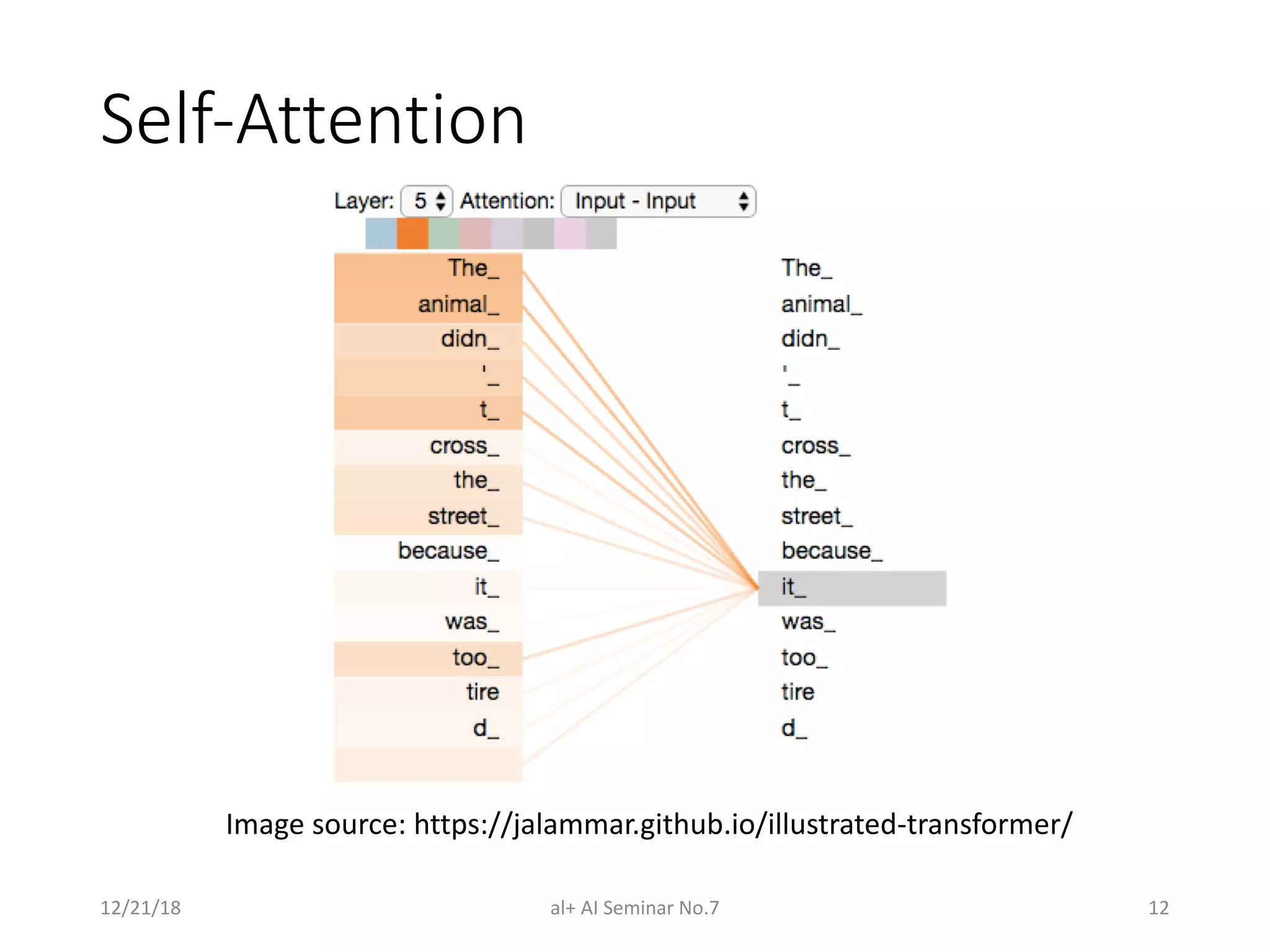
Self-Attention
12/21/18 al+ AI Seminar No.7 12
Image source: https://jalammar.github.io/illustrated-transformer/
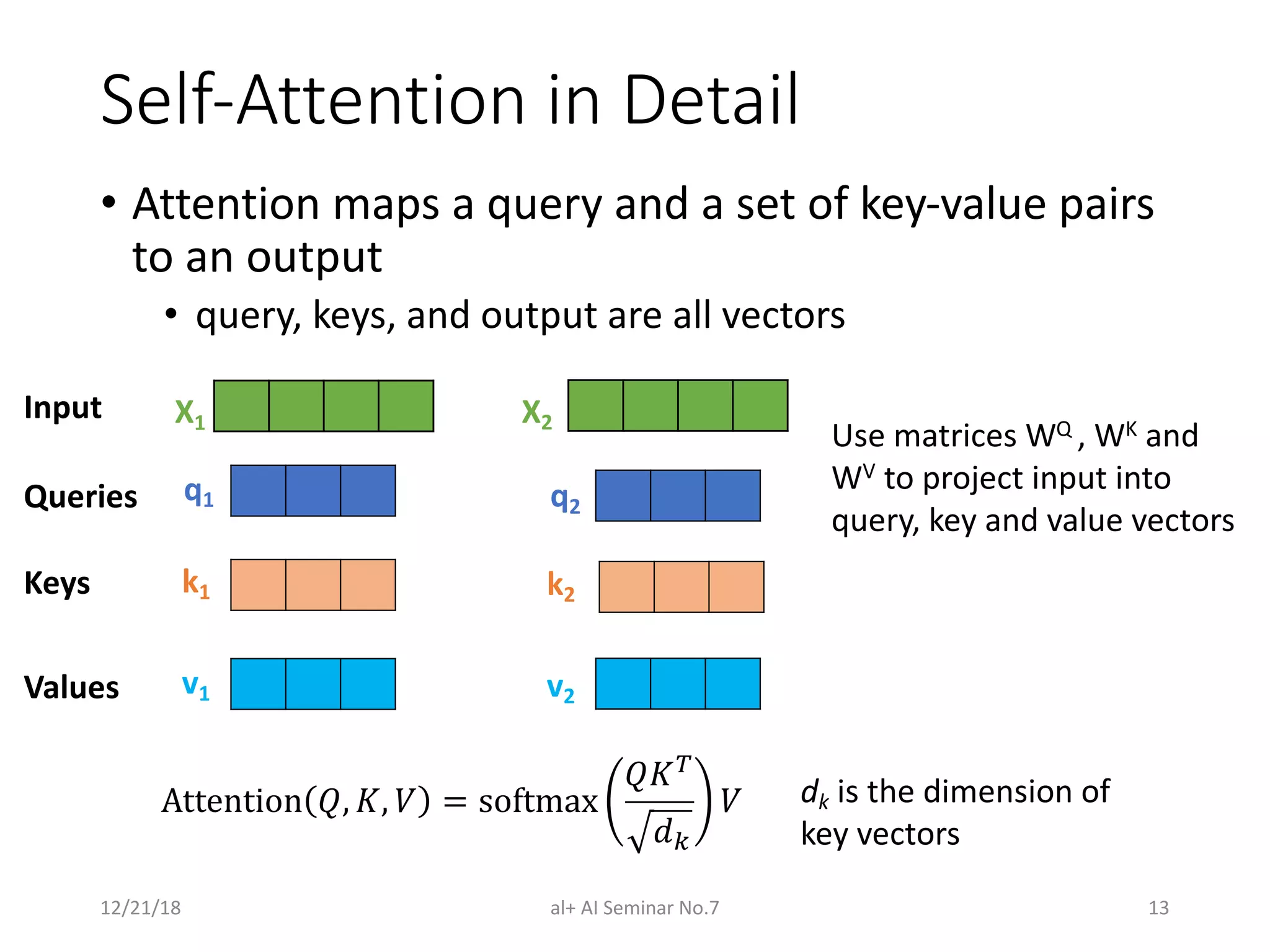
Self-Attention in Detail
• Attention maps a query and a set of key-value pairs
to an output
• query, keys, and output are all vectors
12/21/18 al+ AI Seminar No.7 13
Input
Queries
Keys
Values
X1 X2
q1 q2
k1 k2
v1 v2
Use matrices WQ , WK and
WV to project input into
query, key and value vectors
Attention ', ), * = softmax
')1
23
* dk is the dimension of
key vectors
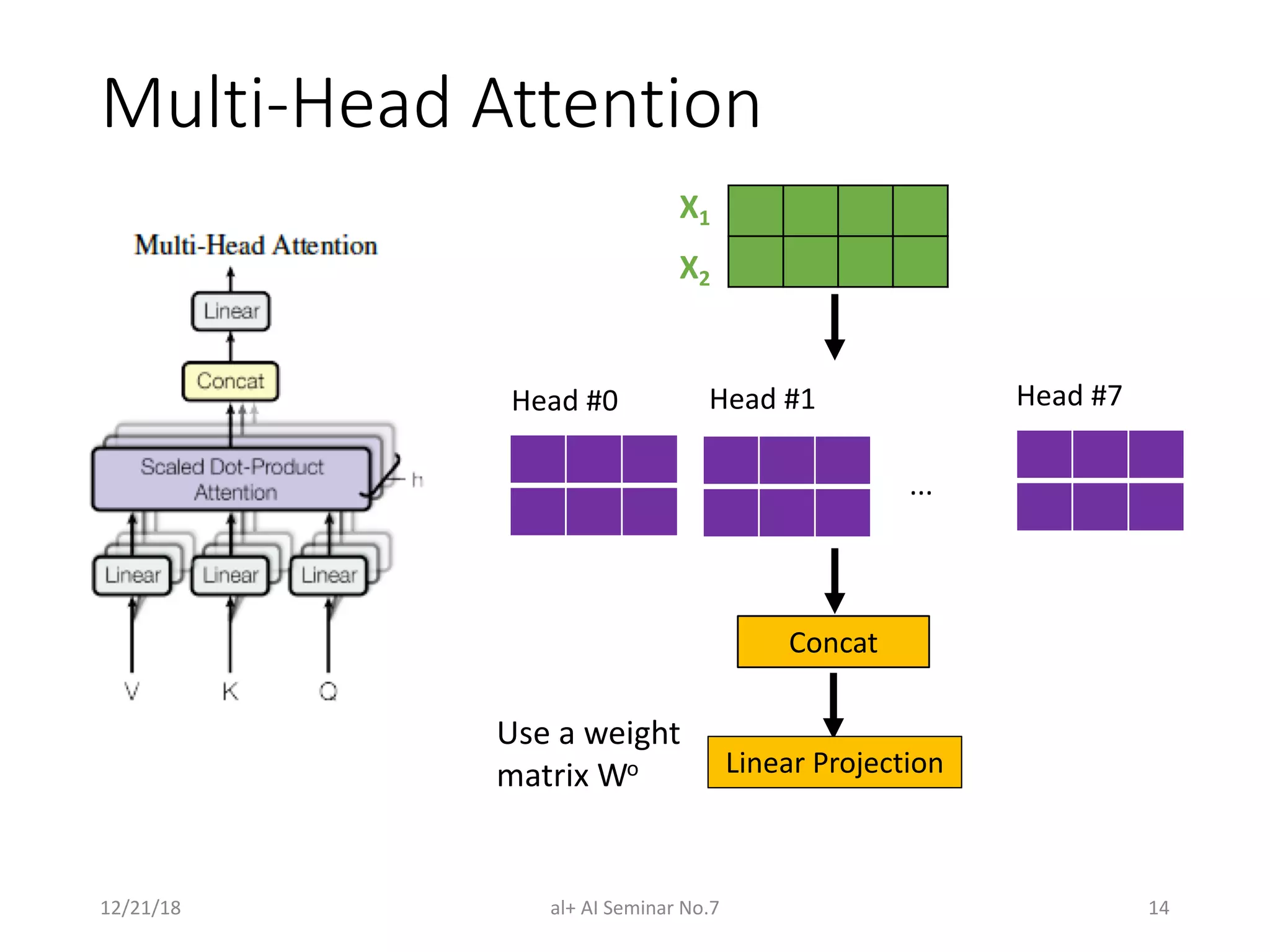
Multi-Head Attention
12/21/18 al+ AI Seminar No.7 14
X1
X2
...
Head #0 Head #1 Head #7
Concat
Linear Projection
Use a weight
matrix Wo
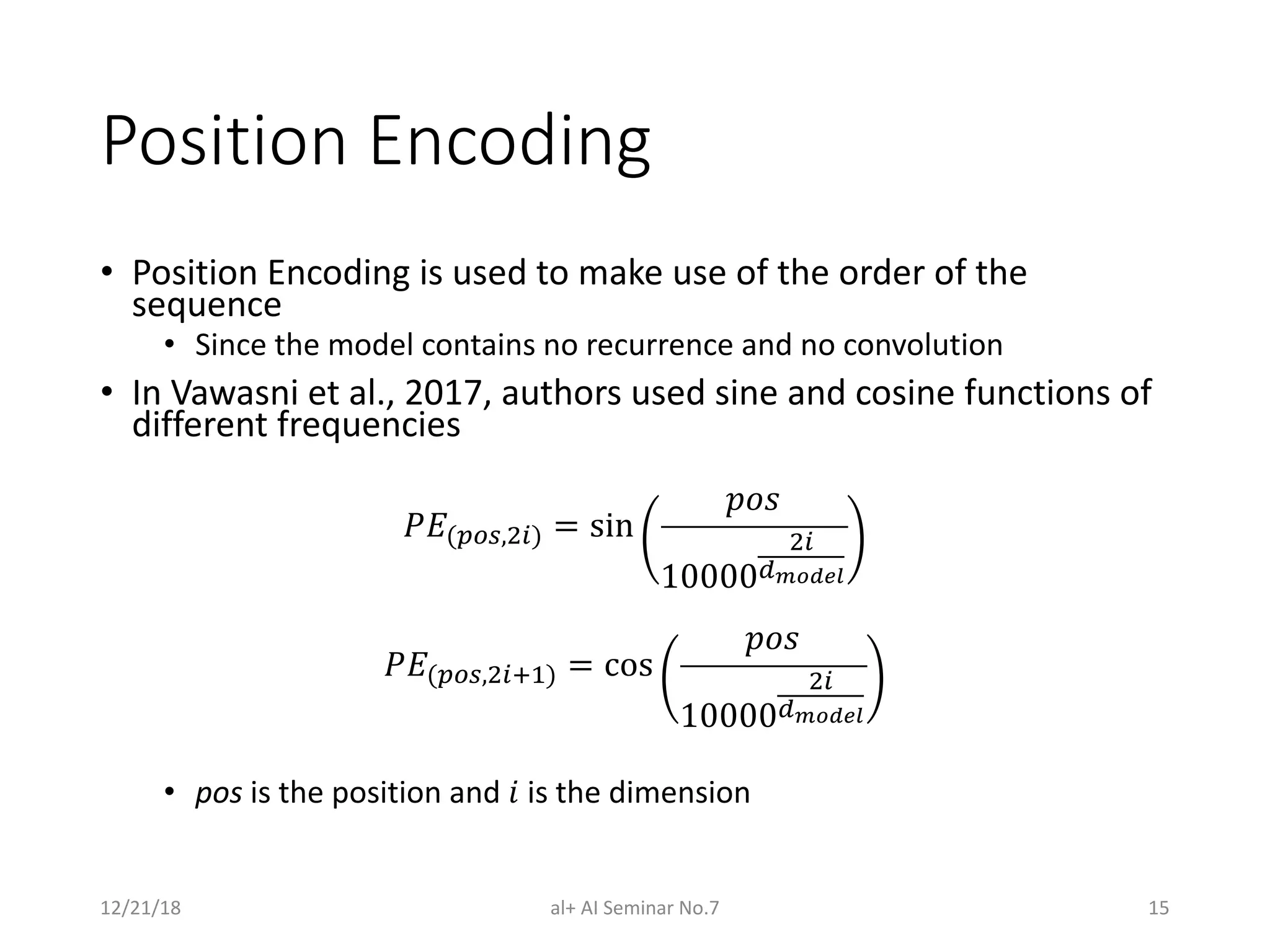
Position Encoding
• Position Encoding is used to make use of the order of the
sequence
• Since the model contains no recurrence and no convolution
• In Vawasni et al., 2017, authors used sine and cosine functions of
different frequencies
!"($%&,()) = sin
/01
10000
()
4!"#$%
!"($%&,()56) = cos
/01
10000
()
4!"#$%
• pos is the position and 9 is the dimension
12/21/18 al+ AI Seminar No.7 15
Input Representation
12/21/18 al+ AI Seminar No.7 16
• Token Embeddings: Use pretrained WordPiece embeddings
• Position Embeddings: Use learned Position Embeddings
• Jonas Gehring, Michael Auli, David Grangier, Denis Yarats, and Yann N.
Dauphin. Convolutionalsequence to sequence learning. arXiv preprint
arXiv:1705.03122v2, 2017.
• Added sentence embedding to every tokens of each sentence
• Use [CLS] for the classification tasks
• Separate sentences by using a special token [SEP]
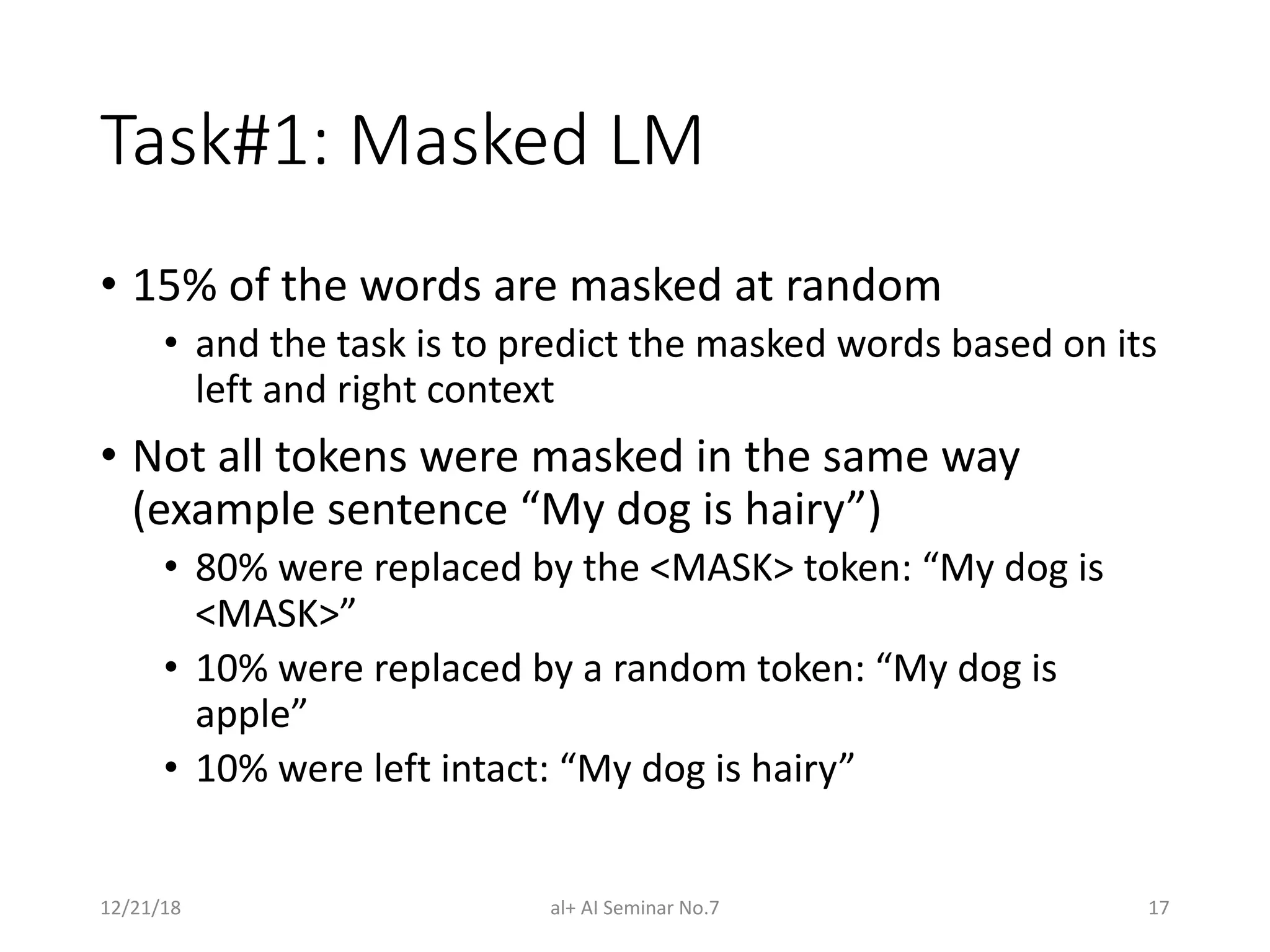
Task#1: Masked LM
• 15% of the words are masked at random
• and the task is to predict the masked words based on its
left and right context
• Not all tokens were masked in the same way
(example sentence “My dog is hairy”)
• 80% were replaced by the <MASK> token: “My dog is
<MASK>”
• 10% were replaced by a random token: “My dog is
apple”
• 10% were left intact: “My dog is hairy”
12/21/18 al+ AI Seminar No.7 17
Task#2: Next Sentence Prediction
• Motivation
• Many downstream tasks are based on understanding the
relationship between two text sentences
• Question Answering (QA) and Natural Language Inference (NLI)
• Language modeling does not directly capture that
relationship
• The task is pre-training binarized next sentence
prediction task
12/21/18 al+ AI Seminar No.7 18
Input = [CLS] the man went to [MASK] store [SEP] he bought a gallon
[MASK] milk [SEP]
Label = isNext
Input = [CLS] the man [MASK] to the store [SEP]penguin [MASK] are
flight ##less birds [SEP]
Label = NotNext
Pre-training procedure
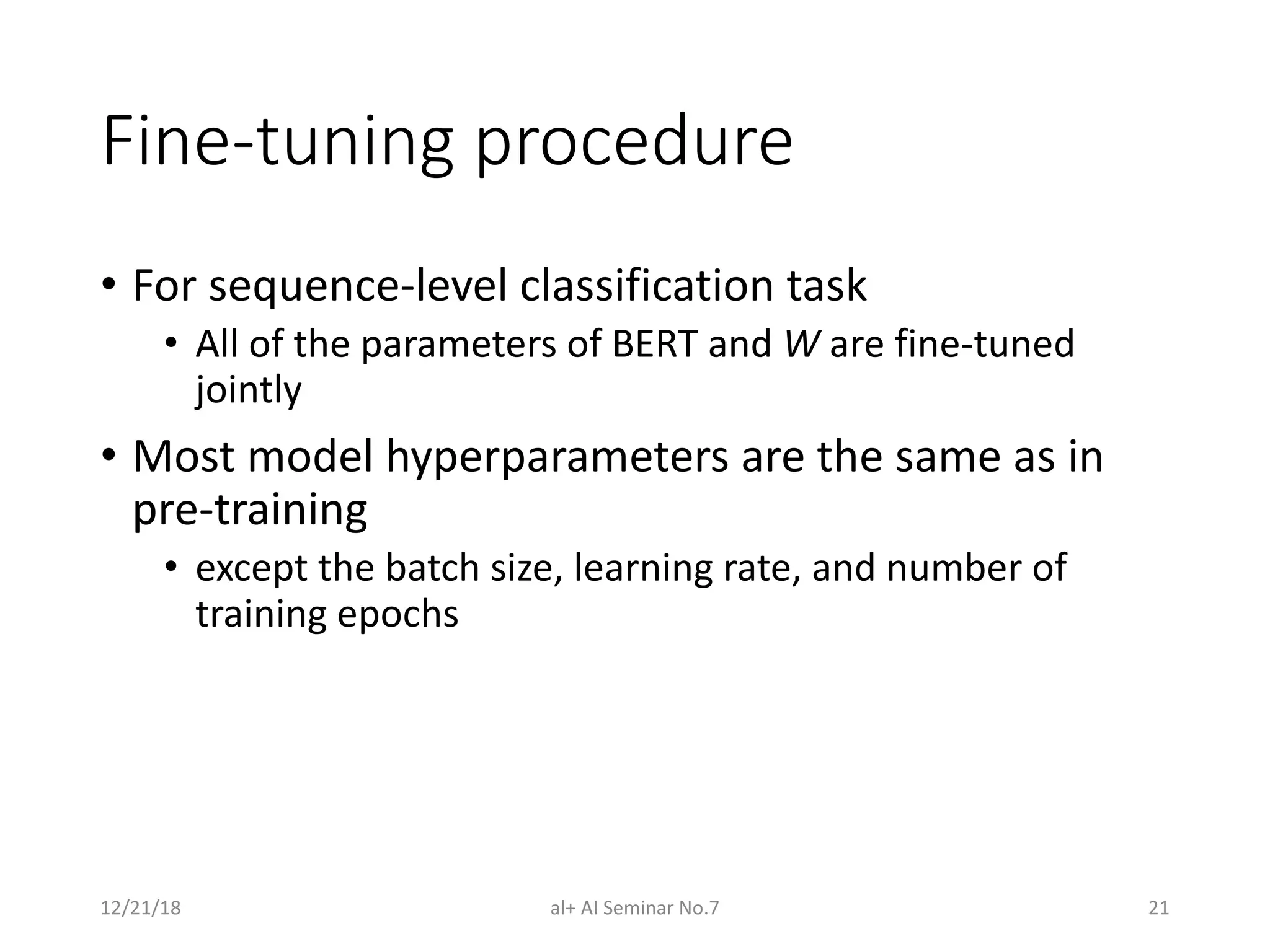
• Training data: BooksCorpus (800M words) + English
Wikipedia (2,500M words)
• To generate each training input sequences: sample
two spans of text (A and B) from the corpus
• The combined length is ≤ 500 tokens
• 50% B is the actual next sentence that follows A and 50%
of the time it is a random sentence from the corpus
• The training loss is the sum of the mean masked
LM likelihood and the mean next sentence
prediction likelihood
12/21/18 al+ AI Seminar No.7 19
Fine-tuning procedure
• For sequence-level classification task
• Obtain the representation of the input sequence by using the
final hidden state (hidden state at the position of the special
token [CLS]) ! ∈ #$
• Just add a classification layer and use softmax to calculate
label probabilities. Parameters W ∈ #&×$
( = softmax(!23
)
12/21/18 al+ AI Seminar No.7 20
Fine-tuning procedure
• For sequence-level classification task
• All of the parameters of BERT and W are fine-tuned
jointly
• Most model hyperparameters are the same as in
pre-training
• except the batch size, learning rate, and number of
training epochs
12/21/18 al+ AI Seminar No.7 21
Fine-tuning procedure
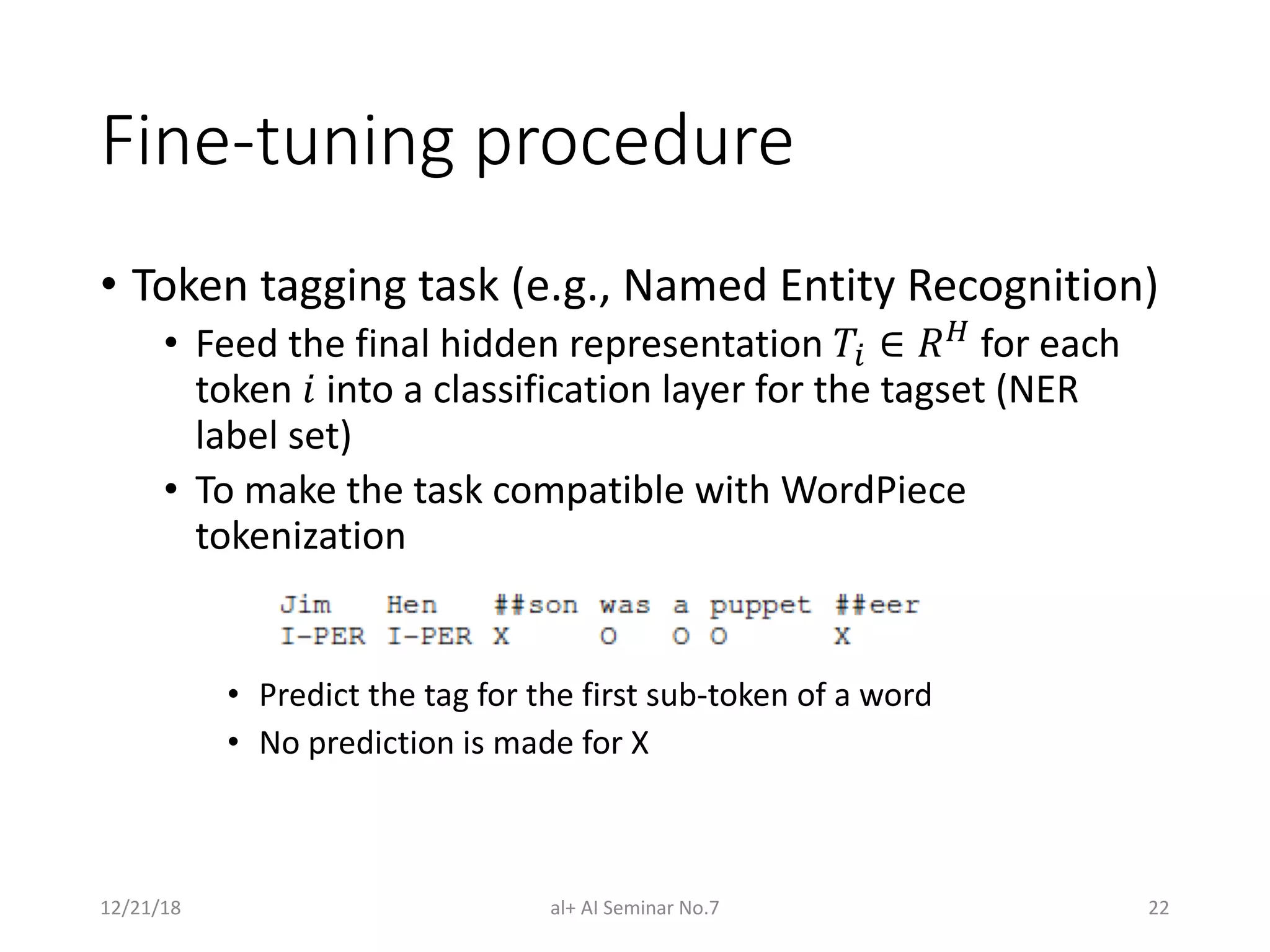
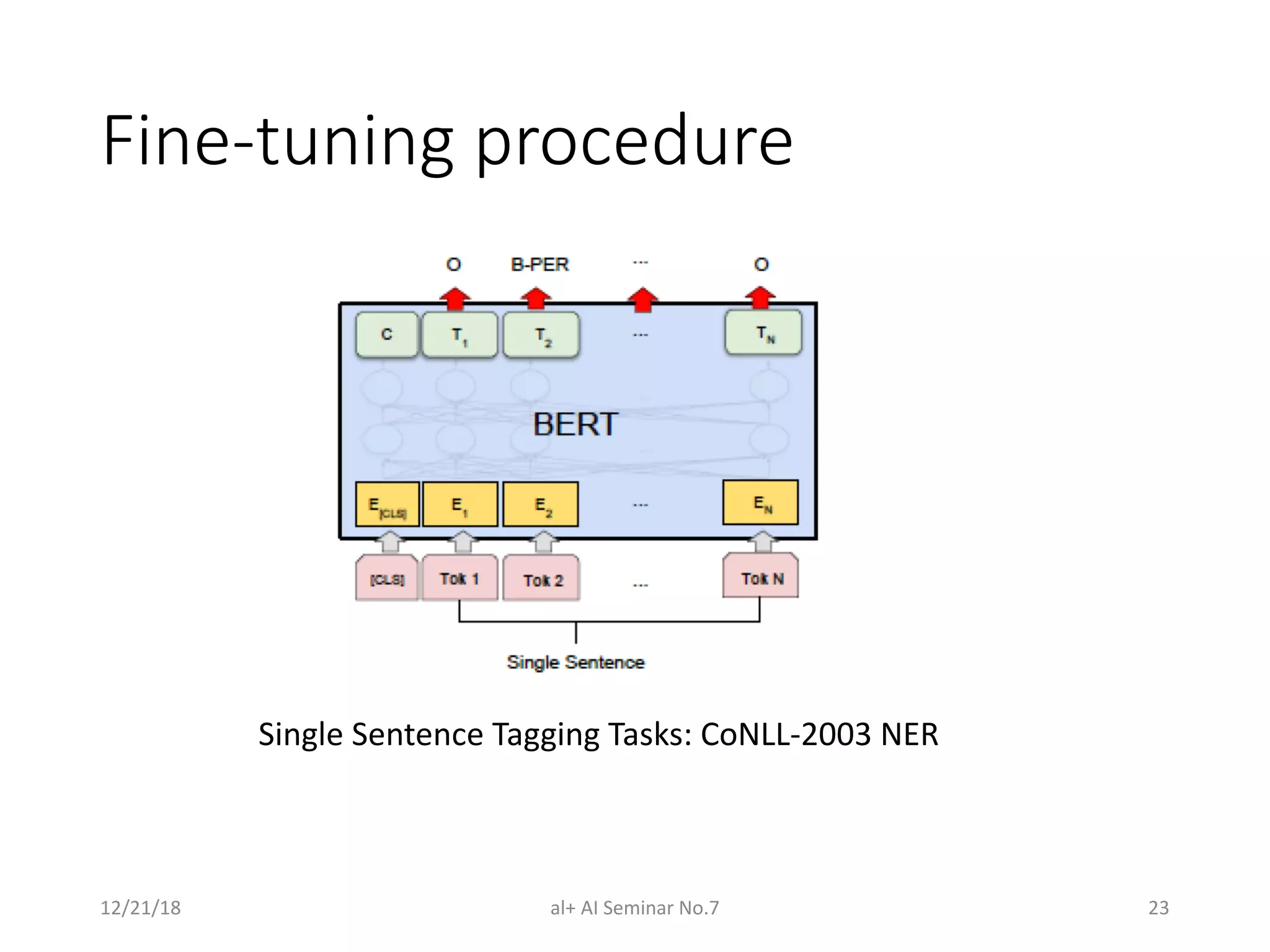
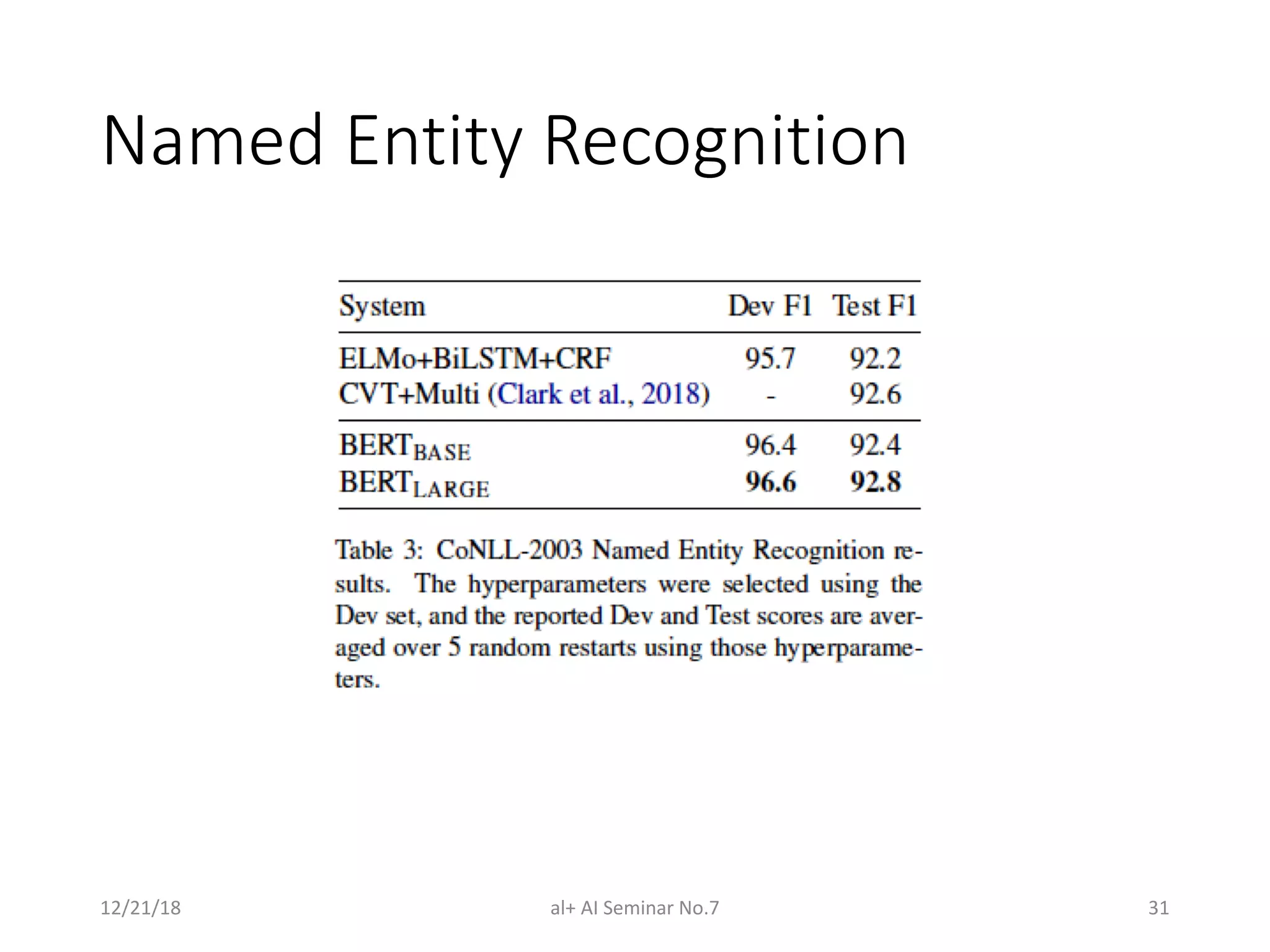
• Token tagging task (e.g., Named Entity Recognition)
• Feed the final hidden representation !" ∈ $% for each
token & into a classification layer for the tagset (NER
label set)
• To make the task compatible with WordPiece
tokenization
• Predict the tag for the first sub-token of a word
• No prediction is made for X
12/21/18 al+ AI Seminar No.7 22
Fine-tuning procedure
12/21/18 al+ AI Seminar No.7 23
Single Sentence Tagging Tasks: CoNLL-2003 NER
Fine-tuning procedure
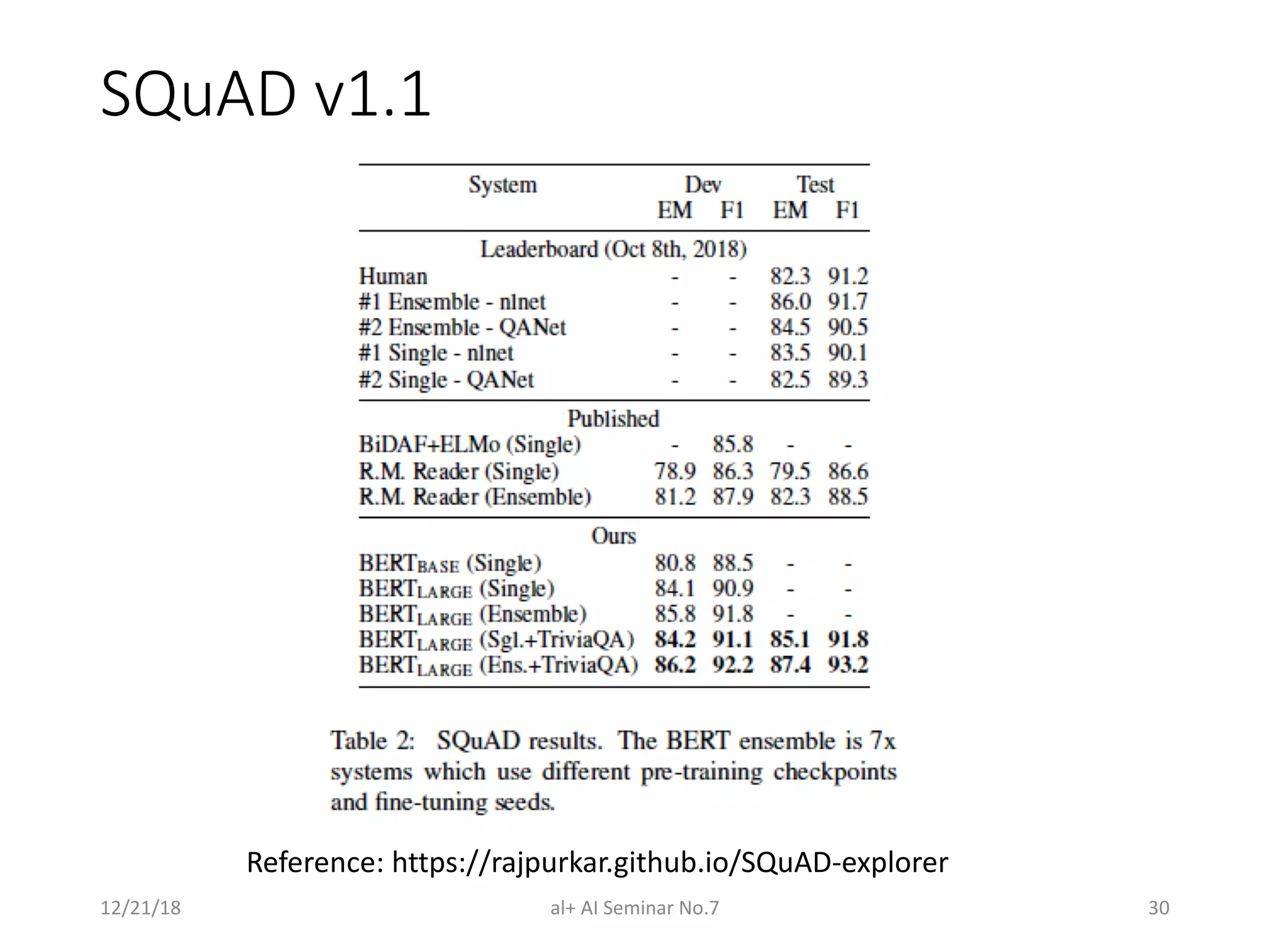
• Span-level task: SQuAD v1.1
• Input Question:
Where do water droplets collide with ice
crystals to form precipitation?
• Input Paragraph:
.... Precipitation forms as smaller
dropletscoalesce via collision with other rain
dropsor ice crystals within a cloud. ...
• Output Answer:
within a cloud
12/21/18 al+ AI Seminar No.7 24
Fine-tuning procedure
• Span-level task: SQuAD v1.1
• Represent the input question and paragraph as a single
packed sequence
• The question uses the A embedding and the paragraph uses
the B embedding
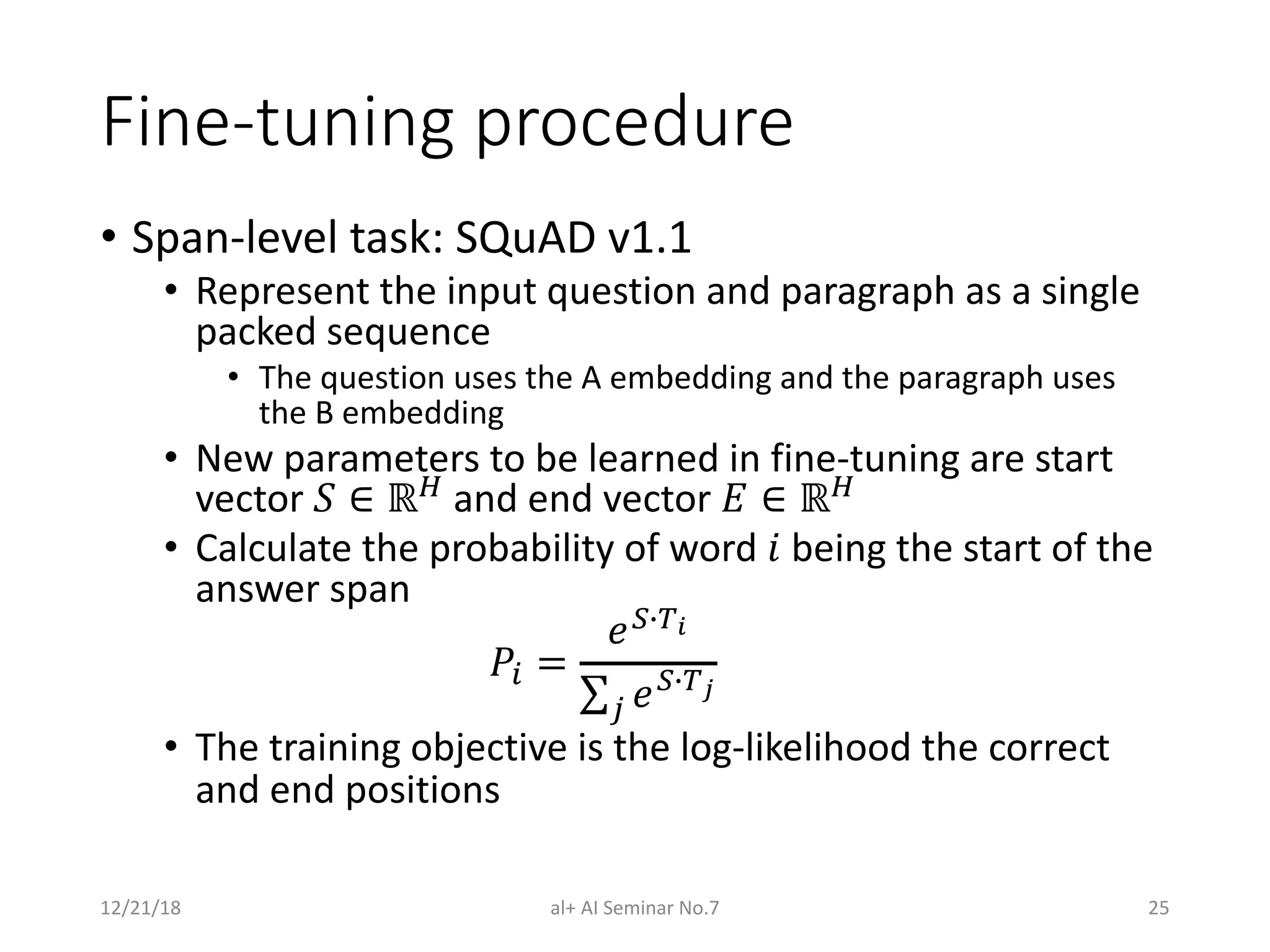
• New parameters to be learned in fine-tuning are start
vector ! ∈ ℝ$ and end vector % ∈ ℝ$
• Calculate the probability of word & being the start of the
answer span
'( =
*+,-!
∑/ *+,-"
• The training objective is the log-likelihood the correct
and end positions
12/21/18 al+ AI Seminar No.7 25
Comparison of BERT and OpenAI GPT
OpenAI GPT BERT
Trained on BooksCorpus (800M) Trained on BooksCorpus (800M) +
Wikipedia (2,500M)
Use sentence separater ([SEP])
and classifier token ([CLS]) only at
fine-tuning time
BERT learns [SEP], [CLS] and
sentence A/B embeddings during
pre-training
Trained for 1M steps with a batch-
size of 32,000 words
Trained for 1M steps with a batch-
size of 128,000 words
Use the same learning rate of 5e-5
for all fine-tuning experiments
BERT choose a task-specific
learning rate which performs the
best on the development set
12/21/18 al+ AI Seminar No.7 26
Outline
• Research context
• Main ideas
• BERT
• Experiments
• Conclusions
12/21/18 al+ AI Seminar No.7 27
Experiments
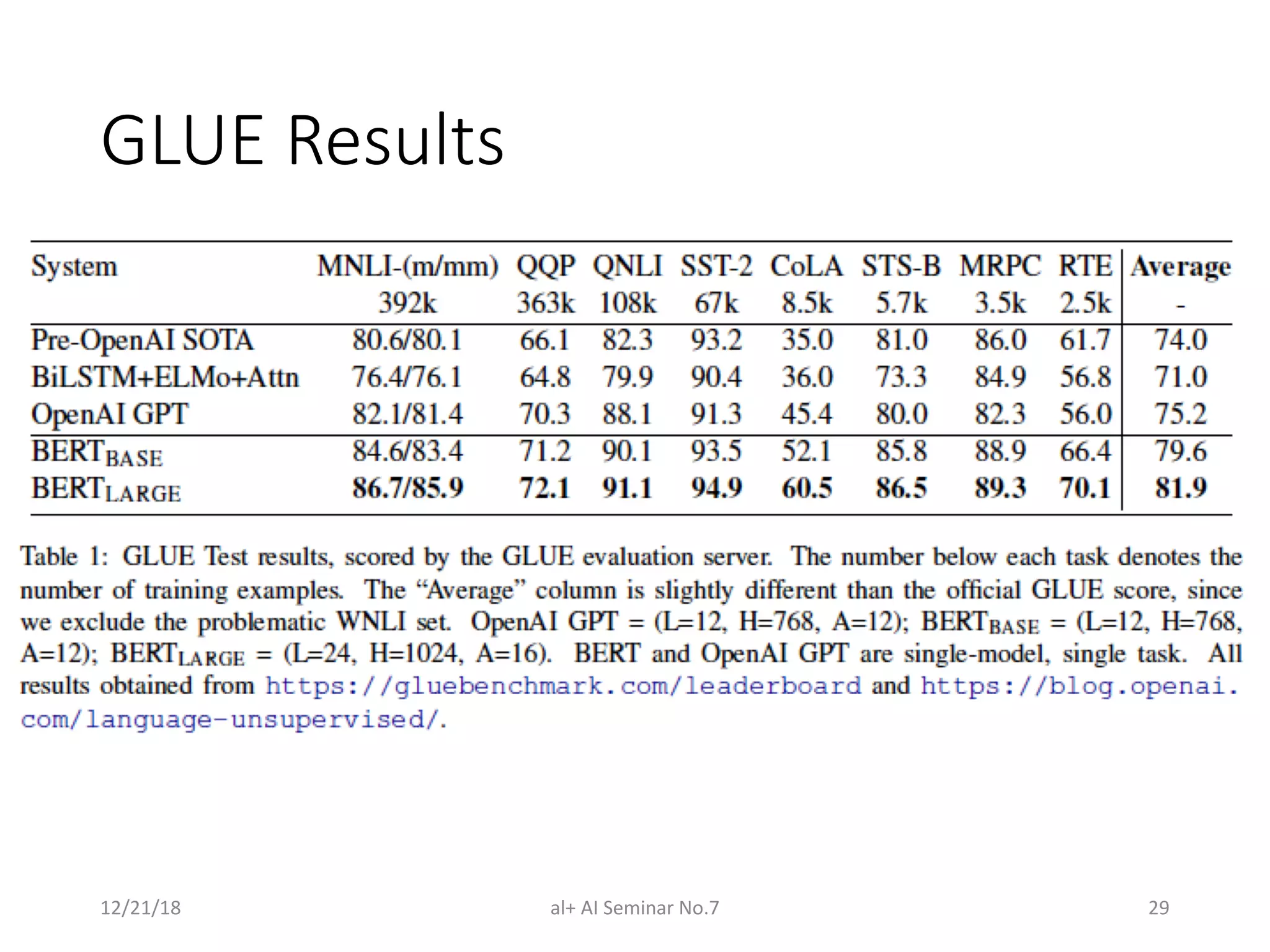
• GLUE (General Language Understanding Evaluation)
benchmark
• Distribute canonical Train, Dev and Test splits
• Labels for Test set are not provided
• Datasets in GLUE:
• MNLI: Multi-Genre Natural Language Inference
• QQP: Quora Question Pairs
• QNLI: Question Natural Language Inference
• SST-2: Stanford Sentiment Treebank
• CoLA: The corpus of Linguistic Acceptability
• STS-B: The Semantic Textual Similarity Benchmark
• MRPC: Microsoft Research Paraphrase Corpus
• RTE: Recognizing Textual Entailment
• WNLI: Winograd NLI
12/21/18 al+ AI Seminar No.7 28
GLUE Results
12/21/18 al+ AI Seminar No.7 29
SQuAD v1.1
12/21/18 al+ AI Seminar No.7 30
Reference: https://rajpurkar.github.io/SQuAD-explorer
Named Entity Recognition
12/21/18 al+ AI Seminar No.7 31
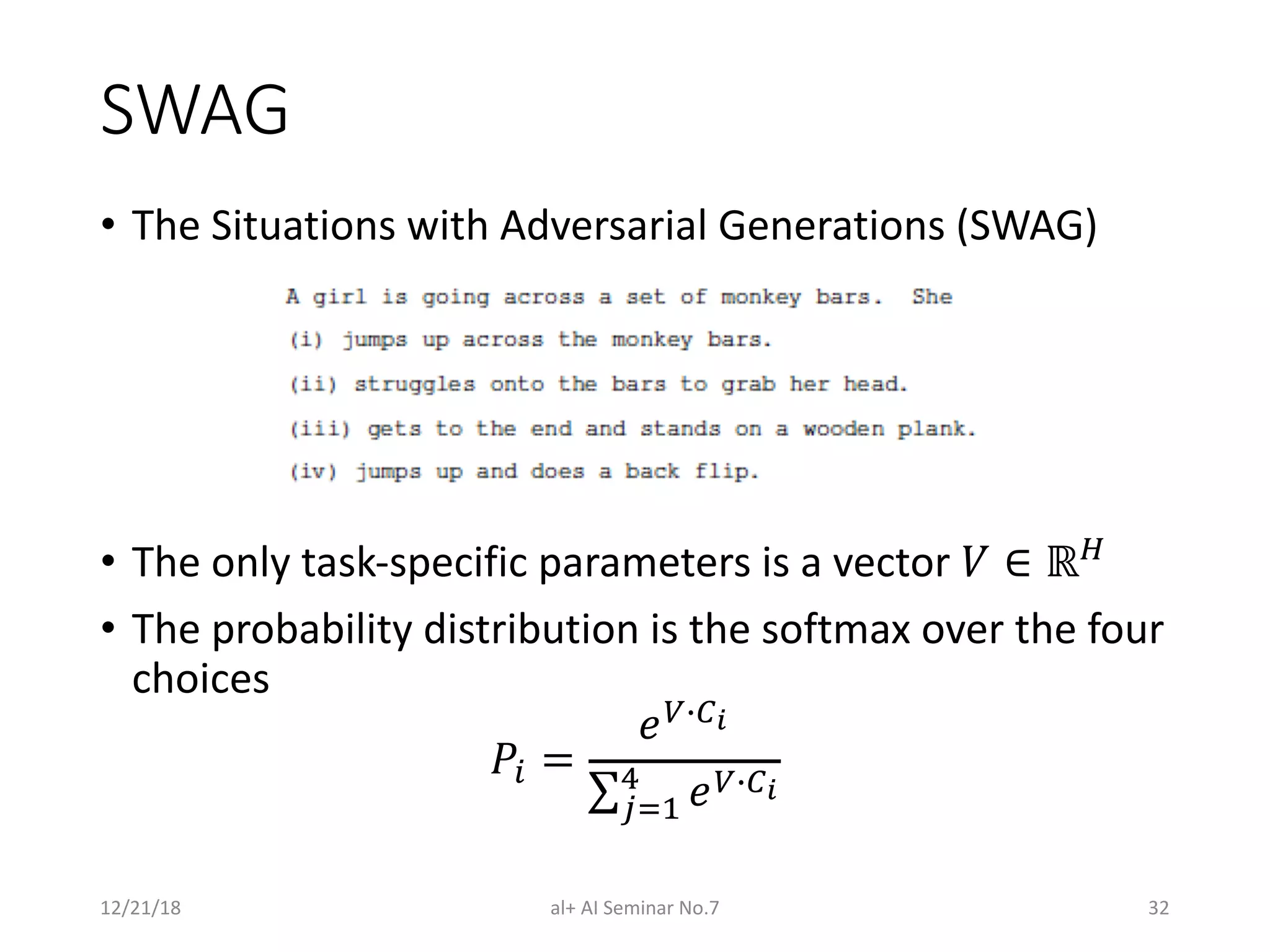
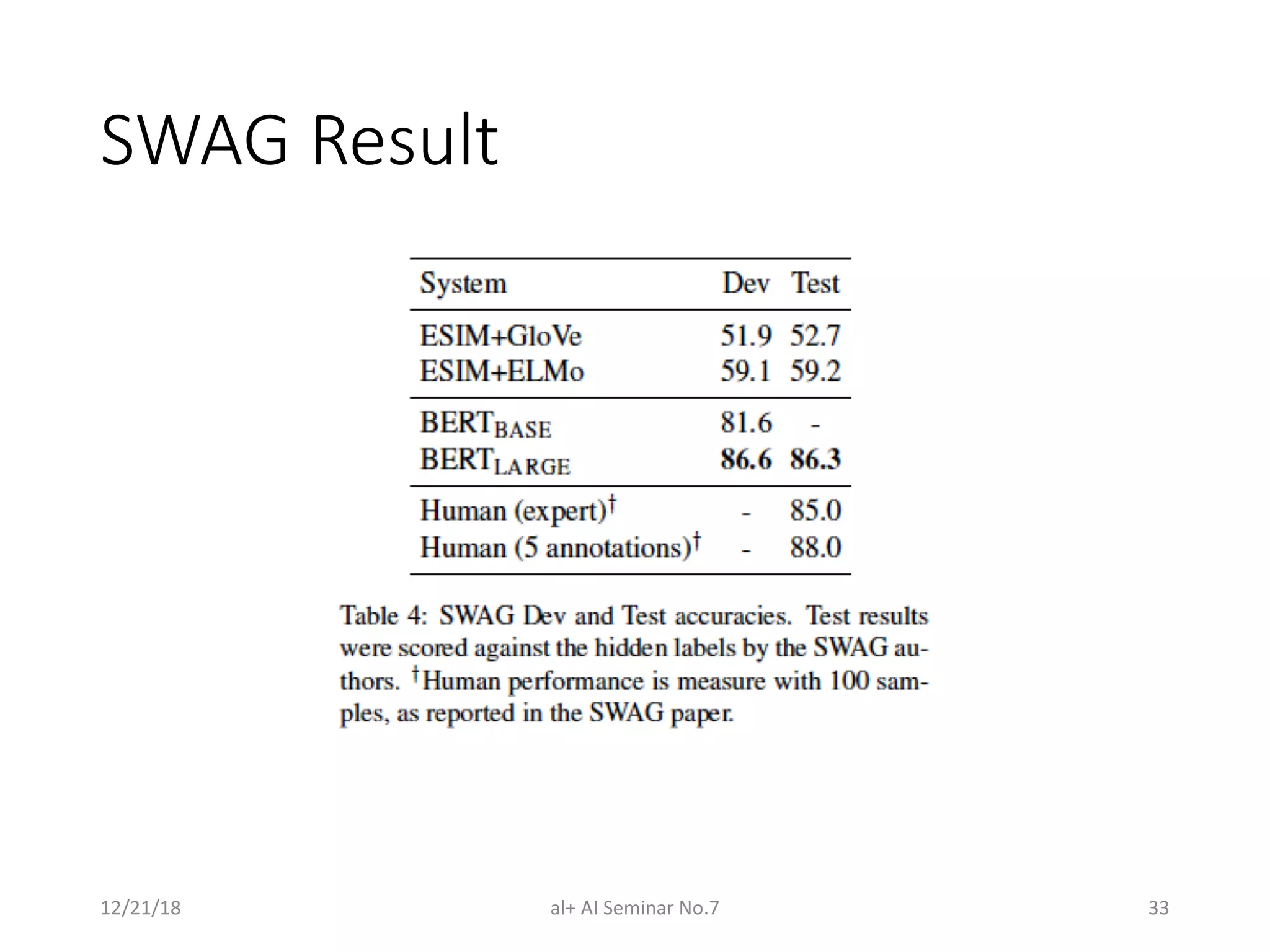
SWAG
• The Situations with Adversarial Generations (SWAG)
• The only task-specific parameters is a vector ! ∈ ℝ$
• The probability distribution is the softmax over the four
choices
%& =
()*+,
∑./0
1
()*+,
12/21/18 al+ AI Seminar No.7 32
SWAG Result
12/21/18 al+ AI Seminar No.7 33
Ablation Studies
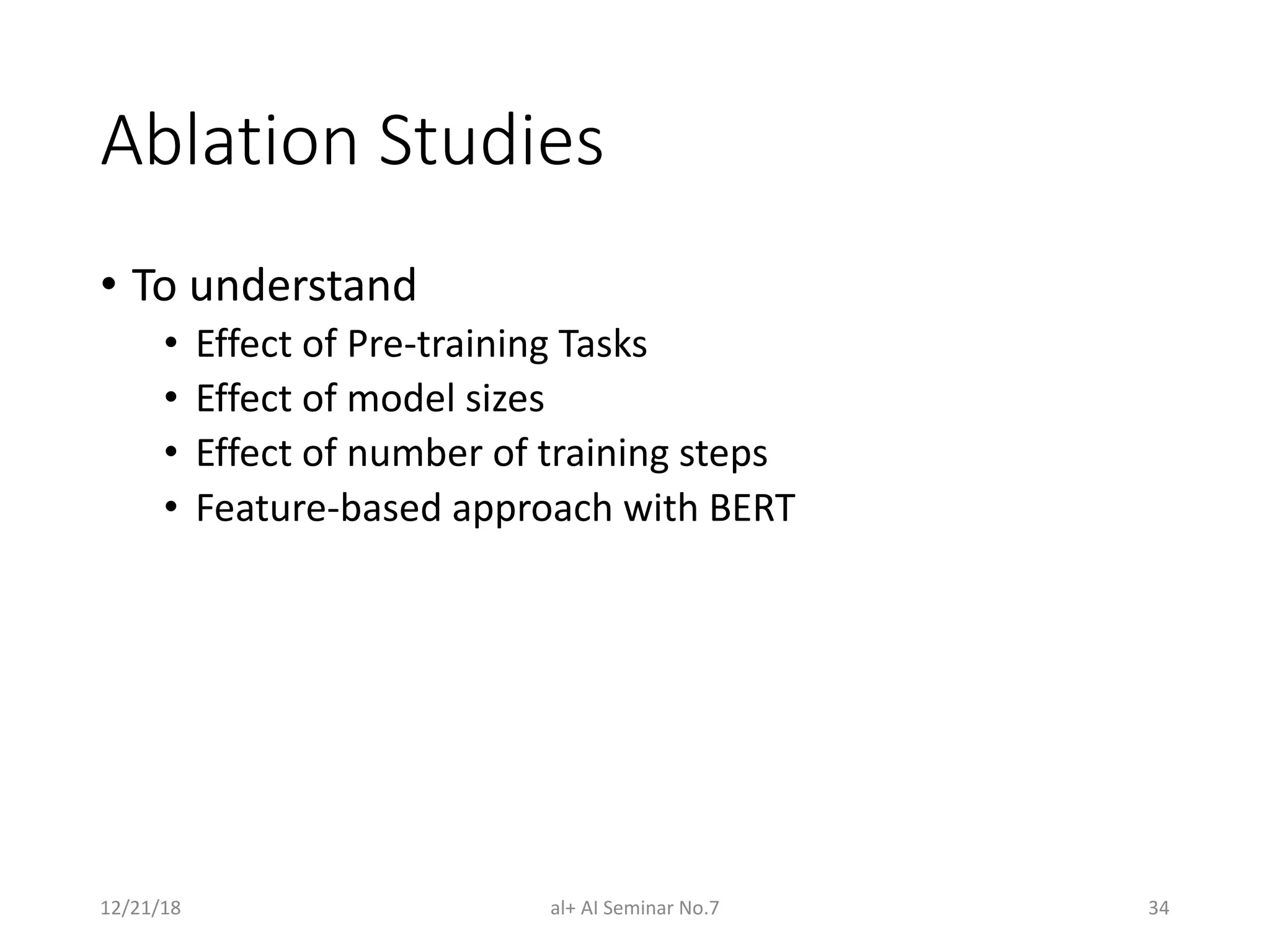
• To understand
• Effect of Pre-training Tasks
• Effect of model sizes
• Effect of number of training steps
• Feature-based approach with BERT
12/21/18 al+ AI Seminar No.7 34
Ablation Studies
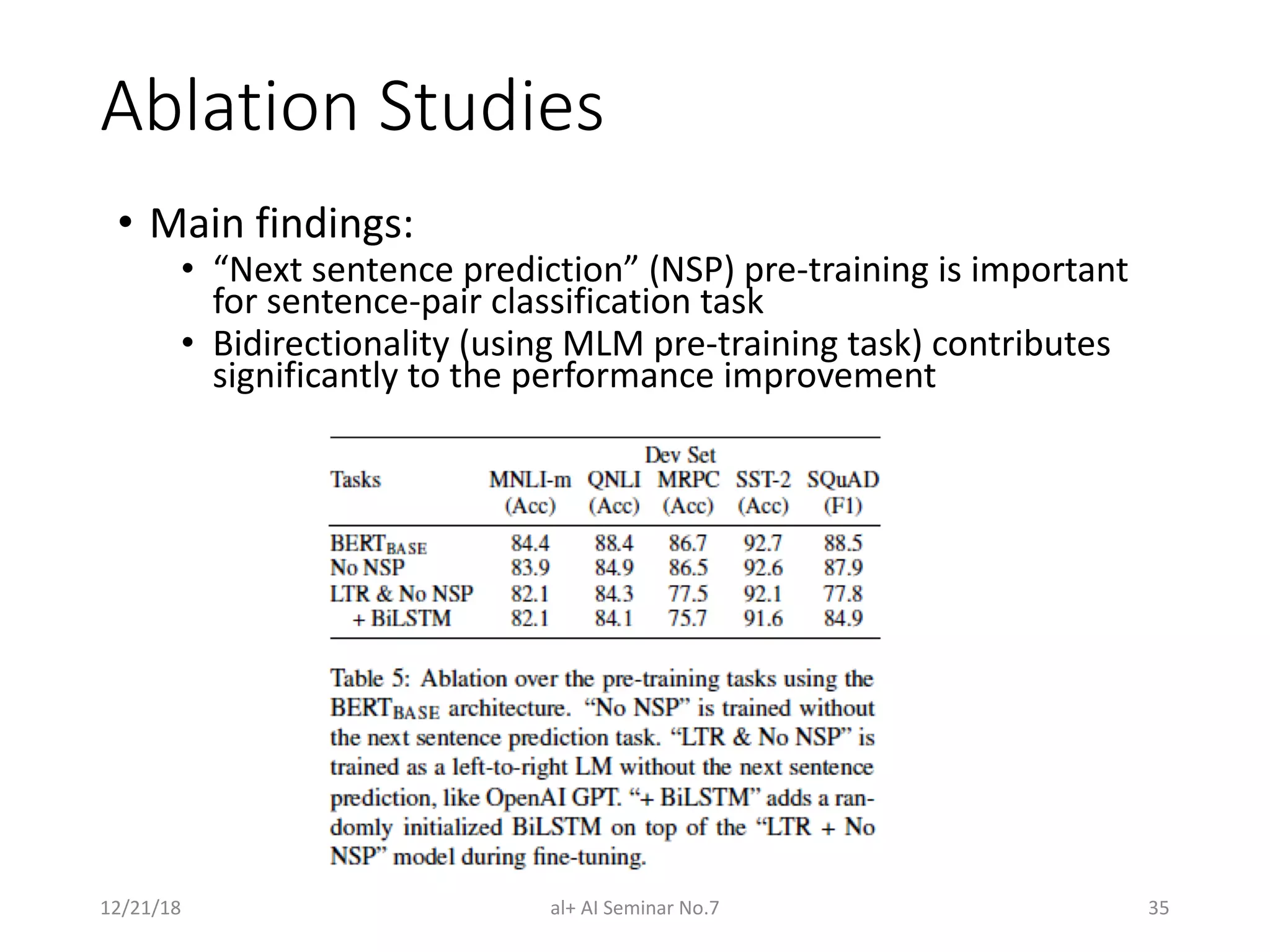
• Main findings:
• “Next sentence prediction” (NSP) pre-training is important
for sentence-pair classification task
• Bidirectionality (using MLM pre-training task) contributes
significantly to the performance improvement
12/21/18 al+ AI Seminar No.7 35
Ablation Studies
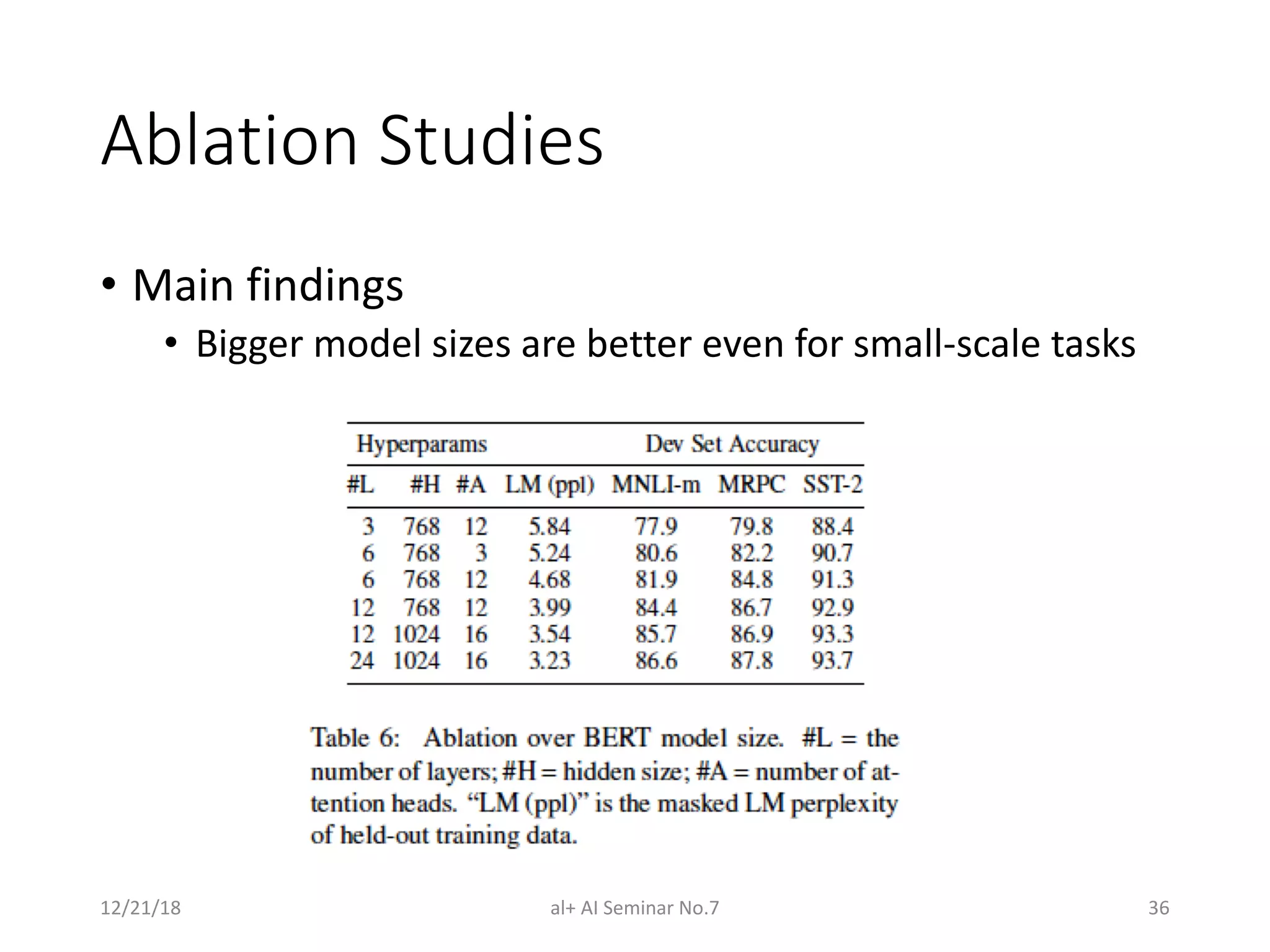
• Main findings
• Bigger model sizes are better even for small-scale tasks
12/21/18 al+ AI Seminar No.7 36
Conclusions
• Unsupervised pre-training (pre-training language
model) is increasingly adopted in many NLP tasks
• Major contribution of the paper is to propose a
deep bidirectional architecture from Transformer
• Advance state-of-the-art for many important NLP tasks
12/21/18 al+ AI Seminar No.7 37
Links
• TensorFlow code and pre-trained models for BERT:
https://github.com/google-research/bert
• PyTorch Pretrained Bert:
https://github.com/huggingface/pytorch-
pretrained-BERT
• BERT-pytorch: https://github.com/codertimo/BERT-
pytorch
• BERT-keras: https://github.com/Separius/BERT-
keras
12/21/18 al+ AI Seminar No.7 38
Remark: Applying BERT for non-
English languages
• Pre-trained BERT models are provided for more than
100 languages (including Vietnamese)
• https://github.com/google-
research/bert/blob/master/multilingual.md
• Be careful with tokenization!!
• For Japanese (and Chinese): “spaces were added
around every character in the CJI Unicode rage before
applying WordPiece” => Not a good way to do
• Use SentencePiece:
https://github.com/google/sentencepiece
• We may need to pre-train BERT model
12/21/18 al+ AI Seminar No.7 39
References
1. Devlin, J., Chang, M. W., Lee, K., & Toutanova, K.
(2018). BERT: Pre-training of Deep Bidirectional
Transformers for Language Understanding. arXiv
preprint arXiv:1810.04805.
2. Vaswani et al. (2017). Attention Is All You Need. arXiv
preprint arXiv:1706.03762.
https://arxiv.org/abs/1706.03762
3. The Annotated Transformer:
http://nlp.seas.harvard.edu/2018/04/03/attention.ht
ml, by harvardnlp.
4. Dissecting BERT: https://medium.com/dissecting-bert
12/21/18 al+ AI Seminar No.7 40

BERT: Pre-training of Deep Bidirectional Transformers for Language Understanding

  • 1.
    BERT: Pre-training ofDeep Bidirectional Transformers for Language Understanding Devlin et al., 2018 (Google AI Language) Presenter Phạm Quang Nhật Minh NLP Researcher Alt Vietnam al+ AI Seminar No. 7 2018/12/21
  • 2.
    Outline • Research context •Main ideas • BERT • Experiments • Conclusions 12/21/18 al+ AI Seminar No.7 2
  • 3.
    Research context • Languagemodel pre-training has been used to improve many NLP tasks • ELMo (Peters et al., 2018) • OpenAI GPT (Radford et al., 2018) • ULMFit (Howard and Rudder, 2018) • Two existing strategies for applying pre-trained language representations to downstream tasks • Feature-based: include pre-trained representations as additional features (e.g., ELMo) • Fine-tunning: introduce task-specific parameters and fine-tune the pre-trained parameters (e.g., OpenAI GPT, ULMFit) 12/21/18 al+ AI Seminar No.7 3
  • 4.
    Limitations of currenttechniques • Language models in pre-training are unidirectional, they restrict the power of the pre-trained representations • OpenAI GPT used left-to-right architecture • ELMo concatenates forward and backward language models • Solution BERT: Bidirectional Encoder Representations from Transformers 12/21/18 al+ AI Seminar No.7 4
  • 5.
    BERT: Bidirectional Encoder Representationsfrom Transformers • Main ideas • Propose a new pre-training objective so that a deep bidirectional Transformer can be trained • The “masked language model” (MLM): the objective is to predict the original word of a masked word based only on its context • ”Next sentence prediction” • Merits of BERT • Just fine-tune BERT model for specific tasks to achieve state-of-the-art performance • BERT advances the state-of-the-art for eleven NLP tasks 12/21/18 al+ AI Seminar No.7 5
  • 6.
    12/21/18 al+ AISeminar No.7 6 BERT: Bidirectional Encoder Representations from Transformers
  • 7.
    Model architecture • BERT’smodel architecture is a multi-layer bidirectional Transformer encoder • (Vaswani et al., 2017) “Attention is all you need” • Two models with different sizes were investigated • BERTBASE: L=12, H=768, A=12, Total Parameters=110M • (L: number of layers (Transformer blocks), H is the hidden size, A: the number of self-attention heads) • BERTLARGE: L=24, H=1024, A=16, Total Parameters=340M 12/21/18 al+ AI Seminar No.7 7
  • 8.
    12/21/18 al+ AISeminar No.7 8 Differences in pre-training model architectures: BERT, OpenAI GPT, and ELMo
  • 9.
    Transformer Encoders • Transformeris an attention-based architecture for NLP • Transformer composed of two parts: Encoding component and Decoding component • BERT is a multi-layer bidirectional Transformer encoder 12/21/18 al+ AI Seminar No.7 9 Vaswani et al. (2017) Attention is all you need Encoder Block Encoder Block Encoder Block Input sequence
  • 10.
    Inside an EncoderBlock 12/21/18 al+ AI Seminar No.7 10 Source: https://medium.com/dissecting- bert/dissecting-bert-part-1-d3c3d495cdb3 In BERT experiments, the number of blocks N was chosen to be 12 and 24. Blocks do not share weights with each other
  • 11.
    Transformer Encoders: KeyConcepts 12/21/18 al+ AI Seminar No.7 11 Multi-head self-attention Self- attention Transformer Encoders Position Encoding Layer NormalizationResidual Connections Position-wise Feed Forward Network
  • 12.
    Self-Attention 12/21/18 al+ AISeminar No.7 12 Image source: https://jalammar.github.io/illustrated-transformer/
  • 13.
    Self-Attention in Detail •Attention maps a query and a set of key-value pairs to an output • query, keys, and output are all vectors 12/21/18 al+ AI Seminar No.7 13 Input Queries Keys Values X1 X2 q1 q2 k1 k2 v1 v2 Use matrices WQ , WK and WV to project input into query, key and value vectors Attention ', ), * = softmax ')1 23 * dk is the dimension of key vectors
  • 14.
    Multi-Head Attention 12/21/18 al+AI Seminar No.7 14 X1 X2 ... Head #0 Head #1 Head #7 Concat Linear Projection Use a weight matrix Wo
  • 15.
    Position Encoding • PositionEncoding is used to make use of the order of the sequence • Since the model contains no recurrence and no convolution • In Vawasni et al., 2017, authors used sine and cosine functions of different frequencies !"($%&,()) = sin /01 10000 () 4!"#$% !"($%&,()56) = cos /01 10000 () 4!"#$% • pos is the position and 9 is the dimension 12/21/18 al+ AI Seminar No.7 15
  • 16.
    Input Representation 12/21/18 al+AI Seminar No.7 16 • Token Embeddings: Use pretrained WordPiece embeddings • Position Embeddings: Use learned Position Embeddings • Jonas Gehring, Michael Auli, David Grangier, Denis Yarats, and Yann N. Dauphin. Convolutionalsequence to sequence learning. arXiv preprint arXiv:1705.03122v2, 2017. • Added sentence embedding to every tokens of each sentence • Use [CLS] for the classification tasks • Separate sentences by using a special token [SEP]
  • 17.
    Task#1: Masked LM •15% of the words are masked at random • and the task is to predict the masked words based on its left and right context • Not all tokens were masked in the same way (example sentence “My dog is hairy”) • 80% were replaced by the <MASK> token: “My dog is <MASK>” • 10% were replaced by a random token: “My dog is apple” • 10% were left intact: “My dog is hairy” 12/21/18 al+ AI Seminar No.7 17
  • 18.
    Task#2: Next SentencePrediction • Motivation • Many downstream tasks are based on understanding the relationship between two text sentences • Question Answering (QA) and Natural Language Inference (NLI) • Language modeling does not directly capture that relationship • The task is pre-training binarized next sentence prediction task 12/21/18 al+ AI Seminar No.7 18 Input = [CLS] the man went to [MASK] store [SEP] he bought a gallon [MASK] milk [SEP] Label = isNext Input = [CLS] the man [MASK] to the store [SEP]penguin [MASK] are flight ##less birds [SEP] Label = NotNext
  • 19.
    Pre-training procedure • Trainingdata: BooksCorpus (800M words) + English Wikipedia (2,500M words) • To generate each training input sequences: sample two spans of text (A and B) from the corpus • The combined length is ≤ 500 tokens • 50% B is the actual next sentence that follows A and 50% of the time it is a random sentence from the corpus • The training loss is the sum of the mean masked LM likelihood and the mean next sentence prediction likelihood 12/21/18 al+ AI Seminar No.7 19
  • 20.
    Fine-tuning procedure • Forsequence-level classification task • Obtain the representation of the input sequence by using the final hidden state (hidden state at the position of the special token [CLS]) ! ∈ #$ • Just add a classification layer and use softmax to calculate label probabilities. Parameters W ∈ #&×$ ( = softmax(!23 ) 12/21/18 al+ AI Seminar No.7 20
  • 21.
    Fine-tuning procedure • Forsequence-level classification task • All of the parameters of BERT and W are fine-tuned jointly • Most model hyperparameters are the same as in pre-training • except the batch size, learning rate, and number of training epochs 12/21/18 al+ AI Seminar No.7 21
  • 22.
    Fine-tuning procedure • Tokentagging task (e.g., Named Entity Recognition) • Feed the final hidden representation !" ∈ $% for each token & into a classification layer for the tagset (NER label set) • To make the task compatible with WordPiece tokenization • Predict the tag for the first sub-token of a word • No prediction is made for X 12/21/18 al+ AI Seminar No.7 22
  • 23.
    Fine-tuning procedure 12/21/18 al+AI Seminar No.7 23 Single Sentence Tagging Tasks: CoNLL-2003 NER
  • 24.
    Fine-tuning procedure • Span-leveltask: SQuAD v1.1 • Input Question: Where do water droplets collide with ice crystals to form precipitation? • Input Paragraph: .... Precipitation forms as smaller dropletscoalesce via collision with other rain dropsor ice crystals within a cloud. ... • Output Answer: within a cloud 12/21/18 al+ AI Seminar No.7 24
  • 25.
    Fine-tuning procedure • Span-leveltask: SQuAD v1.1 • Represent the input question and paragraph as a single packed sequence • The question uses the A embedding and the paragraph uses the B embedding • New parameters to be learned in fine-tuning are start vector ! ∈ ℝ$ and end vector % ∈ ℝ$ • Calculate the probability of word & being the start of the answer span '( = *+,-! ∑/ *+,-" • The training objective is the log-likelihood the correct and end positions 12/21/18 al+ AI Seminar No.7 25
  • 26.
    Comparison of BERTand OpenAI GPT OpenAI GPT BERT Trained on BooksCorpus (800M) Trained on BooksCorpus (800M) + Wikipedia (2,500M) Use sentence separater ([SEP]) and classifier token ([CLS]) only at fine-tuning time BERT learns [SEP], [CLS] and sentence A/B embeddings during pre-training Trained for 1M steps with a batch- size of 32,000 words Trained for 1M steps with a batch- size of 128,000 words Use the same learning rate of 5e-5 for all fine-tuning experiments BERT choose a task-specific learning rate which performs the best on the development set 12/21/18 al+ AI Seminar No.7 26
  • 27.
    Outline • Research context •Main ideas • BERT • Experiments • Conclusions 12/21/18 al+ AI Seminar No.7 27
  • 28.
    Experiments • GLUE (GeneralLanguage Understanding Evaluation) benchmark • Distribute canonical Train, Dev and Test splits • Labels for Test set are not provided • Datasets in GLUE: • MNLI: Multi-Genre Natural Language Inference • QQP: Quora Question Pairs • QNLI: Question Natural Language Inference • SST-2: Stanford Sentiment Treebank • CoLA: The corpus of Linguistic Acceptability • STS-B: The Semantic Textual Similarity Benchmark • MRPC: Microsoft Research Paraphrase Corpus • RTE: Recognizing Textual Entailment • WNLI: Winograd NLI 12/21/18 al+ AI Seminar No.7 28
  • 29.
    GLUE Results 12/21/18 al+AI Seminar No.7 29
  • 30.
    SQuAD v1.1 12/21/18 al+AI Seminar No.7 30 Reference: https://rajpurkar.github.io/SQuAD-explorer
  • 31.
    Named Entity Recognition 12/21/18al+ AI Seminar No.7 31
  • 32.
    SWAG • The Situationswith Adversarial Generations (SWAG) • The only task-specific parameters is a vector ! ∈ ℝ$ • The probability distribution is the softmax over the four choices %& = ()*+, ∑./0 1 ()*+, 12/21/18 al+ AI Seminar No.7 32
  • 33.
    SWAG Result 12/21/18 al+AI Seminar No.7 33
  • 34.
    Ablation Studies • Tounderstand • Effect of Pre-training Tasks • Effect of model sizes • Effect of number of training steps • Feature-based approach with BERT 12/21/18 al+ AI Seminar No.7 34
  • 35.
    Ablation Studies • Mainfindings: • “Next sentence prediction” (NSP) pre-training is important for sentence-pair classification task • Bidirectionality (using MLM pre-training task) contributes significantly to the performance improvement 12/21/18 al+ AI Seminar No.7 35
  • 36.
    Ablation Studies • Mainfindings • Bigger model sizes are better even for small-scale tasks 12/21/18 al+ AI Seminar No.7 36
  • 37.
    Conclusions • Unsupervised pre-training(pre-training language model) is increasingly adopted in many NLP tasks • Major contribution of the paper is to propose a deep bidirectional architecture from Transformer • Advance state-of-the-art for many important NLP tasks 12/21/18 al+ AI Seminar No.7 37
  • 38.
    Links • TensorFlow codeand pre-trained models for BERT: https://github.com/google-research/bert • PyTorch Pretrained Bert: https://github.com/huggingface/pytorch- pretrained-BERT • BERT-pytorch: https://github.com/codertimo/BERT- pytorch • BERT-keras: https://github.com/Separius/BERT- keras 12/21/18 al+ AI Seminar No.7 38
  • 39.
    Remark: Applying BERTfor non- English languages • Pre-trained BERT models are provided for more than 100 languages (including Vietnamese) • https://github.com/google- research/bert/blob/master/multilingual.md • Be careful with tokenization!! • For Japanese (and Chinese): “spaces were added around every character in the CJI Unicode rage before applying WordPiece” => Not a good way to do • Use SentencePiece: https://github.com/google/sentencepiece • We may need to pre-train BERT model 12/21/18 al+ AI Seminar No.7 39
  • 40.
    References 1. Devlin, J.,Chang, M. W., Lee, K., & Toutanova, K. (2018). BERT: Pre-training of Deep Bidirectional Transformers for Language Understanding. arXiv preprint arXiv:1810.04805. 2. Vaswani et al. (2017). Attention Is All You Need. arXiv preprint arXiv:1706.03762. https://arxiv.org/abs/1706.03762 3. The Annotated Transformer: http://nlp.seas.harvard.edu/2018/04/03/attention.ht ml, by harvardnlp. 4. Dissecting BERT: https://medium.com/dissecting-bert 12/21/18 al+ AI Seminar No.7 40