CRANIAL MENINGES
Rajasri Manimaran
Group 2
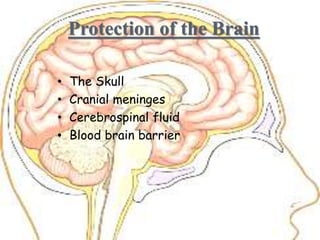
Protection of the Brain
• The Skull
• Cranial meninges
• Cerebrospinal fluid
• Blood brain barrier
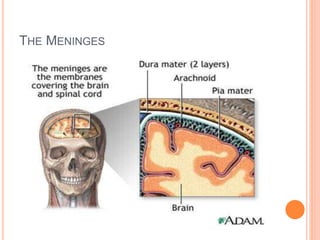
THE MENINGES
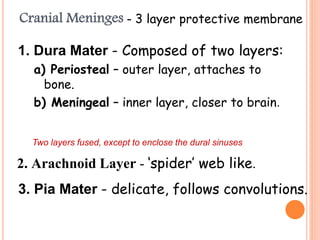
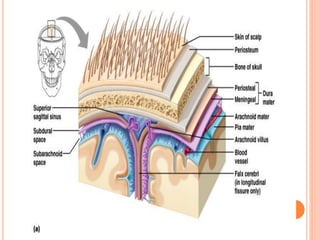
1. Dura Mater - Composed of two layers:
a) Periosteal – outer layer, attaches to
bone.
b) Meningeal – inner layer, closer to brain.
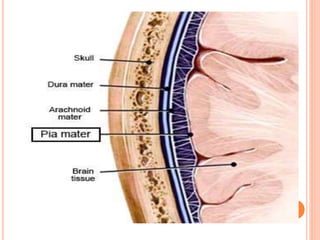
Cranial Meninges - 3 layer protective membrane
Two layers fused, except to enclose the dural sinuses
3. Pia Mater - delicate, follows convolutions.
2. Arachnoid Layer - ‘spider’ web like.
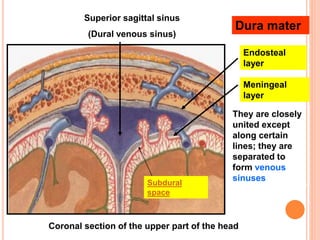
Coronal section of the upper part of the head
Endosteal
layer
Meningeal
layer
They are closely
united except
along certain
lines; they are
separated to
form venous
sinuses
Superior sagittal sinus
(Dural venous sinus)
Dura mater
Subdural
space
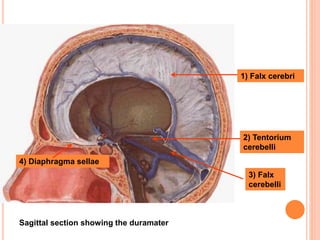
Sagittal section showing the duramater
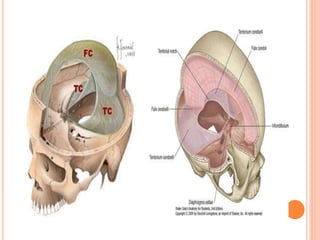
1) Falx cerebri
2) Tentorium
cerebelli
3) Falx
cerebelli
4) Diaphragma sellae
DURAL NERVE SUPPLY
 Branches of the trigeminal, vagus, and
first three cervical nerves and branches
from the sympathetic system pass to the
dura.
 The dura is sensitive to stretching, which
produces the sensation of headache.
DURAL BLOOD SUPPLY
 The middle meningeal artery supplies
most of the blood for the dura mater,
though the meningeal branches of
the posterior and anterior ethmoidal
artery also contribute.
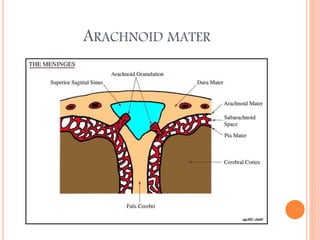
ARACHNOID MATER
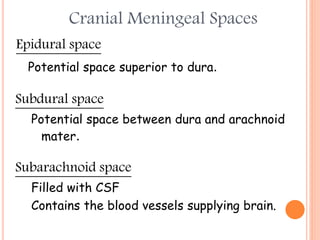
Subdural space
Potential space between dura and arachnoid
mater.
Cranial Meningeal Spaces
Epidural space
Potential space superior to dura.
Subarachnoid space
Filled with CSF
Contains the blood vessels supplying brain.
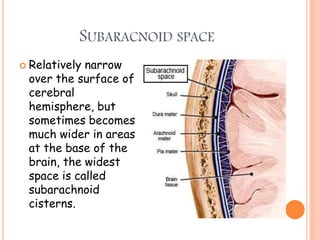
SUBARACNOID SPACE
 Relatively narrow
over the surface of
cerebral
hemisphere, but
sometimes becomes
much wider in areas
at the base of the
brain, the widest
space is called
subarachnoid
cisterns.
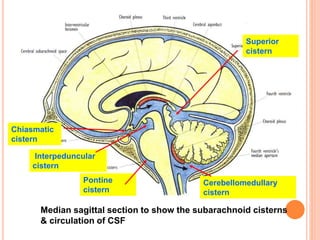
Median sagittal section to show the subarachnoid cisterns
& circulation of CSF
Superior
cistern
Interpeduncular
cistern
Cerebellomedullary
cistern
Chiasmatic
cistern
Pontine
cistern
PIA MATER
 Pia mater functions to cover and protect
the central nervous system (CNS), to
protect the blood vessels and enclose the
venous sinuses near the CNS, to contain
the cerebrospinal fluid (CSF) and to form
partitions with the skull.
 The CSF, pia mater, and other layers of
the meninges work together as a
protection device for the brain, with the
CSF often referred to as the fourth
layer of the meninges.
PATHOLOGY
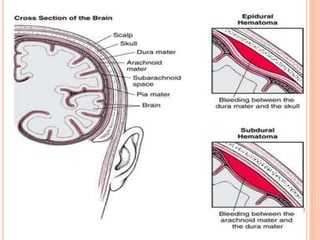
There are three types of hemorrhage involving the
meninges:
 An epidural hematoma arise after an accident or
spontaneously
 A subdural hematoma is a hematoma (collection
of blood) located in a separation of
the arachnoid from the dura mater. The small
veins that connect the dura mater and
the arachnoid are torn, usually during an
accident, and blood leaks into this area
 A subarachnoid hemorrhage is acute bleeding
under the arachnoid; it may occur spontaneously
or as a result of trauma.
 Other medical conditions that affect the
meninges include meningitis (usually
from fungal, bacterial, or viral infection)
and meningiomas that arise from the
meninges, or from meningeal
carcinomatoses (tumors) that form
elsewhere in the body and metastasize to
the meninges.
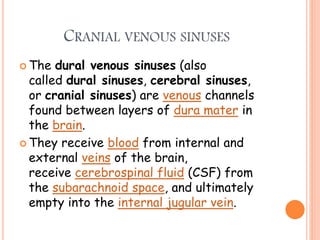
CRANIAL VENOUS SINUSES
 The dural venous sinuses (also
called dural sinuses, cerebral sinuses,
or cranial sinuses) are venous channels
found between layers of dura mater in
the brain.
 They receive blood from internal and
external veins of the brain,
receive cerebrospinal fluid (CSF) from
the subarachnoid space, and ultimately
empty into the internal jugular vein.
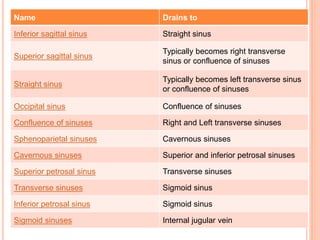
Name Drains to
Inferior sagittal sinus Straight sinus
Superior sagittal sinus
Typically becomes right transverse
sinus or confluence of sinuses
Straight sinus
Typically becomes left transverse sinus
or confluence of sinuses
Occipital sinus Confluence of sinuses
Confluence of sinuses Right and Left transverse sinuses
Sphenoparietal sinuses Cavernous sinuses
Cavernous sinuses Superior and inferior petrosal sinuses
Superior petrosal sinus Transverse sinuses
Transverse sinuses Sigmoid sinus
Inferior petrosal sinus Sigmoid sinus
Sigmoid sinuses Internal jugular vein
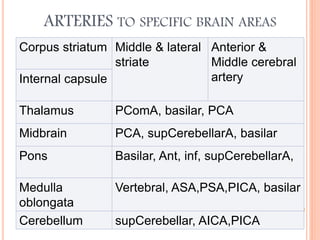
ARTERIES TO SPECIFIC BRAIN AREAS
Corpus striatum Middle & lateral
striate
Anterior &
Middle cerebral
arteryInternal capsule
Thalamus PComA, basilar, PCA
Midbrain PCA, supCerebellarA, basilar
Pons Basilar, Ant, inf, supCerebellarA,
Medulla
oblongata
Vertebral, ASA,PSA,PICA, basilar
Cerebellum supCerebellar, AICA,PICA
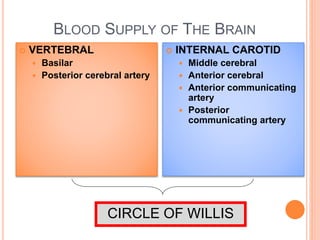
BLOOD SUPPLY OF THE BRAIN
 VERTEBRAL
 Basilar
 Posterior cerebral artery
 INTERNAL CAROTID
 Middle cerebral
 Anterior cerebral
 Anterior communicating
artery
 Posterior
communicating artery
CIRCLE OF WILLIS
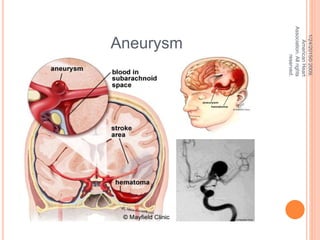
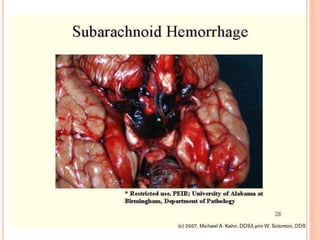
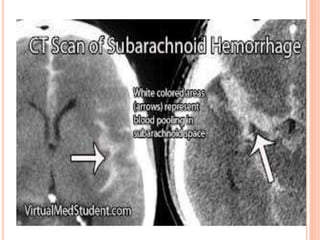
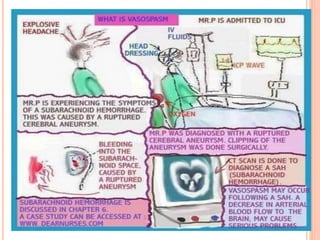
Subarachnoid hemorrhage
1/24/2015©2009,
AmericanHeart
Association.Allrights
reserved.
Aneurysm
SYMPTOMS
 Headache (sudden onset, greater
severity)
 Nausea and vomitting
 Loss or impairment of consciousness (may
progress to coma and death)
 Confusion and irritability
 Meningial irritation and nuchal rigidity
(stiff neck)
 Focal neurological deficits (may indicate
site of lesions).
DIFFERENTIAL DIAGNOSIS
 Meningitis
 Migraine
 Intracerebral hemorrhage
 Ischemic stroke
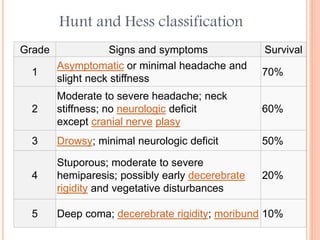
Grade Signs and symptoms Survival
1
Asymptomatic or minimal headache and
slight neck stiffness
70%
2
Moderate to severe headache; neck
stiffness; no neurologic deficit
except cranial nerve plasy
60%
3 Drowsy; minimal neurologic deficit 50%
4
Stuporous; moderate to severe
hemiparesis; possibly early decerebrate
rigidity and vegetative disturbances
20%
5 Deep coma; decerebrate rigidity; moribund 10%
Hunt and Hess classification
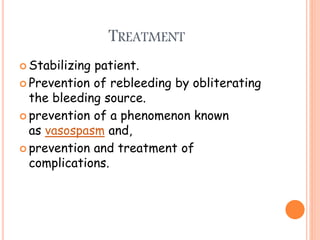
TREATMENT
 Stabilizing patient.
 Prevention of rebleeding by obliterating
the bleeding source.
 prevention of a phenomenon known
as vasospasm and,
 prevention and treatment of
complications.
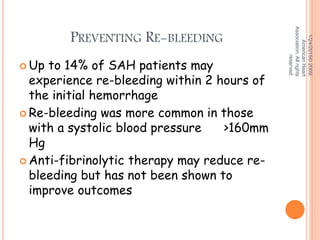
PREVENTING RE-BLEEDING
 Up to 14% of SAH patients may
experience re-bleeding within 2 hours of
the initial hemorrhage
 Re-bleeding was more common in those
with a systolic blood pressure >160mm
Hg
 Anti-fibrinolytic therapy may reduce re-
bleeding but has not been shown to
improve outcomes
1/24/2015©2009,
AmericanHeart
Association.Allrights
reserved.
SURGICAL AND ENDOVASCULAR
MANAGEMENT OF SAH
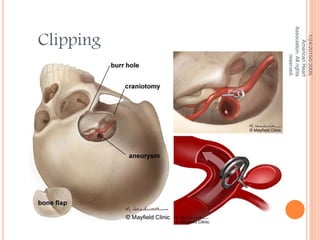
 Surgery – clip aneurysm base
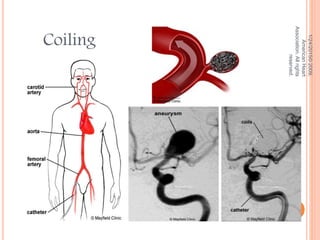
 Endovascular – coiling
 Should be performed within 2 days of
hemorrhage.
1/24/2015©2009,
AmericanHeart
Association.Allrights
reserved.
1/24/2015©2009,
AmericanHeart
Association.Allrights
reserved.
Clipping
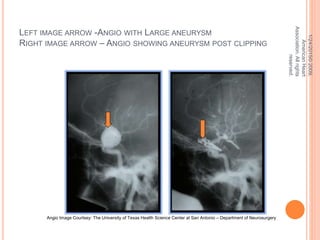
LEFT IMAGE ARROW -ANGIO WITH LARGE ANEURYSM
RIGHT IMAGE ARROW – ANGIO SHOWING ANEURYSM POST CLIPPING
1/24/2015©2009,
AmericanHeart
Association.Allrights
reserved.
Angio Image Courtsey: The University of Texas Health Science Center at San Antonio – Department of Neurosurgery
SURGICAL AND ENDOVASCULAR
MANAGEMENT OF SAH
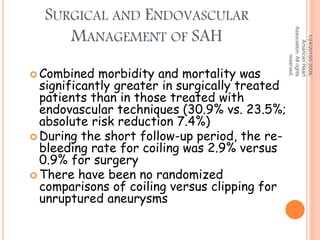
 Combined morbidity and mortality was
significantly greater in surgically treated
patients than in those treated with
endovascular techniques (30.9% vs. 23.5%;
absolute risk reduction 7.4%)
 During the short follow-up period, the re-
bleeding rate for coiling was 2.9% versus
0.9% for surgery
 There have been no randomized
comparisons of coiling versus clipping for
unruptured aneurysms
1/24/2015©2009,
AmericanHeart
Association.Allrights
reserved.
1/24/2015©2009,
AmericanHeart
Association.Allrights
reserved.
Coiling
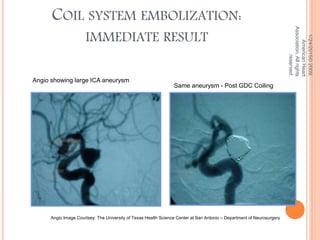
COIL SYSTEM EMBOLIZATION:
IMMEDIATE RESULT
1/24/2015©2009,
AmericanHeart
Association.Allrights
reserved.
Angio showing large ICA aneurysm
Same aneurysm - Post GDC Coiling
Angio Image Courtsey: The University of Texas Health Science Center at San Antonio – Department of Neurosurgery
PREVENTING VASOSPASM
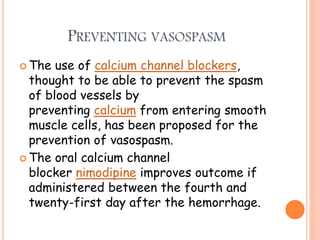
 The use of calcium channel blockers,
thought to be able to prevent the spasm
of blood vessels by
preventing calcium from entering smooth
muscle cells, has been proposed for the
prevention of vasospasm.
 The oral calcium channel
blocker nimodipine improves outcome if
administered between the fourth and
twenty-first day after the hemorrhage.
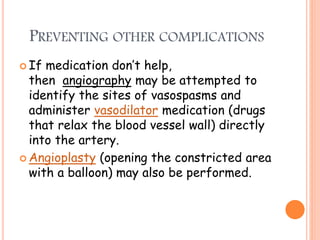
PREVENTING OTHER COMPLICATIONS
 If medication don’t help,
then angiography may be attempted to
identify the sites of vasospasms and
administer vasodilator medication (drugs
that relax the blood vessel wall) directly
into the artery.
 Angioplasty (opening the constricted area
with a balloon) may also be performed.
SUMMARY AND CONCLUSIONS
 The current standard of practice calls
for microsurgical clipping or endovascular
coiling of the aneurysm neck whenever
possible
 Treatment morbidity is determined by
numerous factors, including patient,
aneurysm, and institutional factors
1/24/2015©2009,
AmericanHeart
Association.Allrights
reserved.
SUMMARY AND CONCLUSIONS
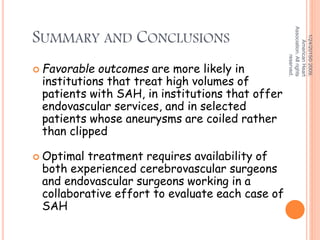
 Favorable outcomes are more likely in
institutions that treat high volumes of
patients with SAH, in institutions that offer
endovascular services, and in selected
patients whose aneurysms are coiled rather
than clipped
 Optimal treatment requires availability of
both experienced cerebrovascular surgeons
and endovascular surgeons working in a
collaborative effort to evaluate each case of
SAH
1/24/2015©2009,
AmericanHeart
Association.Allrights
reserved.
Cranial meninges

Cranial meninges

  • 1.
  • 2.
    Protection of theBrain • The Skull • Cranial meninges • Cerebrospinal fluid • Blood brain barrier
  • 3.
  • 4.
    1. Dura Mater- Composed of two layers: a) Periosteal – outer layer, attaches to bone. b) Meningeal – inner layer, closer to brain. Cranial Meninges - 3 layer protective membrane Two layers fused, except to enclose the dural sinuses 3. Pia Mater - delicate, follows convolutions. 2. Arachnoid Layer - ‘spider’ web like.
  • 5.
    Coronal section ofthe upper part of the head Endosteal layer Meningeal layer They are closely united except along certain lines; they are separated to form venous sinuses Superior sagittal sinus (Dural venous sinus) Dura mater Subdural space
  • 6.
    Sagittal section showingthe duramater 1) Falx cerebri 2) Tentorium cerebelli 3) Falx cerebelli 4) Diaphragma sellae
  • 8.
    DURAL NERVE SUPPLY Branches of the trigeminal, vagus, and first three cervical nerves and branches from the sympathetic system pass to the dura.  The dura is sensitive to stretching, which produces the sensation of headache.
  • 9.
    DURAL BLOOD SUPPLY The middle meningeal artery supplies most of the blood for the dura mater, though the meningeal branches of the posterior and anterior ethmoidal artery also contribute.
  • 10.
  • 11.
    Subdural space Potential spacebetween dura and arachnoid mater. Cranial Meningeal Spaces Epidural space Potential space superior to dura. Subarachnoid space Filled with CSF Contains the blood vessels supplying brain.
  • 13.
    SUBARACNOID SPACE  Relativelynarrow over the surface of cerebral hemisphere, but sometimes becomes much wider in areas at the base of the brain, the widest space is called subarachnoid cisterns.
  • 14.
    Median sagittal sectionto show the subarachnoid cisterns & circulation of CSF Superior cistern Interpeduncular cistern Cerebellomedullary cistern Chiasmatic cistern Pontine cistern
  • 15.
    PIA MATER  Piamater functions to cover and protect the central nervous system (CNS), to protect the blood vessels and enclose the venous sinuses near the CNS, to contain the cerebrospinal fluid (CSF) and to form partitions with the skull.  The CSF, pia mater, and other layers of the meninges work together as a protection device for the brain, with the CSF often referred to as the fourth layer of the meninges.
  • 17.
    PATHOLOGY There are threetypes of hemorrhage involving the meninges:  An epidural hematoma arise after an accident or spontaneously  A subdural hematoma is a hematoma (collection of blood) located in a separation of the arachnoid from the dura mater. The small veins that connect the dura mater and the arachnoid are torn, usually during an accident, and blood leaks into this area  A subarachnoid hemorrhage is acute bleeding under the arachnoid; it may occur spontaneously or as a result of trauma.
  • 18.
     Other medicalconditions that affect the meninges include meningitis (usually from fungal, bacterial, or viral infection) and meningiomas that arise from the meninges, or from meningeal carcinomatoses (tumors) that form elsewhere in the body and metastasize to the meninges.
  • 20.
    CRANIAL VENOUS SINUSES The dural venous sinuses (also called dural sinuses, cerebral sinuses, or cranial sinuses) are venous channels found between layers of dura mater in the brain.  They receive blood from internal and external veins of the brain, receive cerebrospinal fluid (CSF) from the subarachnoid space, and ultimately empty into the internal jugular vein.
  • 21.
    Name Drains to Inferiorsagittal sinus Straight sinus Superior sagittal sinus Typically becomes right transverse sinus or confluence of sinuses Straight sinus Typically becomes left transverse sinus or confluence of sinuses Occipital sinus Confluence of sinuses Confluence of sinuses Right and Left transverse sinuses Sphenoparietal sinuses Cavernous sinuses Cavernous sinuses Superior and inferior petrosal sinuses Superior petrosal sinus Transverse sinuses Transverse sinuses Sigmoid sinus Inferior petrosal sinus Sigmoid sinus Sigmoid sinuses Internal jugular vein
  • 22.
    ARTERIES TO SPECIFICBRAIN AREAS Corpus striatum Middle & lateral striate Anterior & Middle cerebral arteryInternal capsule Thalamus PComA, basilar, PCA Midbrain PCA, supCerebellarA, basilar Pons Basilar, Ant, inf, supCerebellarA, Medulla oblongata Vertebral, ASA,PSA,PICA, basilar Cerebellum supCerebellar, AICA,PICA
  • 23.
    BLOOD SUPPLY OFTHE BRAIN  VERTEBRAL  Basilar  Posterior cerebral artery  INTERNAL CAROTID  Middle cerebral  Anterior cerebral  Anterior communicating artery  Posterior communicating artery CIRCLE OF WILLIS
  • 25.
  • 26.
  • 29.
    SYMPTOMS  Headache (suddenonset, greater severity)  Nausea and vomitting  Loss or impairment of consciousness (may progress to coma and death)  Confusion and irritability  Meningial irritation and nuchal rigidity (stiff neck)  Focal neurological deficits (may indicate site of lesions).
  • 30.
    DIFFERENTIAL DIAGNOSIS  Meningitis Migraine  Intracerebral hemorrhage  Ischemic stroke
  • 34.
    Grade Signs andsymptoms Survival 1 Asymptomatic or minimal headache and slight neck stiffness 70% 2 Moderate to severe headache; neck stiffness; no neurologic deficit except cranial nerve plasy 60% 3 Drowsy; minimal neurologic deficit 50% 4 Stuporous; moderate to severe hemiparesis; possibly early decerebrate rigidity and vegetative disturbances 20% 5 Deep coma; decerebrate rigidity; moribund 10% Hunt and Hess classification
  • 35.
    TREATMENT  Stabilizing patient. Prevention of rebleeding by obliterating the bleeding source.  prevention of a phenomenon known as vasospasm and,  prevention and treatment of complications.
  • 36.
    PREVENTING RE-BLEEDING  Upto 14% of SAH patients may experience re-bleeding within 2 hours of the initial hemorrhage  Re-bleeding was more common in those with a systolic blood pressure >160mm Hg  Anti-fibrinolytic therapy may reduce re- bleeding but has not been shown to improve outcomes 1/24/2015©2009, AmericanHeart Association.Allrights reserved.
  • 37.
    SURGICAL AND ENDOVASCULAR MANAGEMENTOF SAH  Surgery – clip aneurysm base  Endovascular – coiling  Should be performed within 2 days of hemorrhage. 1/24/2015©2009, AmericanHeart Association.Allrights reserved.
  • 38.
  • 39.
    LEFT IMAGE ARROW-ANGIO WITH LARGE ANEURYSM RIGHT IMAGE ARROW – ANGIO SHOWING ANEURYSM POST CLIPPING 1/24/2015©2009, AmericanHeart Association.Allrights reserved. Angio Image Courtsey: The University of Texas Health Science Center at San Antonio – Department of Neurosurgery
  • 40.
    SURGICAL AND ENDOVASCULAR MANAGEMENTOF SAH  Combined morbidity and mortality was significantly greater in surgically treated patients than in those treated with endovascular techniques (30.9% vs. 23.5%; absolute risk reduction 7.4%)  During the short follow-up period, the re- bleeding rate for coiling was 2.9% versus 0.9% for surgery  There have been no randomized comparisons of coiling versus clipping for unruptured aneurysms 1/24/2015©2009, AmericanHeart Association.Allrights reserved.
  • 41.
  • 42.
    COIL SYSTEM EMBOLIZATION: IMMEDIATERESULT 1/24/2015©2009, AmericanHeart Association.Allrights reserved. Angio showing large ICA aneurysm Same aneurysm - Post GDC Coiling Angio Image Courtsey: The University of Texas Health Science Center at San Antonio – Department of Neurosurgery
  • 44.
    PREVENTING VASOSPASM  Theuse of calcium channel blockers, thought to be able to prevent the spasm of blood vessels by preventing calcium from entering smooth muscle cells, has been proposed for the prevention of vasospasm.  The oral calcium channel blocker nimodipine improves outcome if administered between the fourth and twenty-first day after the hemorrhage.
  • 45.
    PREVENTING OTHER COMPLICATIONS If medication don’t help, then angiography may be attempted to identify the sites of vasospasms and administer vasodilator medication (drugs that relax the blood vessel wall) directly into the artery.  Angioplasty (opening the constricted area with a balloon) may also be performed.
  • 46.
    SUMMARY AND CONCLUSIONS The current standard of practice calls for microsurgical clipping or endovascular coiling of the aneurysm neck whenever possible  Treatment morbidity is determined by numerous factors, including patient, aneurysm, and institutional factors 1/24/2015©2009, AmericanHeart Association.Allrights reserved.
  • 47.
    SUMMARY AND CONCLUSIONS Favorable outcomes are more likely in institutions that treat high volumes of patients with SAH, in institutions that offer endovascular services, and in selected patients whose aneurysms are coiled rather than clipped  Optimal treatment requires availability of both experienced cerebrovascular surgeons and endovascular surgeons working in a collaborative effort to evaluate each case of SAH 1/24/2015©2009, AmericanHeart Association.Allrights reserved.