Contents
1. Introduction
2. List of Hyphenated Techniques
3. GC-MS
4. LC-MS
5. GC-IR
6. LC-ESI-MS
7. Advantages of Hyphenated Techniques
8. References
2
 What Is Hyphenated Technique ?(1)
 The term “hyphenation” was first adapted by Hirschfeld in
1980.
 The technique developed from the coupling of a separation
technique and an on-line spectroscopic detection technology
is known as hyphenated technique.
3
Introduction
 Hyphenated techniques ranges from
combination of –
1. Separation-separation
2. Separation-identification &
3. Identification- identification techniques
Introduction conti….
4
1. GC-MS
2. LC-MS
3. LC-NMR
4. EC-MS
5. CE-MS
6. GC-IR
7. LC-ESI-MS
8. LC-MS-MS
9. GC-MS-MS
10. GC-GC-MS
11. GC-NMR
12. HPLC-DAD-MS
13. HPLC-DAD-NMR-MS
5
List of Hyphenated
Techniques
Gas
Chromatography
Mass
Spectroscopy
GC-MS
• Invented By James & Martin in 1952
6
GC-MS
 Principles :
 GC :
• May be Gas Liquid [GLC] or Gas Solid Chromatography [GSC]
but GLC is preferred
• GLC works by partition but GSC works by adsorption
• In GLC the substance to be studied first converted to gas which
works as the mobile phase.
 MS :
1. Ion Formation
2. Ion Separation & Detection 7
GC-MS conti….
• Techniques used to form ions are:
1. Electron Ionisation
2. Chemical Ionisation
3. Desorption Ionisation
i. Secondary Ion Mass Spectroscopy [SIMS]
ii. Fast Atom Bombardment [FAB]
iii. Matrix Associated Laser Desorption
Ionisation [MALDI]
4. Electrospray Ionisation
8
1. Ion Formation
GC-MS conti….
2. Ion Separation and Detection
• Types of instruments are used:
i. Direct Focusing Type:
a) Single Focusing
b) Double Focusing
ii. Quadruple Mass Analyser
iii. Quadruple Mass Storage
iv. Time of Flight Mass Analyser
9
GC-MS conti….
 Instrumentation of GC :
A. Carrier Gas:
• Chemically inert
• Suitable for the detector use
• Amount of impurity should be less
• Easily available and should be cheap
• Non inflammable
Generally used carrier gases are
He, H, N, Ar etc.
10
GC-MS conti….
B. Flow Regulators:
Used to maintain the
uniform pressure and
flow rate.
Generally used are:
• Rotameter
• Soap Bubble Flow Meter
11
GC-MS conti….
C. Injection Devices:
• GAS : Valve Devices
• LIQUID : Loop Devices
• SOLID : Dissolve the
substance in suitable
solvent and then inject.
12
GC-MS conti….
D. Columns:
Columns can be of the following types:
• Packed Columns [Stationary Phase- PEG]
• Open Tubular Column or Open Capillary Column/ GOLAY Column
• SCOT ( Support Coated Open Tubular Column)
13
GC-MS conti….
E. Temperature Controlling Devices:
The devices are very important role playing.
Generally used Temperature Controlling Devices are:
• Pre heaters(for vapour formation)
• Thermostatically controlled oven
14
GC-MS conti….
 Instrumentation of MS :
15
GC-MS conti….
 Principle of working and interfaces :
GC-MS works by :
1. Iso Thermal Principle
2. Liner Principle
Interfaces of GC MS are :
1. Molecular Separator
2. Permeation Separator
3. Open Split
4. Capillary Direct
16
GC-MS conti….
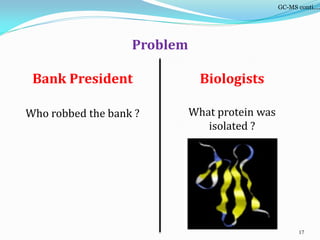
Problem
Bank President
Who robbed the bank ?
17
Biologists
What protein was
isolated ?
GC-MS conti….
Gather Evidence
18
Police Officer
1. Interview witness
2. Dust for fingerprints
Mass Spectrometrist
1. Interview biologists who
isolated the protein
2. Cleave protein to obtain
peptide mixture
3. Analyse peptide mixture by MS
to obtain Peptide molecular
masses !
GC-MS conti….
19
Database Search Results
Police Officer
Identifies the robber
Mr. XYZ
Mass Spectrometrist
Identifies the protein
e.g. bovine carbonic
anhydrase
GC-MS conti….
 Applications of GC-MS :(1)
 Elucidation of the structure of organic & biological
molecules.
 Impurity profiling of pharmaceuticals.
 Identification of components in thin layer & paper
chromatograms.
 Identification of drugs of abuse & metabolites of drugs of
abuse in blood, urine & saliva.
20
GC-MS conti….
 Sports antidoping analysis (in forensic GC-MS).
 Analyzer of aerosol particles.
 Determination of pesticide residues in food.
 Polymer characterization (pyrolysis methods combined
GCMS).
 Drug monitoring & toxicology studies.
 Explosive analysis
 Environmental analysis
21
GC-MS conti….
22
LC-MS
Liquid
Chromatography
Mass
Spectroscopy
LC-MS
 Components of LC-MS :
HPLC
Ion
source
Mass
analyser
Detector
23
LC-MS conti….
 HPLC :
• Non polar S.P. like C8 column, C18
column phenyl-bonded silica
Stationary
phase
• Water, Acetonitrile, Methanol etc.
Mobile phase
• Length : 150mm(large column),
50mm (short column),
• Internal diameter : 2mm – 4.6mm
Column
• 0.05 to 0.2 ml/min
Flow rate
24
LC-MS conti….
 Mass Spectroscopy :(5,6)
Ionization
chambers
Mass
analysers
Detectors
25
LC-MS conti….
 Ionization and Interface :
Electrospray Ionization (ESI)
Atmospheric Pressure Chemical Ionization (APCI)
Thermo Spray Ionization (TSI)
Atmospheric Pressure Photo Ionization(APPI)
Particle Beam Ionization
26
LC-MS conti….
Acceleration
Ionisation
27
LC-MS conti….
28
LC-MS conti….
Electrospray Ionization (ESI) :
29
LC-MS conti….
Atmospheric Pressure Chemical Ionization (APCI) :
30
LC-MS conti….
Atmospheric Pressure
Photo Ionization (APPI) :
Thermo Spray
Ionization (TSI)
 Mass Analysers :
Quadrapole Analyser
Time of Flight Analyser
Ion Trap Analysers
Fourier Transform-Ion Cyclotron Resonance
analyser (FT-ICR)
31
LC-MS conti….
Quadrapole Analyser
32
LC-MS conti….
Ion Trap Analyser
33
LC-MS conti….
Time of Flight
Analyser
Fourier Transform-Ion Cyclotron
Resonance analyser (FT-ICR)
34
LC-MS conti….
 Detectors :
Records either the charge induced or the current produced
when an ion passes by or hits a surface.
A continuous dynode particle
multiplier detector
35
LC-MS conti….
Faraday Cup Detector
36
LC-MS conti….
Detection
37
LC-MS conti….
Mass spectrum of chemical compounds
38
LC-MS conti….
 Pharmacokinetics: Bio analysis
 Drug development
 Molecular weight determination
 Toxicology
 Impurity detection
 Determination of isotopes
 Proteomics/Metabolomics
 Determination of pesticides, herbicides & organic
pollutants for environmental ,monitoring.
 Applications of LC-MS :(1)
39
LC-MS conti….
Comparison of LC-MS with GC-MS :
• GC-MS requires compounds to be volatile to be ionised.
- traditionally electron impact source is used.
• LC-MS can be used to detect compounds from poly-
aromatic (non-polar) to peptide & proteins.
• GC-MS is still able to detect long chain aliphatic
compounds (petroleum based analytes) & very low mass
volatile material better than LC-MS.
40
 Very sensitive, very expensive, sample recovery is also
possible because IR is non-destructive technique.
 In this, GC does the separation part where as IR perform
function of identification.
 Effluent from GC is directly forwarded into the heated
pipe of IR at atmospheric pressure.
 IR spectroscopy identifies the compound by identifying
the functional group. 41
GC-IR
Gas
Chromatography
Infrared
Spectroscopy
GC-IR
42
 Applications of GC-IR :
 DNA analysis of blood samples, other fluids.
 Pharmaceutical applications
 Industrial applications
GC-IR conti….
43
LC-ESI-MS
44
 Principle :
LC-ESI-MS conti….
1. Fast and accurate analysis.
2. Higher degree of automation.
3. Higher sample throughput.
4. Better reproducibility.
5. Reduction of contamination due to its closed system.
6. Separation and quantification achieved at same time.
45
Advantages of
Hyphenated Techniques:
1. Kalpesh N Patel, et al ; Introduction to hyphenated techniques and their
applications in Pharmacy; Pharmaceutical Methods; Oct-Dec 2010; Vol 1 ;
Issue 1.
2. Silverstein R; Spectroscopic Identification of Organic Compounds; Wiley
Publication Delhi; 6th edition; 2009; Page 2-70
3. Skoog D et al; Fundamentals of Analytical Chemistry; Cengage Brain
Publication London; 9th edition; 2010; Page 16-25.
4. AH Beckett, J.B Stenlake, Pharmaceutical chemistry;4th edition-Part
2;Page 474-477.
5. Gurdeep R. Chatwal, K. Anand; Instrumental methods of chemical
analysis; Page 2.272,2.673
6. G. C. Stafford et al.; International Journal of Mass Spectrometry and Ion
Processes, 60; 1984, Page 85 and Analytical Chemistry, 59; 1987, Page
1677.
7. https://www.jic.ac.uk/services/metabolomics/topics/lcms/why.htm
46
References
hyphenatedtechniques-200429145545.pdf

hyphenatedtechniques-200429145545.pdf

  • 2.
    Contents 1. Introduction 2. Listof Hyphenated Techniques 3. GC-MS 4. LC-MS 5. GC-IR 6. LC-ESI-MS 7. Advantages of Hyphenated Techniques 8. References 2
  • 3.
     What IsHyphenated Technique ?(1)  The term “hyphenation” was first adapted by Hirschfeld in 1980.  The technique developed from the coupling of a separation technique and an on-line spectroscopic detection technology is known as hyphenated technique. 3 Introduction
  • 4.
     Hyphenated techniquesranges from combination of – 1. Separation-separation 2. Separation-identification & 3. Identification- identification techniques Introduction conti…. 4
  • 5.
    1. GC-MS 2. LC-MS 3.LC-NMR 4. EC-MS 5. CE-MS 6. GC-IR 7. LC-ESI-MS 8. LC-MS-MS 9. GC-MS-MS 10. GC-GC-MS 11. GC-NMR 12. HPLC-DAD-MS 13. HPLC-DAD-NMR-MS 5 List of Hyphenated Techniques
  • 6.
  • 7.
     Principles : GC : • May be Gas Liquid [GLC] or Gas Solid Chromatography [GSC] but GLC is preferred • GLC works by partition but GSC works by adsorption • In GLC the substance to be studied first converted to gas which works as the mobile phase.  MS : 1. Ion Formation 2. Ion Separation & Detection 7 GC-MS conti….
  • 8.
    • Techniques usedto form ions are: 1. Electron Ionisation 2. Chemical Ionisation 3. Desorption Ionisation i. Secondary Ion Mass Spectroscopy [SIMS] ii. Fast Atom Bombardment [FAB] iii. Matrix Associated Laser Desorption Ionisation [MALDI] 4. Electrospray Ionisation 8 1. Ion Formation GC-MS conti….
  • 9.
    2. Ion Separationand Detection • Types of instruments are used: i. Direct Focusing Type: a) Single Focusing b) Double Focusing ii. Quadruple Mass Analyser iii. Quadruple Mass Storage iv. Time of Flight Mass Analyser 9 GC-MS conti….
  • 10.
     Instrumentation ofGC : A. Carrier Gas: • Chemically inert • Suitable for the detector use • Amount of impurity should be less • Easily available and should be cheap • Non inflammable Generally used carrier gases are He, H, N, Ar etc. 10 GC-MS conti….
  • 11.
    B. Flow Regulators: Usedto maintain the uniform pressure and flow rate. Generally used are: • Rotameter • Soap Bubble Flow Meter 11 GC-MS conti….
  • 12.
    C. Injection Devices: •GAS : Valve Devices • LIQUID : Loop Devices • SOLID : Dissolve the substance in suitable solvent and then inject. 12 GC-MS conti….
  • 13.
    D. Columns: Columns canbe of the following types: • Packed Columns [Stationary Phase- PEG] • Open Tubular Column or Open Capillary Column/ GOLAY Column • SCOT ( Support Coated Open Tubular Column) 13 GC-MS conti….
  • 14.
    E. Temperature ControllingDevices: The devices are very important role playing. Generally used Temperature Controlling Devices are: • Pre heaters(for vapour formation) • Thermostatically controlled oven 14 GC-MS conti….
  • 15.
     Instrumentation ofMS : 15 GC-MS conti….
  • 16.
     Principle ofworking and interfaces : GC-MS works by : 1. Iso Thermal Principle 2. Liner Principle Interfaces of GC MS are : 1. Molecular Separator 2. Permeation Separator 3. Open Split 4. Capillary Direct 16 GC-MS conti….
  • 17.
    Problem Bank President Who robbedthe bank ? 17 Biologists What protein was isolated ? GC-MS conti….
  • 18.
    Gather Evidence 18 Police Officer 1.Interview witness 2. Dust for fingerprints Mass Spectrometrist 1. Interview biologists who isolated the protein 2. Cleave protein to obtain peptide mixture 3. Analyse peptide mixture by MS to obtain Peptide molecular masses ! GC-MS conti….
  • 19.
    19 Database Search Results PoliceOfficer Identifies the robber Mr. XYZ Mass Spectrometrist Identifies the protein e.g. bovine carbonic anhydrase GC-MS conti….
  • 20.
     Applications ofGC-MS :(1)  Elucidation of the structure of organic & biological molecules.  Impurity profiling of pharmaceuticals.  Identification of components in thin layer & paper chromatograms.  Identification of drugs of abuse & metabolites of drugs of abuse in blood, urine & saliva. 20 GC-MS conti….
  • 21.
     Sports antidopinganalysis (in forensic GC-MS).  Analyzer of aerosol particles.  Determination of pesticide residues in food.  Polymer characterization (pyrolysis methods combined GCMS).  Drug monitoring & toxicology studies.  Explosive analysis  Environmental analysis 21 GC-MS conti….
  • 22.
  • 23.
     Components ofLC-MS : HPLC Ion source Mass analyser Detector 23 LC-MS conti….
  • 24.
     HPLC : •Non polar S.P. like C8 column, C18 column phenyl-bonded silica Stationary phase • Water, Acetonitrile, Methanol etc. Mobile phase • Length : 150mm(large column), 50mm (short column), • Internal diameter : 2mm – 4.6mm Column • 0.05 to 0.2 ml/min Flow rate 24 LC-MS conti….
  • 25.
     Mass Spectroscopy:(5,6) Ionization chambers Mass analysers Detectors 25 LC-MS conti….
  • 26.
     Ionization andInterface : Electrospray Ionization (ESI) Atmospheric Pressure Chemical Ionization (APCI) Thermo Spray Ionization (TSI) Atmospheric Pressure Photo Ionization(APPI) Particle Beam Ionization 26 LC-MS conti….
  • 27.
  • 28.
  • 29.
    29 LC-MS conti…. Atmospheric PressureChemical Ionization (APCI) :
  • 30.
    30 LC-MS conti…. Atmospheric Pressure PhotoIonization (APPI) : Thermo Spray Ionization (TSI)
  • 31.
     Mass Analysers: Quadrapole Analyser Time of Flight Analyser Ion Trap Analysers Fourier Transform-Ion Cyclotron Resonance analyser (FT-ICR) 31 LC-MS conti….
  • 32.
  • 33.
    Ion Trap Analyser 33 LC-MSconti…. Time of Flight Analyser
  • 34.
    Fourier Transform-Ion Cyclotron Resonanceanalyser (FT-ICR) 34 LC-MS conti….
  • 35.
     Detectors : Recordseither the charge induced or the current produced when an ion passes by or hits a surface. A continuous dynode particle multiplier detector 35 LC-MS conti….
  • 36.
  • 37.
  • 38.
    Mass spectrum ofchemical compounds 38 LC-MS conti….
  • 39.
     Pharmacokinetics: Bioanalysis  Drug development  Molecular weight determination  Toxicology  Impurity detection  Determination of isotopes  Proteomics/Metabolomics  Determination of pesticides, herbicides & organic pollutants for environmental ,monitoring.  Applications of LC-MS :(1) 39 LC-MS conti….
  • 40.
    Comparison of LC-MSwith GC-MS : • GC-MS requires compounds to be volatile to be ionised. - traditionally electron impact source is used. • LC-MS can be used to detect compounds from poly- aromatic (non-polar) to peptide & proteins. • GC-MS is still able to detect long chain aliphatic compounds (petroleum based analytes) & very low mass volatile material better than LC-MS. 40
  • 41.
     Very sensitive,very expensive, sample recovery is also possible because IR is non-destructive technique.  In this, GC does the separation part where as IR perform function of identification.  Effluent from GC is directly forwarded into the heated pipe of IR at atmospheric pressure.  IR spectroscopy identifies the compound by identifying the functional group. 41 GC-IR Gas Chromatography Infrared Spectroscopy GC-IR
  • 42.
    42  Applications ofGC-IR :  DNA analysis of blood samples, other fluids.  Pharmaceutical applications  Industrial applications GC-IR conti….
  • 43.
  • 44.
  • 45.
    1. Fast andaccurate analysis. 2. Higher degree of automation. 3. Higher sample throughput. 4. Better reproducibility. 5. Reduction of contamination due to its closed system. 6. Separation and quantification achieved at same time. 45 Advantages of Hyphenated Techniques:
  • 46.
    1. Kalpesh NPatel, et al ; Introduction to hyphenated techniques and their applications in Pharmacy; Pharmaceutical Methods; Oct-Dec 2010; Vol 1 ; Issue 1. 2. Silverstein R; Spectroscopic Identification of Organic Compounds; Wiley Publication Delhi; 6th edition; 2009; Page 2-70 3. Skoog D et al; Fundamentals of Analytical Chemistry; Cengage Brain Publication London; 9th edition; 2010; Page 16-25. 4. AH Beckett, J.B Stenlake, Pharmaceutical chemistry;4th edition-Part 2;Page 474-477. 5. Gurdeep R. Chatwal, K. Anand; Instrumental methods of chemical analysis; Page 2.272,2.673 6. G. C. Stafford et al.; International Journal of Mass Spectrometry and Ion Processes, 60; 1984, Page 85 and Analytical Chemistry, 59; 1987, Page 1677. 7. https://www.jic.ac.uk/services/metabolomics/topics/lcms/why.htm 46 References