HYPERTHYROIDISM
• Hyperthyroidism is a condition in which your thyroid creates and releases more hormones than you
need.
• This is also called overactive thyroid.
• The main hormones your thyroid makes include triiodothyronine (T3) and thyroxine (T4
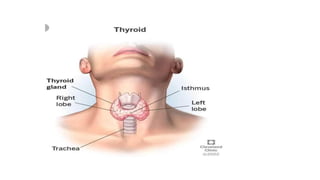
Location of the thyroid gland
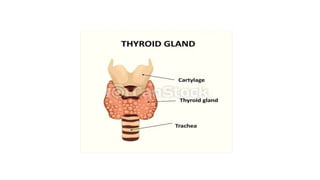
• Thyroid is a small, butterfly-shaped gland located at the front of your neck under your skin.
• In its anatomic position, the thyroid gland lies posterior to the sternothyroid and sternohyoid
muscles, wrapping around the cricoid cartilage and tracheal rings.
• It is located inferior to the laryngeal thyroid cartilage, typically corresponding to the vertebral levels
C5-T1.
• The thyroid hormone is well known for controlling metabolism, growth, and many other bodily
functions.
• The thyroid gland, anterior pituitary gland, and hypothalamus comprise a self-regulatory circuit
called the hypothalamic-pituitary-thyroid axis.
• The main hormones produced by the thyroid gland are thyroxine or tetraiodothyronine (T4) and
triiodothyronine (T3).
• Thyrotropin-releasing hormone (TRH) from the hypothalamus, thyroid-stimulating hormone (TSH)
from the anterior pituitary gland, and T4 work in synchronous harmony to maintain proper feedback
mechanism and homeostasis.
• Hypothyroidism, caused by an underactive thyroid gland, typically manifests as bradycardia, cold
intolerance, constipation, fatigue, and weight gain
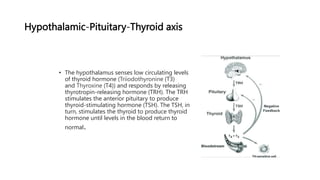
Hypothalamic-Pituitary-Thyroid axis
• The hypothalamus senses low circulating levels
of thyroid hormone (Triiodothyronine (T3)
and Thyroxine (T4)) and responds by releasing
thyrotropin-releasing hormone (TRH). The TRH
stimulates the anterior pituitary to produce
thyroid-stimulating hormone (TSH). The TSH, in
turn, stimulates the thyroid to produce thyroid
hormone until levels in the blood return to
normal.
Causes of hyperthyroidism
1. Grave’s disease
2. Graves disease is an autoimmune disorder characterized by hyperthyroidism due to circulating
autoantibodies.
• Thyroid-stimulating immunoglobulins (TSIs) bind to and activate thyroid-stimulating hormone
(TSH) receptors, causing the thyroid gland to grow and the thyroid follicles to increase synthesis of
thyroid hormone.
2. Thyroid nodules
• Overactive thyroid nodules, or lumps in your thyroid, are common and usually not cancerous.
• However, one or more nodules may become overactive and produce too much thyroid hormone.
• Overactive nodules are found most often in older adults
3. Thyroiditis
• Thyroiditis is inflammation of your thyroid gland. Some types of thyroiditis can cause thyroid
hormone to leak out of your thyroid gland into your bloodstream. As a result, you may
develop symptoms of hyperthyroidism.
• The types of thyroiditis that can cause hyperthyroidism include
• subacute thyroiditis, which involves a painfully inflamed and enlarged thyroid.
• postpartum thyroiditis, which can develop after a woman gives birth.
4. Medication
• Hyperthyroidism can also be caused by taking too much thyroid hormone medicine for
hypothyroidism. This is called factitious hyperthyroidism. When this occurs because the prescribed
dosage of hormone medicine is too high, it is called iatrogenic, or doctor-induced, hyperthyroidism.
This is common
Diagnosis
1. Physical examination
For patients experiencing symptoms check the following
• Thyroid- palpate the neck to check if it’s enlarged or tender
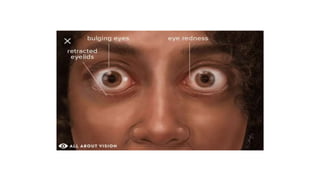
• Eyes- check if they are swelling,redness,bulging or other signs of grave’s disease
• Heart- auscultation the heart for rapid heart beats
• Hands- outstretched the hands to look for tremors or changes in the finger nails
• Skin- feel the skin its warmth and moisture
2. Thyroid functioning test
• Blood samples maybe taken to look for high levels of
thyroid hormone
• This is called thyroid function testing.
• When you have hyperthyroidism, levels of the thyroid hormones T3 and T4 are above normal and
thyroid-stimulating hormone (TSH) is lower than normal.
Imaging tests
1. Radioactive iodine uptake (RAIU) test:
• For this test, a small, safe dose of radioactive iodine is taken (also called a radiotracer) by mouth to
see how much of it your thyroid absorbs. After a certain amount of time — usually at six and 24
hours later — a neck scan is done with a device called a gamma probe to see how much of the
radioactive iodine your thyroid has absorbed. If your thyroid has absorbed a lot of the radioactive
iodine, it means that your thyroid gland is producing too much thyroxine (T4). If this is the case, it is
most likely to be Graves' disease or thyroid nodules
2. Thyroid scan
• This procedure is an extension of the RAIU, where in addition to measuring the absorbed amount of
radioactivity by your thyroid,
• A special camera (gamma camera) takes several images of the thyroid. The radioactive material
makes all or certain parts of the thyroid appear “bright” on the screen.
• Thyroid scan may be usedto look for lumps or nodules on the thyroid, inflammation, swelling, goiter
or thyroid cancer.
Management and treatment
1. Antithyroid drugs
• These drugs block the ability of your thyroid to make hormones.
• They offer rapid control of your thyroid.
2. Radioactive iodine:
• Radioactive is an oral medication that your overactive thyroid cells absorb.
The radioactive iodine damages these cells and causes your thyroid to
shrink and thyroid hormone levels to go down over a few weeks. This
usually leads to permanent destruction of the thyroid, which will cure
hyperthyroidism. The amount of radiation delivered by this medication is
different from the amount used for the radioactive iodine uptake (RAIU)
test and scan for diagnosis. Most people who receive this treatment have
to take thyroid hormone drugs for the rest of their lives to maintain normal
hormone levels.
3. Beta blockers.
• These drugs block the action of thyroid hormones on the body. They do
not change the level of hormones in your blood, but they can help
manage symptoms like rapid heartbeat, nervousness and shakiness that
are caused by hyperthyroidism.
• This treatment isn’t used alone and is usually paired with another option to
treat hyperthyroidism over the long term.
4. Surgery.
• Removal of the thyroid gland through surgery (thyroidectomy).
• This will correct your hyperthyroidism, but it will usually
cause hypothyroidism (an underactive thyroid), which requires lifelong
thyroid supplements to keep hormone levels normal.
Thyroid crisis
• Happens when the thyroid gland releases a large amount of thyroid
hormone in a short amount of time.
• It’s a rare complication of hyperthyroidism.
• Thyroid crisis is a medical emergency and is life-threatening.
Causes
• Thyroid crisis can develop in cases of long-term untreated or undertreated
hyperthyroidism, it’s often caused by a sudden and intense (acute) event or
situation.
• Sudden events that can trigger a thyroid storm include:
1. Suddenly stop taking your antithyroid medication.
2. Thyroid surgery (thyroidectomy).
3. Nonthyroid surgery
4. Trauma.
5. Infection.
6. Acute illnesses such as diabetic ketoacidosis (DKA), heart failure and a
drug reaction.
7. A sudden large amount of iodine in your body, such as from an iodinated
contrast agent that’s used for certain imaging procedures.
8. Giving birth.
Signs and symptoms
• Having a high fever.
• Having a rapid heart rate (tachycardia) that can exceed 140 beats per
minute.
• Feeling agitated, irritable and/or anxious.
• Delirium.
• Congestive heart failure.
• Loss of consciousness
Management and treatment.
• The treatment strategy for thyroid crisis can be divided into four general
categories, including:
1. Treatment targeted against thyroid hormone creation and release.
2. Treating your body systems and tissues, such as your heart, that are
affected by the excess thyroid hormone.
3. Treatment of the situation or illness that caused your thyroid storm.
4. Other supportive treatments to help with symptoms and side effects.
• Medications and treatment therapies for thyroid crisis can include:
1. Antithyroid medication (thionamides) to stop your thyroid from making
new thyroid hormones.
2. Iodine solution to stop your thyroid from releasing thyroid hormone.
3. Beta-blockers to manage your symptoms.
4. Bile acid sequestrants to prevent your gut from reabsorbing thyroid
hormone.
5. Acetaminophen and cooling blankets to lower your temperature.
6. Respiratory treatment, such as supplemental oxygen.

hyperthyroidism 1.pptx

  • 1.
  • 2.
    • Hyperthyroidism isa condition in which your thyroid creates and releases more hormones than you need. • This is also called overactive thyroid. • The main hormones your thyroid makes include triiodothyronine (T3) and thyroxine (T4
  • 4.
    Location of thethyroid gland • Thyroid is a small, butterfly-shaped gland located at the front of your neck under your skin. • In its anatomic position, the thyroid gland lies posterior to the sternothyroid and sternohyoid muscles, wrapping around the cricoid cartilage and tracheal rings. • It is located inferior to the laryngeal thyroid cartilage, typically corresponding to the vertebral levels C5-T1.
  • 6.
    • The thyroidhormone is well known for controlling metabolism, growth, and many other bodily functions. • The thyroid gland, anterior pituitary gland, and hypothalamus comprise a self-regulatory circuit called the hypothalamic-pituitary-thyroid axis. • The main hormones produced by the thyroid gland are thyroxine or tetraiodothyronine (T4) and triiodothyronine (T3).
  • 7.
    • Thyrotropin-releasing hormone(TRH) from the hypothalamus, thyroid-stimulating hormone (TSH) from the anterior pituitary gland, and T4 work in synchronous harmony to maintain proper feedback mechanism and homeostasis. • Hypothyroidism, caused by an underactive thyroid gland, typically manifests as bradycardia, cold intolerance, constipation, fatigue, and weight gain
  • 8.
    Hypothalamic-Pituitary-Thyroid axis • Thehypothalamus senses low circulating levels of thyroid hormone (Triiodothyronine (T3) and Thyroxine (T4)) and responds by releasing thyrotropin-releasing hormone (TRH). The TRH stimulates the anterior pituitary to produce thyroid-stimulating hormone (TSH). The TSH, in turn, stimulates the thyroid to produce thyroid hormone until levels in the blood return to normal.
  • 9.
    Causes of hyperthyroidism 1.Grave’s disease 2. Graves disease is an autoimmune disorder characterized by hyperthyroidism due to circulating autoantibodies. • Thyroid-stimulating immunoglobulins (TSIs) bind to and activate thyroid-stimulating hormone (TSH) receptors, causing the thyroid gland to grow and the thyroid follicles to increase synthesis of thyroid hormone.
  • 10.
    2. Thyroid nodules •Overactive thyroid nodules, or lumps in your thyroid, are common and usually not cancerous. • However, one or more nodules may become overactive and produce too much thyroid hormone. • Overactive nodules are found most often in older adults
  • 11.
    3. Thyroiditis • Thyroiditisis inflammation of your thyroid gland. Some types of thyroiditis can cause thyroid hormone to leak out of your thyroid gland into your bloodstream. As a result, you may develop symptoms of hyperthyroidism. • The types of thyroiditis that can cause hyperthyroidism include • subacute thyroiditis, which involves a painfully inflamed and enlarged thyroid. • postpartum thyroiditis, which can develop after a woman gives birth.
  • 12.
    4. Medication • Hyperthyroidismcan also be caused by taking too much thyroid hormone medicine for hypothyroidism. This is called factitious hyperthyroidism. When this occurs because the prescribed dosage of hormone medicine is too high, it is called iatrogenic, or doctor-induced, hyperthyroidism. This is common
  • 13.
    Diagnosis 1. Physical examination Forpatients experiencing symptoms check the following • Thyroid- palpate the neck to check if it’s enlarged or tender • Eyes- check if they are swelling,redness,bulging or other signs of grave’s disease • Heart- auscultation the heart for rapid heart beats • Hands- outstretched the hands to look for tremors or changes in the finger nails • Skin- feel the skin its warmth and moisture
  • 15.
    2. Thyroid functioningtest • Blood samples maybe taken to look for high levels of thyroid hormone • This is called thyroid function testing. • When you have hyperthyroidism, levels of the thyroid hormones T3 and T4 are above normal and thyroid-stimulating hormone (TSH) is lower than normal.
  • 16.
    Imaging tests 1. Radioactiveiodine uptake (RAIU) test: • For this test, a small, safe dose of radioactive iodine is taken (also called a radiotracer) by mouth to see how much of it your thyroid absorbs. After a certain amount of time — usually at six and 24 hours later — a neck scan is done with a device called a gamma probe to see how much of the radioactive iodine your thyroid has absorbed. If your thyroid has absorbed a lot of the radioactive iodine, it means that your thyroid gland is producing too much thyroxine (T4). If this is the case, it is most likely to be Graves' disease or thyroid nodules
  • 17.
    2. Thyroid scan •This procedure is an extension of the RAIU, where in addition to measuring the absorbed amount of radioactivity by your thyroid, • A special camera (gamma camera) takes several images of the thyroid. The radioactive material makes all or certain parts of the thyroid appear “bright” on the screen. • Thyroid scan may be usedto look for lumps or nodules on the thyroid, inflammation, swelling, goiter or thyroid cancer.
  • 18.
    Management and treatment 1.Antithyroid drugs • These drugs block the ability of your thyroid to make hormones. • They offer rapid control of your thyroid.
  • 19.
    2. Radioactive iodine: •Radioactive is an oral medication that your overactive thyroid cells absorb. The radioactive iodine damages these cells and causes your thyroid to shrink and thyroid hormone levels to go down over a few weeks. This usually leads to permanent destruction of the thyroid, which will cure hyperthyroidism. The amount of radiation delivered by this medication is different from the amount used for the radioactive iodine uptake (RAIU) test and scan for diagnosis. Most people who receive this treatment have to take thyroid hormone drugs for the rest of their lives to maintain normal hormone levels.
  • 20.
    3. Beta blockers. •These drugs block the action of thyroid hormones on the body. They do not change the level of hormones in your blood, but they can help manage symptoms like rapid heartbeat, nervousness and shakiness that are caused by hyperthyroidism. • This treatment isn’t used alone and is usually paired with another option to treat hyperthyroidism over the long term.
  • 21.
    4. Surgery. • Removalof the thyroid gland through surgery (thyroidectomy). • This will correct your hyperthyroidism, but it will usually cause hypothyroidism (an underactive thyroid), which requires lifelong thyroid supplements to keep hormone levels normal.
  • 22.
    Thyroid crisis • Happenswhen the thyroid gland releases a large amount of thyroid hormone in a short amount of time. • It’s a rare complication of hyperthyroidism. • Thyroid crisis is a medical emergency and is life-threatening.
  • 23.
    Causes • Thyroid crisiscan develop in cases of long-term untreated or undertreated hyperthyroidism, it’s often caused by a sudden and intense (acute) event or situation. • Sudden events that can trigger a thyroid storm include: 1. Suddenly stop taking your antithyroid medication. 2. Thyroid surgery (thyroidectomy). 3. Nonthyroid surgery
  • 24.
    4. Trauma. 5. Infection. 6.Acute illnesses such as diabetic ketoacidosis (DKA), heart failure and a drug reaction. 7. A sudden large amount of iodine in your body, such as from an iodinated contrast agent that’s used for certain imaging procedures. 8. Giving birth.
  • 25.
    Signs and symptoms •Having a high fever. • Having a rapid heart rate (tachycardia) that can exceed 140 beats per minute. • Feeling agitated, irritable and/or anxious. • Delirium. • Congestive heart failure. • Loss of consciousness
  • 26.
    Management and treatment. •The treatment strategy for thyroid crisis can be divided into four general categories, including: 1. Treatment targeted against thyroid hormone creation and release. 2. Treating your body systems and tissues, such as your heart, that are affected by the excess thyroid hormone. 3. Treatment of the situation or illness that caused your thyroid storm. 4. Other supportive treatments to help with symptoms and side effects.
  • 27.
    • Medications andtreatment therapies for thyroid crisis can include: 1. Antithyroid medication (thionamides) to stop your thyroid from making new thyroid hormones. 2. Iodine solution to stop your thyroid from releasing thyroid hormone. 3. Beta-blockers to manage your symptoms. 4. Bile acid sequestrants to prevent your gut from reabsorbing thyroid hormone. 5. Acetaminophen and cooling blankets to lower your temperature. 6. Respiratory treatment, such as supplemental oxygen.