DAMAGE CONTROL
Dr. Sudhanshu Goyal,
PGY-1, General Surgery,
Civil Hospital Aizawl
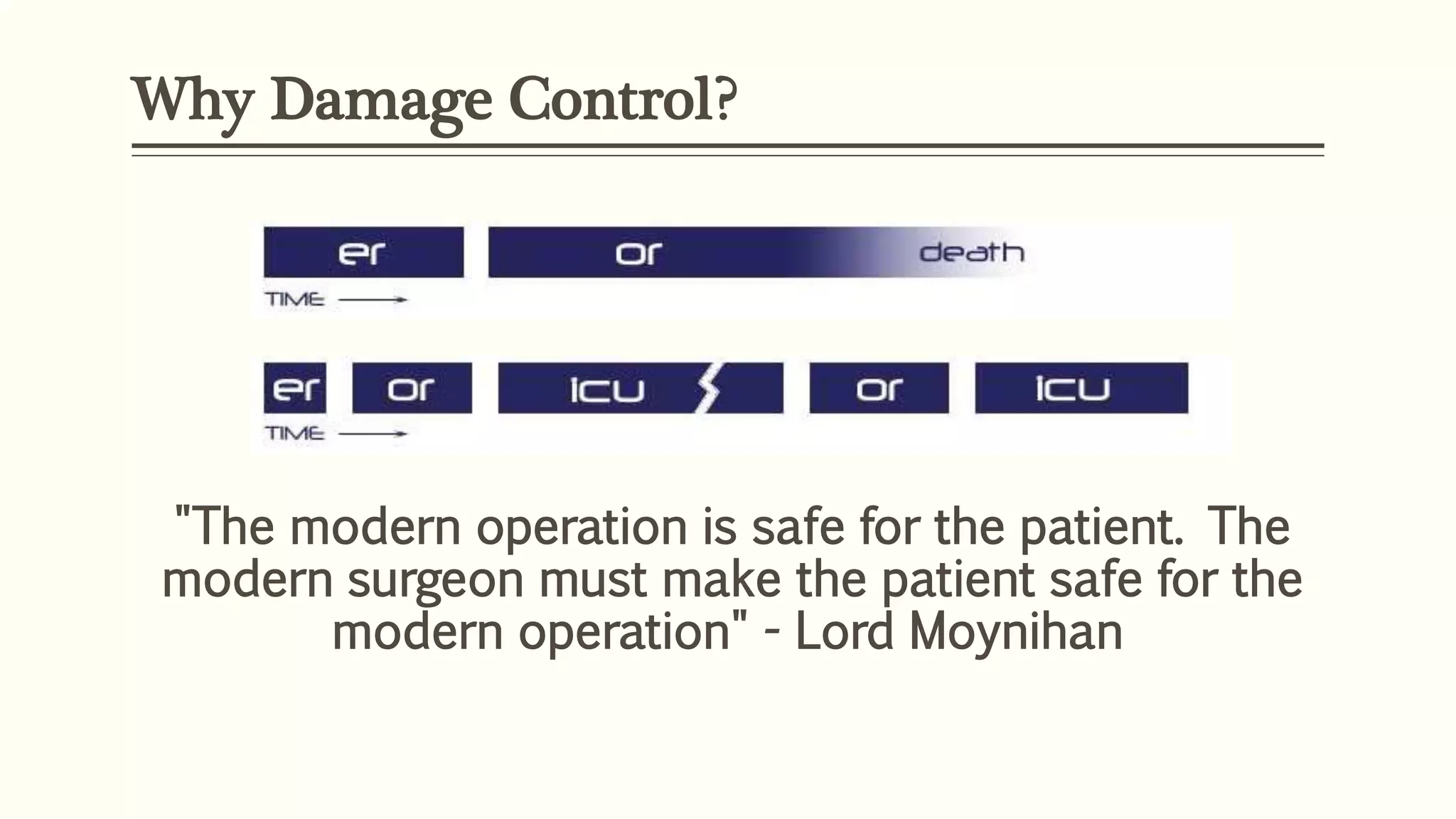
Why Damage Control?
"The modern operation is safe for the patient. The
modern surgeon must make the patient safe for the
modern operation" - Lord Moynihan
Principles
 Lethal Triad:
 Acidosis, Hypothermia and Coagulopathy
 Damage Control Resuscitation (DCR)
 Novel resuscitative strategies to limit
physiological derangement
 Damage Control Surgery (DCS)
 Treatment strategy of TEMPORIZATION by
prioritizing Physiological Recovery before
Anatomical Repair
Four phase strategy
 DC0: DCR, RSI, early rewarming
and expedient transport to OR
 DC1: concurrent DCR and DCS
 DC2: ICU resuscitation and
stabalization
 DC3: Definitive surgery
Indications
 Massive Blood Transfusion
 >10 unit PRBC
 Severe Metabolic Acidosis
 pH< 7.30
 Hypothermia
 <35 degree C
 Operative time
 >90 mins
 Coagulopathy
 Either on lab results or ‘non surgical’ bleeding
 Lactate
 >5 mmol/L
Estimates show
10% of the
major trauma
patients to
benefit from
DCS
DC0
 Extends from pre-hospital setting to ER
 DCR
 Deleterious effect of excessive fluid and Acute
traumatic coagulopathy
 Consist of
 <C>ABC (RSI)
 Permissive hypotension
 Limitation of crystalloid and early transfusion
 Early use of TXA
 Early use of Blood and Blood products
 Blood components targeting ATC
 Optimal ratio of PRBS,PC, FFP and other
products
 Massive transfusion protocol
 Prevent delay in accessing blood
 E.g.
 1 pack of un-crossmatched blood in ER
 f/b protocoled transfusion to prevent clotting factor
depletion
 Imaging
 RSI f/b chest x-ray
 Spinal precations
 Pelvic binder
 If stabilized CT scan
 Primary and secondary surverys
DC1 (DCS)
 Objectives
 Haemorrhage control
 Limitation of contaimination
 Temporary abdominal closure
 Preperation
 OT prepped before taking patient
 Criciform position
 Prepped from chin to mid thigh
 RT, Foley’s
 Don’t delay for central line
 Incision
 Midline laparotomy
 In pelvic fracture limit just
below umbilicus
 Easy to extend superiorly or
laterally
DC1 (DCS) cont…
 Haemorrhage control
 Large clots removed manually
 Retract and pack each quadrant
sequentially
 While packing assess degree and location
of significant injuries
 If still hypotensive – suspect significant
arterial source
 Occlude aorta sequentially to gain control
 Major vascular injuries
 Arterial either ligation or
temporary shunt
 Venous majority can be
ligated, if not shunting
 Definitive reconstruction to
be avoided
DC1 (DCS) cont…
 Haemorrhage control cont…
 Solid organ injuries
 Prolonged repair to be avoided
 Splenic, Renal and Pancreatic injuries best
by partial or total resection
 Liver bleeding managed by packing, tropical
hemostatic agents
 Consider angioembolization whenever
available
 Contamination control
 Control spillage of intestinal
content and urine
 Simple bowel perforation in
limited number may be
repaired, else resection
 Reconstruction, stoma
creation and feeding tube
avaoided
 Biliary/ Pancreatic duct
injury: controlled fistula
DC1 (DCS) cont…
 Abdominal closure
 Fascial closure not
recommended
 Temporary closure to avoid
IAH/ACS
 Contamination control cont…
 Biliary/ Pancreatic duct injury: controlled
fistula
 Bladder injury: Primary suturing with foleys
drainage, if large packing with foley’s
drainage
 Ureteric injuries: drained over IFT
 Abdominal packing: sufficient to provide
tamponade but not impeding vascular
return or arterial suppy
DC2
 Goal:
 Reverse hypotension related metabolic failure
 Support physiological and biochemical
restoration
 Normalise lactate within 24 hrs
 Aggressive Core Rewarming
 Improves perfusion and reverses coagulopathy
 Correct Coagulopathy
 FFP, Platelets and Cryoprecipitates
 Complete physical examination
and relevant imaging
 Repair planning
 Usually require 24 to 36 hrs
 Unplanned re-operation
 Ongoing transfusion despite
normal clotting and core temp.
 ACS: sustained or repeated IAP >20
mm Hg + new single/multiple
organ failure
DC3
 Maximum impact on achieving successful
outcome
 Normothermic, normal coagulation, pH and
lactate (24 – 36 hrs)
 Operative game plan
 Handover (if different surgeon)
 Irrigate packs to avoid clot disruption
 Complete re-examination and definitive
repair
 Additional sites of bleeding controlled,
vascular repairs done and intestinal
continuity is restored
 Abdominal closure
 Formal abdominal closure
without tension should be
done
 If airway pressure >10 cm H2O
temporary closure to be done
 Can be closed within 1 week
THANK
YOU

Damage control Surgery

  • 1.
    DAMAGE CONTROL Dr. SudhanshuGoyal, PGY-1, General Surgery, Civil Hospital Aizawl
  • 2.
    Why Damage Control? "Themodern operation is safe for the patient. The modern surgeon must make the patient safe for the modern operation" - Lord Moynihan
  • 3.
    Principles  Lethal Triad: Acidosis, Hypothermia and Coagulopathy  Damage Control Resuscitation (DCR)  Novel resuscitative strategies to limit physiological derangement  Damage Control Surgery (DCS)  Treatment strategy of TEMPORIZATION by prioritizing Physiological Recovery before Anatomical Repair Four phase strategy  DC0: DCR, RSI, early rewarming and expedient transport to OR  DC1: concurrent DCR and DCS  DC2: ICU resuscitation and stabalization  DC3: Definitive surgery
  • 4.
    Indications  Massive BloodTransfusion  >10 unit PRBC  Severe Metabolic Acidosis  pH< 7.30  Hypothermia  <35 degree C  Operative time  >90 mins  Coagulopathy  Either on lab results or ‘non surgical’ bleeding  Lactate  >5 mmol/L Estimates show 10% of the major trauma patients to benefit from DCS
  • 5.
    DC0  Extends frompre-hospital setting to ER  DCR  Deleterious effect of excessive fluid and Acute traumatic coagulopathy  Consist of  <C>ABC (RSI)  Permissive hypotension  Limitation of crystalloid and early transfusion  Early use of TXA  Early use of Blood and Blood products  Blood components targeting ATC  Optimal ratio of PRBS,PC, FFP and other products  Massive transfusion protocol  Prevent delay in accessing blood  E.g.  1 pack of un-crossmatched blood in ER  f/b protocoled transfusion to prevent clotting factor depletion  Imaging  RSI f/b chest x-ray  Spinal precations  Pelvic binder  If stabilized CT scan  Primary and secondary surverys
  • 6.
    DC1 (DCS)  Objectives Haemorrhage control  Limitation of contaimination  Temporary abdominal closure  Preperation  OT prepped before taking patient  Criciform position  Prepped from chin to mid thigh  RT, Foley’s  Don’t delay for central line  Incision  Midline laparotomy  In pelvic fracture limit just below umbilicus  Easy to extend superiorly or laterally
  • 7.
    DC1 (DCS) cont… Haemorrhage control  Large clots removed manually  Retract and pack each quadrant sequentially  While packing assess degree and location of significant injuries  If still hypotensive – suspect significant arterial source  Occlude aorta sequentially to gain control  Major vascular injuries  Arterial either ligation or temporary shunt  Venous majority can be ligated, if not shunting  Definitive reconstruction to be avoided
  • 8.
    DC1 (DCS) cont… Haemorrhage control cont…  Solid organ injuries  Prolonged repair to be avoided  Splenic, Renal and Pancreatic injuries best by partial or total resection  Liver bleeding managed by packing, tropical hemostatic agents  Consider angioembolization whenever available  Contamination control  Control spillage of intestinal content and urine  Simple bowel perforation in limited number may be repaired, else resection  Reconstruction, stoma creation and feeding tube avaoided  Biliary/ Pancreatic duct injury: controlled fistula
  • 9.
    DC1 (DCS) cont… Abdominal closure  Fascial closure not recommended  Temporary closure to avoid IAH/ACS  Contamination control cont…  Biliary/ Pancreatic duct injury: controlled fistula  Bladder injury: Primary suturing with foleys drainage, if large packing with foley’s drainage  Ureteric injuries: drained over IFT  Abdominal packing: sufficient to provide tamponade but not impeding vascular return or arterial suppy
  • 10.
    DC2  Goal:  Reversehypotension related metabolic failure  Support physiological and biochemical restoration  Normalise lactate within 24 hrs  Aggressive Core Rewarming  Improves perfusion and reverses coagulopathy  Correct Coagulopathy  FFP, Platelets and Cryoprecipitates  Complete physical examination and relevant imaging  Repair planning  Usually require 24 to 36 hrs  Unplanned re-operation  Ongoing transfusion despite normal clotting and core temp.  ACS: sustained or repeated IAP >20 mm Hg + new single/multiple organ failure
  • 11.
    DC3  Maximum impacton achieving successful outcome  Normothermic, normal coagulation, pH and lactate (24 – 36 hrs)  Operative game plan  Handover (if different surgeon)  Irrigate packs to avoid clot disruption  Complete re-examination and definitive repair  Additional sites of bleeding controlled, vascular repairs done and intestinal continuity is restored  Abdominal closure  Formal abdominal closure without tension should be done  If airway pressure >10 cm H2O temporary closure to be done  Can be closed within 1 week
  • 12.