Next day discharge following
elective caesarean section using
Enhanced Recovery Care
Pathways.
Ian Wrench (Consultant Anaesthetist)
Andrea Galimberti (Consultant Obstetrician)
Jan Hall (Midwifery Sister – Postnatal ward)
Julie Humphries (Midwifery Sister – Postnatal Ward)
Structure of talk:
 Rationale for introduction of enhanced

recovery for elective caesarean section
 Patient survey
 Multidisciplinary group
 Changes made to pathway
 Results
 Conclusions and future direction
Rationale



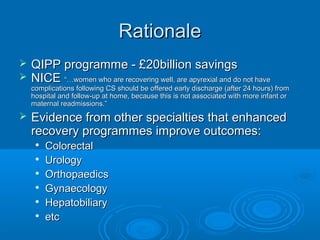
QIPP programme - £20billion savings
NICE “…women who are recovering well, are apyrexial and do not have

complications following CS should be offered early discharge (after 24 hours) from
hospital and follow-up at home, because this is not associated with more infant or
maternal readmissions.”



Evidence from other specialties that enhanced
recovery programmes improve outcomes:







Colorectal
Urology
Orthopaedics
Gynaecology
Hepatobiliary
etc
•
•

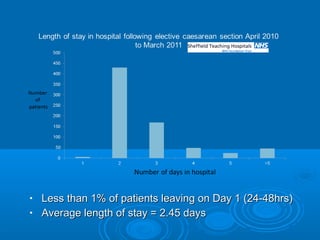
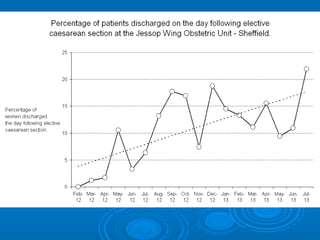
Less than 1% of patients leaving on Day 1 (24-48hrs)
Average length of stay = 2.45 days
Enhanced recovery
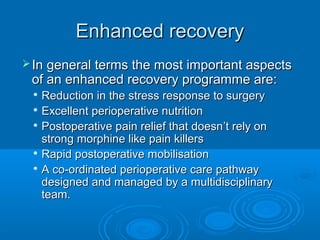
 In general terms the most important aspects

of an enhanced recovery programme are:
Reduction in the stress response to surgery

Excellent perioperative nutrition
 Postoperative pain relief that doesn ’t rely on
strong morphine like pain killers
 Rapid postoperative mobilisation

A co-ordinated perioperative care pathway
designed and managed by a multidisciplinary
team.

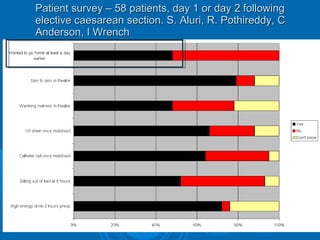
Patient survey – 58 patients, day 1 or day 2 following
elective caesarean section. S. Aluri, R. Pothireddy, C
Anderson, I Wrench
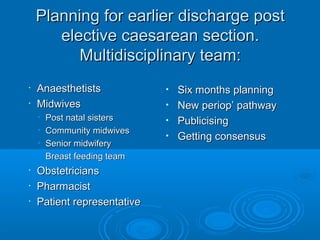
Planning for earlier discharge post
elective caesarean section.
Multidisciplinary team:
•

•
•
•

Anaesthetists
Midwives

•

•
•
•
•

•

•

Post natal sisters
Community midwives
Senior midwifery
Breast feeding team

Obstetricians
Pharmacist
Patient representative

•

•

Six months planning
New periop’ pathway
Publicising
Getting consensus
What changes did we
introduce?
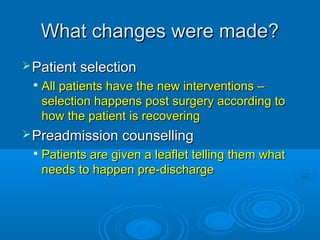
What changes were made?
 Patient selection


All patients have the new interventions –
selection happens post surgery according to
how the patient is recovering

 Preadmission counselling


Patients are given a leaflet telling them what
needs to happen pre-discharge
You are going to have a planned
(elective) caesarean section. Usually
you will stay in hospital for at least
two days but some women may go
home the day after the operation if
their recovery is going well. Below is
some information about what needs
to have happened before you can go
home.
NEW WORDING:
You are going to have a planned (elective)
caesarean section. If your recovery is
going well you may go home the day after
the operation. Below is some information
about what needs to have happened
before you can go home.
What changes were made?
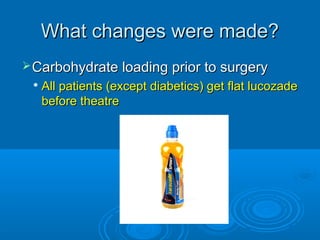
 Carbohydrate loading prior to surgery


All patients (except diabetics) get flat lucozade
before theatre
What changes were made?
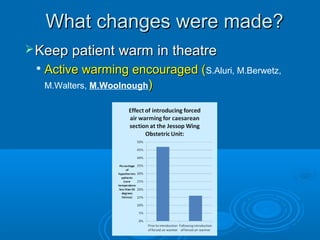
 Keep patient warm


in theatre

Active warming encouraged (S.Aluri, M.Berwetz,
M.Walters, M.Woolnough)
What changes were made?
 Avoidance of fluid overload in theatre


Usually fluid management is simple – no large
fluid shifts

 Surgical technique - short incisions/ no

drains


Already have horizontal incision with drains
rarely used.
What changes were made?
 Non-opiate oral analgesics/ NSAIDs

where possible postoperatively

New oramorph regime introduced – service
evaluation shows it to be effective

TTO’s prescribed in theatre so that this isn’t a
problem to organise later


 Prevention of postoperative nausea and

vomiting


No changes made – rarely prevents discharge
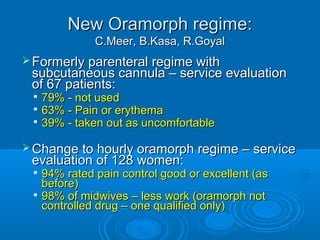
New Oramorph regime:
C.Meer, B.Kasa, R.Goyal
 Formerly parenteral regime with

subcutaneous cannula – service evaluation
of 67 patients:
79% - not used

63% - Pain or erythema

39% - taken out as uncomfortable


 Change to hourly oramorph regime – service

evaluation of 128 women:

94% rated pain control good or excellent (as
before)

98% of midwives – less work (oramorph not
controlled drug – one qualified only)

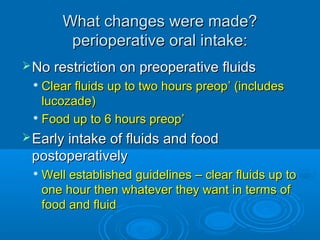
What changes were made?
perioperative oral intake:
 No restriction on preoperative fluids

Clear fluids up to two hours preop’ (includes
lucozade)
 Food up to 6 hours preop ’


 Early intake of fluids and food

postoperatively


Well established guidelines – clear fluids up to
one hour then whatever they want in terms of
food and fluid
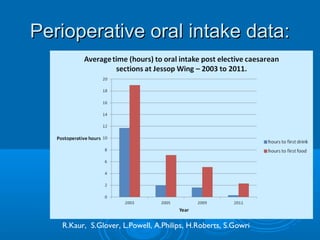
Perioperative oral intake data:

R.Kaur, S.Glover, L.Powell, A.Philips, H.Roberts, S.Gowri
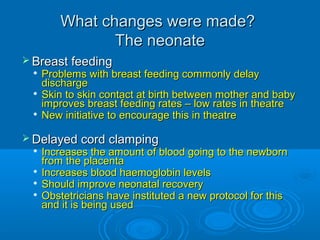
What changes were made?
The neonate
 Breast feeding

Problems with breast feeding commonly delay
discharge
 Skin to skin contact at birth between mother and baby
improves breast feeding rates – low rates in theatre
 New initiative to encourage this in theatre


 Delayed cord clamping

Increases the amount of blood going to the newborn
from the placenta

Increases blood haemoglobin levels
 Should improve neonatal recovery
 Obstetricians have instituted a new protocol for this
and it is being used

Postoperative management:


Postoperative mobilisation








Spinal anaesthesia takes 4 to 9 hours to wear off
8 hours post op is in the evening for most
Fewer staff then - ?safe to mobilise?
Patients ambivalent about early mobilisation
Elected to mobilise day after surgery as before.

Removal of urinary catheters


No change – removed on mobilising as before
Telephone service evaluation:







19 women were followed up by telephone on
discharge
100% reported they were able to do daily
activities
96% reported feeling ‘back to normal’
82.3% reported no pain.
76.5% breastfeeding rate; 100% reported no
problems at all in looking after the baby
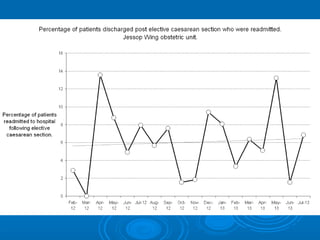
No readmissions or problems reported in women
or neonates discharged on day 1
Summary
 Enhanced recovery successfully

introduced for elective caesarean section
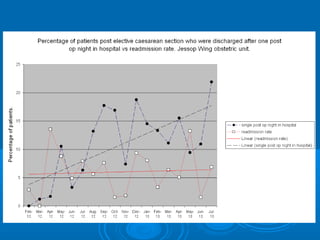
 15 - 20% of patients leave on day one


Previously around 1%

 No increase in readmission rates
 No evidence of problems in the

community
Future developments




Apply to emergency caesarean sections
Increase uptake of skin to skin and delayed cord
clamping in theatre
Patient self administration of postop’ analgesia


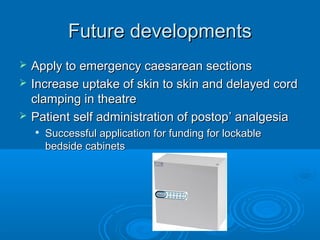
Successful application for funding for lockable
bedside cabinets
Next day discharge following elective caesarean section

Next day discharge following elective caesarean section

  • 1.
    Next day dischargefollowing elective caesarean section using Enhanced Recovery Care Pathways. Ian Wrench (Consultant Anaesthetist) Andrea Galimberti (Consultant Obstetrician) Jan Hall (Midwifery Sister – Postnatal ward) Julie Humphries (Midwifery Sister – Postnatal Ward)
  • 2.
    Structure of talk: Rationale for introduction of enhanced recovery for elective caesarean section  Patient survey  Multidisciplinary group  Changes made to pathway  Results  Conclusions and future direction
  • 3.
    Rationale   QIPP programme -£20billion savings NICE “…women who are recovering well, are apyrexial and do not have complications following CS should be offered early discharge (after 24 hours) from hospital and follow-up at home, because this is not associated with more infant or maternal readmissions.”  Evidence from other specialties that enhanced recovery programmes improve outcomes:       Colorectal Urology Orthopaedics Gynaecology Hepatobiliary etc
  • 4.
    • • Less than 1%of patients leaving on Day 1 (24-48hrs) Average length of stay = 2.45 days
  • 5.
    Enhanced recovery  Ingeneral terms the most important aspects of an enhanced recovery programme are: Reduction in the stress response to surgery  Excellent perioperative nutrition  Postoperative pain relief that doesn ’t rely on strong morphine like pain killers  Rapid postoperative mobilisation  A co-ordinated perioperative care pathway designed and managed by a multidisciplinary team. 
  • 6.
    Patient survey –58 patients, day 1 or day 2 following elective caesarean section. S. Aluri, R. Pothireddy, C Anderson, I Wrench
  • 7.
    Planning for earlierdischarge post elective caesarean section. Multidisciplinary team: • • • • Anaesthetists Midwives • • • • • • • Post natal sisters Community midwives Senior midwifery Breast feeding team Obstetricians Pharmacist Patient representative • • Six months planning New periop’ pathway Publicising Getting consensus
  • 8.
    What changes didwe introduce?
  • 9.
    What changes weremade?  Patient selection  All patients have the new interventions – selection happens post surgery according to how the patient is recovering  Preadmission counselling  Patients are given a leaflet telling them what needs to happen pre-discharge
  • 10.
    You are goingto have a planned (elective) caesarean section. Usually you will stay in hospital for at least two days but some women may go home the day after the operation if their recovery is going well. Below is some information about what needs to have happened before you can go home. NEW WORDING: You are going to have a planned (elective) caesarean section. If your recovery is going well you may go home the day after the operation. Below is some information about what needs to have happened before you can go home.
  • 11.
    What changes weremade?  Carbohydrate loading prior to surgery  All patients (except diabetics) get flat lucozade before theatre
  • 12.
    What changes weremade?  Keep patient warm  in theatre Active warming encouraged (S.Aluri, M.Berwetz, M.Walters, M.Woolnough)
  • 13.
    What changes weremade?  Avoidance of fluid overload in theatre  Usually fluid management is simple – no large fluid shifts  Surgical technique - short incisions/ no drains  Already have horizontal incision with drains rarely used.
  • 14.
    What changes weremade?  Non-opiate oral analgesics/ NSAIDs where possible postoperatively New oramorph regime introduced – service evaluation shows it to be effective  TTO’s prescribed in theatre so that this isn’t a problem to organise later   Prevention of postoperative nausea and vomiting  No changes made – rarely prevents discharge
  • 15.
    New Oramorph regime: C.Meer,B.Kasa, R.Goyal  Formerly parenteral regime with subcutaneous cannula – service evaluation of 67 patients: 79% - not used  63% - Pain or erythema  39% - taken out as uncomfortable   Change to hourly oramorph regime – service evaluation of 128 women: 94% rated pain control good or excellent (as before)  98% of midwives – less work (oramorph not controlled drug – one qualified only) 
  • 16.
    What changes weremade? perioperative oral intake:  No restriction on preoperative fluids Clear fluids up to two hours preop’ (includes lucozade)  Food up to 6 hours preop ’   Early intake of fluids and food postoperatively  Well established guidelines – clear fluids up to one hour then whatever they want in terms of food and fluid
  • 17.
    Perioperative oral intakedata: R.Kaur, S.Glover, L.Powell, A.Philips, H.Roberts, S.Gowri
  • 18.
    What changes weremade? The neonate  Breast feeding Problems with breast feeding commonly delay discharge  Skin to skin contact at birth between mother and baby improves breast feeding rates – low rates in theatre  New initiative to encourage this in theatre   Delayed cord clamping Increases the amount of blood going to the newborn from the placenta  Increases blood haemoglobin levels  Should improve neonatal recovery  Obstetricians have instituted a new protocol for this and it is being used 
  • 19.
    Postoperative management:  Postoperative mobilisation       Spinalanaesthesia takes 4 to 9 hours to wear off 8 hours post op is in the evening for most Fewer staff then - ?safe to mobilise? Patients ambivalent about early mobilisation Elected to mobilise day after surgery as before. Removal of urinary catheters  No change – removed on mobilising as before
  • 23.
    Telephone service evaluation:       19women were followed up by telephone on discharge 100% reported they were able to do daily activities 96% reported feeling ‘back to normal’ 82.3% reported no pain. 76.5% breastfeeding rate; 100% reported no problems at all in looking after the baby No readmissions or problems reported in women or neonates discharged on day 1
  • 24.
    Summary  Enhanced recoverysuccessfully introduced for elective caesarean section  15 - 20% of patients leave on day one  Previously around 1%  No increase in readmission rates  No evidence of problems in the community
  • 25.
    Future developments    Apply toemergency caesarean sections Increase uptake of skin to skin and delayed cord clamping in theatre Patient self administration of postop’ analgesia  Successful application for funding for lockable bedside cabinets