drtoufiq19711@yahoo.com
Hypertensive emergencies
and urgencies
Dr. Md.Toufiqur Rahman
MBBS, FCPS, MD, FACC, FESC, FRCP, FSCAI,
FCCP,FAPSC, FAPSIC, FAHA,FACP
Professor of Cardiology
CMMC,Manikganj
Consultant, Medinova, Malbagh branch.
How will you manage a case of 45
years old gentleman presented
with headache and visual
disturbance and papilledema with
BP 200/115 mmHg admitted in
CCU/ICU department?
Cardiology Round
drtoufiq1971@yahoo.com
â€ĸ severe hypertension (grade 3)
â€ĸ associated with acute HMOD,
â€ĸ which is often lifethreatening and
requires immediate but careful
intervention to lower BP, usually with
intravenous (i.v.) therapy.
Cardiology Round
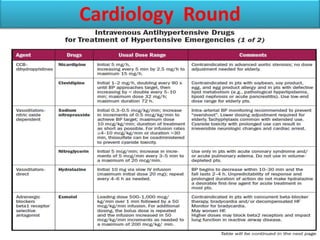
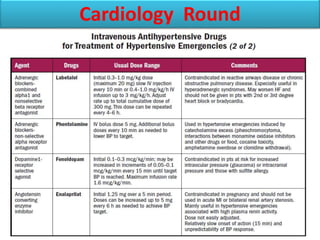
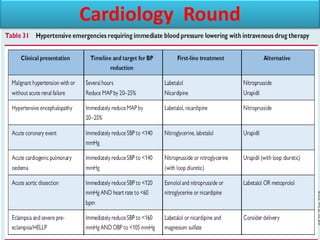
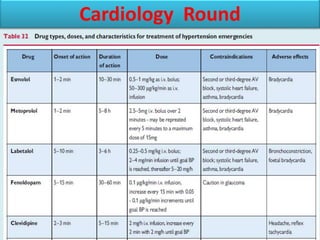
Hypertension emergencies
Typical presentations are:
Patients with malignant hypertension, characterized by
â€ĸ severe hypertension (usually grade 3)
â€ĸ associated with funduscopic changes (flame haemorrhages
and/or papilloedema),
â€ĸ microangiopathy, and
â€ĸ disseminated intravascular coagulation,
â€ĸ and can be associated with encephalopathy (in about 15% of
cases),
â€ĸ acute heart failure, and
â€ĸ acute deterioration in renal function.
â€ĸ The hallmark of this condition is small artery fibrinoid
necrosis in the kidney, retina, and brain.
Cardiology Round
Hypertension emergencies
â€ĸ The term ‘malignant’ reflects the very poor prognosis
for this condition if untreated.
â€ĸ Patients with severe hypertension associated with other
clinical conditions who are likely to require an urgent
reduction of BP, e.g.
acute aortic dissection,
acute myocardial ischaemia, or
acute heart failure.
Patients with sudden severe hypertension due to
phaeochromocytoma, associated with organ damage.
Pregnant women with severe hypertension or
preeclampsia.
Cardiology Round
Hypertension emergencies
The most common emergency symptoms will
depend of the organs affected but may include
headache,
visual disturbances,
Chest pain,
dyspnoea,
dizziness,
 and other neurological deficits.
Cardiology Round
Hypertension emergencies
In patients with hypertensive encephalopathy, the
presence of
somnolence,
lethargy,
tonic clonic seizures,
and cortical blindness may precede a
loss of consciousness;
however, focal neurological lesions are rare
and should raise the suspicion of stroke.
Acute stroke, especially intracerebral haemorrhage.
Cardiology Round
Hypertension emergencies
The term ‘hypertension urgency’ has also been used
to describe
 severe hypertension in patients presenting to the
emergency department
no clinical evidence of acute HMOD.
Require BP reduction but do not usually require
admission to hospital,
BP reduction is best achieved with oral medication
 will require urgent outpatient review to ensure
that their BP is coming under control.
Cardiology Round
Hypertension urgency
Acute and severe increases in BP can sometimes
be precipitated by ingestion of sympathomimetics
such as meta-amphetamine or cocaine.
This can result in a hypertension emergency when
there is evidence of acute HMOD.
many patients in an emergency department with
acute pain or distress may experience an acute
elevation in BP that will be restored to normal
when the pain and distress are relieved, rather
than requiring any specific intervention to lower
BP.
Cardiology Round
Hypertension urgency
Cardiology Round
drtoufiq19711@yahoo.com
Cardiology Round
Cardiology Round
Cardiology Round
Cardiology Round
Cardiology Round
Cardiology Round

Hypertensive emergency and urgency

  • 1.
    drtoufiq19711@yahoo.com Hypertensive emergencies and urgencies Dr.Md.Toufiqur Rahman MBBS, FCPS, MD, FACC, FESC, FRCP, FSCAI, FCCP,FAPSC, FAPSIC, FAHA,FACP Professor of Cardiology CMMC,Manikganj Consultant, Medinova, Malbagh branch.
  • 2.
    How will youmanage a case of 45 years old gentleman presented with headache and visual disturbance and papilledema with BP 200/115 mmHg admitted in CCU/ICU department? Cardiology Round drtoufiq1971@yahoo.com
  • 3.
    â€ĸ severe hypertension(grade 3) â€ĸ associated with acute HMOD, â€ĸ which is often lifethreatening and requires immediate but careful intervention to lower BP, usually with intravenous (i.v.) therapy. Cardiology Round Hypertension emergencies
  • 4.
    Typical presentations are: Patientswith malignant hypertension, characterized by â€ĸ severe hypertension (usually grade 3) â€ĸ associated with funduscopic changes (flame haemorrhages and/or papilloedema), â€ĸ microangiopathy, and â€ĸ disseminated intravascular coagulation, â€ĸ and can be associated with encephalopathy (in about 15% of cases), â€ĸ acute heart failure, and â€ĸ acute deterioration in renal function. â€ĸ The hallmark of this condition is small artery fibrinoid necrosis in the kidney, retina, and brain. Cardiology Round Hypertension emergencies
  • 5.
    â€ĸ The term‘malignant’ reflects the very poor prognosis for this condition if untreated. â€ĸ Patients with severe hypertension associated with other clinical conditions who are likely to require an urgent reduction of BP, e.g. acute aortic dissection, acute myocardial ischaemia, or acute heart failure. Patients with sudden severe hypertension due to phaeochromocytoma, associated with organ damage. Pregnant women with severe hypertension or preeclampsia. Cardiology Round Hypertension emergencies
  • 6.
    The most commonemergency symptoms will depend of the organs affected but may include headache, visual disturbances, Chest pain, dyspnoea, dizziness,  and other neurological deficits. Cardiology Round Hypertension emergencies
  • 7.
    In patients withhypertensive encephalopathy, the presence of somnolence, lethargy, tonic clonic seizures, and cortical blindness may precede a loss of consciousness; however, focal neurological lesions are rare and should raise the suspicion of stroke. Acute stroke, especially intracerebral haemorrhage. Cardiology Round Hypertension emergencies
  • 8.
    The term ‘hypertensionurgency’ has also been used to describe  severe hypertension in patients presenting to the emergency department no clinical evidence of acute HMOD. Require BP reduction but do not usually require admission to hospital, BP reduction is best achieved with oral medication  will require urgent outpatient review to ensure that their BP is coming under control. Cardiology Round Hypertension urgency
  • 9.
    Acute and severeincreases in BP can sometimes be precipitated by ingestion of sympathomimetics such as meta-amphetamine or cocaine. This can result in a hypertension emergency when there is evidence of acute HMOD. many patients in an emergency department with acute pain or distress may experience an acute elevation in BP that will be restored to normal when the pain and distress are relieved, rather than requiring any specific intervention to lower BP. Cardiology Round Hypertension urgency
  • 10.
  • 11.
  • 13.
  • 14.
  • 15.
  • 16.
  • 17.