HYPERTENSIVE
EMERGENCIES
 Lakshmi Beeravolu,MD
Discussion
    Categories
    Etiology/pathophysiology
    History/Physical
    Workup
    Treatment
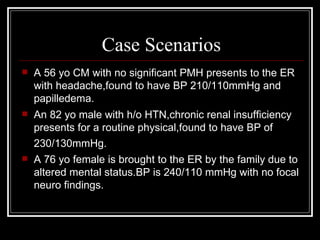
Case Scenarios
   A 56 yo CM with no significant PMH presents to the ER
    with headache,found to have BP 210/110mmHg and
    papilledema.
   An 82 yo male with h/o HTN,chronic renal insufficiency
    presents for a routine physical,found to have BP of
    230/130mmHg.
   A 76 yo female is brought to the ER by the family due to
    altered mental status.BP is 240/110 mmHg with no focal
    neuro findings.
DEFINITIONS
    Systolic blood pressure >220 and diastolic >120mmHg.
    Patients with hypertension can be classified into 3 categories based upon their
     symptoms and the organ systems that are affected at the time of presentation:
    -HYPERTENSIVE EMERGENCY: also called hypertensive crisis, is severe
     hypertension with acute impairment of an organ system (e.g., central nervous
     system [CNS], cardiovascular, renal). In these conditions, the blood pressure (BP)
     should be lowered aggressively over minutes to hours.Presence of papilledema
     indicates MALIGNANT HYPERTENSION.
    -HYPERTENSIVE URGENCY: the BP is a potential risk but has not yet caused acute
     end-organ damage. These patients require BP control over several days to weeks.
    -ACCELERATED HYPERTENSION: recent significant increase over baseline blood
     pressure that is associated with target organ damage. This is usually vascular
     damage on fundoscopic examination, such as flame-shaped hemorrhages or soft
     exudates, but without papilledema.
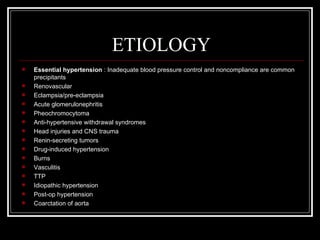
ETIOLOGY
   Essential hypertension : Inadequate blood pressure control and noncompliance are common
    precipitants
   Renovascular
   Eclampsia/pre-eclampsia
   Acute glomerulonephritis
   Pheochromocytoma
   Anti-hypertensive withdrawal syndromes
   Head injuries and CNS trauma
   Renin-secreting tumors
   Drug-induced hypertension
   Burns
   Vasculitis
   TTP
   Idiopathic hypertension
   Post-op hypertension
   Coarctation of aorta
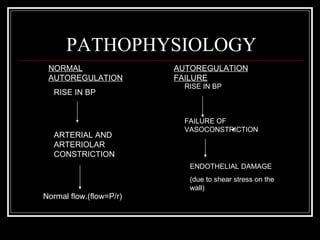
PATHOPHYSIOLOGY
 NORMAL                  AUTOREGULATION
 AUTOREGULATION          FAILURE
                           RISE IN BP
  RISE IN BP


                           FAILURE OF
                           VASOCONSTRICTION
  ARTERIAL AND
  ARTERIOLAR
  CONSTRICTION
                            ENDOTHELIAL DAMAGE
                            (due to shear stress on the
                            wall)
Normal flow.(flow=P/r)
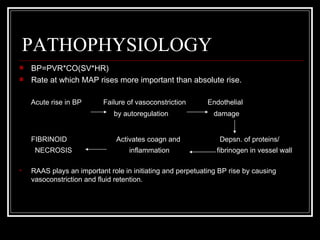
PATHOPHYSIOLOGY
   BP=PVR*CO(SV*HR)
   Rate at which MAP rises more important than absolute rise.

    Acute rise in BP      Failure of vasoconstriction       Endothelial
                              by autoregulation               damage


    FIBRINOID                  Activates coagn and              Depsn. of proteins/
     NECROSIS                      inflammation                fibrinogen in vessel wall

   RAAS plays an important role in initiating and perpetuating BP rise by causing
    vasoconstriction and fluid retention.
CENTRAL NERVOUS SYSTEM
   CENTRAL NERVOUS SYSTEM: The CNS is affected as the elevated BP
    overwhelms the normal cerebral autoregulation. Under normal circumstances, with
    an increase in BP, cerebral arterioles vasoconstrict and cerebral blood flow (CBF)
    remains constant. During a hypertensive emergency, the elevated BP overwhelms
    arteriolar control over vasoconstriction and autoregulation of CBF. This results in
    transudate leak across capillaries and continued arteriolar damage. Subsequent
    fibrinoid necrosis causes normal autoregulatory mechanisms to fail, leading to
    clinically apparent papilledema, the sine qua non of malignant hypertension. The end
    result of loss of autoregulation is hypertensive encephalopathy.
CARDIOVASCULAR SYSTEM
   The cardiovascular system is affected as
    increased cardiac workload leads to cardiac
    failure; this is accompanied by pulmonary
    edema, myocardial ischemia, or myocardial
    infarction.
RENAL SYSTEM
   The renal system is impaired when high BP
    leads to arteriosclerosis, fibrinoid necrosis,
    and an overall impairment of renal
    protective autoregulation mechanisms. This
    may manifest as worsening renal function,
    hematuria, red blood cell (RBC) cast
    formation, and/or proteinuria.
EPIDEMIOLOGY
   In the US: More than 60 million Americans, about 25-30% of the
    population, have hypertension. Of these individuals, 70% have mild
    disease, 20% moderate, and 10% severe hypertension (diastolic BP [DBP]
    >110 mm Hg). Approximately 1-2% develop a hypertensive emergency with
    end-organ damage.
   Mortality/Morbidity: Morbidity and mortality depend on the extent of end-
    organ damage on presentation and the degree to which BP is controlled
    subsequently. BP control may prevent progression to end-organ
    impairment. I yr mortality in untreated pts. >90%.5 yr survival of all
    presentations is 74%.
   Race: African Americans have a higher incidence of hypertensive
    emergencies than Caucasians.
   Sex: Males are at greater risk of hypertensive emergencies than females.
   Age:Most commonly in middle-aged people.Peak age:40-50yrs.
HISTORY
   Focus on circumstances surrounding hypertension & etiology :
    -Medications:esp. hypertensive drugs/their compliance,illicit drugs
    -Duration of hypertension
    -Duration of current symptoms
    -Date of LMP
    -Other medical problems:prior
    hypertension,thyrotoxicosis,Cushing’s,SLE,renal
   Focus on complications :
    -CNS:headaches,blurred vision,wt. loss,nausea,vomiting,weakness,fatigue,
     confusion and mental status changes.
    -CVS:symptoms of CHF,angina,dissection,SOB
    -Renal:hematuria,oliguria.
PHYSICAL
   Use an approach based on organ systems to identify signs of end-
    organ damage
    -CNS: focal neuro deficits,seizures,stupor,coma, papilledema,
    hemorrhages, exudates, or evidence of closed-angle glaucoma
    -CVS:JVD,lung auscultaion for crackles,peripheral edema,extra
    heart sounds, equal and symmetric BP and pulses bilaterally.
    -Check for abdominal masses and bruits.
DIFFERENTIALS
Acute Coronary Syndrome
Aortic dissection
CHF,pulmonary edema
Acute Coronary Syndrome
Aneurysm, Abdominal
Anxiety
Congestive Heart Failure and Pulmonary Edema
Cushing Syndrome
Delirium Tremens
Encephalitis
Glomerulonephritis, Acute
Headache, Cluster
Headache, Migraine
Headache, Tension
Hyperthyroidism, Thyroid Storm, and Graves Disease
Myocardial Infarction
Pregnancy, Eclampsia
Pregnancy, Preeclampsia
Stroke, Hemorrhagic
Stroke, Ischemic
Subarachnoid Hemorrhage
Systemic Lupus Erythematosus
Differential(contd.)
   Others:
    -Steroid use
    -Use of over-the-counter or recreational
    sympathomimetic drugs
    -Pheochromocytoma
    -Acute vasculitis
    -Serotonin syndrome
    -Other CNS pathology
    -Coarctation of the aorta
Work-up
   CBC,Chem 8
   Urinanalysis:hematuria,proteinuria,RBCs,RBC casts.
   Toxicology,pregnancy,endocrine causes.
   Imaging:Chest X-ray,Head CT,Chest CT,aortic angiogram
   EKG,cardiac enzymes
TREATMENT
   Weigh benefits of decreasing BP against risks of decreasing end-
    organ perfusion. Important steps include:
    -Appropriately evaluating patients with an elevated BP
    -Correctly classifying the hypertension
    -Determining aggressiveness of therapy
    An important point to remember in the management of the patient
    with any degree of BP elevation is to "treat the patient and not the
    number."
Treatment
   Initial considerations: Place patient who is not in distress in a quiet
    room and reevaluate after an initial interview. In one study, 27% of patients
    with an initial DBP >130 mm Hg had their DBP fall below critical levels after
    relaxation without specific treatment.
   Consider the context of the elevated BP (eg, severe pain)
   Screen for end-organ damage- Patients with end-organ damage usually
    require admission and rapid lowering of BP using iv meds.Suggested meds
    depend on the end-organ system damaged.
   Patients without evidence of end-organ effects may be discharged with
    follow–up.It is a misconception that a patient should not be discharged from
    the ER with elevated BP.Giving oral meds such as nifedipine to rapidly
    lower BP may be dangerous as the BP may have been elevated for
    sometime and there may be organ hypoperfusion.Acute control has not
    improved long term mortality and morbidity rates.
INITIAL STEPS
   Initial considerations: Place patient who is not in distress in a quiet
    room and reevaluate after an initial interview. In one study, 27% of patients
    with an initial DBP >130 mm Hg had their DBP fall below critical levels after
    relaxation without specific treatment.
   Consider the context of the elevated BP (eg, severe pain)
   Screen for end-organ damage- Patients with end-organ damage usually
    require admission and rapid lowering of BP using iv meds.Suggested meds
    depend on the end-organ system damaged.
   Patients without evidence of end-organ effects may be discharged with
    follow–up.It is a misconception that a patient should not be discharged from
    the ER with elevated BP. Giving oral meds such as nifedipine to rapidly
    lower BP may be dangerous as the BP may have been elevated for
    sometime and there may be organ hypoperfusion.Acute control has
    not improved long term mortality and morbidity rates.
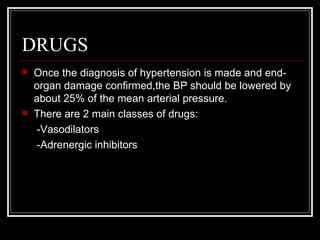
DRUGS
   Once the diagnosis of hypertension is made and end-
    organ damage confirmed,the BP should be lowered by
    about 25% of the mean arterial pressure.
   There are 2 main classes of drugs:
    -Vasodilators
    -Adrenergic inhibitors
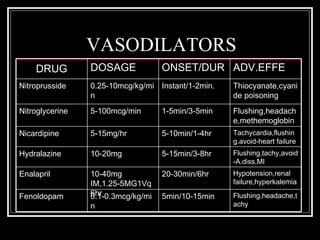
VASODILATORS
    DRUG         DOSAGE             ONSET/DUR ADV.EFFE
Nitroprusside    0.25-10mcg/kg/mi Instant/1-2min.   Thiocyanate,cyani
                 n                                  de poisoning
Nitroglycerine   5-100mcg/min       1-5min/3-5min   Flushing,headach
                                                    e,methemoglobin
Nicardipine      5-15mg/hr          5-10min/1-4hr   Tachycardia,flushin
                                                    g.avoid-heart failure
Hydralazine      10-20mg            5-15min/3-8hr   Flushing,tachy,avoid
                                                    -A.diss,MI
Enalapril        10-40mg            20-30min/6hr    Hypotension,renal
                 IM,1.25-5MG1Vq                     failure,hyperkalemia

Fenoldopam       6hr
                 0.1-0.3mcg/kg/mi   5min/10-15min   Flushing,headache,t
                 n                                  achy
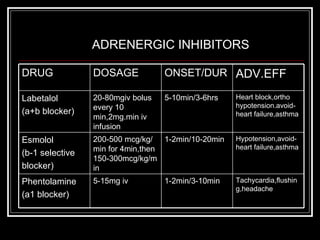
ADRENERGIC INHIBITORS

DRUG             DOSAGE            ONSET/DUR ADV.EFF

Labetalol        20-80mgiv bolus   5-10min/3-6hrs   Heart block,ortho
                 every 10                           hypotension.avoid-
(a+b blocker)                                       heart failure,asthma
                 min,2mg.min iv
                 infusion
Esmolol          200-500 mcg/kg/ 1-2min/10-20min    Hypotension,avoid-
                 min for 4min,then                  heart failure,asthma
(b-1 selective
                 150-300mcg/kg/m
blocker)         in
Phentolamine     5-15mg iv         1-2min/3-10min   Tachycardia,flushin
                                                    g,headache
(a1 blocker)
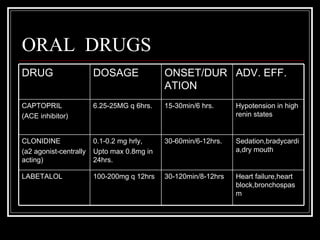
ORAL DRUGS
DRUG                    DOSAGE              ONSET/DUR ADV. EFF.
                                            ATION
CAPTOPRIL               6.25-25MG q 6hrs.   15-30min/6 hrs.     Hypotension in high
(ACE inhibitor)                                                 renin states


CLONIDINE               0.1-0.2 mg hrly,    30-60min/6-12hrs.   Sedation,bradycardi
(a2 agonist-centrally   Upto max 0.8mg in                       a,dry mouth
acting)                 24hrs.

LABETALOL               100-200mg q 12hrs   30-120min/8-12hrs   Heart failure,heart
                                                                block,bronchospas
                                                                m
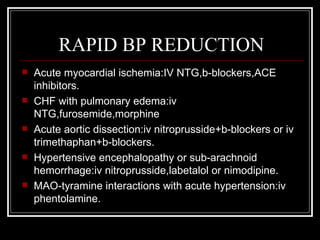
RAPID BP REDUCTION
   Acute myocardial ischemia:IV NTG,b-blockers,ACE
    inhibitors.
   CHF with pulmonary edema:iv
    NTG,furosemide,morphine
   Acute aortic dissection:iv nitroprusside+b-blockers or iv
    trimethaphan+b-blockers.
   Hypertensive encephalopathy or sub-arachnoid
    hemorrhage:iv nitroprusside,labetalol or nimodipine.
   MAO-tyramine interactions with acute hypertension:iv
    phentolamine.
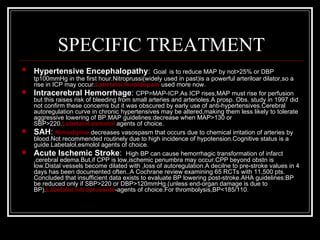
SPECIFIC TREATMENT
   Hypertensive Encephalopathy:                  Goal is to reduce MAP by not>25% or DBP
    tp100mmHg in the first hour.Nitroprussi(widely used in past)is a powerful arteriloar dilator,so a
    rise in ICP may occur.Labetalol,fenoldopam used more now.
   Intracerebral Hemorrhage: CPP=MAP-ICP.As ICP rises,MAP must rise for perfusion
    but this raises risk of bleeding from small arteries and arterioles.A prosp. Obs. study in 1997 did
    not confirm these concerns but it was obscured by early use of anti-hypertensives.Cerebral
    autoregulation curve in chronic hypertensives may be altered,making them less likely to tolerate
    aggressive lowering of BP.MAP guidelines:decrease when MAP>130 or
    SBP>220.Labetalol,esmolol agents of choice.
   SAH: Nimodipine decreases vasospasm that occurs due to chemical irritation of arteries by
    blood.Not recommended routinely due to high incidence of hypotension.Cognitive status is a
    guide.Labetalol,esmolol agents of choice.
   Acute Ischemic Stroke: High BP can cause hemorrhagic transformation of infarct
    ,cerebral edema.But,if CPP is low,ischemic penumbra may occur.CPP beyond obstn is
    low.Distal vessels become dilated with ,loss of autoregulation.A decilne to pre-stroke values in 4
    days has been documented often..A Cochrane review examining 65 RCTs with 11,500 pts.
    Concluded that insufficient data exists to evaluate BP lowering post-stroke.AHA guidelines:BP
    be reduced only if SBP>220 or DBP>120mmHg.(unless end-organ damage is due to
    BP).Labetalol,nitroprusside-agents of choice.For thrombolysis,BP<185/110.
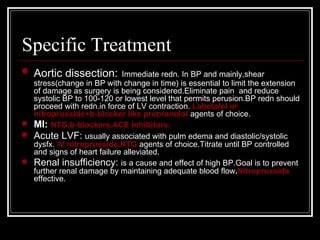
Specific Treatment
   Aortic dissection:      Immediate redn. In BP and mainly,shear
  stress(change in BP with change in time) is essential to limit the extension
  of damage as surgery is being considered.Eliminate pain and reduce
  systolic BP to 100-120 or lowest level that permits perusion.BP redn should
  proceed with redn.in force of LV contraction. Labetalol or
  nitroprusside+b-blocker like propranolol agents of choice.
 MI: NTG,b-blockers,ACE inhibitors.
 Acute LVF: usually associated with pulm edema and diastolic/systolic
  dysfx. IV nitroprusside,NTG agents of choice.Titrate until BP controlled
  and signs of heart failure alleviated.
 Renal insufficiency: is a cause and effect of high BP.Goal is to prevent
  further renal damage by maintaining adequate blood flow.Nitroprusside
  effective.
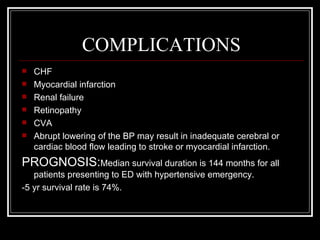
COMPLICATIONS
   CHF
   Myocardial infarction
   Renal failure
   Retinopathy
   CVA
   Abrupt lowering of the BP may result in inadequate cerebral or
    cardiac blood flow leading to stroke or myocardial infarction.
PROGNOSIS:Median survival duration is 144 months for all
   patients presenting to ED with hypertensive emergency.
-5 yr survival rate is 74%.
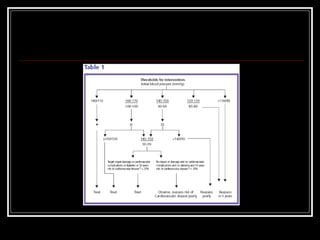
FOLLOW-UP
    The Joint National Committee on High Blood Pressure has
     published a series of recommendations for appropriate follow-up,
     assuming no end-organ damage.
    -For a systolic BP 140-159 mm Hg/diastolic 90-99 mm Hg, confirm
     BP within 2 months.
    -For systolic BP 160-179 mm Hg/diastolic 100-109 mm Hg, evaluate
     within a month.
    - For systolic BP 180-209 mm Hg/diastolic 110-119 mm Hg,
     evaluate within a week.
    -For systolic BP greater than 210 mm Hg/diastolic greater than 120
     mm Hg, evaluate immediately.
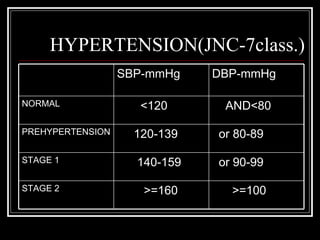
HYPERTENSION(JNC-7class.)
                  SBP-mmHg    DBP-mmHg

NORMAL               <120      AND<80

PREHYPERTENSION     120-139   or 80-89

STAGE 1             140-159   or 90-99

STAGE 2              >=160      >=100
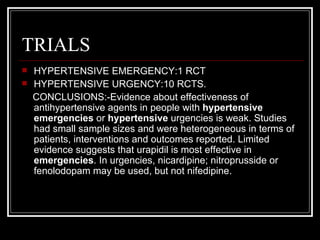
TRIALS
   HYPERTENSIVE EMERGENCY:1 RCT
   HYPERTENSIVE URGENCY:10 RCTS.
    CONCLUSIONS:-Evidence about effectiveness of
    antihypertensive agents in people with hypertensive
    emergencies or hypertensive urgencies is weak. Studies
    had small sample sizes and were heterogeneous in terms of
    patients, interventions and outcomes reported. Limited
    evidence suggests that urapidil is most effective in
    emergencies. In urgencies, nicardipine; nitroprusside or
    fenolodopam may be used, but not nifedipine.
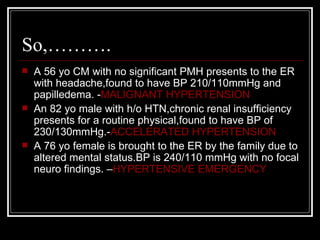
So,……….
   A 56 yo CM with no significant PMH presents to the ER
    with headache,found to have BP 210/110mmHg and
    papilledema. -MALIGNANT HYPERTENSION
   An 82 yo male with h/o HTN,chronic renal insufficiency
    presents for a routine physical,found to have BP of
    230/130mmHg.-ACCELERATED HYPERTENSION
   A 76 yo female is brought to the ER by the family due to
    altered mental status.BP is 240/110 mmHg with no focal
    neuro findings. –HYPERTENSIVE EMERGENCY

Hypertensive Emergencies

  • 1.
  • 2.
    Discussion  Categories  Etiology/pathophysiology  History/Physical  Workup  Treatment
  • 3.
    Case Scenarios  A 56 yo CM with no significant PMH presents to the ER with headache,found to have BP 210/110mmHg and papilledema.  An 82 yo male with h/o HTN,chronic renal insufficiency presents for a routine physical,found to have BP of 230/130mmHg.  A 76 yo female is brought to the ER by the family due to altered mental status.BP is 240/110 mmHg with no focal neuro findings.
  • 4.
    DEFINITIONS  Systolic blood pressure >220 and diastolic >120mmHg.  Patients with hypertension can be classified into 3 categories based upon their symptoms and the organ systems that are affected at the time of presentation: -HYPERTENSIVE EMERGENCY: also called hypertensive crisis, is severe hypertension with acute impairment of an organ system (e.g., central nervous system [CNS], cardiovascular, renal). In these conditions, the blood pressure (BP) should be lowered aggressively over minutes to hours.Presence of papilledema indicates MALIGNANT HYPERTENSION. -HYPERTENSIVE URGENCY: the BP is a potential risk but has not yet caused acute end-organ damage. These patients require BP control over several days to weeks. -ACCELERATED HYPERTENSION: recent significant increase over baseline blood pressure that is associated with target organ damage. This is usually vascular damage on fundoscopic examination, such as flame-shaped hemorrhages or soft exudates, but without papilledema.
  • 5.
    ETIOLOGY  Essential hypertension : Inadequate blood pressure control and noncompliance are common precipitants  Renovascular  Eclampsia/pre-eclampsia  Acute glomerulonephritis  Pheochromocytoma  Anti-hypertensive withdrawal syndromes  Head injuries and CNS trauma  Renin-secreting tumors  Drug-induced hypertension  Burns  Vasculitis  TTP  Idiopathic hypertension  Post-op hypertension  Coarctation of aorta
  • 6.
    PATHOPHYSIOLOGY NORMAL AUTOREGULATION AUTOREGULATION FAILURE RISE IN BP RISE IN BP FAILURE OF VASOCONSTRICTION ARTERIAL AND ARTERIOLAR CONSTRICTION ENDOTHELIAL DAMAGE (due to shear stress on the wall) Normal flow.(flow=P/r)
  • 7.
    PATHOPHYSIOLOGY  BP=PVR*CO(SV*HR)  Rate at which MAP rises more important than absolute rise. Acute rise in BP Failure of vasoconstriction Endothelial by autoregulation damage FIBRINOID Activates coagn and Depsn. of proteins/ NECROSIS inflammation fibrinogen in vessel wall  RAAS plays an important role in initiating and perpetuating BP rise by causing vasoconstriction and fluid retention.
  • 8.
    CENTRAL NERVOUS SYSTEM  CENTRAL NERVOUS SYSTEM: The CNS is affected as the elevated BP overwhelms the normal cerebral autoregulation. Under normal circumstances, with an increase in BP, cerebral arterioles vasoconstrict and cerebral blood flow (CBF) remains constant. During a hypertensive emergency, the elevated BP overwhelms arteriolar control over vasoconstriction and autoregulation of CBF. This results in transudate leak across capillaries and continued arteriolar damage. Subsequent fibrinoid necrosis causes normal autoregulatory mechanisms to fail, leading to clinically apparent papilledema, the sine qua non of malignant hypertension. The end result of loss of autoregulation is hypertensive encephalopathy.
  • 9.
    CARDIOVASCULAR SYSTEM  The cardiovascular system is affected as increased cardiac workload leads to cardiac failure; this is accompanied by pulmonary edema, myocardial ischemia, or myocardial infarction.
  • 10.
    RENAL SYSTEM  The renal system is impaired when high BP leads to arteriosclerosis, fibrinoid necrosis, and an overall impairment of renal protective autoregulation mechanisms. This may manifest as worsening renal function, hematuria, red blood cell (RBC) cast formation, and/or proteinuria.
  • 11.
    EPIDEMIOLOGY  In the US: More than 60 million Americans, about 25-30% of the population, have hypertension. Of these individuals, 70% have mild disease, 20% moderate, and 10% severe hypertension (diastolic BP [DBP] >110 mm Hg). Approximately 1-2% develop a hypertensive emergency with end-organ damage.  Mortality/Morbidity: Morbidity and mortality depend on the extent of end- organ damage on presentation and the degree to which BP is controlled subsequently. BP control may prevent progression to end-organ impairment. I yr mortality in untreated pts. >90%.5 yr survival of all presentations is 74%.  Race: African Americans have a higher incidence of hypertensive emergencies than Caucasians.  Sex: Males are at greater risk of hypertensive emergencies than females.  Age:Most commonly in middle-aged people.Peak age:40-50yrs.
  • 12.
    HISTORY  Focus on circumstances surrounding hypertension & etiology : -Medications:esp. hypertensive drugs/their compliance,illicit drugs -Duration of hypertension -Duration of current symptoms -Date of LMP -Other medical problems:prior hypertension,thyrotoxicosis,Cushing’s,SLE,renal  Focus on complications : -CNS:headaches,blurred vision,wt. loss,nausea,vomiting,weakness,fatigue, confusion and mental status changes. -CVS:symptoms of CHF,angina,dissection,SOB -Renal:hematuria,oliguria.
  • 13.
    PHYSICAL  Use an approach based on organ systems to identify signs of end- organ damage -CNS: focal neuro deficits,seizures,stupor,coma, papilledema, hemorrhages, exudates, or evidence of closed-angle glaucoma -CVS:JVD,lung auscultaion for crackles,peripheral edema,extra heart sounds, equal and symmetric BP and pulses bilaterally. -Check for abdominal masses and bruits.
  • 14.
    DIFFERENTIALS Acute Coronary Syndrome Aorticdissection CHF,pulmonary edema Acute Coronary Syndrome Aneurysm, Abdominal Anxiety Congestive Heart Failure and Pulmonary Edema Cushing Syndrome Delirium Tremens Encephalitis Glomerulonephritis, Acute Headache, Cluster Headache, Migraine Headache, Tension Hyperthyroidism, Thyroid Storm, and Graves Disease Myocardial Infarction Pregnancy, Eclampsia Pregnancy, Preeclampsia Stroke, Hemorrhagic Stroke, Ischemic Subarachnoid Hemorrhage Systemic Lupus Erythematosus
  • 15.
    Differential(contd.)  Others: -Steroid use -Use of over-the-counter or recreational sympathomimetic drugs -Pheochromocytoma -Acute vasculitis -Serotonin syndrome -Other CNS pathology -Coarctation of the aorta
  • 16.
    Work-up  CBC,Chem 8  Urinanalysis:hematuria,proteinuria,RBCs,RBC casts.  Toxicology,pregnancy,endocrine causes.  Imaging:Chest X-ray,Head CT,Chest CT,aortic angiogram  EKG,cardiac enzymes
  • 17.
    TREATMENT  Weigh benefits of decreasing BP against risks of decreasing end- organ perfusion. Important steps include: -Appropriately evaluating patients with an elevated BP -Correctly classifying the hypertension -Determining aggressiveness of therapy An important point to remember in the management of the patient with any degree of BP elevation is to "treat the patient and not the number."
  • 18.
    Treatment  Initial considerations: Place patient who is not in distress in a quiet room and reevaluate after an initial interview. In one study, 27% of patients with an initial DBP >130 mm Hg had their DBP fall below critical levels after relaxation without specific treatment.  Consider the context of the elevated BP (eg, severe pain)  Screen for end-organ damage- Patients with end-organ damage usually require admission and rapid lowering of BP using iv meds.Suggested meds depend on the end-organ system damaged.  Patients without evidence of end-organ effects may be discharged with follow–up.It is a misconception that a patient should not be discharged from the ER with elevated BP.Giving oral meds such as nifedipine to rapidly lower BP may be dangerous as the BP may have been elevated for sometime and there may be organ hypoperfusion.Acute control has not improved long term mortality and morbidity rates.
  • 19.
    INITIAL STEPS  Initial considerations: Place patient who is not in distress in a quiet room and reevaluate after an initial interview. In one study, 27% of patients with an initial DBP >130 mm Hg had their DBP fall below critical levels after relaxation without specific treatment.  Consider the context of the elevated BP (eg, severe pain)  Screen for end-organ damage- Patients with end-organ damage usually require admission and rapid lowering of BP using iv meds.Suggested meds depend on the end-organ system damaged.  Patients without evidence of end-organ effects may be discharged with follow–up.It is a misconception that a patient should not be discharged from the ER with elevated BP. Giving oral meds such as nifedipine to rapidly lower BP may be dangerous as the BP may have been elevated for sometime and there may be organ hypoperfusion.Acute control has not improved long term mortality and morbidity rates.
  • 20.
    DRUGS  Once the diagnosis of hypertension is made and end- organ damage confirmed,the BP should be lowered by about 25% of the mean arterial pressure.  There are 2 main classes of drugs: -Vasodilators -Adrenergic inhibitors
  • 21.
    VASODILATORS DRUG DOSAGE ONSET/DUR ADV.EFFE Nitroprusside 0.25-10mcg/kg/mi Instant/1-2min. Thiocyanate,cyani n de poisoning Nitroglycerine 5-100mcg/min 1-5min/3-5min Flushing,headach e,methemoglobin Nicardipine 5-15mg/hr 5-10min/1-4hr Tachycardia,flushin g.avoid-heart failure Hydralazine 10-20mg 5-15min/3-8hr Flushing,tachy,avoid -A.diss,MI Enalapril 10-40mg 20-30min/6hr Hypotension,renal IM,1.25-5MG1Vq failure,hyperkalemia Fenoldopam 6hr 0.1-0.3mcg/kg/mi 5min/10-15min Flushing,headache,t n achy
  • 22.
    ADRENERGIC INHIBITORS DRUG DOSAGE ONSET/DUR ADV.EFF Labetalol 20-80mgiv bolus 5-10min/3-6hrs Heart block,ortho every 10 hypotension.avoid- (a+b blocker) heart failure,asthma min,2mg.min iv infusion Esmolol 200-500 mcg/kg/ 1-2min/10-20min Hypotension,avoid- min for 4min,then heart failure,asthma (b-1 selective 150-300mcg/kg/m blocker) in Phentolamine 5-15mg iv 1-2min/3-10min Tachycardia,flushin g,headache (a1 blocker)
  • 23.
    ORAL DRUGS DRUG DOSAGE ONSET/DUR ADV. EFF. ATION CAPTOPRIL 6.25-25MG q 6hrs. 15-30min/6 hrs. Hypotension in high (ACE inhibitor) renin states CLONIDINE 0.1-0.2 mg hrly, 30-60min/6-12hrs. Sedation,bradycardi (a2 agonist-centrally Upto max 0.8mg in a,dry mouth acting) 24hrs. LABETALOL 100-200mg q 12hrs 30-120min/8-12hrs Heart failure,heart block,bronchospas m
  • 24.
    RAPID BP REDUCTION  Acute myocardial ischemia:IV NTG,b-blockers,ACE inhibitors.  CHF with pulmonary edema:iv NTG,furosemide,morphine  Acute aortic dissection:iv nitroprusside+b-blockers or iv trimethaphan+b-blockers.  Hypertensive encephalopathy or sub-arachnoid hemorrhage:iv nitroprusside,labetalol or nimodipine.  MAO-tyramine interactions with acute hypertension:iv phentolamine.
  • 25.
    SPECIFIC TREATMENT  Hypertensive Encephalopathy: Goal is to reduce MAP by not>25% or DBP tp100mmHg in the first hour.Nitroprussi(widely used in past)is a powerful arteriloar dilator,so a rise in ICP may occur.Labetalol,fenoldopam used more now.  Intracerebral Hemorrhage: CPP=MAP-ICP.As ICP rises,MAP must rise for perfusion but this raises risk of bleeding from small arteries and arterioles.A prosp. Obs. study in 1997 did not confirm these concerns but it was obscured by early use of anti-hypertensives.Cerebral autoregulation curve in chronic hypertensives may be altered,making them less likely to tolerate aggressive lowering of BP.MAP guidelines:decrease when MAP>130 or SBP>220.Labetalol,esmolol agents of choice.  SAH: Nimodipine decreases vasospasm that occurs due to chemical irritation of arteries by blood.Not recommended routinely due to high incidence of hypotension.Cognitive status is a guide.Labetalol,esmolol agents of choice.  Acute Ischemic Stroke: High BP can cause hemorrhagic transformation of infarct ,cerebral edema.But,if CPP is low,ischemic penumbra may occur.CPP beyond obstn is low.Distal vessels become dilated with ,loss of autoregulation.A decilne to pre-stroke values in 4 days has been documented often..A Cochrane review examining 65 RCTs with 11,500 pts. Concluded that insufficient data exists to evaluate BP lowering post-stroke.AHA guidelines:BP be reduced only if SBP>220 or DBP>120mmHg.(unless end-organ damage is due to BP).Labetalol,nitroprusside-agents of choice.For thrombolysis,BP<185/110.
  • 26.
    Specific Treatment  Aortic dissection: Immediate redn. In BP and mainly,shear stress(change in BP with change in time) is essential to limit the extension of damage as surgery is being considered.Eliminate pain and reduce systolic BP to 100-120 or lowest level that permits perusion.BP redn should proceed with redn.in force of LV contraction. Labetalol or nitroprusside+b-blocker like propranolol agents of choice.  MI: NTG,b-blockers,ACE inhibitors.  Acute LVF: usually associated with pulm edema and diastolic/systolic dysfx. IV nitroprusside,NTG agents of choice.Titrate until BP controlled and signs of heart failure alleviated.  Renal insufficiency: is a cause and effect of high BP.Goal is to prevent further renal damage by maintaining adequate blood flow.Nitroprusside effective.
  • 27.
    COMPLICATIONS  CHF  Myocardial infarction  Renal failure  Retinopathy  CVA  Abrupt lowering of the BP may result in inadequate cerebral or cardiac blood flow leading to stroke or myocardial infarction. PROGNOSIS:Median survival duration is 144 months for all patients presenting to ED with hypertensive emergency. -5 yr survival rate is 74%.
  • 28.
    FOLLOW-UP  The Joint National Committee on High Blood Pressure has published a series of recommendations for appropriate follow-up, assuming no end-organ damage. -For a systolic BP 140-159 mm Hg/diastolic 90-99 mm Hg, confirm BP within 2 months. -For systolic BP 160-179 mm Hg/diastolic 100-109 mm Hg, evaluate within a month. - For systolic BP 180-209 mm Hg/diastolic 110-119 mm Hg, evaluate within a week. -For systolic BP greater than 210 mm Hg/diastolic greater than 120 mm Hg, evaluate immediately.
  • 30.
    HYPERTENSION(JNC-7class.) SBP-mmHg DBP-mmHg NORMAL <120 AND<80 PREHYPERTENSION 120-139 or 80-89 STAGE 1 140-159 or 90-99 STAGE 2 >=160 >=100
  • 31.
    TRIALS  HYPERTENSIVE EMERGENCY:1 RCT  HYPERTENSIVE URGENCY:10 RCTS. CONCLUSIONS:-Evidence about effectiveness of antihypertensive agents in people with hypertensive emergencies or hypertensive urgencies is weak. Studies had small sample sizes and were heterogeneous in terms of patients, interventions and outcomes reported. Limited evidence suggests that urapidil is most effective in emergencies. In urgencies, nicardipine; nitroprusside or fenolodopam may be used, but not nifedipine.
  • 32.
    So,……….  A 56 yo CM with no significant PMH presents to the ER with headache,found to have BP 210/110mmHg and papilledema. -MALIGNANT HYPERTENSION  An 82 yo male with h/o HTN,chronic renal insufficiency presents for a routine physical,found to have BP of 230/130mmHg.-ACCELERATED HYPERTENSION  A 76 yo female is brought to the ER by the family due to altered mental status.BP is 240/110 mmHg with no focal neuro findings. –HYPERTENSIVE EMERGENCY