Emergency Case Presentation
Mr. Kamal raj oli
Health Assistant
Emergency Department
26th Dec. 2019
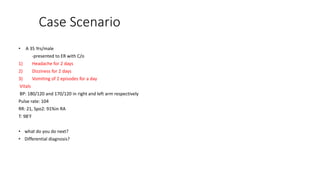
Case Scenario
• A 35 Yrs/male
-presented to ER with C/o
1) Headache for 2 days
2) Dizziness for 2 days
3) Vomiting of 2 episodes for a day
Vitals
BP: 180/120 and 170/120 in right and left arm respectively
Pulse rate: 104
RR: 21, Spo2: 91%in RA
T: 98’F
• what do you do next?
• Differential diagnosis?
What do you do next?
• Analgesics e.g.. T. PCM 1gm stat
• Antihypertensive e.g. T. Nifedipine 20mg stat
• Antiemetic e.g. T. ondansetron 4mg stat
• Positioning
Differential Diagnosis
• Hypertensive emergency/urgency
• Migraine
• Myocardial infarction
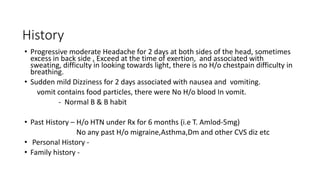
History
• Progressive moderate Headache for 2 days at both sides of the head, sometimes
excess in back side , Exceed at the time of exertion, and associated with
sweating, difficulty in looking towards light, there is no H/o chestpain difficulty in
breathing.
• Sudden mild Dizziness for 2 days associated with nausea and vomiting.
vomit contains food particles, there were No H/o blood In vomit.
- Normal B & B habit
• Past History – H/o HTN under Rx for 6 months (i.e T. Amlod-5mg)
No any past H/o migraine,Asthma,Dm and other CVS diz etc
• Personal History -
• Family history -
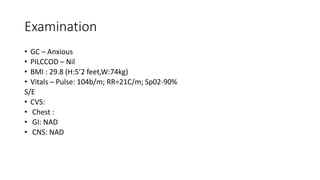
Examination
• GC – Anxious
• PILCCOD – Nil
• BMI : 29.8 (H:5’2 feet,W:74kg)
• Vitals – Pulse: 104b/m; RR=21C/m; Sp02-90%
S/E
• CVS:
• Chest :
• GI: NAD
• CNS: NAD
Provisional Diagnosis
• Hypertensive Urgency
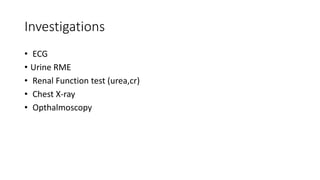
Investigations
• ECG
• Urine RME
• Renal Function test (urea,cr)
• Chest X-ray
• Opthalmoscopy
Final Diagnosis
• Hypertensive Urgency
Patient Reassessment
After;T. nifedipine 20mg po stat
T. ondem 4mg
T. pcm
BP: 140/100 mmHg (rt Arm), 140/90 (lft Arm),P:98 b/m,RR = 20 C/m;
No active Nausea vomiting +nt.
Dispatch:
Hypertension
Hypertension is a worldwide epidemic.
- Systolic Blood Pressure: >= 140mmHg
- Diastolic Blood Pressure: >= 90mmHg
- someone requiring antihypertensive medications for
control of sustained elevations of blood pressure
• Hypertension can be classified as either Primary or
Secondary hypertension.
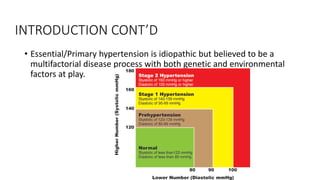
INTRODUCTION CONT’D
• Essential/Primary hypertension is idiopathic but believed to be a
multifactorial disease process with both genetic and environmental
factors at play.
HYPERTENSIVE CRISIS
Not determined by a specific range of elevation in the blood pressure.
Usually,
-SBP: >= 180mmHg
- DBP: >= 120mmHg
CATEGORIES
1. Hypertensive Urgency: Acute severe hypertension without any signs
of damage to target organs (heart, brain, kidneys).
2. Hypertensive Emergencies: Acute severe hypertension with signs of
progressive damage to target organs.
History
 History of hypertension
-Duration and patient baseline
-Controlled or Uncontrolled
- Compliant or Non-compliance
 High BP readings
 Co-morbidities
 Evidence of any target-organ damage
 Details of current antihypertensive therapy
 Recreational drug use
Examination FINDINGS
 O2 Saturation
 Cardiovascular system
 Check patient’s blood pressure in both arms
Heart Rate
Elevated JVP
Heart murmurs (ischemic mitral regurgitation)
 Basal lung crepitation
 Central Nervous System
- Altered mental status
-Focal neurological deficits
Ex FINDINGS Cont.
• Abdomen
Palpate abdominal masses
Auscultate for renal bruits
Investigations
• RFT (Urea and Creatinine)
• Urinalysis
• Electrocardiography (ECG)
• Chest X-rays
• CT Brain
Management
 Hypertensive Emergency Vs. Hypertensive Urgency
 IV access
 Continuous BP monitoring
 Supplemental O2
The initial goal of therapy in hypertensive emergencies is to reduce
mean arterial pressure by no more than 25% (within minutes to 1
hour), then, if stable, to 160/100 to 110 mm Hg within the next 2 to 6
hours.
Any Questions ??

Hypertension in emergency

  • 1.
    Emergency Case Presentation Mr.Kamal raj oli Health Assistant Emergency Department 26th Dec. 2019
  • 2.
    Case Scenario • A35 Yrs/male -presented to ER with C/o 1) Headache for 2 days 2) Dizziness for 2 days 3) Vomiting of 2 episodes for a day Vitals BP: 180/120 and 170/120 in right and left arm respectively Pulse rate: 104 RR: 21, Spo2: 91%in RA T: 98’F • what do you do next? • Differential diagnosis?
  • 3.
    What do youdo next? • Analgesics e.g.. T. PCM 1gm stat • Antihypertensive e.g. T. Nifedipine 20mg stat • Antiemetic e.g. T. ondansetron 4mg stat • Positioning
  • 4.
    Differential Diagnosis • Hypertensiveemergency/urgency • Migraine • Myocardial infarction
  • 5.
    History • Progressive moderateHeadache for 2 days at both sides of the head, sometimes excess in back side , Exceed at the time of exertion, and associated with sweating, difficulty in looking towards light, there is no H/o chestpain difficulty in breathing. • Sudden mild Dizziness for 2 days associated with nausea and vomiting. vomit contains food particles, there were No H/o blood In vomit. - Normal B & B habit • Past History – H/o HTN under Rx for 6 months (i.e T. Amlod-5mg) No any past H/o migraine,Asthma,Dm and other CVS diz etc • Personal History - • Family history -
  • 6.
    Examination • GC –Anxious • PILCCOD – Nil • BMI : 29.8 (H:5’2 feet,W:74kg) • Vitals – Pulse: 104b/m; RR=21C/m; Sp02-90% S/E • CVS: • Chest : • GI: NAD • CNS: NAD
  • 7.
  • 8.
    Investigations • ECG • UrineRME • Renal Function test (urea,cr) • Chest X-ray • Opthalmoscopy
  • 9.
  • 10.
    Patient Reassessment After;T. nifedipine20mg po stat T. ondem 4mg T. pcm BP: 140/100 mmHg (rt Arm), 140/90 (lft Arm),P:98 b/m,RR = 20 C/m; No active Nausea vomiting +nt. Dispatch:
  • 11.
    Hypertension Hypertension is aworldwide epidemic. - Systolic Blood Pressure: >= 140mmHg - Diastolic Blood Pressure: >= 90mmHg - someone requiring antihypertensive medications for control of sustained elevations of blood pressure • Hypertension can be classified as either Primary or Secondary hypertension.
  • 12.
    INTRODUCTION CONT’D • Essential/Primaryhypertension is idiopathic but believed to be a multifactorial disease process with both genetic and environmental factors at play.
  • 13.
    HYPERTENSIVE CRISIS Not determinedby a specific range of elevation in the blood pressure. Usually, -SBP: >= 180mmHg - DBP: >= 120mmHg CATEGORIES 1. Hypertensive Urgency: Acute severe hypertension without any signs of damage to target organs (heart, brain, kidneys). 2. Hypertensive Emergencies: Acute severe hypertension with signs of progressive damage to target organs.
  • 14.
    History  History ofhypertension -Duration and patient baseline -Controlled or Uncontrolled - Compliant or Non-compliance  High BP readings  Co-morbidities  Evidence of any target-organ damage  Details of current antihypertensive therapy  Recreational drug use
  • 15.
    Examination FINDINGS  O2Saturation  Cardiovascular system  Check patient’s blood pressure in both arms Heart Rate Elevated JVP Heart murmurs (ischemic mitral regurgitation)  Basal lung crepitation  Central Nervous System - Altered mental status -Focal neurological deficits
  • 16.
    Ex FINDINGS Cont. •Abdomen Palpate abdominal masses Auscultate for renal bruits
  • 17.
    Investigations • RFT (Ureaand Creatinine) • Urinalysis • Electrocardiography (ECG) • Chest X-rays • CT Brain
  • 18.
    Management  Hypertensive EmergencyVs. Hypertensive Urgency  IV access  Continuous BP monitoring  Supplemental O2 The initial goal of therapy in hypertensive emergencies is to reduce mean arterial pressure by no more than 25% (within minutes to 1 hour), then, if stable, to 160/100 to 110 mm Hg within the next 2 to 6 hours.
  • 19.