Welcome To
Clinical Meeting
HYPERTENSIVE
EMERGENCIES
Chairperson
Dr. Nur AAlom Khan
Assoc. Professor
Unit Head MU-5
Dr. Md. Nur Un Nobi Khondker
IMO,MU-5
Objectives
• Distinguish which hypertensive
presentations require immediate therapy
• Describe appropriate therapies for each
presentation
• Describe the risks of treatment
• Discuss the advantages and
disadvantages of currently available
antihypertensive drugs
Cases
• Asymptomatic 65 year-old, BP 280/210mmHg
• Ischemic stroke, BP 215/105mmHg
• Hemorrhagic stroke, BP 200/100mmHg
• SAH, BP 180/100mmHg
• Pregnant female, BP 150/100mmHg
• Encephalopathy, BP 260/160mmHg
• Acute pulmonary edema, BP 220/120mmHg
Definition of
Hypertensive Emergencies
Hypertension emergencies are situations in
which severe hypertension (grade 3) is
associated with acute HMOD(Hypertension
Mediated Organ Damage), which is often life
threatening and requires immediate but
careful intervention to lower BP, usually with
intravenous therapy.
Contd…
• The rate and magnitude of an increase in
BP may be at least as important as the
absolute level of BP in determining the
magnitude of organ injury.
Typical Presentations
1) Patients with malignant hypertension,
characterized by severe hypertension
(usually grade 3) associated with
funduscopic changes (flame haemorrhages
and/or papilloedema), microangiopathy, and
disseminated intravascular coagulation, and
can be associated with encephalopathy,
acute heart failure, and acute deterioration
in renal function.
Contd..
The hallmark of this condition is small
artery fibrinoid necrosis in the kidney, retina,
and brain. The term ‘malignant’ reflects the
very poor prognosis for this condition if
untreated.
2) Patients with severe hypertension
associated with other clinical conditions who
are likely to require an urgent reduction of
BP, e.g.
acute aortic dissection,
acute myocardial ischaemia,
acute heart failure.
3) Patients with sudden severe hypertension
due to phaeochromocytoma, associated with
organ damage.
4)Pregnant women with severe hypertension
or preeclampsia.
The term ‘hypertension urgency’ has also
been used to describe severe hypertension in
patients presenting to the emergency
department in whom there is no clinical
evidence of acute HMOD (Hypertension
Mediated Organ Damage).
Whilst these patients require BP reduction,
they do not usually require admission to
hospital, and BP reduction is best achieved
with oral medication according to the drug
treatment algorithm.
However, these patients will require
urgent outpatient review to ensure that their
BP is coming under control.
Acute and severe increases in BP can
sometimes be precipitated by ingestion of
sympathomimetics such as
methamphetamine or cocaine.
It is emphasized that many patients in an
emergency department with acute pain or
distress may experience an acute elevation
in BP that will be restored to normal when
the pain and distress are relieved, rather
than requiring any specific intervention to
lower BP.
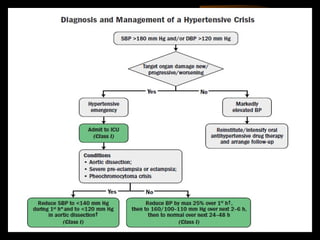
• The key to successful management of
severe hypertension is to differentiate
hypertensive crises from hyperten­sive
urgencies.
• The degree of target organ damage, rather
than the level of blood pressure alone,
determines the rapidity with which blood
pressure should be lowered.
Investigations
Common test for all potential cause:
• Fundoscopy is a critical part of the diagnostic
workup
• 12­lead ECG
• Haemoglobin, platelet count, fibrinogen
• Creatinine, eGFR, electrolytes, LDH, haptoglobin
• Urine albumin:creatinine ratio, urine microscopy
for red cells,leucocytes, casts
• Pregnancy test in women of child­bearing age
Specific tests by indication:
• Troponin, CK­MB (in suspected cardiac involvement, e.g.
acute chest pain or acute heart failure) and NT­proBNP
• Chest X­ray (fluid overload)
• Echocardiography (aortic dissection, heart failure, or
ischaemia)
• CT angiography of thorax and/or abdomen in suspected
acute aortic disease (e.g. aortic dissection)
• CT or MRI brain (nervous system involvement)
• Renal ultrasound (renal impairment or suspected renal
artery stenosis)
• Urine drug screen (suspected methamphetamine or cocaine
use)
Acute management of
hypertensive emergencies
Apart from acute BP lowering in stroke,
there are no RCTs evaluating different
treatment strategies for hypertensive
emergencies.
The key considerations in defining the
treatment strategy are:
(1) Establishing the target organs that are
affected, whether they require any specific
interventions other than BP lowering, and
whether there is a precipitating cause for the
acute rise in BP that might affect the
treatment plan (e.g. pregnancy).
(2) The recommended timescale and
magnitude of BP lowering required for safe
BP reduction
(3) The type of BP-lowering treatment
required. With regard to drug treatment, in a
hypertension emergency, i.v. treatment with a
drug with a short half-life is ideal to allow
careful titration of the BP response to
treatment in a higher dependency clinical area
with facilities for continuous haemodynamic
monitoring.
Rapid uncontrolled BP lowering is not
recommended as this can lead to complications.
In hypertensive individuals, the upper and
lower limits of autoregulation of cerebral blood
flow are shifted to higher levels of arterial
pressure, and rapid lowering of blood pressure to
below the lower limit of autoregulation may
precipi-tate cerebral ischemia or infarction as a
consequence of decreased cerebral blood flow.
Renal and coronary blood flows also may
decrease with overly aggressive acute
therapy. The initial goal of therapy is to
reduce mean arterial blood pressure by no
more than 25% within minutes to 2 h or to a
blood pressure in the range of 160/100–110
mmHg.
Although i.v. drug administration is
recommended for most hypertension
emergencies, oral therapy with ACE
inhibitors, ARBs, or beta-blockers is
sometimes very effective in malignant
hypertension because the renin system is
activated by renal ischaemia.
However, low initial doses should be used
because these patients can be very sensitive to
these agents and treatment should take place
in hospital.
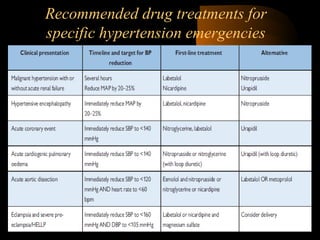
Recommended drug treatments for
specific hypertension emergencies
Drugs
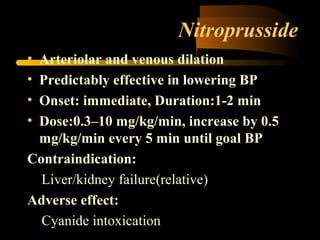
Nitroprusside
• Arteriolar and venous dilation
• Predictably effective in lowering BP
• Onset: immediate, Duration:1-2 min
• Dose:0.3–10 mg/kg/min, increase by 0.5
mg/kg/min every 5 min until goal BP
Contraindication:
Liver/kidney failure(relative)
Adverse effect:
Cyanide intoxication
Nitroglycerin
• Predominant venodilation at low infusion
rates; significant arteriolar dilation at
higher dosages
• Effective in management of hypertension
complicated by CHF or cardiac ischemia
• Onset:1-5 min ,duration:3-5 min
• Usual dosage 5-200mg/min,5mg/min
increase every 5 min.
Labetalol
• Combined α, β adrenergic blockade
• Onset < 5 min, peak 5-10 min, duration 2-6 hr
(sometimes longer)
• Dose:0.25-0.5 mg/kg, 2-4mg/min until goal BP is
reached, thereafter 5–20 mg/h
Contraindication:
• Second or third-degree AV block;
• systolic heart failure,
• asthma, bradycardia
Adverse effect:
• Bronchoconstriction,
• foetal bradycardia
Hydralazine
• Unpredictable hypotensive effect
• Delayed onset compared to other
parenteral agents
• Reflex increase in HR and CO
• Largely outmoded for acute therapy
except in pre-eclampsia/eclampsia,
where it is “traditional” therapy
• Adverse effects on cerebral auto
reglation.
Contd…
• Initial 10 mg via slow IV infusion
(maximum initial dose 20 mg); repeat every
4–6 h as needed.
• BP begins to decrease within 10–30 min
and the fall lasts 2–4 h. Unpredictability of
response and prolonged duration of action
do not make hydralazine a desirable rst-line
agent for acute treatment in most pts.
Nicardipine
• Initial 5 mg/h, increasing every 5 min by
2.5 mg/h to maximum 15 mg/h.
• Contraindicated in advanced aortic stenosis;
no dose adjustment needed for elderly
ACEI
• IV enalaprilat, oral captopril potentially
useful for acute BP reduction
• Little clinical experience in patients with
hypertensive emergencies
• Difficult to titrate (sometimes ineffective,
sometimes excessive BP ↓)
Clevidipine
• Initial 1–2 mg/h, doubling every 90 s until
BP approaches target, then increasing by <
double every 5–10 min; maximum dose 32
mg/h; maximum duration 72 h.
• Contraindicated in patient with soybean,
soy product, egg, and egg product allergy
and in patient with defective lipid
metabolism (e.g., pathological
hyperlipidemia, lipoid nephrosis or acute
pancreatitis). Use low-end dose range for
elderly patient.
Esmolol
• Loading dose 500–1,000 mcg/ kg/min over
1 min followed by a 50 mcg/kg/min
infusion. For additional dosing, the bolus
dose is repeated and the infusion increased
in 50 mcg/kg/min increments as needed to a
maximum of 200 mcg/kg/ min.
Contd…
• Contraindicated in pts with concurrent beta-
blocker therapy, bradycardia and/or
decompensated HF Monitor for
bradycardia. May worsen HF. Higher doses
may block beta2 receptors and impact lung
function in reactive airway disease.
Prognosis and follow-up
The survival of patients with hypertension
emergencies has improved dramatically over
past decades but these patients remain at high
risk and should be screened for secondary
hypertension.
After discharge from hospital, when BP has
reached a safe and stable level on oral
therapy, we recommend frequent, at least
monthly, visits in a specialized setting until
the optimal target BP is achieved and long-
term specialist follow-up thereafter.
THANKS
TO
ALL

Hypertensive emergencies

  • 1.
  • 2.
    HYPERTENSIVE EMERGENCIES Chairperson Dr. Nur AAlomKhan Assoc. Professor Unit Head MU-5 Dr. Md. Nur Un Nobi Khondker IMO,MU-5
  • 3.
    Objectives • Distinguish whichhypertensive presentations require immediate therapy • Describe appropriate therapies for each presentation • Describe the risks of treatment • Discuss the advantages and disadvantages of currently available antihypertensive drugs
  • 4.
    Cases • Asymptomatic 65year-old, BP 280/210mmHg • Ischemic stroke, BP 215/105mmHg • Hemorrhagic stroke, BP 200/100mmHg • SAH, BP 180/100mmHg • Pregnant female, BP 150/100mmHg • Encephalopathy, BP 260/160mmHg • Acute pulmonary edema, BP 220/120mmHg
  • 5.
  • 6.
    Hypertension emergencies aresituations in which severe hypertension (grade 3) is associated with acute HMOD(Hypertension Mediated Organ Damage), which is often life threatening and requires immediate but careful intervention to lower BP, usually with intravenous therapy.
  • 7.
    Contd… • The rateand magnitude of an increase in BP may be at least as important as the absolute level of BP in determining the magnitude of organ injury.
  • 8.
  • 9.
    1) Patients withmalignant hypertension, characterized by severe hypertension (usually grade 3) associated with funduscopic changes (flame haemorrhages and/or papilloedema), microangiopathy, and disseminated intravascular coagulation, and can be associated with encephalopathy, acute heart failure, and acute deterioration in renal function.
  • 10.
    Contd.. The hallmark ofthis condition is small artery fibrinoid necrosis in the kidney, retina, and brain. The term ‘malignant’ reflects the very poor prognosis for this condition if untreated.
  • 11.
    2) Patients withsevere hypertension associated with other clinical conditions who are likely to require an urgent reduction of BP, e.g. acute aortic dissection, acute myocardial ischaemia, acute heart failure.
  • 12.
    3) Patients withsudden severe hypertension due to phaeochromocytoma, associated with organ damage. 4)Pregnant women with severe hypertension or preeclampsia.
  • 13.
    The term ‘hypertensionurgency’ has also been used to describe severe hypertension in patients presenting to the emergency department in whom there is no clinical evidence of acute HMOD (Hypertension Mediated Organ Damage).
  • 14.
    Whilst these patientsrequire BP reduction, they do not usually require admission to hospital, and BP reduction is best achieved with oral medication according to the drug treatment algorithm.
  • 15.
    However, these patientswill require urgent outpatient review to ensure that their BP is coming under control. Acute and severe increases in BP can sometimes be precipitated by ingestion of sympathomimetics such as methamphetamine or cocaine.
  • 16.
    It is emphasizedthat many patients in an emergency department with acute pain or distress may experience an acute elevation in BP that will be restored to normal when the pain and distress are relieved, rather than requiring any specific intervention to lower BP.
  • 17.
    • The keyto successful management of severe hypertension is to differentiate hypertensive crises from hyperten­sive urgencies. • The degree of target organ damage, rather than the level of blood pressure alone, determines the rapidity with which blood pressure should be lowered.
  • 18.
  • 19.
    Common test forall potential cause: • Fundoscopy is a critical part of the diagnostic workup • 12­lead ECG • Haemoglobin, platelet count, fibrinogen • Creatinine, eGFR, electrolytes, LDH, haptoglobin • Urine albumin:creatinine ratio, urine microscopy for red cells,leucocytes, casts • Pregnancy test in women of child­bearing age
  • 20.
    Specific tests byindication: • Troponin, CK­MB (in suspected cardiac involvement, e.g. acute chest pain or acute heart failure) and NT­proBNP • Chest X­ray (fluid overload) • Echocardiography (aortic dissection, heart failure, or ischaemia) • CT angiography of thorax and/or abdomen in suspected acute aortic disease (e.g. aortic dissection) • CT or MRI brain (nervous system involvement) • Renal ultrasound (renal impairment or suspected renal artery stenosis) • Urine drug screen (suspected methamphetamine or cocaine use)
  • 21.
  • 22.
    Apart from acuteBP lowering in stroke, there are no RCTs evaluating different treatment strategies for hypertensive emergencies. The key considerations in defining the treatment strategy are:
  • 23.
    (1) Establishing thetarget organs that are affected, whether they require any specific interventions other than BP lowering, and whether there is a precipitating cause for the acute rise in BP that might affect the treatment plan (e.g. pregnancy).
  • 24.
    (2) The recommendedtimescale and magnitude of BP lowering required for safe BP reduction
  • 25.
    (3) The typeof BP-lowering treatment required. With regard to drug treatment, in a hypertension emergency, i.v. treatment with a drug with a short half-life is ideal to allow careful titration of the BP response to treatment in a higher dependency clinical area with facilities for continuous haemodynamic monitoring.
  • 26.
    Rapid uncontrolled BPlowering is not recommended as this can lead to complications. In hypertensive individuals, the upper and lower limits of autoregulation of cerebral blood flow are shifted to higher levels of arterial pressure, and rapid lowering of blood pressure to below the lower limit of autoregulation may precipi-tate cerebral ischemia or infarction as a consequence of decreased cerebral blood flow.
  • 27.
    Renal and coronaryblood flows also may decrease with overly aggressive acute therapy. The initial goal of therapy is to reduce mean arterial blood pressure by no more than 25% within minutes to 2 h or to a blood pressure in the range of 160/100–110 mmHg.
  • 28.
    Although i.v. drugadministration is recommended for most hypertension emergencies, oral therapy with ACE inhibitors, ARBs, or beta-blockers is sometimes very effective in malignant hypertension because the renin system is activated by renal ischaemia.
  • 29.
    However, low initialdoses should be used because these patients can be very sensitive to these agents and treatment should take place in hospital.
  • 30.
    Recommended drug treatmentsfor specific hypertension emergencies
  • 32.
  • 33.
    Nitroprusside • Arteriolar andvenous dilation • Predictably effective in lowering BP • Onset: immediate, Duration:1-2 min • Dose:0.3–10 mg/kg/min, increase by 0.5 mg/kg/min every 5 min until goal BP Contraindication: Liver/kidney failure(relative) Adverse effect: Cyanide intoxication
  • 34.
    Nitroglycerin • Predominant venodilationat low infusion rates; significant arteriolar dilation at higher dosages • Effective in management of hypertension complicated by CHF or cardiac ischemia • Onset:1-5 min ,duration:3-5 min • Usual dosage 5-200mg/min,5mg/min increase every 5 min.
  • 35.
    Labetalol • Combined α,β adrenergic blockade • Onset < 5 min, peak 5-10 min, duration 2-6 hr (sometimes longer) • Dose:0.25-0.5 mg/kg, 2-4mg/min until goal BP is reached, thereafter 5–20 mg/h Contraindication: • Second or third-degree AV block; • systolic heart failure, • asthma, bradycardia Adverse effect: • Bronchoconstriction, • foetal bradycardia
  • 36.
    Hydralazine • Unpredictable hypotensiveeffect • Delayed onset compared to other parenteral agents • Reflex increase in HR and CO • Largely outmoded for acute therapy except in pre-eclampsia/eclampsia, where it is “traditional” therapy • Adverse effects on cerebral auto reglation.
  • 37.
    Contd… • Initial 10mg via slow IV infusion (maximum initial dose 20 mg); repeat every 4–6 h as needed. • BP begins to decrease within 10–30 min and the fall lasts 2–4 h. Unpredictability of response and prolonged duration of action do not make hydralazine a desirable rst-line agent for acute treatment in most pts.
  • 38.
    Nicardipine • Initial 5mg/h, increasing every 5 min by 2.5 mg/h to maximum 15 mg/h. • Contraindicated in advanced aortic stenosis; no dose adjustment needed for elderly
  • 39.
    ACEI • IV enalaprilat,oral captopril potentially useful for acute BP reduction • Little clinical experience in patients with hypertensive emergencies • Difficult to titrate (sometimes ineffective, sometimes excessive BP ↓)
  • 40.
    Clevidipine • Initial 1–2mg/h, doubling every 90 s until BP approaches target, then increasing by < double every 5–10 min; maximum dose 32 mg/h; maximum duration 72 h. • Contraindicated in patient with soybean, soy product, egg, and egg product allergy and in patient with defective lipid metabolism (e.g., pathological hyperlipidemia, lipoid nephrosis or acute pancreatitis). Use low-end dose range for elderly patient.
  • 41.
    Esmolol • Loading dose500–1,000 mcg/ kg/min over 1 min followed by a 50 mcg/kg/min infusion. For additional dosing, the bolus dose is repeated and the infusion increased in 50 mcg/kg/min increments as needed to a maximum of 200 mcg/kg/ min.
  • 42.
    Contd… • Contraindicated inpts with concurrent beta- blocker therapy, bradycardia and/or decompensated HF Monitor for bradycardia. May worsen HF. Higher doses may block beta2 receptors and impact lung function in reactive airway disease.
  • 43.
  • 44.
    The survival ofpatients with hypertension emergencies has improved dramatically over past decades but these patients remain at high risk and should be screened for secondary hypertension. After discharge from hospital, when BP has reached a safe and stable level on oral therapy, we recommend frequent, at least monthly, visits in a specialized setting until the optimal target BP is achieved and long- term specialist follow-up thereafter.
  • 45.