DKA & HHS
PATHOGENESIS
DR MOHAMMAD DAOUD
CONSULTANT ENDOCRINOLOGIST
KAMC -JEDDAH
OBJECTIVES
Introduction
Definitions
Pathogenesis
S & S
Management
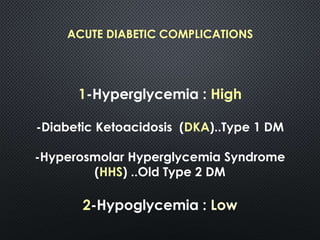
ACUTE DIABETIC COMPLICATIONS
1-Hyperglycemia : High
-Diabetic Ketoacidosis (DKA)..Type 1 DM
-Hyperosmolar Hyperglycemia Syndrome
(HHS) ..Old Type 2 DM
2-Hypoglycemia : Low
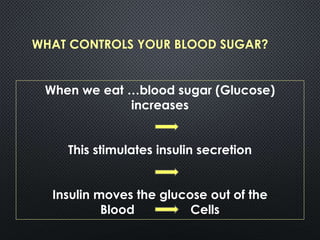
WHAT CONTROLS YOUR BLOOD SUGAR?
When we eat …blood sugar (Glucose)
increases
This stimulates insulin secretion
Insulin moves the glucose out of the
Blood Cells
GLUCOSE :FACTS
 Carbohydrates (Glucose) are the main
calorie source for our body
 Extra CHO are stored as:
Glycogen (liver and muscles)
OR
Fat (Adipose tissue)
GLUCOSE :FACTS
The brain relies almost exclusively on
glucose as a fuel, but cannot synthesize or
store it
Adequate uptake of glucose from the
plasma is essential for normal brain function
and survival
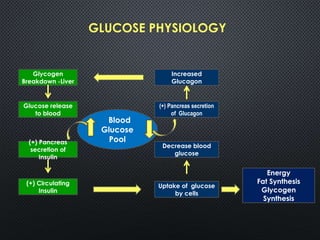
GLUCOSE PHYSIOLOGY
Glycogen
Breakdown -Liver
Increased
Glucagon
Energy
Fat Synthesis
Glycogen
Synthesis
Glucose release
to blood
(+) Pancreas secretion
of Glucagon
Blood
Glucose
Pool(+) Pancreas
secretion of
Insulin
(+) Circulating
Insulin
Uptake of glucose
by cells
Decrease blood
glucose
GLUCOSE :FACTS
In case of CHO shortage ( ex: Starvation)
OR
Unable to use CHO ( ex: No insulin as in
DKA)
Body shifts gear to other sources of energy
GLUCOSE :FACTS
Other sources of energy …
Protein breakdown to amino acids
and glucose synthesis
Fat breakdown into FFA and
ketones formation (with acidosis)..
Minimal amount of Insulin can prevent Ketogenesis
WHAT CONTROLS YOUR BLOOD SUGAR?
-Insulin …Lowers
-Glucagon…Increases
-Other hormones
Amount of CHO load
Physical activity
Stress factors
Counter Regulatory Hormones
HYPERGLYCEMIA
Hyperglycemia basic processes are :
1-Impaired/decreased glucose use
2-Increased gluconeogenesis
(Make up of glucose from other sources)
3-Increased glycogenolysis
(breakdown of Glycogen to Glucose )
HYPERGLYCEMIA
Due to variable reasons…
Insulin deficiency (Absolute / Relative)
Insulin Resistance
Excess counter regulatory hormones
(Glucagon, Cortisol…)
Defected secretion of GLP-1…
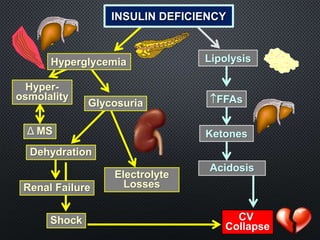
Electrolyte
LossesRenal Failure
Shock CV
Collapse
INSULIN DEFICIENCY
13
Hyperglycemia
Hyper-
osmolality
Δ MS
Lipolysis
FFAs
Acidosis
Ketones
CV
Collapse
Glycosuria
Dehydration
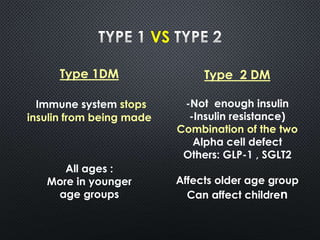
VS
Type 1DM
Immune system stops
insulin from being made
All ages :
More in younger
age groups
Type 2 DM
-Not enough insulin
-Insulin resistance)
Combination of the two
Alpha cell defect
Others: GLP-1 , SGLT2
Affects older age group
Can affect children
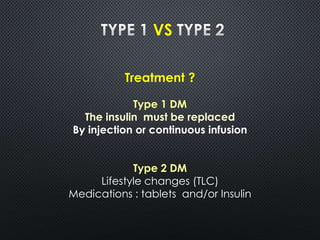
VS
Treatment ?
Type 1 DM
The insulin must be replaced
By injection or continuous infusion
Type 2 DM
Lifestyle changes (TLC)
Medications : tablets and/or Insulin
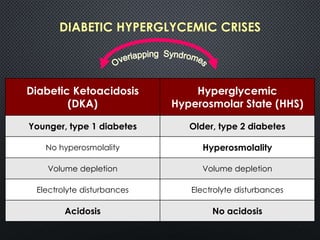
DIABETIC HYPERGLYCEMIC CRISES
Diabetic Ketoacidosis
(DKA)
Hyperglycemic
Hyperosmolar State (HHS)
Younger, type 1 diabetes Older, type 2 diabetes
No hyperosmolality Hyperosmolality
Volume depletion Volume depletion
Electrolyte disturbances Electrolyte disturbances
Acidosis No acidosis
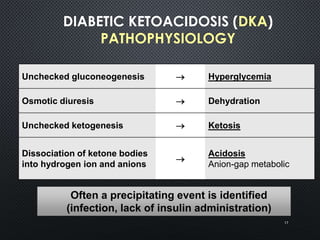
DIABETIC KETOACIDOSIS (DKA)
PATHOPHYSIOLOGY
Unchecked gluconeogenesis  Hyperglycemia
Osmotic diuresis  Dehydration
Unchecked ketogenesis  Ketosis
Dissociation of ketone bodies
into hydrogen ion and anions

Acidosis
Anion-gap metabolic
17
Often a precipitating event is identified
(infection, lack of insulin administration)
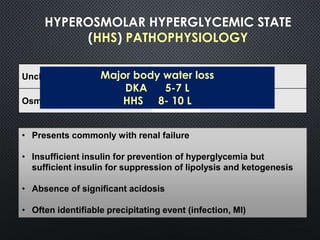
HYPEROSMOLAR HYPERGLYCEMIC STATE
(HHS) PATHOPHYSIOLOGY
Unchecked gluconeogenesis  Hyperglycemia
Osmotic diuresis  Dehydration
• Presents commonly with renal failure
• Insufficient insulin for prevention of hyperglycemia but
sufficient insulin for suppression of lipolysis and ketogenesis
• Absence of significant acidosis
• Often identifiable precipitating event (infection, MI)
Major body water loss
DKA 5-7 L
HHS 8- 10 L
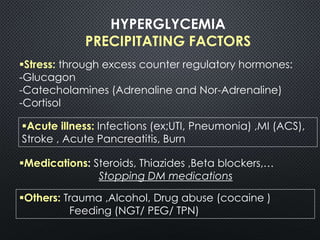
HYPERGLYCEMIA
PRECIPITATING FACTORS
Stress: through excess counter regulatory hormones:
-Glucagon
-Catecholamines (Adrenaline and Nor-Adrenaline)
-Cortisol
Medications: Steroids, Thiazides ,Beta blockers,…
Stopping DM medications
Acute illness: Infections (ex;UTI, Pneumonia) ,MI (ACS),
Stroke , Acute Pancreatitis, Burn
Others: Trauma ,Alcohol, Drug abuse (cocaine )
Feeding (NGT/ PEG/ TPN)
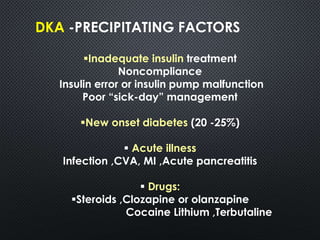
DKA -PRECIPITATING FACTORS
Inadequate insulin treatment
Noncompliance
Insulin error or insulin pump malfunction
Poor “sick-day” management
New onset diabetes (20 -25%)
 Acute illness
Infection ,CVA, MI ,Acute pancreatitis
 Drugs:
Steroids ,Clozapine or olanzapine
Cocaine Lithium ,Terbutaline
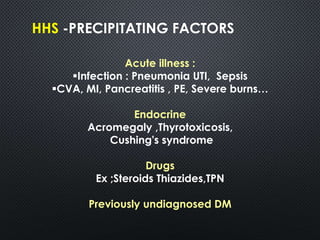
HHS -PRECIPITATING FACTORS
Acute illness :
Infection : Pneumonia UTI, Sepsis
CVA, MI, Pancreatitis , PE, Severe burns…
Endocrine
Acromegaly ,Thyrotoxicosis,
Cushing's syndrome
Drugs
Ex ;Steroids Thiazides,TPN
Previously undiagnosed DM
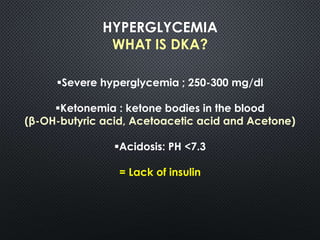
HYPERGLYCEMIA
WHAT IS DKA?
Severe hyperglycemia ; 250-300 mg/dl
Ketonemia : ketone bodies in the blood
(β-OH-butyric acid, Acetoacetic acid and Acetone)
Acidosis: PH <7.3
= Lack of insulin
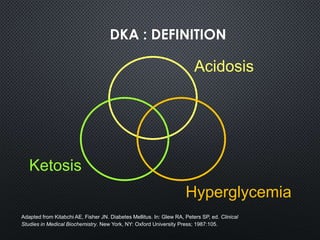
Hyperglycemia
Ketosis
Acidosis
Adapted from Kitabchi AE, Fisher JN. Diabetes Mellitus. In: Glew RA, Peters SP, ed. Clinical
Studies in Medical Biochemistry. New York, NY: Oxford University Press; 1987:105.
DKA : DEFINITION
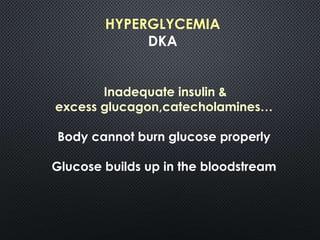
HYPERGLYCEMIA
DKA
Inadequate insulin &
excess glucagon,catecholamines…
Body cannot burn glucose properly
Glucose builds up in the bloodstream
HYPERGLYCEMIA
DKA
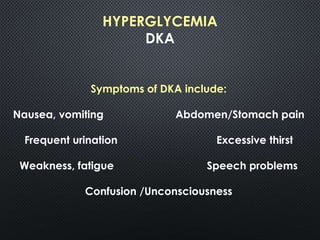
Symptoms of DKA include:
Nausea, vomiting Abdomen/Stomach pain
Frequent urination Excessive thirst
Weakness, fatigue Speech problems
Confusion /Unconsciousness
HYPERGLYCEMIA
DKA
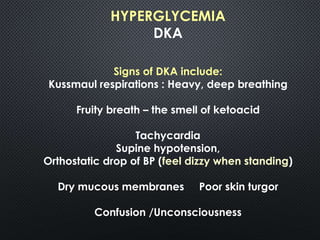
Signs of DKA include:
Kussmaul respirations : Heavy, deep breathing
Fruity breath – the smell of ketoacid
Tachycardia
Supine hypotension,
Orthostatic drop of BP (feel dizzy when standing)
Dry mucous membranes Poor skin turgor
Confusion /Unconsciousness
HYPERGLYCEMIA
DKA
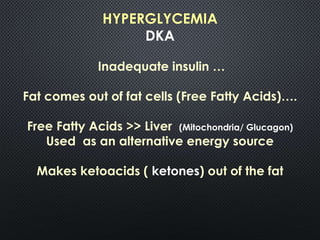
Inadequate insulin …
Fat comes out of fat cells (Free Fatty Acids)….

Free Fatty Acids >> Liver (Mitochondria/ Glucagon)
Used as an alternative energy source
Makes ketoacids ( ketones) out of the fat
HYPERGLYCEMIA
HHS
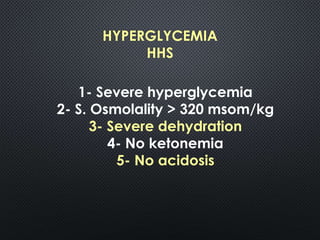
1- Severe hyperglycemia
2- S. Osmolality > 320 msom/kg
3- Severe dehydration
4- No ketonemia
5- No acidosis
HHS
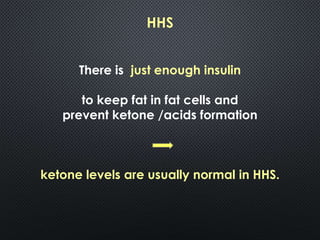
There is just enough insulin
to keep fat in fat cells and
prevent ketone /acids formation
ketone levels are usually normal in HHS.
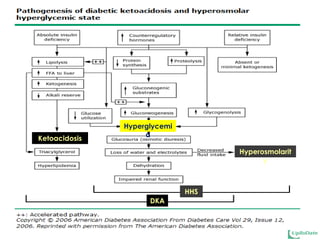
Hyperglycemi
a
Hyperosmolarit
y
Ketoacidosis
HHS
DKA
Take Home
Messages
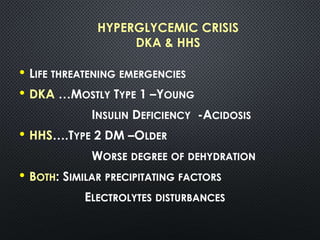
HYPERGLYCEMIC CRISIS
DKA & HHS
• LIFE THREATENING EMERGENCIES
• DKA …MOSTLY TYPE 1 –YOUNG
INSULIN DEFICIENCY -ACIDOSIS
• HHS….TYPE 2 DM –OLDER
WORSE DEGREE OF DEHYDRATION
• BOTH: SIMILAR PRECIPITATING FACTORS
ELECTROLYTES DISTURBANCES
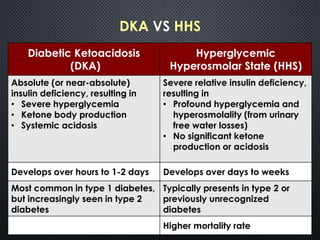
DKA VS HHS
Diabetic Ketoacidosis
(DKA)
Hyperglycemic
Hyperosmolar State (HHS)
Absolute (or near-absolute)
insulin deficiency, resulting in
• Severe hyperglycemia
• Ketone body production
• Systemic acidosis
Severe relative insulin deficiency,
resulting in
• Profound hyperglycemia and
hyperosmolality (from urinary
free water losses)
• No significant ketone
production or acidosis
Develops over hours to 1-2 days Develops over days to weeks
Most common in type 1 diabetes,
but increasingly seen in type 2
diabetes
Typically presents in type 2 or
previously unrecognized
diabetes
Higher mortality rate
DKA & HHS
• EARLY AGGRESSIVE MANAGEMENT
• HYDRATION
• INSULIN
• ELECTROLYTES DISTURBANCES RX
• LOOK FOR PRECIPITATING FACTORS :
TREAT AND TEACH TO AVOID ..IF POSSIBLE
35
PREDISCHARGE CHECKLIST
• EDUCATION
• DIET INFORMATION
• TREATMENT GOALS
• “SURVIVAL SKILLS” TRAINING
• “MEDIC-ALERT” BRACELET
• PROVIDE :
GLUCOSE MONITOR AND STRIPS
MEDICATIONS, INSULIN, NEEDLES
• CONTACT PHONE NUMBERS
Thank You
Any Questions ?

Hyperglycemia emergency for dm educators

  • 1.
    DKA & HHS PATHOGENESIS DRMOHAMMAD DAOUD CONSULTANT ENDOCRINOLOGIST KAMC -JEDDAH
  • 2.
  • 3.
    ACUTE DIABETIC COMPLICATIONS 1-Hyperglycemia: High -Diabetic Ketoacidosis (DKA)..Type 1 DM -Hyperosmolar Hyperglycemia Syndrome (HHS) ..Old Type 2 DM 2-Hypoglycemia : Low
  • 4.
    WHAT CONTROLS YOURBLOOD SUGAR? When we eat …blood sugar (Glucose) increases This stimulates insulin secretion Insulin moves the glucose out of the Blood Cells
  • 5.
    GLUCOSE :FACTS  Carbohydrates(Glucose) are the main calorie source for our body  Extra CHO are stored as: Glycogen (liver and muscles) OR Fat (Adipose tissue)
  • 6.
    GLUCOSE :FACTS The brainrelies almost exclusively on glucose as a fuel, but cannot synthesize or store it Adequate uptake of glucose from the plasma is essential for normal brain function and survival
  • 7.
    GLUCOSE PHYSIOLOGY Glycogen Breakdown -Liver Increased Glucagon Energy FatSynthesis Glycogen Synthesis Glucose release to blood (+) Pancreas secretion of Glucagon Blood Glucose Pool(+) Pancreas secretion of Insulin (+) Circulating Insulin Uptake of glucose by cells Decrease blood glucose
  • 8.
    GLUCOSE :FACTS In caseof CHO shortage ( ex: Starvation) OR Unable to use CHO ( ex: No insulin as in DKA) Body shifts gear to other sources of energy
  • 9.
    GLUCOSE :FACTS Other sourcesof energy … Protein breakdown to amino acids and glucose synthesis Fat breakdown into FFA and ketones formation (with acidosis).. Minimal amount of Insulin can prevent Ketogenesis
  • 10.
    WHAT CONTROLS YOURBLOOD SUGAR? -Insulin …Lowers -Glucagon…Increases -Other hormones Amount of CHO load Physical activity Stress factors Counter Regulatory Hormones
  • 11.
    HYPERGLYCEMIA Hyperglycemia basic processesare : 1-Impaired/decreased glucose use 2-Increased gluconeogenesis (Make up of glucose from other sources) 3-Increased glycogenolysis (breakdown of Glycogen to Glucose )
  • 12.
    HYPERGLYCEMIA Due to variablereasons… Insulin deficiency (Absolute / Relative) Insulin Resistance Excess counter regulatory hormones (Glucagon, Cortisol…) Defected secretion of GLP-1…
  • 13.
    Electrolyte LossesRenal Failure Shock CV Collapse INSULINDEFICIENCY 13 Hyperglycemia Hyper- osmolality Δ MS Lipolysis FFAs Acidosis Ketones CV Collapse Glycosuria Dehydration
  • 14.
    VS Type 1DM Immune systemstops insulin from being made All ages : More in younger age groups Type 2 DM -Not enough insulin -Insulin resistance) Combination of the two Alpha cell defect Others: GLP-1 , SGLT2 Affects older age group Can affect children
  • 15.
    VS Treatment ? Type 1DM The insulin must be replaced By injection or continuous infusion Type 2 DM Lifestyle changes (TLC) Medications : tablets and/or Insulin
  • 16.
    DIABETIC HYPERGLYCEMIC CRISES DiabeticKetoacidosis (DKA) Hyperglycemic Hyperosmolar State (HHS) Younger, type 1 diabetes Older, type 2 diabetes No hyperosmolality Hyperosmolality Volume depletion Volume depletion Electrolyte disturbances Electrolyte disturbances Acidosis No acidosis
  • 17.
    DIABETIC KETOACIDOSIS (DKA) PATHOPHYSIOLOGY Uncheckedgluconeogenesis  Hyperglycemia Osmotic diuresis  Dehydration Unchecked ketogenesis  Ketosis Dissociation of ketone bodies into hydrogen ion and anions  Acidosis Anion-gap metabolic 17 Often a precipitating event is identified (infection, lack of insulin administration)
  • 18.
    HYPEROSMOLAR HYPERGLYCEMIC STATE (HHS)PATHOPHYSIOLOGY Unchecked gluconeogenesis  Hyperglycemia Osmotic diuresis  Dehydration • Presents commonly with renal failure • Insufficient insulin for prevention of hyperglycemia but sufficient insulin for suppression of lipolysis and ketogenesis • Absence of significant acidosis • Often identifiable precipitating event (infection, MI) Major body water loss DKA 5-7 L HHS 8- 10 L
  • 20.
    HYPERGLYCEMIA PRECIPITATING FACTORS Stress: throughexcess counter regulatory hormones: -Glucagon -Catecholamines (Adrenaline and Nor-Adrenaline) -Cortisol Medications: Steroids, Thiazides ,Beta blockers,… Stopping DM medications Acute illness: Infections (ex;UTI, Pneumonia) ,MI (ACS), Stroke , Acute Pancreatitis, Burn Others: Trauma ,Alcohol, Drug abuse (cocaine ) Feeding (NGT/ PEG/ TPN)
  • 21.
    DKA -PRECIPITATING FACTORS Inadequateinsulin treatment Noncompliance Insulin error or insulin pump malfunction Poor “sick-day” management New onset diabetes (20 -25%)  Acute illness Infection ,CVA, MI ,Acute pancreatitis  Drugs: Steroids ,Clozapine or olanzapine Cocaine Lithium ,Terbutaline
  • 22.
    HHS -PRECIPITATING FACTORS Acuteillness : Infection : Pneumonia UTI, Sepsis CVA, MI, Pancreatitis , PE, Severe burns… Endocrine Acromegaly ,Thyrotoxicosis, Cushing's syndrome Drugs Ex ;Steroids Thiazides,TPN Previously undiagnosed DM
  • 23.
    HYPERGLYCEMIA WHAT IS DKA? Severehyperglycemia ; 250-300 mg/dl Ketonemia : ketone bodies in the blood (β-OH-butyric acid, Acetoacetic acid and Acetone) Acidosis: PH <7.3 = Lack of insulin
  • 24.
    Hyperglycemia Ketosis Acidosis Adapted from KitabchiAE, Fisher JN. Diabetes Mellitus. In: Glew RA, Peters SP, ed. Clinical Studies in Medical Biochemistry. New York, NY: Oxford University Press; 1987:105. DKA : DEFINITION
  • 25.
    HYPERGLYCEMIA DKA Inadequate insulin & excessglucagon,catecholamines… Body cannot burn glucose properly Glucose builds up in the bloodstream
  • 26.
    HYPERGLYCEMIA DKA Symptoms of DKAinclude: Nausea, vomiting Abdomen/Stomach pain Frequent urination Excessive thirst Weakness, fatigue Speech problems Confusion /Unconsciousness
  • 27.
    HYPERGLYCEMIA DKA Signs of DKAinclude: Kussmaul respirations : Heavy, deep breathing Fruity breath – the smell of ketoacid Tachycardia Supine hypotension, Orthostatic drop of BP (feel dizzy when standing) Dry mucous membranes Poor skin turgor Confusion /Unconsciousness
  • 28.
    HYPERGLYCEMIA DKA Inadequate insulin … Fatcomes out of fat cells (Free Fatty Acids)…. Free Fatty Acids >> Liver (Mitochondria/ Glucagon) Used as an alternative energy source Makes ketoacids ( ketones) out of the fat
  • 29.
    HYPERGLYCEMIA HHS 1- Severe hyperglycemia 2-S. Osmolality > 320 msom/kg 3- Severe dehydration 4- No ketonemia 5- No acidosis
  • 30.
    HHS There is justenough insulin to keep fat in fat cells and prevent ketone /acids formation ketone levels are usually normal in HHS.
  • 31.
  • 32.
  • 33.
    HYPERGLYCEMIC CRISIS DKA &HHS • LIFE THREATENING EMERGENCIES • DKA …MOSTLY TYPE 1 –YOUNG INSULIN DEFICIENCY -ACIDOSIS • HHS….TYPE 2 DM –OLDER WORSE DEGREE OF DEHYDRATION • BOTH: SIMILAR PRECIPITATING FACTORS ELECTROLYTES DISTURBANCES
  • 34.
    DKA VS HHS DiabeticKetoacidosis (DKA) Hyperglycemic Hyperosmolar State (HHS) Absolute (or near-absolute) insulin deficiency, resulting in • Severe hyperglycemia • Ketone body production • Systemic acidosis Severe relative insulin deficiency, resulting in • Profound hyperglycemia and hyperosmolality (from urinary free water losses) • No significant ketone production or acidosis Develops over hours to 1-2 days Develops over days to weeks Most common in type 1 diabetes, but increasingly seen in type 2 diabetes Typically presents in type 2 or previously unrecognized diabetes Higher mortality rate
  • 35.
    DKA & HHS •EARLY AGGRESSIVE MANAGEMENT • HYDRATION • INSULIN • ELECTROLYTES DISTURBANCES RX • LOOK FOR PRECIPITATING FACTORS : TREAT AND TEACH TO AVOID ..IF POSSIBLE 35
  • 36.
    PREDISCHARGE CHECKLIST • EDUCATION •DIET INFORMATION • TREATMENT GOALS • “SURVIVAL SKILLS” TRAINING • “MEDIC-ALERT” BRACELET • PROVIDE : GLUCOSE MONITOR AND STRIPS MEDICATIONS, INSULIN, NEEDLES • CONTACT PHONE NUMBERS
  • 37.