DYSLIPIDEMIA
CLINICAL GUIDELINES UPDATE
DR. MOHAMMAD DAOUD
CONSULTANT ENDOCRINOLOGIST
KAMC-NGHA JEDDAH
THE AGENDA…
INTRODUCTION
RISK ASSESSMENT TOOLS
GUIDELINES : HEAD TO HEAD
MANAGEMENT : STATINS +/-
CONCLUSION
CARDIOVASCULAR DISEASE (CVD)
 (CVD) = Disease of the heart and blood vessels
caused by the process of atherosclerosis;
Includes CHD; ACS/Angina, TIA/Stroke and PAD
 The leading cause of death in many countries
with significant cost implications
 Though mortality from CVD is falling but
morbidity appears to be rising
CARDIOVASCULAR DISEASE (CVD)
(CVD) predominantly affects people older than 50 years
Risk factors
Non-modifiable
Age
Sex
Family history of CVD
Ethnic background
Modifiable
Smoking
HTN
Dyslipidemia
DM
Social : Low income
and social deprivation
WHERE WE ARE WE NOW?
FROM ….TO
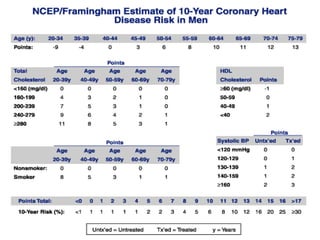
Risk stratification based on Five major steps.
- Obtain Fasting Lipid profile
- Identify CHD risk equivalents
- Identify CHD risk factors
- Calculate 10 year risk of CHD using Framingham risk score
- Determine the risk category and goals of therapy.
NCEP ATP III GUIDELINES FOR RISK ASSESSMENT
1.Diabetes Mellitus
2.Symptomatic Carotid Artery Disease
3.Peripheral Arterial Disease
4.Abdominal Aortic Aneurysm
5.CRF with Cr > 1.5 or GFR< 60
6.Multiple risk factors with a 10 year risk of CHD> 20%
CHD RISK EQUIVALENTS
ATP III
MAJOR CHD RISK FACTORS OTHER THAN LDL-C
• Cigarette smoking
• Hypertension: BP 140/90 mm Hg or on antihypertensive
medication
• Low HDL-C: 40 mg/dL (1.03mmol/L)*
• Family history of premature CHD (1st-degree relative):
• Male relative age 55 years
• Female relative age 65 years
• Age -Male 45 years
-Female 55 years
HDL-C 60 mg/dL (1.55mmol/L) = negative risk factor; Delete one risk factor.
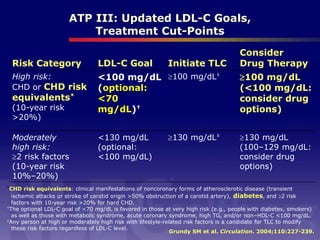
ATP III: Updated LDL-C Goals,
Treatment Cut-Points
Grundy SM et al. Circulation. 2004;110:227-239.
<130 mg/dL
(optional:
<100 mg/dL)
<100 mg/dL
(optional:
<70
mg/dL)†
LDL-C Goal
130 mg/dL
(100–129 mg/dL:
consider drug
options)
130 mg/dL‡Moderately
high risk:
2 risk factors
(10-year risk
10%–20%)
100 mg/dL
(<100 mg/dL:
consider drug
options)
100 mg/dL‡High risk:
CHD or CHD risk
equivalents*
(10-year risk
>20%)
Consider
Drug TherapyInitiate TLCRisk Category
*CHD risk equivalents: clinical manifestations of noncoronary forms of atherosclerotic disease (transient
ischemic attacks or stroke of carotid origin >50% obstruction of a carotid artery), diabetes, and 2 risk
factors with 10-year risk >20% for hard CHD.
†The optional LDL-C goal of <70 mg/dL is favored in those at very high risk (e.g., people with diabetes, smokers)
as well as those with metabolic syndrome, acute coronary syndrome, high TG, and/or non–HDL-C <100 mg/dL.
‡Any person at high or moderately high risk with lifestyle-related risk factors is a candidate for TLC to modify
these risk factors regardless of LDL-C level.
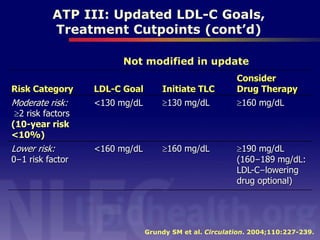
ATP III: Updated LDL-C Goals,
Treatment Cutpoints (cont’d)
Grundy SM et al. Circulation. 2004;110:227-239.
Risk Category LDL-C Goal Initiate TLC
Consider
Drug Therapy
Moderate risk:
2 risk factors
(10-year risk
<10%)
<130 mg/dL 130 mg/dL 160 mg/dL
Lower risk:
0–1 risk factor
<160 mg/dL 160 mg/dL 190 mg/dL
(160–189 mg/dL:
LDL-C–lowering
drug optional)
Not modified in update
WHAT’S NEW ?
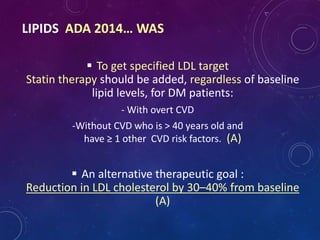
LIPIDS ADA 2014… WAS
 To get specified LDL target
Statin therapy should be added, regardless of baseline
lipid levels, for DM patients:
- With overt CVD
-Without CVD who is > 40 years old and
have ≥ 1 other CVD risk factors. (A)
 An alternative therapeutic goal :
Reduction in LDL cholesterol by 30–40% from baseline
(A)
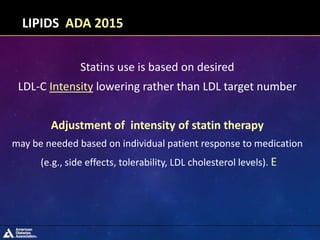
Statins use is based on desired
LDL-C Intensity lowering rather than LDL target number
Adjustment of intensity of statin therapy
may be needed based on individual patient response to medication
(e.g., side effects, tolerability, LDL cholesterol levels). E
LIPIDS ADA 2015
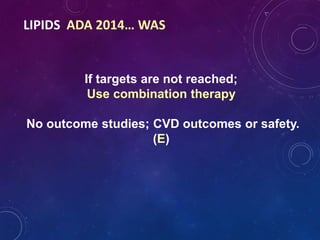
LIPIDS ADA 2014… WAS
If targets are not reached;
Use combination therapy
No outcome studies; CVD outcomes or safety.
(E)
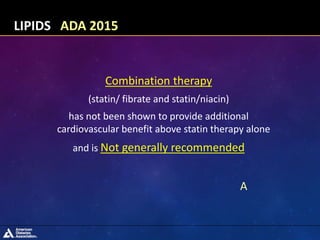
Combination therapy
(statin/ fibrate and statin/niacin)
has not been shown to provide additional
cardiovascular benefit above statin therapy alone
and is Not generally recommended
A
LIPIDS ADA 2015
2013 ACC/AHA
GUIDELINES ON TREATMENT OF BLOOD
CHOLESTEROL TO REDUCE ATHEROSCLEROTIC
CARDIOVASCULAR RISK IN ADULTS
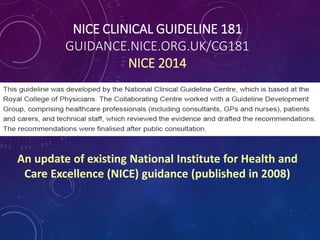
NICE CLINICAL GUIDELINE 181
GUIDANCE.NICE.ORG.UK/CG181
NICE 2014
An update of existing National Institute for Health and
Care Excellence (NICE) guidance (published in 2008)
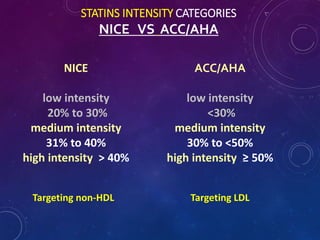
STATINS INTENSITY CATEGORIES
NICE VS ACC/AHA
NICE
low intensity
20% to 30%
medium intensity
31% to 40%
high intensity > 40%
ACC/AHA
low intensity
<30%
medium intensity
30% to <50%
high intensity ≥ 50%
Targeting LDLTargeting non-HDL
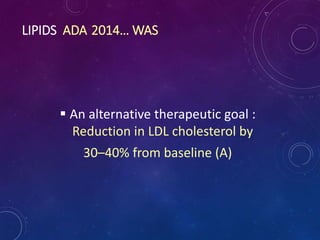
LIPIDS ADA 2014… WAS
 An alternative therapeutic goal :
Reduction in LDL cholesterol by
30–40% from baseline (A)
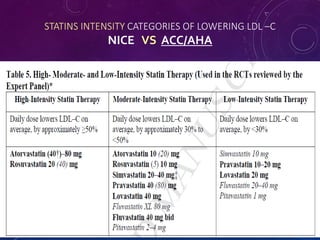
STATINS INTENSITY CATEGORIES OF LOWERING LDL –C
NICE VS ACC/AHA
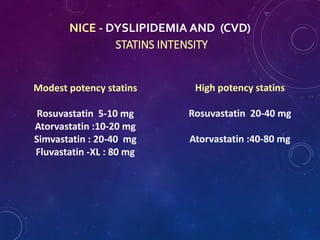
NICE - DYSLIPIDEMIA AND (CVD)
STATINS INTENSITY
Modest potency statins
Rosuvastatin 5-10 mg
Atorvastatin :10-20 mg
Simvastatin : 20-40 mg
Fluvastatin -XL : 80 mg
High potency statins
Rosuvastatin 20-40 mg
Atorvastatin :40-80 mg
2013 ACC/AHA
GUIDELINES ON TREATMENT OF BLOOD
CHOLESTEROL TO REDUCE ATHEROSCLEROTIC
CARDIOVASCULAR RISK IN ADULTS
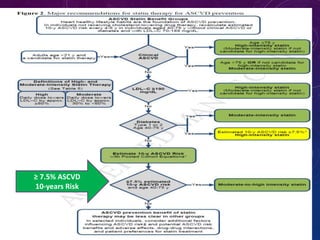
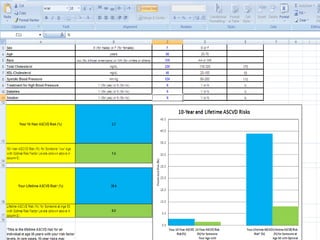
≥ 7.5% ASCVD
10-years Risk
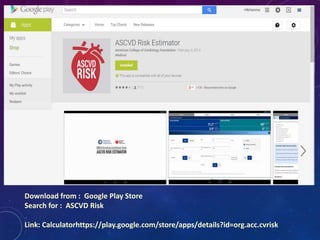
Download from : Google Play Store
Search for : ASCVD Risk
Link: Calculatorhttps://play.google.com/store/apps/details?id=org.acc.cvrisk
NICE CLINICAL GUIDELINE 181
GUIDANCE.NICE.ORG.UK/CG181
NICE
LIPID MODIFICATION
CARDIOVASCULAR RISK ASSESSMENT AND THE
MODIFICATION OF BLOOD LIPIDS FOR THE PRIMARY
AND SECONDARY PREVENTION OF CARDIOVASCULAR
DISEASE
ISSUED: JULY 2014
LAST MODIFIED: SEPTEMBER 2014
NICE GUIDELINES-2014
DYSLIPIDEMIA AND (CVD)
Do not use a risk assessment tool for people
1-With pre-existing CVD
2-Familial hyper-cholesterolemia
3- With type 1 DM
4-With CKD ; e GFR < 60 ml/min/1.73 m2 and/or albuminuria
NICE GUIDELINES -DYSLIPIDEMIA AND (CVD)
IDENTIFYING AND ASSESSING (CVD) RISK
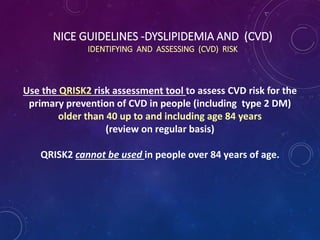
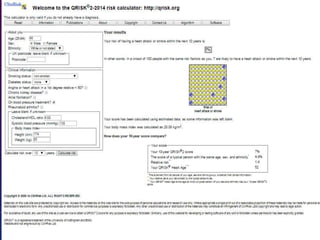
Use the QRISK2 risk assessment tool to assess CVD risk for the
primary prevention of CVD in people (including type 2 DM)
older than 40 up to and including age 84 years
(review on regular basis)
QRISK2 cannot be used in people over 84 years of age.
NICE GUIDELINES -DYSLIPIDEMIA AND (CVD)
IDENTIFYING PEOPLE FOR FULL FORMAL RISK ASSESSMENT
DIABETIC PATIENTS
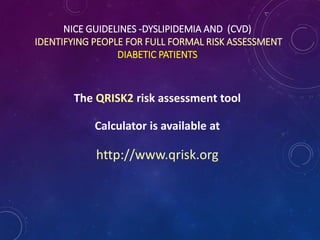
The QRISK2 risk assessment tool
Calculator is available at
http://www.qrisk.org
Exclude common secondary causes
of dyslipidemia before referral
(Ex:excess alcohol, uncontrolled DM, hypothyroidism,
liver disease and nephrotic syndrome)
DYSLIPIDEMIA AND (CVD)
Include all of the following in the assessment:
-Smoking status
-Alcohol consumption
-Blood pressure
-Body mass index or other measure of obesity
-Total-C, HDL-C, non-HDL-C and triglycerides
-HbA1c
-Renal function and e-GFR
-Transaminase level (ALT , AST )
-TSH
NICE : LIPID MODIFICATION THERAPY FOR THE PRIMARY AND
SECONDARY PREVENTION OF CVD
Lipid measurement and referral
A fasting sample is not needed
Measure a full lipid profile (Total-C , HDL – C , TAG ) and
(non-HDL-C ) to achieve the best estimate of CVD risk
Clinical findings
Lipid profile
Family history
=The likelihood of a familial lipid disorder
NICE : LIPID MODIFICATION THERAPY FOR THE PRIMARY AND
SECONDARY PREVENTION OF CVD
Lipid measurement and referral
Consider Familial hyper- cholesterolemia
and investigate if they have:
1-Total-C > 7.5 mmol/L and
2- Family history of premature CHD
Definite MI or sudden death affecting a first degree relative
before age of 55 yrs (males) or 65 yrs (females)
NICE : LIPID MODIFICATION THERAPY FOR THE PRIMARY AND
SECONDARY PREVENTION OF CVD
Lipid measurement and referral
Arrange for specialist assessment if
Total –C > 9.0 mmol/L or a non-HDL C > 7.5 mmol/L
even in the absence of a first-degree F.Hx of premature CHD disease
Refer for urgent specialist review if a person has a
triglyceride concentration of > 20 mmol/L
(Exclude excess alcohol or poor glycemic control)
DYSLIPIDEMIA AND (CVD)
PHARMACOLOGIC THERAPY FOR THE
PRIMARY AND SECONDARY PREVENTION OF CVD
Use drugs with evidence
in clinical trials of a beneficial effect on CVD morbidity and
mortality
When a decision is made to prescribe a statin
use a statin of high intensity and low acquisition cost
NICE GUIDELINES -DYSLIPIDEMIA AND (CVD)
STARTING A STATIN
Decide after an informed discussion
and assure patient’s knowledge about Pros/ Cons
=Individualized care
Stress the importance of TLC
and consider the patient preferences, Co-morbidities,
poly-pharmacy, general frailty, and life Expectancy
LIPIDS
RX RECOMMENDATIONS AND GOALS
Lifestyle modification (TLC) has been shown to
Improve the lipid profile in patients with diabetes.
(A)
This include:
- Reduction of saturated fat, trans fat, and cholesterol intake
-Increase of n-3 fatty acids, viscous fiber and plant stanols / sterols
-Weight loss (if indicated); and increased physical activity
NICE GUIDELINES -DYSLIPIDEMIA AND (CVD)
SECONDARY PREVENTION OF CVD
-Start statin Rx in people with CVD with Atorvastatin 80 mg
(or equivalent)
Use a lower dose of atorvastatin if any of the following apply:
Potential drug interactions
High risk of adverse effects
Patient preference
Do not delay statin in secondary prevention to manage
modifiable risk factors Ex : Person has ACS
NICE GUIDELINES -DYSLIPIDEMIA AND (CVD)
PRIMARY PREVENTION OF CVD
-Estimate the level of risk using the QRISK2 (when indicated)
-Exclude secondary causes
Offer Atorvastatin 20 mg for the primary prevention of CVD
to people who have a ≥ 10% (10-year) risk of developing CVD
(estimated with QRISK2 ).
NICE GUIDELINES -DYSLIPIDEMIA AND (CVD)
PRIMARY PREVENTION FOR PEOPLE WITH
TYPE 2 DM
Offer Atorvastatin 20 mg for the primary prevention of
CVD to people with type 2 DM who have
a ≥ 10% (10-year) risk of developing CVD
Estimate the level of risk using the QRISK2 assessment
tool
NICE GUIDELINES -DYSLIPIDEMIA AND (CVD)
PRIMARY PREVENTION FOR PEOPLE WITH
TYPE 1 DM
 Offer statin treatment for the primary prevention of CVD to
adults with type 1 DM who:
1- Are older than 40 years or have had DM for > 10 years or
2- Have established nephropathy or have other CVD risk factors.
>>>>>>
 Treat adults with type 1 DM
with Atorvastatin 20 mg
NICE GUIDELINES -DYSLIPIDEMIA AND (CVD)
PREVENTION OF CVD TO PEOPLE WITH
CKD
 Offer Atorvastatin 20 mg for the primary or secondary
prevention of CVD to people with CKD
Increase the dose if a > 40% reduction in non-HDL cholesterol
is not achieved and (e GFR ) is ≥ 30 ml/min/1.73 m2
 Agree the use of higher doses with a renal specialist if
e GFR is < 30 ml/min/ 1.73 m2.
DYSLIPIDEMIA AND (CVD)
STATINS
EFFICACY , SAFETY , TOLERABILITY
DYSLIPIDEMIA AND (CVD)
FOLLOW-UP OF PEOPLE STARTED ON STATIN TREATMENT
Measure Total-C, HDL-C and non-HDL-C in all people who have
been started on high-intensity Statin treatment at 3 months of
treatment and aim for > 40% reduction in non-HDL-C
If the non-HDL cholesterol is not reduced by > 40 % :
 Discuss adherence and timing of dose
 Optimize adherence to diet and lifestyle measures
 Consider increasing the dose
(if started on less than atorvastatin 80 mg and the person is judged to be at
higher risk because of comorbidities, risk score or using clinical judgment)
NICE
ADVICE AND MONITORING FOR STATINS AE
.
Statins and pregnancy/lacttion
Potential teratogenicity
Stop Statins if pregnancy is a possibility
Stop Statins 3 months before any attempt to conceive and
to not restart them until breastfeeding is finished
NICE
ADVICE AND MONITORING FOR STATINS AE
Advise people who are being treated with a Statin:
Do not stop statins because of an increase in blood
glucose level or HbA1c.
STATINS IMPACT ON RISK OF DM / DM CONTROL
 Up to 9-14 % risk of new onset DM is reported from different
meta-analysis esp. with high doses; Such effect of statins
remains modest
 Both T1D and T2D:HbA1c was slightly higher in the group
treated with statins
(7.53% v.s. 7.41% . Mean difference was 0.12%, (P=0.003).
 CV events were reduced by 16% in the group treated with
intensive statin ;The efficacy of statins in reducing CV outcomes
in T2D is well-established and of major importance to offset
such HbA1c changes
Use of statins in primary prevention in T2D should not be changed.
NICE
ADVICE AND MONITORING FOR STATINS AE
Statins and creatine kinase (CK)
1- Do not measure CK levels in asymptomatic people who are being
treated with a statin
2- If patient has suggestive myopathy symptoms ( persistent
generalized unexplained muscle pain, associated or not with
previous lipid-lowering therapy) before or after start of a statin
If they have, measure creatine kinase (CK) levels
NICE
ADVICE AND MONITORING FOR STATINS AE
Statins and creatine kinase (CK)
3- If patient has suggestive myopathy symptoms measure (CK):
If CK levels are > 5 times the ULN, re-measure it after 7 days.
If CK levels are still 5 times ULN, do not start statin treatment
If CK levels are raised but < 5 times ULN, start statin treatment at a
lower dose
4- If statin therapy was tolerated for > 3 months ; R/O other causes
of muscle pain or weakness and raised CK
NICE
ADVICE AND MONITORING FOR STATINS AE
Statins and Liver Transaminases
1- Measure baseline liver transaminase enzymes (ALT or AST ) ,at
baseline , 3 and 12 months of starting a statin
-No more testing unless clinically indicated
2- Do not routinely exclude from statin therapy people who have
liver transaminase levels that are raised but are < 3 times ULN
NICE
INTOLERANCE OF STATINS
If a patient is un-able to tolerate a high-intensity statin;
Treat with the maximum tolerated dose
NICE
INTOLERANCE OF STATINS
Seek specialist advice (by telephone, virtual clinic or referral)
about options for treating people at high risk of CVD:
CKD
Type 1 diabetes
Type 2 diabetes
Genetic Dyslipidemia
CVD, who are intolerant to 3 different statins
NICE ADVICE ON
OTHER LIPID LOWERING AGENTS /COMBINATIONS
NICE
COMBINATION RX
Do not routinely offer Fibrates and
Do not offer Nicotinic acid (niacin) or Bile acid sequestrants (anion
exchange resins) or omega-3 fatty acid compounds for the
prevention of CVD to any of the following group of patients :
-Treated for primary prevention
-Treated for secondary prevention
-With CKD
-With type 1 DM
-With type 2 DM
[new 2014]
NICE
COMBINATION THERAPY FOR PREVENTING CVD
Ezetimibe treatment in addition to Statins
should be considered
For people with primary hyper- cholesterolemia
(heterozygous familial and non-familial hyper- cholesterolemia )
TAKE HOME MESSAGES
DYSLIPIDEMIA AND (CVD)
TAKE HOME MESSAGES
Guidelines are Guidelines
Should not eliminate our clinical judgment
Patient centered personalized care
Safest practice and
best shared-decision
DYSLIPIDEMIA AND (CVD)
TAKE HOME MESSAGES
 Risk assessment tools
High risk groups = No need to calculate Risk
All others : Risk calculator ;Not “eyeballing” them !!
 Use (non-HDL-C)
(=Total-C – HDL-C) rather than LDL-C ;No need to fast
Or
Fasting lipid profile : LDL-C
1.ASCVD / CHD equivalent
2-Diabetes Mellitus
3-Severe Dyslipidemia –Familial
4-CKD
5- Risk calculator : over next 10yrs
HIGH CVD RISK GROUPS - SUMMARY
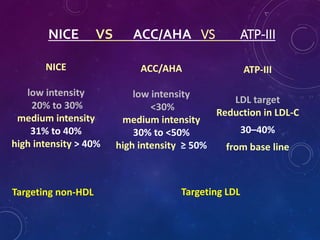
NICE VS ACC/AHA VS ATP-III
NICE
low intensity
20% to 30%
medium intensity
31% to 40%
high intensity > 40%
ACC/AHA
low intensity
<30%
medium intensity
30% to <50%
high intensity ≥ 50%
Targeting LDLTargeting non-HDL
ATP-III
LDL target
Reduction in LDL-C
30–40%
from base line
DYSLIPIDEMIA AND (CVD)
TAKE HOME MESSAGES
 Lipid-lowering drugs
-Statins for primary and secondary prevention
-Use the highest tolerated dose
-Combination Rx ?
 Use simultaneously guidelines on
other modifiable risk factors for CVD (like HTN , DM)
NICE GUIDELINES DYSLIPIDEMIA AND (CVD)
GUIDELINE DEVELOPMENT GROUP (GDG)
1-Use medium intensity statins for Primary prevention
Atorvastatin 20 mg
2- Use high intensity statin for Secondary prevention
Atorvastatin 80 mg
3- Do it safely
Assess on regular basis for
tolerance and adverse effects

Dyslipdemia Guidelines Head to Head

  • 1.
    DYSLIPIDEMIA CLINICAL GUIDELINES UPDATE DR.MOHAMMAD DAOUD CONSULTANT ENDOCRINOLOGIST KAMC-NGHA JEDDAH
  • 2.
    THE AGENDA… INTRODUCTION RISK ASSESSMENTTOOLS GUIDELINES : HEAD TO HEAD MANAGEMENT : STATINS +/- CONCLUSION
  • 3.
    CARDIOVASCULAR DISEASE (CVD) (CVD) = Disease of the heart and blood vessels caused by the process of atherosclerosis; Includes CHD; ACS/Angina, TIA/Stroke and PAD  The leading cause of death in many countries with significant cost implications  Though mortality from CVD is falling but morbidity appears to be rising
  • 4.
    CARDIOVASCULAR DISEASE (CVD) (CVD)predominantly affects people older than 50 years Risk factors Non-modifiable Age Sex Family history of CVD Ethnic background Modifiable Smoking HTN Dyslipidemia DM Social : Low income and social deprivation
  • 5.
    WHERE WE AREWE NOW? FROM ….TO
  • 6.
    Risk stratification basedon Five major steps. - Obtain Fasting Lipid profile - Identify CHD risk equivalents - Identify CHD risk factors - Calculate 10 year risk of CHD using Framingham risk score - Determine the risk category and goals of therapy. NCEP ATP III GUIDELINES FOR RISK ASSESSMENT
  • 7.
    1.Diabetes Mellitus 2.Symptomatic CarotidArtery Disease 3.Peripheral Arterial Disease 4.Abdominal Aortic Aneurysm 5.CRF with Cr > 1.5 or GFR< 60 6.Multiple risk factors with a 10 year risk of CHD> 20% CHD RISK EQUIVALENTS
  • 8.
    ATP III MAJOR CHDRISK FACTORS OTHER THAN LDL-C • Cigarette smoking • Hypertension: BP 140/90 mm Hg or on antihypertensive medication • Low HDL-C: 40 mg/dL (1.03mmol/L)* • Family history of premature CHD (1st-degree relative): • Male relative age 55 years • Female relative age 65 years • Age -Male 45 years -Female 55 years HDL-C 60 mg/dL (1.55mmol/L) = negative risk factor; Delete one risk factor.
  • 10.
    ATP III: UpdatedLDL-C Goals, Treatment Cut-Points Grundy SM et al. Circulation. 2004;110:227-239. <130 mg/dL (optional: <100 mg/dL) <100 mg/dL (optional: <70 mg/dL)† LDL-C Goal 130 mg/dL (100–129 mg/dL: consider drug options) 130 mg/dL‡Moderately high risk: 2 risk factors (10-year risk 10%–20%) 100 mg/dL (<100 mg/dL: consider drug options) 100 mg/dL‡High risk: CHD or CHD risk equivalents* (10-year risk >20%) Consider Drug TherapyInitiate TLCRisk Category *CHD risk equivalents: clinical manifestations of noncoronary forms of atherosclerotic disease (transient ischemic attacks or stroke of carotid origin >50% obstruction of a carotid artery), diabetes, and 2 risk factors with 10-year risk >20% for hard CHD. †The optional LDL-C goal of <70 mg/dL is favored in those at very high risk (e.g., people with diabetes, smokers) as well as those with metabolic syndrome, acute coronary syndrome, high TG, and/or non–HDL-C <100 mg/dL. ‡Any person at high or moderately high risk with lifestyle-related risk factors is a candidate for TLC to modify these risk factors regardless of LDL-C level.
  • 11.
    ATP III: UpdatedLDL-C Goals, Treatment Cutpoints (cont’d) Grundy SM et al. Circulation. 2004;110:227-239. Risk Category LDL-C Goal Initiate TLC Consider Drug Therapy Moderate risk: 2 risk factors (10-year risk <10%) <130 mg/dL 130 mg/dL 160 mg/dL Lower risk: 0–1 risk factor <160 mg/dL 160 mg/dL 190 mg/dL (160–189 mg/dL: LDL-C–lowering drug optional) Not modified in update
  • 12.
  • 13.
    LIPIDS ADA 2014…WAS  To get specified LDL target Statin therapy should be added, regardless of baseline lipid levels, for DM patients: - With overt CVD -Without CVD who is > 40 years old and have ≥ 1 other CVD risk factors. (A)  An alternative therapeutic goal : Reduction in LDL cholesterol by 30–40% from baseline (A)
  • 14.
    Statins use isbased on desired LDL-C Intensity lowering rather than LDL target number Adjustment of intensity of statin therapy may be needed based on individual patient response to medication (e.g., side effects, tolerability, LDL cholesterol levels). E LIPIDS ADA 2015
  • 15.
    LIPIDS ADA 2014…WAS If targets are not reached; Use combination therapy No outcome studies; CVD outcomes or safety. (E)
  • 16.
    Combination therapy (statin/ fibrateand statin/niacin) has not been shown to provide additional cardiovascular benefit above statin therapy alone and is Not generally recommended A LIPIDS ADA 2015
  • 17.
    2013 ACC/AHA GUIDELINES ONTREATMENT OF BLOOD CHOLESTEROL TO REDUCE ATHEROSCLEROTIC CARDIOVASCULAR RISK IN ADULTS
  • 18.
    NICE CLINICAL GUIDELINE181 GUIDANCE.NICE.ORG.UK/CG181 NICE 2014 An update of existing National Institute for Health and Care Excellence (NICE) guidance (published in 2008)
  • 19.
    STATINS INTENSITY CATEGORIES NICEVS ACC/AHA NICE low intensity 20% to 30% medium intensity 31% to 40% high intensity > 40% ACC/AHA low intensity <30% medium intensity 30% to <50% high intensity ≥ 50% Targeting LDLTargeting non-HDL
  • 20.
    LIPIDS ADA 2014…WAS  An alternative therapeutic goal : Reduction in LDL cholesterol by 30–40% from baseline (A)
  • 21.
    STATINS INTENSITY CATEGORIESOF LOWERING LDL –C NICE VS ACC/AHA
  • 22.
    NICE - DYSLIPIDEMIAAND (CVD) STATINS INTENSITY Modest potency statins Rosuvastatin 5-10 mg Atorvastatin :10-20 mg Simvastatin : 20-40 mg Fluvastatin -XL : 80 mg High potency statins Rosuvastatin 20-40 mg Atorvastatin :40-80 mg
  • 23.
    2013 ACC/AHA GUIDELINES ONTREATMENT OF BLOOD CHOLESTEROL TO REDUCE ATHEROSCLEROTIC CARDIOVASCULAR RISK IN ADULTS
  • 24.
  • 25.
    Download from :Google Play Store Search for : ASCVD Risk Link: Calculatorhttps://play.google.com/store/apps/details?id=org.acc.cvrisk
  • 27.
    NICE CLINICAL GUIDELINE181 GUIDANCE.NICE.ORG.UK/CG181 NICE LIPID MODIFICATION CARDIOVASCULAR RISK ASSESSMENT AND THE MODIFICATION OF BLOOD LIPIDS FOR THE PRIMARY AND SECONDARY PREVENTION OF CARDIOVASCULAR DISEASE ISSUED: JULY 2014 LAST MODIFIED: SEPTEMBER 2014
  • 28.
    NICE GUIDELINES-2014 DYSLIPIDEMIA AND(CVD) Do not use a risk assessment tool for people 1-With pre-existing CVD 2-Familial hyper-cholesterolemia 3- With type 1 DM 4-With CKD ; e GFR < 60 ml/min/1.73 m2 and/or albuminuria
  • 29.
    NICE GUIDELINES -DYSLIPIDEMIAAND (CVD) IDENTIFYING AND ASSESSING (CVD) RISK Use the QRISK2 risk assessment tool to assess CVD risk for the primary prevention of CVD in people (including type 2 DM) older than 40 up to and including age 84 years (review on regular basis) QRISK2 cannot be used in people over 84 years of age.
  • 30.
    NICE GUIDELINES -DYSLIPIDEMIAAND (CVD) IDENTIFYING PEOPLE FOR FULL FORMAL RISK ASSESSMENT DIABETIC PATIENTS The QRISK2 risk assessment tool Calculator is available at http://www.qrisk.org
  • 32.
    Exclude common secondarycauses of dyslipidemia before referral (Ex:excess alcohol, uncontrolled DM, hypothyroidism, liver disease and nephrotic syndrome)
  • 33.
    DYSLIPIDEMIA AND (CVD) Includeall of the following in the assessment: -Smoking status -Alcohol consumption -Blood pressure -Body mass index or other measure of obesity -Total-C, HDL-C, non-HDL-C and triglycerides -HbA1c -Renal function and e-GFR -Transaminase level (ALT , AST ) -TSH
  • 34.
    NICE : LIPIDMODIFICATION THERAPY FOR THE PRIMARY AND SECONDARY PREVENTION OF CVD Lipid measurement and referral A fasting sample is not needed Measure a full lipid profile (Total-C , HDL – C , TAG ) and (non-HDL-C ) to achieve the best estimate of CVD risk Clinical findings Lipid profile Family history =The likelihood of a familial lipid disorder
  • 35.
    NICE : LIPIDMODIFICATION THERAPY FOR THE PRIMARY AND SECONDARY PREVENTION OF CVD Lipid measurement and referral Consider Familial hyper- cholesterolemia and investigate if they have: 1-Total-C > 7.5 mmol/L and 2- Family history of premature CHD Definite MI or sudden death affecting a first degree relative before age of 55 yrs (males) or 65 yrs (females)
  • 36.
    NICE : LIPIDMODIFICATION THERAPY FOR THE PRIMARY AND SECONDARY PREVENTION OF CVD Lipid measurement and referral Arrange for specialist assessment if Total –C > 9.0 mmol/L or a non-HDL C > 7.5 mmol/L even in the absence of a first-degree F.Hx of premature CHD disease Refer for urgent specialist review if a person has a triglyceride concentration of > 20 mmol/L (Exclude excess alcohol or poor glycemic control)
  • 37.
    DYSLIPIDEMIA AND (CVD) PHARMACOLOGICTHERAPY FOR THE PRIMARY AND SECONDARY PREVENTION OF CVD Use drugs with evidence in clinical trials of a beneficial effect on CVD morbidity and mortality When a decision is made to prescribe a statin use a statin of high intensity and low acquisition cost
  • 38.
    NICE GUIDELINES -DYSLIPIDEMIAAND (CVD) STARTING A STATIN Decide after an informed discussion and assure patient’s knowledge about Pros/ Cons =Individualized care Stress the importance of TLC and consider the patient preferences, Co-morbidities, poly-pharmacy, general frailty, and life Expectancy
  • 39.
    LIPIDS RX RECOMMENDATIONS ANDGOALS Lifestyle modification (TLC) has been shown to Improve the lipid profile in patients with diabetes. (A) This include: - Reduction of saturated fat, trans fat, and cholesterol intake -Increase of n-3 fatty acids, viscous fiber and plant stanols / sterols -Weight loss (if indicated); and increased physical activity
  • 40.
    NICE GUIDELINES -DYSLIPIDEMIAAND (CVD) SECONDARY PREVENTION OF CVD -Start statin Rx in people with CVD with Atorvastatin 80 mg (or equivalent) Use a lower dose of atorvastatin if any of the following apply: Potential drug interactions High risk of adverse effects Patient preference Do not delay statin in secondary prevention to manage modifiable risk factors Ex : Person has ACS
  • 41.
    NICE GUIDELINES -DYSLIPIDEMIAAND (CVD) PRIMARY PREVENTION OF CVD -Estimate the level of risk using the QRISK2 (when indicated) -Exclude secondary causes Offer Atorvastatin 20 mg for the primary prevention of CVD to people who have a ≥ 10% (10-year) risk of developing CVD (estimated with QRISK2 ).
  • 42.
    NICE GUIDELINES -DYSLIPIDEMIAAND (CVD) PRIMARY PREVENTION FOR PEOPLE WITH TYPE 2 DM Offer Atorvastatin 20 mg for the primary prevention of CVD to people with type 2 DM who have a ≥ 10% (10-year) risk of developing CVD Estimate the level of risk using the QRISK2 assessment tool
  • 43.
    NICE GUIDELINES -DYSLIPIDEMIAAND (CVD) PRIMARY PREVENTION FOR PEOPLE WITH TYPE 1 DM  Offer statin treatment for the primary prevention of CVD to adults with type 1 DM who: 1- Are older than 40 years or have had DM for > 10 years or 2- Have established nephropathy or have other CVD risk factors. >>>>>>  Treat adults with type 1 DM with Atorvastatin 20 mg
  • 44.
    NICE GUIDELINES -DYSLIPIDEMIAAND (CVD) PREVENTION OF CVD TO PEOPLE WITH CKD  Offer Atorvastatin 20 mg for the primary or secondary prevention of CVD to people with CKD Increase the dose if a > 40% reduction in non-HDL cholesterol is not achieved and (e GFR ) is ≥ 30 ml/min/1.73 m2  Agree the use of higher doses with a renal specialist if e GFR is < 30 ml/min/ 1.73 m2.
  • 45.
  • 46.
    DYSLIPIDEMIA AND (CVD) FOLLOW-UPOF PEOPLE STARTED ON STATIN TREATMENT Measure Total-C, HDL-C and non-HDL-C in all people who have been started on high-intensity Statin treatment at 3 months of treatment and aim for > 40% reduction in non-HDL-C If the non-HDL cholesterol is not reduced by > 40 % :  Discuss adherence and timing of dose  Optimize adherence to diet and lifestyle measures  Consider increasing the dose (if started on less than atorvastatin 80 mg and the person is judged to be at higher risk because of comorbidities, risk score or using clinical judgment)
  • 47.
    NICE ADVICE AND MONITORINGFOR STATINS AE . Statins and pregnancy/lacttion Potential teratogenicity Stop Statins if pregnancy is a possibility Stop Statins 3 months before any attempt to conceive and to not restart them until breastfeeding is finished
  • 48.
    NICE ADVICE AND MONITORINGFOR STATINS AE Advise people who are being treated with a Statin: Do not stop statins because of an increase in blood glucose level or HbA1c.
  • 49.
    STATINS IMPACT ONRISK OF DM / DM CONTROL  Up to 9-14 % risk of new onset DM is reported from different meta-analysis esp. with high doses; Such effect of statins remains modest  Both T1D and T2D:HbA1c was slightly higher in the group treated with statins (7.53% v.s. 7.41% . Mean difference was 0.12%, (P=0.003).  CV events were reduced by 16% in the group treated with intensive statin ;The efficacy of statins in reducing CV outcomes in T2D is well-established and of major importance to offset such HbA1c changes Use of statins in primary prevention in T2D should not be changed.
  • 50.
    NICE ADVICE AND MONITORINGFOR STATINS AE Statins and creatine kinase (CK) 1- Do not measure CK levels in asymptomatic people who are being treated with a statin 2- If patient has suggestive myopathy symptoms ( persistent generalized unexplained muscle pain, associated or not with previous lipid-lowering therapy) before or after start of a statin If they have, measure creatine kinase (CK) levels
  • 51.
    NICE ADVICE AND MONITORINGFOR STATINS AE Statins and creatine kinase (CK) 3- If patient has suggestive myopathy symptoms measure (CK): If CK levels are > 5 times the ULN, re-measure it after 7 days. If CK levels are still 5 times ULN, do not start statin treatment If CK levels are raised but < 5 times ULN, start statin treatment at a lower dose 4- If statin therapy was tolerated for > 3 months ; R/O other causes of muscle pain or weakness and raised CK
  • 52.
    NICE ADVICE AND MONITORINGFOR STATINS AE Statins and Liver Transaminases 1- Measure baseline liver transaminase enzymes (ALT or AST ) ,at baseline , 3 and 12 months of starting a statin -No more testing unless clinically indicated 2- Do not routinely exclude from statin therapy people who have liver transaminase levels that are raised but are < 3 times ULN
  • 53.
    NICE INTOLERANCE OF STATINS Ifa patient is un-able to tolerate a high-intensity statin; Treat with the maximum tolerated dose
  • 54.
    NICE INTOLERANCE OF STATINS Seekspecialist advice (by telephone, virtual clinic or referral) about options for treating people at high risk of CVD: CKD Type 1 diabetes Type 2 diabetes Genetic Dyslipidemia CVD, who are intolerant to 3 different statins
  • 55.
    NICE ADVICE ON OTHERLIPID LOWERING AGENTS /COMBINATIONS
  • 56.
    NICE COMBINATION RX Do notroutinely offer Fibrates and Do not offer Nicotinic acid (niacin) or Bile acid sequestrants (anion exchange resins) or omega-3 fatty acid compounds for the prevention of CVD to any of the following group of patients : -Treated for primary prevention -Treated for secondary prevention -With CKD -With type 1 DM -With type 2 DM [new 2014]
  • 57.
    NICE COMBINATION THERAPY FORPREVENTING CVD Ezetimibe treatment in addition to Statins should be considered For people with primary hyper- cholesterolemia (heterozygous familial and non-familial hyper- cholesterolemia )
  • 58.
  • 59.
    DYSLIPIDEMIA AND (CVD) TAKEHOME MESSAGES Guidelines are Guidelines Should not eliminate our clinical judgment Patient centered personalized care Safest practice and best shared-decision
  • 60.
    DYSLIPIDEMIA AND (CVD) TAKEHOME MESSAGES  Risk assessment tools High risk groups = No need to calculate Risk All others : Risk calculator ;Not “eyeballing” them !!  Use (non-HDL-C) (=Total-C – HDL-C) rather than LDL-C ;No need to fast Or Fasting lipid profile : LDL-C
  • 61.
    1.ASCVD / CHDequivalent 2-Diabetes Mellitus 3-Severe Dyslipidemia –Familial 4-CKD 5- Risk calculator : over next 10yrs HIGH CVD RISK GROUPS - SUMMARY
  • 62.
    NICE VS ACC/AHAVS ATP-III NICE low intensity 20% to 30% medium intensity 31% to 40% high intensity > 40% ACC/AHA low intensity <30% medium intensity 30% to <50% high intensity ≥ 50% Targeting LDLTargeting non-HDL ATP-III LDL target Reduction in LDL-C 30–40% from base line
  • 63.
    DYSLIPIDEMIA AND (CVD) TAKEHOME MESSAGES  Lipid-lowering drugs -Statins for primary and secondary prevention -Use the highest tolerated dose -Combination Rx ?  Use simultaneously guidelines on other modifiable risk factors for CVD (like HTN , DM)
  • 64.
    NICE GUIDELINES DYSLIPIDEMIAAND (CVD) GUIDELINE DEVELOPMENT GROUP (GDG) 1-Use medium intensity statins for Primary prevention Atorvastatin 20 mg 2- Use high intensity statin for Secondary prevention Atorvastatin 80 mg 3- Do it safely Assess on regular basis for tolerance and adverse effects