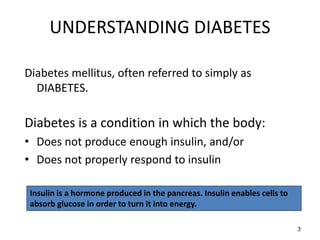
UNDERSTANDING DIABETES
Diabetes mellitus, often referred to simply as
DIABETES.
Diabetes is a condition in which the body:
• Does not produce enough insulin, and/or
• Does not properly respond to insulin
Insulin is a hormone produced in the pancreas. Insulin enables cells to
absorb glucose in order to turn it into energy.
3
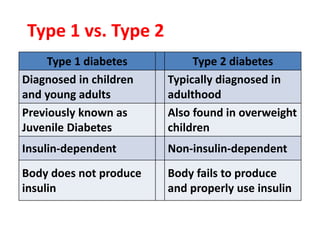
Type 1 vs. Type 2
Type 1 diabetes Type 2 diabetes
Diagnosed in children
and young adults
Typically diagnosed in
adulthood
Previously known as
Juvenile Diabetes
Also found in overweight
children
Insulin-dependent Non-insulin-dependent
Body does not produce
insulin
Body fails to produce
and properly use insulin
Complications of blood glucose alterations
• Hypoglycemia
• Hyperglycemia
• Ketosis
• Acidosis
• DKA (Hyperglycemia + Ketosis + Acidosis)
Blood Glucose Alterations
Normal fasting blood glucose level 4-6 mmol/L
DIABETIC KETOACIDOSIS (DKA)
Hyperosmolar Hyperglycemic State (HHS)
DIABETIC KETOACIDOSIS (DKA)
• A state of absolute or relative insulin deficiency
aggravated by ensuing hyperglycemia, dehydration,
and acidosis-producing derangements in intermediary
metabolism, including production of serum acetone.
• Can occur in both Type I Diabetes and Type II
Diabetes
– In type II diabetics with insulin
deficiency/dependence
• The presenting symptom for ~ 25% of Type I
Diabetics.
Diabetic KetoAcidosis (DKA)
1. 160,000 Admissions to private
hospitals/year
2. Cost = over 1 billion $ annually
3. 65% = <19 years old
4. Main cause of death in children with
diabetes (approximately 85%)
5. Cerebral edema in 69%
Hyperosmolar Hyperglycemic State (HHS)
• An acute metabolic complication of diabetes
mellitus characterized by impaired mental status
and elevated plasma osmolality in a patient with
hyperglycemia.
• Occurs predominately in Type II Diabetics
– A few reports of cases in type I diabetics.
• The presenting symptom for 30-40% of Type II
diabetics.
• Not commonly associated with ketonaemia and
acidosis
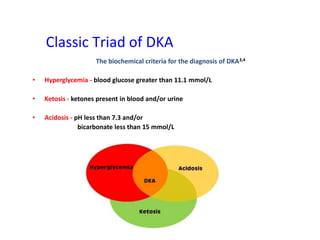
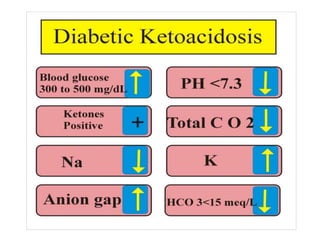
The biochemical criteria for the diagnosis of DKA3,4
• Hyperglycemia - blood glucose greater than 11.1 mmol/L
• Ketosis - ketones present in blood and/or urine
• Acidosis - pH less than 7.3 and/or
bicarbonate less than 15 mmol/L
Classic Triad of DKA
DKA is generally categorized by the severity of the
acidosis.
• MILD – Venous pH less than 7.3 and/or
bicarbonate concentration less than 15 mmol/L
• MODERATE – Venous pH less than 7.2 and/or
bicarbonate concentration less than 10 mmol/L
• SEVERE – Venous pH less than 7.1 and/or
bicarbonate concentration less than 5 mmol/L
CLASSIFICATION OF DKA
Risk factors for DKA at onset
• Age <12 yrs
• No first degree diabetic relative
• Lower socioeconomic status
• High dose glucocorticoids, atypical antipsychotics, diazoxide
and some immunosuppresive drugs
• Poor access to medical care
• Uninsured
• Usage of SGLT-2 inhibitor – euglycaemic DKA
SGLT2 inhibitors blunt insulin production in the face of stress
hormones leading to increased ketotic metabolism
Why do ketones develop?
No carbohydrate intake
• fasting
• gastroenteritis
• Atkins diet, neonates fed high-fat milk
Prolonged exercise, pregnancy
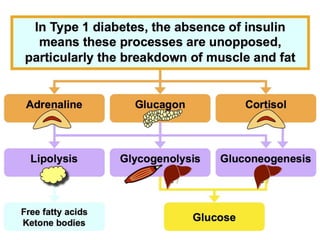
Lack of insulin activity
• onset of diabetes (insufficient secretion)
• interruption of insulin delivery in established pt
Increase in insulin resistance
• infection, illness, surgery, stress
Alcohol, salicylate ingestion, inborn metabolic errors
Causes of DKA/HHS
• Stressful precipitating event that results in increased
catecholamines, cortisol, glucagon.
– Infection (pneumonia, UTI)
– Alcohol, drugs
– Stroke
– Myocardial Infarction
– Pancreatitis
– Trauma
– Medications (steroids, thiazide diuretics)
– Non-compliance with insulin
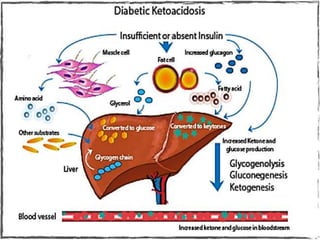
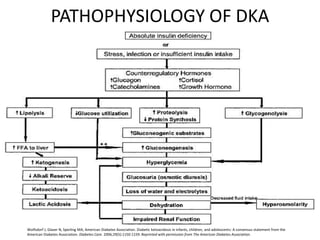
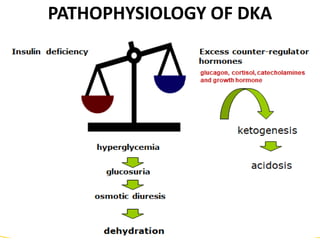
PATHOPHYSIOLOGY OF DKA
Wolfsdorf J, Glaser N, Sperling MA; American Diabetes Association. Diabetic ketoacidosis in infants, children, and adolescents: A consensus statement from the
American Diabetes Association. Diabetes Care. 2006;29(5):1150-1159. Reprinted with permission from The American Diabetes Association.
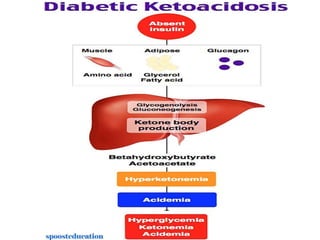
PATHOPHYSIOLOGY OF DKA
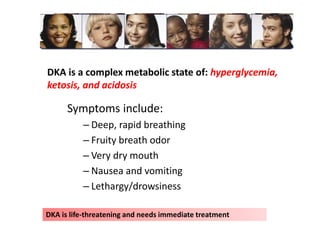
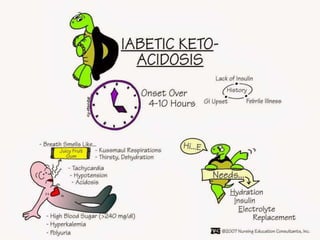
DKA is a complex metabolic state of: hyperglycemia,
ketosis, and acidosis
Symptoms include:
– Deep, rapid breathing
– Fruity breath odor
– Very dry mouth
– Nausea and vomiting
– Lethargy/drowsiness
DKA is life-threatening and needs immediate treatment
Symptoms of DKA/HHS
• Polyuria
• Polydypsia
• Blurred vision
• Nausea/Vomiting
• Abdominal Pain
• Fatigue
• Confusion
• Obtundation
Physical Examination in DKA/HHS
• Hypotension, tachycardia
• Kussmaul breathing (deep, labored breaths)
• Fruity odor to breath (due to acetone)
• Dry mucus membranes
• Confusion
• Abdominal tenderness
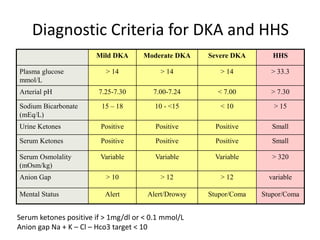
Diagnostic Criteria for DKA and HHS
Mild DKA Moderate DKA Severe DKA HHS
Plasma glucose
mmol/L
> 14 > 14 > 14 > 33.3
Arterial pH 7.25-7.30 7.00-7.24 < 7.00 > 7.30
Sodium Bicarbonate
(mEq/L)
15 – 18 10 - <15 < 10 > 15
Urine Ketones Positive Positive Positive Small
Serum Ketones Positive Positive Positive Small
Serum Osmolality
(mOsm/kg)
Variable Variable Variable > 320
Anion Gap > 10 > 12 > 12 variable
Mental Status Alert Alert/Drowsy Stupor/Coma Stupor/Coma
Serum ketones positive if > 1mg/dl or < 0.1 mmol/L
Anion gap Na + K – Cl – Hco3 target < 10
Identify and Treat the Precipitating
Factor
• Insulin omission – MOST COMMON CAUSE of DKA
• New diagnosis of diabetes
• Infection / Sepsis
• Myocardial infarction
– Small rise in troponin may occur without overt
ischemia
– ECG changes may reflect hyperkalemia
• Thyrotoxicosis
• Drugs
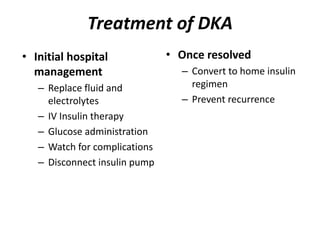
Treatment of DKA
• Once resolved
– Convert to home insulin
regimen
– Prevent recurrence
• Initial hospital
management
– Replace fluid and
electrolytes
– IV Insulin therapy
– Glucose administration
– Watch for complications
– Disconnect insulin pump
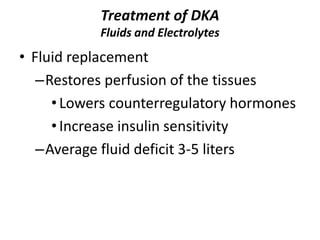
Treatment of DKA
Fluids and Electrolytes
• Fluid replacement
–Restores perfusion of the tissues
•Lowers counterregulatory hormones
•Increase insulin sensitivity
–Average fluid deficit 3-5 liters
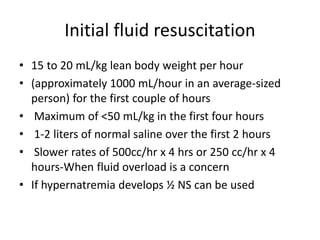
Initial fluid resuscitation
• 15 to 20 mL/kg lean body weight per hour
• (approximately 1000 mL/hour in an average-sized
person) for the first couple of hours
• Maximum of <50 mL/kg in the first four hours
• 1-2 liters of normal saline over the first 2 hours
• Slower rates of 500cc/hr x 4 hrs or 250 cc/hr x 4
hours-When fluid overload is a concern
• If hypernatremia develops ½ NS can be used
Treatment of DKA
Fluids and Electrolytes
• Hyperkalemia initially present
– Resolves quickly with insulin drip
– Once urine output is present and K<5.0, add 20-40
meq KCL per liter.
• Phosphate deficit
– May want to use Kphos
• Bicarbonate not given unless pH <7 or
bicarbonate <5 mmol/L
Treatment of DKA
Insulin Therapy
• IV bolus of 0.1-0.2 units/kg (~ 10 units) regular
insulin
• Follow with hourly regular insulin infusion
• Glucose levels
– Decrease 4 to 5.5 mmol/L per hour
– Minimize rapid fluid shifts
Treatment of DKA
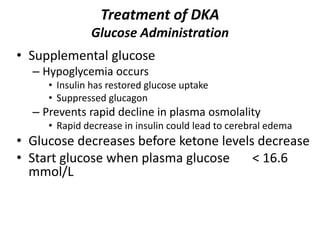
Glucose Administration
• Supplemental glucose
– Hypoglycemia occurs
• Insulin has restored glucose uptake
• Suppressed glucagon
– Prevents rapid decline in plasma osmolality
• Rapid decrease in insulin could lead to cerebral edema
• Glucose decreases before ketone levels decrease
• Start glucose when plasma glucose < 16.6
mmol/L
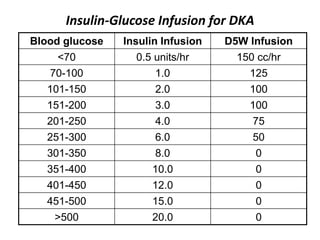
Insulin-Glucose Infusion for DKA
Blood glucose Insulin Infusion D5W Infusion
<70 0.5 units/hr 150 cc/hr
70-100 1.0 125
101-150 2.0 100
151-200 3.0 100
201-250 4.0 75
251-300 6.0 50
301-350 8.0 0
351-400 10.0 0
401-450 12.0 0
451-500 15.0 0
>500 20.0 0
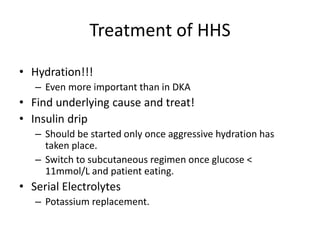
Treatment of HHS
• Hydration!!!
– Even more important than in DKA
• Find underlying cause and treat!
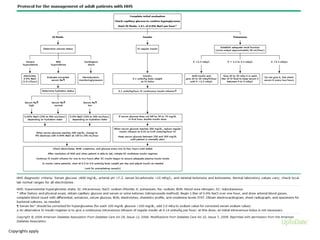
• Insulin drip
– Should be started only once aggressive hydration has
taken place.
– Switch to subcutaneous regimen once glucose <
11mmol/L and patient eating.
• Serial Electrolytes
– Potassium replacement.
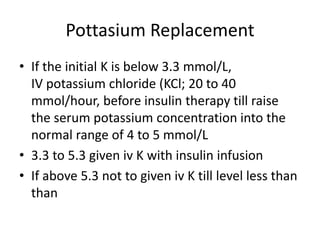
Pottasium Replacement
• If the initial K is below 3.3 mmol/L,
IV potassium chloride (KCl; 20 to 40
mmol/hour, before insulin therapy till raise
the serum potassium concentration into the
normal range of 4 to 5 mmol/L
• 3.3 to 5.3 given iv K with insulin infusion
• If above 5.3 not to given iv K till level less than
than
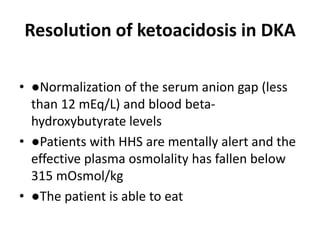
Resolution of ketoacidosis in DKA
• ●Normalization of the serum anion gap (less
than 12 mEq/L) and blood beta-
hydroxybutyrate levels
• ●Patients with HHS are mentally alert and the
effective plasma osmolality has fallen below
315 mOsmol/kg
• ●The patient is able to eat
Caveat
• Urinary ketones by the nitroprusside method can
be used for the initial diagnosis of ketoacidosis
• It should not be used for monitoring resolution of
DKA.
• Nitroprusside reacts mainly with acetoacetate, to
a much lesser degree with acetone (which is not
an acid), and not with beta-hydroxybutyrate.
• A positive nitroprusside test may persist for up to
36 hours after resolution of the ketoacidosis due
to a positive reaction with acetone, which is
slowly eliminated,
Once DKA Resolved
Treatment
• Most patients require 0.5-0.6 units/kg/day
• Pubertal or highly insulin resistant patients
– 0.8-1.0 units/kg/day
• Long acting insulin
– 1/2-2/3 daily requirement
– NPH, Lente, Ultralente or Lantus
• Short acting insulin
– 1/3-1/2 given at meals
– Regular, Humalog, Novolog
• Give insulin at least 2 hours prior to weaning insulin
infusion.
Copyrights apply
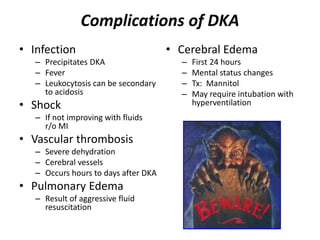
Complications of DKA
• Infection
– Precipitates DKA
– Fever
– Leukocytosis can be secondary
to acidosis
• Shock
– If not improving with fluids
r/o MI
• Vascular thrombosis
– Severe dehydration
– Cerebral vessels
– Occurs hours to days after DKA
• Pulmonary Edema
– Result of aggressive fluid
resuscitation
• Cerebral Edema
– First 24 hours
– Mental status changes
– Tx: Mannitol
– May require intubation with
hyperventilation
Prevention of DKA / HHS
• Type 1 diabetes
– Education around sick day management
– Continuation of insulin even when not eating
– Frequent monitoring when ill
• Type 2 diabetes
– Education around sick day management
– Frequent monitoring when ill
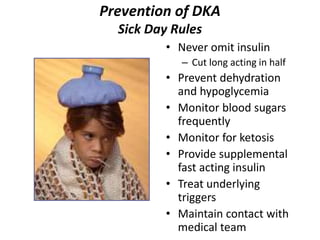
Prevention of DKA
Sick Day Rules
• Never omit insulin
– Cut long acting in half
• Prevent dehydration
and hypoglycemia
• Monitor blood sugars
frequently
• Monitor for ketosis
• Provide supplemental
fast acting insulin
• Treat underlying
triggers
• Maintain contact with
medical team
Conclusion
• Successful management
requires
– Judicious use of fluids
• Establish good perfusion
– Insulin drip
• Steady decline
• Complete resolution of ketosis
– Electrolyte replacement
– Frequent neurological evaluations
– High suspicion for complications
• Determine etiology to avoid
recurrent episodes
dkadrsyed2584-190602083813 (1).pdf

dkadrsyed2584-190602083813 (1).pdf

  • 3.
    UNDERSTANDING DIABETES Diabetes mellitus,often referred to simply as DIABETES. Diabetes is a condition in which the body: • Does not produce enough insulin, and/or • Does not properly respond to insulin Insulin is a hormone produced in the pancreas. Insulin enables cells to absorb glucose in order to turn it into energy. 3
  • 4.
    Type 1 vs.Type 2 Type 1 diabetes Type 2 diabetes Diagnosed in children and young adults Typically diagnosed in adulthood Previously known as Juvenile Diabetes Also found in overweight children Insulin-dependent Non-insulin-dependent Body does not produce insulin Body fails to produce and properly use insulin
  • 6.
    Complications of bloodglucose alterations • Hypoglycemia • Hyperglycemia • Ketosis • Acidosis • DKA (Hyperglycemia + Ketosis + Acidosis) Blood Glucose Alterations Normal fasting blood glucose level 4-6 mmol/L
  • 8.
  • 9.
    DIABETIC KETOACIDOSIS (DKA) •A state of absolute or relative insulin deficiency aggravated by ensuing hyperglycemia, dehydration, and acidosis-producing derangements in intermediary metabolism, including production of serum acetone. • Can occur in both Type I Diabetes and Type II Diabetes – In type II diabetics with insulin deficiency/dependence • The presenting symptom for ~ 25% of Type I Diabetics.
  • 11.
    Diabetic KetoAcidosis (DKA) 1.160,000 Admissions to private hospitals/year 2. Cost = over 1 billion $ annually 3. 65% = <19 years old 4. Main cause of death in children with diabetes (approximately 85%) 5. Cerebral edema in 69%
  • 12.
    Hyperosmolar Hyperglycemic State(HHS) • An acute metabolic complication of diabetes mellitus characterized by impaired mental status and elevated plasma osmolality in a patient with hyperglycemia. • Occurs predominately in Type II Diabetics – A few reports of cases in type I diabetics. • The presenting symptom for 30-40% of Type II diabetics. • Not commonly associated with ketonaemia and acidosis
  • 14.
    The biochemical criteriafor the diagnosis of DKA3,4 • Hyperglycemia - blood glucose greater than 11.1 mmol/L • Ketosis - ketones present in blood and/or urine • Acidosis - pH less than 7.3 and/or bicarbonate less than 15 mmol/L Classic Triad of DKA
  • 15.
    DKA is generallycategorized by the severity of the acidosis. • MILD – Venous pH less than 7.3 and/or bicarbonate concentration less than 15 mmol/L • MODERATE – Venous pH less than 7.2 and/or bicarbonate concentration less than 10 mmol/L • SEVERE – Venous pH less than 7.1 and/or bicarbonate concentration less than 5 mmol/L CLASSIFICATION OF DKA
  • 17.
    Risk factors forDKA at onset • Age <12 yrs • No first degree diabetic relative • Lower socioeconomic status • High dose glucocorticoids, atypical antipsychotics, diazoxide and some immunosuppresive drugs • Poor access to medical care • Uninsured • Usage of SGLT-2 inhibitor – euglycaemic DKA SGLT2 inhibitors blunt insulin production in the face of stress hormones leading to increased ketotic metabolism
  • 19.
    Why do ketonesdevelop? No carbohydrate intake • fasting • gastroenteritis • Atkins diet, neonates fed high-fat milk Prolonged exercise, pregnancy Lack of insulin activity • onset of diabetes (insufficient secretion) • interruption of insulin delivery in established pt Increase in insulin resistance • infection, illness, surgery, stress Alcohol, salicylate ingestion, inborn metabolic errors
  • 20.
    Causes of DKA/HHS •Stressful precipitating event that results in increased catecholamines, cortisol, glucagon. – Infection (pneumonia, UTI) – Alcohol, drugs – Stroke – Myocardial Infarction – Pancreatitis – Trauma – Medications (steroids, thiazide diuretics) – Non-compliance with insulin
  • 22.
    PATHOPHYSIOLOGY OF DKA WolfsdorfJ, Glaser N, Sperling MA; American Diabetes Association. Diabetic ketoacidosis in infants, children, and adolescents: A consensus statement from the American Diabetes Association. Diabetes Care. 2006;29(5):1150-1159. Reprinted with permission from The American Diabetes Association.
  • 23.
  • 26.
    DKA is acomplex metabolic state of: hyperglycemia, ketosis, and acidosis Symptoms include: – Deep, rapid breathing – Fruity breath odor – Very dry mouth – Nausea and vomiting – Lethargy/drowsiness DKA is life-threatening and needs immediate treatment
  • 27.
    Symptoms of DKA/HHS •Polyuria • Polydypsia • Blurred vision • Nausea/Vomiting • Abdominal Pain • Fatigue • Confusion • Obtundation
  • 28.
    Physical Examination inDKA/HHS • Hypotension, tachycardia • Kussmaul breathing (deep, labored breaths) • Fruity odor to breath (due to acetone) • Dry mucus membranes • Confusion • Abdominal tenderness
  • 30.
    Diagnostic Criteria forDKA and HHS Mild DKA Moderate DKA Severe DKA HHS Plasma glucose mmol/L > 14 > 14 > 14 > 33.3 Arterial pH 7.25-7.30 7.00-7.24 < 7.00 > 7.30 Sodium Bicarbonate (mEq/L) 15 – 18 10 - <15 < 10 > 15 Urine Ketones Positive Positive Positive Small Serum Ketones Positive Positive Positive Small Serum Osmolality (mOsm/kg) Variable Variable Variable > 320 Anion Gap > 10 > 12 > 12 variable Mental Status Alert Alert/Drowsy Stupor/Coma Stupor/Coma Serum ketones positive if > 1mg/dl or < 0.1 mmol/L Anion gap Na + K – Cl – Hco3 target < 10
  • 33.
    Identify and Treatthe Precipitating Factor • Insulin omission – MOST COMMON CAUSE of DKA • New diagnosis of diabetes • Infection / Sepsis • Myocardial infarction – Small rise in troponin may occur without overt ischemia – ECG changes may reflect hyperkalemia • Thyrotoxicosis • Drugs
  • 34.
    Treatment of DKA •Once resolved – Convert to home insulin regimen – Prevent recurrence • Initial hospital management – Replace fluid and electrolytes – IV Insulin therapy – Glucose administration – Watch for complications – Disconnect insulin pump
  • 35.
    Treatment of DKA Fluidsand Electrolytes • Fluid replacement –Restores perfusion of the tissues •Lowers counterregulatory hormones •Increase insulin sensitivity –Average fluid deficit 3-5 liters
  • 36.
    Initial fluid resuscitation •15 to 20 mL/kg lean body weight per hour • (approximately 1000 mL/hour in an average-sized person) for the first couple of hours • Maximum of <50 mL/kg in the first four hours • 1-2 liters of normal saline over the first 2 hours • Slower rates of 500cc/hr x 4 hrs or 250 cc/hr x 4 hours-When fluid overload is a concern • If hypernatremia develops ½ NS can be used
  • 37.
    Treatment of DKA Fluidsand Electrolytes • Hyperkalemia initially present – Resolves quickly with insulin drip – Once urine output is present and K<5.0, add 20-40 meq KCL per liter. • Phosphate deficit – May want to use Kphos • Bicarbonate not given unless pH <7 or bicarbonate <5 mmol/L
  • 38.
    Treatment of DKA InsulinTherapy • IV bolus of 0.1-0.2 units/kg (~ 10 units) regular insulin • Follow with hourly regular insulin infusion • Glucose levels – Decrease 4 to 5.5 mmol/L per hour – Minimize rapid fluid shifts
  • 39.
    Treatment of DKA GlucoseAdministration • Supplemental glucose – Hypoglycemia occurs • Insulin has restored glucose uptake • Suppressed glucagon – Prevents rapid decline in plasma osmolality • Rapid decrease in insulin could lead to cerebral edema • Glucose decreases before ketone levels decrease • Start glucose when plasma glucose < 16.6 mmol/L
  • 40.
    Insulin-Glucose Infusion forDKA Blood glucose Insulin Infusion D5W Infusion <70 0.5 units/hr 150 cc/hr 70-100 1.0 125 101-150 2.0 100 151-200 3.0 100 201-250 4.0 75 251-300 6.0 50 301-350 8.0 0 351-400 10.0 0 401-450 12.0 0 451-500 15.0 0 >500 20.0 0
  • 41.
    Treatment of HHS •Hydration!!! – Even more important than in DKA • Find underlying cause and treat! • Insulin drip – Should be started only once aggressive hydration has taken place. – Switch to subcutaneous regimen once glucose < 11mmol/L and patient eating. • Serial Electrolytes – Potassium replacement.
  • 42.
    Pottasium Replacement • Ifthe initial K is below 3.3 mmol/L, IV potassium chloride (KCl; 20 to 40 mmol/hour, before insulin therapy till raise the serum potassium concentration into the normal range of 4 to 5 mmol/L • 3.3 to 5.3 given iv K with insulin infusion • If above 5.3 not to given iv K till level less than than
  • 43.
    Resolution of ketoacidosisin DKA • ●Normalization of the serum anion gap (less than 12 mEq/L) and blood beta- hydroxybutyrate levels • ●Patients with HHS are mentally alert and the effective plasma osmolality has fallen below 315 mOsmol/kg • ●The patient is able to eat
  • 44.
    Caveat • Urinary ketonesby the nitroprusside method can be used for the initial diagnosis of ketoacidosis • It should not be used for monitoring resolution of DKA. • Nitroprusside reacts mainly with acetoacetate, to a much lesser degree with acetone (which is not an acid), and not with beta-hydroxybutyrate. • A positive nitroprusside test may persist for up to 36 hours after resolution of the ketoacidosis due to a positive reaction with acetone, which is slowly eliminated,
  • 45.
    Once DKA Resolved Treatment •Most patients require 0.5-0.6 units/kg/day • Pubertal or highly insulin resistant patients – 0.8-1.0 units/kg/day • Long acting insulin – 1/2-2/3 daily requirement – NPH, Lente, Ultralente or Lantus • Short acting insulin – 1/3-1/2 given at meals – Regular, Humalog, Novolog • Give insulin at least 2 hours prior to weaning insulin infusion.
  • 46.
  • 48.
    Complications of DKA •Infection – Precipitates DKA – Fever – Leukocytosis can be secondary to acidosis • Shock – If not improving with fluids r/o MI • Vascular thrombosis – Severe dehydration – Cerebral vessels – Occurs hours to days after DKA • Pulmonary Edema – Result of aggressive fluid resuscitation • Cerebral Edema – First 24 hours – Mental status changes – Tx: Mannitol – May require intubation with hyperventilation
  • 50.
    Prevention of DKA/ HHS • Type 1 diabetes – Education around sick day management – Continuation of insulin even when not eating – Frequent monitoring when ill • Type 2 diabetes – Education around sick day management – Frequent monitoring when ill
  • 51.
    Prevention of DKA SickDay Rules • Never omit insulin – Cut long acting in half • Prevent dehydration and hypoglycemia • Monitor blood sugars frequently • Monitor for ketosis • Provide supplemental fast acting insulin • Treat underlying triggers • Maintain contact with medical team
  • 54.
    Conclusion • Successful management requires –Judicious use of fluids • Establish good perfusion – Insulin drip • Steady decline • Complete resolution of ketosis – Electrolyte replacement – Frequent neurological evaluations – High suspicion for complications • Determine etiology to avoid recurrent episodes