Diabetic Ketoacidosis (DKA)
• Life-threatening emergency
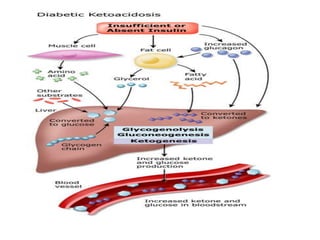
• Gross insulin deficiency is the predominant problem of DKA
• Most common in patients with
type 1 diabetes
• Can occur in patients with type 2 diabetes due to
progressive loss of β-cell reserve
• A metabolic status caused by formation of “ketone bodies”
• By-products are produced by metabolism of fatty acids for
energy. This is usually due to inability to use glucose
• Acetoacetic acid and Beta-hydroxybutyrate are commonly
produced
• They are acids which lead to drop in blood pH 
potentially fatal
• Ketones can also form during deamination of amino acids
Hyperosmolar Hyperglycemic State (HHS)
• An acute metabolic complication of diabetes
mellitus characterized by impaired mental
status and elevated plasma osmolality in a
patient with hyperglycemia.
• Occurs predominately in Type II Diabetics
– A few reports of cases in type I diabetics.
• The presenting symptom for 30-40% of Type II
diabetics.
Causes of DKA/HHS
• Stressful precipitating event that results in increased
catecholamines, cortisol, glucagon.
– Infection (pneumonia, UTI)
– Alcohol, drugs
– Stroke
– Myocardial Infarction
– Pancreatitis
– Trauma
– Medications (steroids, thiazide diuretics)
– Non-compliance with insulin
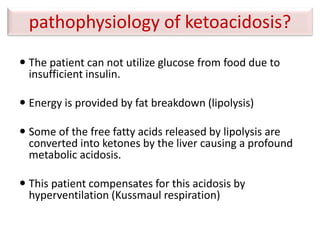
pathophysiology of ketoacidosis?
 The patient can not utilize glucose from food due to
insufficient insulin.
 Energy is provided by fat breakdown (lipolysis)
 Some of the free fatty acids released by lipolysis are
converted into ketones by the liver causing a profound
metabolic acidosis.
 This patient compensates for this acidosis by
hyperventilation (Kussmaul respiration)
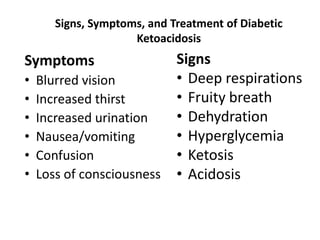
Signs, Symptoms, and Treatment of Diabetic
Ketoacidosis
Symptoms
• Blurred vision
• Increased thirst
• Increased urination
• Nausea/vomiting
• Confusion
• Loss of consciousness
Signs
• Deep respirations
• Fruity breath
• Dehydration
• Hyperglycemia
• Ketosis
• Acidosis
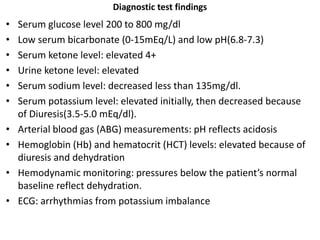
Diagnostic test findings
• Serum glucose level 200 to 800 mg/dl
• Low serum bicarbonate (0-15mEq/L) and low pH(6.8-7.3)
• Serum ketone level: elevated 4+
• Urine ketone level: elevated
• Serum sodium level: decreased less than 135mg/dl.
• Serum potassium level: elevated initially, then decreased because
of Diuresis(3.5-5.0 mEq/dl).
• Arterial blood gas (ABG) measurements: pH reflects acidosis
• Hemoglobin (Hb) and hematocrit (HCT) levels: elevated because of
diuresis and dehydration
• Hemodynamic monitoring: pressures below the patient’s normal
baseline reflect dehydration.
• ECG: arrhythmias from potassium imbalance
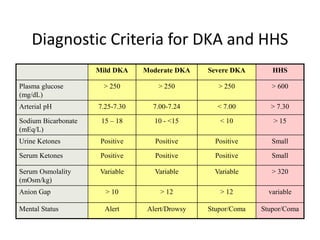
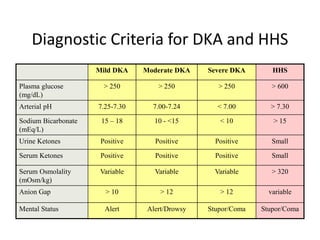
Diagnostic Criteria for DKA and HHS
Mild DKA Moderate DKA Severe DKA HHS
Plasma glucose
(mg/dL)
> 250 > 250 > 250 > 600
Arterial pH 7.25-7.30 7.00-7.24 < 7.00 > 7.30
Sodium Bicarbonate
(mEq/L)
15 – 18 10 - <15 < 10 > 15
Urine Ketones Positive Positive Positive Small
Serum Ketones Positive Positive Positive Small
Serum Osmolality
(mOsm/kg)
Variable Variable Variable > 320
Anion Gap > 10 > 12 > 12 variable
Mental Status Alert Alert/Drowsy Stupor/Coma Stupor/Coma
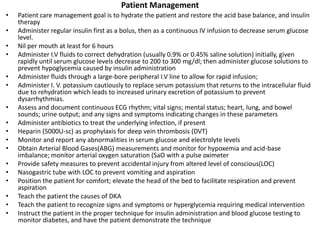
Patient Management
• Patient care management goal is to hydrate the patient and restore the acid base balance, and insulin
therapy
• Administer regular insulin first as a bolus, then as a continuous IV infusion to decrease serum glucose
level.
• Nil per mouth at least for 6 hours
• Administer I.V fluids to correct dehydration (usually 0.9% or 0.45% saline solution) initially, given
rapidly until serum glucose levels decrease to 200 to 300 mg/dl; then administer glucose solutions to
prevent hypoglycemia caused by insulin administration
• Administer fluids through a large-bore peripheral I.V line to allow for rapid infusion;
• Administer I. V. potassium cautiously to replace serum potassium that returns to the intracellular fluid
due to rehydration which leads to increased urinary excretion of potassium to prevent
dysarrhythmias.
• Assess and document continuous ECG rhythm; vital signs; mental status; heart, lung, and bowel
sounds; urine output; and any signs and symptoms indicating changes in these parameters
• Administer antibiotics to treat the underlying infection, if present
• Heparin (5000U-sc) as prophylaxis for deep vein thrombosis (DVT)
• Monitor and report any abnormalities in serum glucose and electrolyte levels
• Obtain Arterial Blood Gases(ABG) measurements and monitor for hypoxemia and acid-base
imbalance; monitor arterial oxygen saturation (SaO with a pulse oximeter
• Provide safety measures to prevent accidental injury from altered level of conscious(LOC)
• Nasogastric tube with LOC to prevent vomiting and aspiration
• Position the patient for comfort; elevate the head of the bed to facilitate respiration and prevent
aspiration
• Teach the patient the causes of DKA
• Teach the patient to recognize signs and symptoms or hyperglycemia requiring medical intervention
• Instruct the patient in the proper technique for insulin administration and blood glucose testing to
monitor diabetes, and have the patient demonstrate the technique
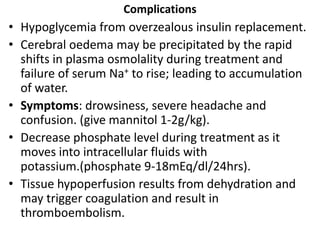
Complications
• Hypoglycemia from overzealous insulin replacement.
• Cerebral oedema may be precipitated by the rapid
shifts in plasma osmolality during treatment and
failure of serum Na+ to rise; leading to accumulation
of water.
• Symptoms: drowsiness, severe headache and
confusion. (give mannitol 1-2g/kg).
• Decrease phosphate level during treatment as it
moves into intracellular fluids with
potassium.(phosphate 9-18mEq/dl/24hrs).
• Tissue hypoperfusion results from dehydration and
may trigger coagulation and result in
thromboembolism.
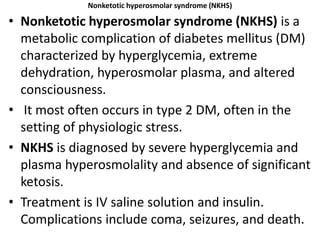
Nonketotic hyperosmolar syndrome (NKHS)
• Nonketotic hyperosmolar syndrome (NKHS) is a
metabolic complication of diabetes mellitus (DM)
characterized by hyperglycemia, extreme
dehydration, hyperosmolar plasma, and altered
consciousness.
• It most often occurs in type 2 DM, often in the
setting of physiologic stress.
• NKHS is diagnosed by severe hyperglycemia and
plasma hyperosmolality and absence of significant
ketosis.
• Treatment is IV saline solution and insulin.
Complications include coma, seizures, and death.
Diagnostic Criteria for DKA and HHS
Mild DKA Moderate DKA Severe DKA HHS
Plasma glucose
(mg/dL)
> 250 > 250 > 250 > 600
Arterial pH 7.25-7.30 7.00-7.24 < 7.00 > 7.30
Sodium Bicarbonate
(mEq/L)
15 – 18 10 - <15 < 10 > 15
Urine Ketones Positive Positive Positive Small
Serum Ketones Positive Positive Positive Small
Serum Osmolality
(mOsm/kg)
Variable Variable Variable > 320
Anion Gap > 10 > 12 > 12 variable
Mental Status Alert Alert/Drowsy Stupor/Coma Stupor/Coma

TRAUMA AND EMERGENCY NURSING 2.ppt

  • 1.
    Diabetic Ketoacidosis (DKA) •Life-threatening emergency • Gross insulin deficiency is the predominant problem of DKA • Most common in patients with type 1 diabetes • Can occur in patients with type 2 diabetes due to progressive loss of β-cell reserve • A metabolic status caused by formation of “ketone bodies” • By-products are produced by metabolism of fatty acids for energy. This is usually due to inability to use glucose • Acetoacetic acid and Beta-hydroxybutyrate are commonly produced • They are acids which lead to drop in blood pH  potentially fatal • Ketones can also form during deamination of amino acids
  • 3.
    Hyperosmolar Hyperglycemic State(HHS) • An acute metabolic complication of diabetes mellitus characterized by impaired mental status and elevated plasma osmolality in a patient with hyperglycemia. • Occurs predominately in Type II Diabetics – A few reports of cases in type I diabetics. • The presenting symptom for 30-40% of Type II diabetics.
  • 4.
    Causes of DKA/HHS •Stressful precipitating event that results in increased catecholamines, cortisol, glucagon. – Infection (pneumonia, UTI) – Alcohol, drugs – Stroke – Myocardial Infarction – Pancreatitis – Trauma – Medications (steroids, thiazide diuretics) – Non-compliance with insulin
  • 5.
    pathophysiology of ketoacidosis? The patient can not utilize glucose from food due to insufficient insulin.  Energy is provided by fat breakdown (lipolysis)  Some of the free fatty acids released by lipolysis are converted into ketones by the liver causing a profound metabolic acidosis.  This patient compensates for this acidosis by hyperventilation (Kussmaul respiration)
  • 6.
    Signs, Symptoms, andTreatment of Diabetic Ketoacidosis Symptoms • Blurred vision • Increased thirst • Increased urination • Nausea/vomiting • Confusion • Loss of consciousness Signs • Deep respirations • Fruity breath • Dehydration • Hyperglycemia • Ketosis • Acidosis
  • 7.
    Diagnostic test findings •Serum glucose level 200 to 800 mg/dl • Low serum bicarbonate (0-15mEq/L) and low pH(6.8-7.3) • Serum ketone level: elevated 4+ • Urine ketone level: elevated • Serum sodium level: decreased less than 135mg/dl. • Serum potassium level: elevated initially, then decreased because of Diuresis(3.5-5.0 mEq/dl). • Arterial blood gas (ABG) measurements: pH reflects acidosis • Hemoglobin (Hb) and hematocrit (HCT) levels: elevated because of diuresis and dehydration • Hemodynamic monitoring: pressures below the patient’s normal baseline reflect dehydration. • ECG: arrhythmias from potassium imbalance
  • 8.
    Diagnostic Criteria forDKA and HHS Mild DKA Moderate DKA Severe DKA HHS Plasma glucose (mg/dL) > 250 > 250 > 250 > 600 Arterial pH 7.25-7.30 7.00-7.24 < 7.00 > 7.30 Sodium Bicarbonate (mEq/L) 15 – 18 10 - <15 < 10 > 15 Urine Ketones Positive Positive Positive Small Serum Ketones Positive Positive Positive Small Serum Osmolality (mOsm/kg) Variable Variable Variable > 320 Anion Gap > 10 > 12 > 12 variable Mental Status Alert Alert/Drowsy Stupor/Coma Stupor/Coma
  • 9.
    Patient Management • Patientcare management goal is to hydrate the patient and restore the acid base balance, and insulin therapy • Administer regular insulin first as a bolus, then as a continuous IV infusion to decrease serum glucose level. • Nil per mouth at least for 6 hours • Administer I.V fluids to correct dehydration (usually 0.9% or 0.45% saline solution) initially, given rapidly until serum glucose levels decrease to 200 to 300 mg/dl; then administer glucose solutions to prevent hypoglycemia caused by insulin administration • Administer fluids through a large-bore peripheral I.V line to allow for rapid infusion; • Administer I. V. potassium cautiously to replace serum potassium that returns to the intracellular fluid due to rehydration which leads to increased urinary excretion of potassium to prevent dysarrhythmias. • Assess and document continuous ECG rhythm; vital signs; mental status; heart, lung, and bowel sounds; urine output; and any signs and symptoms indicating changes in these parameters • Administer antibiotics to treat the underlying infection, if present • Heparin (5000U-sc) as prophylaxis for deep vein thrombosis (DVT) • Monitor and report any abnormalities in serum glucose and electrolyte levels • Obtain Arterial Blood Gases(ABG) measurements and monitor for hypoxemia and acid-base imbalance; monitor arterial oxygen saturation (SaO with a pulse oximeter • Provide safety measures to prevent accidental injury from altered level of conscious(LOC) • Nasogastric tube with LOC to prevent vomiting and aspiration • Position the patient for comfort; elevate the head of the bed to facilitate respiration and prevent aspiration • Teach the patient the causes of DKA • Teach the patient to recognize signs and symptoms or hyperglycemia requiring medical intervention • Instruct the patient in the proper technique for insulin administration and blood glucose testing to monitor diabetes, and have the patient demonstrate the technique
  • 10.
    Complications • Hypoglycemia fromoverzealous insulin replacement. • Cerebral oedema may be precipitated by the rapid shifts in plasma osmolality during treatment and failure of serum Na+ to rise; leading to accumulation of water. • Symptoms: drowsiness, severe headache and confusion. (give mannitol 1-2g/kg). • Decrease phosphate level during treatment as it moves into intracellular fluids with potassium.(phosphate 9-18mEq/dl/24hrs). • Tissue hypoperfusion results from dehydration and may trigger coagulation and result in thromboembolism.
  • 11.
    Nonketotic hyperosmolar syndrome(NKHS) • Nonketotic hyperosmolar syndrome (NKHS) is a metabolic complication of diabetes mellitus (DM) characterized by hyperglycemia, extreme dehydration, hyperosmolar plasma, and altered consciousness. • It most often occurs in type 2 DM, often in the setting of physiologic stress. • NKHS is diagnosed by severe hyperglycemia and plasma hyperosmolality and absence of significant ketosis. • Treatment is IV saline solution and insulin. Complications include coma, seizures, and death.
  • 12.
    Diagnostic Criteria forDKA and HHS Mild DKA Moderate DKA Severe DKA HHS Plasma glucose (mg/dL) > 250 > 250 > 250 > 600 Arterial pH 7.25-7.30 7.00-7.24 < 7.00 > 7.30 Sodium Bicarbonate (mEq/L) 15 – 18 10 - <15 < 10 > 15 Urine Ketones Positive Positive Positive Small Serum Ketones Positive Positive Positive Small Serum Osmolality (mOsm/kg) Variable Variable Variable > 320 Anion Gap > 10 > 12 > 12 variable Mental Status Alert Alert/Drowsy Stupor/Coma Stupor/Coma