









DCCT- EDIC
THE THIRTY PLUS YEARS TRIAL
LESSONS AND OUTCOMES
DCC = DIABETES CONTROL AND COMPLICATIONS TRIAL
EDIC = EPIDEMIOLOGY OF DIABETES INTERVENTIONS AND COMPLICATIONS STUDY
Mohammad Daoud , MD
Consultant Endocrinologist –ABIM
KAMC-NGHA , Jeddah
DM is Not a Number
DM= A Cardiovascular Disease
Complications : Micro / Macro
Hidden Faces of :
Sexual dysfunction ,Diabetic foot
Depression
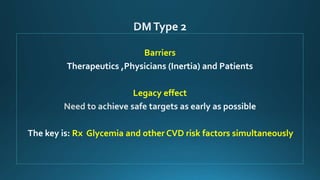
Barriers
Therapeutics ,Physicians (Inertia) and Patients
Legacy effect
The key is: Rx Glycemia and other CVD risk factors simultaneously
WHAT ABOUT TYPE 1 DM PATIENTS…
DOES THE SAME CONCEPTS APPLY ?
DCCT –EDIC
Overview
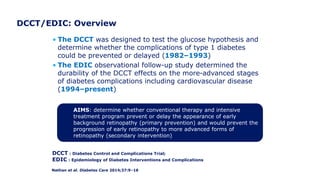
DCCT/EDIC: Overview
• The DCCT was designed to test the glucose hypothesis and
determine whether the complications of type 1 diabetes
could be prevented or delayed (1982–1993)
• The EDIC observational follow-up study determined the
durability of the DCCT effects on the more-advanced stages
of diabetes complications including cardiovascular disease
(1994–present)
Nathan et al. Diabetes Care 2014;37:9–16
AIMS: determine whether conventional therapy and intensive
treatment program prevent or delay the appearance of early
background retinopathy (primary prevention) and would prevent the
progression of early retinopathy to more advanced forms of
retinopathy (secondary intervention)
DCCT : Diabetes Control and Complications Trial;
EDIC : Epidemiology of Diabetes Interventions and Complications
Initial DCCT Results Presented at ADA 1993
•Initial results of the DCCT were presented in 1993 at
the 53rd Scientific Sessions of the American Diabetes
Association in Las Vegas, NV, USA
• The significance of the findings was instantly apparent
• Results meant that there was no more guessing on what the
standards of treatment should be
• Initial results ushered in a new paradigm of treatment
•No one could predict what was to come of the DCCT
over the next 20 years!
ADA, American Diabetes Association
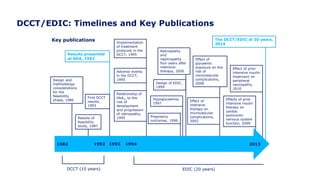
DCCT/EDIC: Timelines and Key Publications
1982 1994 2013
EDIC (20 years)
1993
DCCT (10 years)
1992
Design and
methodology
considerations
for the
feasibility
phase, 1986
Results of
feasibility
study, 1987
First DCCT
results,
1993
Key publications Implementation
of treatment
protocols in the
DCCT, 1995
Adverse events
in the DCCT,
1995
Relationship of
HbA1c to the
risk of
development
and progression
of retinopathy,
1995 Pregnancy
outcomes, 1996
Hypoglycaemia,
1997
Design of EDIC,
1999
Retinopathy
and
nephropathy
four years after
intensive
therapy, 2000
Effect of
intensive
therapy on
microvascular
complications,
2002
Effect of
glycaemic
exposure on the
risk of
microvascular
complications,
2008
Effects of prior
intensive insulin
therapy on
cardiac
autonomic
nervous system
function, 2009
Effect of prior
intensive insulin
treatment on
peripheral
neuropathy,
2010
The DCCT/EDIC at 30 years,
2014
Results presented
at ADA, 1993
DCCT / EDIC
DESIGN AN METHODS
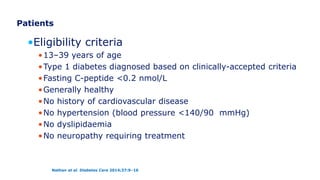
Patients
•Eligibility criteria
•13–39 years of age
•Type 1 diabetes diagnosed based on clinically-accepted criteria
•Fasting C-peptide <0.2 nmol/L
•Generally healthy
•No history of cardiovascular disease
•No hypertension (blood pressure <140/90 mmHg)
•No dyslipidaemia
•No neuropathy requiring treatment
Nathan et al. Diabetes Care 2014;37:9–16
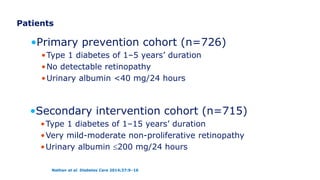
Patients
•Primary prevention cohort (n=726)
•Type 1 diabetes of 1–5 years’ duration
•No detectable retinopathy
•Urinary albumin <40 mg/24 hours
Nathan et al. Diabetes Care 2014;37:9–16
•Secondary intervention cohort (n=715)
•Type 1 diabetes of 1–15 years’ duration
•Very mild-moderate non-proliferative retinopathy
•Urinary albumin 200 mg/24 hours
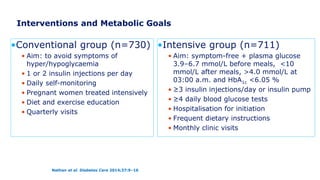
Interventions and Metabolic Goals
•Conventional group (n=730)
• Aim: to avoid symptoms of
hyper/hypoglycaemia
• 1 or 2 insulin injections per day
• Daily self-monitoring
• Pregnant women treated intensively
• Diet and exercise education
• Quarterly visits
Nathan et al. Diabetes Care 2014;37:9–16
•Intensive group (n=711)
• Aim: symptom-free + plasma glucose
3.9–6.7 mmol/L before meals, <10
mmol/L after meals, >4.0 mmol/L at
03:00 a.m. and HbA1c <6.05 %
• ≥3 insulin injections/day or insulin pump
• ≥4 daily blood glucose tests
• Hospitalisation for initiation
• Frequent dietary instructions
• Monthly clinic visits
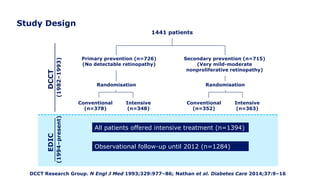
Study Design
DCCT Research Group. N Engl J Med 1993;329:977–86; Nathan et al. Diabetes Care 2014;37:9–16
Primary prevention (n=726)
(No detectable retinopathy)
Secondary prevention (n=715)
(Very mild-moderate
nonproliferative retinopathy)
1441 patients
Randomisation Randomisation
Conventional
(n=378)
Conventional
(n=352)
Intensive
(n=348)
Intensive
(n=363)
DCCT
(1982–1993)
EDIC
(1994–present)
All patients offered intensive treatment (n=1394)
Observational follow-up until 2012 (n=1284)
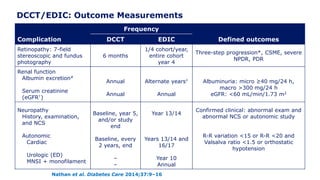
DCCT/EDIC: Outcome Measurements
Nathan et al. Diabetes Care 2014;37:9–16
Frequency
Complication DCCT EDIC Defined outcomes
Retinopathy: 7-field
stereoscopic and fundus
photography
6 months
1/4 cohort/year,
entire cohort
year 4
Three-step progression*, CSME, severe
NPDR, PDR
Renal function
Albumin excretion#
Serum creatinine
(eGFR†)
Annual
Annual
Alternate years‡
Annual
Albuminuria: micro ≥40 mg/24 h,
macro >300 mg/24 h
eGFR: <60 mL/min/1.73 m2
Neuropathy
History, examination,
and NCS
Autonomic
Cardiac
Urologic (ED)
MNSI + monofilament
Baseline, year 5,
and/or study
end
Baseline, every
2 years, end
–
–
Year 13/14
Years 13/14 and
16/17
Year 10
Annual
Confirmed clinical: abnormal exam and
abnormal NCS or autonomic study
R-R variation <15 or R-R <20 and
Valsalva ratio <1.5 or orthostatic
hypotension
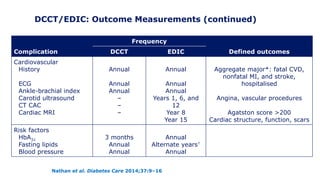
DCCT/EDIC: Outcome Measurements (continued)
Nathan et al. Diabetes Care 2014;37:9–16
Frequency
Complication DCCT EDIC Defined outcomes
Cardiovascular
History
ECG
Ankle-brachial index
Carotid ultrasound
CT CAC
Cardiac MRI
Annual
Annual
Annual
–
–
–
Annual
Annual
Annual
Years 1, 6, and
12
Year 8
Year 15
Aggregate major*: fatal CVD,
nonfatal MI, and stroke,
hospitalised
Angina, vascular procedures
Agatston score >200
Cardiac structure, function, scars
Risk factors
HbA1c
Fasting lipids
Blood pressure
3 months
Annual
Annual
Annual
Alternate years†
Annual
Results of DCCT/EDIC
Patient characteristics and demographics
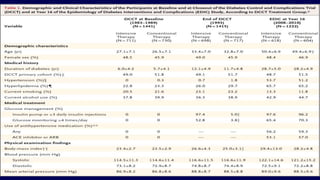
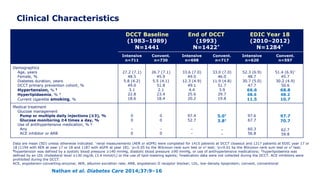
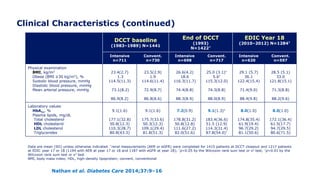
Clinical Characteristics
Nathan et al. Diabetes Care 2014;37:9–16
DCCT Baseline
(1983–1989)
N=1441
End of DCCT
(1993)
N=1422*
EDIC Year 18
(2010–2012)
N=1284*
Intensive
n=711
Convent.
n=730
Intensive
n=698
Convent.
n=717
Intensive
n=620
Convent.
n=597
Demographics
Age, years
Female, %
Diabetes duration, years
DCCT primary prevention cohort, %
Hypertension, % ¶
Hyperlipidaemia, % #
Current cigarette smoking, %
27.2 (7.1)
48.5
5.8 (4.2)
49.0
3.1
22.8
18.6
26.7 (7.1)
45.9
5.5 (4.1)
51.8
2.1
23.4
18.4
33.6 (7.0)
49.0
12.3 (4.9)
49.1
4.4
25.6
20.2
33.0 (7.0)
46.0
11.9 (4.8)
51.7
3.9
29.7
19.8
52.3 (6.9)
48.7
30.7 (5.0)
47.7
66.6
68.6
11.5
51.4 (6.9)†
45.7
30.2 (4.9)
50.6
68.8
68.2
10.7
Medical treatment
Glucose management
Pump or multiple daily injections (≥3), %
Glucose monitoring ≥4 times a day, %
Use of antihypertensive medication, % §
Any
ACE inhibitor or ARB
0
0
–
0
0
0
–
0
97.4
52.7
–
–
5.0‡
3.8‡
–
–
97.6
67.7
60.3
56.8
97.7
70.7
62.7
59.8
Data are mean (SD) unless otherwise indicated. *renal measurements (AER or eGFR) were completed for 1415 patients at DCCT closeout and 1217 patients at EDIC year 17 or
18 (1194 with AER at year 17 or 18 and 1187 with eGFR at year 18); †p=0.05 by the Wilcoxon rank sum test or x2 test; ‡p=0.01 by the Wilcoxon rank sum test or x2 test;
¶hypertension was defined by a systolic blood pressure ≥140 mmHg, diastolic blood pressure ≥90 mmHg, or use of antihypertensive medications; #hyperlipidaemia was
defined by an LDL cholesterol level ≥130 mg/dL (3.4 mmol/L) or the use of lipid-lowering agents; §medication data were not collected during the DCCT. ACE inhibitors were
prohibited during the DCCT.
ACE, angiotensin-converting-enzyme; AER, albumin excretion rate; ARB, angiotensin II receptor blocker; LDL, low-density lipoprotein; convent, conventional
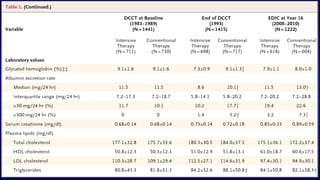
Clinical Characteristics (continued)
Nathan et al. Diabetes Care 2014;37:9–16
DCCT baseline
(1983–1989) N=1441
End of DCCT
(1993)
N=1422*
EDIC Year 18
(2010–2012) N=1284*
Intensive
n=711
Convent.
n=730
Intensive
n=698
Convent.
n=717
Intensive
n=620
Convent.
n=597
Physical examination
BMI, kg/m2
Obese (BMI ≥30 kg/m2), %
Systolic blood pressure, mmHg
Diastolic blood pressure, mmHg
Mean arterial pressure, mmHg
23.4(2.7)
1.3
114.5(11.3)
73.1(8.2)
86.9(8.2)
23.5(2.9)
1.9
114.6(11.4)
72.9(8.7)
86.8(8.6)
26.6(4.2)
18.6
116.3(11.7)
74.4(8.8)
88.3(8.9)
25.0 (3.1)‡
5.6‡
115.3(12.0)
74.3(8.8)
88.0(8.9)
29.1 (5.7)
36.1
122.4(15.4)
71.4(9.0)
88.4(9.8)
28.5 (5.1)
33.0
121.8(15.1)
71.3(8.8)
88.2(9.6)
Laboratory values
HbA1c, %
Plasma lipids, mg/dL
Total cholesterol
HDL cholesterol
LDL cholesterol
Triglycerides
9.1(1.6)
177.1(32.8)
50.8(12.3)
110.3(28.7)
80.8(43.3)
9.1(1.6)
175.7(33.6)
50.3(12.3)
109.1(29.4)
81.8(51.3)
7.2(0.9)
178.8(31.2)
50.8(12.8)
111.6(27.2)
82.0(51.6)
9.1(1.3)‡
183.4(36.6)
51.5 (12.9)
114.3(31.4)
87.8(54.0)†
8.0(1.0)
174.8(35.4)
61.9(19.4)
96.7(29.2)
81.1(50.6)
8.0(1.0)
172.1(36.4)
61.5(17.7)
94.7(29.5)
80.6(71.5)
Data are mean (SD) unless otherwise indicated. *renal measurements (AER or eGFR) were completed for 1415 patients at DCCT closeout and 1217 patients
at EDIC year 17 or 18 (1194 with AER at year 17 or 18 and 1187 with eGFR at year 18); †p=0.05 by the Wilcoxon rank sum test or x2 test; ‡p=0.01 by the
Wilcoxon rank sum test or x2 test
BMI, body mass index; HDL, high-density lipoprotein; convent, conventional
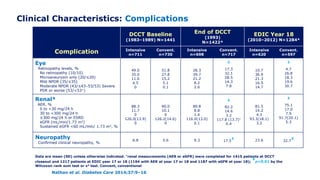
Clinical Characteristics: Complications
Nathan et al. Diabetes Care 2014;37:9–16
DCCT Baseline
(1983–1989) N=1441
End of DCCT
(1993)
N=1422*
EDIC Year 18
(2010–2012) N=1284*
Complication Intensive
n=711
Convent.
n=730
Intensive
n=698
Convent.
n=717
Intensive
n=620
Convent.
n=597
Eye
Retinopathy levels, %
No retinopathy (10/10)
Microaneurysm only (20/≤20)
Mild NPDR (35/≤35)
Moderate NPDR (43/≤43–53/53) Severe
PDR or worse (53/<53+)
49.0
35.0
11.6
4.5
0
51.8
27.8
15.2
5.1
0.1
28.3
39.7
21.2
8.2
2.6
‡
17.3
32.1
28.5
14.3
7.8
10.7
36.9
21.3
16.5
14.7
‡
4.7
26.8
18.3
19.6
30.7
Renal*
AER, %
0 to <30 mg/24 h
30 to <300 mg/24 h
≥300 mg/24 h or ESRD
eGFR (mL/min/1.73 m2)
Sustained eGFR <60 mL/min/ 1.73 m2, %
88.3
11.7
0
126.0(13.9)
0
90.0
10.1
0
126.2(14.6)
0
89.8
8.8
1.4
116.0(13.0)
0.1
‡
82.2
14.6
3.2
117.8 (13.7)‡
0.4
81.5
14.2
4.3
93.3(18.1)
3.2
‡
75.1
17.0
7.9
91.7(20.1)
5.3
Neuropathy
Confirmed clinical neuropathy, %
6.8 5.6 9.3 17.5
‡ 23.6 32.7
‡
Data are mean (SD) unless otherwise indicated. *renal measurements (AER or eGFR) were completed for 1415 patients at DCCT
closeout and 1217 patients at EDIC year 17 or 18 (1194 with AER at year 17 or 18 and 1187 with eGFR at year 18);
‡p=0.01 by the
Wilcoxon rank sum test or x2 test. Convent, conventional
Key DCCT Findings
Results of DCCT/EDIC
Glycaemic control & Major complications
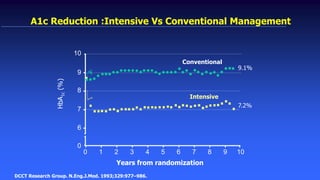
A1c Reduction :Intensive Vs Conventional Management
0 2 4 6 8 10
Years from randomization
5 731 9
8
9
10
7
HbA1c(%)
6
0
Intensive
Conventional
DCCT Research Group. N.Eng.J.Med. 1993;329:977–986.
9.1%
7.2%
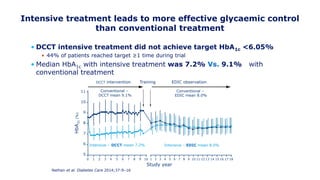
Intensive treatment leads to more effective glycaemic control
than conventional treatment
• DCCT intensive treatment did not achieve target HbA1c <6.05%
• 44% of patients reached target ≥1 time during trial
• Median HbA1c with intensive treatment was 7.2% Vs. 9.1% with
conventional treatment
Nathan et al. Diabetes Care 2014;37:9–16
Intensive – EDIC mean 8.0%Intensive – DCCT mean 7.2%
11
10
9
8
7
6
5
0 1 2 3 4 5 6 7 8 9 10
Conventional –
EDIC mean 8.0%
Conventional –
DCCT mean 9.1%
Study year
TrainingDCCT intervention EDIC observation
HbA1c(%)
1 2 3 4 5 6 7 8 11 12 13 14 15 16 17 189 10
0
0.2
0.4
0.6
0.8
1.0
1.2
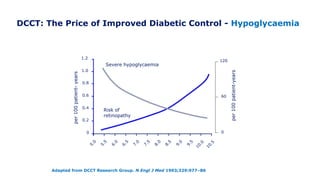
Risk of
retinopathy
Severe hypoglycaemia
120
60
0
per100patient-years
HbA1c (%)
DCCT: The Price of Improved Diabetic Control - Hypoglycaemia
per100patient-years
Adapted from DCCT Research Group. N Engl J Med 1993;329:977–86
Results of DCCT/EDIC
Diabetic Retinopathy and other ocular findings
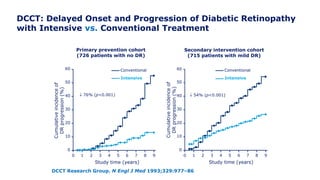
DCCT: Delayed Onset and Progression of Diabetic Retinopathy
with Intensive vs. Conventional Treatment
Primary prevention cohort
(726 patients with no DR)
Secondary intervention cohort
(715 patients with mild DR)
 54% (p<0.001)
60
50
40
30
20
10
0
0 1 2 3 4
Study time (years)
5 6 7 8 9
60
50
40
30
20
10
0
0 1 2 3 4 5 6 7 8 9
Conventional
Intensive
Cumulativeincidenceof
DRprogression(%)
Cumulativeincidenceof
DRprogression(%)
Conventional
Intensive
 76% (p<0.001)
Study time (years)
DCCT Research Group. N Engl J Med 1993;329:977–86
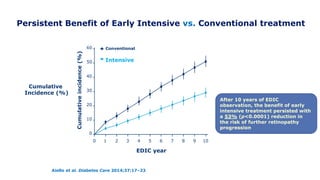
Persistent Benefit of Early Intensive vs. Conventional treatment
After 10 years of EDIC
observation, the benefit of early
intensive treatment persisted with
a 53% (p<0.0001) reduction in
the risk of further retinopathy
progression
Aiello et al. Diabetes Care 2014;37:17–23
60
50
40
30
20
10
0
0 1 2 3 4 5 6 7 8 9 10
Conventional
Intensive
EDIC year
Cumulativeincidence(%)
Cumulative
Incidence (%)
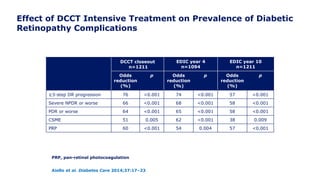
Effect of DCCT Intensive Treatment on Prevalence of Diabetic
Retinopathy Complications
Aiello et al. Diabetes Care 2014;37:17–23
DCCT closeout
n=1211
EDIC year 4
n=1094
EDIC year 10
n=1211
Odds
reduction
(%)
p Odds
reduction
(%)
p Odds
reduction
(%)
p
≥3-step DR progression 76 <0.001 74 <0.001 57 <0.001
Severe NPDR or worse 66 <0.001 68 <0.001 58 <0.001
PDR or worse 64 <0.001 65 <0.001 58 <0.001
CSME 51 0.005 62 <0.001 38 0.009
PRP 60 <0.001 54 0.004 57 <0.001
PRP, pan-retinal photocoagulation
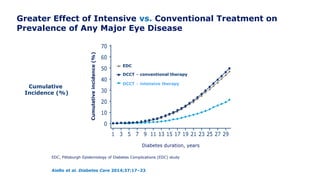
Greater Effect of Intensive vs. Conventional Treatment on
Prevalence of Any Major Eye Disease
Aiello et al. Diabetes Care 2014;37:17–23
Diabetes duration, years
Cumulativeincidence(%)
EDC, Pittsburgh Epidemiology of Diabetes Complications (EDC) study
EDC
DCCT – conventional therapy
DCCT – intensive therapy
Cumulative
Incidence (%)
Results of DCCT/EDIC
Kidney disease and related findings
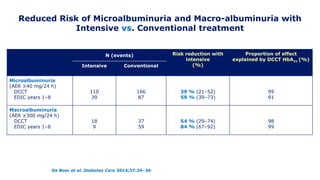
Reduced Risk of Microalbuminuria and Macro-albuminuria with
Intensive vs. Conventional treatment
De Boer et al. Diabetes Care 2014;37:24–30
N (events) Risk reduction with
intensive
(%)
Proportion of effect
explained by DCCT HbA1c (%)
Intensive Conventional
Microalbuminuria
(AER ≥40 mg/24 h)
DCCT
EDIC years 1–8
110
39
166
87
39 % (21–52)
59 % (39–73)
99
91
Macroalbuminuria
(AER ≥300 mg/24 h)
DCCT
EDIC years 1–8
18
9
37
59
54 % (29–74)
84 % (67–92)
98
99
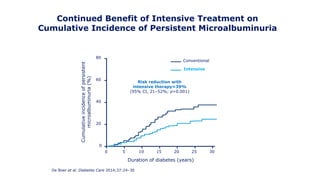
Continued Benefit of Intensive Treatment on
Cumulative Incidence of Persistent Microalbuminuria
De Boer et al. Diabetes Care 2014;37:24–30
80
60
40
20
0
0 5
Duration of diabetes (years)
10 15 20 25 30
Conventional
Intensive
Risk reduction with
intensive therapy=39%
(95% CI, 21–52%; p=0.001)
Cumulativeincidenceofpersistent
microalbuminuria(%)
Date of download: 3/15/2016
Copyright © 2016 American Medical
Association. All rights reserved.
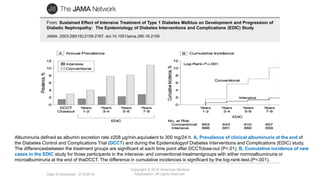
From: Sustained Effect of Intensive Treatment of Type 1 Diabetes Mellitus on Development and Progression of
Diabetic Nephropathy: The Epidemiology of Diabetes Interventions and Complications (EDIC) Study
JAMA. 2003;290(16):2159-2167. doi:10.1001/jama.290.16.2159
Albuminuria defined as albumin excretion rate ≥208 µg/min,equivalent to 300 mg/24 h. A, Prevalence of clinical albuminuria at the end of
the Diabetes Control and Complications Trial (DCCT) and during the Epidemiologyof Diabetes Interventions and Complications (EDIC) study.
The differencesbetween the treatment groups are significant at each time point after DCCTclose-out (P<.01). B, Cumulative incidence of new
cases in the EDIC study for those participants in the intensive- and conventional-treatmentgroups with either normoalbuminuria or
microalbuminuria at the end of theDCCT. The difference in cumulative incidences is significant by the log-rank-test.(P<.001).
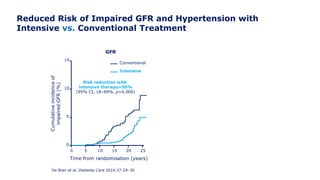
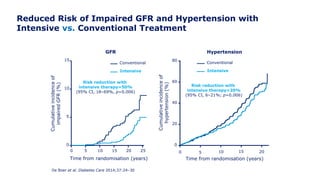
Reduced Risk of Impaired GFR and Hypertension with
Intensive vs. Conventional Treatment
Risk reduction with
intensive therapy=20%
(95% CI, 6–21%; p=0.006)
GFR Hypertension
De Boer et al. Diabetes Care 2014;37:24–30
Conventional
Intensive
Cumulativeincidenceof
hypertension(%)
0 5 10 15 20
80
60
40
20
0
Time from randomisation (years)
15
10
5
0
0 5 10 15 20
Time from randomisation (years)
25
Cumulativeincidenceof
impairedGFR(%)
Risk reduction with
intensive therapy=50%
(95% CI, 18–69%, p=0.006)
Conventional
Intensive
Reduced Risk of Impaired GFR and Hypertension with
Intensive vs. Conventional Treatment
Risk reduction with
intensive therapy=20%
(95% CI, 6–21%; p=0.006)
GFR Hypertension
De Boer et al. Diabetes Care 2014;37:24–30
Conventional
Intensive
Cumulativeincidenceof
hypertension(%)
0 5 10 15 20
80
60
40
20
0
Time from randomisation (years)
15
10
5
0
0 5 10 15 20
Time from randomisation (years)
25
Cumulativeincidenceof
impairedGFR(%)
Risk reduction with
intensive therapy=50%
(95% CI, 18–69%, p=0.006)
Conventional
Intensive
Date of download: 3/15/2016
Copyright © 2016 American Medical
Association. All rights reserved.
From: Sustained Effect of Intensive Treatment of Type 1 Diabetes Mellitus on Development and Progression of
Diabetic Nephropathy: The Epidemiology of Diabetes Interventions and Complications (EDIC) Study
JAMA. 2003;290(16):2159-2167. doi:10.1001/jama.290.16.2159
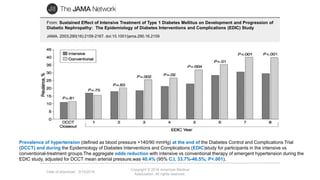
Prevalence of hypertension (defined as blood pressure >140/90 mmHg) at the end of the Diabetes Control and Complications Trial
(DCCT) and during the Epidemiology of Diabetes Interventions and Complications (EDIC)study for participants in the intensive vs
conventional-treatment groups.The aggregate odds reduction with intensive vs conventional therapy of emergent hypertension during the
EDIC study, adjusted for DCCT mean arterial pressure,was 40.4% (95% C.I, 33.7%-46.5%; P<.001).
Results of DCCT/EDIC
Neuropathy and related findings
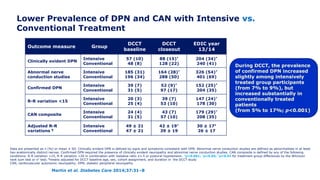
Lower Prevalence of DPN and CAN with Intensive vs.
Conventional Treatment
During DCCT, the prevalence
of confirmed DPN increased
slightly among intensively
treated group participants
(from 7% to 9%), but
increased substantially in
conventionally treated
patients
(from 5% to 17%; p<0.001)
Martin et al. Diabetes Care 2014;37:31–8
Outcome measure Group
DCCT
baseline
DCCT
closeout
EDIC year
13/14
Clinically evident DPN
Intensive
Conventional
57 (10)
48 (8)
88 (15)*
128 (22)
204 (34)*
240 (41)
Abnormal nerve
conduction studies
Intensive
Conventional
185 (31)
196 (34)
164 (28)*
288 (50)
326 (54)*
401 (69)
Confirmed DPN
Intensive
Conventional
39 (7)
31 (5)
52 (9)*
97 (17)
152 (25)*
204 (35)
R-R variation <15
Intensive
Conventional
20 (3)
25 (4)
39 (7)
53 (10)
147 (24)†
178 (30)
CAN composite
Intensive
Conventional
24 (4)
31 (5)
43 (7)
57 (10)
179 (29)†
208 (35)
Adjusted R-R
variations ¶
Intensive
Conventional
49 ± 21
47 ± 21
42 ± 19†
39 ± 19
30 ± 17‡
26 ± 17
Data are presented as n (%) or mean ± SD. Clinically evident DPN is defined by signs and symptoms consistent with DPN. Abnormal nerve conduction studies are defined as abnormalities in at least
two anatomically distinct nerves. Confirmed DPN required the presence of clinically evident neuropathy and abnormal nerve conduction studies. CAN composite is defined by any of the following
conditions: R-R variation <15, R-R variation <20 in combination with Valsalva ratio ≤1.5 or postural hypotension. *p<0.001; †p<0.05; ‡p<0.01 for treatment group differences by the Wilcoxon
rank sum test or x2 test; ¶means adjusted for DCCT baseline age, sex, cohort assignment, and duration in the DCCT study
CAN, cardiovascular autonomic neuropathy; DPN; diabetic peripheral neuropathy
Lower Prevalence of DPN and CAN with Intensive vs.
Conventional Treatment
In EDIC, a 30% reduction in the risk of incident confirmed DPN was observed with
prior intensive therapy odds ratio [OR] 0.70 [95% CI: 0.52–0.93]
Martin et al. Diabetes Care 2014;37:31–8
*Incidence at DCCT closeout is among participants without the defined outcome at DCCT baseline. Incidence at
EDIC year 13/14 is among participants without the defined outcome at DCCT closeout. †p<0.001; ‡p=0.0125
former intensive vs. conventional
Outcome measure Group DCCT closeout* EDIC year 13/14
Clinically evident DPN
Intensive
Conventional
57 (11)†
96 (18)
145 (29)
154 (34)
Abnormal nerve
conduction studies
Intensive
Conventional
73 (18)†
137 (36)
195 (45)
151 (52)
Confirmed DPN
Intensive
Conventional
32 (6)†
75 (14)
117 (22)‡
136 (28)
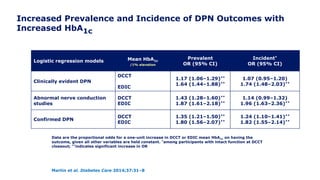
Increased Prevalence and Incidence of DPN Outcomes with
Increased HbA1c
Martin et al. Diabetes Care 2014;37:31–8
Logistic regression models Mean HbA1c
/1% elevation
Prevalent
OR (95% CI)
Incident*
OR (95% CI)
Clinically evident DPN
DCCT
EDIC
1.17 (1.06–1.29)**
1.64 (1.44–1.88)**
1.07 (0.95–1.20)
1.74 (1.48–2.03)**
Abnormal nerve conduction
studies
DCCT
EDIC
1.43 (1.28–1.60)**
1.87 (1.61–2.18)**
1.14 (0.99–1.32)
1.96 (1.63–2.36)**
Confirmed DPN
DCCT
EDIC
1.35 (1.21–1.50)**
1.80 (1.56–2.07)**
1.24 (1.10–1.41)**
1.82 (1.55–2.14)**
Data are the proportional odds for a one-unit increase in DCCT or EDIC mean HbA1c on having the
outcome, given all other variables are held constant. *among participants with intact function at DCCT
closeout; **indicates significant increase in OR
Results of DCCT/EDIC
Cardiovascular outcomes
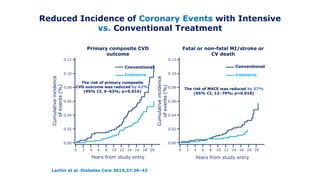
Reduced Incidence of Coronary Events with Intensive
vs. Conventional Treatment
Lachin et al. Diabetes Care 2014;37:39–43
Primary composite CVD
outcome
Fatal or non-fatal MI/stroke or
CV deathCumulativeincidence
ofevents(%)
Cumulativeincidence
ofevents(%)
Years from study entry
0.12
0.10
0.08
0.06
0.04
0.02
0.00
0 2 4 6 8 10 12 14 16 18 20
Years from study entry
0.12
0.10
0.08
0.06
0.04
0.02
0.00
0 2 4 6 8 10 12 14 16 18 20
Conventional
Intensive
Conventional
Intensive
The risk of primary composite
CVD outcome was reduced by 42%
(95% CI, 9–63%; p=0.016)
The risk of MACE was reduced by 57%
(95% CI, 12–79%; p=0.018)
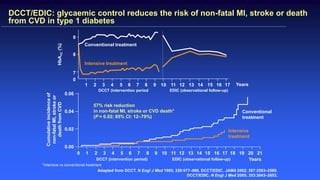
57% risk reduction
in non-fatal MI, stroke or CVD death*
(P = 0.02; 95% CI: 12–79%)
Cumulativeincidenceof
non-fatalMI,strokeor
deathfromCVD
Conventional
treatment
Intensive
treatment
0 1 2 3 4 5 6 7 8 9 10 11 12 13 14 15 16 17 18 19 20 21
Years
0.06
0.04
0.02
0.00
Adapted from DCCT. N Engl J Med 1993; 329:977–986. DCCT/EDIC. JAMA 2002; 287:2563–2569.
DCCT/EDIC. N Engl J Med 2005; 353:2643–2653.
DCCT/EDIC: glycaemic control reduces the risk of non-fatal MI, stroke or death
from CVD in type 1 diabetes
0
7
1 6
HbA1C(%)
9
8
2 3 4 5 7 8 9
Conventional treatment
Intensive treatment
11 12 13 14 15 16 1710
*Intensive vs conventional treatment
DCCT (intervention period EDIC (observational follow-up)
DCCT (intervention period) EDIC (observational follow-up)
Years
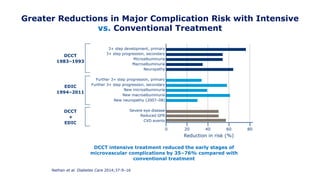
Greater Reductions in Major Complication Risk with Intensive
vs. Conventional Treatment
DCCT intensive treatment reduced the early stages of
microvascular complications by 35–76% compared with
conventional treatment
Nathan et al. Diabetes Care 2014;37:9–16
0 20 40 60 80
3+ step development, primary
3+ step progression, secondary
Microalbuminuria
Macroalbuminuria
Neuropathy
Further 3+ step progression, primary
Further 3+ step progression, secondary
New microalbuminuria
New macroalbuminuria
New neuropathy (2007–08)
Severe eye disease
Reduced GFR
CVD events
Reduction in risk (%)
DCCT
1983–1993
EDIC
1994–2011
DCCT
+
EDIC
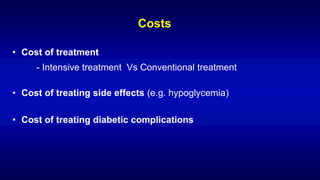
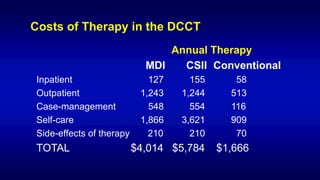
Costs
• Cost of treatment
- Intensive treatment Vs Conventional treatment
• Cost of treating side effects (e.g. hypoglycemia)
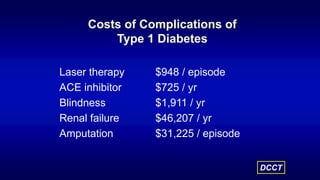
• Cost of treating diabetic complications
Costs of Therapy in the DCCT
Annual Therapy
MDI CSII Conventional
Inpatient 127 155 58
Outpatient 1,243 1,244 513
Case-management 548 554 116
Self-care 1,866 3,621 909
Side-effects of therapy 210 210 70
TOTAL $4,014 $5,784 $1,666
Costs of Complications of
Type 1 Diabetes
Laser therapy $948 / episode
ACE inhibitor $725 / yr
Blindness $1,911 / yr
Renal failure $46,207 / yr
Amputation $31,225 / episode
DCCT
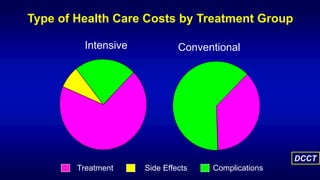
Type of Health Care Costs by Treatment Group
Intensive Conventional
Treatment Side Effects Complications
DCCT
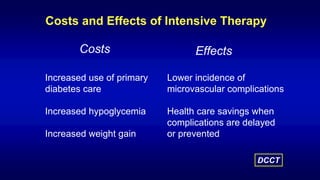
Costs and Effects of Intensive Therapy
Increased use of primary
diabetes care
Increased hypoglycemia
Increased weight gain
Lower incidence of
microvascular complications
Health care savings when
complications are delayed
or prevented
DCCT
Costs Effects
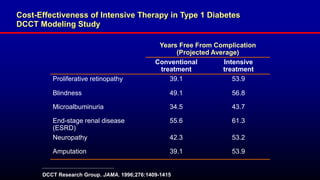
Cost-Effectiveness of Intensive Therapy in Type 1 Diabetes
DCCT Modeling Study
Years Free From Complication
(Projected Average)
Conventional
treatment
Intensive
treatment
Proliferative retinopathy 39.1 53.9
Blindness 49.1 56.8
Microalbuminuria 34.5 43.7
End-stage renal disease
(ESRD)
55.6 61.3
Neuropathy 42.3 53.2
Amputation 39.1 53.9
DCCT Research Group. JAMA. 1996;276:1409-1415
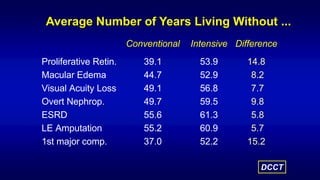
Average Number of Years Living Without ...
Conventional Intensive Difference
Proliferative Retin. 39.1 53.9 14.8
Macular Edema 44.7 52.9 8.2
Visual Acuity Loss 49.1 56.8 7.7
Overt Nephrop. 49.7 59.5 9.8
ESRD 55.6 61.3 5.8
LE Amputation 55.2 60.9 5.7
1st major comp. 37.0 52.2 15.2
DCCT
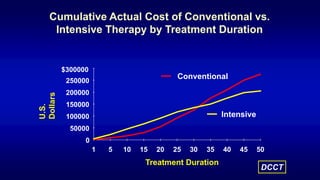
Treatment Duration
U.S.
Dollars
0
50000
100000
150000
200000
250000
$300000
1 5 10 15 20 25 30 35 40 45 50
Conventional
Intensive
DCCT
Cumulative Actual Cost of Conventional vs.
Intensive Therapy by Treatment Duration
ADA 2016
Summary
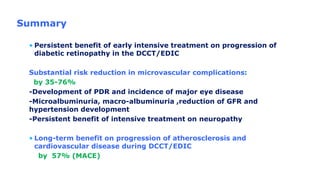
• Persistent benefit of early intensive treatment on progression of
diabetic retinopathy in the DCCT/EDIC
Substantial risk reduction in microvascular complications:
by 35-76%
-Development of PDR and incidence of major eye disease
-Microalbuminuria, macro-albuminuria ,reduction of GFR and
hypertension development
-Persistent benefit of intensive treatment on neuropathy
• Long-term benefit on progression of atherosclerosis and
cardiovascular disease during DCCT/EDIC
by 57% (MACE)
Summary (continued)
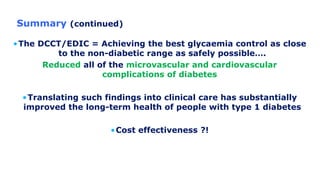
•The DCCT/EDIC = Achieving the best glycaemia control as close
to the non-diabetic range as safely possible….
Reduced all of the microvascular and cardiovascular
complications of diabetes
•Translating such findings into clinical care has substantially
improved the long-term health of people with type 1 diabetes
•Cost effectiveness ?!
Thank You
Any Questions ?

DCCT Learned Lessons

  • 1.
    DCCT- EDIC THE THIRTYPLUS YEARS TRIAL LESSONS AND OUTCOMES DCC = DIABETES CONTROL AND COMPLICATIONS TRIAL EDIC = EPIDEMIOLOGY OF DIABETES INTERVENTIONS AND COMPLICATIONS STUDY Mohammad Daoud , MD Consultant Endocrinologist –ABIM KAMC-NGHA , Jeddah
  • 2.
    DM is Nota Number DM= A Cardiovascular Disease Complications : Micro / Macro Hidden Faces of : Sexual dysfunction ,Diabetic foot Depression
  • 3.
    Barriers Therapeutics ,Physicians (Inertia)and Patients Legacy effect The key is: Rx Glycemia and other CVD risk factors simultaneously
  • 4.
    WHAT ABOUT TYPE1 DM PATIENTS… DOES THE SAME CONCEPTS APPLY ?
  • 5.
  • 6.
    DCCT/EDIC: Overview • TheDCCT was designed to test the glucose hypothesis and determine whether the complications of type 1 diabetes could be prevented or delayed (1982–1993) • The EDIC observational follow-up study determined the durability of the DCCT effects on the more-advanced stages of diabetes complications including cardiovascular disease (1994–present) Nathan et al. Diabetes Care 2014;37:9–16 AIMS: determine whether conventional therapy and intensive treatment program prevent or delay the appearance of early background retinopathy (primary prevention) and would prevent the progression of early retinopathy to more advanced forms of retinopathy (secondary intervention) DCCT : Diabetes Control and Complications Trial; EDIC : Epidemiology of Diabetes Interventions and Complications
  • 7.
    Initial DCCT ResultsPresented at ADA 1993 •Initial results of the DCCT were presented in 1993 at the 53rd Scientific Sessions of the American Diabetes Association in Las Vegas, NV, USA • The significance of the findings was instantly apparent • Results meant that there was no more guessing on what the standards of treatment should be • Initial results ushered in a new paradigm of treatment •No one could predict what was to come of the DCCT over the next 20 years! ADA, American Diabetes Association
  • 8.
    DCCT/EDIC: Timelines andKey Publications 1982 1994 2013 EDIC (20 years) 1993 DCCT (10 years) 1992 Design and methodology considerations for the feasibility phase, 1986 Results of feasibility study, 1987 First DCCT results, 1993 Key publications Implementation of treatment protocols in the DCCT, 1995 Adverse events in the DCCT, 1995 Relationship of HbA1c to the risk of development and progression of retinopathy, 1995 Pregnancy outcomes, 1996 Hypoglycaemia, 1997 Design of EDIC, 1999 Retinopathy and nephropathy four years after intensive therapy, 2000 Effect of intensive therapy on microvascular complications, 2002 Effect of glycaemic exposure on the risk of microvascular complications, 2008 Effects of prior intensive insulin therapy on cardiac autonomic nervous system function, 2009 Effect of prior intensive insulin treatment on peripheral neuropathy, 2010 The DCCT/EDIC at 30 years, 2014 Results presented at ADA, 1993
  • 9.
  • 10.
    Patients •Eligibility criteria •13–39 yearsof age •Type 1 diabetes diagnosed based on clinically-accepted criteria •Fasting C-peptide <0.2 nmol/L •Generally healthy •No history of cardiovascular disease •No hypertension (blood pressure <140/90 mmHg) •No dyslipidaemia •No neuropathy requiring treatment Nathan et al. Diabetes Care 2014;37:9–16
  • 11.
    Patients •Primary prevention cohort(n=726) •Type 1 diabetes of 1–5 years’ duration •No detectable retinopathy •Urinary albumin <40 mg/24 hours Nathan et al. Diabetes Care 2014;37:9–16 •Secondary intervention cohort (n=715) •Type 1 diabetes of 1–15 years’ duration •Very mild-moderate non-proliferative retinopathy •Urinary albumin 200 mg/24 hours
  • 12.
    Interventions and MetabolicGoals •Conventional group (n=730) • Aim: to avoid symptoms of hyper/hypoglycaemia • 1 or 2 insulin injections per day • Daily self-monitoring • Pregnant women treated intensively • Diet and exercise education • Quarterly visits Nathan et al. Diabetes Care 2014;37:9–16 •Intensive group (n=711) • Aim: symptom-free + plasma glucose 3.9–6.7 mmol/L before meals, <10 mmol/L after meals, >4.0 mmol/L at 03:00 a.m. and HbA1c <6.05 % • ≥3 insulin injections/day or insulin pump • ≥4 daily blood glucose tests • Hospitalisation for initiation • Frequent dietary instructions • Monthly clinic visits
  • 13.
    Study Design DCCT ResearchGroup. N Engl J Med 1993;329:977–86; Nathan et al. Diabetes Care 2014;37:9–16 Primary prevention (n=726) (No detectable retinopathy) Secondary prevention (n=715) (Very mild-moderate nonproliferative retinopathy) 1441 patients Randomisation Randomisation Conventional (n=378) Conventional (n=352) Intensive (n=348) Intensive (n=363) DCCT (1982–1993) EDIC (1994–present) All patients offered intensive treatment (n=1394) Observational follow-up until 2012 (n=1284)
  • 14.
    DCCT/EDIC: Outcome Measurements Nathanet al. Diabetes Care 2014;37:9–16 Frequency Complication DCCT EDIC Defined outcomes Retinopathy: 7-field stereoscopic and fundus photography 6 months 1/4 cohort/year, entire cohort year 4 Three-step progression*, CSME, severe NPDR, PDR Renal function Albumin excretion# Serum creatinine (eGFR†) Annual Annual Alternate years‡ Annual Albuminuria: micro ≥40 mg/24 h, macro >300 mg/24 h eGFR: <60 mL/min/1.73 m2 Neuropathy History, examination, and NCS Autonomic Cardiac Urologic (ED) MNSI + monofilament Baseline, year 5, and/or study end Baseline, every 2 years, end – – Year 13/14 Years 13/14 and 16/17 Year 10 Annual Confirmed clinical: abnormal exam and abnormal NCS or autonomic study R-R variation <15 or R-R <20 and Valsalva ratio <1.5 or orthostatic hypotension
  • 15.
    DCCT/EDIC: Outcome Measurements(continued) Nathan et al. Diabetes Care 2014;37:9–16 Frequency Complication DCCT EDIC Defined outcomes Cardiovascular History ECG Ankle-brachial index Carotid ultrasound CT CAC Cardiac MRI Annual Annual Annual – – – Annual Annual Annual Years 1, 6, and 12 Year 8 Year 15 Aggregate major*: fatal CVD, nonfatal MI, and stroke, hospitalised Angina, vascular procedures Agatston score >200 Cardiac structure, function, scars Risk factors HbA1c Fasting lipids Blood pressure 3 months Annual Annual Annual Alternate years† Annual
  • 16.
    Results of DCCT/EDIC Patientcharacteristics and demographics
  • 19.
    Clinical Characteristics Nathan etal. Diabetes Care 2014;37:9–16 DCCT Baseline (1983–1989) N=1441 End of DCCT (1993) N=1422* EDIC Year 18 (2010–2012) N=1284* Intensive n=711 Convent. n=730 Intensive n=698 Convent. n=717 Intensive n=620 Convent. n=597 Demographics Age, years Female, % Diabetes duration, years DCCT primary prevention cohort, % Hypertension, % ¶ Hyperlipidaemia, % # Current cigarette smoking, % 27.2 (7.1) 48.5 5.8 (4.2) 49.0 3.1 22.8 18.6 26.7 (7.1) 45.9 5.5 (4.1) 51.8 2.1 23.4 18.4 33.6 (7.0) 49.0 12.3 (4.9) 49.1 4.4 25.6 20.2 33.0 (7.0) 46.0 11.9 (4.8) 51.7 3.9 29.7 19.8 52.3 (6.9) 48.7 30.7 (5.0) 47.7 66.6 68.6 11.5 51.4 (6.9)† 45.7 30.2 (4.9) 50.6 68.8 68.2 10.7 Medical treatment Glucose management Pump or multiple daily injections (≥3), % Glucose monitoring ≥4 times a day, % Use of antihypertensive medication, % § Any ACE inhibitor or ARB 0 0 – 0 0 0 – 0 97.4 52.7 – – 5.0‡ 3.8‡ – – 97.6 67.7 60.3 56.8 97.7 70.7 62.7 59.8 Data are mean (SD) unless otherwise indicated. *renal measurements (AER or eGFR) were completed for 1415 patients at DCCT closeout and 1217 patients at EDIC year 17 or 18 (1194 with AER at year 17 or 18 and 1187 with eGFR at year 18); †p=0.05 by the Wilcoxon rank sum test or x2 test; ‡p=0.01 by the Wilcoxon rank sum test or x2 test; ¶hypertension was defined by a systolic blood pressure ≥140 mmHg, diastolic blood pressure ≥90 mmHg, or use of antihypertensive medications; #hyperlipidaemia was defined by an LDL cholesterol level ≥130 mg/dL (3.4 mmol/L) or the use of lipid-lowering agents; §medication data were not collected during the DCCT. ACE inhibitors were prohibited during the DCCT. ACE, angiotensin-converting-enzyme; AER, albumin excretion rate; ARB, angiotensin II receptor blocker; LDL, low-density lipoprotein; convent, conventional
  • 20.
    Clinical Characteristics (continued) Nathanet al. Diabetes Care 2014;37:9–16 DCCT baseline (1983–1989) N=1441 End of DCCT (1993) N=1422* EDIC Year 18 (2010–2012) N=1284* Intensive n=711 Convent. n=730 Intensive n=698 Convent. n=717 Intensive n=620 Convent. n=597 Physical examination BMI, kg/m2 Obese (BMI ≥30 kg/m2), % Systolic blood pressure, mmHg Diastolic blood pressure, mmHg Mean arterial pressure, mmHg 23.4(2.7) 1.3 114.5(11.3) 73.1(8.2) 86.9(8.2) 23.5(2.9) 1.9 114.6(11.4) 72.9(8.7) 86.8(8.6) 26.6(4.2) 18.6 116.3(11.7) 74.4(8.8) 88.3(8.9) 25.0 (3.1)‡ 5.6‡ 115.3(12.0) 74.3(8.8) 88.0(8.9) 29.1 (5.7) 36.1 122.4(15.4) 71.4(9.0) 88.4(9.8) 28.5 (5.1) 33.0 121.8(15.1) 71.3(8.8) 88.2(9.6) Laboratory values HbA1c, % Plasma lipids, mg/dL Total cholesterol HDL cholesterol LDL cholesterol Triglycerides 9.1(1.6) 177.1(32.8) 50.8(12.3) 110.3(28.7) 80.8(43.3) 9.1(1.6) 175.7(33.6) 50.3(12.3) 109.1(29.4) 81.8(51.3) 7.2(0.9) 178.8(31.2) 50.8(12.8) 111.6(27.2) 82.0(51.6) 9.1(1.3)‡ 183.4(36.6) 51.5 (12.9) 114.3(31.4) 87.8(54.0)† 8.0(1.0) 174.8(35.4) 61.9(19.4) 96.7(29.2) 81.1(50.6) 8.0(1.0) 172.1(36.4) 61.5(17.7) 94.7(29.5) 80.6(71.5) Data are mean (SD) unless otherwise indicated. *renal measurements (AER or eGFR) were completed for 1415 patients at DCCT closeout and 1217 patients at EDIC year 17 or 18 (1194 with AER at year 17 or 18 and 1187 with eGFR at year 18); †p=0.05 by the Wilcoxon rank sum test or x2 test; ‡p=0.01 by the Wilcoxon rank sum test or x2 test BMI, body mass index; HDL, high-density lipoprotein; convent, conventional
  • 21.
    Clinical Characteristics: Complications Nathanet al. Diabetes Care 2014;37:9–16 DCCT Baseline (1983–1989) N=1441 End of DCCT (1993) N=1422* EDIC Year 18 (2010–2012) N=1284* Complication Intensive n=711 Convent. n=730 Intensive n=698 Convent. n=717 Intensive n=620 Convent. n=597 Eye Retinopathy levels, % No retinopathy (10/10) Microaneurysm only (20/≤20) Mild NPDR (35/≤35) Moderate NPDR (43/≤43–53/53) Severe PDR or worse (53/<53+) 49.0 35.0 11.6 4.5 0 51.8 27.8 15.2 5.1 0.1 28.3 39.7 21.2 8.2 2.6 ‡ 17.3 32.1 28.5 14.3 7.8 10.7 36.9 21.3 16.5 14.7 ‡ 4.7 26.8 18.3 19.6 30.7 Renal* AER, % 0 to <30 mg/24 h 30 to <300 mg/24 h ≥300 mg/24 h or ESRD eGFR (mL/min/1.73 m2) Sustained eGFR <60 mL/min/ 1.73 m2, % 88.3 11.7 0 126.0(13.9) 0 90.0 10.1 0 126.2(14.6) 0 89.8 8.8 1.4 116.0(13.0) 0.1 ‡ 82.2 14.6 3.2 117.8 (13.7)‡ 0.4 81.5 14.2 4.3 93.3(18.1) 3.2 ‡ 75.1 17.0 7.9 91.7(20.1) 5.3 Neuropathy Confirmed clinical neuropathy, % 6.8 5.6 9.3 17.5 ‡ 23.6 32.7 ‡ Data are mean (SD) unless otherwise indicated. *renal measurements (AER or eGFR) were completed for 1415 patients at DCCT closeout and 1217 patients at EDIC year 17 or 18 (1194 with AER at year 17 or 18 and 1187 with eGFR at year 18); ‡p=0.01 by the Wilcoxon rank sum test or x2 test. Convent, conventional
  • 22.
  • 23.
    Results of DCCT/EDIC Glycaemiccontrol & Major complications
  • 24.
    A1c Reduction :IntensiveVs Conventional Management 0 2 4 6 8 10 Years from randomization 5 731 9 8 9 10 7 HbA1c(%) 6 0 Intensive Conventional DCCT Research Group. N.Eng.J.Med. 1993;329:977–986. 9.1% 7.2%
  • 25.
    Intensive treatment leadsto more effective glycaemic control than conventional treatment • DCCT intensive treatment did not achieve target HbA1c <6.05% • 44% of patients reached target ≥1 time during trial • Median HbA1c with intensive treatment was 7.2% Vs. 9.1% with conventional treatment Nathan et al. Diabetes Care 2014;37:9–16 Intensive – EDIC mean 8.0%Intensive – DCCT mean 7.2% 11 10 9 8 7 6 5 0 1 2 3 4 5 6 7 8 9 10 Conventional – EDIC mean 8.0% Conventional – DCCT mean 9.1% Study year TrainingDCCT intervention EDIC observation HbA1c(%) 1 2 3 4 5 6 7 8 11 12 13 14 15 16 17 189 10
  • 26.
    0 0.2 0.4 0.6 0.8 1.0 1.2 Risk of retinopathy Severe hypoglycaemia 120 60 0 per100patient-years HbA1c(%) DCCT: The Price of Improved Diabetic Control - Hypoglycaemia per100patient-years Adapted from DCCT Research Group. N Engl J Med 1993;329:977–86
  • 28.
    Results of DCCT/EDIC DiabeticRetinopathy and other ocular findings
  • 29.
    DCCT: Delayed Onsetand Progression of Diabetic Retinopathy with Intensive vs. Conventional Treatment Primary prevention cohort (726 patients with no DR) Secondary intervention cohort (715 patients with mild DR)  54% (p<0.001) 60 50 40 30 20 10 0 0 1 2 3 4 Study time (years) 5 6 7 8 9 60 50 40 30 20 10 0 0 1 2 3 4 5 6 7 8 9 Conventional Intensive Cumulativeincidenceof DRprogression(%) Cumulativeincidenceof DRprogression(%) Conventional Intensive  76% (p<0.001) Study time (years) DCCT Research Group. N Engl J Med 1993;329:977–86
  • 30.
    Persistent Benefit ofEarly Intensive vs. Conventional treatment After 10 years of EDIC observation, the benefit of early intensive treatment persisted with a 53% (p<0.0001) reduction in the risk of further retinopathy progression Aiello et al. Diabetes Care 2014;37:17–23 60 50 40 30 20 10 0 0 1 2 3 4 5 6 7 8 9 10 Conventional Intensive EDIC year Cumulativeincidence(%) Cumulative Incidence (%)
  • 31.
    Effect of DCCTIntensive Treatment on Prevalence of Diabetic Retinopathy Complications Aiello et al. Diabetes Care 2014;37:17–23 DCCT closeout n=1211 EDIC year 4 n=1094 EDIC year 10 n=1211 Odds reduction (%) p Odds reduction (%) p Odds reduction (%) p ≥3-step DR progression 76 <0.001 74 <0.001 57 <0.001 Severe NPDR or worse 66 <0.001 68 <0.001 58 <0.001 PDR or worse 64 <0.001 65 <0.001 58 <0.001 CSME 51 0.005 62 <0.001 38 0.009 PRP 60 <0.001 54 0.004 57 <0.001 PRP, pan-retinal photocoagulation
  • 32.
    Greater Effect ofIntensive vs. Conventional Treatment on Prevalence of Any Major Eye Disease Aiello et al. Diabetes Care 2014;37:17–23 Diabetes duration, years Cumulativeincidence(%) EDC, Pittsburgh Epidemiology of Diabetes Complications (EDC) study EDC DCCT – conventional therapy DCCT – intensive therapy Cumulative Incidence (%)
  • 36.
    Results of DCCT/EDIC Kidneydisease and related findings
  • 37.
    Reduced Risk ofMicroalbuminuria and Macro-albuminuria with Intensive vs. Conventional treatment De Boer et al. Diabetes Care 2014;37:24–30 N (events) Risk reduction with intensive (%) Proportion of effect explained by DCCT HbA1c (%) Intensive Conventional Microalbuminuria (AER ≥40 mg/24 h) DCCT EDIC years 1–8 110 39 166 87 39 % (21–52) 59 % (39–73) 99 91 Macroalbuminuria (AER ≥300 mg/24 h) DCCT EDIC years 1–8 18 9 37 59 54 % (29–74) 84 % (67–92) 98 99
  • 38.
    Continued Benefit ofIntensive Treatment on Cumulative Incidence of Persistent Microalbuminuria De Boer et al. Diabetes Care 2014;37:24–30 80 60 40 20 0 0 5 Duration of diabetes (years) 10 15 20 25 30 Conventional Intensive Risk reduction with intensive therapy=39% (95% CI, 21–52%; p=0.001) Cumulativeincidenceofpersistent microalbuminuria(%)
  • 39.
    Date of download:3/15/2016 Copyright © 2016 American Medical Association. All rights reserved. From: Sustained Effect of Intensive Treatment of Type 1 Diabetes Mellitus on Development and Progression of Diabetic Nephropathy: The Epidemiology of Diabetes Interventions and Complications (EDIC) Study JAMA. 2003;290(16):2159-2167. doi:10.1001/jama.290.16.2159 Albuminuria defined as albumin excretion rate ≥208 µg/min,equivalent to 300 mg/24 h. A, Prevalence of clinical albuminuria at the end of the Diabetes Control and Complications Trial (DCCT) and during the Epidemiologyof Diabetes Interventions and Complications (EDIC) study. The differencesbetween the treatment groups are significant at each time point after DCCTclose-out (P<.01). B, Cumulative incidence of new cases in the EDIC study for those participants in the intensive- and conventional-treatmentgroups with either normoalbuminuria or microalbuminuria at the end of theDCCT. The difference in cumulative incidences is significant by the log-rank-test.(P<.001).
  • 41.
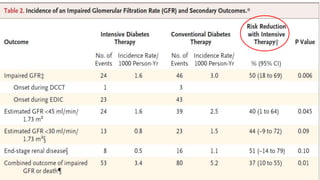
    Reduced Risk ofImpaired GFR and Hypertension with Intensive vs. Conventional Treatment Risk reduction with intensive therapy=20% (95% CI, 6–21%; p=0.006) GFR Hypertension De Boer et al. Diabetes Care 2014;37:24–30 Conventional Intensive Cumulativeincidenceof hypertension(%) 0 5 10 15 20 80 60 40 20 0 Time from randomisation (years) 15 10 5 0 0 5 10 15 20 Time from randomisation (years) 25 Cumulativeincidenceof impairedGFR(%) Risk reduction with intensive therapy=50% (95% CI, 18–69%, p=0.006) Conventional Intensive
  • 42.
    Reduced Risk ofImpaired GFR and Hypertension with Intensive vs. Conventional Treatment Risk reduction with intensive therapy=20% (95% CI, 6–21%; p=0.006) GFR Hypertension De Boer et al. Diabetes Care 2014;37:24–30 Conventional Intensive Cumulativeincidenceof hypertension(%) 0 5 10 15 20 80 60 40 20 0 Time from randomisation (years) 15 10 5 0 0 5 10 15 20 Time from randomisation (years) 25 Cumulativeincidenceof impairedGFR(%) Risk reduction with intensive therapy=50% (95% CI, 18–69%, p=0.006) Conventional Intensive
  • 43.
    Date of download:3/15/2016 Copyright © 2016 American Medical Association. All rights reserved. From: Sustained Effect of Intensive Treatment of Type 1 Diabetes Mellitus on Development and Progression of Diabetic Nephropathy: The Epidemiology of Diabetes Interventions and Complications (EDIC) Study JAMA. 2003;290(16):2159-2167. doi:10.1001/jama.290.16.2159 Prevalence of hypertension (defined as blood pressure >140/90 mmHg) at the end of the Diabetes Control and Complications Trial (DCCT) and during the Epidemiology of Diabetes Interventions and Complications (EDIC)study for participants in the intensive vs conventional-treatment groups.The aggregate odds reduction with intensive vs conventional therapy of emergent hypertension during the EDIC study, adjusted for DCCT mean arterial pressure,was 40.4% (95% C.I, 33.7%-46.5%; P<.001).
  • 44.
    Results of DCCT/EDIC Neuropathyand related findings
  • 45.
    Lower Prevalence ofDPN and CAN with Intensive vs. Conventional Treatment During DCCT, the prevalence of confirmed DPN increased slightly among intensively treated group participants (from 7% to 9%), but increased substantially in conventionally treated patients (from 5% to 17%; p<0.001) Martin et al. Diabetes Care 2014;37:31–8 Outcome measure Group DCCT baseline DCCT closeout EDIC year 13/14 Clinically evident DPN Intensive Conventional 57 (10) 48 (8) 88 (15)* 128 (22) 204 (34)* 240 (41) Abnormal nerve conduction studies Intensive Conventional 185 (31) 196 (34) 164 (28)* 288 (50) 326 (54)* 401 (69) Confirmed DPN Intensive Conventional 39 (7) 31 (5) 52 (9)* 97 (17) 152 (25)* 204 (35) R-R variation <15 Intensive Conventional 20 (3) 25 (4) 39 (7) 53 (10) 147 (24)† 178 (30) CAN composite Intensive Conventional 24 (4) 31 (5) 43 (7) 57 (10) 179 (29)† 208 (35) Adjusted R-R variations ¶ Intensive Conventional 49 ± 21 47 ± 21 42 ± 19† 39 ± 19 30 ± 17‡ 26 ± 17 Data are presented as n (%) or mean ± SD. Clinically evident DPN is defined by signs and symptoms consistent with DPN. Abnormal nerve conduction studies are defined as abnormalities in at least two anatomically distinct nerves. Confirmed DPN required the presence of clinically evident neuropathy and abnormal nerve conduction studies. CAN composite is defined by any of the following conditions: R-R variation <15, R-R variation <20 in combination with Valsalva ratio ≤1.5 or postural hypotension. *p<0.001; †p<0.05; ‡p<0.01 for treatment group differences by the Wilcoxon rank sum test or x2 test; ¶means adjusted for DCCT baseline age, sex, cohort assignment, and duration in the DCCT study CAN, cardiovascular autonomic neuropathy; DPN; diabetic peripheral neuropathy
  • 46.
    Lower Prevalence ofDPN and CAN with Intensive vs. Conventional Treatment In EDIC, a 30% reduction in the risk of incident confirmed DPN was observed with prior intensive therapy odds ratio [OR] 0.70 [95% CI: 0.52–0.93] Martin et al. Diabetes Care 2014;37:31–8 *Incidence at DCCT closeout is among participants without the defined outcome at DCCT baseline. Incidence at EDIC year 13/14 is among participants without the defined outcome at DCCT closeout. †p<0.001; ‡p=0.0125 former intensive vs. conventional Outcome measure Group DCCT closeout* EDIC year 13/14 Clinically evident DPN Intensive Conventional 57 (11)† 96 (18) 145 (29) 154 (34) Abnormal nerve conduction studies Intensive Conventional 73 (18)† 137 (36) 195 (45) 151 (52) Confirmed DPN Intensive Conventional 32 (6)† 75 (14) 117 (22)‡ 136 (28)
  • 47.
    Increased Prevalence andIncidence of DPN Outcomes with Increased HbA1c Martin et al. Diabetes Care 2014;37:31–8 Logistic regression models Mean HbA1c /1% elevation Prevalent OR (95% CI) Incident* OR (95% CI) Clinically evident DPN DCCT EDIC 1.17 (1.06–1.29)** 1.64 (1.44–1.88)** 1.07 (0.95–1.20) 1.74 (1.48–2.03)** Abnormal nerve conduction studies DCCT EDIC 1.43 (1.28–1.60)** 1.87 (1.61–2.18)** 1.14 (0.99–1.32) 1.96 (1.63–2.36)** Confirmed DPN DCCT EDIC 1.35 (1.21–1.50)** 1.80 (1.56–2.07)** 1.24 (1.10–1.41)** 1.82 (1.55–2.14)** Data are the proportional odds for a one-unit increase in DCCT or EDIC mean HbA1c on having the outcome, given all other variables are held constant. *among participants with intact function at DCCT closeout; **indicates significant increase in OR
  • 48.
  • 49.
    Reduced Incidence ofCoronary Events with Intensive vs. Conventional Treatment Lachin et al. Diabetes Care 2014;37:39–43 Primary composite CVD outcome Fatal or non-fatal MI/stroke or CV deathCumulativeincidence ofevents(%) Cumulativeincidence ofevents(%) Years from study entry 0.12 0.10 0.08 0.06 0.04 0.02 0.00 0 2 4 6 8 10 12 14 16 18 20 Years from study entry 0.12 0.10 0.08 0.06 0.04 0.02 0.00 0 2 4 6 8 10 12 14 16 18 20 Conventional Intensive Conventional Intensive The risk of primary composite CVD outcome was reduced by 42% (95% CI, 9–63%; p=0.016) The risk of MACE was reduced by 57% (95% CI, 12–79%; p=0.018)
  • 50.
    57% risk reduction innon-fatal MI, stroke or CVD death* (P = 0.02; 95% CI: 12–79%) Cumulativeincidenceof non-fatalMI,strokeor deathfromCVD Conventional treatment Intensive treatment 0 1 2 3 4 5 6 7 8 9 10 11 12 13 14 15 16 17 18 19 20 21 Years 0.06 0.04 0.02 0.00 Adapted from DCCT. N Engl J Med 1993; 329:977–986. DCCT/EDIC. JAMA 2002; 287:2563–2569. DCCT/EDIC. N Engl J Med 2005; 353:2643–2653. DCCT/EDIC: glycaemic control reduces the risk of non-fatal MI, stroke or death from CVD in type 1 diabetes 0 7 1 6 HbA1C(%) 9 8 2 3 4 5 7 8 9 Conventional treatment Intensive treatment 11 12 13 14 15 16 1710 *Intensive vs conventional treatment DCCT (intervention period EDIC (observational follow-up) DCCT (intervention period) EDIC (observational follow-up) Years
  • 51.
    Greater Reductions inMajor Complication Risk with Intensive vs. Conventional Treatment DCCT intensive treatment reduced the early stages of microvascular complications by 35–76% compared with conventional treatment Nathan et al. Diabetes Care 2014;37:9–16 0 20 40 60 80 3+ step development, primary 3+ step progression, secondary Microalbuminuria Macroalbuminuria Neuropathy Further 3+ step progression, primary Further 3+ step progression, secondary New microalbuminuria New macroalbuminuria New neuropathy (2007–08) Severe eye disease Reduced GFR CVD events Reduction in risk (%) DCCT 1983–1993 EDIC 1994–2011 DCCT + EDIC
  • 56.
    Costs • Cost oftreatment - Intensive treatment Vs Conventional treatment • Cost of treating side effects (e.g. hypoglycemia) • Cost of treating diabetic complications
  • 57.
    Costs of Therapyin the DCCT Annual Therapy MDI CSII Conventional Inpatient 127 155 58 Outpatient 1,243 1,244 513 Case-management 548 554 116 Self-care 1,866 3,621 909 Side-effects of therapy 210 210 70 TOTAL $4,014 $5,784 $1,666
  • 58.
    Costs of Complicationsof Type 1 Diabetes Laser therapy $948 / episode ACE inhibitor $725 / yr Blindness $1,911 / yr Renal failure $46,207 / yr Amputation $31,225 / episode DCCT
  • 59.
    Type of HealthCare Costs by Treatment Group Intensive Conventional Treatment Side Effects Complications DCCT
  • 60.
    Costs and Effectsof Intensive Therapy Increased use of primary diabetes care Increased hypoglycemia Increased weight gain Lower incidence of microvascular complications Health care savings when complications are delayed or prevented DCCT Costs Effects
  • 61.
    Cost-Effectiveness of IntensiveTherapy in Type 1 Diabetes DCCT Modeling Study Years Free From Complication (Projected Average) Conventional treatment Intensive treatment Proliferative retinopathy 39.1 53.9 Blindness 49.1 56.8 Microalbuminuria 34.5 43.7 End-stage renal disease (ESRD) 55.6 61.3 Neuropathy 42.3 53.2 Amputation 39.1 53.9 DCCT Research Group. JAMA. 1996;276:1409-1415
  • 62.
    Average Number ofYears Living Without ... Conventional Intensive Difference Proliferative Retin. 39.1 53.9 14.8 Macular Edema 44.7 52.9 8.2 Visual Acuity Loss 49.1 56.8 7.7 Overt Nephrop. 49.7 59.5 9.8 ESRD 55.6 61.3 5.8 LE Amputation 55.2 60.9 5.7 1st major comp. 37.0 52.2 15.2 DCCT
  • 63.
    Treatment Duration U.S. Dollars 0 50000 100000 150000 200000 250000 $300000 1 510 15 20 25 30 35 40 45 50 Conventional Intensive DCCT Cumulative Actual Cost of Conventional vs. Intensive Therapy by Treatment Duration
  • 64.
  • 65.
    Summary • Persistent benefitof early intensive treatment on progression of diabetic retinopathy in the DCCT/EDIC Substantial risk reduction in microvascular complications: by 35-76% -Development of PDR and incidence of major eye disease -Microalbuminuria, macro-albuminuria ,reduction of GFR and hypertension development -Persistent benefit of intensive treatment on neuropathy • Long-term benefit on progression of atherosclerosis and cardiovascular disease during DCCT/EDIC by 57% (MACE)
  • 66.
    Summary (continued) •The DCCT/EDIC= Achieving the best glycaemia control as close to the non-diabetic range as safely possible…. Reduced all of the microvascular and cardiovascular complications of diabetes •Translating such findings into clinical care has substantially improved the long-term health of people with type 1 diabetes •Cost effectiveness ?!
  • 67.