
HYPOGLYCEMIA
IN DIABETIC PATIENTS
FOR DIABETES EDUCATORS
DR. MOHAMMAD DAOUD
CONSULTANT ENDOCRINOLOGIST
KAMC-NGHA JEDDAH
HYPOGLYCEMIA
OBJECTIVES
Basic physiology
Definitions
Clinical Picture
Management
HYPOGLYCEMIA
FACTS
Carbohydrates (Glucose) are the first/ main calorie
resource for our body
Extra CHO are stored as glycogen in liver and
muscles Or shifted to fat
The Brain and RBCs .. only glucose as a fuel
HYPOGLYCEMIA
DEFINITIONS
Hypoglycemia :
“All episodes of an abnormally low plasma glucose
concentration (w or w/o symptoms) that expose the
individual to harm”
Low blood sugar, occurs when brain and body are
not getting enough sugar.
Hypoglycemia …. < 70 mg/dl (< 3.9 mmol/L)
WHAT IS HYPOGLYCEMIA ?
For Non Diabetic patient
Glucose value < 50 mg/dl (2.8mmo/L)
For Diabetic patient
Glucose value < 70 mg/dl (3.9 mmo/L)
HYPOGLYCEMIA
DEFINITIONS
Mild Hypoglycemia :
Can be managed by patient him self
Severe Hypoglycemia :
Need assistance /Hospital visit
HYPOGLYCEMIA
FACTS
The brain relies almost exclusively on glucose
So …
Adequate uptake of glucose from the plasma is essential for
normal brain function and survival
Luckily …
Very effective physiological and behavioral mechanisms
normally prevent or rapidly correct hypoglycemia
HYPOGLYCEMIA – PATHO-PHYSIOLOGY
Glycogen
Breakdown -Liver
Increased Glucagon
Energy
Fat Synthesis
Glycogen Synthesis
Glucose release to
blood
(+) Pancreas secretion
of Glucagon
Blood
Glucose
Pool
(+) Pancreas
secretion of Insulin
(+) Circulating
Insulin
Uptake of glucose by
cells
Decrease blood
glucose
HYPOGLYCEMIA
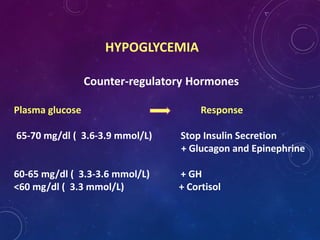
Counter-regulatory Hormones
Plasma glucose Response
65-70 mg/dl ( 3.6-3.9 mmol/L) Stop Insulin Secretion
+ Glucagon and Epinephrine
60-65 mg/dl ( 3.3-3.6 mmol/L) + GH
<60 mg/dl ( 3.3 mmol/L) + Cortisol
HYPOGLYCEMIA
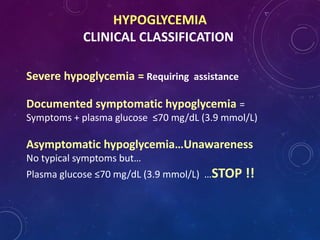
CLINICAL CLASSIFICATION
Severe hypoglycemia = Requiring assistance
Documented symptomatic hypoglycemia =
Symptoms + plasma glucose ≤70 mg/dL (3.9 mmol/L)
Asymptomatic hypoglycemia…Unawareness
No typical symptoms but…
Plasma glucose ≤70 mg/dL (3.9 mmol/L) …STOP !!
HYPOGLYCEMIA
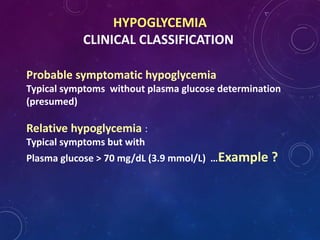
CLINICAL CLASSIFICATION
Probable symptomatic hypoglycemia
Typical symptoms without plasma glucose determination
(presumed)
Relative hypoglycemia :
Typical symptoms but with
Plasma glucose > 70 mg/dL (3.9 mmol/L) …Example ?
HYPOGLYCEMIA : S & S
Hyper-adrenergic
Plasma Glucose < 70 mg/ dL (3.9 mmol/L)
Diaphoresis (Sweating)
Tachycardia (Rapid heartbeat )/Palpitation
Anxiety Tremor /Shaking
Tachypnea Vomiting
Dizziness Hunger
HYPOGLYCEMIA : S & S
Neuro-glycopenic
Plasma Glucose < 50 mg/dL (2.8 mmol/L)
Slurred speech
Cognitive impairment Inattention and confusion
Focal neurologic deficits Seizures
Behavioral/ Irritability/ Sudden moodiness
Change in personality Lack of coordination
Severe and prolonged hypoglycemia
LOC/Coma Irreversible brain injury
HYPOGLYCEMIA
WHY DOES IT MATTER ?
HYPOGLYCEMIA
IT MATTERS …
The major limiting factor for achieving strict
control in DM patients
Still , it is an expected price for adequate
control
HYPOGLYCEMIA
IT MATTERS …
Bad impact on:
Quality of life: Fear / Psych
Satisfaction
Compliance; to diet and Rx
Achieving proper targets ?
HYPOGLYCEMIA
IT MATTERS …
Disturbing S & S
-Anxiety / Embarrassment
-Risk of accidents with impaired LOC
-Limitation of performance
-Rebound /Reaction
-Weight gain ?
HYPOGLYCEMIA
…IS COMMON
Common ; up to 30- 60% in DM patients
Type 1 > Type 2 …But !
Intensive DM control (lower HbA1c…?)
Elderly
Duration of disease
Asymptomatic in 50% + …Unawareness !
Nocturnal …very common !
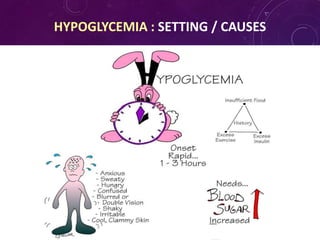
HYPOGLYCEMIA : SETTING / CAUSES
SETTING FOR HYPOGLYCEMIA
Identification of the precipitating factors
is important to prevent future events
HYPOGLYCEMIA
SETTING
Common with
Diabetics who are treated with
Insulin releasing pills
(sulfonylureas, Meglitinides, or Nateglinide)
Insulin
Very unlikely with
Lifestyle changes (TLC) only
Using alone medications like :
( ex: Metformin ,DPP4I, GLP-1 + ,SGLT2 -)
SETTING FOR HYPOGLYCEMIA
FOOD INTAKE
Skipped or delayed meals
(ex: Fasting Ramadan)
Vomiting after meal & meds intake
Mismatch:
Wrong dose or too high a dose of medications
for the amount of food;
Too little carbohydrate
SETTING FOR HYPOGLYCEMIA
Unplanned / Excess exercise
without snack / Rx adjustment
Excessive insulin / OHA doses
Organ Failure Medications
Alcohol use
Identification of the precipitating factors is important to
prevent future events
Risk factors for hospital hypoglycemia
Reduction of oral intake
Interruption of feeding/
New NPO status
Reduction of of Dextrose-IVF
Eemesis
Others:
Malignancy, infection, or sepsis.
Risk factors for hospital hypoglycemia
Sudden reduction of corticosteroid dose
Altered ability of the patient to report symptoms
Rx Timing:
Inappropriate timing of short- or rapid-acting insulin
HYPOGLYCEMIA
CAUSES
Organ failure :
Renal
Hepatic
Cardiac
Endocrine Failure:
Adrenal
Glucagon
Cortisol
Pituitary (ACTH/GH..)
INSULIN EXCESS -ABSOLUTE OR RELATIVE
Excess insulin (Secretagogues) Doses, ill-timed /wrong type
Reduced exogenous glucose intake (Fasting /missed meals)
Increased insulin-independent glucose utilization
(During and shortly after exercise)
Increased sensitivity to insulin (Hours after exercise, weight loss,
nocturnal ,after improved control)
Reduced endogenous glucose production
(Alcohol ingestion)
Reduced insulin clearance (Renal failure)
HYPOGLYCEMIC UNAWARENESS
Longer duration of DM and Autonomic Neuropathy
The brain has a trigger point at which it leads to release
stress hormones (Counter Regulatory Hormones)
With frequent low blood sugars, this set point gets reprogrammed
to lower and lower blood sugar levels.
Stress hormones aren’t released until the blood sugar is
dangerously low
HYPOGLYCEMIC UNAWARENESS
What causes hypoglycemic unawareness?
Loss of the ability to detect a low blood sugar
Patient needs to be vigilant; Do frequent monitoring
It may not be a permanent condition
Managed by easing the strict control for 2-3 weeks of
more
HYPOGLYCEMIA
MANAGEMENT
HYPOGLYCEMIA -MX
Prevention
Recognition and Treatment
Addressing underlying cause
Intervention to prevent recurrence
HYPOGLYCEMIA
MANAGEMENT
Prevention = Education
HYPOGLYCEMIA-PREVENTION
Patient/care-giver education; Empower
Frequent self-monitoring of blood glucose (SMBG)
Flexible and rational insulin (and other drug) regimens
Individualized glycemic goals
HYPOGLYCEMIA-PREVENTION
Medical alert identification
Keeping some sugar or sweet handy
 Glucagon Emergency kit
Professional guidance and support.
ADA-2015
7.5-8.5%
100-150
150-200
A1C VS AVERAGE GLUCOSE
ADA. V. Diabetes Care. Diabetes Care 2014;37(suppl 1):S23; Table 8
A1C (%) Mean plasma glucose mg/dl
6 ̴ 120
7 ̴ 150
8 ̴ 180
9 ̴ 210
10 ̴ 240
11 ̴ 270
12 ̴ 300
ADA – EASD Consensus:
(June 2012)
HYPOGLYCEMIA
MANAGEMENT
Recognize & Treat
HYPOGLYCEMIA
RECOGNITION & TREATMENT
Recognize S & S
Document /Measure the glucose by finger stick
If < 70 mg/dl…
Conscious Vs
Unconscious patient/ unable to swallow
Role of 15; Minutes/Gms
HYPOGLYCEMIA
TREATMENT
Conscious patient
Rapidly absorbed CHO ( glucose- or sucrose-
containing foods) orally
Unconscious patient/ unable to swallow
IV dextrose or
IM glucagon
HYPOGLYCEMIA
TAKE CONTROL
+ve mild symptoms
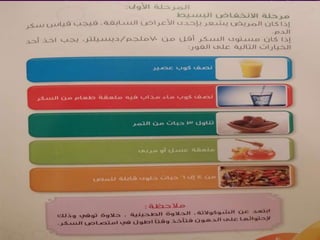
Check blood sugar - Take fast acting CHO
½ cup of fruit juice or low fat / fat-free milk, Regular soda
3 glucose tablets
2 tbsp of raisins, 1 tbsp of honey or 2 tbsp of jam
3 dates
About 15-20 grams of glucose
HYPOGLYCEMIA
TAKE CONTROL
+ve mild symptoms
You will need more glucose if the blood sugar is very low
Check your blood sugar again after 15 minutes.
Repeat same dose if the sugar is still low (<70mg/dl)
Double Dose if getting lower
If blood glucose is getting
lower than base line
Double the amount
HYPOGLYCEMIA
TAKE CONTROL
+ve severe symptoms :Call for help
Emergency IM glucagon by someone trained to do so
(SC/ IM injection) of 0.5 to 1.0 mg
Recovery of consciousness within 10 to 15 minutes
Glucagon may cause nausea or vomiting
Check blood sugar
Don’t wait for the emergency personnel arrival
HYPOGLYCEMIA
TAKE CONTROL
+ve severe symptoms
Patients in the hospital
Give 15-20 g of 50% glucose (dextrose) intravenously
A subsequent glucose infusion (or food, if patient is able to eat) is
often needed, depending upon the cause of the hypoglycemia
ADA 2015 - HYPOGLYCEMIA
Individuals at risk for hypoglycemia should be asked about
symptomatic and asymptomatic hypoglycemia at each
encounter. C
Ongoing assessment of cognitive function is suggested with
increased vigilance for hypoglycemia by the clinician, patient,
and caregivers if low cognition and/or declining cognition
is found. B
ADA 2015 - HYPOGLYCEMIA
Glucose (15–20 g) is the preferred treatment for the conscious
individual with hypoglycemia, although any form of CHO that
contains glucose may be used
15-minutes after treatment, if SMBG shows continued
hypoglycemia, the treatment should be repeated.
Once SMBG returns to normal, the individual should consume a
meal or snack to prevent recurrence of hypoglycemia. E
ADA 2015 - HYPOGLYCEMIA
Glucagon
Prescribe for all patients with increased risk
of severe hypoglycemia
Keep it handy !!
Make sure about :
Proper storage /Refrigerator/ No direct light /
Expiration date
ADA 2015 - HYPOGLYCEMIA
Glucagon
Caregivers or family members
(not limited to health care professionals)
Should be instructed on its proper
mixing and administer immediately
Glucagon can cause vomiting
Risk of aspiration when unconscious
Keep patient on his side
ADA 2015 - HYPOGLYCEMIA
Hypoglycemia unawareness or
one or more episodes of severe hypoglycemia
should trigger reevaluation of the treatment regimen. E
Action:
Raise their glycemic targets
to avoid further hypoglycemia for at least several weeks
Aiming to partially reverse hypoglycemia unawareness and reduce
risk of future episodes. A
HYPOGLYCEMIA
MANAGEMENT
Address Underlying Cause / Setting
&
Intervene to Prevent Recurrence
HYPOGLYCEMIA
MANAGEMENT
Verify etiology & Prevent
Diet
Medication
Safe activities
Precautions : ID
Be equipped :CHO /Glucagon
…..
Educate …Educate …Educate
Risks associated with FASTING in patients
with diabetes
Diabetes Care, volume 28, NUMBER 9, September 2005
1. Hypoglycemia
2. Hyperglycemia : DKA / HHS
3. Dehydration and thrombosis
4. Hospitalizations
DM and Fasting
BGM
Frequent monitoring of glycemia:
esp. in the first few days
esp. with Insulin use or insulin secretagogues
To verify Safe DM control:
Early morning , noon ,late afternoon , before sunset
To verify Adequate DM control:
After Iftar , late night and before Sohour
Nutrition in Ramadan
Aim to not overeat
-Healthy and balanced diet
-Avoid large quantities of fried foods and CHO-meals
- Sohour (pre-dawn meal):
- Delay as late as possible
- Use “complex” carbohydrates
-Aim at maintaining a constant body mass
- Plenty of fluid during non-fasting hours
TAKE HOME MESSAGES
HYPOGLYCEMIA
TAKE HOME MESSAGES
All episodes of an abnormally low plasma glucose that
expose the individual to harm) ;
PG <70 mg/dL (3.9 mmol/L)
Occurs in both type 1 DM and patients with type 2 DM
(Insulin and SU …highest risk)
HYPOGLYCEMIA
TAKE HOME MESSAGES
Hypoglycemia can occur
at any level of glycemic control / HbA1c level ,
but the risk increases with more intensive therapy
It is a major limiting factor for intensive DM control
Hypoglycemia : Cost / M &M
HYPOGLYCEMIA
TAKE HOME MESSAGES
 Know the risk factors /setting
 Beware of nocturnal , exercise-induced and
unawareness forms
 Treat and try to prevent recurrence
 Educate your self , your patients and their families
‫سكر‬ ‫اآلنسة‬
https://www.youtube.com/watch?v=Ao
9iNysZG2g
‫السكر‬...‫لالطفال‬ ‫فلم‬
https://www.youtube.com/watch?v=jk
QoQxJubJg

Hypoglycemi for dm educators

  • 1.
    HYPOGLYCEMIA IN DIABETIC PATIENTS FORDIABETES EDUCATORS DR. MOHAMMAD DAOUD CONSULTANT ENDOCRINOLOGIST KAMC-NGHA JEDDAH
  • 2.
  • 3.
    HYPOGLYCEMIA FACTS Carbohydrates (Glucose) arethe first/ main calorie resource for our body Extra CHO are stored as glycogen in liver and muscles Or shifted to fat The Brain and RBCs .. only glucose as a fuel
  • 4.
    HYPOGLYCEMIA DEFINITIONS Hypoglycemia : “All episodesof an abnormally low plasma glucose concentration (w or w/o symptoms) that expose the individual to harm” Low blood sugar, occurs when brain and body are not getting enough sugar. Hypoglycemia …. < 70 mg/dl (< 3.9 mmol/L)
  • 5.
    WHAT IS HYPOGLYCEMIA? For Non Diabetic patient Glucose value < 50 mg/dl (2.8mmo/L) For Diabetic patient Glucose value < 70 mg/dl (3.9 mmo/L)
  • 6.
    HYPOGLYCEMIA DEFINITIONS Mild Hypoglycemia : Canbe managed by patient him self Severe Hypoglycemia : Need assistance /Hospital visit
  • 7.
    HYPOGLYCEMIA FACTS The brain reliesalmost exclusively on glucose So … Adequate uptake of glucose from the plasma is essential for normal brain function and survival Luckily … Very effective physiological and behavioral mechanisms normally prevent or rapidly correct hypoglycemia
  • 8.
    HYPOGLYCEMIA – PATHO-PHYSIOLOGY Glycogen Breakdown-Liver Increased Glucagon Energy Fat Synthesis Glycogen Synthesis Glucose release to blood (+) Pancreas secretion of Glucagon Blood Glucose Pool (+) Pancreas secretion of Insulin (+) Circulating Insulin Uptake of glucose by cells Decrease blood glucose
  • 9.
    HYPOGLYCEMIA Counter-regulatory Hormones Plasma glucoseResponse 65-70 mg/dl ( 3.6-3.9 mmol/L) Stop Insulin Secretion + Glucagon and Epinephrine 60-65 mg/dl ( 3.3-3.6 mmol/L) + GH <60 mg/dl ( 3.3 mmol/L) + Cortisol
  • 11.
    HYPOGLYCEMIA CLINICAL CLASSIFICATION Severe hypoglycemia= Requiring assistance Documented symptomatic hypoglycemia = Symptoms + plasma glucose ≤70 mg/dL (3.9 mmol/L) Asymptomatic hypoglycemia…Unawareness No typical symptoms but… Plasma glucose ≤70 mg/dL (3.9 mmol/L) …STOP !!
  • 12.
    HYPOGLYCEMIA CLINICAL CLASSIFICATION Probable symptomatichypoglycemia Typical symptoms without plasma glucose determination (presumed) Relative hypoglycemia : Typical symptoms but with Plasma glucose > 70 mg/dL (3.9 mmol/L) …Example ?
  • 13.
    HYPOGLYCEMIA : S& S Hyper-adrenergic Plasma Glucose < 70 mg/ dL (3.9 mmol/L) Diaphoresis (Sweating) Tachycardia (Rapid heartbeat )/Palpitation Anxiety Tremor /Shaking Tachypnea Vomiting Dizziness Hunger
  • 15.
    HYPOGLYCEMIA : S& S Neuro-glycopenic Plasma Glucose < 50 mg/dL (2.8 mmol/L) Slurred speech Cognitive impairment Inattention and confusion Focal neurologic deficits Seizures Behavioral/ Irritability/ Sudden moodiness Change in personality Lack of coordination Severe and prolonged hypoglycemia LOC/Coma Irreversible brain injury
  • 17.
  • 18.
    HYPOGLYCEMIA IT MATTERS … Themajor limiting factor for achieving strict control in DM patients Still , it is an expected price for adequate control
  • 19.
    HYPOGLYCEMIA IT MATTERS … Badimpact on: Quality of life: Fear / Psych Satisfaction Compliance; to diet and Rx Achieving proper targets ?
  • 20.
    HYPOGLYCEMIA IT MATTERS … DisturbingS & S -Anxiety / Embarrassment -Risk of accidents with impaired LOC -Limitation of performance -Rebound /Reaction -Weight gain ?
  • 21.
    HYPOGLYCEMIA …IS COMMON Common ;up to 30- 60% in DM patients Type 1 > Type 2 …But ! Intensive DM control (lower HbA1c…?) Elderly Duration of disease Asymptomatic in 50% + …Unawareness ! Nocturnal …very common !
  • 22.
  • 23.
    SETTING FOR HYPOGLYCEMIA Identificationof the precipitating factors is important to prevent future events
  • 24.
    HYPOGLYCEMIA SETTING Common with Diabetics whoare treated with Insulin releasing pills (sulfonylureas, Meglitinides, or Nateglinide) Insulin Very unlikely with Lifestyle changes (TLC) only Using alone medications like : ( ex: Metformin ,DPP4I, GLP-1 + ,SGLT2 -)
  • 25.
    SETTING FOR HYPOGLYCEMIA FOODINTAKE Skipped or delayed meals (ex: Fasting Ramadan) Vomiting after meal & meds intake Mismatch: Wrong dose or too high a dose of medications for the amount of food; Too little carbohydrate
  • 26.
    SETTING FOR HYPOGLYCEMIA Unplanned/ Excess exercise without snack / Rx adjustment Excessive insulin / OHA doses Organ Failure Medications Alcohol use Identification of the precipitating factors is important to prevent future events
  • 27.
    Risk factors forhospital hypoglycemia Reduction of oral intake Interruption of feeding/ New NPO status Reduction of of Dextrose-IVF Eemesis Others: Malignancy, infection, or sepsis.
  • 28.
    Risk factors forhospital hypoglycemia Sudden reduction of corticosteroid dose Altered ability of the patient to report symptoms Rx Timing: Inappropriate timing of short- or rapid-acting insulin
  • 29.
    HYPOGLYCEMIA CAUSES Organ failure : Renal Hepatic Cardiac EndocrineFailure: Adrenal Glucagon Cortisol Pituitary (ACTH/GH..)
  • 30.
    INSULIN EXCESS -ABSOLUTEOR RELATIVE Excess insulin (Secretagogues) Doses, ill-timed /wrong type Reduced exogenous glucose intake (Fasting /missed meals) Increased insulin-independent glucose utilization (During and shortly after exercise) Increased sensitivity to insulin (Hours after exercise, weight loss, nocturnal ,after improved control) Reduced endogenous glucose production (Alcohol ingestion) Reduced insulin clearance (Renal failure)
  • 31.
    HYPOGLYCEMIC UNAWARENESS Longer durationof DM and Autonomic Neuropathy The brain has a trigger point at which it leads to release stress hormones (Counter Regulatory Hormones) With frequent low blood sugars, this set point gets reprogrammed to lower and lower blood sugar levels. Stress hormones aren’t released until the blood sugar is dangerously low
  • 32.
    HYPOGLYCEMIC UNAWARENESS What causeshypoglycemic unawareness? Loss of the ability to detect a low blood sugar Patient needs to be vigilant; Do frequent monitoring It may not be a permanent condition Managed by easing the strict control for 2-3 weeks of more
  • 33.
  • 34.
    HYPOGLYCEMIA -MX Prevention Recognition andTreatment Addressing underlying cause Intervention to prevent recurrence
  • 35.
  • 36.
    HYPOGLYCEMIA-PREVENTION Patient/care-giver education; Empower Frequentself-monitoring of blood glucose (SMBG) Flexible and rational insulin (and other drug) regimens Individualized glycemic goals
  • 37.
    HYPOGLYCEMIA-PREVENTION Medical alert identification Keepingsome sugar or sweet handy  Glucagon Emergency kit Professional guidance and support.
  • 38.
  • 39.
    A1C VS AVERAGEGLUCOSE ADA. V. Diabetes Care. Diabetes Care 2014;37(suppl 1):S23; Table 8 A1C (%) Mean plasma glucose mg/dl 6 ̴ 120 7 ̴ 150 8 ̴ 180 9 ̴ 210 10 ̴ 240 11 ̴ 270 12 ̴ 300
  • 40.
    ADA – EASDConsensus: (June 2012)
  • 42.
  • 43.
    HYPOGLYCEMIA RECOGNITION & TREATMENT RecognizeS & S Document /Measure the glucose by finger stick If < 70 mg/dl… Conscious Vs Unconscious patient/ unable to swallow
  • 44.
    Role of 15;Minutes/Gms
  • 45.
    HYPOGLYCEMIA TREATMENT Conscious patient Rapidly absorbedCHO ( glucose- or sucrose- containing foods) orally Unconscious patient/ unable to swallow IV dextrose or IM glucagon
  • 48.
    HYPOGLYCEMIA TAKE CONTROL +ve mildsymptoms Check blood sugar - Take fast acting CHO ½ cup of fruit juice or low fat / fat-free milk, Regular soda 3 glucose tablets 2 tbsp of raisins, 1 tbsp of honey or 2 tbsp of jam 3 dates About 15-20 grams of glucose
  • 49.
    HYPOGLYCEMIA TAKE CONTROL +ve mildsymptoms You will need more glucose if the blood sugar is very low Check your blood sugar again after 15 minutes. Repeat same dose if the sugar is still low (<70mg/dl) Double Dose if getting lower
  • 50.
    If blood glucoseis getting lower than base line Double the amount
  • 51.
    HYPOGLYCEMIA TAKE CONTROL +ve severesymptoms :Call for help Emergency IM glucagon by someone trained to do so (SC/ IM injection) of 0.5 to 1.0 mg Recovery of consciousness within 10 to 15 minutes Glucagon may cause nausea or vomiting Check blood sugar Don’t wait for the emergency personnel arrival
  • 52.
    HYPOGLYCEMIA TAKE CONTROL +ve severesymptoms Patients in the hospital Give 15-20 g of 50% glucose (dextrose) intravenously A subsequent glucose infusion (or food, if patient is able to eat) is often needed, depending upon the cause of the hypoglycemia
  • 53.
    ADA 2015 -HYPOGLYCEMIA Individuals at risk for hypoglycemia should be asked about symptomatic and asymptomatic hypoglycemia at each encounter. C Ongoing assessment of cognitive function is suggested with increased vigilance for hypoglycemia by the clinician, patient, and caregivers if low cognition and/or declining cognition is found. B
  • 54.
    ADA 2015 -HYPOGLYCEMIA Glucose (15–20 g) is the preferred treatment for the conscious individual with hypoglycemia, although any form of CHO that contains glucose may be used 15-minutes after treatment, if SMBG shows continued hypoglycemia, the treatment should be repeated. Once SMBG returns to normal, the individual should consume a meal or snack to prevent recurrence of hypoglycemia. E
  • 55.
    ADA 2015 -HYPOGLYCEMIA Glucagon Prescribe for all patients with increased risk of severe hypoglycemia Keep it handy !! Make sure about : Proper storage /Refrigerator/ No direct light / Expiration date
  • 56.
    ADA 2015 -HYPOGLYCEMIA Glucagon Caregivers or family members (not limited to health care professionals) Should be instructed on its proper mixing and administer immediately Glucagon can cause vomiting Risk of aspiration when unconscious Keep patient on his side
  • 57.
    ADA 2015 -HYPOGLYCEMIA Hypoglycemia unawareness or one or more episodes of severe hypoglycemia should trigger reevaluation of the treatment regimen. E Action: Raise their glycemic targets to avoid further hypoglycemia for at least several weeks Aiming to partially reverse hypoglycemia unawareness and reduce risk of future episodes. A
  • 58.
    HYPOGLYCEMIA MANAGEMENT Address Underlying Cause/ Setting & Intervene to Prevent Recurrence
  • 59.
    HYPOGLYCEMIA MANAGEMENT Verify etiology &Prevent Diet Medication Safe activities Precautions : ID Be equipped :CHO /Glucagon ….. Educate …Educate …Educate
  • 60.
    Risks associated withFASTING in patients with diabetes Diabetes Care, volume 28, NUMBER 9, September 2005 1. Hypoglycemia 2. Hyperglycemia : DKA / HHS 3. Dehydration and thrombosis 4. Hospitalizations
  • 61.
    DM and Fasting BGM Frequentmonitoring of glycemia: esp. in the first few days esp. with Insulin use or insulin secretagogues To verify Safe DM control: Early morning , noon ,late afternoon , before sunset To verify Adequate DM control: After Iftar , late night and before Sohour
  • 62.
    Nutrition in Ramadan Aimto not overeat -Healthy and balanced diet -Avoid large quantities of fried foods and CHO-meals - Sohour (pre-dawn meal): - Delay as late as possible - Use “complex” carbohydrates -Aim at maintaining a constant body mass - Plenty of fluid during non-fasting hours
  • 63.
  • 64.
    HYPOGLYCEMIA TAKE HOME MESSAGES Allepisodes of an abnormally low plasma glucose that expose the individual to harm) ; PG <70 mg/dL (3.9 mmol/L) Occurs in both type 1 DM and patients with type 2 DM (Insulin and SU …highest risk)
  • 65.
    HYPOGLYCEMIA TAKE HOME MESSAGES Hypoglycemiacan occur at any level of glycemic control / HbA1c level , but the risk increases with more intensive therapy It is a major limiting factor for intensive DM control Hypoglycemia : Cost / M &M
  • 66.
    HYPOGLYCEMIA TAKE HOME MESSAGES Know the risk factors /setting  Beware of nocturnal , exercise-induced and unawareness forms  Treat and try to prevent recurrence  Educate your self , your patients and their families
  • 67.

Editor's Notes

  • #2 This guideline offers best practice advice on the care of people at risk of cardiovascular disease.
  • #5 This cut-off value has been debated, with some favoring a value of <63 mg/dL (3.5 mmol/L) to avoid overclassification of hypoglycemia in asymptomatic patients For Non Diabetics : < 50 mg/dl(< 2.8 mmol/L)
  • #8 The brain relies almost exclusively on glucose as a fuel, but cannot synthesize or store it
  • #12 Severe hypoglycemia – An event requiring the assistance of another person to actively administer carbohydrate, glucagon or other resuscitative actions is classified as a severe hypoglycemic event. Plasma glucose measurements may not be available during such an event, but neurological recovery attributable to restoration of plasma glucose to normal is considered sufficient evidence that the event was induced by a low plasma glucose concentration. Documented symptomatic hypoglycemia – An event during which typical symptoms of hypoglycemia are accompanied by a measured (typically with a monitor or with a validated glucose sensor) plasma glucose concentration ≤70 mg/dL (3.9 mmol/L) is classified as a documented symptomatic hypoglycemic event. Asymptomatic hypoglycemia – Asymptomatic hypoglycemia is classified as an event not accompanied by typical symptoms of hypoglycemia but with a measured plasma glucose concentration of ≤70 mg/dL (3.9 mmol/L). Probable symptomatic hypoglycemia – Probable symptomatic hypoglycemia is classified as an event during which typical symptoms of hypoglycemia are not accompanied by a plasma glucose determination (but that was presumably caused by a plasma glucose concentration ≤70 mg/dL [3.9 mmol/L]). Relative hypoglycemia – Relative hypoglycemia is classified as an event during which the person with diabetes reports typical symptoms of hypoglycemia, and interprets those as indicative of hypoglycemia, but with a measured plasma glucose concentration >70 mg/dL (3.9 mmol/L). This category reflects the fact that patients with chronically poor glycemic control can experience symptoms of hypoglycemia at plasma glucose levels >70 mg/dL (3.9 mmol/L) as glucose levels decline into the physiological range.
  • #13 Severe hypoglycemia – An event requiring the assistance of another person to actively administer carbohydrate, glucagon or other resuscitative actions is classified as a severe hypoglycemic event. Plasma glucose measurements may not be available during such an event, but neurological recovery attributable to restoration of plasma glucose to normal is considered sufficient evidence that the event was induced by a low plasma glucose concentration. Documented symptomatic hypoglycemia – An event during which typical symptoms of hypoglycemia are accompanied by a measured (typically with a monitor or with a validated glucose sensor) plasma glucose concentration ≤70 mg/dL (3.9 mmol/L) is classified as a documented symptomatic hypoglycemic event. Asymptomatic hypoglycemia – Asymptomatic hypoglycemia is classified as an event not accompanied by typical symptoms of hypoglycemia but with a measured plasma glucose concentration of ≤70 mg/dL (3.9 mmol/L). Probable symptomatic hypoglycemia – Probable symptomatic hypoglycemia is classified as an event during which typical symptoms of hypoglycemia are not accompanied by a plasma glucose determination (but that was presumably caused by a plasma glucose concentration ≤70 mg/dL [3.9 mmol/L]). Relative hypoglycemia – Relative hypoglycemia is classified as an event during which the person with diabetes reports typical symptoms of hypoglycemia, and interprets those as indicative of hypoglycemia, but with a measured plasma glucose concentration >70 mg/dL (3.9 mmol/L). This category reflects the fact that patients with chronically poor glycemic control can experience symptoms of hypoglycemia at plasma glucose levels >70 mg/dL (3.9 mmol/L) as glucose levels decline into the physiological range.
  • #22 Risk of hypoglycemia is more related to treatment used rather than to the A1c level; i.E : Metformin or TLC have very low risk or none Vs SU / insulin …even with same A1c of 6.8%
  • #24 Alcohol use (which suppresses hepatic glucose production)
  • #27 Alcohol use (which suppresses hepatic glucose production)
  • #40 These estimates are based on ADAG data of ~2,700 glucose measurements over 3 months per A1C measurement in 507 adults with type 1, type 2, and no diabetes. The correlation between A1C and average glucose was 0.92. A calculator for converting A1C results into estimated average glucose (eAG), in either mg/dl or mmol/l, is available at http://professional.diabetes.org/GlucoseCalculator.aspx.
  • #48 8 pieces of Lifesavers candy, 2 tbsp of raisins, 7 small gumdrops, fruit juice Regular soda. 1 cup of fat-free milk, 1 tbsp of hone y or corn syrup and 2 tbsp of jam. Glucose tablets are useful for relieving a low blood sugar attack, as well. Read more : http://www.ehow.com/way_5649280_eat-low-blood-sugar.html
  • #61 Long-term morbidity and mortality stud- ies in people with diabetes, such as the Diabetes Control and Complications Trial (DCCT) and the UK Prospective Diabetes Study (UKPDS), demonstrated the link among hyperglycemia, microvascular complications, and possibly macrovascu- lar complications (19,22). However, there is no information linking repeated yearly episodes of short-term hyperglyce- mia (e.g., 4-week duration) and diabetes- related complications. Control of glycemia in patients with diabetes who fasted during Ramadan has been reported to deteriorate, improve, or show no change (21–25). The extensive EPIDIAR study showed a fivefold increase in the incidence of severe hyperglycemia (re- quiring hospitalization) during Ramadan in patients with type 2 diabetes (from 1 to 5 events 􏰅 100 people􏰂1 􏰅 month􏰂1) and an approximate threefold increase in the incidence of severe hyperglycemia with or without ketoacidosis in patients with type 1 diabetes (from 5 to 17 events 􏰅 100 peo- ple􏰂1 􏰅 month􏰂1) (6). Hyperglycemia may have been due to excessive reduction in dosages of medications to prevent hy- poglycemia. Patients who reported an in- crease in food and/or sugar intake had significantly higher rates of severe hyper- glycemia (6). Diabetic ketoacidosis Patients with diabetes, especially those with type 1 diabetes, who fast during Ra-madan, are at increased risk for development of diabetic ketoacidosis, particularly if their diabetes is poorly controlled be- fore Ramadan (6). In addition, the risk for diabetic ketoacidosis may be further increased due to excessive reduction of insulin dosages based on the assumption that food intake is reduced during the month. hyperglycemia produces an osmotic diuresis, further contributing to volume and electrolyte depletion. Orthostatic hypotension may develop, especially in patients with preexisting autonomic neuropathy. Syncope, falls, injuries, and bone fractures may result from hypovolemia and the associated hy- potension. In addition, contraction of the intravascular space can further exacerbate the hypercoagulable state that is well demonstrated in diabetes (23). Increased blood viscosity secondary to dehydration may enhance the risk of thrombosis and stroke (24). A report from Saudi Arabia suggested an increased incidence of reti- nal vein occlusion in patients who fasted during Ramadan (25). However, hospital- izations due to coronary events or stroke were not increased during Ramadan (26). There are no data concerning the effect of fasting on mortality in patients with or without diabetes
  • #63 with an emphasis on whole grains, lean sources of meat, fish and poultry, small amounts of heart healthy fats and limit added sugars Drink plenty of water and sugar free beverages though out the evening, but avoid caffeine beverages as they can be dehydrating. 
  • #64 8 pieces of Lifesavers candy, 2 tbsp of raisins, 7 small gumdrops, fruit juice or regular soda. You should keep a supply of these foods in the car in your purse or pockets and at the office. If you experience an attack at home, other foods that help increase your blood sugar include 1 cup of fat-free milk, 1 tbsp of honey or corn syrup and 2 tbsp of jam. Glucose tablets are useful for relieving a low blood sugar attack, as well. Read more : http://www.ehow.com/way_5649280_eat-low-blood-sugar.html