DIABETICDIABETIC
KETOACIDOSISKETOACIDOSIS
DISHAN LOWEDISHAN LOWE
Consultant EndocrinologistConsultant Endocrinologist
General HospitalGeneral Hospital
KandyKandy
Diabetic KetoacidosisDiabetic Ketoacidosis
 Metabolic acidosis from the accumulationMetabolic acidosis from the accumulation
of ketones due to severely depressedof ketones due to severely depressed
insulin levelsinsulin levels
 Typically characterized by;Typically characterized by;
 Hyperglycemia (blood glucoseHyperglycemia (blood glucose>25>250 mg/dL)0 mg/dL)
 Low bicarbonate (<15 mEq/L)Low bicarbonate (<15 mEq/L)
 Acidosis (pH <7.30)Acidosis (pH <7.30)
 Ketonemia and ketonuriaKetonemia and ketonuria
 In the US:In the US:
 DKA seen primarily in type 1 DMDKA seen primarily in type 1 DM
 Incidence is roughly 2/100 patient years ofIncidence is roughly 2/100 patient years of
diabetes, with about 3% of type 1 diabeticdiabetes, with about 3% of type 1 diabetic
patients initially presenting with DKApatients initially presenting with DKA
 Mortality <5% in experienced centers .Mortality <5% in experienced centers .
Before the discovery of insulin in 1922,Before the discovery of insulin in 1922,
mortality rate was 100%mortality rate was 100%
 Mortality in HHS still remains high at 15%Mortality in HHS still remains high at 15%
 DKA tends to occur in individuals youngerDKA tends to occur in individuals younger
than 19 years, the more brittle type 1than 19 years, the more brittle type 1
diabetic patientsdiabetic patients
 May occur in type 1 and type 2 diabeticMay occur in type 1 and type 2 diabetic
patients of any agepatients of any age
 Most serious acute metabolicMost serious acute metabolic
complications of diabetes mellituscomplications of diabetes mellitus
Copyright ©2003 CMA Media Inc. or its licensors
Chiasson, J.-L. et al. CMAJ 2003;168:859-866
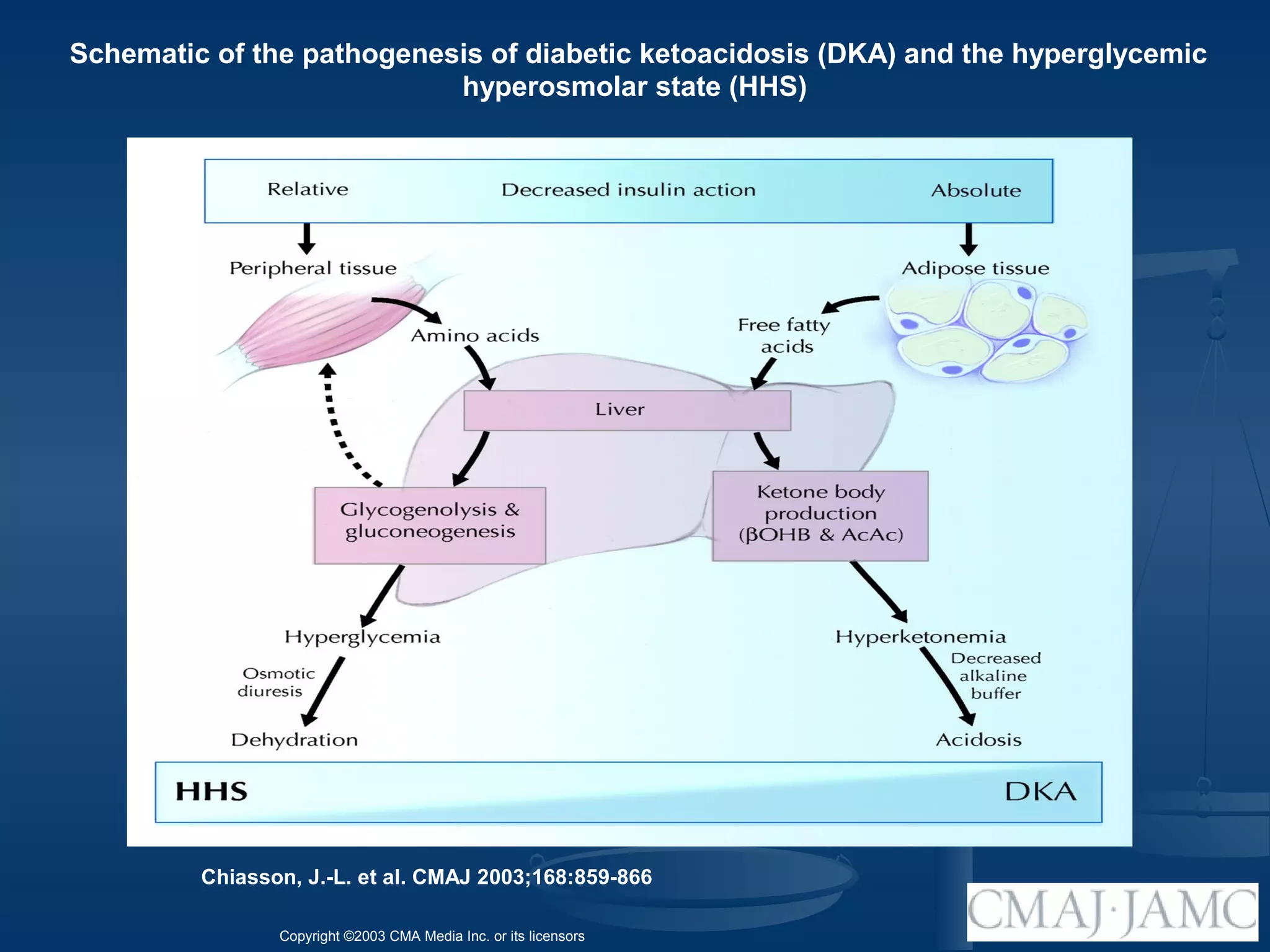
Schematic of the pathogenesis of diabetic ketoacidosis (DKA) and the hyperglycemic
hyperosmolar state (HHS)
 Diabetic ketoacidosis (DKA) and theDiabetic ketoacidosis (DKA) and the
Hyperglycemic Hyperosmolar State (HHS)Hyperglycemic Hyperosmolar State (HHS)
appear as 2 extremes in the spectrum ofappear as 2 extremes in the spectrum of
Diabetic DecompensationDiabetic Decompensation
Overlap of DKA/HHSOverlap of DKA/HHS
Findings in 612 patients admitted with hyperglycemia
0
20
40
60
DKA HHS Mixed
Wachtel et al. J Gen Int Med 6:495, 1991
%
Copyright ©2003 CMA Media Inc. or its licensors
Chiasson, J.-L. et al. CMAJ 2003;168:859-866
Pathophysiology of DKAPathophysiology of DKA
Relative/absolute insulin deficiencyRelative/absolute insulin deficiency
Elevations of insulin counterregulatoryElevations of insulin counterregulatory
hormones (ICRH)hormones (ICRH)
GlucagonGlucagon
Catecholamines (epinephrine, norepinephrine)Catecholamines (epinephrine, norepinephrine)
CortisolCortisol
Growth hormoneGrowth hormone
Pathogenesis of DKAPathogenesis of DKA
What causes hyperglycemia?What causes hyperglycemia?
What causes ketogenesis?What causes ketogenesis?
InsulinInsulin
Anabolic actionsAnabolic actions
Promotes glucose uptake in muscle and fatPromotes glucose uptake in muscle and fat
Stimulates glucose oxidationStimulates glucose oxidation
Regulates rates of hepatic glucose productionRegulates rates of hepatic glucose production
Stimulates glycogen formationStimulates glycogen formation
Stimulates protein synthesis and lipogenesisStimulates protein synthesis and lipogenesis
Increases lipoprotein lipase activityIncreases lipoprotein lipase activity
Inhibits catabolic processesInhibits catabolic processes
Inhibits glycogen breakdownInhibits glycogen breakdown
Inhibits gluconeogenesisInhibits gluconeogenesis
Inhibits protein breakdownInhibits protein breakdown
Inhibits lipolysisInhibits lipolysis
Inhibits ketogenesisInhibits ketogenesis
GlucagonGlucagon
 Inhibits insulin mediated glucoseInhibits insulin mediated glucose
uptakeuptake
 Stimulates gluconeogenesisStimulates gluconeogenesis
 Stimulates glycogenolysisStimulates glycogenolysis
 Inhibits lipogenesisInhibits lipogenesis
 Stimulates ketone formationStimulates ketone formation
Epi Increase EGP
Norepi Activates lipolysis
Inhibits insulin release
Decrease glucose uptake
Cortisol Increased EGP
Increase protein breakdown
Increase lipolysis
Growth Decrease glucose uptake
Hormone
Other Counterregulatory Hormones
Insulin deficiency
glucose uptake
(muscle/fat)
Glucagon excess
Proteolysis  Alanine
Lipolysis  glycerol
GNG
Hyperglycemia
Stimulates ketogenesis
Insulin deficiencyInsulin deficiency
glucose uptake
(muscle/fat)
Proteolysis  Alanine
Lipolysis  glycerol
Insulin deficiency
Pathogenesis of DKAPathogenesis of DKA
What causes acidosis?What causes acidosis?
Lipid and ketone metabolismLipid and ketone metabolism
Triglyceride
Activation of HSL
GlycerolMassive release
of FFA
Insulin deficiency
Increase ICRH
Glucagon
Substrate for GNG
Increase production
of ketone bodies by
the liver
Glucagon
+
Glucagon effect on ketoacid productionGlucagon effect on ketoacid production
Acetyl CoA Malonyl CoA FFAAcetyl CoA Malonyl CoA FFA
acetyl CoA carboxylaseacetyl CoA carboxylase
Low levels of malonyl CoA Increased CPT1Low levels of malonyl CoA Increased CPT1
Increase in CPT1 facilitates entry of FFA into theIncrease in CPT1 facilitates entry of FFA into the
mitochondria for oxidationmitochondria for oxidation
__
Outer Membrane
Inner Membrane
Mitochondrial matrix
Fatty Acyl CoA
CoASH
Carnitine Acyl carnitine
CPT1
CPT2
CoASH
Acetyl CoA
Fatty acid
β oxidation
Acyl CoA
Cytosol
Triglyceride synthesisMalonyl CoA
Ketone bodies
Keto-acidsKeto-acids
Beta-hydroxybutyrate and acetoacetatic acidBeta-hydroxybutyrate and acetoacetatic acid
 Weak acids that dissociate atWeak acids that dissociate at
physiologic pHphysiologic pH
 HH++ + HCO3- H2O and CO2+ HCO3- H2O and CO2
 Decrease in serum HCO3-Decrease in serum HCO3-
 Increase in Anion Gap approximatelyIncrease in Anion Gap approximately
equal to the decline in bicarbonateequal to the decline in bicarbonate
levelslevels
Keto-acidsKeto-acids
Beta-hydroxybutyrate and acetoacetatic acidBeta-hydroxybutyrate and acetoacetatic acid
Nitroprusside RXN:Nitroprusside RXN:
Acetest Test mainly forAcetest Test mainly for
Ketostix acetoacetateKetostix acetoacetate
Chemstrips UGKChemstrips UGK
MeasuringMeasuring
urine and serum ketonesurine and serum ketones
 Absence of a nitroprusside reaction does notAbsence of a nitroprusside reaction does not
eliminate the possibility of DKAeliminate the possibility of DKA
 Even a positive test can grossly underestimateEven a positive test can grossly underestimate
the severity of the DKAthe severity of the DKA
 Conversely, the persistence of or an increase inConversely, the persistence of or an increase in
ketones during therapy is not necessarily aketones during therapy is not necessarily a
manifestation of deteriorating clinical status, andmanifestation of deteriorating clinical status, and
may in fact be a sign of improvementmay in fact be a sign of improvement
Renal threshold for glucose ~ 180-200Renal threshold for glucose ~ 180-200
mg/dlmg/dl
Renal threshold for ketones is very lowRenal threshold for ketones is very low
Differential diagnosisDifferential diagnosis
 Starvation ketosisStarvation ketosis
 Alcoholic ketoacidosis (AKA)Alcoholic ketoacidosis (AKA)
 Other causes of high-anion gap metabolicOther causes of high-anion gap metabolic
acidosis;acidosis;
 lactic acidosislactic acidosis
 ingestion of drugs such as salicylate,ingestion of drugs such as salicylate,
methanol, ethylene glycol, and paraldehydemethanol, ethylene glycol, and paraldehyde
 chronic renal failurechronic renal failure
Precipitating factors forPrecipitating factors for
DKA/HHSDKA/HHS
New onset DM (8%)New onset DM (8%)
Omission of orOmission of or
inadequate dose ofinadequate dose of
insulin (21%)insulin (21%)
Any acute illnessAny acute illness
MI (5%)MI (5%)
Pancreatitis (5%)Pancreatitis (5%)
Infection (37%)Infection (37%)
Drugs/alcohol (10%)Drugs/alcohol (10%)
Insulin pumpInsulin pump
malfunctionmalfunction
Luteal phase decreaseLuteal phase decrease
in insulin sensitivityin insulin sensitivity
HypovolemiaHypovolemia
Unknown (14%)Unknown (14%)
Clinical presentation
 Ketoacidosis usually evolve in <24 hrsKetoacidosis usually evolve in <24 hrs
 May evolve or develop more acutelyMay evolve or develop more acutely
 May present in DKA with no prior clues orMay present in DKA with no prior clues or
symptomssymptoms
 For both DKA and HHS, the classicalFor both DKA and HHS, the classical
clinical picture includesclinical picture includes;;
 a history of polyuria, polydipsia, polyphagia,a history of polyuria, polydipsia, polyphagia,
 weight loss,weight loss,
 vomiting,vomiting,
 abdominal pain (only in DKA),abdominal pain (only in DKA),
 dehydration,dehydration,
 weakness,weakness,
 clouding of sensoria, and finally comaclouding of sensoria, and finally coma
 Physical findings may include poor skin turgor,Physical findings may include poor skin turgor,
Kussmaul respirations (in DKA), tachycardia,Kussmaul respirations (in DKA), tachycardia,
hypotension, alteration in mental status, shock,hypotension, alteration in mental status, shock,
and ultimately coma (more frequent in HHS).and ultimately coma (more frequent in HHS).
 A normal or elevated temperature may indicateA normal or elevated temperature may indicate
underlying infectionunderlying infection primarily because ofprimarily because of
peripheral vasodilationperipheral vasodilation
 Hypothermia, if present, is a poor prognosticHypothermia, if present, is a poor prognostic
sign*sign*
* Matz R: Hypothermia in diabetic acidosis. Hormones 3:36–41, 1972
 Up to 25% of DKA patients have emesis,Up to 25% of DKA patients have emesis,
which may be coffee-ground inwhich may be coffee-ground in
appearance.appearance.
 Endoscopy has related this finding to theEndoscopy has related this finding to the
presence of hemorrhagic gastritispresence of hemorrhagic gastritis
Abdominal PainAbdominal Pain
in Decompensated DMin Decompensated DM
Infrequent with HCO3- > 10 meq/LInfrequent with HCO3- > 10 meq/L
No correlation with degree ofNo correlation with degree of
hyperglycemia or dehydrationhyperglycemia or dehydration
May be related to precipitating eventMay be related to precipitating event
Campbell et al. JAMA 233:66, 1975Campbell et al. JAMA 233:66, 1975
Level of consciousness is related to theLevel of consciousness is related to the
severity of the serum osmolarity inseverity of the serum osmolarity in
DKA/HHSDKA/HHS
250
300
350
400
1 2 3 4
Fulop et al. Lancet 2:635, 1973
Glasgow Coma scale
 Occurrence of coma in diabetic patients in theOccurrence of coma in diabetic patients in the
absence of definitive elevation of effectiveabsence of definitive elevation of effective
osmolality ≥320 mOsm/kg demandsosmolality ≥320 mOsm/kg demands
immediate consideration of other causes ofimmediate consideration of other causes of
such change.such change.
 Effective osmolality may be calculated by theEffective osmolality may be calculated by the
following formula:following formula:
2[measured Na (mEq/l)] + glucose (mg/dl)/182[measured Na (mEq/l)] + glucose (mg/dl)/18
Initial laboratory evaluation of patients withInitial laboratory evaluation of patients with
suspected DKA or HHS should includesuspected DKA or HHS should include
 plasma glucoseplasma glucose
 blood urea/creatinineblood urea/creatinine
 serum ketonesserum ketones
 electrolytes (withelectrolytes (with
calculated anion gap)calculated anion gap)
 osmolalityosmolality
 UrinalysisUrinalysis
 urine ketones byurine ketones by
dipstickdipstick
 arterial blood gasesarterial blood gases
 complete blood countcomplete blood count
with differentialwith differential
 electrocardiogram.electrocardiogram.
 Bacterial culturesBacterial cultures of urine, blood, and throat,of urine, blood, and throat,
etc., should be obtained and appropriateetc., should be obtained and appropriate
antibiotics given if infection is suspected.antibiotics given if infection is suspected.
 CXRCXR should also be obtained if indicated.should also be obtained if indicated.
 HbA1cHbA1c may be useful in determiningmay be useful in determining
◊◊culmination of an evolutionary process inculmination of an evolutionary process in
previously undiagnosed or poorly controlledpreviously undiagnosed or poorly controlled
diabetesdiabetes
◊◊truly acute episode in an otherwisetruly acute episode in an otherwise well-well-
controlled patientcontrolled patient
FINDINGFINDING CAUSE/SCAUSE/S
LeukocytosisLeukocytosis Proportional to blood ketone bodyProportional to blood ketone body
concentration, Infectionconcentration, Infection
Hyponatraemia*Hyponatraemia* Osmotic flux of water from theOsmotic flux of water from the
intracellular to the extracellular space,intracellular to the extracellular space,
Severe hypertriglyceridemiaSevere hypertriglyceridemia
HypokalaemiaHypokalaemia Extracellular shift of potassium caused byExtracellular shift of potassium caused by
insulin deficiency, hypertonicity, andinsulin deficiency, hypertonicity, and
acidemiaacidemia
Elevated AmylaseElevated Amylase Non-pancreatic sources, such as theNon-pancreatic sources, such as the
parotid glandparotid gland
* Serum Na should be corrected for hyperglycemia (for each 100 mg/dl
glucose >100 mg/dl, add 1.6 mEq to sodium value for corrected Na value)
TreatmentTreatment
 The success of treatment of DKA andThe success of treatment of DKA and
HHS depends on;HHS depends on;
 Adequate correction ofAdequate correction of dehydrationdehydration,,
hyperglycemiahyperglycemia,, ketoacidosisketoacidosis andand electrolyteelectrolyte
deficitsdeficits
 Identification & treatment of anyIdentification & treatment of any comorbidcomorbid
precipitating eventsprecipitating events
 Frequent patientFrequent patient monitoringmonitoring
Fluid therapyFluid therapy
 Objective is to expand extracellularObjective is to expand extracellular
volume and restore renal perfusionvolume and restore renal perfusion
 Start with infusion of isotonic salineStart with infusion of isotonic saline
 (0.9% NaCl) at a rate of 15–20 mL/kg per hour(0.9% NaCl) at a rate of 15–20 mL/kg per hour
during the first hour (1–1.5 L in the averageduring the first hour (1–1.5 L in the average
adult)adult)
 Subsequent choice of fluid replacementSubsequent choice of fluid replacement
depends on the state of hydration,depends on the state of hydration,
electrolyte levels and urinary output.electrolyte levels and urinary output.
 InfuseInfuse 0.45% Nacl0.45% Nacl at a rate of 4–14 mL/kgat a rate of 4–14 mL/kg
per hour if theper hour if the correctedcorrected serum Na isserum Na is
normal or elevatednormal or elevated..
 0.9% NaCl0.9% NaCl at a similar rate is appropriateat a similar rate is appropriate
if correctedif corrected serum Na is lowserum Na is low
 Successful progress with fluidSuccessful progress with fluid
replacement is judged by;replacement is judged by;
 hemodynamic monitoring (improve BP)hemodynamic monitoring (improve BP)
 measurement of fluid input/outputmeasurement of fluid input/output
 clinical examinationclinical examination
 Fluid replacement should correctFluid replacement should correct
estimated deficits within the first 24 h.estimated deficits within the first 24 h.
 Induced change in s osmolality should notInduced change in s osmolality should not
exceed 3 mOsm · kg-1 H2O · h-1exceed 3 mOsm · kg-1 H2O · h-1
 When the plasma glucose level reachesWhen the plasma glucose level reaches
250mg/dl, change to250mg/dl, change to 5% dextrose5% dextrose withwith
0.45% Nacl infused at 150-250 ml/hr0.45% Nacl infused at 150-250 ml/hr
Paediatric patients (<20 yrs of age)Paediatric patients (<20 yrs of age)
 The 1st hr of fluids should be isotonicThe 1st hr of fluids should be isotonic
saline at 10–20 ml · kg-1 · h-1.saline at 10–20 ml · kg-1 · h-1.
 Initial reexpansion should not exceed 50Initial reexpansion should not exceed 50
ml/kg over the first 4 h of therapy.ml/kg over the first 4 h of therapy.
 Replace fluid deficit evenly over 48 hReplace fluid deficit evenly over 48 h
 In general, 0.45–0.9% NaCl (dependingIn general, 0.45–0.9% NaCl (depending
on serum Na ) infused at a rate of 1.5on serum Na ) infused at a rate of 1.5
times the 24-h maintenancetimes the 24-h maintenance
requirements ( 5 ml · kg-1 · h-1) willrequirements ( 5 ml · kg-1 · h-1) will
accomplish a smooth rehydrationaccomplish a smooth rehydration
Potassium therapyPotassium therapy
 The treatment of DKA and HHS withThe treatment of DKA and HHS with
rehydration and insulin is typicallyrehydration and insulin is typically
associated with a rapid decline in theassociated with a rapid decline in the
plasma K concentration, particularly duringplasma K concentration, particularly during
the first few hours of therapythe first few hours of therapy
Causes of hypokalaemiaCauses of hypokalaemia
 insulin-mediated re-entry of potassium intoinsulin-mediated re-entry of potassium into
the intracellular compartmentthe intracellular compartment
 extracellular fluid volume expansionextracellular fluid volume expansion
 correction of acidosiscorrection of acidosis
 continued potassium loss owing tocontinued potassium loss owing to
osmotic diuresis and ketonuriaosmotic diuresis and ketonuria
 Because treatment will rapidly induceBecause treatment will rapidly induce
decreased serum K concentrations, Kdecreased serum K concentrations, K
replacement must be initiated as soon asreplacement must be initiated as soon as
levels falllevels fall below 5.0 mmol/Lbelow 5.0 mmol/L, assuming, assuming
urine output is adequateurine output is adequate
 It is recommended thatIt is recommended that 20–30 mmol of K20–30 mmol of K
be added to each litrebe added to each litre of infusion fluid toof infusion fluid to
maintainmaintain K concentration 4 - 5 mmol/LK concentration 4 - 5 mmol/L
 If serum K level isIf serum K level is << 3.3 mmol/L3.3 mmol/L, K, K
replacement should be startedreplacement should be started
immediately with fluid therapyimmediately with fluid therapy
 Initiation of insulin should be delayed untilInitiation of insulin should be delayed until
K is restored toK is restored to >>3.3 mmol/L, in order to3.3 mmol/L, in order to
avoid arrhythmia, cardiac arrest andavoid arrhythmia, cardiac arrest and
respiratory muscle weaknessrespiratory muscle weakness
 Initially, the serum K level should beInitially, the serum K level should be
measured every 1–2 hrs because the mostmeasured every 1–2 hrs because the most
rapid change occurs during the first 5 hrsrapid change occurs during the first 5 hrs
of treatment.of treatment.
 After that, it should be measured every 4–After that, it should be measured every 4–
6 hrs as indicated clinically6 hrs as indicated clinically
Insulin therapyInsulin therapy
 Consensus is that, in DKA & HHS, regularConsensus is that, in DKA & HHS, regular
insulin should be administered byinsulin should be administered by
continuous iv infusion in small dosescontinuous iv infusion in small doses
through an infusion pumpthrough an infusion pump
 Low-dose insulin provides;Low-dose insulin provides;
 More physiologic insulin concentrationsMore physiologic insulin concentrations
 More gradual and steady fall in plasmaMore gradual and steady fall in plasma
glucose levelsglucose levels
 Decreased risk of hypoglycemia andDecreased risk of hypoglycemia and
hypokalemiahypokalemia
 As soon as hypokalemia (K < 3.3 mmol/L)As soon as hypokalemia (K < 3.3 mmol/L)
excluded, continuous infusion of regularexcluded, continuous infusion of regular
insulin can be started at a dose of 0.1insulin can be started at a dose of 0.1
U/kg per hourU/kg per hour
 This should produce a gradual decreaseThis should produce a gradual decrease
in the plasma glucose level of 3–4 mmol/Lin the plasma glucose level of 3–4 mmol/L
per hourper hour
 There is evidence that an iv bolus ofThere is evidence that an iv bolus of
insulin is not necessary. However, a bolusinsulin is not necessary. However, a bolus
may be used at the start of insulin therapy,may be used at the start of insulin therapy,
particularly if insulin treatment has beenparticularly if insulin treatment has been
delayed.delayed.
 In unusual circumstances where ivIn unusual circumstances where iv
administration is not possible, the im or scadministration is not possible, the im or sc
route has been used effectively. However,route has been used effectively. However,
poor perfusion will impair absorption ofpoor perfusion will impair absorption of
insulin.insulin.
 If the glucose level does not decline by 3If the glucose level does not decline by 3
mmol/L in the first hour, the hydrationmmol/L in the first hour, the hydration
status should be checked;status should be checked;
 if it is acceptable, the insulin dose shouldif it is acceptable, the insulin dose should
bebe doubled every hourdoubled every hour until a decrease ofuntil a decrease of
3–4 mmol/L per hour3–4 mmol/L per hour in the plasmain the plasma
glucose level is observedglucose level is observed
 When the plasma glucose level reachesWhen the plasma glucose level reaches
12–14 mmol/L, the12–14 mmol/L, the insulin infusion rateinsulin infusion rate
may be decreased by 50%may be decreased by 50% as 5%as 5%
dextrose is addeddextrose is added
 Thereafter, the insulin infusion dose mustThereafter, the insulin infusion dose must
be adjusted to maintain the plasmabe adjusted to maintain the plasma
glucose value in the range of 150 –glucose value in the range of 150 –
200mg/dl until the acidosis in DKA (or the200mg/dl until the acidosis in DKA (or the
clouded consciousness andclouded consciousness and
hyperosmolality in HHS) have beenhyperosmolality in HHS) have been
resolvedresolved
 It takes longer to correct ketonuria thanIt takes longer to correct ketonuria than
hyperglycemia.hyperglycemia.
 Because ß-hydroxybutyric acid is theBecause ß-hydroxybutyric acid is the
prevalent ketoacid and is graduallyprevalent ketoacid and is gradually
converted to acetoacetic acid, theconverted to acetoacetic acid, the
correction of ketonuria is underestimatedcorrection of ketonuria is underestimated
when measured by the nitroprussidewhen measured by the nitroprusside
methodmethod
 Measurement ofMeasurement of serum ß-hydroxybutyricserum ß-hydroxybutyric
acid levels using a reagent strip and aacid levels using a reagent strip and a
reflectance meter has been validatedreflectance meter has been validated
 Offers the possibility of bedside diagnosisOffers the possibility of bedside diagnosis
with better follow-up parameters ofwith better follow-up parameters of
hyperketonemia during treatmenthyperketonemia during treatment
 Once the ketoacidosis in DKA has beenOnce the ketoacidosis in DKA has been
correctedcorrected (plasma glucose level < 11.0(plasma glucose level < 11.0
mmol/L, serum bicarbonate level ≥18mmol/L, serum bicarbonate level ≥18
mmol/L, venous pH > 7.3 and anion gap <mmol/L, venous pH > 7.3 and anion gap <
12 mmol/L), the clouded consciousness12 mmol/L), the clouded consciousness
and hyperosmolality in HHS haveand hyperosmolality in HHS have
resolved, and patients are able to takeresolved, and patients are able to take
fluids orally)fluids orally),, a multidose insulin regimena multidose insulin regimen
may be initiated based on the patient'smay be initiated based on the patient's
treatment before DKA or HHS developedtreatment before DKA or HHS developed
PhosphatePhosphate
 Despite whole-body phosphate deficits inDespite whole-body phosphate deficits in
DKA , serum phosphate is often normal orDKA , serum phosphate is often normal or
increased at presentation. Phosphateincreased at presentation. Phosphate
concentration decreases with insulinconcentration decreases with insulin
therapy.therapy.
 Prospective randomized studies haveProspective randomized studies have
failed to show any beneficial effect offailed to show any beneficial effect of
phosphate replacement on the clinicalphosphate replacement on the clinical
outcome in DKAoutcome in DKA
 However, to avoid cardiac and skeletalHowever, to avoid cardiac and skeletal
muscle weakness and respiratorymuscle weakness and respiratory
depression due to hypophosphatemia,depression due to hypophosphatemia,
careful phosphatecareful phosphate replacement mayreplacement may
sometimes be indicated in patients withsometimes be indicated in patients with
cardiac dysfunction, anemia, or respiratorycardiac dysfunction, anemia, or respiratory
depression and in those with serumdepression and in those with serum
phosphate concentration <1.0 mg/dl.phosphate concentration <1.0 mg/dl.
 When needed, 20–30 mEq/l potassiumWhen needed, 20–30 mEq/l potassium
phosphate can be added to replacementphosphate can be added to replacement
fluids.fluids.
 Overzealous phosphate therapy canOverzealous phosphate therapy can
causecause severe hypocalcemiasevere hypocalcemia with nowith no
evidence of tetanyevidence of tetany
BicarbonateBicarbonate
 Bicarbonate use in DKA remains controversial.Bicarbonate use in DKA remains controversial.
 At a pH >7.0, reestablishing insulin activityAt a pH >7.0, reestablishing insulin activity
blocks lipolysis and resolves ketoacidosisblocks lipolysis and resolves ketoacidosis
without any added bicarbonate.without any added bicarbonate. Studies failed toStudies failed to
show either beneficial or deleterious changes inshow either beneficial or deleterious changes in
morbidity or mortality with bicarbonate therapy inmorbidity or mortality with bicarbonate therapy in
DKA patients with pH between 6.9 - 7.1DKA patients with pH between 6.9 - 7.1
 No studies concerning the use of bicarbonate inNo studies concerning the use of bicarbonate in
DKA with pH values <6.9 have been reported.DKA with pH values <6.9 have been reported.
Severe acidosis may lead to adverseSevere acidosis may lead to adverse
vascular effectsvascular effects
RECOMMENDATIONS
PH HCO3 Infusion Rate
>7 No HCO3
6.9 - 7 50 mmol in 200ml water 200ml/hr
<6.9 100 mmol in 400ml water 200ml/hr
---
 Venous pH should be assessed every 2 hVenous pH should be assessed every 2 h
until the pH rises to 7.0, & treatmentuntil the pH rises to 7.0, & treatment
should be repeated every 2 h if necessaryshould be repeated every 2 h if necessary
 In the paediatric patient, If pH remainsIn the paediatric patient, If pH remains
<7.0 after the initial hour of hydration, it<7.0 after the initial hour of hydration, it
seems prudent to administer 1–2 mEq/kgseems prudent to administer 1–2 mEq/kg
HCO3 over the course of 1 h. This HCO3HCO3 over the course of 1 h. This HCO3
can be added to NaCl, with any requiredcan be added to NaCl, with any required
K, to produce a solution that does notK, to produce a solution that does not
exceed 155 mEq/l sodium.exceed 155 mEq/l sodium.
COMPLICATIONS OF THERAPYCOMPLICATIONS OF THERAPY
 HypoglycemiaHypoglycemia - overzealous Rx with insulin- overzealous Rx with insulin
 HypokalemiaHypokalemia due to insulin & treatment ofdue to insulin & treatment of
acidosis with bicarbonateacidosis with bicarbonate
 HyperglycemiaHyperglycemia secondary tosecondary to
interruption/discontinuance of iv insulin therapyinterruption/discontinuance of iv insulin therapy
after recoveryafter recovery
 HyperchloremiaHyperchloremia caused by the use of excessivecaused by the use of excessive
salinesaline
 Transient non-anion gap metabolic acidosisTransient non-anion gap metabolic acidosis asas
ClCl‾‾ from iv fluids replaces ketoanions lost as Nafrom iv fluids replaces ketoanions lost as Na
& K salts during osmotic diuresis& K salts during osmotic diuresis
 HypoxemiaHypoxemia
 noncardiogenicnoncardiogenic pulmonary oedemapulmonary oedema
 Cerebral OedemaCerebral Oedema
 Hypoxemia is attributed to a reduction in colloidHypoxemia is attributed to a reduction in colloid
osmotic pressure that results in increased lungosmotic pressure that results in increased lung
water content and decreased lung compliance.water content and decreased lung compliance.
Patients with DKA who have a widened alveolo-Patients with DKA who have a widened alveolo-
arteriolar oxygen gradient noted on initial bloodarteriolar oxygen gradient noted on initial blood
gas measurement or with pulmonary rales ongas measurement or with pulmonary rales on
physical examination appear to be at higher riskphysical examination appear to be at higher risk
for the development of pulmonary edemafor the development of pulmonary edema
COMPLICATIONS OF THERAPYCOMPLICATIONS OF THERAPY
Cerebral edema in DKACerebral edema in DKA
More common in children and young adultsMore common in children and young adults
Incidence ~ 1%Incidence ~ 1%
Accounts for 31% of deaths associated with DKAAccounts for 31% of deaths associated with DKA
Heralded by development of a headache andHeralded by development of a headache and
increasing lethargyincreasing lethargy
Develops 4-12 hours after initiation of treatmentDevelops 4-12 hours after initiation of treatment
Proposed risk factors:Proposed risk factors:
Low pCOLow pCO22 ( 15 mm Hg) and elevated urea nitrogen( 15 mm Hg) and elevated urea nitrogen
(>21 mg/dl) at presentation(>21 mg/dl) at presentation
Treatment with bicarbonateTreatment with bicarbonate
Too rapid correction of dehydrationToo rapid correction of dehydration
Once the clinical symptoms other thanOnce the clinical symptoms other than
lethargy and behavioural changes occur,lethargy and behavioural changes occur,
mortality is high (>70%)mortality is high (>70%)
Only 7–14% of patients recover withoutOnly 7–14% of patients recover without
permanent morbiditypermanent morbidity
Cerebral Oedema in DKACerebral Oedema in DKA
Mechanism of Cerebral OedemaMechanism of Cerebral Oedema
 Not knownNot known
 Likely results from osmotically drivenLikely results from osmotically driven
movement of water into the centralmovement of water into the central
nervous system when plasma osmolalitynervous system when plasma osmolality
declines too rapidly with the treatment ofdeclines too rapidly with the treatment of
DKA or HHS.DKA or HHS.
 There is a lack of information on theThere is a lack of information on the
morbidity associated with cerebral edemamorbidity associated with cerebral edema
in adult patientsin adult patients
Prevention and treatment of cerebralPrevention and treatment of cerebral
edemaedema
PreventionPrevention
Gradual replacement of Na & HGradual replacement of Na & H22 O deficitsO deficits
Once plasma glucose of 200-250 mg/dlOnce plasma glucose of 200-250 mg/dl
achieved, maintain at this level with 5%achieved, maintain at this level with 5%
dextrosedextrose
TreatmentTreatment
IV mannitol 1G/kg over 30 minutes, followedIV mannitol 1G/kg over 30 minutes, followed
by infusion to maintain plasma osmolalityby infusion to maintain plasma osmolality
and sustain osmotic diuresis of waterand sustain osmotic diuresis of water
Strategies to Prevent Diabetic Ketoacidosis
Diabetic education
Blood glucose monitoring
Sick-day management
Home monitoring of ketones or beta-hydroxybutyrate
Supplemental short-acting insulin regimens
Easily digestible liquid diets when sick
Reducing, rather than eliminating, insulin when patients are
not eating
Guidelines for when patients should seek medical attention
Case monitoring of high-risk patients
Special education for patients on pump management

Diabetic ketoacidosis

  • 1.
    DIABETICDIABETIC KETOACIDOSISKETOACIDOSIS DISHAN LOWEDISHAN LOWE ConsultantEndocrinologistConsultant Endocrinologist General HospitalGeneral Hospital KandyKandy
  • 2.
    Diabetic KetoacidosisDiabetic Ketoacidosis Metabolic acidosis from the accumulationMetabolic acidosis from the accumulation of ketones due to severely depressedof ketones due to severely depressed insulin levelsinsulin levels  Typically characterized by;Typically characterized by;  Hyperglycemia (blood glucoseHyperglycemia (blood glucose>25>250 mg/dL)0 mg/dL)  Low bicarbonate (<15 mEq/L)Low bicarbonate (<15 mEq/L)  Acidosis (pH <7.30)Acidosis (pH <7.30)  Ketonemia and ketonuriaKetonemia and ketonuria
  • 3.
     In theUS:In the US:  DKA seen primarily in type 1 DMDKA seen primarily in type 1 DM  Incidence is roughly 2/100 patient years ofIncidence is roughly 2/100 patient years of diabetes, with about 3% of type 1 diabeticdiabetes, with about 3% of type 1 diabetic patients initially presenting with DKApatients initially presenting with DKA  Mortality <5% in experienced centers .Mortality <5% in experienced centers . Before the discovery of insulin in 1922,Before the discovery of insulin in 1922, mortality rate was 100%mortality rate was 100%  Mortality in HHS still remains high at 15%Mortality in HHS still remains high at 15%
  • 4.
     DKA tendsto occur in individuals youngerDKA tends to occur in individuals younger than 19 years, the more brittle type 1than 19 years, the more brittle type 1 diabetic patientsdiabetic patients  May occur in type 1 and type 2 diabeticMay occur in type 1 and type 2 diabetic patients of any agepatients of any age  Most serious acute metabolicMost serious acute metabolic complications of diabetes mellituscomplications of diabetes mellitus
  • 5.
    Copyright ©2003 CMAMedia Inc. or its licensors Chiasson, J.-L. et al. CMAJ 2003;168:859-866 Schematic of the pathogenesis of diabetic ketoacidosis (DKA) and the hyperglycemic hyperosmolar state (HHS)
  • 6.
     Diabetic ketoacidosis(DKA) and theDiabetic ketoacidosis (DKA) and the Hyperglycemic Hyperosmolar State (HHS)Hyperglycemic Hyperosmolar State (HHS) appear as 2 extremes in the spectrum ofappear as 2 extremes in the spectrum of Diabetic DecompensationDiabetic Decompensation
  • 7.
    Overlap of DKA/HHSOverlapof DKA/HHS Findings in 612 patients admitted with hyperglycemia 0 20 40 60 DKA HHS Mixed Wachtel et al. J Gen Int Med 6:495, 1991 %
  • 8.
    Copyright ©2003 CMAMedia Inc. or its licensors Chiasson, J.-L. et al. CMAJ 2003;168:859-866
  • 9.
    Pathophysiology of DKAPathophysiologyof DKA Relative/absolute insulin deficiencyRelative/absolute insulin deficiency Elevations of insulin counterregulatoryElevations of insulin counterregulatory hormones (ICRH)hormones (ICRH) GlucagonGlucagon Catecholamines (epinephrine, norepinephrine)Catecholamines (epinephrine, norepinephrine) CortisolCortisol Growth hormoneGrowth hormone
  • 10.
    Pathogenesis of DKAPathogenesisof DKA What causes hyperglycemia?What causes hyperglycemia? What causes ketogenesis?What causes ketogenesis?
  • 11.
    InsulinInsulin Anabolic actionsAnabolic actions Promotesglucose uptake in muscle and fatPromotes glucose uptake in muscle and fat Stimulates glucose oxidationStimulates glucose oxidation Regulates rates of hepatic glucose productionRegulates rates of hepatic glucose production Stimulates glycogen formationStimulates glycogen formation Stimulates protein synthesis and lipogenesisStimulates protein synthesis and lipogenesis Increases lipoprotein lipase activityIncreases lipoprotein lipase activity Inhibits catabolic processesInhibits catabolic processes Inhibits glycogen breakdownInhibits glycogen breakdown Inhibits gluconeogenesisInhibits gluconeogenesis Inhibits protein breakdownInhibits protein breakdown Inhibits lipolysisInhibits lipolysis Inhibits ketogenesisInhibits ketogenesis
  • 12.
    GlucagonGlucagon  Inhibits insulinmediated glucoseInhibits insulin mediated glucose uptakeuptake  Stimulates gluconeogenesisStimulates gluconeogenesis  Stimulates glycogenolysisStimulates glycogenolysis  Inhibits lipogenesisInhibits lipogenesis  Stimulates ketone formationStimulates ketone formation
  • 13.
    Epi Increase EGP NorepiActivates lipolysis Inhibits insulin release Decrease glucose uptake Cortisol Increased EGP Increase protein breakdown Increase lipolysis Growth Decrease glucose uptake Hormone Other Counterregulatory Hormones
  • 14.
    Insulin deficiency glucose uptake (muscle/fat) Glucagonexcess Proteolysis  Alanine Lipolysis  glycerol GNG Hyperglycemia Stimulates ketogenesis Insulin deficiencyInsulin deficiency glucose uptake (muscle/fat) Proteolysis  Alanine Lipolysis  glycerol Insulin deficiency
  • 15.
    Pathogenesis of DKAPathogenesisof DKA What causes acidosis?What causes acidosis?
  • 16.
    Lipid and ketonemetabolismLipid and ketone metabolism Triglyceride Activation of HSL GlycerolMassive release of FFA Insulin deficiency Increase ICRH Glucagon Substrate for GNG Increase production of ketone bodies by the liver Glucagon +
  • 17.
    Glucagon effect onketoacid productionGlucagon effect on ketoacid production Acetyl CoA Malonyl CoA FFAAcetyl CoA Malonyl CoA FFA acetyl CoA carboxylaseacetyl CoA carboxylase Low levels of malonyl CoA Increased CPT1Low levels of malonyl CoA Increased CPT1 Increase in CPT1 facilitates entry of FFA into theIncrease in CPT1 facilitates entry of FFA into the mitochondria for oxidationmitochondria for oxidation __
  • 18.
    Outer Membrane Inner Membrane Mitochondrialmatrix Fatty Acyl CoA CoASH Carnitine Acyl carnitine CPT1 CPT2 CoASH Acetyl CoA Fatty acid β oxidation Acyl CoA Cytosol Triglyceride synthesisMalonyl CoA Ketone bodies
  • 19.
    Keto-acidsKeto-acids Beta-hydroxybutyrate and acetoacetaticacidBeta-hydroxybutyrate and acetoacetatic acid  Weak acids that dissociate atWeak acids that dissociate at physiologic pHphysiologic pH  HH++ + HCO3- H2O and CO2+ HCO3- H2O and CO2  Decrease in serum HCO3-Decrease in serum HCO3-  Increase in Anion Gap approximatelyIncrease in Anion Gap approximately equal to the decline in bicarbonateequal to the decline in bicarbonate levelslevels
  • 20.
    Keto-acidsKeto-acids Beta-hydroxybutyrate and acetoacetaticacidBeta-hydroxybutyrate and acetoacetatic acid Nitroprusside RXN:Nitroprusside RXN: Acetest Test mainly forAcetest Test mainly for Ketostix acetoacetateKetostix acetoacetate Chemstrips UGKChemstrips UGK
  • 21.
    MeasuringMeasuring urine and serumketonesurine and serum ketones  Absence of a nitroprusside reaction does notAbsence of a nitroprusside reaction does not eliminate the possibility of DKAeliminate the possibility of DKA  Even a positive test can grossly underestimateEven a positive test can grossly underestimate the severity of the DKAthe severity of the DKA  Conversely, the persistence of or an increase inConversely, the persistence of or an increase in ketones during therapy is not necessarily aketones during therapy is not necessarily a manifestation of deteriorating clinical status, andmanifestation of deteriorating clinical status, and may in fact be a sign of improvementmay in fact be a sign of improvement
  • 22.
    Renal threshold forglucose ~ 180-200Renal threshold for glucose ~ 180-200 mg/dlmg/dl Renal threshold for ketones is very lowRenal threshold for ketones is very low
  • 23.
    Differential diagnosisDifferential diagnosis Starvation ketosisStarvation ketosis  Alcoholic ketoacidosis (AKA)Alcoholic ketoacidosis (AKA)  Other causes of high-anion gap metabolicOther causes of high-anion gap metabolic acidosis;acidosis;  lactic acidosislactic acidosis  ingestion of drugs such as salicylate,ingestion of drugs such as salicylate, methanol, ethylene glycol, and paraldehydemethanol, ethylene glycol, and paraldehyde  chronic renal failurechronic renal failure
  • 24.
    Precipitating factors forPrecipitatingfactors for DKA/HHSDKA/HHS New onset DM (8%)New onset DM (8%) Omission of orOmission of or inadequate dose ofinadequate dose of insulin (21%)insulin (21%) Any acute illnessAny acute illness MI (5%)MI (5%) Pancreatitis (5%)Pancreatitis (5%) Infection (37%)Infection (37%) Drugs/alcohol (10%)Drugs/alcohol (10%) Insulin pumpInsulin pump malfunctionmalfunction Luteal phase decreaseLuteal phase decrease in insulin sensitivityin insulin sensitivity HypovolemiaHypovolemia Unknown (14%)Unknown (14%)
  • 25.
    Clinical presentation  Ketoacidosisusually evolve in <24 hrsKetoacidosis usually evolve in <24 hrs  May evolve or develop more acutelyMay evolve or develop more acutely  May present in DKA with no prior clues orMay present in DKA with no prior clues or symptomssymptoms
  • 26.
     For bothDKA and HHS, the classicalFor both DKA and HHS, the classical clinical picture includesclinical picture includes;;  a history of polyuria, polydipsia, polyphagia,a history of polyuria, polydipsia, polyphagia,  weight loss,weight loss,  vomiting,vomiting,  abdominal pain (only in DKA),abdominal pain (only in DKA),  dehydration,dehydration,  weakness,weakness,  clouding of sensoria, and finally comaclouding of sensoria, and finally coma
  • 27.
     Physical findingsmay include poor skin turgor,Physical findings may include poor skin turgor, Kussmaul respirations (in DKA), tachycardia,Kussmaul respirations (in DKA), tachycardia, hypotension, alteration in mental status, shock,hypotension, alteration in mental status, shock, and ultimately coma (more frequent in HHS).and ultimately coma (more frequent in HHS).  A normal or elevated temperature may indicateA normal or elevated temperature may indicate underlying infectionunderlying infection primarily because ofprimarily because of peripheral vasodilationperipheral vasodilation  Hypothermia, if present, is a poor prognosticHypothermia, if present, is a poor prognostic sign*sign* * Matz R: Hypothermia in diabetic acidosis. Hormones 3:36–41, 1972
  • 28.
     Up to25% of DKA patients have emesis,Up to 25% of DKA patients have emesis, which may be coffee-ground inwhich may be coffee-ground in appearance.appearance.  Endoscopy has related this finding to theEndoscopy has related this finding to the presence of hemorrhagic gastritispresence of hemorrhagic gastritis
  • 29.
    Abdominal PainAbdominal Pain inDecompensated DMin Decompensated DM Infrequent with HCO3- > 10 meq/LInfrequent with HCO3- > 10 meq/L No correlation with degree ofNo correlation with degree of hyperglycemia or dehydrationhyperglycemia or dehydration May be related to precipitating eventMay be related to precipitating event Campbell et al. JAMA 233:66, 1975Campbell et al. JAMA 233:66, 1975
  • 30.
    Level of consciousnessis related to theLevel of consciousness is related to the severity of the serum osmolarity inseverity of the serum osmolarity in DKA/HHSDKA/HHS 250 300 350 400 1 2 3 4 Fulop et al. Lancet 2:635, 1973 Glasgow Coma scale
  • 31.
     Occurrence ofcoma in diabetic patients in theOccurrence of coma in diabetic patients in the absence of definitive elevation of effectiveabsence of definitive elevation of effective osmolality ≥320 mOsm/kg demandsosmolality ≥320 mOsm/kg demands immediate consideration of other causes ofimmediate consideration of other causes of such change.such change.  Effective osmolality may be calculated by theEffective osmolality may be calculated by the following formula:following formula: 2[measured Na (mEq/l)] + glucose (mg/dl)/182[measured Na (mEq/l)] + glucose (mg/dl)/18
  • 32.
    Initial laboratory evaluationof patients withInitial laboratory evaluation of patients with suspected DKA or HHS should includesuspected DKA or HHS should include  plasma glucoseplasma glucose  blood urea/creatinineblood urea/creatinine  serum ketonesserum ketones  electrolytes (withelectrolytes (with calculated anion gap)calculated anion gap)  osmolalityosmolality  UrinalysisUrinalysis  urine ketones byurine ketones by dipstickdipstick  arterial blood gasesarterial blood gases  complete blood countcomplete blood count with differentialwith differential  electrocardiogram.electrocardiogram.
  • 33.
     Bacterial culturesBacterialcultures of urine, blood, and throat,of urine, blood, and throat, etc., should be obtained and appropriateetc., should be obtained and appropriate antibiotics given if infection is suspected.antibiotics given if infection is suspected.  CXRCXR should also be obtained if indicated.should also be obtained if indicated.  HbA1cHbA1c may be useful in determiningmay be useful in determining ◊◊culmination of an evolutionary process inculmination of an evolutionary process in previously undiagnosed or poorly controlledpreviously undiagnosed or poorly controlled diabetesdiabetes ◊◊truly acute episode in an otherwisetruly acute episode in an otherwise well-well- controlled patientcontrolled patient
  • 34.
    FINDINGFINDING CAUSE/SCAUSE/S LeukocytosisLeukocytosis Proportionalto blood ketone bodyProportional to blood ketone body concentration, Infectionconcentration, Infection Hyponatraemia*Hyponatraemia* Osmotic flux of water from theOsmotic flux of water from the intracellular to the extracellular space,intracellular to the extracellular space, Severe hypertriglyceridemiaSevere hypertriglyceridemia HypokalaemiaHypokalaemia Extracellular shift of potassium caused byExtracellular shift of potassium caused by insulin deficiency, hypertonicity, andinsulin deficiency, hypertonicity, and acidemiaacidemia Elevated AmylaseElevated Amylase Non-pancreatic sources, such as theNon-pancreatic sources, such as the parotid glandparotid gland * Serum Na should be corrected for hyperglycemia (for each 100 mg/dl glucose >100 mg/dl, add 1.6 mEq to sodium value for corrected Na value)
  • 35.
    TreatmentTreatment  The successof treatment of DKA andThe success of treatment of DKA and HHS depends on;HHS depends on;  Adequate correction ofAdequate correction of dehydrationdehydration,, hyperglycemiahyperglycemia,, ketoacidosisketoacidosis andand electrolyteelectrolyte deficitsdeficits  Identification & treatment of anyIdentification & treatment of any comorbidcomorbid precipitating eventsprecipitating events  Frequent patientFrequent patient monitoringmonitoring
  • 37.
    Fluid therapyFluid therapy Objective is to expand extracellularObjective is to expand extracellular volume and restore renal perfusionvolume and restore renal perfusion  Start with infusion of isotonic salineStart with infusion of isotonic saline  (0.9% NaCl) at a rate of 15–20 mL/kg per hour(0.9% NaCl) at a rate of 15–20 mL/kg per hour during the first hour (1–1.5 L in the averageduring the first hour (1–1.5 L in the average adult)adult)
  • 38.
     Subsequent choiceof fluid replacementSubsequent choice of fluid replacement depends on the state of hydration,depends on the state of hydration, electrolyte levels and urinary output.electrolyte levels and urinary output.  InfuseInfuse 0.45% Nacl0.45% Nacl at a rate of 4–14 mL/kgat a rate of 4–14 mL/kg per hour if theper hour if the correctedcorrected serum Na isserum Na is normal or elevatednormal or elevated..  0.9% NaCl0.9% NaCl at a similar rate is appropriateat a similar rate is appropriate if correctedif corrected serum Na is lowserum Na is low
  • 39.
     Successful progresswith fluidSuccessful progress with fluid replacement is judged by;replacement is judged by;  hemodynamic monitoring (improve BP)hemodynamic monitoring (improve BP)  measurement of fluid input/outputmeasurement of fluid input/output  clinical examinationclinical examination  Fluid replacement should correctFluid replacement should correct estimated deficits within the first 24 h.estimated deficits within the first 24 h.  Induced change in s osmolality should notInduced change in s osmolality should not exceed 3 mOsm · kg-1 H2O · h-1exceed 3 mOsm · kg-1 H2O · h-1
  • 40.
     When theplasma glucose level reachesWhen the plasma glucose level reaches 250mg/dl, change to250mg/dl, change to 5% dextrose5% dextrose withwith 0.45% Nacl infused at 150-250 ml/hr0.45% Nacl infused at 150-250 ml/hr
  • 41.
    Paediatric patients (<20yrs of age)Paediatric patients (<20 yrs of age)  The 1st hr of fluids should be isotonicThe 1st hr of fluids should be isotonic saline at 10–20 ml · kg-1 · h-1.saline at 10–20 ml · kg-1 · h-1.  Initial reexpansion should not exceed 50Initial reexpansion should not exceed 50 ml/kg over the first 4 h of therapy.ml/kg over the first 4 h of therapy.  Replace fluid deficit evenly over 48 hReplace fluid deficit evenly over 48 h  In general, 0.45–0.9% NaCl (dependingIn general, 0.45–0.9% NaCl (depending on serum Na ) infused at a rate of 1.5on serum Na ) infused at a rate of 1.5 times the 24-h maintenancetimes the 24-h maintenance requirements ( 5 ml · kg-1 · h-1) willrequirements ( 5 ml · kg-1 · h-1) will accomplish a smooth rehydrationaccomplish a smooth rehydration
  • 42.
    Potassium therapyPotassium therapy The treatment of DKA and HHS withThe treatment of DKA and HHS with rehydration and insulin is typicallyrehydration and insulin is typically associated with a rapid decline in theassociated with a rapid decline in the plasma K concentration, particularly duringplasma K concentration, particularly during the first few hours of therapythe first few hours of therapy
  • 43.
    Causes of hypokalaemiaCausesof hypokalaemia  insulin-mediated re-entry of potassium intoinsulin-mediated re-entry of potassium into the intracellular compartmentthe intracellular compartment  extracellular fluid volume expansionextracellular fluid volume expansion  correction of acidosiscorrection of acidosis  continued potassium loss owing tocontinued potassium loss owing to osmotic diuresis and ketonuriaosmotic diuresis and ketonuria
  • 44.
     Because treatmentwill rapidly induceBecause treatment will rapidly induce decreased serum K concentrations, Kdecreased serum K concentrations, K replacement must be initiated as soon asreplacement must be initiated as soon as levels falllevels fall below 5.0 mmol/Lbelow 5.0 mmol/L, assuming, assuming urine output is adequateurine output is adequate  It is recommended thatIt is recommended that 20–30 mmol of K20–30 mmol of K be added to each litrebe added to each litre of infusion fluid toof infusion fluid to maintainmaintain K concentration 4 - 5 mmol/LK concentration 4 - 5 mmol/L
  • 45.
     If serumK level isIf serum K level is << 3.3 mmol/L3.3 mmol/L, K, K replacement should be startedreplacement should be started immediately with fluid therapyimmediately with fluid therapy  Initiation of insulin should be delayed untilInitiation of insulin should be delayed until K is restored toK is restored to >>3.3 mmol/L, in order to3.3 mmol/L, in order to avoid arrhythmia, cardiac arrest andavoid arrhythmia, cardiac arrest and respiratory muscle weaknessrespiratory muscle weakness
  • 46.
     Initially, theserum K level should beInitially, the serum K level should be measured every 1–2 hrs because the mostmeasured every 1–2 hrs because the most rapid change occurs during the first 5 hrsrapid change occurs during the first 5 hrs of treatment.of treatment.  After that, it should be measured every 4–After that, it should be measured every 4– 6 hrs as indicated clinically6 hrs as indicated clinically
  • 47.
    Insulin therapyInsulin therapy Consensus is that, in DKA & HHS, regularConsensus is that, in DKA & HHS, regular insulin should be administered byinsulin should be administered by continuous iv infusion in small dosescontinuous iv infusion in small doses through an infusion pumpthrough an infusion pump  Low-dose insulin provides;Low-dose insulin provides;  More physiologic insulin concentrationsMore physiologic insulin concentrations  More gradual and steady fall in plasmaMore gradual and steady fall in plasma glucose levelsglucose levels  Decreased risk of hypoglycemia andDecreased risk of hypoglycemia and hypokalemiahypokalemia
  • 48.
     As soonas hypokalemia (K < 3.3 mmol/L)As soon as hypokalemia (K < 3.3 mmol/L) excluded, continuous infusion of regularexcluded, continuous infusion of regular insulin can be started at a dose of 0.1insulin can be started at a dose of 0.1 U/kg per hourU/kg per hour  This should produce a gradual decreaseThis should produce a gradual decrease in the plasma glucose level of 3–4 mmol/Lin the plasma glucose level of 3–4 mmol/L per hourper hour
  • 49.
     There isevidence that an iv bolus ofThere is evidence that an iv bolus of insulin is not necessary. However, a bolusinsulin is not necessary. However, a bolus may be used at the start of insulin therapy,may be used at the start of insulin therapy, particularly if insulin treatment has beenparticularly if insulin treatment has been delayed.delayed.  In unusual circumstances where ivIn unusual circumstances where iv administration is not possible, the im or scadministration is not possible, the im or sc route has been used effectively. However,route has been used effectively. However, poor perfusion will impair absorption ofpoor perfusion will impair absorption of insulin.insulin.
  • 50.
     If theglucose level does not decline by 3If the glucose level does not decline by 3 mmol/L in the first hour, the hydrationmmol/L in the first hour, the hydration status should be checked;status should be checked;  if it is acceptable, the insulin dose shouldif it is acceptable, the insulin dose should bebe doubled every hourdoubled every hour until a decrease ofuntil a decrease of 3–4 mmol/L per hour3–4 mmol/L per hour in the plasmain the plasma glucose level is observedglucose level is observed
  • 51.
     When theplasma glucose level reachesWhen the plasma glucose level reaches 12–14 mmol/L, the12–14 mmol/L, the insulin infusion rateinsulin infusion rate may be decreased by 50%may be decreased by 50% as 5%as 5% dextrose is addeddextrose is added  Thereafter, the insulin infusion dose mustThereafter, the insulin infusion dose must be adjusted to maintain the plasmabe adjusted to maintain the plasma glucose value in the range of 150 –glucose value in the range of 150 – 200mg/dl until the acidosis in DKA (or the200mg/dl until the acidosis in DKA (or the clouded consciousness andclouded consciousness and hyperosmolality in HHS) have beenhyperosmolality in HHS) have been resolvedresolved
  • 52.
     It takeslonger to correct ketonuria thanIt takes longer to correct ketonuria than hyperglycemia.hyperglycemia.  Because ß-hydroxybutyric acid is theBecause ß-hydroxybutyric acid is the prevalent ketoacid and is graduallyprevalent ketoacid and is gradually converted to acetoacetic acid, theconverted to acetoacetic acid, the correction of ketonuria is underestimatedcorrection of ketonuria is underestimated when measured by the nitroprussidewhen measured by the nitroprusside methodmethod
  • 53.
     Measurement ofMeasurementof serum ß-hydroxybutyricserum ß-hydroxybutyric acid levels using a reagent strip and aacid levels using a reagent strip and a reflectance meter has been validatedreflectance meter has been validated  Offers the possibility of bedside diagnosisOffers the possibility of bedside diagnosis with better follow-up parameters ofwith better follow-up parameters of hyperketonemia during treatmenthyperketonemia during treatment
  • 54.
     Once theketoacidosis in DKA has beenOnce the ketoacidosis in DKA has been correctedcorrected (plasma glucose level < 11.0(plasma glucose level < 11.0 mmol/L, serum bicarbonate level ≥18mmol/L, serum bicarbonate level ≥18 mmol/L, venous pH > 7.3 and anion gap <mmol/L, venous pH > 7.3 and anion gap < 12 mmol/L), the clouded consciousness12 mmol/L), the clouded consciousness and hyperosmolality in HHS haveand hyperosmolality in HHS have resolved, and patients are able to takeresolved, and patients are able to take fluids orally)fluids orally),, a multidose insulin regimena multidose insulin regimen may be initiated based on the patient'smay be initiated based on the patient's treatment before DKA or HHS developedtreatment before DKA or HHS developed
  • 55.
    PhosphatePhosphate  Despite whole-bodyphosphate deficits inDespite whole-body phosphate deficits in DKA , serum phosphate is often normal orDKA , serum phosphate is often normal or increased at presentation. Phosphateincreased at presentation. Phosphate concentration decreases with insulinconcentration decreases with insulin therapy.therapy.  Prospective randomized studies haveProspective randomized studies have failed to show any beneficial effect offailed to show any beneficial effect of phosphate replacement on the clinicalphosphate replacement on the clinical outcome in DKAoutcome in DKA
  • 56.
     However, toavoid cardiac and skeletalHowever, to avoid cardiac and skeletal muscle weakness and respiratorymuscle weakness and respiratory depression due to hypophosphatemia,depression due to hypophosphatemia, careful phosphatecareful phosphate replacement mayreplacement may sometimes be indicated in patients withsometimes be indicated in patients with cardiac dysfunction, anemia, or respiratorycardiac dysfunction, anemia, or respiratory depression and in those with serumdepression and in those with serum phosphate concentration <1.0 mg/dl.phosphate concentration <1.0 mg/dl.
  • 57.
     When needed,20–30 mEq/l potassiumWhen needed, 20–30 mEq/l potassium phosphate can be added to replacementphosphate can be added to replacement fluids.fluids.  Overzealous phosphate therapy canOverzealous phosphate therapy can causecause severe hypocalcemiasevere hypocalcemia with nowith no evidence of tetanyevidence of tetany
  • 58.
    BicarbonateBicarbonate  Bicarbonate usein DKA remains controversial.Bicarbonate use in DKA remains controversial.  At a pH >7.0, reestablishing insulin activityAt a pH >7.0, reestablishing insulin activity blocks lipolysis and resolves ketoacidosisblocks lipolysis and resolves ketoacidosis without any added bicarbonate.without any added bicarbonate. Studies failed toStudies failed to show either beneficial or deleterious changes inshow either beneficial or deleterious changes in morbidity or mortality with bicarbonate therapy inmorbidity or mortality with bicarbonate therapy in DKA patients with pH between 6.9 - 7.1DKA patients with pH between 6.9 - 7.1  No studies concerning the use of bicarbonate inNo studies concerning the use of bicarbonate in DKA with pH values <6.9 have been reported.DKA with pH values <6.9 have been reported.
  • 59.
    Severe acidosis maylead to adverseSevere acidosis may lead to adverse vascular effectsvascular effects RECOMMENDATIONS PH HCO3 Infusion Rate >7 No HCO3 6.9 - 7 50 mmol in 200ml water 200ml/hr <6.9 100 mmol in 400ml water 200ml/hr ---
  • 60.
     Venous pHshould be assessed every 2 hVenous pH should be assessed every 2 h until the pH rises to 7.0, & treatmentuntil the pH rises to 7.0, & treatment should be repeated every 2 h if necessaryshould be repeated every 2 h if necessary  In the paediatric patient, If pH remainsIn the paediatric patient, If pH remains <7.0 after the initial hour of hydration, it<7.0 after the initial hour of hydration, it seems prudent to administer 1–2 mEq/kgseems prudent to administer 1–2 mEq/kg HCO3 over the course of 1 h. This HCO3HCO3 over the course of 1 h. This HCO3 can be added to NaCl, with any requiredcan be added to NaCl, with any required K, to produce a solution that does notK, to produce a solution that does not exceed 155 mEq/l sodium.exceed 155 mEq/l sodium.
  • 61.
    COMPLICATIONS OF THERAPYCOMPLICATIONSOF THERAPY  HypoglycemiaHypoglycemia - overzealous Rx with insulin- overzealous Rx with insulin  HypokalemiaHypokalemia due to insulin & treatment ofdue to insulin & treatment of acidosis with bicarbonateacidosis with bicarbonate  HyperglycemiaHyperglycemia secondary tosecondary to interruption/discontinuance of iv insulin therapyinterruption/discontinuance of iv insulin therapy after recoveryafter recovery  HyperchloremiaHyperchloremia caused by the use of excessivecaused by the use of excessive salinesaline  Transient non-anion gap metabolic acidosisTransient non-anion gap metabolic acidosis asas ClCl‾‾ from iv fluids replaces ketoanions lost as Nafrom iv fluids replaces ketoanions lost as Na & K salts during osmotic diuresis& K salts during osmotic diuresis
  • 62.
     HypoxemiaHypoxemia  noncardiogenicnoncardiogenicpulmonary oedemapulmonary oedema  Cerebral OedemaCerebral Oedema  Hypoxemia is attributed to a reduction in colloidHypoxemia is attributed to a reduction in colloid osmotic pressure that results in increased lungosmotic pressure that results in increased lung water content and decreased lung compliance.water content and decreased lung compliance. Patients with DKA who have a widened alveolo-Patients with DKA who have a widened alveolo- arteriolar oxygen gradient noted on initial bloodarteriolar oxygen gradient noted on initial blood gas measurement or with pulmonary rales ongas measurement or with pulmonary rales on physical examination appear to be at higher riskphysical examination appear to be at higher risk for the development of pulmonary edemafor the development of pulmonary edema COMPLICATIONS OF THERAPYCOMPLICATIONS OF THERAPY
  • 63.
    Cerebral edema inDKACerebral edema in DKA More common in children and young adultsMore common in children and young adults Incidence ~ 1%Incidence ~ 1% Accounts for 31% of deaths associated with DKAAccounts for 31% of deaths associated with DKA Heralded by development of a headache andHeralded by development of a headache and increasing lethargyincreasing lethargy Develops 4-12 hours after initiation of treatmentDevelops 4-12 hours after initiation of treatment Proposed risk factors:Proposed risk factors: Low pCOLow pCO22 ( 15 mm Hg) and elevated urea nitrogen( 15 mm Hg) and elevated urea nitrogen (>21 mg/dl) at presentation(>21 mg/dl) at presentation Treatment with bicarbonateTreatment with bicarbonate Too rapid correction of dehydrationToo rapid correction of dehydration
  • 64.
    Once the clinicalsymptoms other thanOnce the clinical symptoms other than lethargy and behavioural changes occur,lethargy and behavioural changes occur, mortality is high (>70%)mortality is high (>70%) Only 7–14% of patients recover withoutOnly 7–14% of patients recover without permanent morbiditypermanent morbidity Cerebral Oedema in DKACerebral Oedema in DKA
  • 65.
    Mechanism of CerebralOedemaMechanism of Cerebral Oedema  Not knownNot known  Likely results from osmotically drivenLikely results from osmotically driven movement of water into the centralmovement of water into the central nervous system when plasma osmolalitynervous system when plasma osmolality declines too rapidly with the treatment ofdeclines too rapidly with the treatment of DKA or HHS.DKA or HHS.  There is a lack of information on theThere is a lack of information on the morbidity associated with cerebral edemamorbidity associated with cerebral edema in adult patientsin adult patients
  • 66.
    Prevention and treatmentof cerebralPrevention and treatment of cerebral edemaedema PreventionPrevention Gradual replacement of Na & HGradual replacement of Na & H22 O deficitsO deficits Once plasma glucose of 200-250 mg/dlOnce plasma glucose of 200-250 mg/dl achieved, maintain at this level with 5%achieved, maintain at this level with 5% dextrosedextrose TreatmentTreatment IV mannitol 1G/kg over 30 minutes, followedIV mannitol 1G/kg over 30 minutes, followed by infusion to maintain plasma osmolalityby infusion to maintain plasma osmolality and sustain osmotic diuresis of waterand sustain osmotic diuresis of water
  • 67.
    Strategies to PreventDiabetic Ketoacidosis Diabetic education Blood glucose monitoring Sick-day management Home monitoring of ketones or beta-hydroxybutyrate Supplemental short-acting insulin regimens Easily digestible liquid diets when sick Reducing, rather than eliminating, insulin when patients are not eating Guidelines for when patients should seek medical attention Case monitoring of high-risk patients Special education for patients on pump management

Editor's Notes

  • #15 Inc cortisol  proteolysis  inc ketogenis branch chain aa’s (leucine isoleucine valine)
  • #16 Insulin deficiency  accelerated proteolysis impaired protein synthesis and negative nitrogen balance
  • #20 Glucagon inhibits lipogenesis directly by inhibiting acetyl CoA carbolylase, the enzyme that converts acetyl CoA to malonyl CoA, halting lipogneesis. With a decrease in levels of malonly CoA, CPT1 activated allowing entry of FFA across mitochaondrial membrane for oxication to keo-acis Mitochondirail pyruvate levels are low b/o decrease glycolysis and diversion to GNG. Without pyruvate FFA cannot enter the citric acid cycle and instead form ketoacis..
  • #21 Glucagon reduces hepatic levels of malonyl CoA by blocking conversion of PYR to Acetyl CoA by inhibiting acetyl CoA carboxylase, the 1st rate limiting step in de novo FA synthesis Insulin activates acetyl CoA carboxylase which converts acetyl CoA  malonylCoA Insulin also increases the rate of synthesis of acetyl CoA carboxylase by augmenting th supply of citrate, an allosteric acticator of acetyl CoA carboxylase Insulin stimulates the pentose cycle  increase NADH the necessary reducing equivalents for FA biosynthesis Increase malonyl CoA binds to CPT1 I inactivating it and interfering with transport of FA to the mitochonrion CPT is the rate limiting enzyme for transesterification of fatty acyl-CoA to fatty acyl-carnitine, allowing oxication of FA to KB During fasting hepatic ketogenesis provides ketone bodies as oxidizable fuels for muscle and brain In the absence of insulin there is an increase in HSL activity  accelerated lipolysis  inc FFA  inc FFA transport into hepatocytes Inner mit membrane is impermeable to long chain fatty acyl coA but permeable to fatty acyl carnitine CPT1 inhibited by malonyl-CoA In the setting of unrestricted lipolysis, there is a mass action effect of transport of FFA into the hepatocyte Most fatty acid molecules that enter the mitochondria are converted to ketones Formation of KB in the liver ass w an equivalent increase in H+ ions which titrate plasma HCO3
  • #24 Glu max ~ 300 mg/dl
  • #25 DKA Change in AG = change in bicarbonate Nl respiratory response to met acidosis: pCO2 = (1.5 x HCO3) + 8 (Winter’s equation)
  • #26 Acetoacetate accounts for ~ 80% of the nitroprusside RXN Acetone accounts for ~ 20%
  • #30 Ketones are taken up and secreted by organic acid secretory system in the prox tubule cell Ketones are anionically charged which obligates excretion of pos charged ions i.e. Na K CA Mg to maintain electrical neutrality Increased solute excretion in DKA impairs reabsorption of water thru=-out the prox tubule and the loop of Henle  lowering the conc of Na and Cl in tubular lumen  inc conc gradient and thus inhibiting their transport from lumen to blood
  • #75 Hyperchloremic nl AG metabolic acidosis usually a result of: fluid replacement therapy with 0.9%NS with 154 meq/L of Na and Cl Loss of potential bicarb due to excretion of ketoanions as Na and K salts Decreased availability of HCO3 in the prox tubule  greater Cl reabsorption Reduction of HCO3 and other buffering capacity
  • #77 Hypocapnia  cerebral vasoconstriction Bicarb Rx causes CNS hypoxia in lab animals with DKA Hi BS + ischemia  increases extent of neurologic damage, BBB dysfunction and vasogenic edema with release of vasoactive substances