HYPERGLYCEMIC
EMERGENCIES
Boston University School of Medicine
July, 2013
Marie McDonnell, MD
marie.mcdonnell@bmc.org
Outline
• Definitions: DKA , HHS and HK
– Why do they require ICU in most cases? (and when don’t
they)
• Relevant Epidemiology
• Simple overview of normal insulin physiology and severe
insulin deficiency
– What is going on?
• Clinical features of acute insulin deficiency
• Hyperglycemic crisis: diagnosis and management
– Big picture: Treat hypovolemia agressively while avoiding
iatrogenic complications of therapy
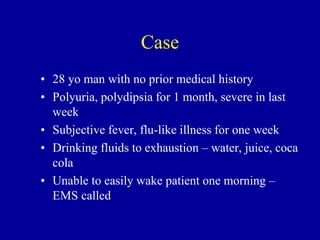
Case
• 28 yo man with no prior medical history
• Polyuria, polydipsia for 1 month, severe in last
week
• Subjective fever, flu-like illness for one week
• Drinking fluids to exhaustion – water, juice, coca
cola
• Unable to easily wake patient one morning –
EMS called
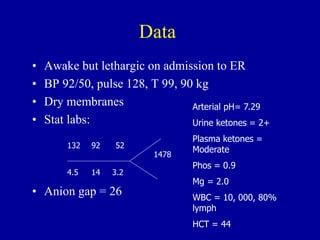
• Awake but lethargic on admission to ER
• BP 92/50, pulse 128, T 99, 90 kg
• Dry membranes
• Stat labs:
• Anion gap = 26
Data
132
4.5 14
1478
92 52
3.2
Arterial pH= 7.29
Urine ketones = 2+
Plasma ketones =
Moderate
Phos = 0.9
Mg = 2.0
WBC = 10, 000, 80%
lymph
HCT = 44
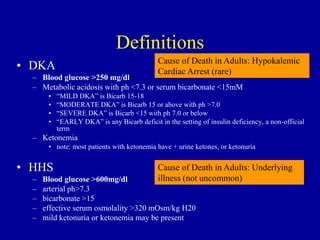
Definitions
• DKA
– Blood glucose >250 mg/dl
– Metabolic acidosis with ph <7.3 or serum bicarbonate <15mM
• “MILD DKA” is Bicarb 15-18
• “MODERATE DKA” is Bicarb 15 or above with ph >7.0
• “SEVERE DKA” is Bicarb <15 with ph 7.0 or below
• “EARLY DKA” is any Bicarb deficit in the setting of insulin deficiency, a non-official
term
– Ketonemia
• note: most patients with ketonemia have + urine ketones, or ketonuria
• HHS
– Blood glucose >600mg/dl
– arterial ph>7.3
– bicarbonate >15
– effective serum osmolality >320 mOsm/kg H20
– mild ketonuria or ketonemia may be present
Cause of Death in Adults: Hypokalemic
Cardiac Arrest (rare)
Cause of Death in Adults: Underlying
illness (not uncommon)
Hyperosmolar Ketoacidosis
• DKA and HHS occur simultaneously
• Worse prognosis
• Implication:
– Much more severe water deficit
– Much more severe insulin deficiency
– Generally more ill overall (underlying illness)
– Requires more aggressive therapies, and hence
increased “iatrogenic” complications
– Identifying this condition is powerful
Hyperosmolality
• Causes progressive depressed mental function as
osmolality rises.
• If serum total osmolality is <340-350 mOsm/kg,
or effective osmolality <320 (doesn’t include
urea), stupor or coma should suggest another
cause
• Correction yields a very predictable improvement
in mental status. If you don’t see this...?LP, toxic
ingestion, etc.
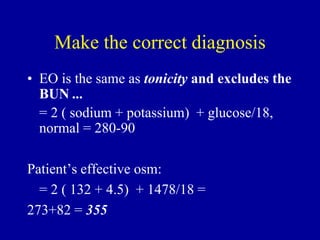
Make the correct diagnosis
• EO is the same as tonicity and excludes the
BUN ...
= 2 ( sodium + potassium) + glucose/18,
normal = 280-90
Patient’s effective osm:
= 2 ( 132 + 4.5) + 1478/18 =
273+82 = 355
Epidemiology
• DKA prevalence is rising
– Since 1996, 50% increase in No. diagnoses in the US
– HHS (when diagnosed properly) is still much less common
• DKA is still the most common cause of death in
children and adolescents with type 1 diabetes
– But death from DKA has declined substantially in last 20-40
years
• Mortality:
– HHS+DKA >> HHS>>>>DKA
• 10-35% >> 5-20% >>>> 1%
• HHS+DKA is often called Hyperosmolar Ketoacidosis (HK)
Epidemiology
• Initial presentation of type 1 diabetes
– Less and less common. Office diagnoses increasing
• Negrato CA. Temporal changes in the diagnosis of type 1
diabetes by diabetic ketoacidosis in Brazil: A nationwide
survery. Diabet Med 2012 Jan.
• Initial presentation of type 2 diabetes
– Overall represents a larger proportion of presentations
given high prevalence of this disease
– More common in patients of Afro-Caribbean ancestry.
• Mauvis-Jarvis F. Ketosis-prone type 2 diabetes in patients of
Sub-Saharan African origin. Diabetes 2004) (Balasubramanyam
A. New profiles of diabetic ketoacidosis. Type 1 vs. type 2
diabetes and the effect of ethnicity. Arch Intern Med 1999
Epidemiology: Why?
• Insulin non-adherence: Most likely reason in all studies
– 68% of patients in a large, urban, inner city US location
• Why does insulin non-adherence happen?
– Financial constraint, feeling unwell, being away from insulin
supply and trying to extend the insulin supply. Over 30% of
patients give no reason for discontinuation. However, factors
such as alcohol and substance abuse, younger age at the time of
diagnosis, depression, longer duration of diabetes and
homelessness contribute substantially to cases of recurrent DKA
• Randall L. Recurrent diabetic ketoacidosis in inner city minority patients:
behavioral, socio-economic, and psychosocial factors. Diabetes Care. 2011)
• DKA may be more common in young immigrants, and of
these, girls are 20% more likely to present compared with
boys.
• Fritsch M, Predictors of diabetic ketoacidosis in children and adolescents with type 1 diabetes.
Experience from a large multicenter database. Pediatr Diabetes 2011 June)
HHS
• Mortality 10-30% depending on institution
• Depends on complications:
– In adults, documented major complications include thrombosis, rhabdomyolysis, renal
failure, and irreversible cardiac arrhythmias
• Younger patients have higher mortality in some studies
• Unique syndrome of hyperthermia, rhabdomyolysis and HHS in Young AA
adults reported, >75% mortality, survivors with evidence of CPM
• Yale report 2007, pts aged 10 to 30 yo
– Out of 629 cases with glucose >600, only 10 met criteria for pure HHS (DKA-HHS
excluded)
– 10% mortality
– Deaths limited those with unreversed shock over the first 24 hours of admission and
who received <40 ml/kg of intravenous fluids over the first 6 hours of treatment.
• Children’s hospital: advocating aggressive volume resuscitation
– http://www.ncbi.nlm.nih.gov/pmc/articles/PMC2842888/
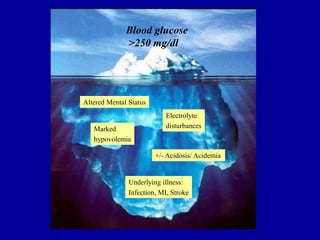
Blood glucose
>250 mg/dl
Underlying illness:
Infection, MI, Stroke
Marked
hypovolemia
Electrolyte
disturbances
+/- Acidosis/ Acidemia
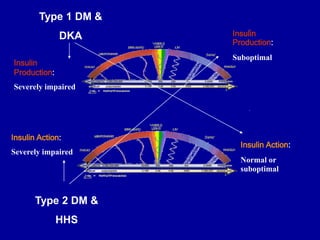
Altered Mental Status
Insulin
Production:
Severely impaired
Insulin Action:
Severely impaired
Insulin Action:
Normal or
suboptimal
Insulin
Production:
Suboptimal
Type 1 DM &
DKA
Type 2 DM &
HHS
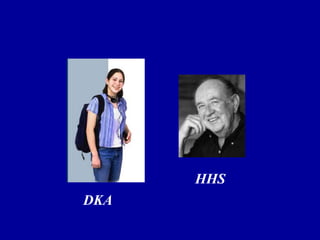
DKA
HHS
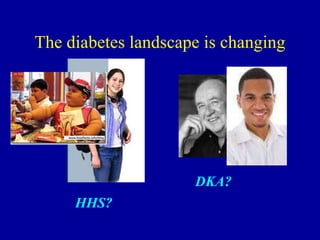
The diabetes landscape is changing
DKA?
HHS?
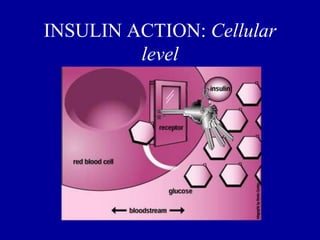
INSULIN ACTION: Cellular
level
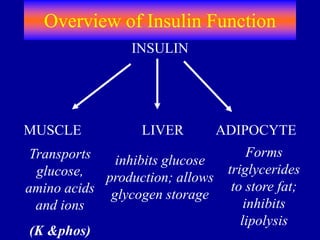
Overview of Insulin Function
Transports
glucose,
amino acids
and ions
(K &phos)
inhibits glucose
production; allows
glycogen storage
Forms
triglycerides
to store fat;
inhibits
lipolysis
INSULIN
MUSCLE LIVER ADIPOCYTE
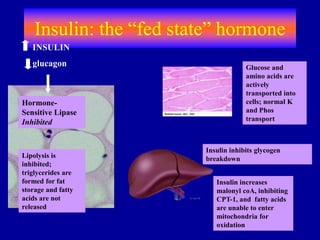
Insulin: the “fed state” hormone
Insulin inhibits glycogen
breakdown
Hormone-
Sensitive Lipase
Inhibited
INSULIN
glucagon
Lipolysis is
inhibited;
triglycerides are
formed for fat
storage and fatty
acids are not
released
Insulin increases
malonyl coA, inhibiting
CPT-1, and fatty acids
are unable to enter
mitochondria for
oxidation
Glucose and
amino acids are
actively
transported into
cells; normal K
and Phos
transport
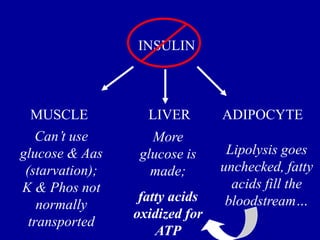
INSULIN
MUSCLE LIVER ADIPOCYTE
Can’t use
glucose & Aas
(starvation);
K & Phos not
normally
transported
Lipolysis goes
unchecked, fatty
acids fill the
bloodstream…
More
glucose is
made;
fatty acids
oxidized for
ATP
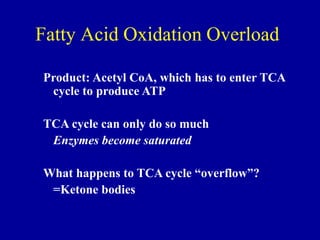
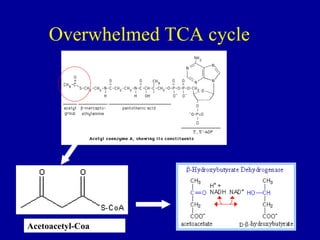
Fatty Acid Oxidation Overload
Product: Acetyl CoA, which has to enter TCA
cycle to produce ATP
TCA cycle can only do so much
Enzymes become saturated
What happens to TCA cycle “overflow”?
=Ketone bodies
Overwhelmed TCA cycle
Acetoacetyl-Coa
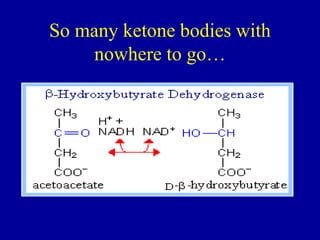
So many ketone bodies with
nowhere to go…
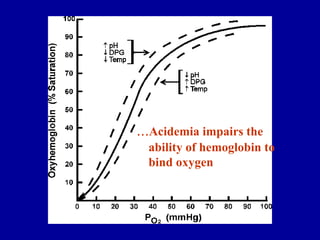
…Acidemia impairs the
ability of hemoglobin to
bind oxygen
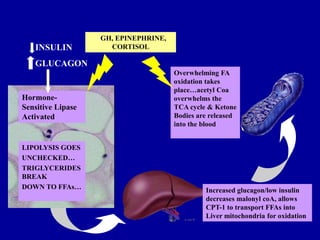
Overwhelming FA
oxidation takes
place…acetyl Coa
overwhelms the
TCA cycle & Ketone
Bodies are released
into the blood
Increased glucagon/low insulin
decreases malonyl coA, allows
CPT-1 to transport FFAs into
Liver mitochondria for oxidation
Hormone-
Sensitive Lipase
Activated
INSULIN
GLUCAGON
LIPOLYSIS GOES
UNCHECKED…
TRIGLYCERIDES
BREAK
DOWN TO FFAs…
GH, EPINEPHRINE,
CORTISOL
How to measure metabolic acidosis?
• Blood pH: measures acidemia
• “Anion Gap”
– Normal extracellular anions =
• Measurable: Cl- and HCO3-
• Unmeasurable: proteins
– Normal measureable extracellular cation =
• Na++
– Electric “balance”
• Anions must =Cations
– Na++ - [Cl- + HCO3-] – (unmeasurable anions) = 0
The
normal
“Gap”
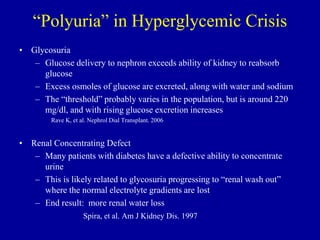
“Polyuria” in Hyperglycemic Crisis
• Glycosuria
– Glucose delivery to nephron exceeds ability of kidney to reabsorb
glucose
– Excess osmoles of glucose are excreted, along with water and sodium
– The “threshold” probably varies in the population, but is around 220
mg/dl, and with rising glucose excretion increases
Rave K, et al. Nephrol Dial Transplant. 2006
• Renal Concentrating Defect
– Many patients with diabetes have a defective ability to concentrate
urine
– This is likely related to glycosuria progressing to “renal wash out”
where the normal electrolyte gradients are lost
– End result: more renal water loss
Spira, et al. Am J Kidney Dis. 1997
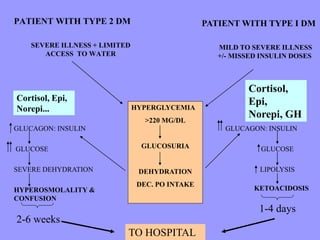
PATIENT WITH TYPE 2 DM
SEVERE ILLNESS + LIMITED
ACCESS TO WATER
HYPERGLYCEMIA
>220 MG/DL
GLUCOSURIA
DEHYDRATION
DEC. PO INTAKE
PATIENT WITH TYPE I DM
MILD TO SEVERE ILLNESS
+/- MISSED INSULIN DOSES
TO HOSPITAL
Cortisol, Epi,
Norepi...
2-6 weeks
GLUCAGON: INSULIN
GLUCOSE
SEVERE DEHYDRATION
HYPEROSMOLALITY &
CONFUSION
GLUCAGON: INSULIN
GLUCOSE
LIPOLYSIS
KETOACIDOSIS
1-4 days
Cortisol,
Epi,
Norepi, GH
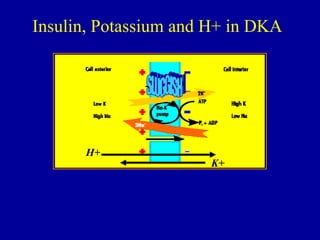
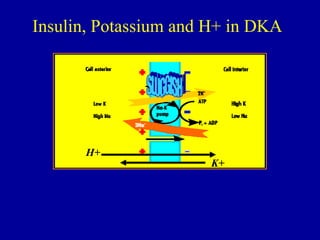
Insulin, Potassium and H+ in DKA
H+
K+
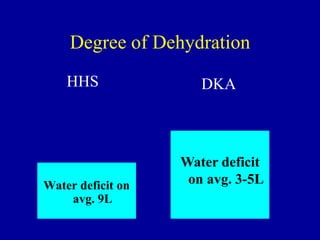
Degree of Dehydration
Water deficit on
avg. 9L
Water deficit
on avg. 3-5L
HHS DKA
Mortality
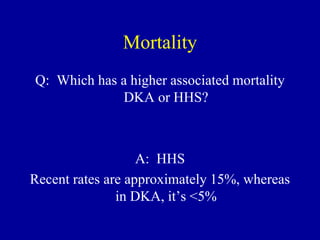
Q: Which has a higher associated mortality
DKA or HHS?
A: HHS
Recent rates are approximately 15%, whereas
in DKA, it’s <5%
Diabetic Ketoacidosis:
extreme insulin deficiency
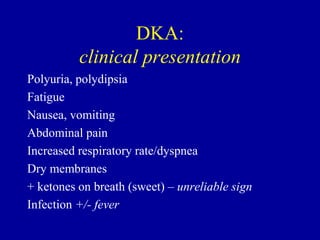
DKA:
clinical presentation
Polyuria, polydipsia
Fatigue
Nausea, vomiting
Abdominal pain
Increased respiratory rate/dyspnea
Dry membranes
+ ketones on breath (sweet) – unreliable sign
Infection +/- fever
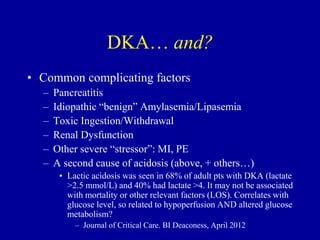
DKA… and?
• Common complicating factors
– Pancreatitis
– Idiopathic “benign” Amylasemia/Lipasemia
– Toxic Ingestion/Withdrawal
– Renal Dysfunction
– Other severe “stressor”: MI, PE
– A second cause of acidosis (above, + others…)
• Lactic acidosis was seen in 68% of adult pts with DKA (lactate
>2.5 mmol/L) and 40% had lactate >4. It may not be associated
with mortality or other relevant factors (LOS). Correlates with
glucose level, so related to hypoperfusion AND altered glucose
metabolism?
– Journal of Critical Care. BI Deaconess, April 2012
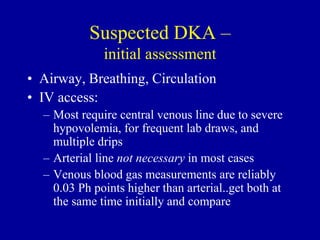
• Airway, Breathing, Circulation
• IV access:
– Most require central venous line due to severe
hypovolemia, for frequent lab draws, and
multiple drips
– Arterial line not necessary in most cases
– Venous blood gas measurements are reliably
0.03 Ph points higher than arterial..get both at
the same time initially and compare
Suspected DKA –
initial assessment
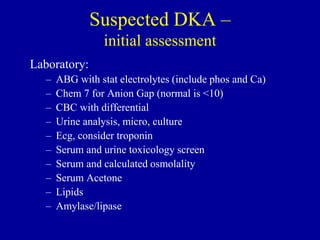
Suspected DKA –
initial assessment
Laboratory:
– ABG with stat electrolytes (include phos and Ca)
– Chem 7 for Anion Gap (normal is <10)
– CBC with differential
– Urine analysis, micro, culture
– Ecg, consider troponin
– Serum and urine toxicology screen
– Serum and calculated osmolality
– Serum Acetone
– Lipids
– Amylase/lipase
DKA:
CLINICAL
MANAGEMENT
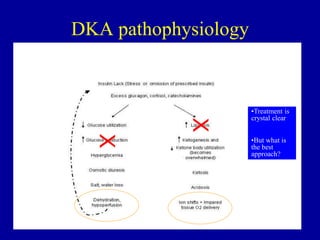
DKA pathophysiology
X
X
•Treatment is
crystal clear
•But what is
the best
approach?
Insulin effect can be slow
• Ketosis causes insulin resistance
– But insulin stops ketosis (so you have to give a LOT at first)
– Need to stop the ketosis before insulin will work well
• You know insulin is working if glucose starts to fall
– Glucose transport is an accurate surrogate marker of insulin
receptor overall function (and the only one we really have)
• When glucose is falling, ketosis is resolving
– At this point, risk of hypoglycemia is high given rapid
improvement in glucose transportation. This likely involves
improved GLUT4 translocation as ketosis resolves
Insulin, Potassium and H+ in DKA
H+
K+
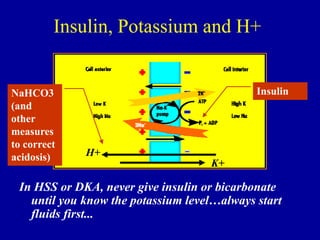
Insulin, Potassium and H+
In HSS or DKA, never give insulin or bicarbonate
until you know the potassium level…always start
fluids first...
H+
K+
NaHCO3
(and
other
measures
to correct
acidosis)
Insulin
Start Fluids First!
Priority 1: Reperfusion
• BP 92/50, pulse 128
• Renal function: 52/3.2
• Urine output: 50cc in 2 hours
• What is the fluid of choice?
0.9% NORMAL SALINE
RATE: WIDE OPEN to start,
reduce as perfusion improves
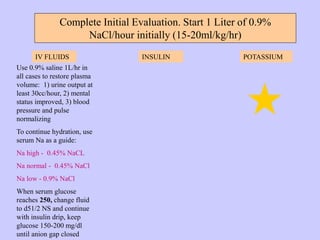
Complete Initial Evaluation. Start 1 Liter of 0.9%
NaCl/hour initially (15-20ml/kg/hr)
IV FLUIDS INSULIN POTASSIUM
Use 0.9% saline 1L/hr in
all cases to restore plasma
volume: 1) urine output at
least 30cc/hour, 2) mental
status improved, 3) blood
pressure and pulse
normalizing
To continue hydration, use
serum Na as a guide:
Na high - 0.45% NaCL
Na normal - 0.45% NaCl
Na low - 0.9% NaCl
When serum glucose
reaches 250, change fluid
to d51/2 NS and continue
with insulin drip, keep
glucose 150-200 mg/dl
until anion gap closed
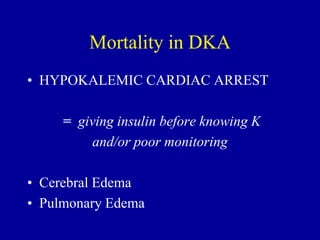
Mortality in DKA
• HYPOKALEMIC CARDIAC ARREST
= giving insulin before knowing K
and/or poor monitoring
• Cerebral Edema
• Pulmonary Edema
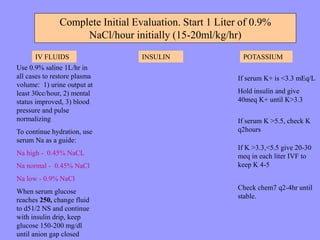
Complete Initial Evaluation. Start 1 Liter of 0.9%
NaCl/hour initially (15-20ml/kg/hr)
IV FLUIDS INSULIN POTASSIUM
Use 0.9% saline 1L/hr in
all cases to restore plasma
volume: 1) urine output at
least 30cc/hour, 2) mental
status improved, 3) blood
pressure and pulse
normalizing
To continue hydration, use
serum Na as a guide:
Na high - 0.45% NaCL
Na normal - 0.45% NaCl
Na low - 0.9% NaCl
When serum glucose
reaches 250, change fluid
to d51/2 NS and continue
with insulin drip, keep
glucose 150-200 mg/dl
until anion gap closed
Check chem7 q2-4hr until
stable.
If K >3.3,<5.5 give 20-30
meq in each liter IVF to
keep K 4-5
If serum K >5.5, check K
q2hours
If serum K+ is <3.3 mEq/L
Hold insulin and give
40meq K+ until K>3.3
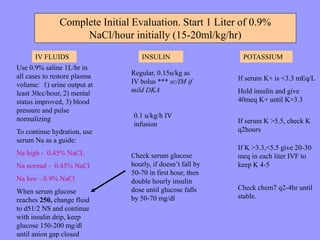
Complete Initial Evaluation. Start 1 Liter of 0.9%
NaCl/hour initially (15-20ml/kg/hr)
IV FLUIDS INSULIN POTASSIUM
Check serum glucose
hourly, if doesn’t fall by
50-70 in first hour, then
double hourly insulin
dose until glucose falls
by 50-70 mg/dl
0.1 u/kg/h IV
infusion
Regular, 0.15u/kg as
IV bolus *** sc/IM if
mild DKA
Check chem7 q2-4hr until
stable.
If K >3.3,<5.5 give 20-30
meq in each liter IVF to
keep K 4-5
If serum K >5.5, check K
q2hours
If serum K+ is <3.3 mEq/L
Hold insulin and give
40meq K+ until K>3.3
Use 0.9% saline 1L/hr in
all cases to restore plasma
volume: 1) urine output at
least 30cc/hour, 2) mental
status improved, 3) blood
pressure and pulse
normalizing
To continue hydration, use
serum Na as a guide:
Na high - 0.45% NaCL
Na normal - 0.45% NaCl
Na low - 0.9% NaCl
When serum glucose
reaches 250, change fluid
to d51/2 NS and continue
with insulin drip, keep
glucose 150-200 mg/dl
until anion gap closed
Add screen shot
Coexisting Illness
• Often serious and “masked”
• Patients with Diabetes have more infections and
more serious infections than the general population
• After you start fluids, the search begins for
underlying disease…
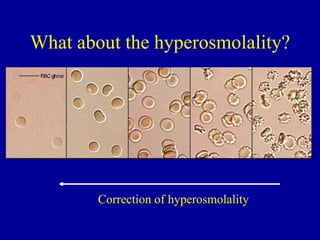
Correction of hyperosmolality
What about the hyperosmolality?
• No RCTs on rate of correction
• Expert opinion: avoid lowering Effective
Osmolality by more than 3 mOsm/kg H2O in
one hour
• Epidemiologic data suggests that cerebral edema
during HHS therapy is RARE
– Most patients are elderly, and have more “space up
there”
– Hypernatremia from dehydration is protective by
stabilizing the effective osmolality while glucose drops
Hyperosmolality
Back to case: Day 2-3
• EO = 292
• Serum C02 is 22
• Ph is 7.4 on VBG
• Anion gap is 8
• 1+ Ketones in urine
• Glucose 150-200 on insulin infusion at 2
units/hour
• Wants to eat
Out of the woods…and the ICUt
• The presence or absence of acetone in the blood or urine
does not indicate how the patient is doing and how
successful your treatment is
• Acetone in the urine can persist for days after acidosis is
resolved, depending on the glomerular filtration rate
(renal function)
The anion gap and serum bicarbonate recovery (often just
partial) are the best ways to decide that the DKA is
resolved
• Avoid stopping an insulin infusion without
overlap, or “transition,” subcutaneous
insulin
• Remember that 1 unit/hour is a still
substantial insulin requirement…
Out of the woods…and the ICU
Transition pitfalls
1. Inadequate overlap of subcutaneous insulin with
IV insulin
2. DKA not yet adequately resolved (bicarb >17
and volume resuscitated)
3. Inadequate dosing of subcutaneous insulin
4. Initial insulin program does not take into
account expected nutritional plan
Prevention
• Outpatient “coaching” with diabetes nurse
educator
• Sick day guidelines – review on a regular basis
• Inpatient diabetes education
• Early outpatient treatment of infections in patients
with Diabetes
• Know about medications that can impair glucose
control
=
Questions?
Never stop the insulin drip without
moderate or long-acting
subcutaneous insulin “on board”
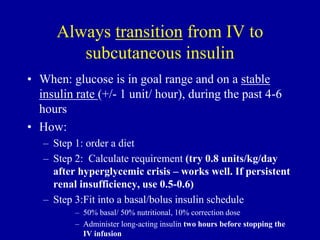
• When: glucose is in goal range and on a stable
insulin rate (+/- 1 unit/ hour), during the past 4-6
hours
• How:
– Step 1: order a diet
– Step 2: Calculate requirement (try 0.8 units/kg/day
after hyperglycemic crisis – works well. If persistent
renal insufficiency, use 0.5-0.6)
– Step 3:Fit into a basal/bolus insulin schedule
– 50% basal/ 50% nutritional, 10% correction dose
– Administer long-acting insulin two hours before stopping the
IV infusion
Always transition from IV to
subcutaneous insulin

Hyperglycemia , insulin, hyperglycemic emergencies

  • 1.
    HYPERGLYCEMIC EMERGENCIES Boston University Schoolof Medicine July, 2013 Marie McDonnell, MD marie.mcdonnell@bmc.org
  • 2.
    Outline • Definitions: DKA, HHS and HK – Why do they require ICU in most cases? (and when don’t they) • Relevant Epidemiology • Simple overview of normal insulin physiology and severe insulin deficiency – What is going on? • Clinical features of acute insulin deficiency • Hyperglycemic crisis: diagnosis and management – Big picture: Treat hypovolemia agressively while avoiding iatrogenic complications of therapy
  • 3.
    Case • 28 yoman with no prior medical history • Polyuria, polydipsia for 1 month, severe in last week • Subjective fever, flu-like illness for one week • Drinking fluids to exhaustion – water, juice, coca cola • Unable to easily wake patient one morning – EMS called
  • 4.
    • Awake butlethargic on admission to ER • BP 92/50, pulse 128, T 99, 90 kg • Dry membranes • Stat labs: • Anion gap = 26 Data 132 4.5 14 1478 92 52 3.2 Arterial pH= 7.29 Urine ketones = 2+ Plasma ketones = Moderate Phos = 0.9 Mg = 2.0 WBC = 10, 000, 80% lymph HCT = 44
  • 5.
    Definitions • DKA – Bloodglucose >250 mg/dl – Metabolic acidosis with ph <7.3 or serum bicarbonate <15mM • “MILD DKA” is Bicarb 15-18 • “MODERATE DKA” is Bicarb 15 or above with ph >7.0 • “SEVERE DKA” is Bicarb <15 with ph 7.0 or below • “EARLY DKA” is any Bicarb deficit in the setting of insulin deficiency, a non-official term – Ketonemia • note: most patients with ketonemia have + urine ketones, or ketonuria • HHS – Blood glucose >600mg/dl – arterial ph>7.3 – bicarbonate >15 – effective serum osmolality >320 mOsm/kg H20 – mild ketonuria or ketonemia may be present Cause of Death in Adults: Hypokalemic Cardiac Arrest (rare) Cause of Death in Adults: Underlying illness (not uncommon)
  • 6.
    Hyperosmolar Ketoacidosis • DKAand HHS occur simultaneously • Worse prognosis • Implication: – Much more severe water deficit – Much more severe insulin deficiency – Generally more ill overall (underlying illness) – Requires more aggressive therapies, and hence increased “iatrogenic” complications – Identifying this condition is powerful
  • 7.
    Hyperosmolality • Causes progressivedepressed mental function as osmolality rises. • If serum total osmolality is <340-350 mOsm/kg, or effective osmolality <320 (doesn’t include urea), stupor or coma should suggest another cause • Correction yields a very predictable improvement in mental status. If you don’t see this...?LP, toxic ingestion, etc.
  • 8.
    Make the correctdiagnosis • EO is the same as tonicity and excludes the BUN ... = 2 ( sodium + potassium) + glucose/18, normal = 280-90 Patient’s effective osm: = 2 ( 132 + 4.5) + 1478/18 = 273+82 = 355
  • 9.
    Epidemiology • DKA prevalenceis rising – Since 1996, 50% increase in No. diagnoses in the US – HHS (when diagnosed properly) is still much less common • DKA is still the most common cause of death in children and adolescents with type 1 diabetes – But death from DKA has declined substantially in last 20-40 years • Mortality: – HHS+DKA >> HHS>>>>DKA • 10-35% >> 5-20% >>>> 1% • HHS+DKA is often called Hyperosmolar Ketoacidosis (HK)
  • 10.
    Epidemiology • Initial presentationof type 1 diabetes – Less and less common. Office diagnoses increasing • Negrato CA. Temporal changes in the diagnosis of type 1 diabetes by diabetic ketoacidosis in Brazil: A nationwide survery. Diabet Med 2012 Jan. • Initial presentation of type 2 diabetes – Overall represents a larger proportion of presentations given high prevalence of this disease – More common in patients of Afro-Caribbean ancestry. • Mauvis-Jarvis F. Ketosis-prone type 2 diabetes in patients of Sub-Saharan African origin. Diabetes 2004) (Balasubramanyam A. New profiles of diabetic ketoacidosis. Type 1 vs. type 2 diabetes and the effect of ethnicity. Arch Intern Med 1999
  • 11.
    Epidemiology: Why? • Insulinnon-adherence: Most likely reason in all studies – 68% of patients in a large, urban, inner city US location • Why does insulin non-adherence happen? – Financial constraint, feeling unwell, being away from insulin supply and trying to extend the insulin supply. Over 30% of patients give no reason for discontinuation. However, factors such as alcohol and substance abuse, younger age at the time of diagnosis, depression, longer duration of diabetes and homelessness contribute substantially to cases of recurrent DKA • Randall L. Recurrent diabetic ketoacidosis in inner city minority patients: behavioral, socio-economic, and psychosocial factors. Diabetes Care. 2011) • DKA may be more common in young immigrants, and of these, girls are 20% more likely to present compared with boys. • Fritsch M, Predictors of diabetic ketoacidosis in children and adolescents with type 1 diabetes. Experience from a large multicenter database. Pediatr Diabetes 2011 June)
  • 12.
    HHS • Mortality 10-30%depending on institution • Depends on complications: – In adults, documented major complications include thrombosis, rhabdomyolysis, renal failure, and irreversible cardiac arrhythmias • Younger patients have higher mortality in some studies • Unique syndrome of hyperthermia, rhabdomyolysis and HHS in Young AA adults reported, >75% mortality, survivors with evidence of CPM • Yale report 2007, pts aged 10 to 30 yo – Out of 629 cases with glucose >600, only 10 met criteria for pure HHS (DKA-HHS excluded) – 10% mortality – Deaths limited those with unreversed shock over the first 24 hours of admission and who received <40 ml/kg of intravenous fluids over the first 6 hours of treatment. • Children’s hospital: advocating aggressive volume resuscitation – http://www.ncbi.nlm.nih.gov/pmc/articles/PMC2842888/
  • 13.
    Blood glucose >250 mg/dl Underlyingillness: Infection, MI, Stroke Marked hypovolemia Electrolyte disturbances +/- Acidosis/ Acidemia Altered Mental Status
  • 14.
    Insulin Production: Severely impaired Insulin Action: Severelyimpaired Insulin Action: Normal or suboptimal Insulin Production: Suboptimal Type 1 DM & DKA Type 2 DM & HHS
  • 15.
  • 16.
    The diabetes landscapeis changing DKA? HHS?
  • 17.
  • 18.
    Overview of InsulinFunction Transports glucose, amino acids and ions (K &phos) inhibits glucose production; allows glycogen storage Forms triglycerides to store fat; inhibits lipolysis INSULIN MUSCLE LIVER ADIPOCYTE
  • 19.
    Insulin: the “fedstate” hormone Insulin inhibits glycogen breakdown Hormone- Sensitive Lipase Inhibited INSULIN glucagon Lipolysis is inhibited; triglycerides are formed for fat storage and fatty acids are not released Insulin increases malonyl coA, inhibiting CPT-1, and fatty acids are unable to enter mitochondria for oxidation Glucose and amino acids are actively transported into cells; normal K and Phos transport
  • 20.
    INSULIN MUSCLE LIVER ADIPOCYTE Can’tuse glucose & Aas (starvation); K & Phos not normally transported Lipolysis goes unchecked, fatty acids fill the bloodstream… More glucose is made; fatty acids oxidized for ATP
  • 21.
    Fatty Acid OxidationOverload Product: Acetyl CoA, which has to enter TCA cycle to produce ATP TCA cycle can only do so much Enzymes become saturated What happens to TCA cycle “overflow”? =Ketone bodies
  • 22.
  • 23.
    So many ketonebodies with nowhere to go…
  • 24.
    …Acidemia impairs the abilityof hemoglobin to bind oxygen
  • 25.
    Overwhelming FA oxidation takes place…acetylCoa overwhelms the TCA cycle & Ketone Bodies are released into the blood Increased glucagon/low insulin decreases malonyl coA, allows CPT-1 to transport FFAs into Liver mitochondria for oxidation Hormone- Sensitive Lipase Activated INSULIN GLUCAGON LIPOLYSIS GOES UNCHECKED… TRIGLYCERIDES BREAK DOWN TO FFAs… GH, EPINEPHRINE, CORTISOL
  • 26.
    How to measuremetabolic acidosis? • Blood pH: measures acidemia • “Anion Gap” – Normal extracellular anions = • Measurable: Cl- and HCO3- • Unmeasurable: proteins – Normal measureable extracellular cation = • Na++ – Electric “balance” • Anions must =Cations – Na++ - [Cl- + HCO3-] – (unmeasurable anions) = 0 The normal “Gap”
  • 27.
    “Polyuria” in HyperglycemicCrisis • Glycosuria – Glucose delivery to nephron exceeds ability of kidney to reabsorb glucose – Excess osmoles of glucose are excreted, along with water and sodium – The “threshold” probably varies in the population, but is around 220 mg/dl, and with rising glucose excretion increases Rave K, et al. Nephrol Dial Transplant. 2006 • Renal Concentrating Defect – Many patients with diabetes have a defective ability to concentrate urine – This is likely related to glycosuria progressing to “renal wash out” where the normal electrolyte gradients are lost – End result: more renal water loss Spira, et al. Am J Kidney Dis. 1997
  • 28.
    PATIENT WITH TYPE2 DM SEVERE ILLNESS + LIMITED ACCESS TO WATER HYPERGLYCEMIA >220 MG/DL GLUCOSURIA DEHYDRATION DEC. PO INTAKE PATIENT WITH TYPE I DM MILD TO SEVERE ILLNESS +/- MISSED INSULIN DOSES TO HOSPITAL Cortisol, Epi, Norepi... 2-6 weeks GLUCAGON: INSULIN GLUCOSE SEVERE DEHYDRATION HYPEROSMOLALITY & CONFUSION GLUCAGON: INSULIN GLUCOSE LIPOLYSIS KETOACIDOSIS 1-4 days Cortisol, Epi, Norepi, GH
  • 29.
    Insulin, Potassium andH+ in DKA H+ K+
  • 30.
    Degree of Dehydration Waterdeficit on avg. 9L Water deficit on avg. 3-5L HHS DKA
  • 31.
    Mortality Q: Which hasa higher associated mortality DKA or HHS? A: HHS Recent rates are approximately 15%, whereas in DKA, it’s <5%
  • 32.
  • 33.
    DKA: clinical presentation Polyuria, polydipsia Fatigue Nausea,vomiting Abdominal pain Increased respiratory rate/dyspnea Dry membranes + ketones on breath (sweet) – unreliable sign Infection +/- fever
  • 34.
    DKA… and? • Commoncomplicating factors – Pancreatitis – Idiopathic “benign” Amylasemia/Lipasemia – Toxic Ingestion/Withdrawal – Renal Dysfunction – Other severe “stressor”: MI, PE – A second cause of acidosis (above, + others…) • Lactic acidosis was seen in 68% of adult pts with DKA (lactate >2.5 mmol/L) and 40% had lactate >4. It may not be associated with mortality or other relevant factors (LOS). Correlates with glucose level, so related to hypoperfusion AND altered glucose metabolism? – Journal of Critical Care. BI Deaconess, April 2012
  • 35.
    • Airway, Breathing,Circulation • IV access: – Most require central venous line due to severe hypovolemia, for frequent lab draws, and multiple drips – Arterial line not necessary in most cases – Venous blood gas measurements are reliably 0.03 Ph points higher than arterial..get both at the same time initially and compare Suspected DKA – initial assessment
  • 36.
    Suspected DKA – initialassessment Laboratory: – ABG with stat electrolytes (include phos and Ca) – Chem 7 for Anion Gap (normal is <10) – CBC with differential – Urine analysis, micro, culture – Ecg, consider troponin – Serum and urine toxicology screen – Serum and calculated osmolality – Serum Acetone – Lipids – Amylase/lipase
  • 37.
  • 38.
    DKA pathophysiology X X •Treatment is crystalclear •But what is the best approach?
  • 39.
    Insulin effect canbe slow • Ketosis causes insulin resistance – But insulin stops ketosis (so you have to give a LOT at first) – Need to stop the ketosis before insulin will work well • You know insulin is working if glucose starts to fall – Glucose transport is an accurate surrogate marker of insulin receptor overall function (and the only one we really have) • When glucose is falling, ketosis is resolving – At this point, risk of hypoglycemia is high given rapid improvement in glucose transportation. This likely involves improved GLUT4 translocation as ketosis resolves
  • 40.
    Insulin, Potassium andH+ in DKA H+ K+
  • 41.
    Insulin, Potassium andH+ In HSS or DKA, never give insulin or bicarbonate until you know the potassium level…always start fluids first... H+ K+ NaHCO3 (and other measures to correct acidosis) Insulin
  • 42.
  • 43.
    Priority 1: Reperfusion •BP 92/50, pulse 128 • Renal function: 52/3.2 • Urine output: 50cc in 2 hours • What is the fluid of choice? 0.9% NORMAL SALINE RATE: WIDE OPEN to start, reduce as perfusion improves
  • 44.
    Complete Initial Evaluation.Start 1 Liter of 0.9% NaCl/hour initially (15-20ml/kg/hr) IV FLUIDS INSULIN POTASSIUM Use 0.9% saline 1L/hr in all cases to restore plasma volume: 1) urine output at least 30cc/hour, 2) mental status improved, 3) blood pressure and pulse normalizing To continue hydration, use serum Na as a guide: Na high - 0.45% NaCL Na normal - 0.45% NaCl Na low - 0.9% NaCl When serum glucose reaches 250, change fluid to d51/2 NS and continue with insulin drip, keep glucose 150-200 mg/dl until anion gap closed
  • 45.
    Mortality in DKA •HYPOKALEMIC CARDIAC ARREST = giving insulin before knowing K and/or poor monitoring • Cerebral Edema • Pulmonary Edema
  • 46.
    Complete Initial Evaluation.Start 1 Liter of 0.9% NaCl/hour initially (15-20ml/kg/hr) IV FLUIDS INSULIN POTASSIUM Use 0.9% saline 1L/hr in all cases to restore plasma volume: 1) urine output at least 30cc/hour, 2) mental status improved, 3) blood pressure and pulse normalizing To continue hydration, use serum Na as a guide: Na high - 0.45% NaCL Na normal - 0.45% NaCl Na low - 0.9% NaCl When serum glucose reaches 250, change fluid to d51/2 NS and continue with insulin drip, keep glucose 150-200 mg/dl until anion gap closed Check chem7 q2-4hr until stable. If K >3.3,<5.5 give 20-30 meq in each liter IVF to keep K 4-5 If serum K >5.5, check K q2hours If serum K+ is <3.3 mEq/L Hold insulin and give 40meq K+ until K>3.3
  • 47.
    Complete Initial Evaluation.Start 1 Liter of 0.9% NaCl/hour initially (15-20ml/kg/hr) IV FLUIDS INSULIN POTASSIUM Check serum glucose hourly, if doesn’t fall by 50-70 in first hour, then double hourly insulin dose until glucose falls by 50-70 mg/dl 0.1 u/kg/h IV infusion Regular, 0.15u/kg as IV bolus *** sc/IM if mild DKA Check chem7 q2-4hr until stable. If K >3.3,<5.5 give 20-30 meq in each liter IVF to keep K 4-5 If serum K >5.5, check K q2hours If serum K+ is <3.3 mEq/L Hold insulin and give 40meq K+ until K>3.3 Use 0.9% saline 1L/hr in all cases to restore plasma volume: 1) urine output at least 30cc/hour, 2) mental status improved, 3) blood pressure and pulse normalizing To continue hydration, use serum Na as a guide: Na high - 0.45% NaCL Na normal - 0.45% NaCl Na low - 0.9% NaCl When serum glucose reaches 250, change fluid to d51/2 NS and continue with insulin drip, keep glucose 150-200 mg/dl until anion gap closed
  • 48.
  • 50.
    Coexisting Illness • Oftenserious and “masked” • Patients with Diabetes have more infections and more serious infections than the general population • After you start fluids, the search begins for underlying disease…
  • 51.
    Correction of hyperosmolality Whatabout the hyperosmolality?
  • 52.
    • No RCTson rate of correction • Expert opinion: avoid lowering Effective Osmolality by more than 3 mOsm/kg H2O in one hour • Epidemiologic data suggests that cerebral edema during HHS therapy is RARE – Most patients are elderly, and have more “space up there” – Hypernatremia from dehydration is protective by stabilizing the effective osmolality while glucose drops Hyperosmolality
  • 53.
    Back to case:Day 2-3 • EO = 292 • Serum C02 is 22 • Ph is 7.4 on VBG • Anion gap is 8 • 1+ Ketones in urine • Glucose 150-200 on insulin infusion at 2 units/hour • Wants to eat
  • 54.
    Out of thewoods…and the ICUt • The presence or absence of acetone in the blood or urine does not indicate how the patient is doing and how successful your treatment is • Acetone in the urine can persist for days after acidosis is resolved, depending on the glomerular filtration rate (renal function) The anion gap and serum bicarbonate recovery (often just partial) are the best ways to decide that the DKA is resolved
  • 55.
    • Avoid stoppingan insulin infusion without overlap, or “transition,” subcutaneous insulin • Remember that 1 unit/hour is a still substantial insulin requirement… Out of the woods…and the ICU
  • 56.
    Transition pitfalls 1. Inadequateoverlap of subcutaneous insulin with IV insulin 2. DKA not yet adequately resolved (bicarb >17 and volume resuscitated) 3. Inadequate dosing of subcutaneous insulin 4. Initial insulin program does not take into account expected nutritional plan
  • 57.
    Prevention • Outpatient “coaching”with diabetes nurse educator • Sick day guidelines – review on a regular basis • Inpatient diabetes education • Early outpatient treatment of infections in patients with Diabetes • Know about medications that can impair glucose control
  • 58.
  • 59.
  • 61.
    Never stop theinsulin drip without moderate or long-acting subcutaneous insulin “on board”
  • 62.
    • When: glucoseis in goal range and on a stable insulin rate (+/- 1 unit/ hour), during the past 4-6 hours • How: – Step 1: order a diet – Step 2: Calculate requirement (try 0.8 units/kg/day after hyperglycemic crisis – works well. If persistent renal insufficiency, use 0.5-0.6) – Step 3:Fit into a basal/bolus insulin schedule – 50% basal/ 50% nutritional, 10% correction dose – Administer long-acting insulin two hours before stopping the IV infusion Always transition from IV to subcutaneous insulin