6/22/2020 1
Hyper-conjugation
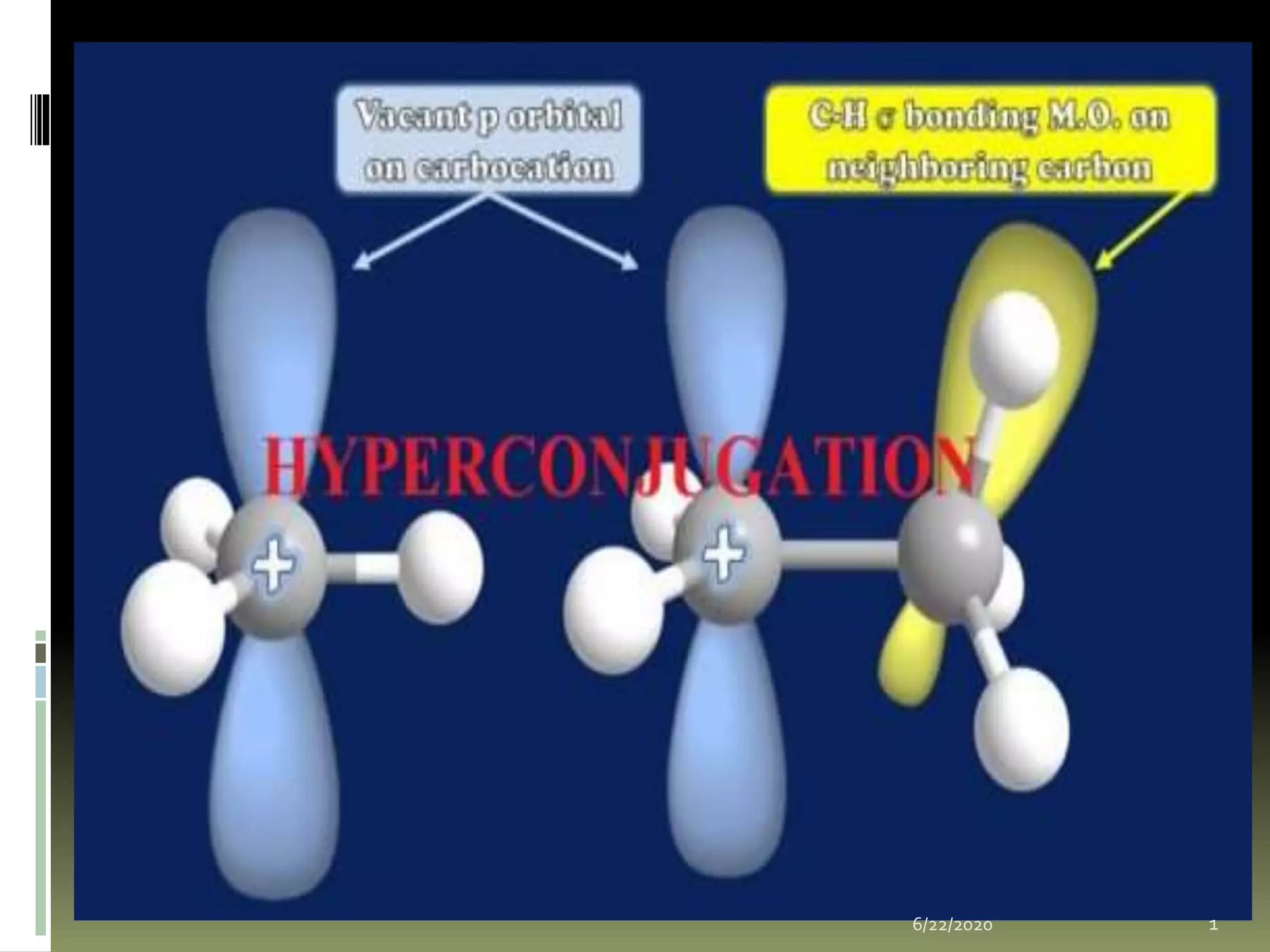
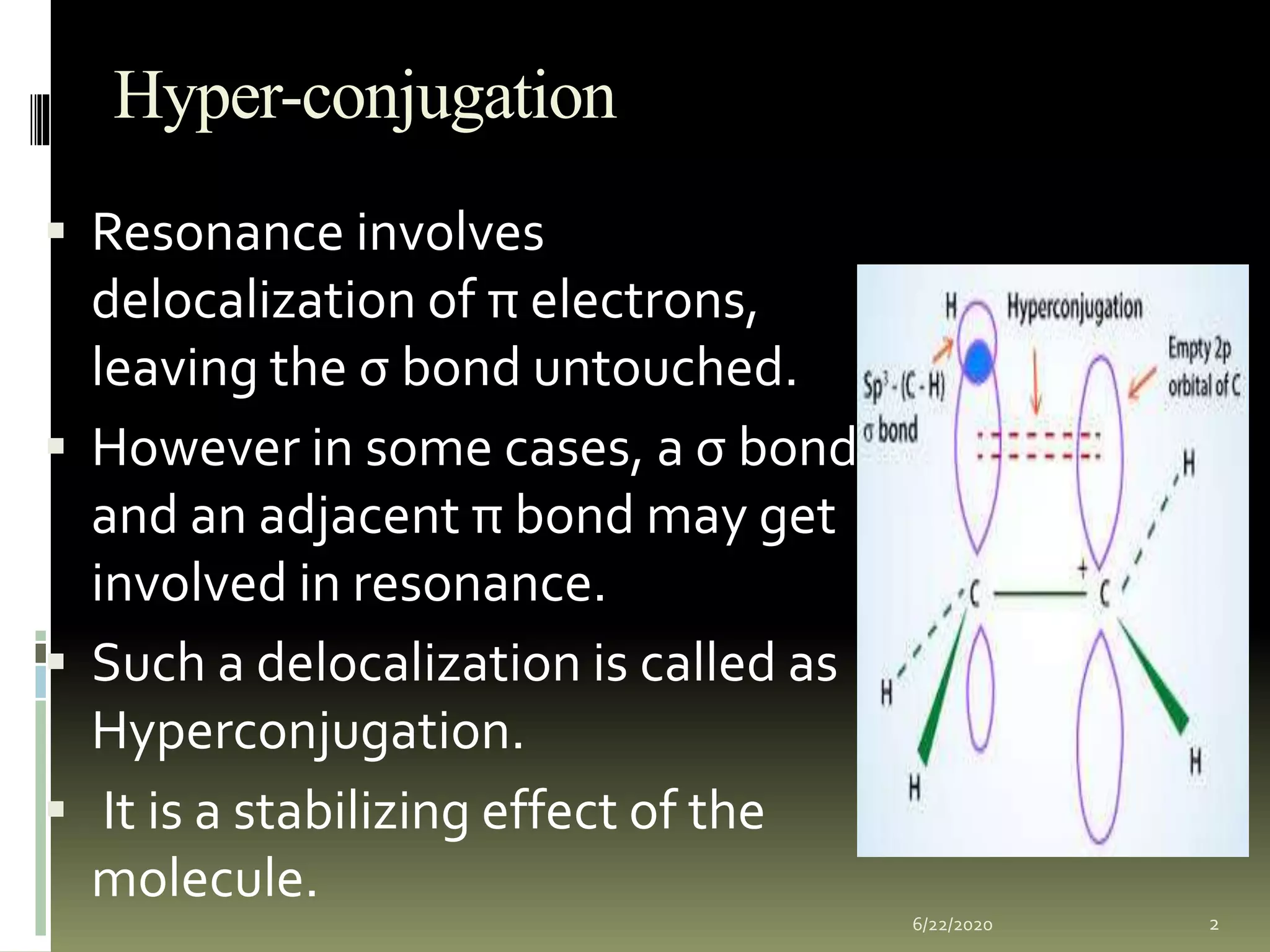
 Resonance involves
delocalization of π electrons,
leaving the σ bond untouched.
 However in some cases, a σ bond
and an adjacent π bond may get
involved in resonance.
 Such a delocalization is called as
Hyperconjugation.
 It is a stabilizing effect of the
molecule.
6/22/2020 2
Hyper-conjugation
 Hyperconjugation occur in
following types of molecules such
as;
Carbocations
 free radical
 alkenes and
 alkynes.
6/22/2020 3
Hyperconjugation in
carbocations:
 Hyperconjugation occur in carbocation for
example in butyl carbocation.
 Butyl carbocation has 9 alpha hydrogen and
hence 9 Hyperconjugation structures can be
written.
6/22/2020 4
Hyperconjugation in free radicals:
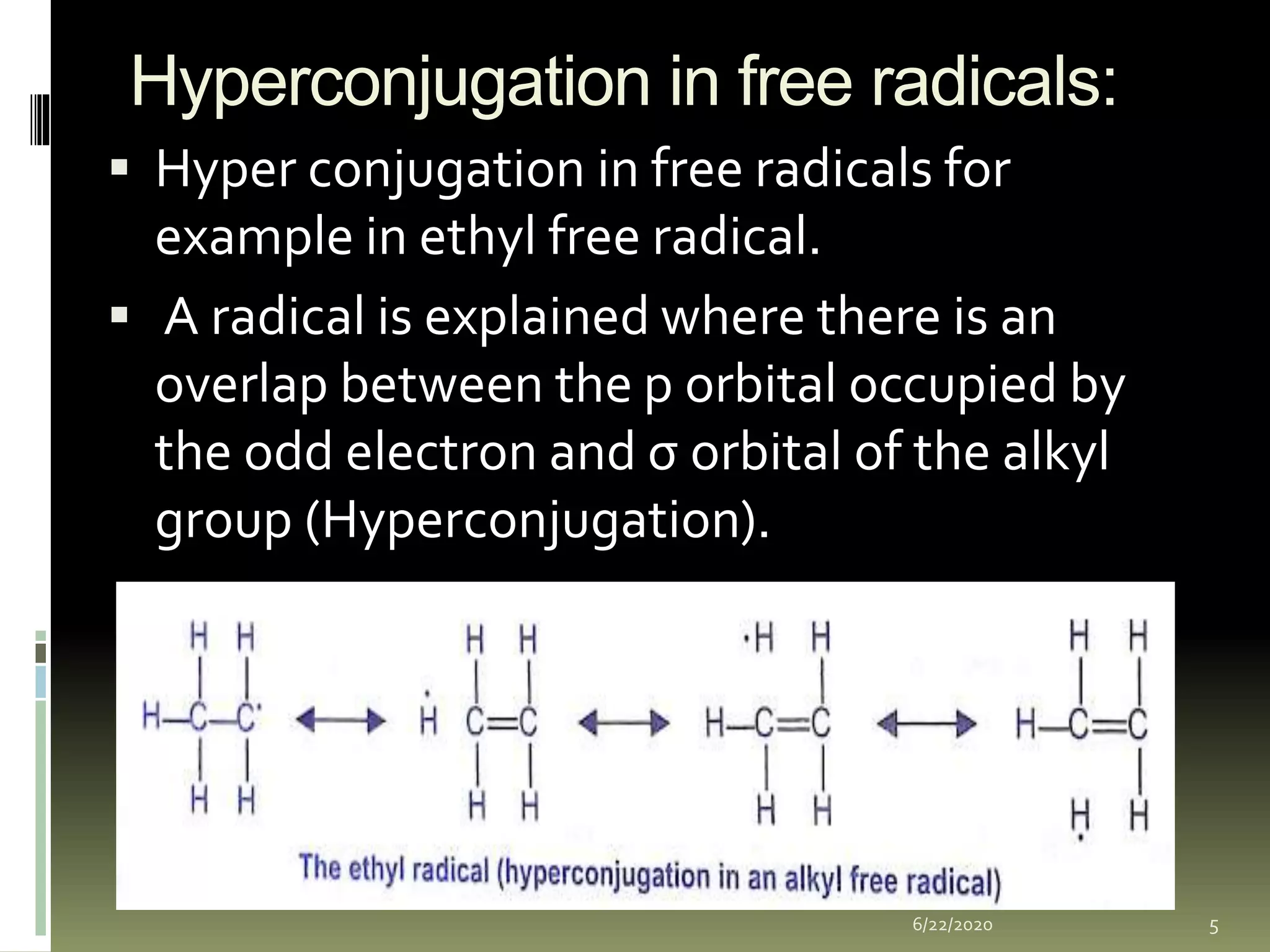
 Hyper conjugation in free radicals for
example in ethyl free radical.
 A radical is explained where there is an
overlap between the p orbital occupied by
the odd electron and σ orbital of the alkyl
group (Hyperconjugation).
6/22/2020 5
Hyperconjugation in alkenes:
 Hyperconjugation in alkenes for example in
propene.
 Hyper conjugation arise due to partial overlap
of sp3 sigma bond orbital and the empty p-
orbital of an adjacent carbon atom. Here one
of the carbon-hydrogen bonds of methyl
group can lie in the plane of pi-bond orbital,
hence partial overlap with pi-bond orbital.
6/22/2020 6
Hyperconjugation in alkynes:
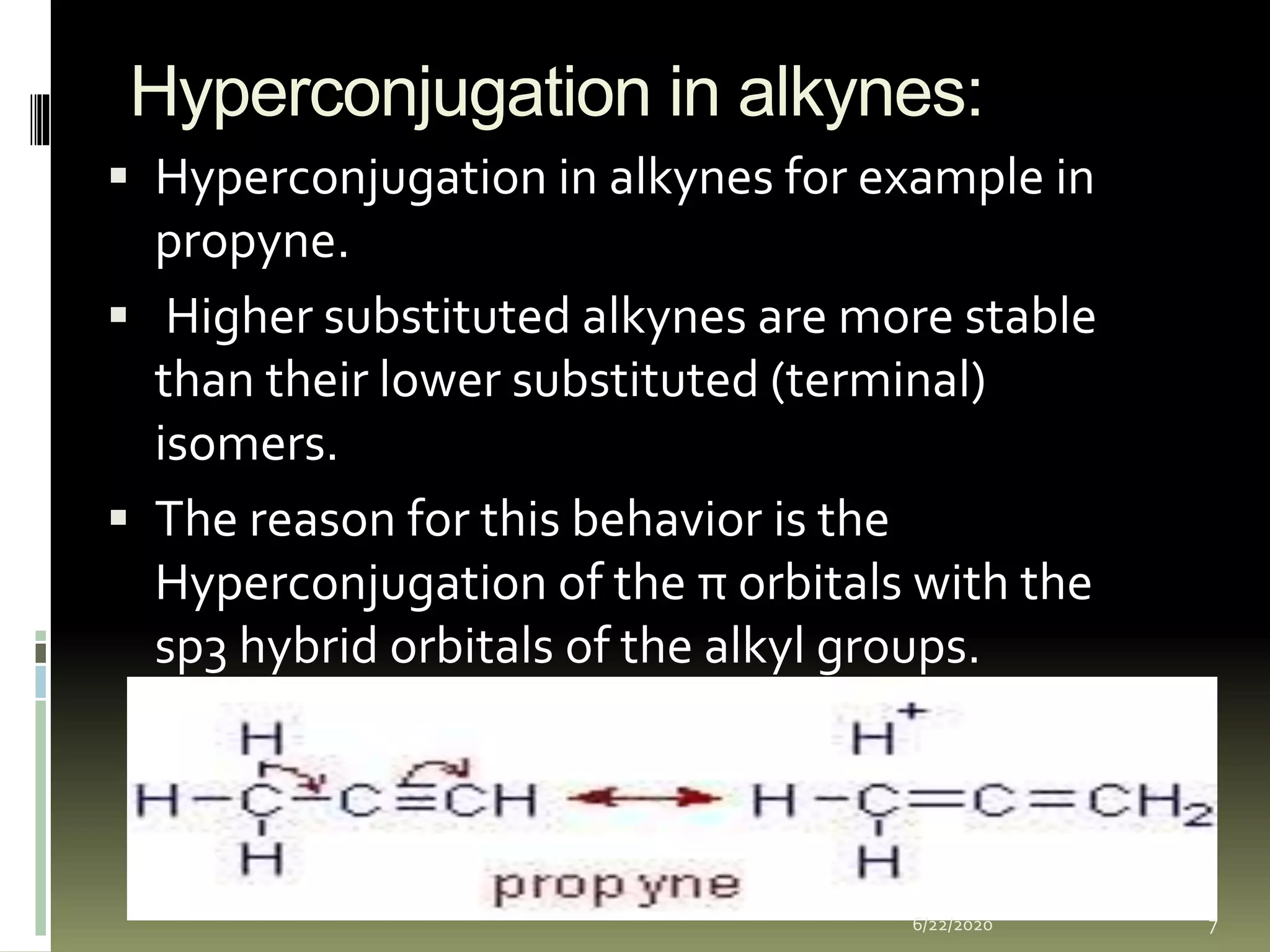
 Hyperconjugation in alkynes for example in
propyne.
 Higher substituted alkynes are more stable
than their lower substituted (terminal)
isomers.
 The reason for this behavior is the
Hyperconjugation of the π orbitals with the
sp3 hybrid orbitals of the alkyl groups.
6/22/2020 7
6/22/2020 8

Hyperconjugation by konain z.m.

  • 1.
  • 2.
    Hyper-conjugation  Resonance involves delocalizationof π electrons, leaving the σ bond untouched.  However in some cases, a σ bond and an adjacent π bond may get involved in resonance.  Such a delocalization is called as Hyperconjugation.  It is a stabilizing effect of the molecule. 6/22/2020 2
  • 3.
    Hyper-conjugation  Hyperconjugation occurin following types of molecules such as; Carbocations  free radical  alkenes and  alkynes. 6/22/2020 3
  • 4.
    Hyperconjugation in carbocations:  Hyperconjugationoccur in carbocation for example in butyl carbocation.  Butyl carbocation has 9 alpha hydrogen and hence 9 Hyperconjugation structures can be written. 6/22/2020 4
  • 5.
    Hyperconjugation in freeradicals:  Hyper conjugation in free radicals for example in ethyl free radical.  A radical is explained where there is an overlap between the p orbital occupied by the odd electron and σ orbital of the alkyl group (Hyperconjugation). 6/22/2020 5
  • 6.
    Hyperconjugation in alkenes: Hyperconjugation in alkenes for example in propene.  Hyper conjugation arise due to partial overlap of sp3 sigma bond orbital and the empty p- orbital of an adjacent carbon atom. Here one of the carbon-hydrogen bonds of methyl group can lie in the plane of pi-bond orbital, hence partial overlap with pi-bond orbital. 6/22/2020 6
  • 7.
    Hyperconjugation in alkynes: Hyperconjugation in alkynes for example in propyne.  Higher substituted alkynes are more stable than their lower substituted (terminal) isomers.  The reason for this behavior is the Hyperconjugation of the π orbitals with the sp3 hybrid orbitals of the alkyl groups. 6/22/2020 7
  • 8.