Factors That Influence Reaction Mechanism
Lecture 4
Partial Ionic Character of Covalent Bond
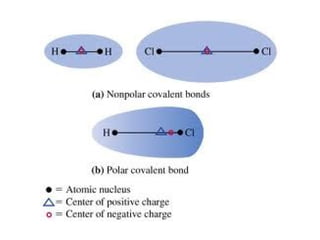
• In a covalent bond, the electron cloud is not static.
• When the atoms involved in the bonding are the same,
the electron cloud in between them is said to be
symmetrically disposed to the two atoms involved in
the bonding e.g. H-H.
• Such bonds are called non-polar covalent bond.
• In the case of covalent bonds formed by atoms
that are not similar, e.g. H-Cl
• Where each of the atoms in bonding have
different electronegativity, the electron cloud is
not symmetrically disposed.
• In H-Cl, the chlorine is more electronegative than
hydrogen and so the electron cloud is displaced
towards chlorine atom than towards hydrogen
atom.
Partial Ionic Character of Covalent Bond
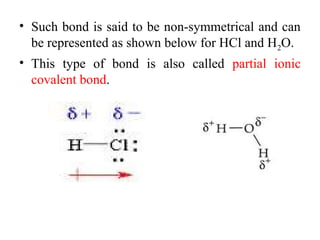
• Such bond is said to be non-symmetrical and can
be represented as shown below for HCl and H2O.
• This type of bond is also called partial ionic
covalent bond.
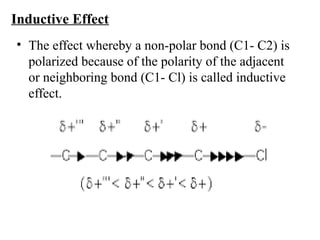
Inductive Effect
• The effect whereby a non-polar bond (C1- C2) is
polarized because of the polarity of the adjacent
or neighboring bond (C1- Cl) is called inductive
effect.
Characteristics of Inductive Effects
I. Inductive effects are permanent effect in the
ground state of a molecule and are therefore
manifested in its physical properties like, its
dipole moment.
II. It occurs only through sigma (single) bonds
Types of Inductive Effects
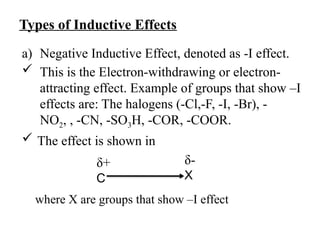
a) Negative Inductive Effect, denoted as -I effect.
 This is the Electron-withdrawing or electron-
attracting effect. Example of groups that show –I
effects are: The halogens (-Cl,-F, -I, -Br), -
NO2, , -CN, -SO3H, -COR, -COOR.
 The effect is shown in
C X
δ-
δ+
where X are groups that show –I effect
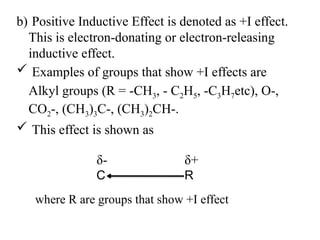
b) Positive Inductive Effect is denoted as +I effect.
This is electron-donating or electron-releasing
inductive effect.
 Examples of groups that show +I effects are
Alkyl groups (R = -CH3, - C2H5, -C3H7etc), O-,
CO2-, (CH3)3C-, (CH3)2CH-.
 This effect is shown as
C R
δ+
δ-
where R are groups that show +I effect
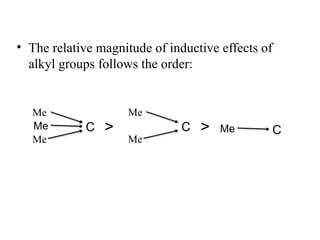
• The relative magnitude of inductive effects of
alkyl groups follows the order:
C
Me
Me
Me
C
Me
Me
C
Me
> >
Electromeric Effect
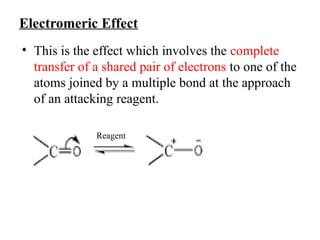
• This is the effect which involves the complete
transfer of a shared pair of electrons to one of the
atoms joined by a multiple bond at the approach
of an attacking reagent.
Reagent
Characteristics of Electromeric Effect
I. It is a temporary effect and the electronic
condition in the molecule is restored as soon as
the attacking reagent is removed
II. It only occurs in multiple bonds and never in
single (sigma) bond.
Resonance or Mesomeric (Conjugative) Effect
This is the simultaneous decrease in electron
density at one position and a corresponding
increase in electron density elsewhere in a
molecule.
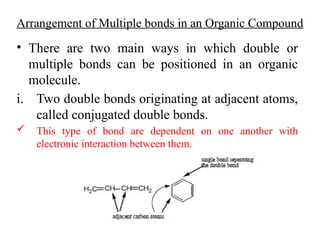
Arrangement of Multiple bonds in an Organic Compound
• There are two main ways in which double or
multiple bonds can be positioned in an organic
molecule.
i. Two double bonds originating at adjacent atoms,
called conjugated double bonds.
 This type of bond are dependent on one another with
electronic interaction between them.
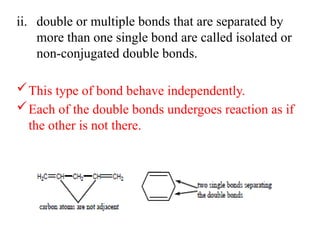
ii. double or multiple bonds that are separated by
more than one single bond are called isolated or
non-conjugated double bonds.
This type of bond behave independently.
Each of the double bonds undergoes reaction as if
the other is not there.
Resonance
• This is the ability of pi electrons in a
conjugated system to move in between atoms
in a molecule.
• Resonance results in:
 oscillation of e-
between atoms within an ion
or molecule.
 no definite description of the valence bond
Electron Shift in Resonance
When writing resonance structures,
• Curved arrows that allow us to progress
systematically from one resonance symbol to another
are used to show shifting of e-
.
• Relative position of the nuclei of the atoms are
maintained i.e. atoms do not change position.
• Only electrons are delocalized or shifted.
• Only pi-electrons or unshared valence electrons can
be shifted.
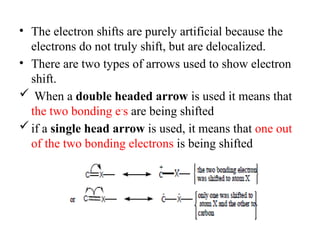
• The electron shifts are purely artificial because the
electrons do not truly shift, but are delocalized.
• There are two types of arrows used to show electron
shift.
 When a double headed arrow is used it means that
the two bonding e-
s are being shifted
if a single head arrow is used, it means that one out
of the two bonding electrons is being shifted
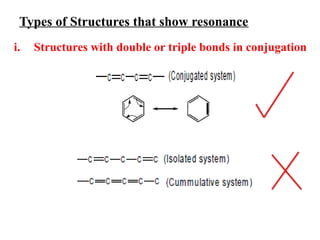
Types of Structures that show resonance
i. Structures with double or triple bonds in conjugation
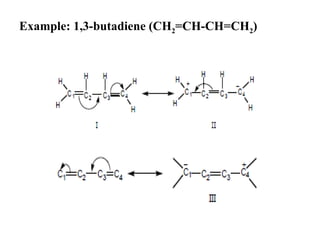
Example: 1,3-butadiene (CH2=CH-CH=CH2)
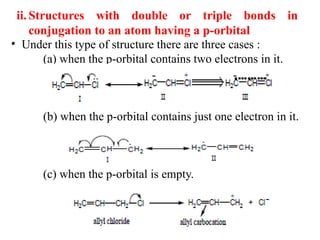
ii. Structures with double or triple bonds in
conjugation to an atom having a p-orbital
• Under this type of structure there are three cases :
(a) when the p-orbital contains two electrons in it.
(b) when the p-orbital contains just one electron in it.
(c) when the p-orbital is empty.
iii. Hyperconjugation
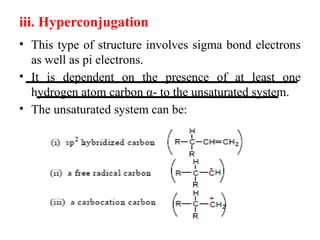
• This type of structure involves sigma bond electrons
as well as pi electrons.
• It is dependent on the presence of at least one
hydrogen atom carbon α- to the unsaturated system.
• The unsaturated system can be:
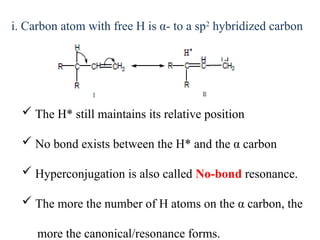
 The H* still maintains its relative position
 No bond exists between the H* and the α carbon
 Hyperconjugation is also called No-bond resonance.
 The more the number of H atoms on the α carbon, the
more the canonical/resonance forms.
i. Carbon atom with free H is α- to a sp2
hybridized carbon
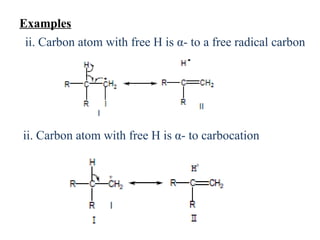
Examples
ii. Carbon atom with free H is α- to a free radical carbon
ii. Carbon atom with free H is α- to carbocation
Rules Governing Resonance
1.
The relative positions of the nuclei must be
maintained in all the resonance structures. Only
electrons (not atoms) may be shifted and the electron
will only be shifted to adjacent atoms or adjacent
bond positions.
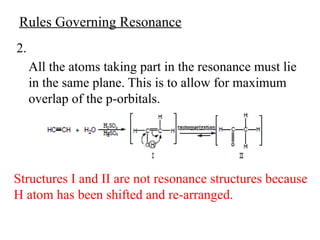
2.
All the atoms taking part in the resonance must lie
in the same plane. This is to allow for maximum
overlap of the p-orbitals.
Rules Governing Resonance
Structures I and II are not resonance structures because
H atom has been shifted and re-arranged.
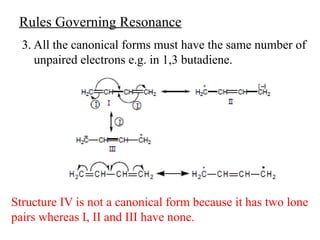
3. All the canonical forms must have the same number of
unpaired electrons e.g. in 1,3 butadiene.
Rules Governing Resonance
Structure IV is not a canonical form because it has two lone
pairs whereas I, II and III have none.
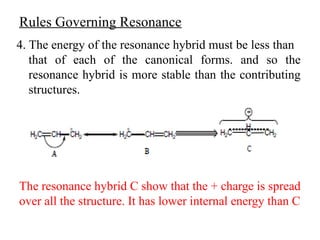
4. The energy of the resonance hybrid must be less than
that of each of the canonical forms. and so the
resonance hybrid is more stable than the contributing
structures.
Rules Governing Resonance
The resonance hybrid C show that the + charge is spread
over all the structure. It has lower internal energy than C
5. All canonical forms may not contribute equally to the
hybrid. Resonance is important only when the
contributing structures have about the same internal
energy i.e. when each of the canonical form has about
the same stability.
Rules Governing Resonance
How to Identify the More Stable Canonical Form
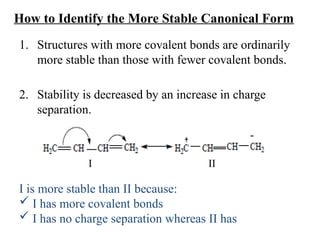
1. Structures with more covalent bonds are ordinarily
more stable than those with fewer covalent bonds.
2. Stability is decreased by an increase in charge
separation.
I II
I is more stable than II because:
 I has more covalent bonds
 I has no charge separation whereas II has
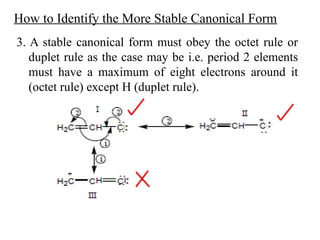
3. A stable canonical form must obey the octet rule or
duplet rule as the case may be i.e. period 2 elements
must have a maximum of eight electrons around it
(octet rule) except H (duplet rule).
How to Identify the More Stable Canonical Form
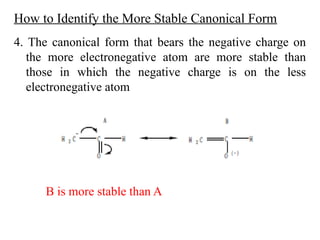
4. The canonical form that bears the negative charge on
the more electronegative atom are more stable than
those in which the negative charge is on the less
electronegative atom
How to Identify the More Stable Canonical Form
B is more stable than A
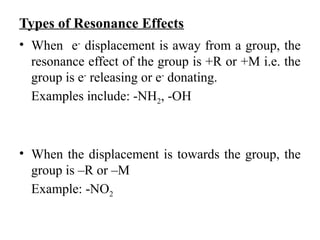
Types of Resonance Effects
• When e-
displacement is away from a group, the
resonance effect of the group is +R or +M i.e. the
group is e-
releasing or e-
donating.
Examples include: -NH2, -OH
• When the displacement is towards the group, the
group is –R or –M
Example: -NO2
Application of Resonance Effects
 It is used to determine and explain the relative
stability of reactive intermediates.
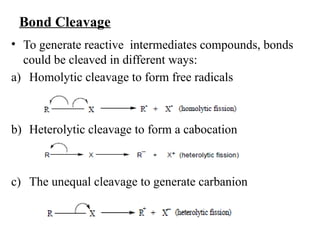
Bond Cleavage
• To generate reactive intermediates compounds, bonds
could be cleaved in different ways:
a) Homolytic cleavage to form free radicals
b) Heterolytic cleavage to form a cabocation
c) The unequal cleavage to generate carbanion
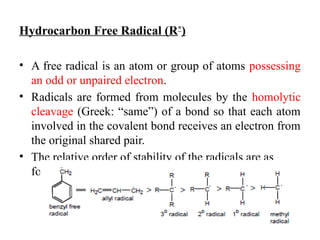
Hydrocarbon Free Radical (R*
)
• A free radical is an atom or group of atoms possessing
an odd or unpaired electron.
• Radicals are formed from molecules by the homolytic
cleavage (Greek: “same”) of a bond so that each atom
involved in the covalent bond receives an electron from
the original shared pair.
• The relative order of stability of the radicals are as
follows:
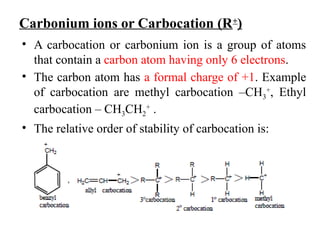
Carbonium ions or Carbocation (R+
)
• A carbocation or carbonium ion is a group of atoms
that contain a carbon atom having only 6 electrons.
• The carbon atom has a formal charge of +1. Example
of carbocation are methyl carbocation –CH3
+
, Ethyl
carbocation – CH3CH2
+
.
• The relative order of stability of carbocation is:
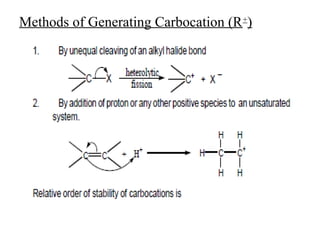
Methods of Generating Carbocation (R+
)
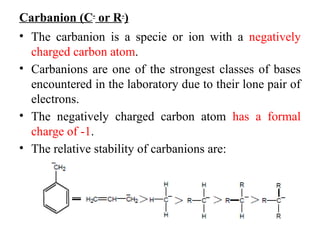
Carbanion (C-
or R-
)
• The carbanion is a specie or ion with a negatively
charged carbon atom.
• Carbanions are one of the strongest classes of bases
encountered in the laboratory due to their lone pair of
electrons.
• The negatively charged carbon atom has a formal
charge of -1.
• The relative stability of carbanions are:
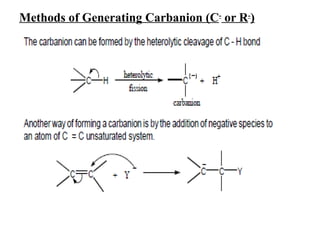
Methods of Generating Carbanion (C-
or R-
)
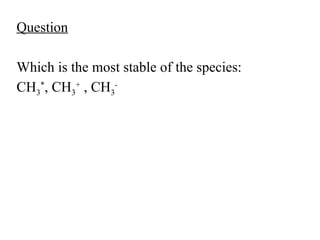
Question
Which is the most stable of the species:
CH3
*
, CH3
+
, CH3
-
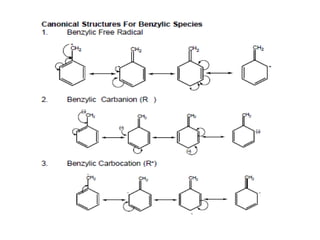
Benzylic and Allylic Species
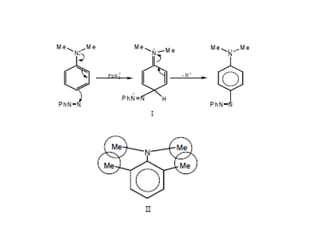
Steric Effect
• The availability of electrons may be modified or even
nullified by the influence of steric factors.
• Effective delocalization via p-orbitals can only take place
if the pi or p-orbitals, on the atoms involved in the
delocalization, can become parallel or fairly nearly so.
• If this is prevented significant overlapping cannot take
place and delocalization may be inhibited.
• This hinderance, mostly due to the presence of bulky
group is known as stearic effect or hinderance.
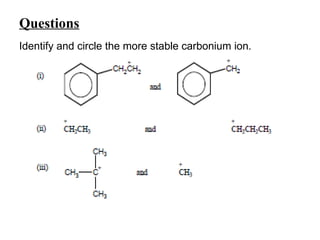
Questions
Identify and circle the more stable carbonium ion.
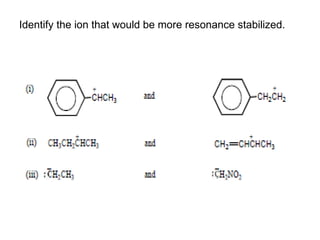
Identify the ion that would be more resonance stabilized.

CHM 203 Lecture 4.pptx presentation for chem undergrad

  • 1.
    Factors That InfluenceReaction Mechanism Lecture 4
  • 2.
    Partial Ionic Characterof Covalent Bond • In a covalent bond, the electron cloud is not static. • When the atoms involved in the bonding are the same, the electron cloud in between them is said to be symmetrically disposed to the two atoms involved in the bonding e.g. H-H. • Such bonds are called non-polar covalent bond.
  • 4.
    • In thecase of covalent bonds formed by atoms that are not similar, e.g. H-Cl • Where each of the atoms in bonding have different electronegativity, the electron cloud is not symmetrically disposed. • In H-Cl, the chlorine is more electronegative than hydrogen and so the electron cloud is displaced towards chlorine atom than towards hydrogen atom. Partial Ionic Character of Covalent Bond
  • 5.
    • Such bondis said to be non-symmetrical and can be represented as shown below for HCl and H2O. • This type of bond is also called partial ionic covalent bond.
  • 6.
    Inductive Effect • Theeffect whereby a non-polar bond (C1- C2) is polarized because of the polarity of the adjacent or neighboring bond (C1- Cl) is called inductive effect.
  • 7.
    Characteristics of InductiveEffects I. Inductive effects are permanent effect in the ground state of a molecule and are therefore manifested in its physical properties like, its dipole moment. II. It occurs only through sigma (single) bonds
  • 8.
    Types of InductiveEffects a) Negative Inductive Effect, denoted as -I effect.  This is the Electron-withdrawing or electron- attracting effect. Example of groups that show –I effects are: The halogens (-Cl,-F, -I, -Br), - NO2, , -CN, -SO3H, -COR, -COOR.  The effect is shown in C X δ- δ+ where X are groups that show –I effect
  • 9.
    b) Positive InductiveEffect is denoted as +I effect. This is electron-donating or electron-releasing inductive effect.  Examples of groups that show +I effects are Alkyl groups (R = -CH3, - C2H5, -C3H7etc), O-, CO2-, (CH3)3C-, (CH3)2CH-.  This effect is shown as C R δ+ δ- where R are groups that show +I effect
  • 10.
    • The relativemagnitude of inductive effects of alkyl groups follows the order: C Me Me Me C Me Me C Me > >
  • 11.
    Electromeric Effect • Thisis the effect which involves the complete transfer of a shared pair of electrons to one of the atoms joined by a multiple bond at the approach of an attacking reagent. Reagent
  • 12.
    Characteristics of ElectromericEffect I. It is a temporary effect and the electronic condition in the molecule is restored as soon as the attacking reagent is removed II. It only occurs in multiple bonds and never in single (sigma) bond.
  • 13.
    Resonance or Mesomeric(Conjugative) Effect This is the simultaneous decrease in electron density at one position and a corresponding increase in electron density elsewhere in a molecule.
  • 14.
    Arrangement of Multiplebonds in an Organic Compound • There are two main ways in which double or multiple bonds can be positioned in an organic molecule. i. Two double bonds originating at adjacent atoms, called conjugated double bonds.  This type of bond are dependent on one another with electronic interaction between them.
  • 15.
    ii. double ormultiple bonds that are separated by more than one single bond are called isolated or non-conjugated double bonds. This type of bond behave independently. Each of the double bonds undergoes reaction as if the other is not there.
  • 16.
    Resonance • This isthe ability of pi electrons in a conjugated system to move in between atoms in a molecule. • Resonance results in:  oscillation of e- between atoms within an ion or molecule.  no definite description of the valence bond
  • 17.
    Electron Shift inResonance When writing resonance structures, • Curved arrows that allow us to progress systematically from one resonance symbol to another are used to show shifting of e- . • Relative position of the nuclei of the atoms are maintained i.e. atoms do not change position. • Only electrons are delocalized or shifted. • Only pi-electrons or unshared valence electrons can be shifted.
  • 18.
    • The electronshifts are purely artificial because the electrons do not truly shift, but are delocalized. • There are two types of arrows used to show electron shift.  When a double headed arrow is used it means that the two bonding e- s are being shifted if a single head arrow is used, it means that one out of the two bonding electrons is being shifted
  • 19.
    Types of Structuresthat show resonance i. Structures with double or triple bonds in conjugation
  • 20.
  • 21.
    ii. Structures withdouble or triple bonds in conjugation to an atom having a p-orbital • Under this type of structure there are three cases : (a) when the p-orbital contains two electrons in it. (b) when the p-orbital contains just one electron in it. (c) when the p-orbital is empty.
  • 22.
    iii. Hyperconjugation • Thistype of structure involves sigma bond electrons as well as pi electrons. • It is dependent on the presence of at least one hydrogen atom carbon α- to the unsaturated system. • The unsaturated system can be:
  • 23.
     The H*still maintains its relative position  No bond exists between the H* and the α carbon  Hyperconjugation is also called No-bond resonance.  The more the number of H atoms on the α carbon, the more the canonical/resonance forms. i. Carbon atom with free H is α- to a sp2 hybridized carbon
  • 24.
    Examples ii. Carbon atomwith free H is α- to a free radical carbon ii. Carbon atom with free H is α- to carbocation
  • 25.
    Rules Governing Resonance 1. Therelative positions of the nuclei must be maintained in all the resonance structures. Only electrons (not atoms) may be shifted and the electron will only be shifted to adjacent atoms or adjacent bond positions.
  • 26.
    2. All the atomstaking part in the resonance must lie in the same plane. This is to allow for maximum overlap of the p-orbitals. Rules Governing Resonance Structures I and II are not resonance structures because H atom has been shifted and re-arranged.
  • 27.
    3. All thecanonical forms must have the same number of unpaired electrons e.g. in 1,3 butadiene. Rules Governing Resonance Structure IV is not a canonical form because it has two lone pairs whereas I, II and III have none.
  • 28.
    4. The energyof the resonance hybrid must be less than that of each of the canonical forms. and so the resonance hybrid is more stable than the contributing structures. Rules Governing Resonance The resonance hybrid C show that the + charge is spread over all the structure. It has lower internal energy than C
  • 29.
    5. All canonicalforms may not contribute equally to the hybrid. Resonance is important only when the contributing structures have about the same internal energy i.e. when each of the canonical form has about the same stability. Rules Governing Resonance
  • 30.
    How to Identifythe More Stable Canonical Form 1. Structures with more covalent bonds are ordinarily more stable than those with fewer covalent bonds. 2. Stability is decreased by an increase in charge separation. I II I is more stable than II because:  I has more covalent bonds  I has no charge separation whereas II has
  • 31.
    3. A stablecanonical form must obey the octet rule or duplet rule as the case may be i.e. period 2 elements must have a maximum of eight electrons around it (octet rule) except H (duplet rule). How to Identify the More Stable Canonical Form
  • 32.
    4. The canonicalform that bears the negative charge on the more electronegative atom are more stable than those in which the negative charge is on the less electronegative atom How to Identify the More Stable Canonical Form B is more stable than A
  • 33.
    Types of ResonanceEffects • When e- displacement is away from a group, the resonance effect of the group is +R or +M i.e. the group is e- releasing or e- donating. Examples include: -NH2, -OH • When the displacement is towards the group, the group is –R or –M Example: -NO2
  • 34.
    Application of ResonanceEffects  It is used to determine and explain the relative stability of reactive intermediates.
  • 35.
    Bond Cleavage • Togenerate reactive intermediates compounds, bonds could be cleaved in different ways: a) Homolytic cleavage to form free radicals b) Heterolytic cleavage to form a cabocation c) The unequal cleavage to generate carbanion
  • 36.
    Hydrocarbon Free Radical(R* ) • A free radical is an atom or group of atoms possessing an odd or unpaired electron. • Radicals are formed from molecules by the homolytic cleavage (Greek: “same”) of a bond so that each atom involved in the covalent bond receives an electron from the original shared pair. • The relative order of stability of the radicals are as follows:
  • 37.
    Carbonium ions orCarbocation (R+ ) • A carbocation or carbonium ion is a group of atoms that contain a carbon atom having only 6 electrons. • The carbon atom has a formal charge of +1. Example of carbocation are methyl carbocation –CH3 + , Ethyl carbocation – CH3CH2 + . • The relative order of stability of carbocation is:
  • 38.
    Methods of GeneratingCarbocation (R+ )
  • 39.
    Carbanion (C- or R- ) •The carbanion is a specie or ion with a negatively charged carbon atom. • Carbanions are one of the strongest classes of bases encountered in the laboratory due to their lone pair of electrons. • The negatively charged carbon atom has a formal charge of -1. • The relative stability of carbanions are:
  • 40.
    Methods of GeneratingCarbanion (C- or R- )
  • 41.
    Question Which is themost stable of the species: CH3 * , CH3 + , CH3 -
  • 42.
  • 44.
    Steric Effect • Theavailability of electrons may be modified or even nullified by the influence of steric factors. • Effective delocalization via p-orbitals can only take place if the pi or p-orbitals, on the atoms involved in the delocalization, can become parallel or fairly nearly so. • If this is prevented significant overlapping cannot take place and delocalization may be inhibited. • This hinderance, mostly due to the presence of bulky group is known as stearic effect or hinderance.
  • 46.
    Questions Identify and circlethe more stable carbonium ion.
  • 47.
    Identify the ionthat would be more resonance stabilized.