HYPERCONJUGATION
Definition
Explanation
Features
Condition
Types
Pharmaceutical application
OTHER NAME:
• Baker and Nathan Effect
• Sigma Bond Effect
• No Bond Resonance
DEFINITION:
• The conjugation occur due to sigma bond.
• Conjugation occur due to attachment and detachment of hydrogen to
adjacent carbon attach to electron deficient group.
• Resonance occur due to repeated separation of hydrogen to any alkyl group
is called hyper conjugation.
Continue…
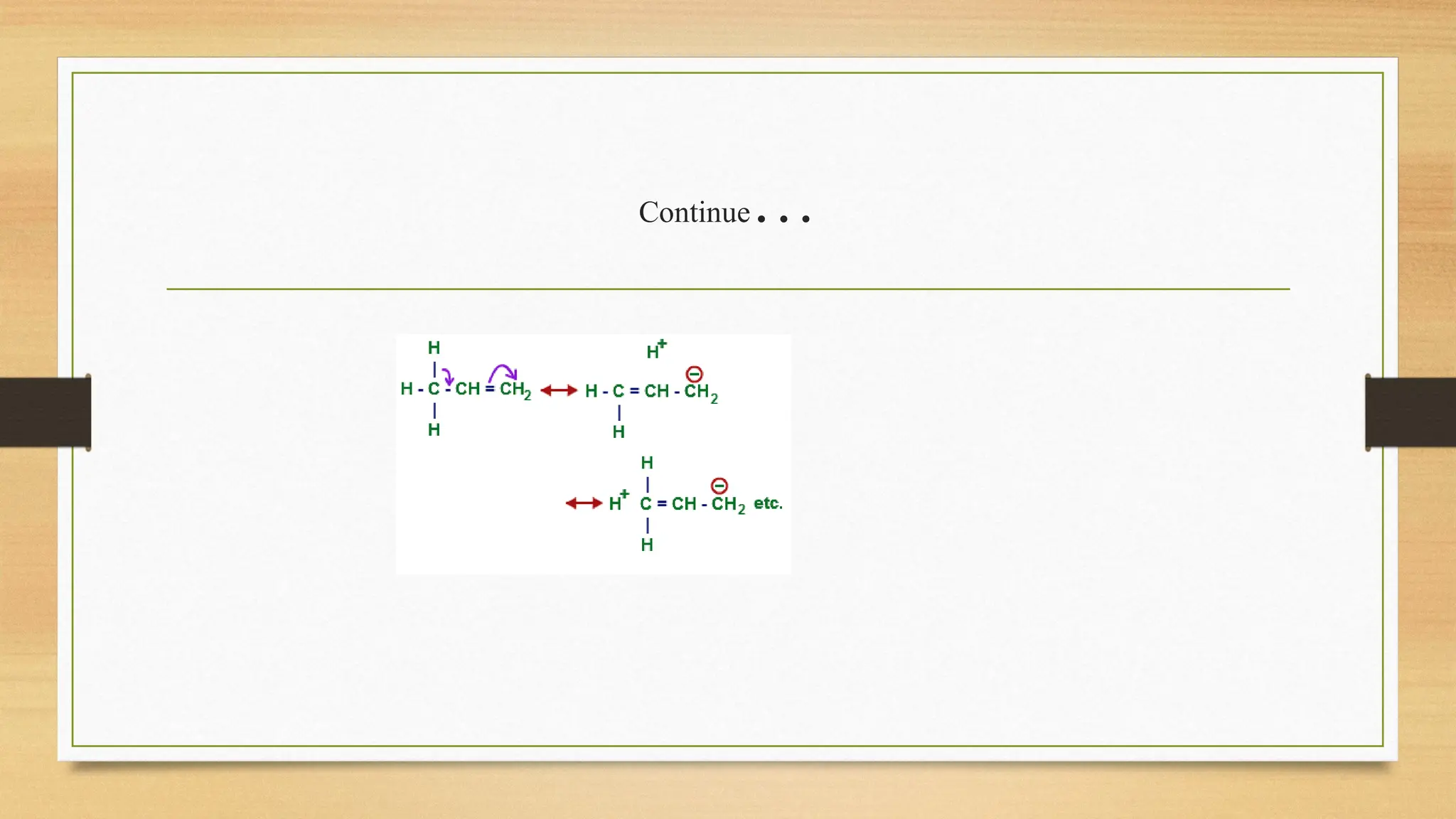
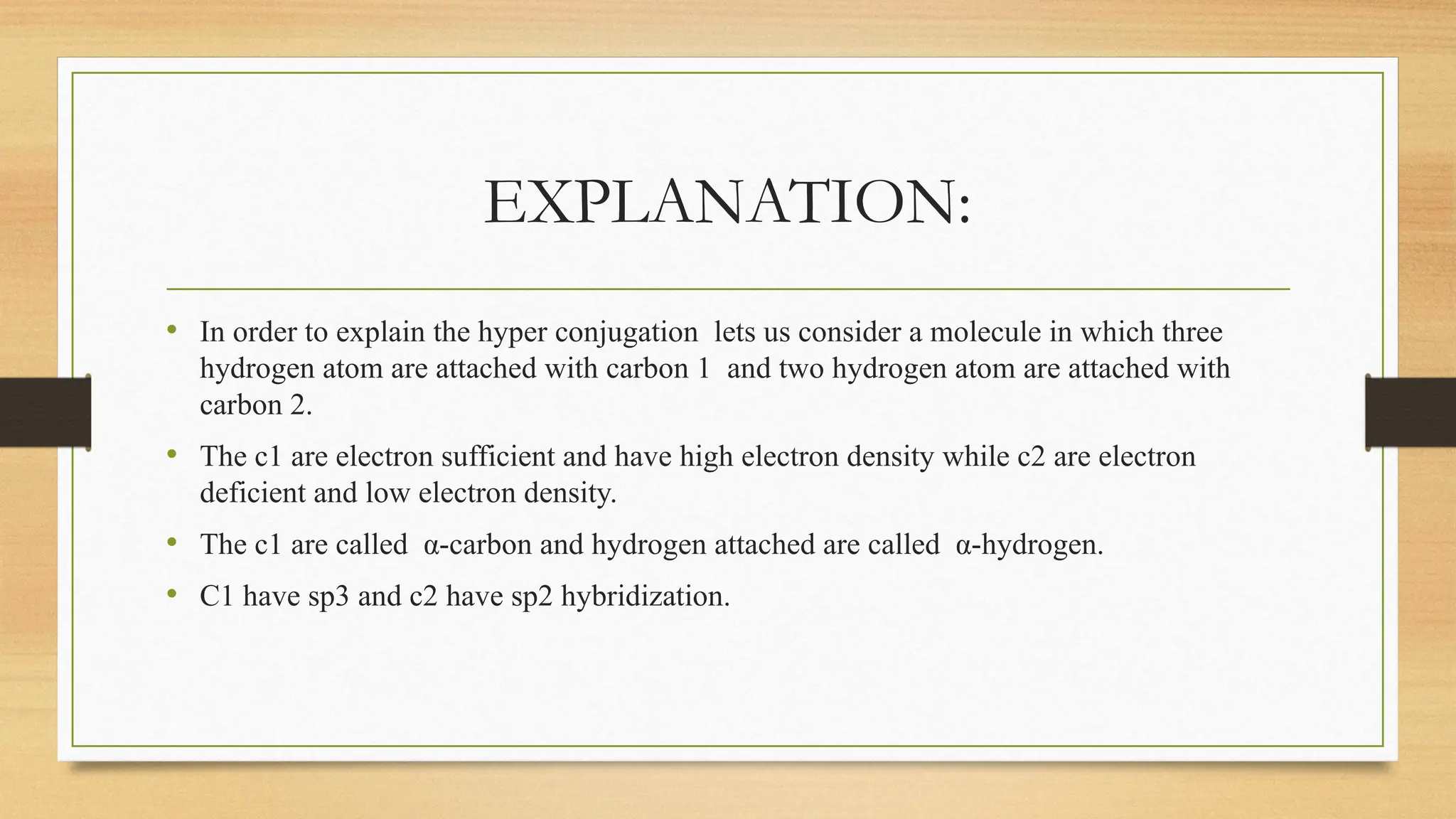
Hyperconjugation: No bond resonance
• The electrons of the sigma bond between C and H are involved in delocalization.
• In structure to the right: No bond between C and H due to migration of the sigma bond.
Hence Hyperconjugation is also called as ‘NO BOND RESONANCE’.
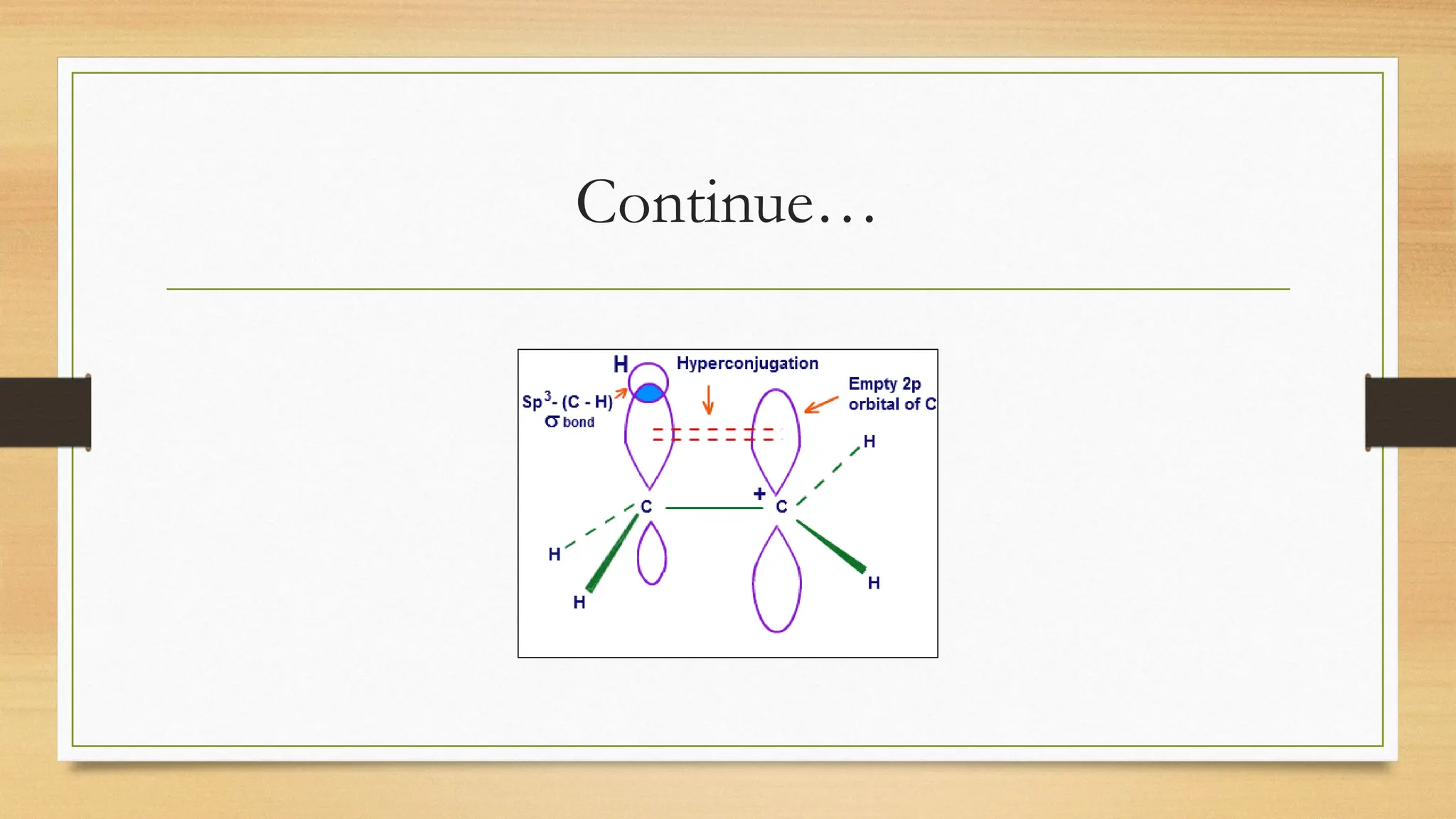
EXPLANATION:
• In order to explain the hyper conjugation lets us consider a molecule in which three
hydrogen atom are attached with carbon 1 and two hydrogen atom are attached with
carbon 2.
• The c1 are electron sufficient and have high electron density while c2 are electron
deficient and low electron density.
• The c1 are called α-carbon and hydrogen attached are called α-hydrogen.
• C1 have sp3 and c2 have sp2 hybridization.
Continue…
Salient Features of Hyper conjugation:
• Hyper conjugation is a permanent effect. This concept was introduced by Baker and
Nathan.
• It is a “mild or partial sort of conjugation” and it explains how saturated σ-bonded
segments interact with π-bonded segments i.e. a double or triple bond. It is also called as
delocalization of sigma electrons.
• The sigma bond involved in hyper conjugation is usually a C-C or C-H bond.
Continue…
• Greater the number of alkyl groups attached to doubly bonded C atoms, greater is the
number of contributing structures and greater is the stability.
• It is also known as no bond resonance or bond sacrificial resonance or “Baker-Nathan
effect” or “sigma-pi (σ-π) conjugation”.’
• Phenomena of hyperconjugation occurs in alkene, alkynes, free radicals (saturated type),
carbonium ions (saturated type) and nitro compounds with α-hydrogen.
CONDITIONS:
• Sigma bond should be weak enough so that electron waves can come out and
enter into the adjacent orbitals.
• It operates only from alpha carbon.
• Bond should be parallel.
• More conjugated hydrogen(s) more is the stability of compound.
TYPES OF HYPERCONJUGATION:
• Sacrificial hyper conjugation
• Isovalant hyper conjugation
• Reverse hyper conjugation
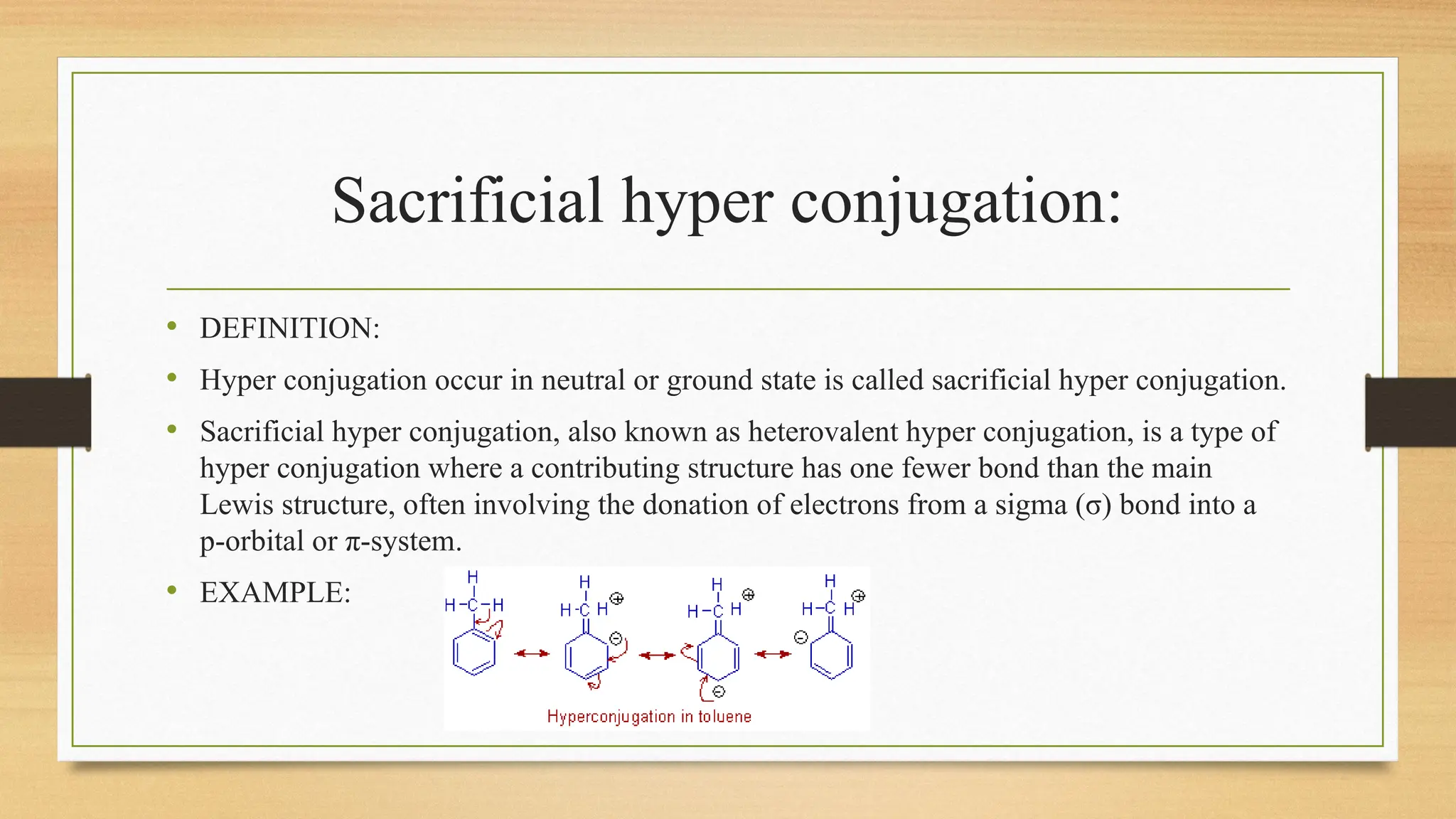
Sacrificial hyper conjugation:
• DEFINITION:
• Hyper conjugation occur in neutral or ground state is called sacrificial hyper conjugation.
• Sacrificial hyper conjugation, also known as heterovalent hyper conjugation, is a type of
hyper conjugation where a contributing structure has one fewer bond than the main
Lewis structure, often involving the donation of electrons from a sigma (σ) bond into a
p-orbital or π-system.
• EXAMPLE:
Isovalant hyper conjugation:
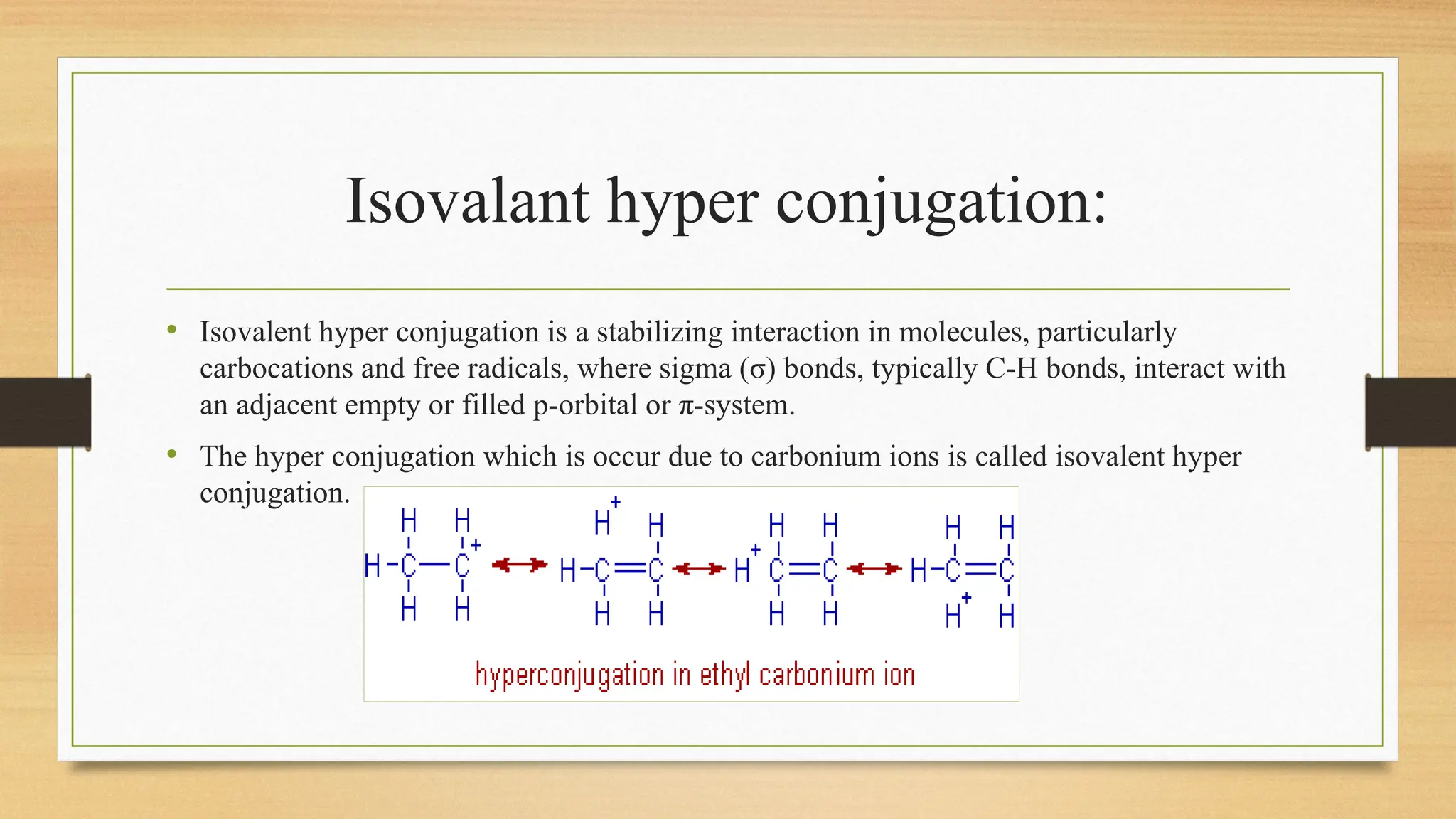
• Isovalent hyper conjugation is a stabilizing interaction in molecules, particularly
carbocations and free radicals, where sigma (σ) bonds, typically C-H bonds, interact with
an adjacent empty or filled p-orbital or π-system.
• The hyper conjugation which is occur due to carbonium ions is called isovalent hyper
conjugation.
Reverse hyper conjugation:
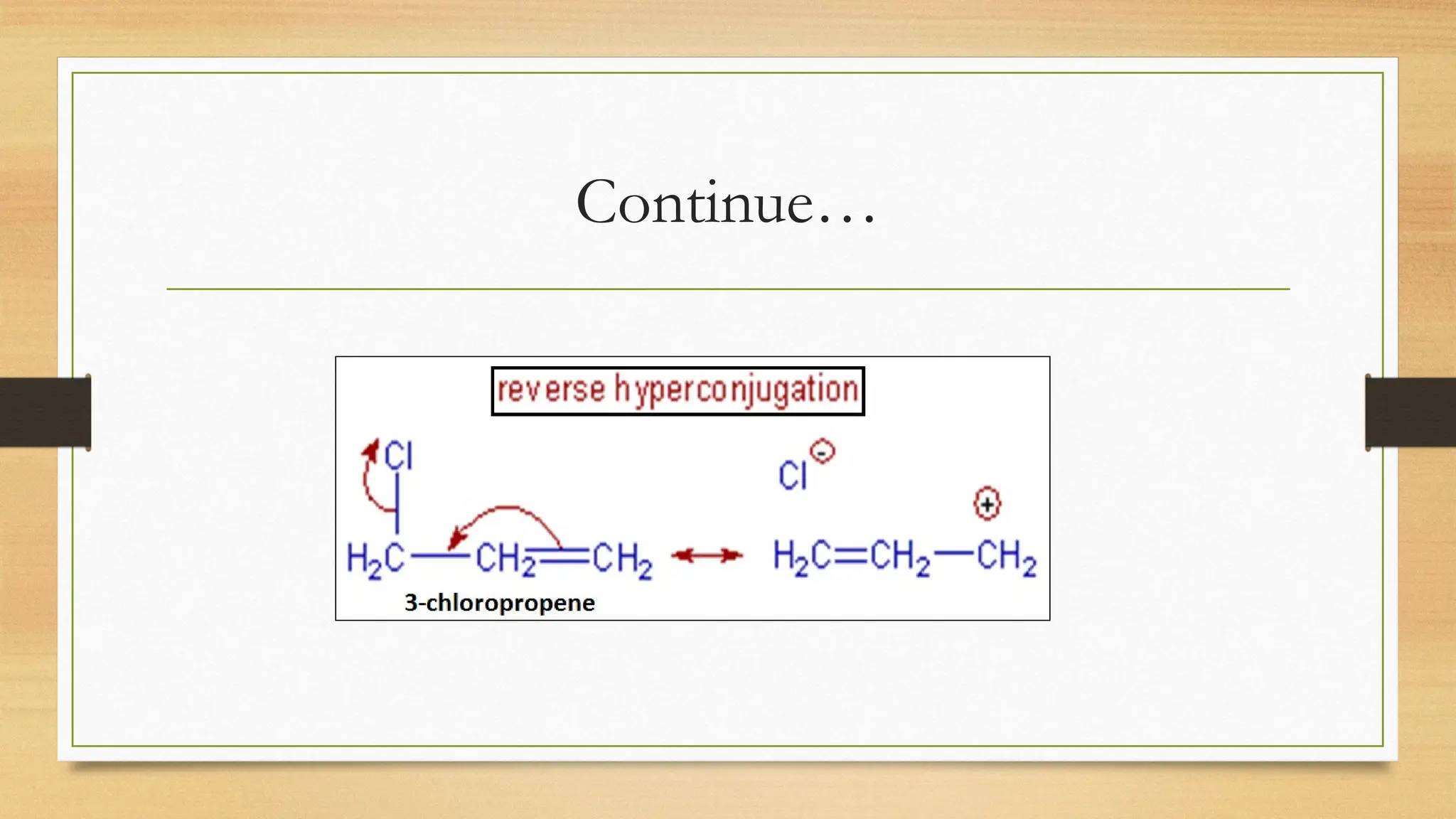
• A type of hyper conjugation in which delocalization of sigma bond toward reverse
direction is called reverse hyper conjugation.
• Reverse hyper conjugation is a situation in which an electron contact is directed from the
pi bond to the sigma bond rather than from the sigma bond to the pi bond.
• Reverse hyper conjugation, also known as negative hyper conjugation.
• In negative hyper conjugation, the electron density flows in the opposite direction (from
π- or p-orbital to empty σ*-orbital) than it does in the more common hyperconjugation
(from σ-orbital to empty p-orbital). In other words, there is a movement of electron
density towards the sigma bond.
Continue…
PHARMACEUTICAL APPLICATION:
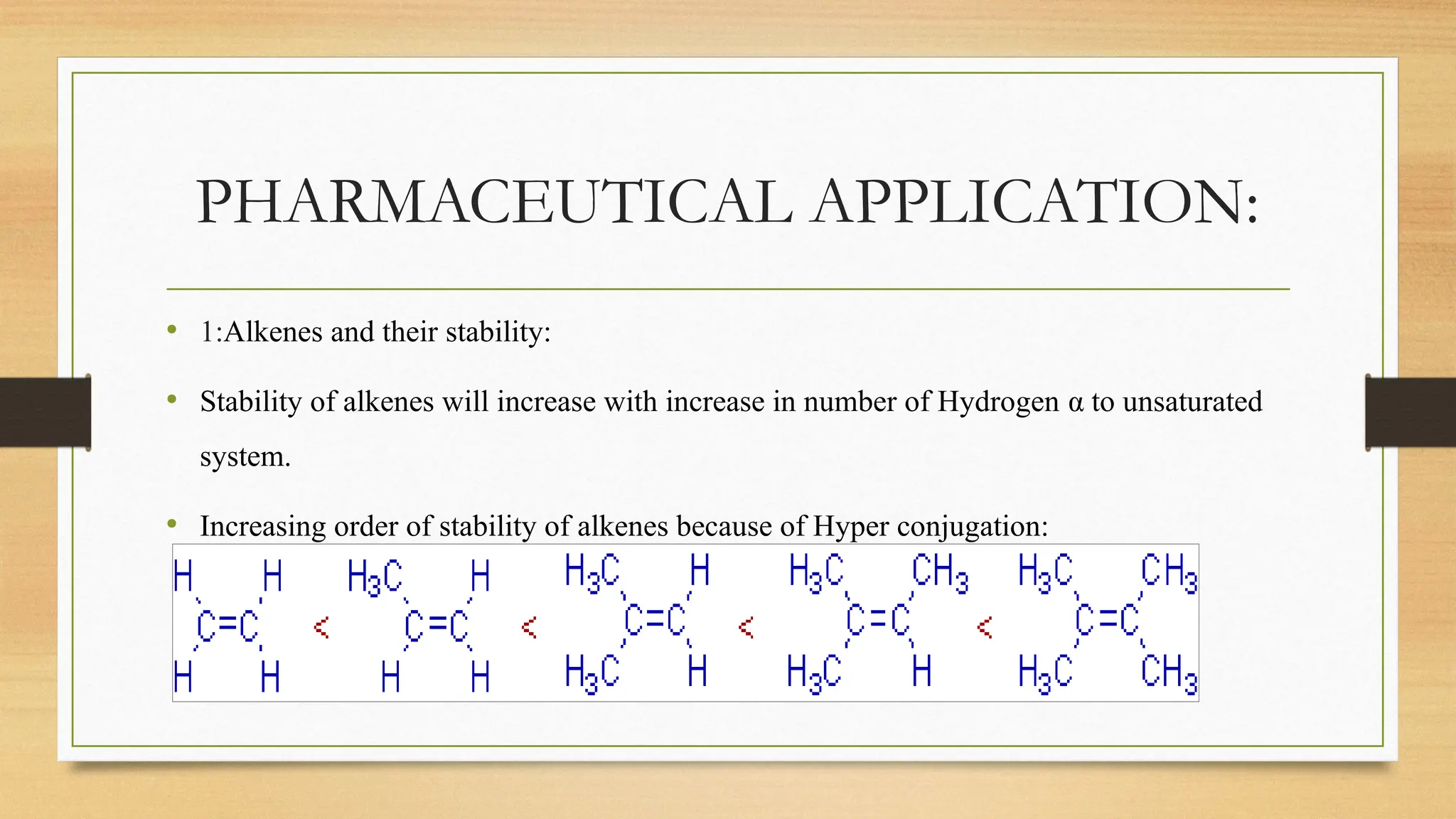
• 1:Alkenes and their stability:
• Stability of alkenes will increase with increase in number of Hydrogen α to unsaturated
system.
• Increasing order of stability of alkenes because of Hyper conjugation:
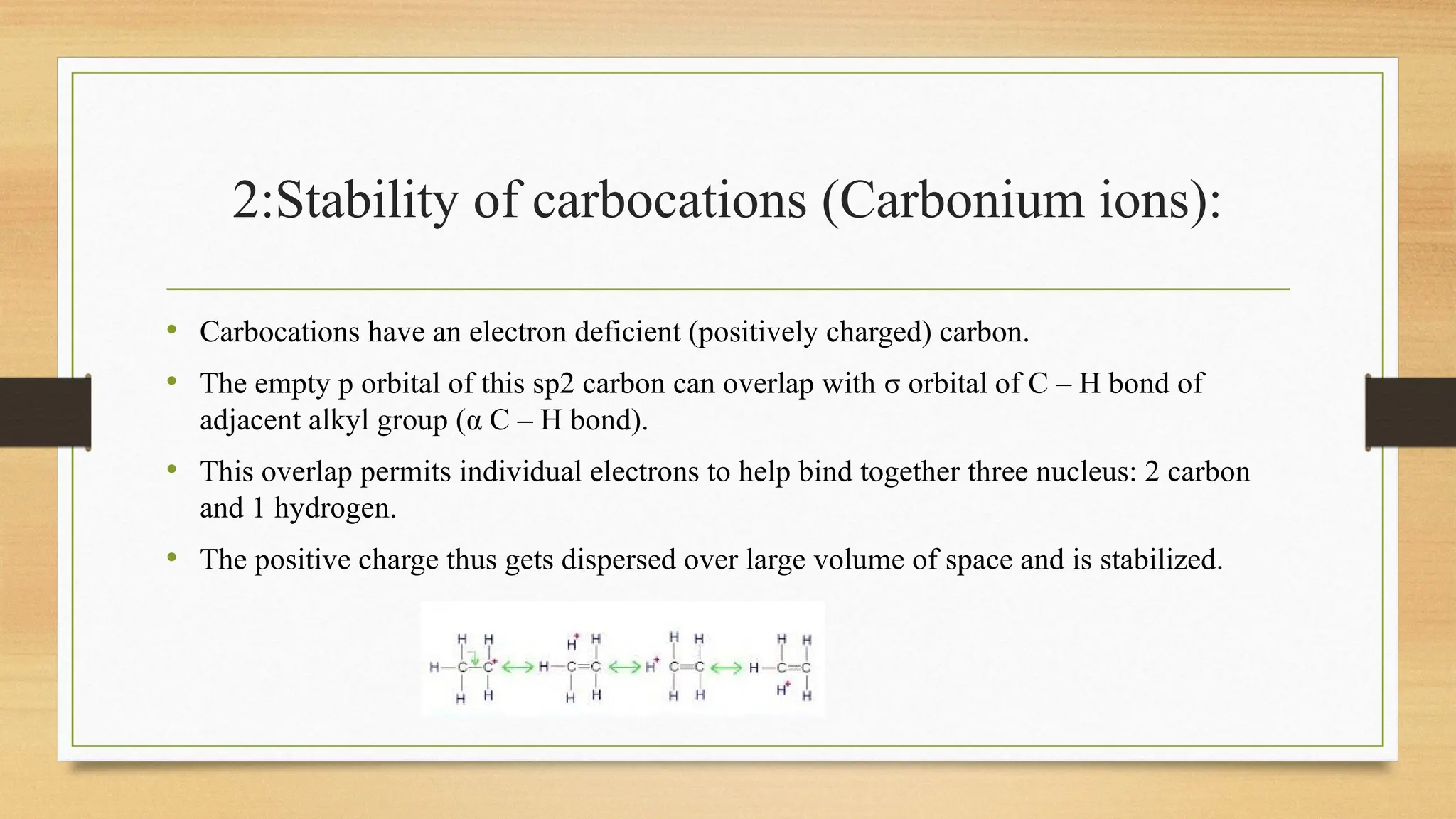
2:Stability of carbocations (Carbonium ions):
• Carbocations have an electron deficient (positively charged) carbon.
• The empty p orbital of this sp2 carbon can overlap with σ orbital of C – H bond of
adjacent alkyl group (α C – H bond).
• This overlap permits individual electrons to help bind together three nucleus: 2 carbon
and 1 hydrogen.
• The positive charge thus gets dispersed over large volume of space and is stabilized.
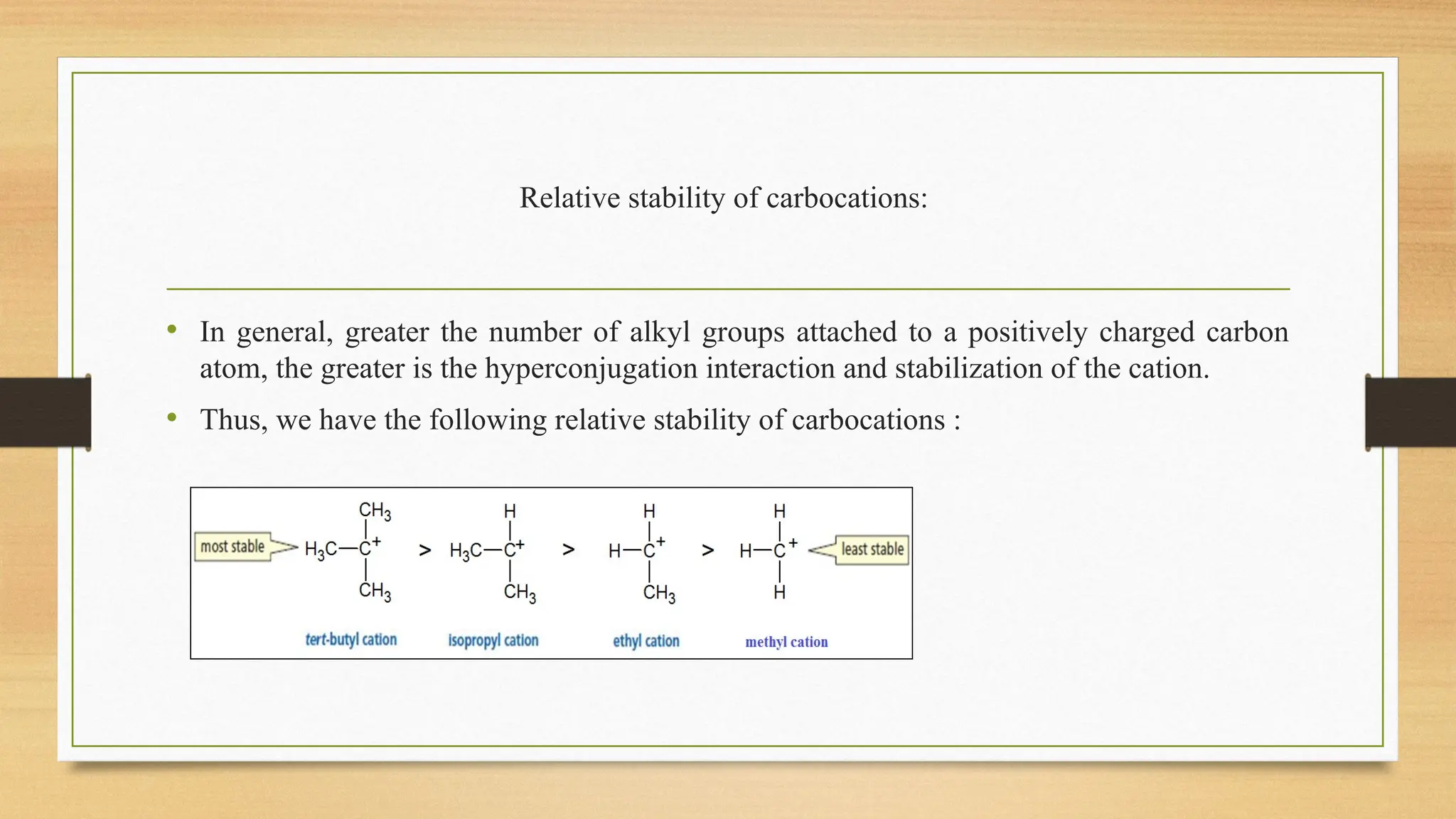
Relative stability of carbocations:
• In general, greater the number of alkyl groups attached to a positively charged carbon
atom, the greater is the hyperconjugation interaction and stabilization of the cation.
• Thus, we have the following relative stability of carbocations :
Continue…
Note:
1. Number of hyper-conjugating structures = number of α-hydrogens.
2. Greater the no. of hyper-conjugating structures, more is the stability of the system.
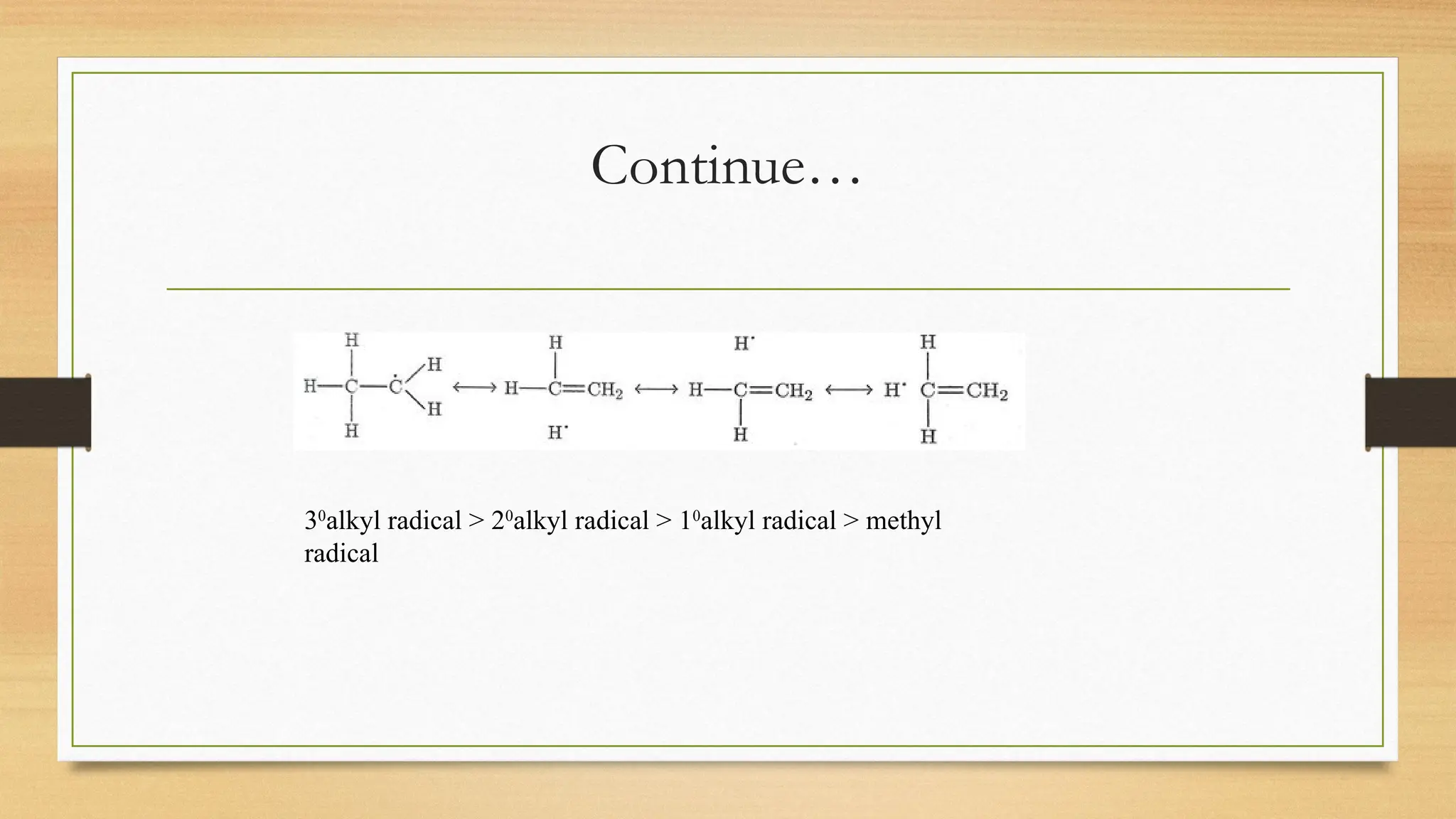
3:Stability of Free Radicals:
• The stability of free radicals is influenced by hyper conjugation in the same fashion as in
case of carbonium ions.
• The σ-electrons of the α-C-H bond can be delocalized into the p-orbital of carbon
containing an odd electron.
• Due to hyper conjugation, the stability of free radicals also follows the same order as that
of carbonium ions. i.e. methyl < primary < secondary < tertiary
Continue…
30
alkyl radical > 20
alkyl radical > 10
alkyl radical > methyl
radical
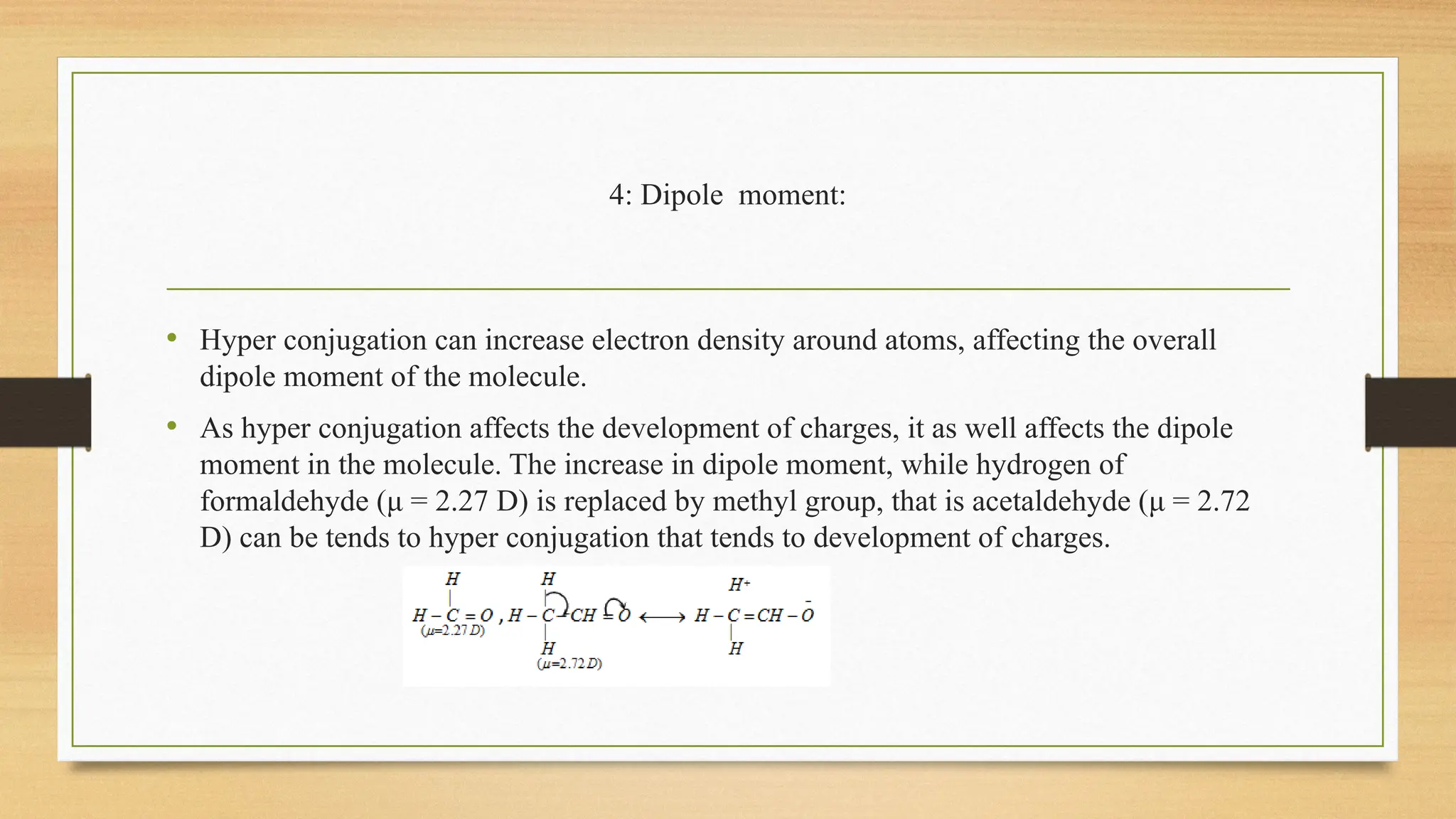
4: Dipole moment:
• Hyper conjugation can increase electron density around atoms, affecting the overall
dipole moment of the molecule.
• As hyper conjugation affects the development of charges, it as well affects the dipole
moment in the molecule. The increase in dipole moment, while hydrogen of
formaldehyde (μ = 2.27 D) is replaced by methyl group, that is acetaldehyde (μ = 2.72
D) can be tends to hyper conjugation that tends to development of charges.

HYPERCONJUGATION PowerPoint slide useful for first prof

  • 1.
  • 2.
    OTHER NAME: • Bakerand Nathan Effect • Sigma Bond Effect • No Bond Resonance
  • 3.
    DEFINITION: • The conjugationoccur due to sigma bond. • Conjugation occur due to attachment and detachment of hydrogen to adjacent carbon attach to electron deficient group. • Resonance occur due to repeated separation of hydrogen to any alkyl group is called hyper conjugation.
  • 4.
  • 5.
    Hyperconjugation: No bondresonance • The electrons of the sigma bond between C and H are involved in delocalization. • In structure to the right: No bond between C and H due to migration of the sigma bond. Hence Hyperconjugation is also called as ‘NO BOND RESONANCE’.
  • 6.
    EXPLANATION: • In orderto explain the hyper conjugation lets us consider a molecule in which three hydrogen atom are attached with carbon 1 and two hydrogen atom are attached with carbon 2. • The c1 are electron sufficient and have high electron density while c2 are electron deficient and low electron density. • The c1 are called α-carbon and hydrogen attached are called α-hydrogen. • C1 have sp3 and c2 have sp2 hybridization.
  • 7.
  • 8.
    Salient Features ofHyper conjugation: • Hyper conjugation is a permanent effect. This concept was introduced by Baker and Nathan. • It is a “mild or partial sort of conjugation” and it explains how saturated σ-bonded segments interact with π-bonded segments i.e. a double or triple bond. It is also called as delocalization of sigma electrons. • The sigma bond involved in hyper conjugation is usually a C-C or C-H bond.
  • 9.
    Continue… • Greater thenumber of alkyl groups attached to doubly bonded C atoms, greater is the number of contributing structures and greater is the stability. • It is also known as no bond resonance or bond sacrificial resonance or “Baker-Nathan effect” or “sigma-pi (σ-π) conjugation”.’ • Phenomena of hyperconjugation occurs in alkene, alkynes, free radicals (saturated type), carbonium ions (saturated type) and nitro compounds with α-hydrogen.
  • 10.
    CONDITIONS: • Sigma bondshould be weak enough so that electron waves can come out and enter into the adjacent orbitals. • It operates only from alpha carbon. • Bond should be parallel. • More conjugated hydrogen(s) more is the stability of compound.
  • 11.
    TYPES OF HYPERCONJUGATION: •Sacrificial hyper conjugation • Isovalant hyper conjugation • Reverse hyper conjugation
  • 12.
    Sacrificial hyper conjugation: •DEFINITION: • Hyper conjugation occur in neutral or ground state is called sacrificial hyper conjugation. • Sacrificial hyper conjugation, also known as heterovalent hyper conjugation, is a type of hyper conjugation where a contributing structure has one fewer bond than the main Lewis structure, often involving the donation of electrons from a sigma (σ) bond into a p-orbital or π-system. • EXAMPLE:
  • 13.
    Isovalant hyper conjugation: •Isovalent hyper conjugation is a stabilizing interaction in molecules, particularly carbocations and free radicals, where sigma (σ) bonds, typically C-H bonds, interact with an adjacent empty or filled p-orbital or π-system. • The hyper conjugation which is occur due to carbonium ions is called isovalent hyper conjugation.
  • 14.
    Reverse hyper conjugation: •A type of hyper conjugation in which delocalization of sigma bond toward reverse direction is called reverse hyper conjugation. • Reverse hyper conjugation is a situation in which an electron contact is directed from the pi bond to the sigma bond rather than from the sigma bond to the pi bond. • Reverse hyper conjugation, also known as negative hyper conjugation. • In negative hyper conjugation, the electron density flows in the opposite direction (from π- or p-orbital to empty σ*-orbital) than it does in the more common hyperconjugation (from σ-orbital to empty p-orbital). In other words, there is a movement of electron density towards the sigma bond.
  • 15.
  • 16.
    PHARMACEUTICAL APPLICATION: • 1:Alkenesand their stability: • Stability of alkenes will increase with increase in number of Hydrogen α to unsaturated system. • Increasing order of stability of alkenes because of Hyper conjugation:
  • 17.
    2:Stability of carbocations(Carbonium ions): • Carbocations have an electron deficient (positively charged) carbon. • The empty p orbital of this sp2 carbon can overlap with σ orbital of C – H bond of adjacent alkyl group (α C – H bond). • This overlap permits individual electrons to help bind together three nucleus: 2 carbon and 1 hydrogen. • The positive charge thus gets dispersed over large volume of space and is stabilized.
  • 18.
    Relative stability ofcarbocations: • In general, greater the number of alkyl groups attached to a positively charged carbon atom, the greater is the hyperconjugation interaction and stabilization of the cation. • Thus, we have the following relative stability of carbocations :
  • 19.
    Continue… Note: 1. Number ofhyper-conjugating structures = number of α-hydrogens. 2. Greater the no. of hyper-conjugating structures, more is the stability of the system.
  • 20.
    3:Stability of FreeRadicals: • The stability of free radicals is influenced by hyper conjugation in the same fashion as in case of carbonium ions. • The σ-electrons of the α-C-H bond can be delocalized into the p-orbital of carbon containing an odd electron. • Due to hyper conjugation, the stability of free radicals also follows the same order as that of carbonium ions. i.e. methyl < primary < secondary < tertiary
  • 21.
    Continue… 30 alkyl radical >20 alkyl radical > 10 alkyl radical > methyl radical
  • 22.
    4: Dipole moment: •Hyper conjugation can increase electron density around atoms, affecting the overall dipole moment of the molecule. • As hyper conjugation affects the development of charges, it as well affects the dipole moment in the molecule. The increase in dipole moment, while hydrogen of formaldehyde (μ = 2.27 D) is replaced by methyl group, that is acetaldehyde (μ = 2.72 D) can be tends to hyper conjugation that tends to development of charges.