Presented  By: IQxplorer
Contents Introduction I/O Bandwidth Problem HyperTransport technology Solution Design Goals Traditional Shared PCI-Architecture  Hypertransport Architecture Features of HyperTransport Flexible I/O Structure of HyperTransport HyperTransport Base packet structure Low Latency Feature  Hypertransport Topologies Application Of HyperTransport Conclusion References
Designing an I/O bus requires more than a protocol definition and electrical interface specification .While these are two very important aspects of any bus architecture, other issues must also be addressed, such as system design. In the past, a bus had to be made wider for higher performance through higher bandwidth. But the ever-shrinking desktop and server form factors required by IT and consumer markets has made this design methodology both unrealistic and expensive, both in terms of actual costs and power consumption.
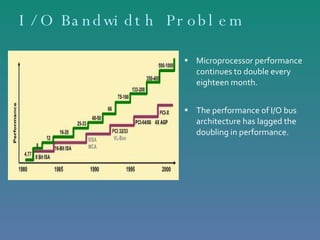
I/O Bandwidth Problem Microprocessor performance continues to double every eighteen month. The performance of I/O bus architecture has lagged the doubling in performance.
Technologies responsible for increased Bandwidth High resolution ,texture mapped 3D graphics and high definitions streaming videos. Technologies like High-speed networking and wireless communication which require large amount of Data handling. Software evolution to use multiprocessor system.
HyperTransport technology Solution HyperTransport formerly known as LDT (lightning Data Transfer) developed by HyperTransport Consortium in 2001 with the help of AMD to provide High-Speed, High performance ,Point- Point link for interconnecting Integrated Circuits ,with a top signaling rate of 1.6 GHz on each wire pair supporting a bandwidth of 12.8 Gbytes /s. It was targeted at networking ,telecommunications , computer and high performance embedded applications and any other application on which high speed, low latency, and scalability is necessary.
Original design Goals  HyperTransport Consortium wanted to develop a new I/O protocol for “In the Box” I/O connectivity that would provide  Improve system performance Simplify system design Increase I/O flexibility  Maintain compatibility with legacy system  Ensure extensibility to new system network architecture (SNA) buses Provide highly scalable multiprocessing systems
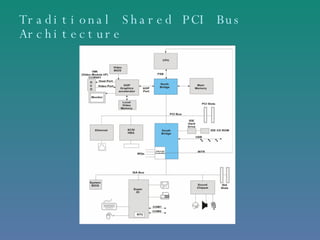
Traditional Shared PCI Bus Architecture
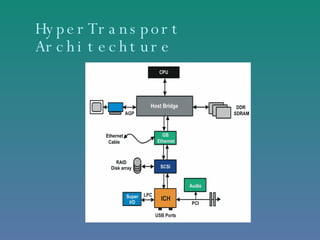
HyperTransport Architechture
Features of HyperTransport Its point to point approach. Only two device per connection . Low voltage differential signaling on high speed paths. Precise control over PCB trace length & routing. Source synchronous clock using Dual Data Rate (DDR) technology. Sophisticated protocol eliminate retries ,disconnect & wait states. Provides support for isochronous traffic . CRC error detection and elimination.  Support for buses for legacy support . PCI compatibility for minimal impact on OS and driver software.  Provides Networking support .
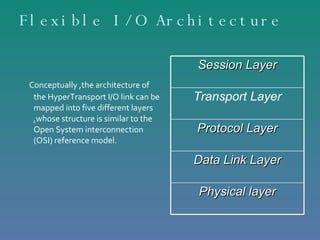
Flexible I/O Architecture Conceptually ,the architecture of the HyperTransport I/O link can be mapped into five different layers ,whose structure is similar to the Open System interconnection (OSI) reference model. Session Layer Transport Layer Protocol Layer Data Link Layer Physical layer
Physical Layer Physical Layer is concerned with the physical connection among the various component with in the computer. Each HyperTransport link consists of two point-to-point unidirectional data path. Data path widths of 2, 4, 8, and 16 bits can be implemented either upstream or  downstream, depending on the device-specific bandwidth requirements.  Commands, addresses, and data (CAD) all use the same set of wires for signaling,  dramatically reducing pin requirements. Enhanced Low-Voltage Differential Signaling   The signaling technology used in HyperTransport technology is a type of low voltage differential signaling (LVDS ). However, it is not the conventional IEEE LVDS standard. It is an enhanced LVDS technique developed to evolve with the performance of future process technologies. This is designed to help ensure that the HyperTransport technology standard has a long lifespan. LVDS has been widely used in these types of applications  because it requires fewer pins and wires.
Data link Layer The data link layer concerned with initialization and configuration sequence, periodic  cyclic redundancy check (CRC),  disconnect/reconnect sequence,  information packets for flow control and error management, and  double word framing for other packets
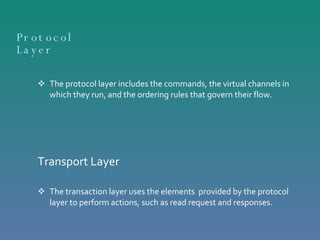
Protocol Layer The protocol layer includes the commands, the virtual channels in which they run, and the ordering rules that govern their flow.  Transport Layer The transaction layer uses the elements  provided by the protocol layer to perform actions, such as read request and responses.
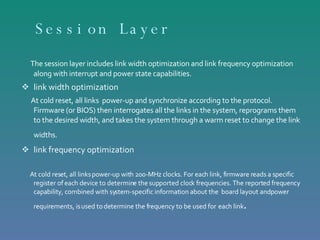
Session Layer The session layer includes link width optimization and link frequency optimization along with interrupt and power state capabilities.  link width optimization At cold reset, all links  power-up and synchronize according to the protocol. Firmware (or BIOS) then interrogates all the links in the system, reprograms them to the desired width, and takes the system through a warm reset to change the link widths.   link frequency optimization At cold reset, all links power-up with 200-MHz clocks. For each link, firmware reads a specific register of each device to determine the supported clock frequencies. The reported frequency capability, combined with system-specific information about the  board layout and power requirements, is used to determine the frequency to be used for  each link .
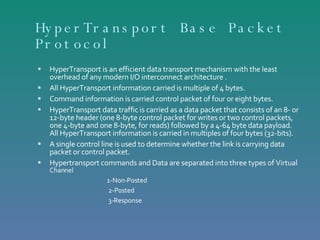
HyperTransport Base Packet Protocol HyperTransport is an efficient data transport mechanism with the least overhead of any modern I/O interconnect architecture . All HyperTransport information carried is multiple of 4 bytes. Command information is carried control packet of four or eight bytes. HyperTransport data traffic is carried as a data packet that consists of an 8- or 12-byte header (one 8-byte control packet for writes or two control packets, one 4-byte and one 8-byte, for reads) followed by a 4-64 byte data payload. All HyperTransport information is carried in multiples of four bytes (32-bits). A single control line is used to determine whether the link is carrying data packet or control packet. Hypertransport commands and Data are separated into three types of Virtual  Channel 1-Non-Posted 2-Posted 3-Response
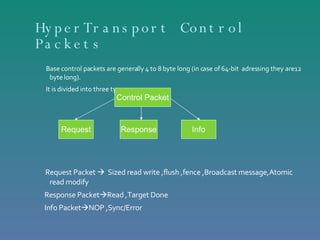
HyperTransport Control Packets Base control packets are generally 4 to 8 byte long (in case of 64-bit  adressing they are12 byte long). It is divided into three types Request Packet     Sized read write ,flush ,fence ,Broadcast message,Atomic read modify Response Packet  Read ,Target Done Info Packet  NOP ,Sync/Error Control Packet Request Response Info
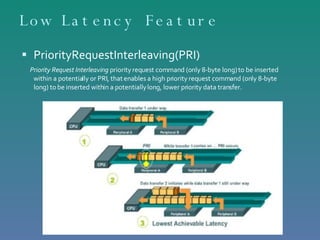
Low Latency Feature PriorityRequestInterleaving(PRI) Priority Request Interleaving  priority request command (only 8-byte long) to be inserted within a potentially or PRI, that enables a high priority request command (only 8-byte long) to be inserted within a potentially long, lower priority data transfer.
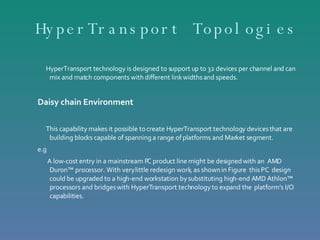
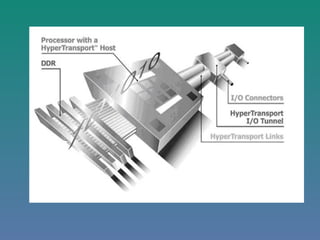
HyperTransport Topologies HyperTransport technology is designed to support up to 32 devices per channel and can  mix and match components with different link widths and speeds.  Daisy chain Environment This capability makes it possible to create HyperTransport technology devices that are building blocks capable of spanning a range of platforms and Market segment.  e.g A low-cost entry in a mainstream PC product line might be designed with an  AMD Duron™ processor. With very little redesign work, as shown in Figure  this PC  design could be upgraded to a high-end workstation by substituting high-end AMD Athlon™ processors and bridges with HyperTransport technology to expand the  platform’s I/O capabilities.
 
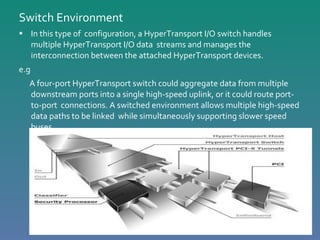
Switch Environment In this type of  configuration, a HyperTransport I/O switch handles multiple HyperTransport I/O data  streams and manages the interconnection between the attached HyperTransport devices.  e.g A four-port HyperTransport switch could aggregate data from multiple  downstream ports into a single high-speed uplink, or it could route port-to-port  connections. A switched environment allows multiple high-speed data paths to be linked  while simultaneously supporting slower speed buses.
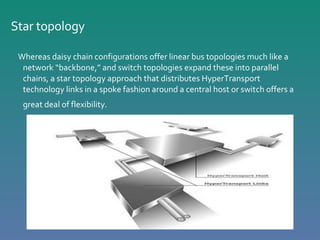
Star topology Whereas daisy chain configurations offer linear bus topologies much like a network “backbone,” and switch topologies expand these into parallel chains, a star topology approach that distributes HyperTransport technology links in a spoke fashion around a central host or switch offers a great deal of flexibility.
Applications for HyperTransport Front-Side Bus Replacement The primary use for HyperTransport is to replace the front-side bus, which is currently different for every type of machine. computer implemented with HyperTransport is faster and more flexible. A single PCI↔HyperTransport adaptor chip will work with any HyperTransport enabled microprocessor and allow the use of PCI cards with these processors.  Multiprocessor interconnect Another use for HyperTransport is as an interconnect for NUMA multiprocessor computers. AMD uses HyperTransport with a proprietary cache coherency extension as part of their Direct Connect Architecture in their Opteron and Atholon 64FX (DCA)The HORUS interconnect from Newisys extends this concept to larger clusters .
Router or Switch Bus Replacement HyperTransport can also be used as a bus in routers and switches. Routers and switches have multiple connections ports and data has to be forwarded between these ports as fast as possible  HTX and Co-processor interconnect The issue of bandwidth between CPUs and co-processors has usually been the major stumbling block to their practical implementation. After years without an officially recognized one, a connector designed for such expansion using a HyperTransport interface was introduced and is known as HyperTransport expansion (HTX)
Conclusion HyperTransport technology is a powerful board-level architecture that delivers high bandwidth, low latency, scalability, PCI compatibility, and extensibility.  When processor-native, HyperTransport provides an integrated front-side bus that eliminates custom/proprietary buses and the need for additional glue logic.  As an integrated I/O bus, HyperTransport eliminates the need for multiple local buses, ultimately simplifying overall system design and implementation.  As a link to legacy PCI and PCI-X subsystems, HyperTransport extends the life of those popular systems and as a lemerging, high-speed serial buses such as PCI Express, it becomes a board-level system architecture
References http://www.hypertransport.org http://computer.howstuffworks.com/motherboard.htm http://search.techrepublic.com.com/search/HyperTransport.html http://en.wikipedia.org/wiki/HyperTransport PC Architechture by Michael Karbo(Chapter 25,26,42) http://developer.amd.com/articlex.jsp?id=70

Hyper Transport Technology

  • 1.
    Presented By:IQxplorer
  • 2.
    Contents Introduction I/OBandwidth Problem HyperTransport technology Solution Design Goals Traditional Shared PCI-Architecture Hypertransport Architecture Features of HyperTransport Flexible I/O Structure of HyperTransport HyperTransport Base packet structure Low Latency Feature Hypertransport Topologies Application Of HyperTransport Conclusion References
  • 3.
    Designing an I/Obus requires more than a protocol definition and electrical interface specification .While these are two very important aspects of any bus architecture, other issues must also be addressed, such as system design. In the past, a bus had to be made wider for higher performance through higher bandwidth. But the ever-shrinking desktop and server form factors required by IT and consumer markets has made this design methodology both unrealistic and expensive, both in terms of actual costs and power consumption.
  • 4.
    I/O Bandwidth ProblemMicroprocessor performance continues to double every eighteen month. The performance of I/O bus architecture has lagged the doubling in performance.
  • 5.
    Technologies responsible forincreased Bandwidth High resolution ,texture mapped 3D graphics and high definitions streaming videos. Technologies like High-speed networking and wireless communication which require large amount of Data handling. Software evolution to use multiprocessor system.
  • 6.
    HyperTransport technology SolutionHyperTransport formerly known as LDT (lightning Data Transfer) developed by HyperTransport Consortium in 2001 with the help of AMD to provide High-Speed, High performance ,Point- Point link for interconnecting Integrated Circuits ,with a top signaling rate of 1.6 GHz on each wire pair supporting a bandwidth of 12.8 Gbytes /s. It was targeted at networking ,telecommunications , computer and high performance embedded applications and any other application on which high speed, low latency, and scalability is necessary.
  • 7.
    Original design Goals HyperTransport Consortium wanted to develop a new I/O protocol for “In the Box” I/O connectivity that would provide Improve system performance Simplify system design Increase I/O flexibility Maintain compatibility with legacy system Ensure extensibility to new system network architecture (SNA) buses Provide highly scalable multiprocessing systems
  • 8.
    Traditional Shared PCIBus Architecture
  • 9.
  • 10.
    Features of HyperTransportIts point to point approach. Only two device per connection . Low voltage differential signaling on high speed paths. Precise control over PCB trace length & routing. Source synchronous clock using Dual Data Rate (DDR) technology. Sophisticated protocol eliminate retries ,disconnect & wait states. Provides support for isochronous traffic . CRC error detection and elimination. Support for buses for legacy support . PCI compatibility for minimal impact on OS and driver software. Provides Networking support .
  • 11.
    Flexible I/O ArchitectureConceptually ,the architecture of the HyperTransport I/O link can be mapped into five different layers ,whose structure is similar to the Open System interconnection (OSI) reference model. Session Layer Transport Layer Protocol Layer Data Link Layer Physical layer
  • 12.
    Physical Layer PhysicalLayer is concerned with the physical connection among the various component with in the computer. Each HyperTransport link consists of two point-to-point unidirectional data path. Data path widths of 2, 4, 8, and 16 bits can be implemented either upstream or downstream, depending on the device-specific bandwidth requirements. Commands, addresses, and data (CAD) all use the same set of wires for signaling, dramatically reducing pin requirements. Enhanced Low-Voltage Differential Signaling The signaling technology used in HyperTransport technology is a type of low voltage differential signaling (LVDS ). However, it is not the conventional IEEE LVDS standard. It is an enhanced LVDS technique developed to evolve with the performance of future process technologies. This is designed to help ensure that the HyperTransport technology standard has a long lifespan. LVDS has been widely used in these types of applications because it requires fewer pins and wires.
  • 13.
    Data link LayerThe data link layer concerned with initialization and configuration sequence, periodic cyclic redundancy check (CRC), disconnect/reconnect sequence, information packets for flow control and error management, and double word framing for other packets
  • 14.
    Protocol Layer Theprotocol layer includes the commands, the virtual channels in which they run, and the ordering rules that govern their flow. Transport Layer The transaction layer uses the elements provided by the protocol layer to perform actions, such as read request and responses.
  • 15.
    Session Layer Thesession layer includes link width optimization and link frequency optimization along with interrupt and power state capabilities. link width optimization At cold reset, all links power-up and synchronize according to the protocol. Firmware (or BIOS) then interrogates all the links in the system, reprograms them to the desired width, and takes the system through a warm reset to change the link widths. link frequency optimization At cold reset, all links power-up with 200-MHz clocks. For each link, firmware reads a specific register of each device to determine the supported clock frequencies. The reported frequency capability, combined with system-specific information about the board layout and power requirements, is used to determine the frequency to be used for each link .
  • 16.
    HyperTransport Base PacketProtocol HyperTransport is an efficient data transport mechanism with the least overhead of any modern I/O interconnect architecture . All HyperTransport information carried is multiple of 4 bytes. Command information is carried control packet of four or eight bytes. HyperTransport data traffic is carried as a data packet that consists of an 8- or 12-byte header (one 8-byte control packet for writes or two control packets, one 4-byte and one 8-byte, for reads) followed by a 4-64 byte data payload. All HyperTransport information is carried in multiples of four bytes (32-bits). A single control line is used to determine whether the link is carrying data packet or control packet. Hypertransport commands and Data are separated into three types of Virtual Channel 1-Non-Posted 2-Posted 3-Response
  • 17.
    HyperTransport Control PacketsBase control packets are generally 4 to 8 byte long (in case of 64-bit adressing they are12 byte long). It is divided into three types Request Packet  Sized read write ,flush ,fence ,Broadcast message,Atomic read modify Response Packet  Read ,Target Done Info Packet  NOP ,Sync/Error Control Packet Request Response Info
  • 18.
    Low Latency FeaturePriorityRequestInterleaving(PRI) Priority Request Interleaving priority request command (only 8-byte long) to be inserted within a potentially or PRI, that enables a high priority request command (only 8-byte long) to be inserted within a potentially long, lower priority data transfer.
  • 19.
    HyperTransport Topologies HyperTransporttechnology is designed to support up to 32 devices per channel and can mix and match components with different link widths and speeds. Daisy chain Environment This capability makes it possible to create HyperTransport technology devices that are building blocks capable of spanning a range of platforms and Market segment. e.g A low-cost entry in a mainstream PC product line might be designed with an AMD Duron™ processor. With very little redesign work, as shown in Figure this PC design could be upgraded to a high-end workstation by substituting high-end AMD Athlon™ processors and bridges with HyperTransport technology to expand the platform’s I/O capabilities.
  • 20.
  • 21.
    Switch Environment Inthis type of configuration, a HyperTransport I/O switch handles multiple HyperTransport I/O data streams and manages the interconnection between the attached HyperTransport devices. e.g A four-port HyperTransport switch could aggregate data from multiple downstream ports into a single high-speed uplink, or it could route port-to-port connections. A switched environment allows multiple high-speed data paths to be linked while simultaneously supporting slower speed buses.
  • 22.
    Star topology Whereasdaisy chain configurations offer linear bus topologies much like a network “backbone,” and switch topologies expand these into parallel chains, a star topology approach that distributes HyperTransport technology links in a spoke fashion around a central host or switch offers a great deal of flexibility.
  • 23.
    Applications for HyperTransportFront-Side Bus Replacement The primary use for HyperTransport is to replace the front-side bus, which is currently different for every type of machine. computer implemented with HyperTransport is faster and more flexible. A single PCI↔HyperTransport adaptor chip will work with any HyperTransport enabled microprocessor and allow the use of PCI cards with these processors. Multiprocessor interconnect Another use for HyperTransport is as an interconnect for NUMA multiprocessor computers. AMD uses HyperTransport with a proprietary cache coherency extension as part of their Direct Connect Architecture in their Opteron and Atholon 64FX (DCA)The HORUS interconnect from Newisys extends this concept to larger clusters .
  • 24.
    Router or SwitchBus Replacement HyperTransport can also be used as a bus in routers and switches. Routers and switches have multiple connections ports and data has to be forwarded between these ports as fast as possible HTX and Co-processor interconnect The issue of bandwidth between CPUs and co-processors has usually been the major stumbling block to their practical implementation. After years without an officially recognized one, a connector designed for such expansion using a HyperTransport interface was introduced and is known as HyperTransport expansion (HTX)
  • 25.
    Conclusion HyperTransport technologyis a powerful board-level architecture that delivers high bandwidth, low latency, scalability, PCI compatibility, and extensibility. When processor-native, HyperTransport provides an integrated front-side bus that eliminates custom/proprietary buses and the need for additional glue logic. As an integrated I/O bus, HyperTransport eliminates the need for multiple local buses, ultimately simplifying overall system design and implementation. As a link to legacy PCI and PCI-X subsystems, HyperTransport extends the life of those popular systems and as a lemerging, high-speed serial buses such as PCI Express, it becomes a board-level system architecture
  • 26.
    References http://www.hypertransport.org http://computer.howstuffworks.com/motherboard.htmhttp://search.techrepublic.com.com/search/HyperTransport.html http://en.wikipedia.org/wiki/HyperTransport PC Architechture by Michael Karbo(Chapter 25,26,42) http://developer.amd.com/articlex.jsp?id=70