A Seminar Presentation on
1
Smart Dustbin for Smart City
versit
Presented By :-Shaikh Kash
Ahmednagar Jilha Vidya Prasarak Samaj’s Shri
Chhatrapati Shivaji Maharaj College Of
Engineering,Ahmednagar
Computer Department
2017-18
Contents
2
• Introduction.
• Literature Survey.
• ExistingSystem
• ProposedSystem
• System Architecture
• System Design
• Implementation
• Advantagesanddisadvantage
• Application
• FutureScope
• Conclusion
• References
Introduction
3
 provide an IOT based solution to garbage collection
planning for enabling collection of garbage generation
data.
This checks the waste level over the dustbins by using
Sensor.
Once it detected immediately this system alert to
concern authorized through GSM/GPRS.
An android application is developed for the desired
information
This is ensued the greenish in the environment and
support for Swachh Bharat for cleanness.
Literature Survey
4
Sr
no
Name of
paper
Author Existing
System
Publish
ed
Elements
1
Design smart
waste bin for
smart waste
management
Aksan Wijaya,
ZahirZainudd,
Muhammad
Niswar
IEEE
August
2017
A smart waste
bin consists of a
smart sensor
&smart comm
2
Smart
Garbage
Monitoring
and Clearance
System using
IOT
Vinoth Kumar,
Senthil Kumaran,
Krishna Kumar&
Mahantesh
Mathapati4
IEEE August
2017
IOTbased smart
waste clean
management
system which
checks the waste
level over the
dustbins by using
Sensor systems.
Literature Survey
5
Sr
no
Name of
paper
Author Existing
System
Publis
hed
Elements
3
Automatio
n of smart
waste
manageme
nt
Bharadwaj B,
M Kumudha,
Gowri
Chandra N,
Chaithra G
IEEE 2017
IOT module is used to
control waste &data will
be sent to the
Organization& common
man.
4
Smart
Dustbins
for Smart
Cities
Bikramjit
Singh,
Manpreet
Kaur
IJCSIT 2016
This system to garbage
collection providing
greater accessibility
,planning proper for
disposing process.
Existing System
6
A waste-bin system can be adapted into general
waste-bin and it consists of the sensing units, a Bluetooth
and GSM Module for data transmission, and a mobile
application and web-based monitoring for interfacing and
communication with the waste department for waste
management
The smart bin is composed of sensor node mounted on
it for the data collection and transmission. The sensors are
divided into two path. One path is mounted with the bin
cover and the other is in the bottom of the bin. The first path
is level sensor to monitoring the level of waste-bin. The
other path is smart load cell sensor to calculate the weight of
waste.
Proposed System
7
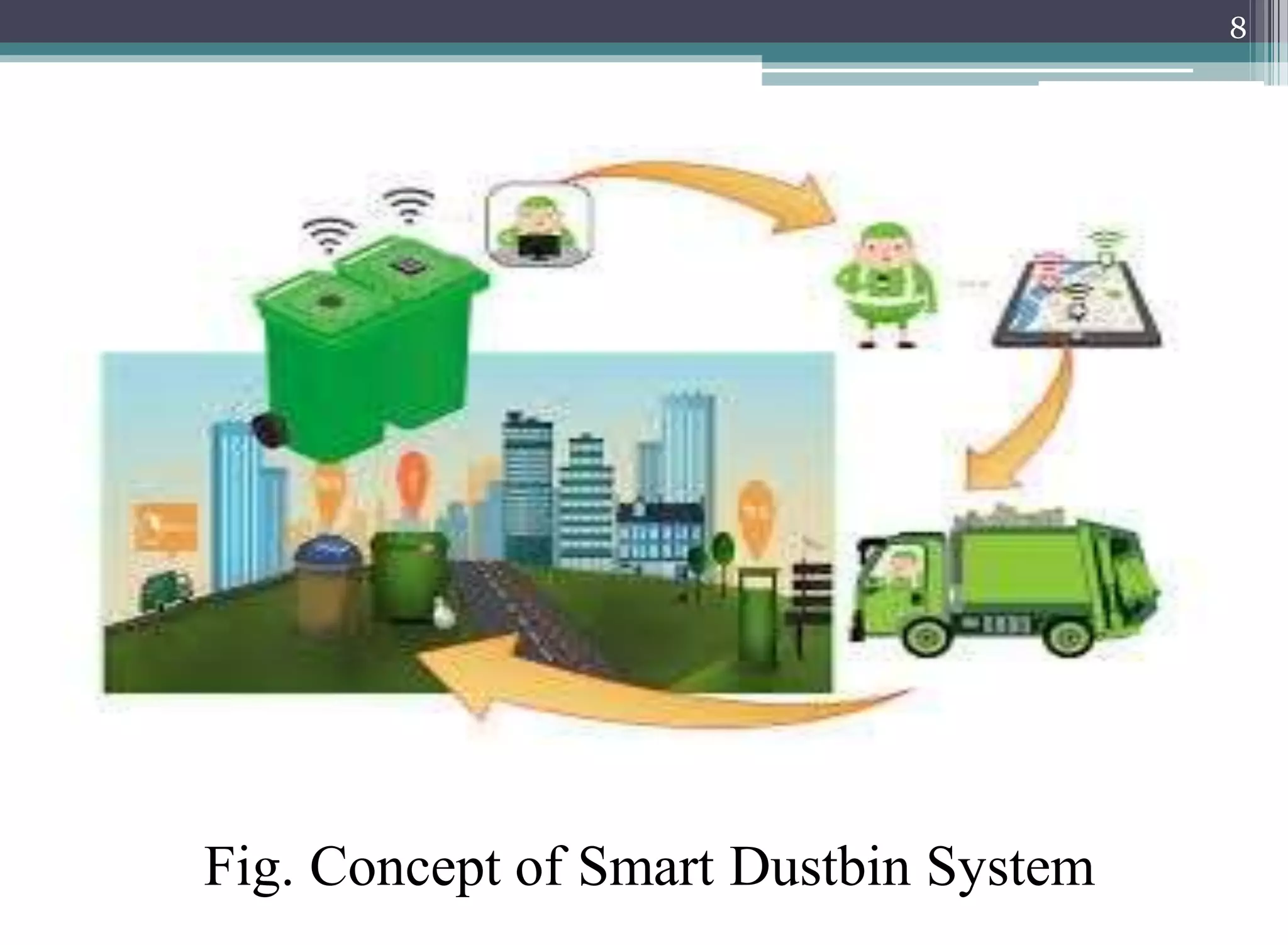
• Real time waste management system to check the fill level
of dustbins whether the dustbins are full or not.
• It will inform the status of each and every dustbin so that
concerned authority can send the garbage collection vehicle
• The level of waste in the dustbins is detected with the help
of Ultrasonic sensor.
• Force sensor is used to measure the weight of the dust bin.
• When the measured value of sensors exceeds a certain
threshold value then red led becomes ON.
• Android device will detects, in which area dustbin is
located and status of that.
8
Fig. Concept of Smart Dustbin System
SystemArchitecture
9
Fig.
Shows the
architecture
of system
System Architecture
10
This proposed system has been divided into three layers:
1) Dustbin Layer: - This layer consists of internet and Wi-
Fi enabled dustbins. Every dustbin contains a sensor
2) Server layer:- Server collects the fill up status and
location of dustbins. It processes the clients query and it
respond with nearest dustbin location.
3) Client layer: - Clients request for the nearest location
of the IT enabled dustbin to the server using Mobile App
designed for this purpose.
System Design
11
Fig. Initial message
displayed on LCD
Fig. Green LED is on
when bin is emptyFig. Message dispalyed on
LCD when bin is filled
System Design
12
Fig. Location of the bin
displayed on Google maps
Fig. Login Screen of App
used in the System
Implementation
13
How we collect the garbage optimally from these dustbins for
this purpose we can use following three scheduling Algorithm.
1) Fixed Scheduling : - Collection process carried out after
fixed interval. The Travelling salesman problem algorithm
used for route planning.
2) Priority Scheduling : - The dustbins are collected according
to the decreasing current fill up status.
3) Average Threshold Scheduling : - We first find out the
average of all fill up status of all dustbins. Then if average is
greater than some threshold like 70% then schedule the
collection process
14
Fig. Collection Process
Advantages
15
1. Our system provides greater accessibility to the
dustbin.
2. In our system if dustbin is relocated to another location
it will automatically registered with the server with the
new GPS location.
3. It will save fuel and time using appropriate route
planning.
4. This practice is highly lucrative
5. Keeps the environment clean and fresh
6. Reduces environmental pollution
Disadvantages
16
1. The process is not always cost-effective
2. The resultant product has a short life
3. The sites are often dangerous
4. The practices are not done uniformly
5. Waste management can cause more problems
6. Garbage segregation is very difficult
Application
17
1. Empowered Swach Bharat Mission.
2. e-Governance Based on Digital India.
3. Reduce environmental pollution.
4. Real time based cleaning of our cities.
5. It makes our system transparent between Municipal
Corporation, Workers and public.
Future Scope
18
 This project is made for demo concern, it can be taken to product
level
 It can be made durable, by making it compact and cost Effective
 Two bins can be placed to collect wet and dry waste
separately.
 Wet waste can be decomposed and used for making biogas.
Conclusion
19
This system help the local municipal administration in
waste management system. i.e., monitoring of domestic
wastage clearance at proper time to avoid damage to the
public health. A web server is also been set up through which
the municipal authorities also get information about the bins
in their area. It uses sensors for sensing information of Bins
and sending to workstation, which is situated at municipal
office for finding shortest path.
This project came in comfortable which a worthy
elucidation for maintaining green environment. The
proposed system is an attempt to improve current waste
collection system in India for the “Clean India Mission”.
References
20
[1] Prakash , Prabu,” IoT Based Waste Management for Smart
City”, published in IJRCCE Volume 4 , Issue 2 , February
2016.
[2] Tarandeep Singh , Rita Mahajan , Deepak Bagai, “Smart
Waste Management using Wireless Sensor Network”, in
IJRCCE Volume 4 , Issue 6 , June 2016.
[3] S.S.Navghane, M.S.Killedar, Dr.V.M.Rohokale, “ IoT
Based Smart Garbage and Waste Collection Bin”, IJARECE)
Volume 5, Issue 5, May 2016.
[4] Alexey Medvedev , Pert Fedchenkov,, AArkady
Zaslavsky,“ Waste Management as an IoT Enabled Service in
Smart Cities”, Springer 2012.
Thank You
versit
21

Smart Dustbin for Smart City

  • 1.
    A Seminar Presentationon 1 Smart Dustbin for Smart City versit Presented By :-Shaikh Kash Ahmednagar Jilha Vidya Prasarak Samaj’s Shri Chhatrapati Shivaji Maharaj College Of Engineering,Ahmednagar Computer Department 2017-18
  • 2.
    Contents 2 • Introduction. • LiteratureSurvey. • ExistingSystem • ProposedSystem • System Architecture • System Design • Implementation • Advantagesanddisadvantage • Application • FutureScope • Conclusion • References
  • 3.
    Introduction 3  provide anIOT based solution to garbage collection planning for enabling collection of garbage generation data. This checks the waste level over the dustbins by using Sensor. Once it detected immediately this system alert to concern authorized through GSM/GPRS. An android application is developed for the desired information This is ensued the greenish in the environment and support for Swachh Bharat for cleanness.
  • 4.
    Literature Survey 4 Sr no Name of paper AuthorExisting System Publish ed Elements 1 Design smart waste bin for smart waste management Aksan Wijaya, ZahirZainudd, Muhammad Niswar IEEE August 2017 A smart waste bin consists of a smart sensor &smart comm 2 Smart Garbage Monitoring and Clearance System using IOT Vinoth Kumar, Senthil Kumaran, Krishna Kumar& Mahantesh Mathapati4 IEEE August 2017 IOTbased smart waste clean management system which checks the waste level over the dustbins by using Sensor systems.
  • 5.
    Literature Survey 5 Sr no Name of paper AuthorExisting System Publis hed Elements 3 Automatio n of smart waste manageme nt Bharadwaj B, M Kumudha, Gowri Chandra N, Chaithra G IEEE 2017 IOT module is used to control waste &data will be sent to the Organization& common man. 4 Smart Dustbins for Smart Cities Bikramjit Singh, Manpreet Kaur IJCSIT 2016 This system to garbage collection providing greater accessibility ,planning proper for disposing process.
  • 6.
    Existing System 6 A waste-binsystem can be adapted into general waste-bin and it consists of the sensing units, a Bluetooth and GSM Module for data transmission, and a mobile application and web-based monitoring for interfacing and communication with the waste department for waste management The smart bin is composed of sensor node mounted on it for the data collection and transmission. The sensors are divided into two path. One path is mounted with the bin cover and the other is in the bottom of the bin. The first path is level sensor to monitoring the level of waste-bin. The other path is smart load cell sensor to calculate the weight of waste.
  • 7.
    Proposed System 7 • Realtime waste management system to check the fill level of dustbins whether the dustbins are full or not. • It will inform the status of each and every dustbin so that concerned authority can send the garbage collection vehicle • The level of waste in the dustbins is detected with the help of Ultrasonic sensor. • Force sensor is used to measure the weight of the dust bin. • When the measured value of sensors exceeds a certain threshold value then red led becomes ON. • Android device will detects, in which area dustbin is located and status of that.
  • 8.
    8 Fig. Concept ofSmart Dustbin System
  • 9.
  • 10.
    System Architecture 10 This proposedsystem has been divided into three layers: 1) Dustbin Layer: - This layer consists of internet and Wi- Fi enabled dustbins. Every dustbin contains a sensor 2) Server layer:- Server collects the fill up status and location of dustbins. It processes the clients query and it respond with nearest dustbin location. 3) Client layer: - Clients request for the nearest location of the IT enabled dustbin to the server using Mobile App designed for this purpose.
  • 11.
    System Design 11 Fig. Initialmessage displayed on LCD Fig. Green LED is on when bin is emptyFig. Message dispalyed on LCD when bin is filled
  • 12.
    System Design 12 Fig. Locationof the bin displayed on Google maps Fig. Login Screen of App used in the System
  • 13.
    Implementation 13 How we collectthe garbage optimally from these dustbins for this purpose we can use following three scheduling Algorithm. 1) Fixed Scheduling : - Collection process carried out after fixed interval. The Travelling salesman problem algorithm used for route planning. 2) Priority Scheduling : - The dustbins are collected according to the decreasing current fill up status. 3) Average Threshold Scheduling : - We first find out the average of all fill up status of all dustbins. Then if average is greater than some threshold like 70% then schedule the collection process
  • 14.
  • 15.
    Advantages 15 1. Our systemprovides greater accessibility to the dustbin. 2. In our system if dustbin is relocated to another location it will automatically registered with the server with the new GPS location. 3. It will save fuel and time using appropriate route planning. 4. This practice is highly lucrative 5. Keeps the environment clean and fresh 6. Reduces environmental pollution
  • 16.
    Disadvantages 16 1. The processis not always cost-effective 2. The resultant product has a short life 3. The sites are often dangerous 4. The practices are not done uniformly 5. Waste management can cause more problems 6. Garbage segregation is very difficult
  • 17.
    Application 17 1. Empowered SwachBharat Mission. 2. e-Governance Based on Digital India. 3. Reduce environmental pollution. 4. Real time based cleaning of our cities. 5. It makes our system transparent between Municipal Corporation, Workers and public.
  • 18.
    Future Scope 18  Thisproject is made for demo concern, it can be taken to product level  It can be made durable, by making it compact and cost Effective  Two bins can be placed to collect wet and dry waste separately.  Wet waste can be decomposed and used for making biogas.
  • 19.
    Conclusion 19 This system helpthe local municipal administration in waste management system. i.e., monitoring of domestic wastage clearance at proper time to avoid damage to the public health. A web server is also been set up through which the municipal authorities also get information about the bins in their area. It uses sensors for sensing information of Bins and sending to workstation, which is situated at municipal office for finding shortest path. This project came in comfortable which a worthy elucidation for maintaining green environment. The proposed system is an attempt to improve current waste collection system in India for the “Clean India Mission”.
  • 20.
    References 20 [1] Prakash ,Prabu,” IoT Based Waste Management for Smart City”, published in IJRCCE Volume 4 , Issue 2 , February 2016. [2] Tarandeep Singh , Rita Mahajan , Deepak Bagai, “Smart Waste Management using Wireless Sensor Network”, in IJRCCE Volume 4 , Issue 6 , June 2016. [3] S.S.Navghane, M.S.Killedar, Dr.V.M.Rohokale, “ IoT Based Smart Garbage and Waste Collection Bin”, IJARECE) Volume 5, Issue 5, May 2016. [4] Alexey Medvedev , Pert Fedchenkov,, AArkady Zaslavsky,“ Waste Management as an IoT Enabled Service in Smart Cities”, Springer 2012.
  • 21.