Gareth Rowlands (g.rowlands@sussex.ac.uk) Ar402, http://www.sussex.ac.uk/Users/kafj6, Reduction and Oxidation 2002
59
*
HYDROGENATION
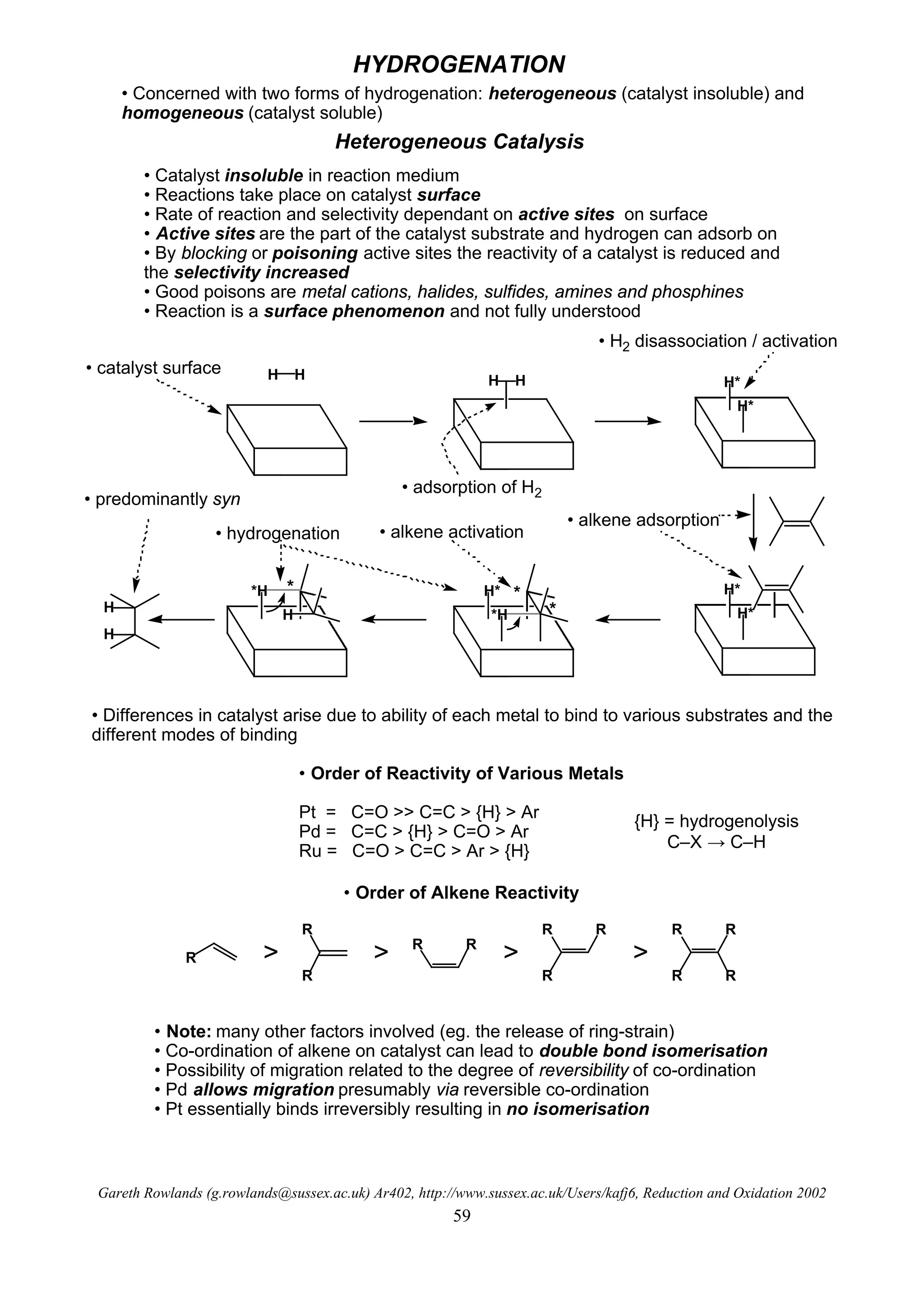
• Concerned with two forms of hydrogenation: heterogeneous (catalyst insoluble) and
homogeneous (catalyst soluble)
Heterogeneous Catalysis
• Catalyst insoluble in reaction medium
• Reactions take place on catalyst surface
• Rate of reaction and selectivity dependant on active sites on surface
• Active sites are the part of the catalyst substrate and hydrogen can adsorb on
• By blocking or poisoning active sites the reactivity of a catalyst is reduced and
the selectivity increased
• Good poisons are metal cations, halides, sulfides, amines and phosphines
• Reaction is a surface phenomenon and not fully understood
H H H H
H*
H*
H*
H*
**H
H***H
H
H
H
• catalyst surface
• adsorption of H2
• H2 disassociation / activation
• alkene adsorption
• alkene activation• hydrogenation
• predominantly syn
• Differences in catalyst arise due to ability of each metal to bind to various substrates and the
different modes of binding
• Order of Reactivity of Various Metals
Pt = C=O >> C=C > {H} > Ar
Pd = C=C > {H} > C=O > Ar
Ru = C=O > C=C > Ar > {H}
{H} = hydrogenolysis
C–X → C–H
• Order of Alkene Reactivity
R
R
R
R R
R
R
R R
R
R
R
> > > >
• Note: many other factors involved (eg. the release of ring-strain)
• Co-ordination of alkene on catalyst can lead to double bond isomerisation
• Possibility of migration related to the degree of reversibility of co-ordination
• Pd allows migration presumably via reversible co-ordination
• Pt essentially binds irreversibly resulting in no isomerisation
Gareth Rowlands (g.rowlands@sussex.ac.uk) Ar402, http://www.sussex.ac.uk/Users/kafj6, Reduction and Oxidation 2002
60
Stereoselectivity
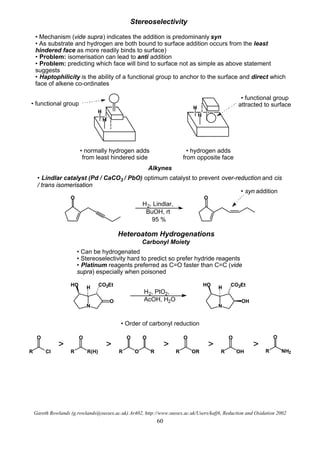
• Mechanism (vide supra) indicates the addition is predominanly syn
• As substrate and hydrogen are both bound to surface addition occurs from the least
hindered face as more readily binds to surface)
• Problem: isomerisation can lead to anti addition
• Problem: predicting which face will bind to surface not as simple as above statement
suggests
• Haptophilicity is the ability of a functional group to anchor to the surface and direct which
face of alkene co-ordinates
H
H
H
H
• normally hydrogen adds
from least hindered side
• hydrogen adds
from opposite face
• functional group
• functional group
attracted to surface
Alkynes
O
• Lindlar catalyst (Pd / CaCO3 / PbO) optimum catalyst to prevent over-reduction and cis
/ trans isomerisation
O
H2, Lindlar,
BuOH, rt
95 %
• syn addition
Heteroatom Hydrogenations
Carbonyl Moiety
• Can be hydrogenated
• Stereoselectivity hard to predict so prefer hydride reagents
• Platinum reagents preferred as C=O faster than C=C (vide
supra) especially when poisoned
N
H
HO CO2Et
O
H2, PtO2,
AcOH, H2O
N
H
HO CO2Et
OH
• Order of carbonyl reduction
R Cl
O
R R(H)
O
R O R
O O
R OR
O
R OH
O
R NH2
O
> > > > >
Gareth Rowlands (g.rowlands@sussex.ac.uk) Ar402, http://www.sussex.ac.uk/Users/kafj6, Reduction and Oxidation 2002
61
Nitriles
N
Bn
C
OBnBnO
OBn
BocHN
N
H2, Pd(OH)2 / C,
MeOH
N
H
OHHO
OH
BocHN NH2
Nitro Group
C4H11
OO
N
O O
O
( )3
C4H11
OO
NH2
O
( )3
N
H
C4H11
OO
( )3
1. H2, Pd / C
2. (CO2H)2
Azides
N
N3 Ph
O
MeO2C
H2. 5 % Pd / C
N
H2N Ph
O
MeO2C
Gareth Rowlands (g.rowlands@sussex.ac.uk) Ar402, http://www.sussex.ac.uk/Users/kafj6, Reduction and Oxidation 2002
62
Homogeneous Catalyst
• Soluble in reaction medium
• Mechanisms much better understood
• Advantages: mild conditions (non-polar solvents which dissolve H2 better)
• Advantages: less catalyst required (each molecule is available for reaction and not just surface)
• Advantages: improved or complimentary selectivity (far more predictable)
• Advantages: directed hydrogenations
• Advantages: asymmetric hydrogenations
Alkene Hydrogenation
• 2 main types of homogeneous catalysts: dihydride and monohydride catalysts
Dihydride Catalysts
LnM + H2
H
LnM
H
• Examples: Wilkinson's Catalyst ClRh(PPh3)3 (hydrogen adds prior to substrate)
Crabtree's Catalyst [Ir(COD)(PCy3)(pyr)]+
PF6
–
(substrate adds before H2)
General Mechanism
LnM
H
MLnMLn
H
LnM H
LnM
H
LnM H
HH HH
H2
H2
reductive
elimination
reductive
elimination
• oxidative
cis addition
Wilkinson's
catalyst
Crabtree's
catalyst
Gareth Rowlands (g.rowlands@sussex.ac.uk) Ar402, http://www.sussex.ac.uk/Users/kafj6, Reduction and Oxidation 2002
63
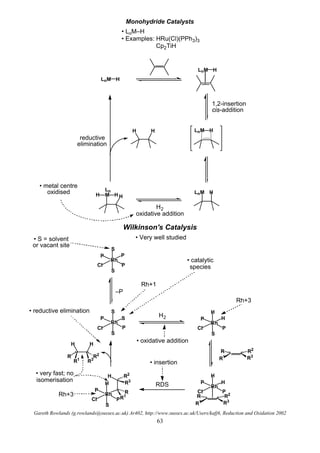
Monohydride Catalysts
• LnM–H
• Examples: HRu(Cl)(PPh3)3
Cp2TiH
LnM H
LnM H
LnM H
Ln
M HHH
LnM H
HH
1,2-insertion
cis-addition
reductive
elimination
Wilkinson's Catalysis
• Very well studied
Cl
Rh
P P
P
S
S
Cl
Rh
P S
P
S
S
Cl
Rh
P H
P
H
S
Cl
Rh
P H
P
H
R3
R1
R R2
Cl
Rh
P
P
H
S
R1
R
H
R3
R2
HH
R3
R1
R R2
R3
R1
R R2
H2
RDS
–P
Rh+1
Rh+3
Rh+3
• oxidative addition
• reductive elimination
H2
oxidative addition
• catalytic
species
• metal centre
oxidised
• insertion
• S = solvent
or vacant site
• very fast; no
isomerisation
Gareth Rowlands (g.rowlands@sussex.ac.uk) Ar402, http://www.sussex.ac.uk/Users/kafj6, Reduction and Oxidation 2002
64
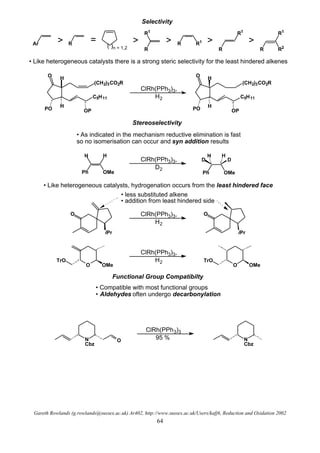
Selectivity
Ar R ( )n = 1,2 R
R1
R R1
R
R1
R
R1
R2
> > > > >=
• Like heterogeneous catalysts there is a strong steric selectivity for the least hindered alkenes
O
PO
C5H11
(CH2)3CO2R
OP
H
H
ClRh(PPh3)3,
H2
O
PO
C5H11
(CH2)3CO2R
OP
H
H
Stereoselectivity
• As indicated in the mechanism reductive elimination is fast
so no isomerisation can occur and syn addition results
Ph
H
OMe
H
ClRh(PPh3)3,
D2
OMePh
HH
DD
• Like heterogeneous catalysts, hydrogenation occurs from the least hindered face
O
iPr
ClRh(PPh3)3,
H2
O
iPr
• less substituted alkene
• addition from least hindered side
O
TrO
OMe
ClRh(PPh3)3,
H2
O
TrO
OMe
Functional Group Compatibilty
• Compatible with most functional groups
• Aldehydes often undergo decarbonylation
N
Cbz
O N
Cbz
ClRh(PPh3)3
95 %
Gareth Rowlands (g.rowlands@sussex.ac.uk) Ar402, http://www.sussex.ac.uk/Users/kafj6, Reduction and Oxidation 2002
65
M
M
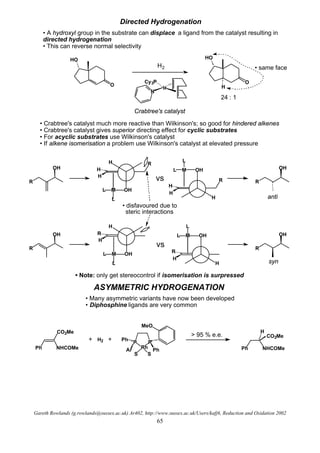
Directed Hydrogenation
• A hydroxyl group in the substrate can displace a ligand from the catalyst resulting in
directed hydrogenation
• This can reverse normal selectivity
HO
O
HO
O
H
N
Ir
Cy3P
Crabtree's catalyst
H2
24 : 1
• same face
• Crabtree's catalyst much more reactive than Wilkinson's; so good for hindered alkenes
• Crabtree's catalyst gives superior directing effect for cyclic substrates
• For acyclic substrates use Wilkinson's catalyst
• If alkene isomerisation a problem use Wilkinson's catalyst at elevated pressure
R
OH
H
OH
R
H
H
L
L
R
H
H
OH
H
L
L
R
OH
R
OH
M
H
R
OH
H
L
L
M
H
OH
H
R
L
L
R
OH
vs
vs
• disfavoured due to
steric interactions
anti
syn
• Note: only get stereocontrol if isomerisation is surpressed
ASYMMETRIC HYDROGENATION
• Many asymmetric variants have now been developed
• Diphosphine ligands are very common
Ph
CO2Me
NHCOMe
+ H2 + P
Rh
P
S S
PhAr
Ph
MeO
Ph NHCOMe
H
CO2Me> 95 % e.e.
Gareth Rowlands (g.rowlands@sussex.ac.uk) Ar402, http://www.sussex.ac.uk/Users/kafj6, Reduction and Oxidation 2002
66
Rh
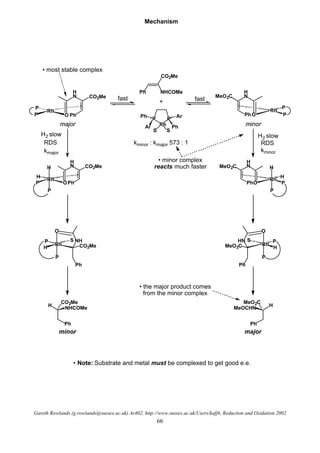
Mechanism
H
N CO2Me
O PhP
P
Rh
H
NMeO2C
OPh P
P
Rh
H
N CO2Me
OPhP
H
H
P
Rh
H
P
O
P
S NH
Ph
CO2Me
Rh
H
NMeO2C
OPh P
H
H
P
Rh
H
P
O
P
SHN
Ph
MeO2C
Ph
H
NHCOMe
CO2Me
Ph
H
MeOCHN
MeO2C
Ph
CO2Me
NHCOMe
P
Rh
P
S S
PhAr
ArPh
+
fast fast
H2 slow
RDS
kmajor
H2 slow
RDS
kminor
minormajor
majorminor
kminor : kmajor 573 : 1
• most stable complex
• minor complex
reacts much faster
• the major product comes
from the minor complex
• Note: Substrate and metal must be complexed to get good e.e.
Gareth Rowlands (g.rowlands@sussex.ac.uk) Ar402, http://www.sussex.ac.uk/Users/kafj6, Reduction and Oxidation 2002
67
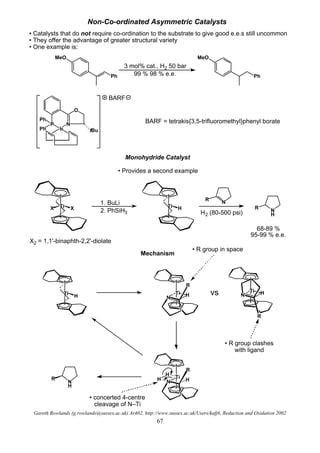
Non-Co-ordinated Asymmetric Catalysts
• Catalysts that do not require co-ordination to the substrate to give good e.e.s still uncommon
• They offer the advantage of greater structural variety
• One example is:
P N
O
tBuIr
Ph
Ph
BARF
Ph
MeO
3 mol% cat., H2 50 bar
99 % 98 % e.e. Ph
MeO
BARF = tetrakis{3,5-trifluoromethyl}phenyl borate
Monohydride Catalyst
• Provides a second example
TiX X
X2 = 1,1'-binaphth-2,2'-diolate
Ti H
NR
N
H
R
1. BuLi
2. PhSiH3 H2 (80-500 psi)
68-89 %
95-99 % e.e.
Ti H
Ti HN
R
Ti HN
R
Ti HN
R
H
H
vs
N
H
R
Mechanism
• R group in space
• R group clashes
with ligand
• concerted 4-centre
cleavage of N–Ti
Gareth Rowlands (g.rowlands@sussex.ac.uk) Ar402, http://www.sussex.ac.uk/Users/kafj6, Reduction and Oxidation 2002
68
R
Transfer Hydrogenation
O
OH
+
OH
O
+
N
ClN
HPh
Ph
Ts
Ru
• free NH crucial
• Mechanism is given in the Oxidation Section of this course
• Problem: the reaction is reversible (hence the oxidation)
• If formic acid / triethyl amine is used as the reductant reaction irreversible
N
H
N
H O
O
H+
N
H
NH +
O
C
O
cat.
Et3N
• gives off CO2
hence irreversible
Hydrogenolysis
R X R H
H2
O
I
OMe
H
I
H2, Ni[R] O OMe
H
• Used to remove various functional groups
• Or protecting groups
O O R
OPh O
H2, Pd / C
O O R
OH O
Easiest
Hardest
RCOCl RCHO
RNO2 RNH2
RC≡CR' RCH=CHR'
RCHO RCH2OH
RCH=CHR' RCH2CH2R'
RCOR' RCHOHR'
ArCH2OR ArCH3 + ROH
RC≡N RCH2NH2
RCO2R' RCH2OH + R'OH
Ease of reduction of functional groups towards catalytic hydrogenation
• note how far
down benzyl
group is
• Note: different catalysts have different propensities
for functional groups so this is only a rough order

Hydrogenation

  • 1.
    Gareth Rowlands (g.rowlands@sussex.ac.uk)Ar402, http://www.sussex.ac.uk/Users/kafj6, Reduction and Oxidation 2002 59 * HYDROGENATION • Concerned with two forms of hydrogenation: heterogeneous (catalyst insoluble) and homogeneous (catalyst soluble) Heterogeneous Catalysis • Catalyst insoluble in reaction medium • Reactions take place on catalyst surface • Rate of reaction and selectivity dependant on active sites on surface • Active sites are the part of the catalyst substrate and hydrogen can adsorb on • By blocking or poisoning active sites the reactivity of a catalyst is reduced and the selectivity increased • Good poisons are metal cations, halides, sulfides, amines and phosphines • Reaction is a surface phenomenon and not fully understood H H H H H* H* H* H* **H H***H H H H • catalyst surface • adsorption of H2 • H2 disassociation / activation • alkene adsorption • alkene activation• hydrogenation • predominantly syn • Differences in catalyst arise due to ability of each metal to bind to various substrates and the different modes of binding • Order of Reactivity of Various Metals Pt = C=O >> C=C > {H} > Ar Pd = C=C > {H} > C=O > Ar Ru = C=O > C=C > Ar > {H} {H} = hydrogenolysis C–X → C–H • Order of Alkene Reactivity R R R R R R R R R R R R > > > > • Note: many other factors involved (eg. the release of ring-strain) • Co-ordination of alkene on catalyst can lead to double bond isomerisation • Possibility of migration related to the degree of reversibility of co-ordination • Pd allows migration presumably via reversible co-ordination • Pt essentially binds irreversibly resulting in no isomerisation
  • 2.
    Gareth Rowlands (g.rowlands@sussex.ac.uk)Ar402, http://www.sussex.ac.uk/Users/kafj6, Reduction and Oxidation 2002 60 Stereoselectivity • Mechanism (vide supra) indicates the addition is predominanly syn • As substrate and hydrogen are both bound to surface addition occurs from the least hindered face as more readily binds to surface) • Problem: isomerisation can lead to anti addition • Problem: predicting which face will bind to surface not as simple as above statement suggests • Haptophilicity is the ability of a functional group to anchor to the surface and direct which face of alkene co-ordinates H H H H • normally hydrogen adds from least hindered side • hydrogen adds from opposite face • functional group • functional group attracted to surface Alkynes O • Lindlar catalyst (Pd / CaCO3 / PbO) optimum catalyst to prevent over-reduction and cis / trans isomerisation O H2, Lindlar, BuOH, rt 95 % • syn addition Heteroatom Hydrogenations Carbonyl Moiety • Can be hydrogenated • Stereoselectivity hard to predict so prefer hydride reagents • Platinum reagents preferred as C=O faster than C=C (vide supra) especially when poisoned N H HO CO2Et O H2, PtO2, AcOH, H2O N H HO CO2Et OH • Order of carbonyl reduction R Cl O R R(H) O R O R O O R OR O R OH O R NH2 O > > > > >
  • 3.
    Gareth Rowlands (g.rowlands@sussex.ac.uk)Ar402, http://www.sussex.ac.uk/Users/kafj6, Reduction and Oxidation 2002 61 Nitriles N Bn C OBnBnO OBn BocHN N H2, Pd(OH)2 / C, MeOH N H OHHO OH BocHN NH2 Nitro Group C4H11 OO N O O O ( )3 C4H11 OO NH2 O ( )3 N H C4H11 OO ( )3 1. H2, Pd / C 2. (CO2H)2 Azides N N3 Ph O MeO2C H2. 5 % Pd / C N H2N Ph O MeO2C
  • 4.
    Gareth Rowlands (g.rowlands@sussex.ac.uk)Ar402, http://www.sussex.ac.uk/Users/kafj6, Reduction and Oxidation 2002 62 Homogeneous Catalyst • Soluble in reaction medium • Mechanisms much better understood • Advantages: mild conditions (non-polar solvents which dissolve H2 better) • Advantages: less catalyst required (each molecule is available for reaction and not just surface) • Advantages: improved or complimentary selectivity (far more predictable) • Advantages: directed hydrogenations • Advantages: asymmetric hydrogenations Alkene Hydrogenation • 2 main types of homogeneous catalysts: dihydride and monohydride catalysts Dihydride Catalysts LnM + H2 H LnM H • Examples: Wilkinson's Catalyst ClRh(PPh3)3 (hydrogen adds prior to substrate) Crabtree's Catalyst [Ir(COD)(PCy3)(pyr)]+ PF6 – (substrate adds before H2) General Mechanism LnM H MLnMLn H LnM H LnM H LnM H HH HH H2 H2 reductive elimination reductive elimination • oxidative cis addition Wilkinson's catalyst Crabtree's catalyst
  • 5.
    Gareth Rowlands (g.rowlands@sussex.ac.uk)Ar402, http://www.sussex.ac.uk/Users/kafj6, Reduction and Oxidation 2002 63 Monohydride Catalysts • LnM–H • Examples: HRu(Cl)(PPh3)3 Cp2TiH LnM H LnM H LnM H Ln M HHH LnM H HH 1,2-insertion cis-addition reductive elimination Wilkinson's Catalysis • Very well studied Cl Rh P P P S S Cl Rh P S P S S Cl Rh P H P H S Cl Rh P H P H R3 R1 R R2 Cl Rh P P H S R1 R H R3 R2 HH R3 R1 R R2 R3 R1 R R2 H2 RDS –P Rh+1 Rh+3 Rh+3 • oxidative addition • reductive elimination H2 oxidative addition • catalytic species • metal centre oxidised • insertion • S = solvent or vacant site • very fast; no isomerisation
  • 6.
    Gareth Rowlands (g.rowlands@sussex.ac.uk)Ar402, http://www.sussex.ac.uk/Users/kafj6, Reduction and Oxidation 2002 64 Selectivity Ar R ( )n = 1,2 R R1 R R1 R R1 R R1 R2 > > > > >= • Like heterogeneous catalysts there is a strong steric selectivity for the least hindered alkenes O PO C5H11 (CH2)3CO2R OP H H ClRh(PPh3)3, H2 O PO C5H11 (CH2)3CO2R OP H H Stereoselectivity • As indicated in the mechanism reductive elimination is fast so no isomerisation can occur and syn addition results Ph H OMe H ClRh(PPh3)3, D2 OMePh HH DD • Like heterogeneous catalysts, hydrogenation occurs from the least hindered face O iPr ClRh(PPh3)3, H2 O iPr • less substituted alkene • addition from least hindered side O TrO OMe ClRh(PPh3)3, H2 O TrO OMe Functional Group Compatibilty • Compatible with most functional groups • Aldehydes often undergo decarbonylation N Cbz O N Cbz ClRh(PPh3)3 95 %
  • 7.
    Gareth Rowlands (g.rowlands@sussex.ac.uk)Ar402, http://www.sussex.ac.uk/Users/kafj6, Reduction and Oxidation 2002 65 M M Directed Hydrogenation • A hydroxyl group in the substrate can displace a ligand from the catalyst resulting in directed hydrogenation • This can reverse normal selectivity HO O HO O H N Ir Cy3P Crabtree's catalyst H2 24 : 1 • same face • Crabtree's catalyst much more reactive than Wilkinson's; so good for hindered alkenes • Crabtree's catalyst gives superior directing effect for cyclic substrates • For acyclic substrates use Wilkinson's catalyst • If alkene isomerisation a problem use Wilkinson's catalyst at elevated pressure R OH H OH R H H L L R H H OH H L L R OH R OH M H R OH H L L M H OH H R L L R OH vs vs • disfavoured due to steric interactions anti syn • Note: only get stereocontrol if isomerisation is surpressed ASYMMETRIC HYDROGENATION • Many asymmetric variants have now been developed • Diphosphine ligands are very common Ph CO2Me NHCOMe + H2 + P Rh P S S PhAr Ph MeO Ph NHCOMe H CO2Me> 95 % e.e.
  • 8.
    Gareth Rowlands (g.rowlands@sussex.ac.uk)Ar402, http://www.sussex.ac.uk/Users/kafj6, Reduction and Oxidation 2002 66 Rh Mechanism H N CO2Me O PhP P Rh H NMeO2C OPh P P Rh H N CO2Me OPhP H H P Rh H P O P S NH Ph CO2Me Rh H NMeO2C OPh P H H P Rh H P O P SHN Ph MeO2C Ph H NHCOMe CO2Me Ph H MeOCHN MeO2C Ph CO2Me NHCOMe P Rh P S S PhAr ArPh + fast fast H2 slow RDS kmajor H2 slow RDS kminor minormajor majorminor kminor : kmajor 573 : 1 • most stable complex • minor complex reacts much faster • the major product comes from the minor complex • Note: Substrate and metal must be complexed to get good e.e.
  • 9.
    Gareth Rowlands (g.rowlands@sussex.ac.uk)Ar402, http://www.sussex.ac.uk/Users/kafj6, Reduction and Oxidation 2002 67 Non-Co-ordinated Asymmetric Catalysts • Catalysts that do not require co-ordination to the substrate to give good e.e.s still uncommon • They offer the advantage of greater structural variety • One example is: P N O tBuIr Ph Ph BARF Ph MeO 3 mol% cat., H2 50 bar 99 % 98 % e.e. Ph MeO BARF = tetrakis{3,5-trifluoromethyl}phenyl borate Monohydride Catalyst • Provides a second example TiX X X2 = 1,1'-binaphth-2,2'-diolate Ti H NR N H R 1. BuLi 2. PhSiH3 H2 (80-500 psi) 68-89 % 95-99 % e.e. Ti H Ti HN R Ti HN R Ti HN R H H vs N H R Mechanism • R group in space • R group clashes with ligand • concerted 4-centre cleavage of N–Ti
  • 10.
    Gareth Rowlands (g.rowlands@sussex.ac.uk)Ar402, http://www.sussex.ac.uk/Users/kafj6, Reduction and Oxidation 2002 68 R Transfer Hydrogenation O OH + OH O + N ClN HPh Ph Ts Ru • free NH crucial • Mechanism is given in the Oxidation Section of this course • Problem: the reaction is reversible (hence the oxidation) • If formic acid / triethyl amine is used as the reductant reaction irreversible N H N H O O H+ N H NH + O C O cat. Et3N • gives off CO2 hence irreversible Hydrogenolysis R X R H H2 O I OMe H I H2, Ni[R] O OMe H • Used to remove various functional groups • Or protecting groups O O R OPh O H2, Pd / C O O R OH O Easiest Hardest RCOCl RCHO RNO2 RNH2 RC≡CR' RCH=CHR' RCHO RCH2OH RCH=CHR' RCH2CH2R' RCOR' RCHOHR' ArCH2OR ArCH3 + ROH RC≡N RCH2NH2 RCO2R' RCH2OH + R'OH Ease of reduction of functional groups towards catalytic hydrogenation • note how far down benzyl group is • Note: different catalysts have different propensities for functional groups so this is only a rough order