DEPARTMENT OF CHEMISTRY
TOPIC – CATALYTIC HYDROGENATION
Presented By
Thippeswamy B A
M.Sc. 2nd Semester
JSTP21CHE028
JSS SCIENCE AND TECHNOLOGY
UNIVERSITY
MYSURU
INDEX
 INTRODUCTION
 CLASSIFICATION
 HETEROGENOUS HYDROGENATION
 HOMOGENOUS HYDROGENATION
 RATE OF REDUCTION
 STEREOCHEMISTRY
 PROBLEMS
 REFERANCE
INTRODUCTION
 A reaction in which hydrogen molecules are added to an alkene
is called a hydrogenation, the reaction is also called reduction
reaction. Alkenes will undergo an addition reaction with
hydrogen in the presence of a catalyst to form alkanes. Catalytic
hydrogenation is the one of the most convenient method to
reduction of alkene. Catalytic hydrogenation is categorised into 2
types
1) Heterogenous Catalytic Hydrogenation.
2) Homogenous Catalytic Hydrogenation
HETEROGENOUS HYDROGENATION.
 Here the reaction will occurs on the surface of metal by absorption of hydrogen. Some
of the metals which or involved in the reaction such as Ni, Pd, and Pt.
 General Mechanism
Rate of reduction
 The case of reduction of an alkene decreases with degree of substitution that is some
times allows selective reduction of one double bond, if more than one double bond is
present with in the molecule.
 Degree of substitution is different then selective reduction takes place.
 Where as if degree of substitution is equal then completely reduced compound will be
only the product.
Stereochemistry
 Catalytic hydrogenation is a stereospecific reaction and gives syn-addition that means
cis -alkene gives racemic mixture.
 If the compound is meso, then it contains more than one assymetric centre or chiral
carbon and plane of symmetry present.
 But experimentally it has been found that the addition of hydrogen is not completely
syn-addition.
 To obtain selective reduction of C=C bond in the presence of other unsaturated groups
in the molecule, Palladium is the best catalyst.
Homogenous hydrogenation
 It is proceed by Wilkinson catalyst and Hydrogen. The use of complexes of Rhodium or
Ruthenium as catalysts enables hydrogenation to be carried out in homogenous
solution.
 [(PPh3)3RhCl] = Wilkinson catalyst is a well known organometallic compound.
 Chloridotris(triphenyl phosphine) Rhodium[I]
 It is also gives syn-addition.
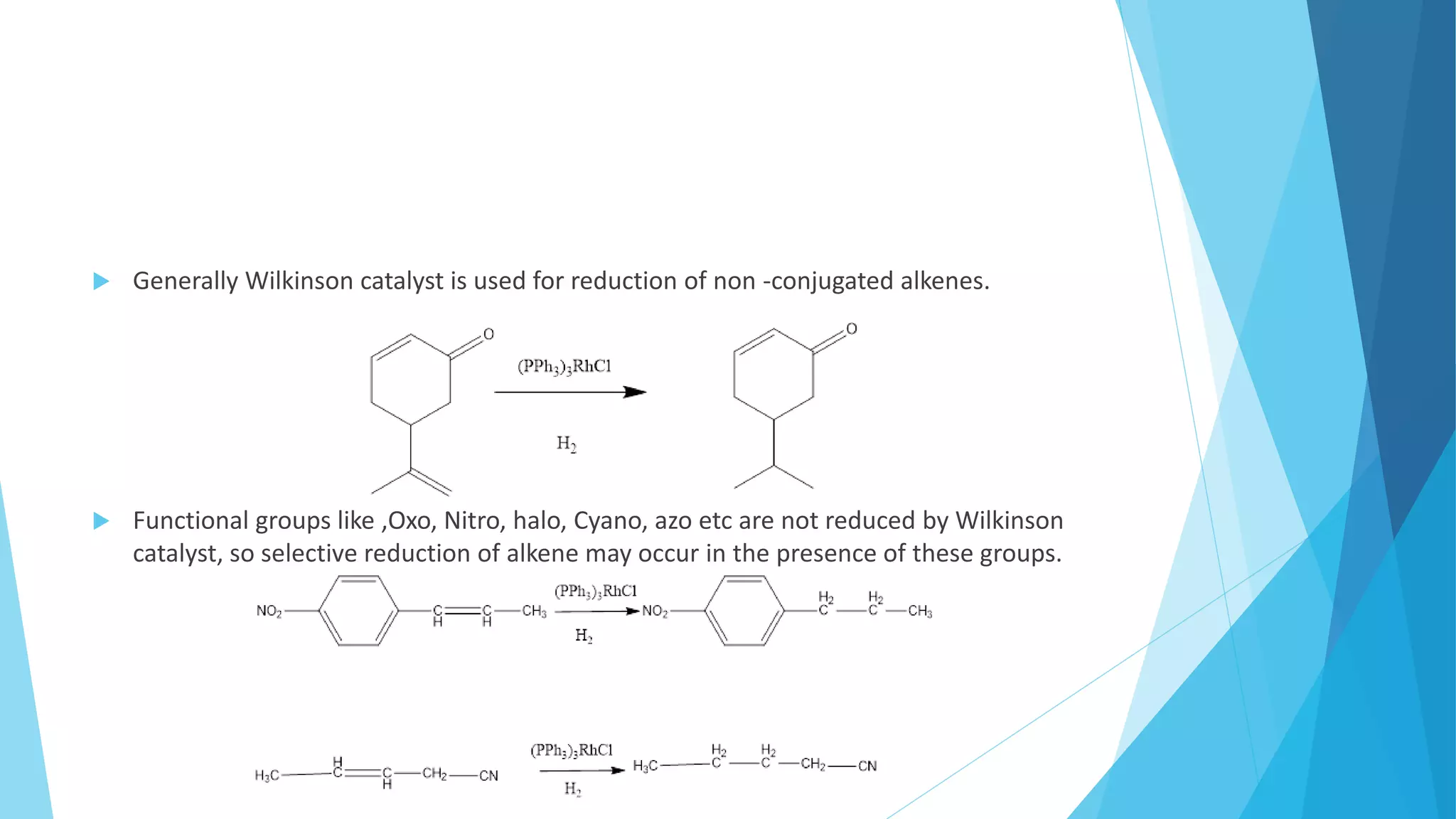
 Generally Wilkinson catalyst is used for reduction of non -conjugated alkenes.
 Functional groups like ,Oxo, Nitro, halo, Cyano, azo etc are not reduced by Wilkinson
catalyst, so selective reduction of alkene may occur in the presence of these groups.
 Less substituted double bond are more rapidly reduced than more substituted double
bonds.
CSIR PROBLEMS
1) Reaction of Cyclohexyl benzyl ether with hydrogen in the presence of 10% Pd/C yields-
--------
(A) Cyclohexanol and toluene
(B) Cyclohexanol and benzyl alcohol
(C) Cyclohexane and benzyl alcohol
(D) Cyclohexane and toluene
2) Catalytic hydrogenation of the following compound produces saturated
hydrocarbon(s). The number of stereoisomer(s) formed is
A)1 B)2 C)3 D)4
REFERENCE
 Organic Reaction Mechanism- V.K.Ahluwalia
 Principles of Organic Synthesis-R.O.C.Norman and J.M.Coxon

Thippeswamy B A.pptx

  • 1.
    DEPARTMENT OF CHEMISTRY TOPIC– CATALYTIC HYDROGENATION Presented By Thippeswamy B A M.Sc. 2nd Semester JSTP21CHE028 JSS SCIENCE AND TECHNOLOGY UNIVERSITY MYSURU
  • 2.
    INDEX  INTRODUCTION  CLASSIFICATION HETEROGENOUS HYDROGENATION  HOMOGENOUS HYDROGENATION  RATE OF REDUCTION  STEREOCHEMISTRY  PROBLEMS  REFERANCE
  • 3.
    INTRODUCTION  A reactionin which hydrogen molecules are added to an alkene is called a hydrogenation, the reaction is also called reduction reaction. Alkenes will undergo an addition reaction with hydrogen in the presence of a catalyst to form alkanes. Catalytic hydrogenation is the one of the most convenient method to reduction of alkene. Catalytic hydrogenation is categorised into 2 types 1) Heterogenous Catalytic Hydrogenation. 2) Homogenous Catalytic Hydrogenation
  • 4.
    HETEROGENOUS HYDROGENATION.  Herethe reaction will occurs on the surface of metal by absorption of hydrogen. Some of the metals which or involved in the reaction such as Ni, Pd, and Pt.  General Mechanism
  • 5.
    Rate of reduction The case of reduction of an alkene decreases with degree of substitution that is some times allows selective reduction of one double bond, if more than one double bond is present with in the molecule.  Degree of substitution is different then selective reduction takes place.
  • 6.
     Where asif degree of substitution is equal then completely reduced compound will be only the product.
  • 7.
    Stereochemistry  Catalytic hydrogenationis a stereospecific reaction and gives syn-addition that means cis -alkene gives racemic mixture.
  • 8.
     If thecompound is meso, then it contains more than one assymetric centre or chiral carbon and plane of symmetry present.
  • 9.
     But experimentallyit has been found that the addition of hydrogen is not completely syn-addition.
  • 10.
     To obtainselective reduction of C=C bond in the presence of other unsaturated groups in the molecule, Palladium is the best catalyst.
  • 11.
    Homogenous hydrogenation  Itis proceed by Wilkinson catalyst and Hydrogen. The use of complexes of Rhodium or Ruthenium as catalysts enables hydrogenation to be carried out in homogenous solution.  [(PPh3)3RhCl] = Wilkinson catalyst is a well known organometallic compound.  Chloridotris(triphenyl phosphine) Rhodium[I]
  • 13.
     It isalso gives syn-addition.
  • 14.
     Generally Wilkinsoncatalyst is used for reduction of non -conjugated alkenes.  Functional groups like ,Oxo, Nitro, halo, Cyano, azo etc are not reduced by Wilkinson catalyst, so selective reduction of alkene may occur in the presence of these groups.
  • 15.
     Less substituteddouble bond are more rapidly reduced than more substituted double bonds.
  • 16.
    CSIR PROBLEMS 1) Reactionof Cyclohexyl benzyl ether with hydrogen in the presence of 10% Pd/C yields- -------- (A) Cyclohexanol and toluene (B) Cyclohexanol and benzyl alcohol (C) Cyclohexane and benzyl alcohol (D) Cyclohexane and toluene
  • 17.
    2) Catalytic hydrogenationof the following compound produces saturated hydrocarbon(s). The number of stereoisomer(s) formed is A)1 B)2 C)3 D)4
  • 19.
    REFERENCE  Organic ReactionMechanism- V.K.Ahluwalia  Principles of Organic Synthesis-R.O.C.Norman and J.M.Coxon