Hydrogen
bonding
Prsented by,
Layba Saifi
M.Sc. Zoology
R.G. P.G.College Meerut
HYDROGEN BONDING
INTRODUCTION
The concept of hydrogen bonding
was first proposed in 1920 by
wendell latimer & worth rodebush .
They used the concept to explain
the anomalous properties of water,
such as its boiling point and freezing
point .
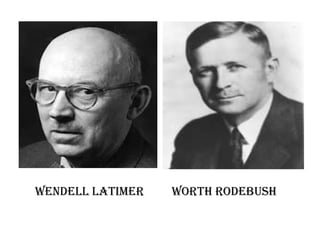
Wendell latimer worth rodebush
Definition
Hydrogen bonding is weak
electrostatic force of attraction
that occurs between a
hydrogen atom & an
electronegative atom ( flourine ,
oxygen & nitrogen).
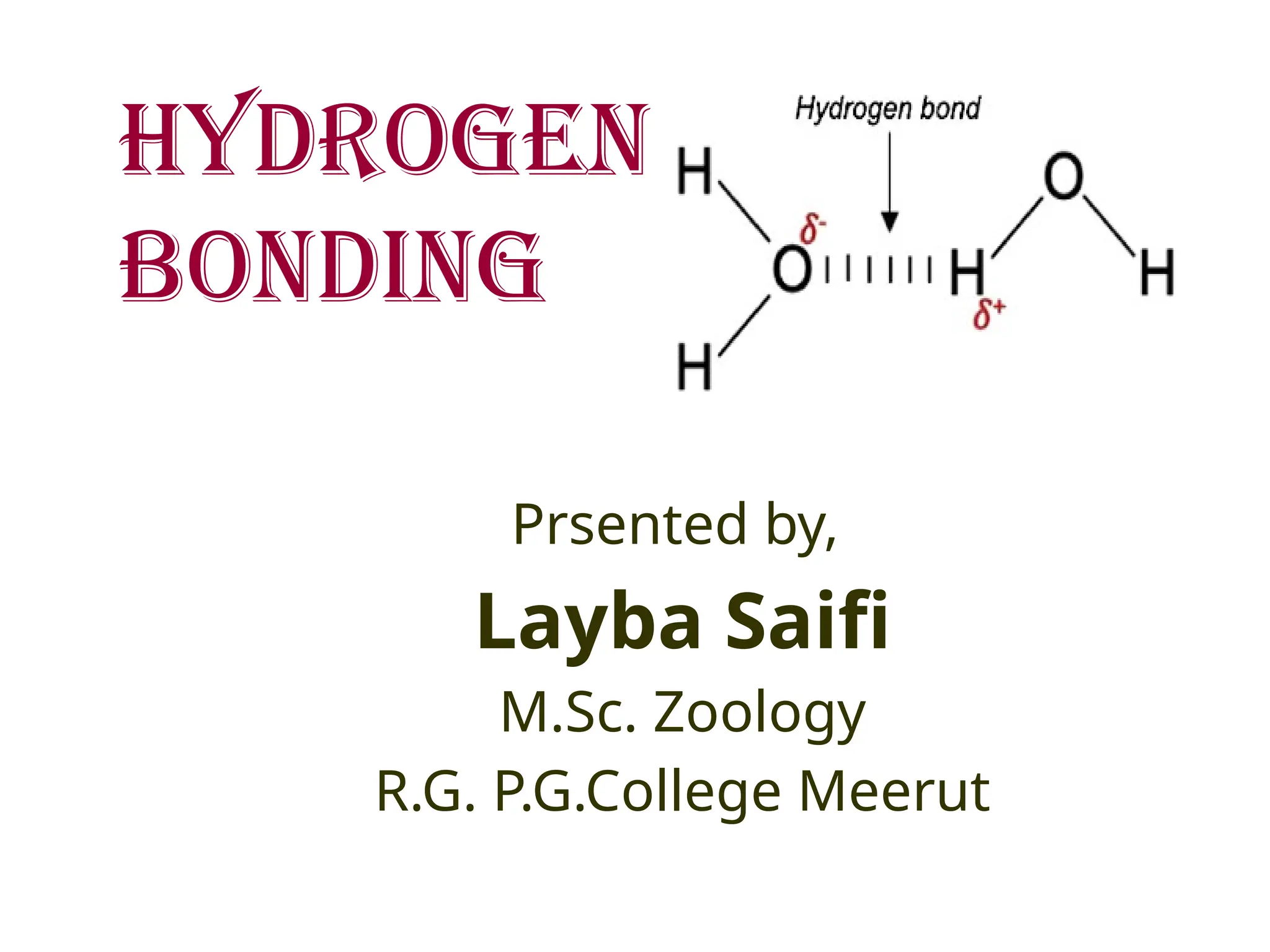
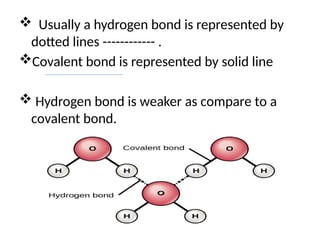
 Usually a hydrogen bond is represented by
dotted lines ------------ .
Covalent bond is represented by solid line
 Hydrogen bond is weaker as compare to a
covalent bond.
• The H atom is more covalently
bonded to a more electronegative
atom, called the donor & is
attracted to another
electronegative atom with a lone
pair of electrons, called the
acceptor.
Condition for hydrogen bonding
• Hydrogen atom should be linked to
a highly electronegative atoms
such as f, o, n.
• The size of electronegative atom
should be small .
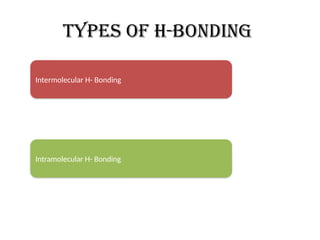
Types of h-bonding
Intermolecular H- Bonding
Intramolecular H- Bonding
Intermolecular h- bonding
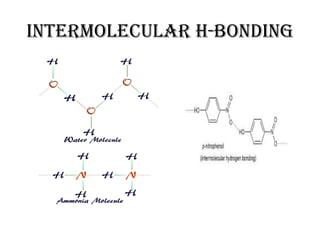
• This type of bonding is formed between two
same or different molecules when combine
together to form a dimer or polymer respectively
& leads to a phenomenon called association.
• Intermolecular H – Bonding increase the boiling
points of the compound and also its solubility in
water.
• Intermolecular H-Bonding is stronger than
Intramolecular H-Bonding.
Intermolecular h-bonding
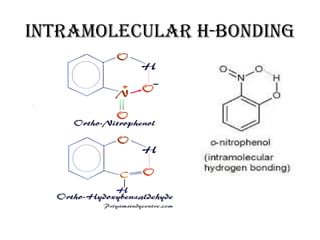
Intramolecular H-bonding
• This type of bonding occur when hydrogen bond is
formed within the two atoms of the same
molecule & leads to a phenomenon called
chelation.
• This type of hydrogen bond frequently occurs in
organic compound & result in the cyclisation ( six
or five member ring ) molecules.
• This type of H-bonding decreases the boiling point
of the compound & also its solubility in water.
Intramolecular h-bonding
Application of h-bonding
 Hydrogen bonding is responsible for the
structure of protein & nucleic acid , such as
DNA.
Hydrogen bonding is responsible for many of
water’s properties , including its high boiling
point & surface tension .
Hydrogen bonding allows water to stick to itself
(cohesion) and other molecules (adhesion).
Hydrogen bonding , Covalent Bond, Biochemistry.pptx

Hydrogen bonding , Covalent Bond, Biochemistry.pptx

  • 1.
    Hydrogen bonding Prsented by, Layba Saifi M.Sc.Zoology R.G. P.G.College Meerut
  • 2.
  • 3.
    INTRODUCTION The concept ofhydrogen bonding was first proposed in 1920 by wendell latimer & worth rodebush . They used the concept to explain the anomalous properties of water, such as its boiling point and freezing point .
  • 4.
  • 5.
    Definition Hydrogen bonding isweak electrostatic force of attraction that occurs between a hydrogen atom & an electronegative atom ( flourine , oxygen & nitrogen).
  • 6.
     Usually ahydrogen bond is represented by dotted lines ------------ . Covalent bond is represented by solid line  Hydrogen bond is weaker as compare to a covalent bond.
  • 7.
    • The Hatom is more covalently bonded to a more electronegative atom, called the donor & is attracted to another electronegative atom with a lone pair of electrons, called the acceptor.
  • 8.
    Condition for hydrogenbonding • Hydrogen atom should be linked to a highly electronegative atoms such as f, o, n. • The size of electronegative atom should be small .
  • 9.
    Types of h-bonding IntermolecularH- Bonding Intramolecular H- Bonding
  • 10.
    Intermolecular h- bonding •This type of bonding is formed between two same or different molecules when combine together to form a dimer or polymer respectively & leads to a phenomenon called association. • Intermolecular H – Bonding increase the boiling points of the compound and also its solubility in water. • Intermolecular H-Bonding is stronger than Intramolecular H-Bonding.
  • 11.
  • 12.
    Intramolecular H-bonding • Thistype of bonding occur when hydrogen bond is formed within the two atoms of the same molecule & leads to a phenomenon called chelation. • This type of hydrogen bond frequently occurs in organic compound & result in the cyclisation ( six or five member ring ) molecules. • This type of H-bonding decreases the boiling point of the compound & also its solubility in water.
  • 13.
  • 14.
    Application of h-bonding Hydrogen bonding is responsible for the structure of protein & nucleic acid , such as DNA. Hydrogen bonding is responsible for many of water’s properties , including its high boiling point & surface tension . Hydrogen bonding allows water to stick to itself (cohesion) and other molecules (adhesion).