Chemistry
Composition of Matter Everything is made of matter Matter  takes up space and has mass Mass  is the measure of the amount of matter in the substance Mass & weight are not the same Weight is the measure of the pull of gravity on an object Matter exists as a solid, liquid or gas
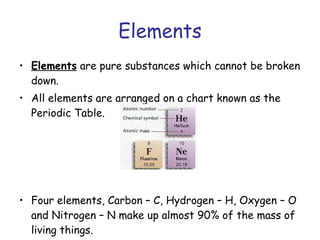
Elements Elements  are pure substances which cannot be broken down. All elements are arranged on a chart known as the Periodic Table. Four elements, Carbon – C, Hydrogen – H, Oxygen – O and Nitrogen – N make up almost 90% of the mass of living things.
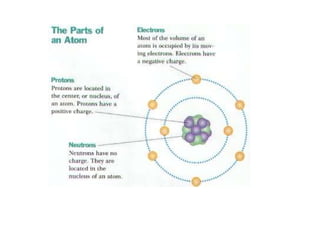
Atoms Atoms are the simplest part of an element that keeps all the element’s properties Atoms consist of 3 subatomic particles- Protons-  Positive charge (p+), found in the nucleus, and determine the atomic number of the element Ex – Carbon has 6 protons so its atomic number is 6 Neutrons   - Neutral charge (n), found in the nucleus and when added to the number of protons, determine the atomic mass of the element. Ex – Sodium has 11 protons and 12 neutrons so its atomic mass is 11 + 12 = 23amu Electrons  – Negative charge (e-), high energy particles that spin around the nucleus in energy levels.
 
Electrons Electrons move around the nucleus in orbitals. Each orbital can hold up to two electrons Orbitals are grouped in electron shells Each electron shell contains a specific number of orbitals.  An electron shell containing a single orbital can hold up to two electrons; a shell with four orbitals can hold up to eight electrons .  Valence electrons – those in the outermost shell.
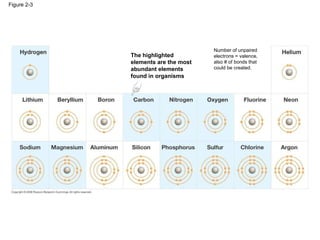
Figure 2-3 The highlighted elements are the most abundant elements found in organisms Number of unpaired electrons = valence,  also # of bonds that could be created.
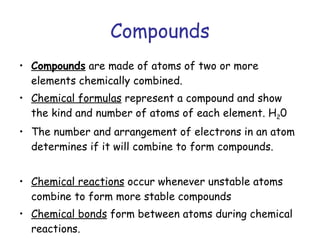
Compounds Compounds  are made of atoms of two or more elements chemically combined. Chemical formulas  represent a compound and show the kind and number of atoms of each element. H 2 0 The number and arrangement of electrons in an atom determines if it will combine to form compounds. Chemical reactions  occur whenever unstable atoms combine to form more stable compounds Chemical bonds  form between atoms during chemical reactions.
Covalent Bonds Form between atoms whenever they share 1 or more pairs of electrons.
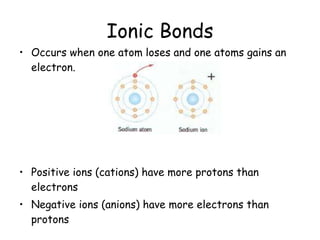
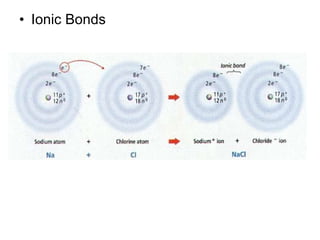
Ionic Bonds Occurs when one atom loses and one atoms gains an electron. Positive ions (cations) have more protons than electrons Negative ions (anions) have more electrons than protons
Ionic Bonds
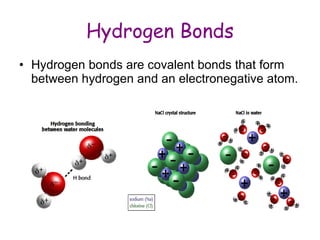
Hydrogen Bonds Hydrogen bonds are covalent bonds that form between hydrogen and an electronegative atom.
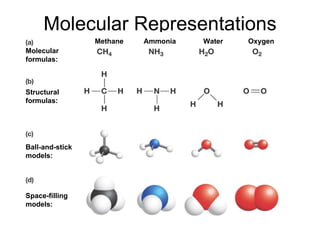
Molecular Representations Methane Ammonia Water Oxygen Molecular formulas: Structural formulas: Ball-and-stick models: Space-filling models:
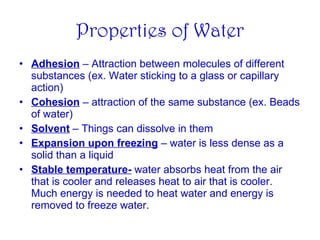
Properties of Water Adhesion  – Attraction between molecules of different substances (ex. Water sticking to a glass or capillary action) Cohesion  – attraction of the same substance (ex. Beads of water) Solvent  – Things can dissolve in them Expansion upon freezing  – water is less dense as a solid than a liquid Stable temperature-  water absorbs heat from the air that is cooler and releases heat to air that is cooler.  Much energy is needed to heat water and energy is removed to freeze water.
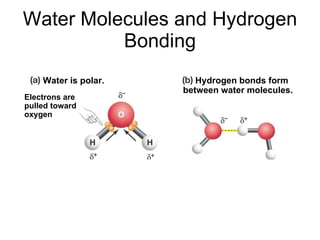
Water Molecules and Hydrogen Bonding Water is polar. Hydrogen bonds form between water molecules.  Electrons are pulled toward oxygen
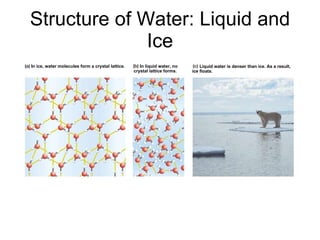
Structure of Water: Liquid and Ice In ice, water molecules form a crystal lattice. In liquid water, no crystal lattice forms. Liquid water is denser than ice. As a result, ice floats.
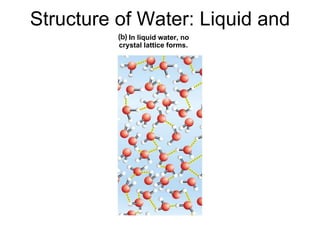
Structure of Water: Liquid and Ice In liquid water, no crystal lattice forms.
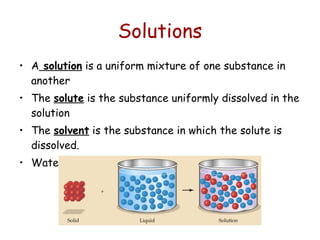
Solutions A  solution  is a uniform mixture of one substance in another The  solute  is the substance uniformly dissolved in the solution The  solvent  is the substance in which the solute is dissolved. Water is the universal solvent
Acids and Bases The force of attraction between molecules is so strong that the oxygen atom of one molecule can actually remove the hydrogen from other water molecules; called dissociation.  H 2 O ----goes to ---  H +   +  OH - OH- called  hydroxide ion   H+ called  hydrogen ion Acidity or alkalinity  is a measure of the relative amount of  H+  and  OH-  ions dissolved in a solution.
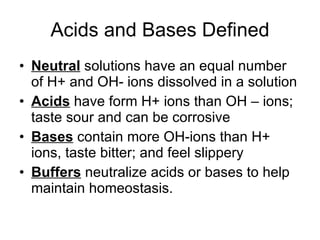
Acids and Bases Defined Neutral  solutions have an equal number of H+ and OH- ions dissolved in a solution Acids  have form H+ ions than OH – ions; taste sour and can be corrosive Bases  contain more OH-ions than H+ ions, taste bitter; and feel slippery  Buffers  neutralize acids or bases to help maintain homeostasis.
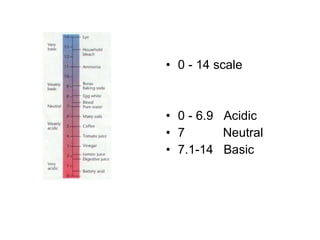
0 - 14 scale 0 - 6.9  Acidic 7  Neutral 7.1-14  Basic

Chemistry ppt

  • 1.
  • 2.
    Composition of MatterEverything is made of matter Matter takes up space and has mass Mass is the measure of the amount of matter in the substance Mass & weight are not the same Weight is the measure of the pull of gravity on an object Matter exists as a solid, liquid or gas
  • 3.
    Elements Elements are pure substances which cannot be broken down. All elements are arranged on a chart known as the Periodic Table. Four elements, Carbon – C, Hydrogen – H, Oxygen – O and Nitrogen – N make up almost 90% of the mass of living things.
  • 4.
    Atoms Atoms arethe simplest part of an element that keeps all the element’s properties Atoms consist of 3 subatomic particles- Protons- Positive charge (p+), found in the nucleus, and determine the atomic number of the element Ex – Carbon has 6 protons so its atomic number is 6 Neutrons - Neutral charge (n), found in the nucleus and when added to the number of protons, determine the atomic mass of the element. Ex – Sodium has 11 protons and 12 neutrons so its atomic mass is 11 + 12 = 23amu Electrons – Negative charge (e-), high energy particles that spin around the nucleus in energy levels.
  • 5.
  • 6.
    Electrons Electrons movearound the nucleus in orbitals. Each orbital can hold up to two electrons Orbitals are grouped in electron shells Each electron shell contains a specific number of orbitals. An electron shell containing a single orbital can hold up to two electrons; a shell with four orbitals can hold up to eight electrons . Valence electrons – those in the outermost shell.
  • 7.
    Figure 2-3 Thehighlighted elements are the most abundant elements found in organisms Number of unpaired electrons = valence, also # of bonds that could be created.
  • 8.
    Compounds Compounds are made of atoms of two or more elements chemically combined. Chemical formulas represent a compound and show the kind and number of atoms of each element. H 2 0 The number and arrangement of electrons in an atom determines if it will combine to form compounds. Chemical reactions occur whenever unstable atoms combine to form more stable compounds Chemical bonds form between atoms during chemical reactions.
  • 9.
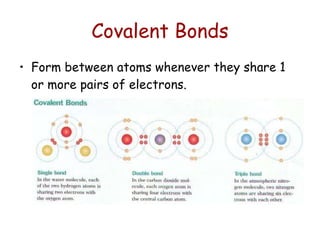
    Covalent Bonds Formbetween atoms whenever they share 1 or more pairs of electrons.
  • 10.
    Ionic Bonds Occurswhen one atom loses and one atoms gains an electron. Positive ions (cations) have more protons than electrons Negative ions (anions) have more electrons than protons
  • 11.
  • 12.
    Hydrogen Bonds Hydrogenbonds are covalent bonds that form between hydrogen and an electronegative atom.
  • 13.
    Molecular Representations MethaneAmmonia Water Oxygen Molecular formulas: Structural formulas: Ball-and-stick models: Space-filling models:
  • 14.
    Properties of WaterAdhesion – Attraction between molecules of different substances (ex. Water sticking to a glass or capillary action) Cohesion – attraction of the same substance (ex. Beads of water) Solvent – Things can dissolve in them Expansion upon freezing – water is less dense as a solid than a liquid Stable temperature- water absorbs heat from the air that is cooler and releases heat to air that is cooler. Much energy is needed to heat water and energy is removed to freeze water.
  • 15.
    Water Molecules andHydrogen Bonding Water is polar. Hydrogen bonds form between water molecules. Electrons are pulled toward oxygen
  • 16.
    Structure of Water:Liquid and Ice In ice, water molecules form a crystal lattice. In liquid water, no crystal lattice forms. Liquid water is denser than ice. As a result, ice floats.
  • 17.
    Structure of Water:Liquid and Ice In liquid water, no crystal lattice forms.
  • 18.
    Solutions A solution is a uniform mixture of one substance in another The solute is the substance uniformly dissolved in the solution The solvent is the substance in which the solute is dissolved. Water is the universal solvent
  • 19.
    Acids and BasesThe force of attraction between molecules is so strong that the oxygen atom of one molecule can actually remove the hydrogen from other water molecules; called dissociation. H 2 O ----goes to --- H + + OH - OH- called hydroxide ion H+ called hydrogen ion Acidity or alkalinity is a measure of the relative amount of H+ and OH- ions dissolved in a solution.
  • 20.
    Acids and BasesDefined Neutral solutions have an equal number of H+ and OH- ions dissolved in a solution Acids have form H+ ions than OH – ions; taste sour and can be corrosive Bases contain more OH-ions than H+ ions, taste bitter; and feel slippery Buffers neutralize acids or bases to help maintain homeostasis.
  • 21.
    0 - 14scale 0 - 6.9 Acidic 7 Neutral 7.1-14 Basic