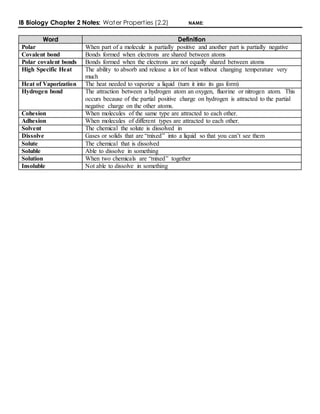
IB Biology Chapter 2 Notes: Water Properties (2.2) NAME:
Word Definition
Polar When part of a molecule is partially positive and another part is partially negative
Covalent bond Bonds formed when electrons are shared between atoms
Polar covalent bonds Bonds formed when the electrons are not equally shared between atoms
High Specific Heat The ability to absorb and release a lot of heat without changing temperature very
much
Heat of Vaporization The heat needed to vaporize a liquid (turn it into its gas form)
Hydrogen bond The attraction between a hydrogen atom an oxygen, fluorine or nitrogen atom. This
occurs because of the partial positive charge on hydrogen is attracted to the partial
negative charge on the other atoms.
Cohesion When molecules of the same type are attracted to each other.
Adhesion When molecules of different types are attracted to each other.
Solvent The chemical the solute is dissolved in
Dissolve Gases or solids that are “mixed” into a liquid so that you can’t see them
Solute The chemical that is dissolved
Soluble Able to dissolve in something
Solution When two chemicals are “mixed” together
Insoluble Not able to dissolve in something
2.2.1 Water molecules are
polar and hydrogen bonds
form between them.
2.2.1 Hydrogen bonding and
dipolarity explain the
adhesive,cohesive, thermal,
and solvent properties of
water.
2.2.3 Substances can be
hydrophilic or hydrophobic.
2.2.4 Compare the thermal
properties of water with
those of methane.
Draw a diagram of a water molecule to the right:
What does it mean that water is a polar molecule?
Describe how hydrogen bonds form:
Adhesive properties:
Thermal properties:
Solvent properties:
Hydrophilic:
Hydrophobic:
Property Methane Water
Formula
Specific Heat
Capacity
Melting point
Boiling point
Explain why water has a much higher melting and boiling temperature than methane:
2.2.5 Explain the use of
water as a coolant in sweat.
2.2.6 Methods oftransport
of glucose, amino acids,
cholesterol, fats, oxygen,
and sodiumchloride in
blood in relation to their
solubility in water.
Sodium chloride:
Amino acids:
Glucose:
Oxygen:
Fat molecules:
Cholesterol:

2.2 Notes

  • 1.
    IB Biology Chapter2 Notes: Water Properties (2.2) NAME: Word Definition Polar When part of a molecule is partially positive and another part is partially negative Covalent bond Bonds formed when electrons are shared between atoms Polar covalent bonds Bonds formed when the electrons are not equally shared between atoms High Specific Heat The ability to absorb and release a lot of heat without changing temperature very much Heat of Vaporization The heat needed to vaporize a liquid (turn it into its gas form) Hydrogen bond The attraction between a hydrogen atom an oxygen, fluorine or nitrogen atom. This occurs because of the partial positive charge on hydrogen is attracted to the partial negative charge on the other atoms. Cohesion When molecules of the same type are attracted to each other. Adhesion When molecules of different types are attracted to each other. Solvent The chemical the solute is dissolved in Dissolve Gases or solids that are “mixed” into a liquid so that you can’t see them Solute The chemical that is dissolved Soluble Able to dissolve in something Solution When two chemicals are “mixed” together Insoluble Not able to dissolve in something
  • 2.
    2.2.1 Water moleculesare polar and hydrogen bonds form between them. 2.2.1 Hydrogen bonding and dipolarity explain the adhesive,cohesive, thermal, and solvent properties of water. 2.2.3 Substances can be hydrophilic or hydrophobic. 2.2.4 Compare the thermal properties of water with those of methane. Draw a diagram of a water molecule to the right: What does it mean that water is a polar molecule? Describe how hydrogen bonds form: Adhesive properties: Thermal properties: Solvent properties: Hydrophilic: Hydrophobic: Property Methane Water Formula Specific Heat Capacity Melting point Boiling point Explain why water has a much higher melting and boiling temperature than methane:
  • 3.
    2.2.5 Explain theuse of water as a coolant in sweat. 2.2.6 Methods oftransport of glucose, amino acids, cholesterol, fats, oxygen, and sodiumchloride in blood in relation to their solubility in water. Sodium chloride: Amino acids: Glucose: Oxygen: Fat molecules: Cholesterol: