Presenter. : Harjot Singh (32)
Moderators : Dr. Zahid Iqbal Mir
Dr. Sanjay Gupta
LIVER HYDATID DISEASE
DIAGNOSIS– INVESTIGATIONS
Investigations
• Imaging techniques: Ultrasonograpghy(USG)
CT
MRI
X –Ray
• Interventional procedures: ERCP
Cyst aspiration, Biopsy
• Routine hematology
• Immunodiagnosis (Serology, Antigen assay, PCR)
• Casoni’s intradermal test
IMAGING TECHNIQUES
✓Ultrasonography
✓Computed tomography
✓Magnetic resonance imaging
• X- ray
Ultrasonography
• Diagnostic investigation of choice
• Sensitivity for evaluation is 90-95%
• It can detect cyst, localise the cyst and can be
used for aspiration purposes
• Advantage – easy availability, affordability,
diagnostic sensitivity, no radiation exposure, non
invasive.
Pathognomic ultrasound diagnostic features
✓Unmistakable daughter cysts ‘rosettes’
within the cyst cavity
✓Detachment of the membrane of the cyst
‘double-contoured membrane’ – floating
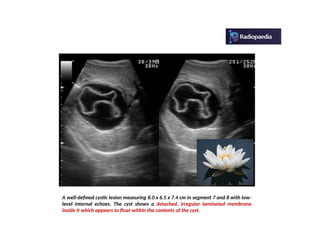
membrane ‘water lily sign’
✓Agglomeration of daughter cysts in the
dependent portion of a cyst – hydatid sand
✓Calcification of the cyst wall.
A well-defined cystic lesion measuring 8.0 x 6.5 x 7.4 cm in segment 7 and 8 with low-
level internal echoes. The cyst shows a detached, irregular laminated membrane
inside it which appears to float within the contents of the cyst.
USG in hydatid disease-
✓ Screening in endemic areas and family members in
infested families
✓ Staging and treatment planning
✓ First-line diagnostics
✓ Interventional, nonoperative treatment procedures
✓ intraoperative US
✓ Treatment monitoring and postoperative follow-up
✓ Workup of patients presenting with jaundice
( daughter cysts vs stones )
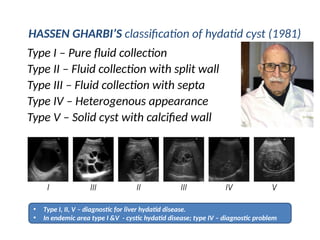
HASSEN GHARBI’S classification of hydatid cyst (1981)
Type I – Pure fluid collection
Type II – Fluid collection with split wall
Type III – Fluid collection with septa
Type IV – Heterogenous appearance
Type V – Solid cyst with calcified wall
• Type I, II, V – diagnostic for liver hydatid disease.
• In endemic area type I &V - cystic hydatid disease; type IV – diagnostic problem
WHO – IWGE USG CLASSIFICATION
✓ Group 1 : Active group – Cyst larger than 2 cm and
often fertile.
✓ Group 2 : Transition group – Cyst starting to
degenerate because of host resistance or
treatment ; may contain viable protoscolices.
✓ Group 3 : Inactive group – Degenerated partially or
totally calcified cyst ; unlikely to contain viable
protoscolices.
WHO
IWGE
USG FEATURES STATU
S
REMARKS GHARBI
S
CL • Signs not
pathognomic
• Unilocular
• No cyst wall
Active • Early stage
• Not fertile
• D/D
necessary
-
CE1 • Unilocular
• Anechoic cystic
lesion
with double line sign
Active • Usually fertile I
CE2 • Multiseptated
“rosette like”
“honeycomb” cyst
Active • Usually fertile III
WHO
IWGE
USG FEATURES STATUS REMARKS GHARBI
S
CE3
A
• Cyst with detached
membrane
“water lilly sign”
- floating membrane
• Less round
( decreased intracystic
pressure)
Transitional II
CE3
B
• Cyst with daughter cyst
in solid matrix
Transitional -
CE4 • Cyst with heterogenous
hypoechoic or
hyperechoic contents
• No daughter cyst
Inactive Usually
no living
protoscoleces
✓ D/D
necessary
IV
How IOUS affects operative
strategy?
✓ Mapping
✓ Multiple cysts
✓ When atrophy / hypertrophy complex
distorts the anatomy
✓ In reoperations for recurrence
✓ Localization and management of
small, nonpalpable cysts deep in liver
parenchyma
✓ Examination of the EHBR
✓ Search for exogenous vesiculation,
especially if nonresectional surgery is
performed.
✓ Detection of CBC
When to suspect CBC on USG ?
✓Dead cyst (heterogeneous US pattern of
the cyst)
✓Hydatid material in the biliary tree
✓Sign of "lost continuity" of the bile duct
adjacent to the cyst wall
✓Gas in the cyst.
Computed tomography
• Most accurate in determining number, position, cyst
characteristics and extent of intra-abdominal disease.
• Discontinuity of the cyst wall in the vicinity of bile ducts
is highly suggestive of CBC.
• Demonstrates exogenous vesiculation - cause of
recurrence
• Characteristically show “Cart wheel” – multivesicular
rossete like pattern.
• Detecting transdiaphragmatic extension and for
assessing the thoracic component
• Used for monitoring lesions during therapy and to detect
reccurences.
CT showing "Cartwheel" Multivesicular rosette
like pattern.
CT of a 50 year old woman showing hepatic hydatid cyst
and the serpentine membrane within the cyst
MRI & MRCP
• High quality images of liver and abdominal hydatidosis
• MRI & MRCP indicated in
✓ Subdiaphragmatic site
✓ Disseminated disease
✓ Extra abdominal location
✓ Complicated, symptomatic cysts , CBC
✓ Jaundiced patients
• Skeletal , vertebral disease and in cardiac cysts
• MR angiography –large cyst , in close proximity to major
vessels or when the patient has been previously operated
several times for hydatid disease and has distorted liver
anatomy
MRI showing water lily sign due to rupture of
membrane
MRI showing large fluid cyst within the liver containing
multiple septations
XRAY
• Limited value
• Endemic area- Elevation of rt.
hemidiaphragm is suggestive
• Plain X-ray may demonstrate
speckled calcification within a
cyst but only in later stages.
ERCP
• Little value in asymptomatic patients - avoided.
• Indications for endoscopic papillotomy in the
preoperative period are
✓ Hydatid material in the CBD
✓ Cholangitis regardless of whether a CBC is
detected
✓ Biliary fistula lasting longer than 3 weeks
✓ High output biliary fistula (>1,000 mL / 24 hours)
✓ Jaundice
✓ Short stricture obstructing the papilla
ERCP showing hydatid membranes that have been extracted from the CBD
Routine hematology
There is nonspecific leukopenia or
thrombocytopenia and mild eosinophilia (15%)
Immunological tests
✓IHA
✓Indirect immunoflourescence
✓Latex agglutination
✓immunoelectrophoresis
✓RIA
✓ELISA
✓ELIEDA
✓IHA
✓Indirect immunoflourescence
✓Latex agglutination
✓immunoelectrophoresis
✓RIA
✓ELISA
✓ELIEDA
✓Detection of precipitation
line (arc 5)
✓Identification of IgG
✓Immunoblot.
✓PCR
✓Detection of precipitation
line (arc 5)
✓Identification of IgG
✓Immunoblot.
✓PCR
• Useful for primary diagnosis and for follow-up after treatment
• Antibody detection is more sensitive than antigen detection
for diagnosis of E. granulosus
ALOGRITHM FOR SEROLOGY
Primary test -ive , asymptomatic, imaging (cystic
echinococcosis ) – Advanced imaging, wait and
watch, repeat serology
Imaging -ive — no further investigation
Symptomatic, imaging (cystic echinococcosis ) – no
further investigation, manage
Primary test +ive, imaging (+/-), Symptoms (+/-) —
Needs Secondary tests
CYST ASPIRATION & BIOPSY
✓ Rarely done — in absence of a + serologic test
— presence of protoscolices, hooklets, or
hydatid membranes
✓ Risk of anaphylaxis and secondary spread of
the infection
✓ Ryan trichrome blue stain ,modified
babxy stain & Ziehl-Neelsen stain
✓ under US or CT guidance; with administration
of albendazole  / praziquantel
Wet mount of contents of hydatid cyst of
liver - scolex of Echinococcus.
Microscopic photograph of aspirated hydatid
fluid showing viable scolices
Casoni’s intradermal test
• Type 1 hypersensitivity skin test.
• Antigen in hydatid fluid is collected from
animal or human cyst and is stertilised.
• Injected (0.2ml) intradermally in one
arm and saline as control in other arm.
• wheal (5cm) in diameter with multiple
pseudopodia like projections within half
hour and fades in an hour.
➢ abandoned now due to nonspecificity.
Differential diagnosis
• Simple (bile duct) cyst
• Hematoma / hemangioma
• Benign adenoma
• Focal nodular hyperplasia
• Metastatic lesion
• Biliary cystadenoma
• Cystadenocarcinoma
• Primary hepatoma
• Pyogenic or amebic abscess
• Echinococcal cyst
ESTABLISHING THE DIAGNOSIS
• Clinical criteria:
✓ slowly growing or static cystic mass (imaging)
✓ anaphylactic reaction (leaking or ruptured cyst)
✓ incidental finding of a cyst in asymptomatic carriers or
detected by screening techniques.
• Diagnostic criteria:
✓ typical organ lesion (imaging)
✓ Specific serum antibodies (serology)
✓ histopathology or parasitology (protoscoleces or hooklets)
✓ pathognomonic macroscopic morphology
REFERENCES

HYDATID CYST.03

  • 1.
    Presenter. : HarjotSingh (32) Moderators : Dr. Zahid Iqbal Mir Dr. Sanjay Gupta LIVER HYDATID DISEASE DIAGNOSIS– INVESTIGATIONS
  • 2.
    Investigations • Imaging techniques:Ultrasonograpghy(USG) CT MRI X –Ray • Interventional procedures: ERCP Cyst aspiration, Biopsy • Routine hematology • Immunodiagnosis (Serology, Antigen assay, PCR) • Casoni’s intradermal test
  • 3.
  • 4.
    Ultrasonography • Diagnostic investigationof choice • Sensitivity for evaluation is 90-95% • It can detect cyst, localise the cyst and can be used for aspiration purposes • Advantage – easy availability, affordability, diagnostic sensitivity, no radiation exposure, non invasive.
  • 5.
    Pathognomic ultrasound diagnosticfeatures ✓Unmistakable daughter cysts ‘rosettes’ within the cyst cavity ✓Detachment of the membrane of the cyst ‘double-contoured membrane’ – floating membrane ‘water lily sign’ ✓Agglomeration of daughter cysts in the dependent portion of a cyst – hydatid sand ✓Calcification of the cyst wall.
  • 6.
    A well-defined cysticlesion measuring 8.0 x 6.5 x 7.4 cm in segment 7 and 8 with low- level internal echoes. The cyst shows a detached, irregular laminated membrane inside it which appears to float within the contents of the cyst.
  • 7.
    USG in hydatiddisease- ✓ Screening in endemic areas and family members in infested families ✓ Staging and treatment planning ✓ First-line diagnostics ✓ Interventional, nonoperative treatment procedures ✓ intraoperative US ✓ Treatment monitoring and postoperative follow-up ✓ Workup of patients presenting with jaundice ( daughter cysts vs stones )
  • 8.
    HASSEN GHARBI’S classificationof hydatid cyst (1981) Type I – Pure fluid collection Type II – Fluid collection with split wall Type III – Fluid collection with septa Type IV – Heterogenous appearance Type V – Solid cyst with calcified wall • Type I, II, V – diagnostic for liver hydatid disease. • In endemic area type I &V - cystic hydatid disease; type IV – diagnostic problem
  • 9.
    WHO – IWGEUSG CLASSIFICATION ✓ Group 1 : Active group – Cyst larger than 2 cm and often fertile. ✓ Group 2 : Transition group – Cyst starting to degenerate because of host resistance or treatment ; may contain viable protoscolices. ✓ Group 3 : Inactive group – Degenerated partially or totally calcified cyst ; unlikely to contain viable protoscolices.
  • 10.
    WHO IWGE USG FEATURES STATU S REMARKSGHARBI S CL • Signs not pathognomic • Unilocular • No cyst wall Active • Early stage • Not fertile • D/D necessary - CE1 • Unilocular • Anechoic cystic lesion with double line sign Active • Usually fertile I CE2 • Multiseptated “rosette like” “honeycomb” cyst Active • Usually fertile III
  • 11.
    WHO IWGE USG FEATURES STATUSREMARKS GHARBI S CE3 A • Cyst with detached membrane “water lilly sign” - floating membrane • Less round ( decreased intracystic pressure) Transitional II CE3 B • Cyst with daughter cyst in solid matrix Transitional - CE4 • Cyst with heterogenous hypoechoic or hyperechoic contents • No daughter cyst Inactive Usually no living protoscoleces ✓ D/D necessary IV
  • 13.
    How IOUS affectsoperative strategy? ✓ Mapping ✓ Multiple cysts ✓ When atrophy / hypertrophy complex distorts the anatomy ✓ In reoperations for recurrence ✓ Localization and management of small, nonpalpable cysts deep in liver parenchyma ✓ Examination of the EHBR ✓ Search for exogenous vesiculation, especially if nonresectional surgery is performed. ✓ Detection of CBC
  • 14.
    When to suspectCBC on USG ? ✓Dead cyst (heterogeneous US pattern of the cyst) ✓Hydatid material in the biliary tree ✓Sign of "lost continuity" of the bile duct adjacent to the cyst wall ✓Gas in the cyst.
  • 15.
    Computed tomography • Mostaccurate in determining number, position, cyst characteristics and extent of intra-abdominal disease. • Discontinuity of the cyst wall in the vicinity of bile ducts is highly suggestive of CBC. • Demonstrates exogenous vesiculation - cause of recurrence • Characteristically show “Cart wheel” – multivesicular rossete like pattern. • Detecting transdiaphragmatic extension and for assessing the thoracic component • Used for monitoring lesions during therapy and to detect reccurences.
  • 16.
    CT showing "Cartwheel"Multivesicular rosette like pattern.
  • 17.
    CT of a50 year old woman showing hepatic hydatid cyst and the serpentine membrane within the cyst
  • 18.
    MRI & MRCP •High quality images of liver and abdominal hydatidosis • MRI & MRCP indicated in ✓ Subdiaphragmatic site ✓ Disseminated disease ✓ Extra abdominal location ✓ Complicated, symptomatic cysts , CBC ✓ Jaundiced patients • Skeletal , vertebral disease and in cardiac cysts • MR angiography –large cyst , in close proximity to major vessels or when the patient has been previously operated several times for hydatid disease and has distorted liver anatomy
  • 19.
    MRI showing waterlily sign due to rupture of membrane
  • 20.
    MRI showing largefluid cyst within the liver containing multiple septations
  • 21.
    XRAY • Limited value •Endemic area- Elevation of rt. hemidiaphragm is suggestive • Plain X-ray may demonstrate speckled calcification within a cyst but only in later stages.
  • 22.
    ERCP • Little valuein asymptomatic patients - avoided. • Indications for endoscopic papillotomy in the preoperative period are ✓ Hydatid material in the CBD ✓ Cholangitis regardless of whether a CBC is detected ✓ Biliary fistula lasting longer than 3 weeks ✓ High output biliary fistula (>1,000 mL / 24 hours) ✓ Jaundice ✓ Short stricture obstructing the papilla
  • 23.
    ERCP showing hydatidmembranes that have been extracted from the CBD
  • 24.
    Routine hematology There isnonspecific leukopenia or thrombocytopenia and mild eosinophilia (15%)
  • 25.
    Immunological tests ✓IHA ✓Indirect immunoflourescence ✓Latexagglutination ✓immunoelectrophoresis ✓RIA ✓ELISA ✓ELIEDA ✓IHA ✓Indirect immunoflourescence ✓Latex agglutination ✓immunoelectrophoresis ✓RIA ✓ELISA ✓ELIEDA ✓Detection of precipitation line (arc 5) ✓Identification of IgG ✓Immunoblot. ✓PCR ✓Detection of precipitation line (arc 5) ✓Identification of IgG ✓Immunoblot. ✓PCR • Useful for primary diagnosis and for follow-up after treatment • Antibody detection is more sensitive than antigen detection for diagnosis of E. granulosus
  • 27.
    ALOGRITHM FOR SEROLOGY Primarytest -ive , asymptomatic, imaging (cystic echinococcosis ) – Advanced imaging, wait and watch, repeat serology Imaging -ive — no further investigation Symptomatic, imaging (cystic echinococcosis ) – no further investigation, manage Primary test +ive, imaging (+/-), Symptoms (+/-) — Needs Secondary tests
  • 28.
    CYST ASPIRATION &BIOPSY ✓ Rarely done — in absence of a + serologic test — presence of protoscolices, hooklets, or hydatid membranes ✓ Risk of anaphylaxis and secondary spread of the infection ✓ Ryan trichrome blue stain ,modified babxy stain & Ziehl-Neelsen stain ✓ under US or CT guidance; with administration of albendazole  / praziquantel Wet mount of contents of hydatid cyst of liver - scolex of Echinococcus.
  • 29.
    Microscopic photograph ofaspirated hydatid fluid showing viable scolices
  • 30.
    Casoni’s intradermal test •Type 1 hypersensitivity skin test. • Antigen in hydatid fluid is collected from animal or human cyst and is stertilised. • Injected (0.2ml) intradermally in one arm and saline as control in other arm. • wheal (5cm) in diameter with multiple pseudopodia like projections within half hour and fades in an hour. ➢ abandoned now due to nonspecificity.
  • 31.
    Differential diagnosis • Simple(bile duct) cyst • Hematoma / hemangioma • Benign adenoma • Focal nodular hyperplasia • Metastatic lesion • Biliary cystadenoma • Cystadenocarcinoma • Primary hepatoma • Pyogenic or amebic abscess • Echinococcal cyst
  • 32.
    ESTABLISHING THE DIAGNOSIS •Clinical criteria: ✓ slowly growing or static cystic mass (imaging) ✓ anaphylactic reaction (leaking or ruptured cyst) ✓ incidental finding of a cyst in asymptomatic carriers or detected by screening techniques. • Diagnostic criteria: ✓ typical organ lesion (imaging) ✓ Specific serum antibodies (serology) ✓ histopathology or parasitology (protoscoleces or hooklets) ✓ pathognomonic macroscopic morphology
  • 34.