P R E P A R E D B Y ,
MS.J.PARUVATHAVARDHINI,AP /ECE
MS.S.MENAGA,AP /ECE
JAI SHRIRAM ENGINEERING
COLLEGE,TIRUPUR
EC 8702- Adhoc and
Wireless Sensor Network
Points to be re-collected
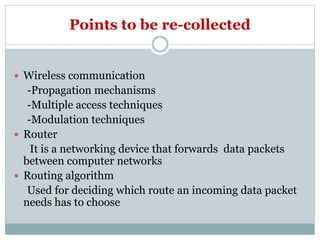
 Wireless communication
-Propagation mechanisms
-Multiple access techniques
-Modulation techniques
 Router
It is a networking device that forwards data packets
between computer networks
 Routing algorithm
Used for deciding which route an incoming data packet
needs has to choose
Continued….
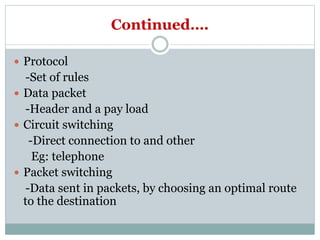
 Protocol
-Set of rules
 Data packet
-Header and a pay load
 Circuit switching
-Direct connection to and other
Eg: telephone
 Packet switching
-Data sent in packets, by choosing an optimal route
to the destination
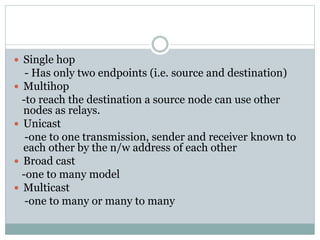
 Single hop
- Has only two endpoints (i.e. source and destination)
 Multihop
-to reach the destination a source node can use other
nodes as relays.
 Unicast
-one to one transmission, sender and receiver known to
each other by the n/w address of each other
 Broad cast
-one to many model
 Multicast
-one to many or many to many
WANET or MANET
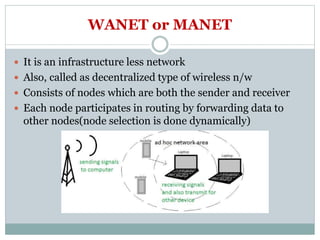
 It is an infrastructure less network
 Also, called as decentralized type of wireless n/w
 Consists of nodes which are both the sender and receiver
 Each node participates in routing by forwarding data to
other nodes(node selection is done dynamically)
In-short, ad-hoc is
 A communication mode that allows computer to
directly communicate with each other without a
router
 Networks are self configuring
 Dynamic networks in which nodes are free to move
Advantages:
 Lack of complexities of infrastructure setup and
administration
 It enables devices to create and join n/ws, “on the fly” any
time, anywhere.
 Each node forwards traffic unrelated to its own use(ie) every
node acts as a router
 The MANETs should be carefully designed
 Each device should be equipped to continuously maintain the
information required to properly route the traffic.
Features
 The desire to route packets to/through every other
node
 The percentage of overhead traffic needed to
maintain real-time routing status
 Each node has its own goodput to route independent
and unaware of others needs,
 All must share limited communication bandwidth,
such as a slice of radio spectrum.
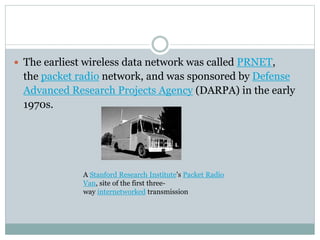
 The earliest wireless data network was called PRNET,
the packet radio network, and was sponsored by Defense
Advanced Research Projects Agency (DARPA) in the early
1970s.
A Stanford Research Institute's Packet Radio
Van, site of the first three-
way internetworked transmission
 These early packet radio systems predated the Internet, and
indeed were part of the motivation of the original Internet
Protocol suite.
 Later DARPA experiments included the Survivable Radio
Network (SURAN) project.
 The growth of laptops and 802.11/Wi-Fi wireless
networking have made MANETs a popular research topic
since the mid-1990s.
 Many academic papers evaluate protocols and their
abilities, assuming varying degrees of mobility within a
bounded space, usually with all nodes within a few hops of
each other.
 Different protocols are then evaluated based on measures
such as the packet drop rate, the overhead introduced by
the routing protocol, end-to-end packet delays, network
throughput, ability to scale, etc.
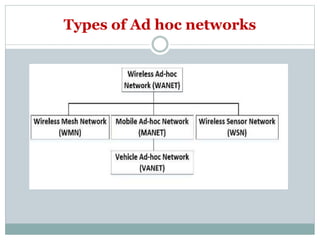
Types of Ad hoc networks
Types of Ad hoc network
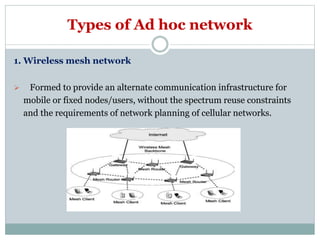
1. Wireless mesh network
 Formed to provide an alternate communication infrastructure for
mobile or fixed nodes/users, without the spectrum reuse constraints
and the requirements of network planning of cellular networks.
Types of Ad hoc network
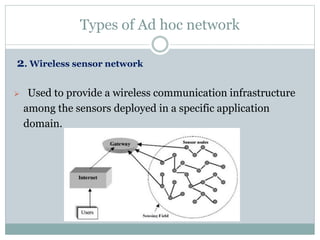
2. Wireless sensor network
 Used to provide a wireless communication infrastructure
among the sensors deployed in a specific application
domain.
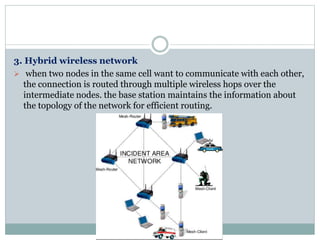
3. Hybrid wireless network
 when two nodes in the same cell want to communicate with each other,
the connection is routed through multiple wireless hops over the
intermediate nodes. the base station maintains the information about
the topology of the network for efficient routing.
Difference between…
Cellular network Ad hoc network
• Fixed infrastructure No infrastructure
• Single hop wireless link Multi hop wireless link
• Centralized routing Distributed routing
• High cost Low cost
• Seamless connectivity Frequent path breaks
due to mobility
•
Applications
 Military applications
 Collaborative computing
 Emergency rescue
 Mesh networks
 Wireless sensor networks
 Multi-hop cellular networks
 Wireless Community Network
Protocol stack
 The challenges affecting MANETs span from various
layers of the OSI protocol stack.
 The media access layer (MAC) has to be improved to
resolve collisions and hidden terminal problems.
 The network layer routing protocol has to be improved
to resolve dynamically changing network topologies
and broken routes.
 The transport layer protocol has to be improved to
handle lost or broken connections.
 The session layer protocol has to deal with discovery of
servers and services
Limitations
 Have high mobility, causing links to be frequently
broken and reestablished.
 Moreover, the bandwidth of a wireless channel is
also limited, and
 Nodes operate on limited battery power, which will
eventually be exhausted
Routing
 There are three types of routing
-Proactive routing
-Reactive routing
-Hybrid routing
Proactive routing
 This type of protocols maintains fresh lists of
destinations and their routes by periodically
distributing routing tables throughout the network
Disadvantages
 Respective amount of data for maintenance.
 Slow reaction on restructuring and failures
- Distance vector routing-based on calculating the
direction and distance to any link in a network
Reactive routing
 This type of protocol finds a route based on user
and traffic demand by flooding the network with
Route Request or Discovery packets
Disadvantages:
 High latency time in route finding.
 Excessive flooding can lead to network clogging.
Flooding- a simple routing algorithm in which
every incoming packet is sent through every
outgoing link except the one it arrived on.
Eg: OSPF, DVMRP
Hybrid routing
 This type of protocol combines the advantages
of proactive and reactive routing. The routing is
initially established with some proactively prospected
routes and then serves the demand from additionally
activated nodes through reactive flooding.
 The choice of one or the other method requires
predetermination for typical cases.
Diadvantages:
 Advantage depends on number of other nodes activated.
 Reaction to traffic demand depends on gradient of traffic
volume
Position-based routing
 Position-based routing methods use information
on the exact locations of the nodes. This
information is obtained for example via
a GPS receiver. Based on the exact location the best
path between source and destination nodes can be
determined.
Eg:"Location-Aided Routing in mobile ad hoc
networks" (LAR)
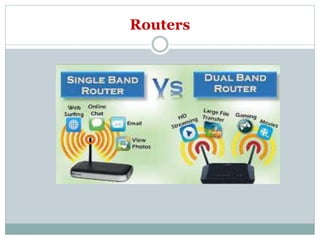
Routers
IEEE 802.11
 IEEE 802.11 is part of the IEEE 802 set of LAN protocols,
and specifies the set of media access control (MAC)
and physical layer (PHY) protocols for
implementing wireless local area network (WLAN) Wi-
Fi computer communication in various frequencies,
including but not limited to 2.4 GHz, 5 GHz, and 60 GHz
frequency bands.
 They are the world's most widely used wireless computer
networking standards, used in most home and office
networks to allow laptops, printers, and smartphones to
talk to each other and access the Internet without
connecting wires.
 They are created and maintained by the Institute of
Electrical and Electronics
Engineers (IEEE) LAN/MAN Standards Committee (IEEE
802).
 The standard and amendments provide the basis for
wireless network products using the Wi- Fi brand.
 While each amendment is officially revoked when it is
incorporated in the latest version of the standard
 The corporate world tends to market to the revisions
because they concisely denote capabilities of their products
 The protocols are typically used in conjunction with IEEE
802.2, and are designed to interwork seamlessly
with Ethernet, and are very often used to carry Internet
Protocol traffic.
 Although IEEE 802.11 specifications list channels that
might be used, the radio frequency spectrum availability
allowed varies significantly by regulatory domain.
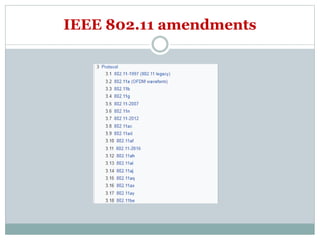
IEEE 802.11 amendments
Thank you

Ad hoc wireless networks-Overview

  • 1.
    P R EP A R E D B Y , MS.J.PARUVATHAVARDHINI,AP /ECE MS.S.MENAGA,AP /ECE JAI SHRIRAM ENGINEERING COLLEGE,TIRUPUR EC 8702- Adhoc and Wireless Sensor Network
  • 2.
    Points to bere-collected  Wireless communication -Propagation mechanisms -Multiple access techniques -Modulation techniques  Router It is a networking device that forwards data packets between computer networks  Routing algorithm Used for deciding which route an incoming data packet needs has to choose
  • 3.
    Continued….  Protocol -Set ofrules  Data packet -Header and a pay load  Circuit switching -Direct connection to and other Eg: telephone  Packet switching -Data sent in packets, by choosing an optimal route to the destination
  • 4.
     Single hop -Has only two endpoints (i.e. source and destination)  Multihop -to reach the destination a source node can use other nodes as relays.  Unicast -one to one transmission, sender and receiver known to each other by the n/w address of each other  Broad cast -one to many model  Multicast -one to many or many to many
  • 5.
    WANET or MANET It is an infrastructure less network  Also, called as decentralized type of wireless n/w  Consists of nodes which are both the sender and receiver  Each node participates in routing by forwarding data to other nodes(node selection is done dynamically)
  • 6.
    In-short, ad-hoc is A communication mode that allows computer to directly communicate with each other without a router  Networks are self configuring  Dynamic networks in which nodes are free to move
  • 7.
    Advantages:  Lack ofcomplexities of infrastructure setup and administration  It enables devices to create and join n/ws, “on the fly” any time, anywhere.  Each node forwards traffic unrelated to its own use(ie) every node acts as a router  The MANETs should be carefully designed  Each device should be equipped to continuously maintain the information required to properly route the traffic.
  • 8.
    Features  The desireto route packets to/through every other node  The percentage of overhead traffic needed to maintain real-time routing status  Each node has its own goodput to route independent and unaware of others needs,  All must share limited communication bandwidth, such as a slice of radio spectrum.
  • 9.
     The earliestwireless data network was called PRNET, the packet radio network, and was sponsored by Defense Advanced Research Projects Agency (DARPA) in the early 1970s. A Stanford Research Institute's Packet Radio Van, site of the first three- way internetworked transmission
  • 10.
     These earlypacket radio systems predated the Internet, and indeed were part of the motivation of the original Internet Protocol suite.  Later DARPA experiments included the Survivable Radio Network (SURAN) project.  The growth of laptops and 802.11/Wi-Fi wireless networking have made MANETs a popular research topic since the mid-1990s.
  • 11.
     Many academicpapers evaluate protocols and their abilities, assuming varying degrees of mobility within a bounded space, usually with all nodes within a few hops of each other.  Different protocols are then evaluated based on measures such as the packet drop rate, the overhead introduced by the routing protocol, end-to-end packet delays, network throughput, ability to scale, etc.
  • 12.
    Types of Adhoc networks
  • 13.
    Types of Adhoc network 1. Wireless mesh network  Formed to provide an alternate communication infrastructure for mobile or fixed nodes/users, without the spectrum reuse constraints and the requirements of network planning of cellular networks.
  • 14.
    Types of Adhoc network 2. Wireless sensor network  Used to provide a wireless communication infrastructure among the sensors deployed in a specific application domain.
  • 15.
    3. Hybrid wirelessnetwork  when two nodes in the same cell want to communicate with each other, the connection is routed through multiple wireless hops over the intermediate nodes. the base station maintains the information about the topology of the network for efficient routing.
  • 16.
    Difference between… Cellular networkAd hoc network • Fixed infrastructure No infrastructure • Single hop wireless link Multi hop wireless link • Centralized routing Distributed routing • High cost Low cost • Seamless connectivity Frequent path breaks due to mobility •
  • 17.
    Applications  Military applications Collaborative computing  Emergency rescue  Mesh networks  Wireless sensor networks  Multi-hop cellular networks  Wireless Community Network
  • 18.
    Protocol stack  Thechallenges affecting MANETs span from various layers of the OSI protocol stack.  The media access layer (MAC) has to be improved to resolve collisions and hidden terminal problems.  The network layer routing protocol has to be improved to resolve dynamically changing network topologies and broken routes.  The transport layer protocol has to be improved to handle lost or broken connections.  The session layer protocol has to deal with discovery of servers and services
  • 19.
    Limitations  Have highmobility, causing links to be frequently broken and reestablished.  Moreover, the bandwidth of a wireless channel is also limited, and  Nodes operate on limited battery power, which will eventually be exhausted
  • 20.
    Routing  There arethree types of routing -Proactive routing -Reactive routing -Hybrid routing
  • 21.
    Proactive routing  Thistype of protocols maintains fresh lists of destinations and their routes by periodically distributing routing tables throughout the network Disadvantages  Respective amount of data for maintenance.  Slow reaction on restructuring and failures - Distance vector routing-based on calculating the direction and distance to any link in a network
  • 22.
    Reactive routing  Thistype of protocol finds a route based on user and traffic demand by flooding the network with Route Request or Discovery packets Disadvantages:  High latency time in route finding.  Excessive flooding can lead to network clogging. Flooding- a simple routing algorithm in which every incoming packet is sent through every outgoing link except the one it arrived on. Eg: OSPF, DVMRP
  • 23.
    Hybrid routing  Thistype of protocol combines the advantages of proactive and reactive routing. The routing is initially established with some proactively prospected routes and then serves the demand from additionally activated nodes through reactive flooding.  The choice of one or the other method requires predetermination for typical cases. Diadvantages:  Advantage depends on number of other nodes activated.  Reaction to traffic demand depends on gradient of traffic volume
  • 24.
    Position-based routing  Position-basedrouting methods use information on the exact locations of the nodes. This information is obtained for example via a GPS receiver. Based on the exact location the best path between source and destination nodes can be determined. Eg:"Location-Aided Routing in mobile ad hoc networks" (LAR)
  • 25.
  • 26.
    IEEE 802.11  IEEE802.11 is part of the IEEE 802 set of LAN protocols, and specifies the set of media access control (MAC) and physical layer (PHY) protocols for implementing wireless local area network (WLAN) Wi- Fi computer communication in various frequencies, including but not limited to 2.4 GHz, 5 GHz, and 60 GHz frequency bands.
  • 27.
     They arethe world's most widely used wireless computer networking standards, used in most home and office networks to allow laptops, printers, and smartphones to talk to each other and access the Internet without connecting wires.  They are created and maintained by the Institute of Electrical and Electronics Engineers (IEEE) LAN/MAN Standards Committee (IEEE 802).
  • 28.
     The standardand amendments provide the basis for wireless network products using the Wi- Fi brand.  While each amendment is officially revoked when it is incorporated in the latest version of the standard  The corporate world tends to market to the revisions because they concisely denote capabilities of their products
  • 29.
     The protocolsare typically used in conjunction with IEEE 802.2, and are designed to interwork seamlessly with Ethernet, and are very often used to carry Internet Protocol traffic.  Although IEEE 802.11 specifications list channels that might be used, the radio frequency spectrum availability allowed varies significantly by regulatory domain.
  • 30.
  • 31.