Air Distribution System of
HVAC
Ashtosh kumar Dubey
Component
• Duct work ,its type ,sizing and Insulation
• Outlet product (Grill & Diffusers)
• Air Control Product
• Air Filter
Duct
Ducts are pipe or passages used in HVAC to deliver and remove air ,For
example, supply air, return air, and exhaust .As such, air ducts are one
method of ensuring acceptable indoor air quality as well as thermal
comfort.
The duct are mostly classified on basis of velocity ,pressure and shape.
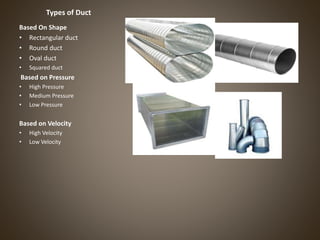
Types of Duct
Based On Shape
• Rectangular duct
• Round duct
• Oval duct
• Squared duct
Based on Pressure
• High Pressure
• Medium Pressure
• Low Pressure
Based on Velocity
• High Velocity
• Low Velocity
Types of Joint Used In Duct
1. Slip Joint
2. Drive slip
3. Flange joint
Material Used for Ducting
1. GI
Galvanized mild steel is standard and most commonly used material used in in fabrication. This
being cheaper ,It is acceptable in most of the application. All the shape of ducting can be fabricated
with GI material.
2. Aluminum
It is noticed that bacterial grow at rusted spot. So GI sheet might rust over the days giving rise to
bacterial growth. This is not of much concern as normal human being has adequate resistance to
bacteria. In hospital the patient in operation theatre,ICU etc. is in most vulnerable condition. There
for at these place AL ducting are used. It is light in weight and rust proof. But this is most
uneconomical and superfluous in normal condition.
3. PI (Pre Insulated Material)
Made of Polyurethane & phenolic foam panel are manufactured with factory applied Aluminum
facing on both side which thickness varies from 25 micrometer to 200 micrometer. The main
advantage of PI material is that it is light in weight and it fabrication takes very less time.
4. Fabric material
In principle a fabric duct is a round, semi-round, or quarter round duct made of a light-
weight fabric material instead of e.g. galvanized steel, stainless steel or aluminum, and
designed for delivery and distribution of cooled or heated air.
Now a days it is used because of its flexibility, mounting, even air distribution and no
insulation required.
Duct Design
Sizing of duct-works in HVAC systems can be done by the
1.Velocity Method
• It is simplest and quickest method of duct design.
• It is based on selection of duct velocities by designer using limiting noise
generation and pressure loss.
• The designer reduces the velocity in subsequent section based on his
experience. The size is drawn be using velocity and discharge from chart.
2.Equal Friction Method
• This method is based on principle that friction rate per unit length in entire
duct system would be maintained constant.
• This can be used by any engineer with knowledge of friction chart.
• For low pressure system friction factor is taken as 0.8 to 1.2 pa/m with duct
velocity not exceeding 10 m/s.
3. The Static Pressure Recovery Method
• This With the static pressure recovery method the secondary and branch
ducts are selected to achieve more or less the same static pressure in front of
all outlets or inlets.
• The major advantage of the method are more common conditions for outlets
and inlets. Unfortunate the method is complicated to use and therefore
seldom used.
• It is used in those part of high pressure system where initial duct velocity
pressure is sufficient to give static pressure regain without unnecessarily low
duct velocity at the end od run.
Other factor Taken in consideration during Duct Design
 Friction rate can be kept constant at 0.08 inch/100Ft of duct length.
 Air flow to be taken from load calculation of that area.
 Restrict aspect ration to 4:1 maximum.
 Velocity to be kept as per application
 Comfort AC
a. Low velocity-1200 -1500 FPM
b. High Velocity –above 2500 FPM
 Industrial Application
a. Low velocity-1200 -1500 FPM
b. High Velocity –above 2500 FPM
Thickness Of GI sheet
Max Size GI Al Joint used
Upto 300 mm 0.63 mm 0.8 mm S Slip Joint
300 to 600 mm 0.63 mm 0.8 mm
S Slip Joint
Drive Slip Joint600 to 750 mm
750 to 1000 mm
0.8 mm 1 mm
Drive Slip Joint
1001 to 1500 40x40 Angle joint
1501 to 2250 1.0 mm 1.5 mm 40x40 Angle joint
2251 to above 1.25 mm 1.8 mm 50x50 Angle joint
Gauge
0.63 mm 24 G
0.8 mm 22G
1.0 mm 20 G
1.25 mm 18 G
1.5 mm 16 G
1.8 mm 14 G
Insulation
• Duct Insulation is mounted or inner lined to reduce heat loss and heat gain
as well as to prevent the condensation on the outer surface of the duct.
• It is usually in the form of duct wrap (outer surface), duct inner liner or
fiberglass duct boards.
• Duct liner provides both thermal insulation and sound attenuation.
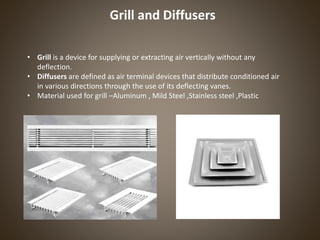
Grill and Diffusers
• Grill is a device for supplying or extracting air vertically without any
deflection.
• Diffusers are defined as air terminal devices that distribute conditioned air
in various directions through the use of its deflecting vanes.
• Material used for grill –Aluminum , Mild Steel ,Stainless steel ,Plastic
Types of Grille and
Diffuser
There are several types of
grille and diffuser to choose
from, as follows;
1. Egg grate grille
2. Bar grille
3. Transfer grille
4. Louvre bladed diffuser
5. Straight bladed diffuser
6. Linear slot diffuser
1.Egg Crate Grille
1. The Egg Crate Grille is probably one of the simplest
and cheapest grilles.
2. If air is to be removed by an extract ventilation
system then a diffuser with profiled blades to direct
the air is not necessary and an egg grate grille can be
used.
3. A grille with a cubical grid core to be used for
return or exhaust where maximum free area is
desired and see-through is not a concern. Typically
used in ceiling applications where see-through sight
lines are minimized to directly below the grille
2.Linear Grille
• The blades of this type of grille are shaped as a bar compared to a narrow
blade.
• The bar profile may be ‘T’ shaped to reduce ‘see through’ visibility.
• It can be used in horizontal and vertical position.
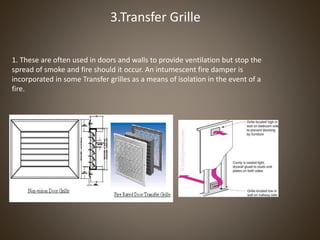
3.Transfer Grille
1. These are often used in doors and walls to provide ventilation but stop the
spread of smoke and fire should it occur. An intumescent fire damper is
incorporated in some Transfer grilles as a means of isolation in the event of a
fire.
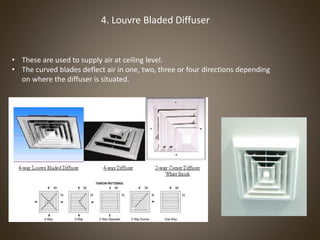
4. Louvre Bladed Diffuser
• These are used to supply air at ceiling level.
• The curved blades deflect air in one, two, three or four directions depending
on where the diffuser is situated.
5. Linear Slot Diffuser
• These are used for an alternative air distribution pattern and for aesthetic reasons.
• Air can be delivered around the perimeter of a room as opposed to point sources interposed in a
ceiling space.
• Linear slots can be used for return air as well as supply.
• In many cases blanking plates are used to create ‘dummy’ slots so that a continuous linear effect is
created.
• One to four slot widths are common depending on how much air is to be delivered.
• Some proprietary plenum boxes are quite tall are require a large ceiling void, to overcome this a special
box can be manufactured to fit the available space.
• Some Slot Diffusers have an adjustable air pattern so that the air distribution can match the room
shape.
• If sound insulation is required in an air conditioning system then a lined plenum box may provide
sufficient sound attenuation.
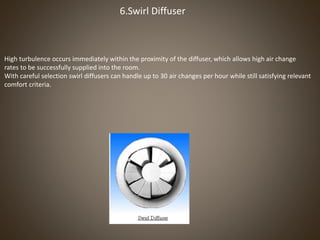
6.Swirl Diffuser
High turbulence occurs immediately within the proximity of the diffuser, which allows high air change
rates to be successfully supplied into the room.
With careful selection swirl diffusers can handle up to 30 air changes per hour while still satisfying relevant
comfort criteria.
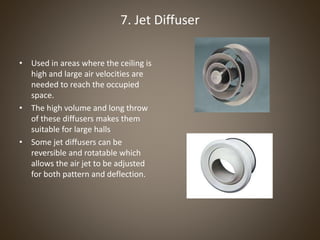
7. Jet Diffuser
• Used in areas where the ceiling is
high and large air velocities are
needed to reach the occupied
space.
• The high volume and long throw
of these diffusers makes them
suitable for large halls
• Some jet diffusers can be
reversible and rotatable which
allows the air jet to be adjusted
for both pattern and deflection.
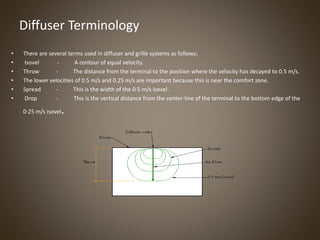
Diffuser Terminology
• There are several terms used in diffuser and grille systems as follows;
• Isovel - A contour of equal velocity.
• Throw - The distance from the terminal to the position where the velocity has decayed to 0.5 m/s.
• The lower velocities of 0.5 m/s and 0.25 m/s are important because this is near the comfort zone.
• Spread - This is the width of the 0·5 m/s isovel .
• Drop - This is the vertical distance from the center-line of the terminal to the bottom edge of the
0·25 m/s isovel.
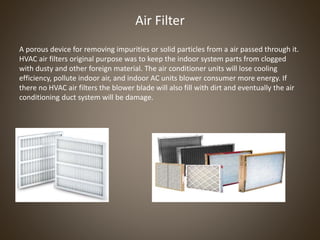
Air Filter
A porous device for removing impurities or solid particles from a air passed through it.
HVAC air filters original purpose was to keep the indoor system parts from clogged
with dusty and other foreign material. The air conditioner units will lose cooling
efficiency, pollute indoor air, and indoor AC units blower consumer more energy. If
there no HVAC air filters the blower blade will also fill with dirt and eventually the air
conditioning duct system will be damage.
Choice of Filter
It depend up on
1.Contamination in air
These are solid like dust ,un burnt carbon ,pollens ,spores ,bacteria and virus like
smoke ,fumes and mist. Their size ,shape and concentration affects the choice of filter.
The sizes are
Tobacco smoke -0.2 Micron
Dust -1 to 100 Micron
Mist -50 to 150 Micron
Bacteria-2 to 10 Micron
Pollen-10 to 150 Micron
2.Performance Criteria
Performance of filter is rated as per air flow resistance and dust capacity efficiency.
The filter resistance varies directly as flow of air and dust load in the air flow. The
capacity of filter is a measure of life of the filter. The efficiency of filter is ration of
mass of impurities removed to mass of total impurities present. But for fine filter
efficiency is measured by dust spot method. The dust spot method measure extent of
blockage of light by the dust spot on the filter. High efficiency filters have low dust
collecting capacity ,lesser life and higher cost.
Types of Filter
1.Disposable filters: These filters are made of a cardboard frame and filter material. As their name implies,
disposable filters are meant to be discarded when they become dirty. They can come in various sizes and
the most common ones are 1″, 2″ and 4″.
2.Washable filters: Washable filters can be removed and cleaned as directed, dried and then reinstalled.
Although more expensive to purchase, you do not have to buy as many as the disposable.
3.Electrostatic filters: Static electricity attracts dirt and dust to vertical and overhead surfaces. The static is
often generated when two surfaces rub together and then are separated. And electrostatic filter puts a
static electrical charge on all particles in the air that pass through eight filter layers. The discharge particles
are then attracted to collector plates with an opposite electrical charge. These filters are washable as well.
4.HEPA filters: HEPA or “high-efficiency particular air filter” removes a high percentage of particles in the
air as the air passes through an air purifier. To qualify as an HEPA filter under US government standards, it
must capture 99.97% of airborne particles. HEPA filters perform significantly better than an ionic process in
electrostatic air cleaners. HEPA filters are most often used in medical facilities and for homeowners who
suffer from severe allergies
5.Ultra Violet light: Ultraviolet light or UV light is a light bulb that is usually inserted into the heating and
cooling system and can eliminate up to 99.9% of the microorganisms and destroy viruses, bacteria, and
fungi in the air. The type of microorganisms and quantity killed depends on the length of exposure and the
output of the lamps. Nowadays there are more advanced UV lights like the air scrubber that can even kill
viruses and bacteria from surfaces and the air.
Air Control Product
The air coming out in branch of duct and collar it need to be control for proper air
distribution. Dampers are used to control air because it offer low cost ,low
maintenance. These damper can be installed in between the duct or at inlet or outlet
of collar.
Types of damper
 Automatic Damper
 Motorized Damper
 Volume control Damper
 Fire Damper
 Collar Damper
All the damper contain blade of various degree, different shapes ,end or center
pivoted and parallel or opposed blade arrangement all uniquely made for specific
application.
1.Automatic Damper
These are commonly associated with wall exhaust or roof ventilator application.
Designed to open automatically when fan turn on and close by gravity when fan
closed. These parallel blade ,end pivoted damper a mechanism which prevent the air
from back flowing trough the system while also serving to exclude outside element
such as rain and snow.
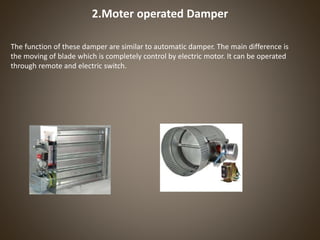
2.Moter operated Damper
The function of these damper are similar to automatic damper. The main difference is
the moving of blade which is completely control by electric motor. It can be operated
through remote and electric switch.
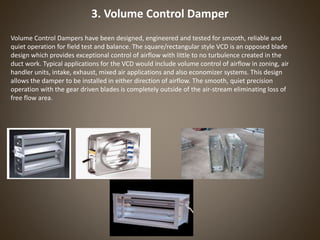
3. Volume Control Damper
Volume Control Dampers have been designed, engineered and tested for smooth, reliable and
quiet operation for field test and balance. The square/rectangular style VCD is an opposed blade
design which provides exceptional control of airflow with little to no turbulence created in the
duct work. Typical applications for the VCD would include volume control of airflow in zoning, air
handler units, intake, exhaust, mixed air applications and also economizer systems. This design
allows the damper to be installed in either direction of airflow. The smooth, quiet precision
operation with the gear driven blades is completely outside of the air-stream eliminating loss of
free flow area.
4. Fire Damper
Fire dampers are passive fire protection products used in HVAC ducts to prevent the spread of fire
inside the ductwork through fire-resistance rated walls and floors. A fire damper works when the
heat from the fire causes the normal temperature of a room to rise to about 165 degrees
Fahrenheit. The fusible link attached to the damper would then melt, causing the damper’s door to
close. In rooms where the normal temperature of the room is consistently higher, a higher degree
fusible link would be attached to the damper. These particular fusible links would melt at a
temperature about 212 Fahrenheit. There are two types of fire damper designs used to help prevent
the spread of flames, a dynamic fire damper and a static fire damper.
5. Collar Damper
This is simple type of damper which is used in cooler to control the air coming out from collar .The
screw or gear system is used in collar damper to operated blade. The blade through lever is set in
such a way that only designed air can come out .
Any Doubt ??????????????????
Air distribution Product

Air distribution Product

  • 1.
    Air Distribution Systemof HVAC Ashtosh kumar Dubey
  • 2.
    Component • Duct work,its type ,sizing and Insulation • Outlet product (Grill & Diffusers) • Air Control Product • Air Filter
  • 3.
    Duct Ducts are pipeor passages used in HVAC to deliver and remove air ,For example, supply air, return air, and exhaust .As such, air ducts are one method of ensuring acceptable indoor air quality as well as thermal comfort. The duct are mostly classified on basis of velocity ,pressure and shape.
  • 4.
    Types of Duct BasedOn Shape • Rectangular duct • Round duct • Oval duct • Squared duct Based on Pressure • High Pressure • Medium Pressure • Low Pressure Based on Velocity • High Velocity • Low Velocity
  • 5.
    Types of JointUsed In Duct 1. Slip Joint 2. Drive slip 3. Flange joint
  • 6.
    Material Used forDucting 1. GI Galvanized mild steel is standard and most commonly used material used in in fabrication. This being cheaper ,It is acceptable in most of the application. All the shape of ducting can be fabricated with GI material. 2. Aluminum It is noticed that bacterial grow at rusted spot. So GI sheet might rust over the days giving rise to bacterial growth. This is not of much concern as normal human being has adequate resistance to bacteria. In hospital the patient in operation theatre,ICU etc. is in most vulnerable condition. There for at these place AL ducting are used. It is light in weight and rust proof. But this is most uneconomical and superfluous in normal condition.
  • 7.
    3. PI (PreInsulated Material) Made of Polyurethane & phenolic foam panel are manufactured with factory applied Aluminum facing on both side which thickness varies from 25 micrometer to 200 micrometer. The main advantage of PI material is that it is light in weight and it fabrication takes very less time. 4. Fabric material In principle a fabric duct is a round, semi-round, or quarter round duct made of a light- weight fabric material instead of e.g. galvanized steel, stainless steel or aluminum, and designed for delivery and distribution of cooled or heated air. Now a days it is used because of its flexibility, mounting, even air distribution and no insulation required.
  • 8.
    Duct Design Sizing ofduct-works in HVAC systems can be done by the 1.Velocity Method • It is simplest and quickest method of duct design. • It is based on selection of duct velocities by designer using limiting noise generation and pressure loss. • The designer reduces the velocity in subsequent section based on his experience. The size is drawn be using velocity and discharge from chart. 2.Equal Friction Method • This method is based on principle that friction rate per unit length in entire duct system would be maintained constant. • This can be used by any engineer with knowledge of friction chart. • For low pressure system friction factor is taken as 0.8 to 1.2 pa/m with duct velocity not exceeding 10 m/s.
  • 9.
    3. The StaticPressure Recovery Method • This With the static pressure recovery method the secondary and branch ducts are selected to achieve more or less the same static pressure in front of all outlets or inlets. • The major advantage of the method are more common conditions for outlets and inlets. Unfortunate the method is complicated to use and therefore seldom used. • It is used in those part of high pressure system where initial duct velocity pressure is sufficient to give static pressure regain without unnecessarily low duct velocity at the end od run.
  • 10.
    Other factor Takenin consideration during Duct Design  Friction rate can be kept constant at 0.08 inch/100Ft of duct length.  Air flow to be taken from load calculation of that area.  Restrict aspect ration to 4:1 maximum.  Velocity to be kept as per application  Comfort AC a. Low velocity-1200 -1500 FPM b. High Velocity –above 2500 FPM  Industrial Application a. Low velocity-1200 -1500 FPM b. High Velocity –above 2500 FPM
  • 11.
    Thickness Of GIsheet Max Size GI Al Joint used Upto 300 mm 0.63 mm 0.8 mm S Slip Joint 300 to 600 mm 0.63 mm 0.8 mm S Slip Joint Drive Slip Joint600 to 750 mm 750 to 1000 mm 0.8 mm 1 mm Drive Slip Joint 1001 to 1500 40x40 Angle joint 1501 to 2250 1.0 mm 1.5 mm 40x40 Angle joint 2251 to above 1.25 mm 1.8 mm 50x50 Angle joint Gauge 0.63 mm 24 G 0.8 mm 22G 1.0 mm 20 G 1.25 mm 18 G 1.5 mm 16 G 1.8 mm 14 G
  • 12.
    Insulation • Duct Insulationis mounted or inner lined to reduce heat loss and heat gain as well as to prevent the condensation on the outer surface of the duct. • It is usually in the form of duct wrap (outer surface), duct inner liner or fiberglass duct boards. • Duct liner provides both thermal insulation and sound attenuation.
  • 13.
    Grill and Diffusers •Grill is a device for supplying or extracting air vertically without any deflection. • Diffusers are defined as air terminal devices that distribute conditioned air in various directions through the use of its deflecting vanes. • Material used for grill –Aluminum , Mild Steel ,Stainless steel ,Plastic
  • 14.
    Types of Grilleand Diffuser There are several types of grille and diffuser to choose from, as follows; 1. Egg grate grille 2. Bar grille 3. Transfer grille 4. Louvre bladed diffuser 5. Straight bladed diffuser 6. Linear slot diffuser
  • 15.
    1.Egg Crate Grille 1.The Egg Crate Grille is probably one of the simplest and cheapest grilles. 2. If air is to be removed by an extract ventilation system then a diffuser with profiled blades to direct the air is not necessary and an egg grate grille can be used. 3. A grille with a cubical grid core to be used for return or exhaust where maximum free area is desired and see-through is not a concern. Typically used in ceiling applications where see-through sight lines are minimized to directly below the grille
  • 16.
    2.Linear Grille • Theblades of this type of grille are shaped as a bar compared to a narrow blade. • The bar profile may be ‘T’ shaped to reduce ‘see through’ visibility. • It can be used in horizontal and vertical position.
  • 17.
    3.Transfer Grille 1. Theseare often used in doors and walls to provide ventilation but stop the spread of smoke and fire should it occur. An intumescent fire damper is incorporated in some Transfer grilles as a means of isolation in the event of a fire.
  • 18.
    4. Louvre BladedDiffuser • These are used to supply air at ceiling level. • The curved blades deflect air in one, two, three or four directions depending on where the diffuser is situated.
  • 19.
    5. Linear SlotDiffuser • These are used for an alternative air distribution pattern and for aesthetic reasons. • Air can be delivered around the perimeter of a room as opposed to point sources interposed in a ceiling space. • Linear slots can be used for return air as well as supply. • In many cases blanking plates are used to create ‘dummy’ slots so that a continuous linear effect is created. • One to four slot widths are common depending on how much air is to be delivered. • Some proprietary plenum boxes are quite tall are require a large ceiling void, to overcome this a special box can be manufactured to fit the available space. • Some Slot Diffusers have an adjustable air pattern so that the air distribution can match the room shape. • If sound insulation is required in an air conditioning system then a lined plenum box may provide sufficient sound attenuation.
  • 20.
    6.Swirl Diffuser High turbulenceoccurs immediately within the proximity of the diffuser, which allows high air change rates to be successfully supplied into the room. With careful selection swirl diffusers can handle up to 30 air changes per hour while still satisfying relevant comfort criteria.
  • 21.
    7. Jet Diffuser •Used in areas where the ceiling is high and large air velocities are needed to reach the occupied space. • The high volume and long throw of these diffusers makes them suitable for large halls • Some jet diffusers can be reversible and rotatable which allows the air jet to be adjusted for both pattern and deflection.
  • 22.
    Diffuser Terminology • Thereare several terms used in diffuser and grille systems as follows; • Isovel - A contour of equal velocity. • Throw - The distance from the terminal to the position where the velocity has decayed to 0.5 m/s. • The lower velocities of 0.5 m/s and 0.25 m/s are important because this is near the comfort zone. • Spread - This is the width of the 0·5 m/s isovel . • Drop - This is the vertical distance from the center-line of the terminal to the bottom edge of the 0·25 m/s isovel.
  • 23.
    Air Filter A porousdevice for removing impurities or solid particles from a air passed through it. HVAC air filters original purpose was to keep the indoor system parts from clogged with dusty and other foreign material. The air conditioner units will lose cooling efficiency, pollute indoor air, and indoor AC units blower consumer more energy. If there no HVAC air filters the blower blade will also fill with dirt and eventually the air conditioning duct system will be damage.
  • 24.
    Choice of Filter Itdepend up on 1.Contamination in air These are solid like dust ,un burnt carbon ,pollens ,spores ,bacteria and virus like smoke ,fumes and mist. Their size ,shape and concentration affects the choice of filter. The sizes are Tobacco smoke -0.2 Micron Dust -1 to 100 Micron Mist -50 to 150 Micron Bacteria-2 to 10 Micron Pollen-10 to 150 Micron 2.Performance Criteria Performance of filter is rated as per air flow resistance and dust capacity efficiency. The filter resistance varies directly as flow of air and dust load in the air flow. The capacity of filter is a measure of life of the filter. The efficiency of filter is ration of mass of impurities removed to mass of total impurities present. But for fine filter efficiency is measured by dust spot method. The dust spot method measure extent of blockage of light by the dust spot on the filter. High efficiency filters have low dust collecting capacity ,lesser life and higher cost.
  • 25.
    Types of Filter 1.Disposablefilters: These filters are made of a cardboard frame and filter material. As their name implies, disposable filters are meant to be discarded when they become dirty. They can come in various sizes and the most common ones are 1″, 2″ and 4″. 2.Washable filters: Washable filters can be removed and cleaned as directed, dried and then reinstalled. Although more expensive to purchase, you do not have to buy as many as the disposable. 3.Electrostatic filters: Static electricity attracts dirt and dust to vertical and overhead surfaces. The static is often generated when two surfaces rub together and then are separated. And electrostatic filter puts a static electrical charge on all particles in the air that pass through eight filter layers. The discharge particles are then attracted to collector plates with an opposite electrical charge. These filters are washable as well. 4.HEPA filters: HEPA or “high-efficiency particular air filter” removes a high percentage of particles in the air as the air passes through an air purifier. To qualify as an HEPA filter under US government standards, it must capture 99.97% of airborne particles. HEPA filters perform significantly better than an ionic process in electrostatic air cleaners. HEPA filters are most often used in medical facilities and for homeowners who suffer from severe allergies 5.Ultra Violet light: Ultraviolet light or UV light is a light bulb that is usually inserted into the heating and cooling system and can eliminate up to 99.9% of the microorganisms and destroy viruses, bacteria, and fungi in the air. The type of microorganisms and quantity killed depends on the length of exposure and the output of the lamps. Nowadays there are more advanced UV lights like the air scrubber that can even kill viruses and bacteria from surfaces and the air.
  • 26.
    Air Control Product Theair coming out in branch of duct and collar it need to be control for proper air distribution. Dampers are used to control air because it offer low cost ,low maintenance. These damper can be installed in between the duct or at inlet or outlet of collar. Types of damper  Automatic Damper  Motorized Damper  Volume control Damper  Fire Damper  Collar Damper All the damper contain blade of various degree, different shapes ,end or center pivoted and parallel or opposed blade arrangement all uniquely made for specific application.
  • 27.
    1.Automatic Damper These arecommonly associated with wall exhaust or roof ventilator application. Designed to open automatically when fan turn on and close by gravity when fan closed. These parallel blade ,end pivoted damper a mechanism which prevent the air from back flowing trough the system while also serving to exclude outside element such as rain and snow.
  • 28.
    2.Moter operated Damper Thefunction of these damper are similar to automatic damper. The main difference is the moving of blade which is completely control by electric motor. It can be operated through remote and electric switch.
  • 29.
    3. Volume ControlDamper Volume Control Dampers have been designed, engineered and tested for smooth, reliable and quiet operation for field test and balance. The square/rectangular style VCD is an opposed blade design which provides exceptional control of airflow with little to no turbulence created in the duct work. Typical applications for the VCD would include volume control of airflow in zoning, air handler units, intake, exhaust, mixed air applications and also economizer systems. This design allows the damper to be installed in either direction of airflow. The smooth, quiet precision operation with the gear driven blades is completely outside of the air-stream eliminating loss of free flow area.
  • 30.
    4. Fire Damper Firedampers are passive fire protection products used in HVAC ducts to prevent the spread of fire inside the ductwork through fire-resistance rated walls and floors. A fire damper works when the heat from the fire causes the normal temperature of a room to rise to about 165 degrees Fahrenheit. The fusible link attached to the damper would then melt, causing the damper’s door to close. In rooms where the normal temperature of the room is consistently higher, a higher degree fusible link would be attached to the damper. These particular fusible links would melt at a temperature about 212 Fahrenheit. There are two types of fire damper designs used to help prevent the spread of flames, a dynamic fire damper and a static fire damper.
  • 31.
    5. Collar Damper Thisis simple type of damper which is used in cooler to control the air coming out from collar .The screw or gear system is used in collar damper to operated blade. The blade through lever is set in such a way that only designed air can come out .
  • 32.