Hurricanes
What is a hurricane?
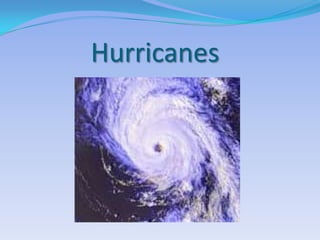
 Hurricanes are tropical cyclones.
 They form in the southern Atlantic Ocean,
 Caribbean, Gulf of Mexico, and eastern
 Pacific Ocean.
 Their winds spiral outward in a
 counterclockwise, circulation pattern.
What conditions must exist for a
hurricane to form?
 Low to medium winds blowing in the same
  direction
 5–30 degrees north of the equator in the ocean
 Ocean surface temperature of greater than 80
  F that extends down to about 150 feet deep (50
  m)
 Lower atmosphere must be moist
How do hurricanes form?
 The air mass above the tropical waters takes on the
  temperature and humidity of the water beneath it.
 Incoming winds force the air upward.
 The warm, moist air rises, forming water vapor and
  clouds.
 Above the storm, the winds flow outward.
 Outside winds blow inward, and the cycle repeats.
How do hurricanes move?
 Hurricanes turn to the right, away from the
 equator, because of the Coriolis Effect
 caused by Earth’s rotation.
 You will learn about this phenomenon later
 in the lesson.
Where does the energy for a
hurricane originate?

 The Sun heats the oceans.

 Warm air rises, and as it cools, it
 releases energy, fueling the hurricane.
Why don’t hurricanes form in
higher latitudes?

 The temperature of the oceans is not
 warm enough.

 The distance is too far from the
 equator.
Hurricane Katrina
Reflective Question

How do oceans play a role in the
development of weather systems including
hurricanes?

Hurricanes cscope with video clips

  • 1.
  • 3.
    What is ahurricane?  Hurricanes are tropical cyclones.  They form in the southern Atlantic Ocean, Caribbean, Gulf of Mexico, and eastern Pacific Ocean.  Their winds spiral outward in a counterclockwise, circulation pattern.
  • 4.
    What conditions mustexist for a hurricane to form?  Low to medium winds blowing in the same direction  5–30 degrees north of the equator in the ocean  Ocean surface temperature of greater than 80 F that extends down to about 150 feet deep (50 m)  Lower atmosphere must be moist
  • 5.
    How do hurricanesform?  The air mass above the tropical waters takes on the temperature and humidity of the water beneath it.  Incoming winds force the air upward.  The warm, moist air rises, forming water vapor and clouds.  Above the storm, the winds flow outward.  Outside winds blow inward, and the cycle repeats.
  • 6.
    How do hurricanesmove?  Hurricanes turn to the right, away from the equator, because of the Coriolis Effect caused by Earth’s rotation.  You will learn about this phenomenon later in the lesson.
  • 7.
    Where does theenergy for a hurricane originate?  The Sun heats the oceans.  Warm air rises, and as it cools, it releases energy, fueling the hurricane.
  • 8.
    Why don’t hurricanesform in higher latitudes?  The temperature of the oceans is not warm enough.  The distance is too far from the equator.
  • 9.
  • 11.
    Reflective Question How dooceans play a role in the development of weather systems including hurricanes?

Editor's Notes

  • #2 http://www.srh.noaa.gov/crp/?n=education-hurricanes
  • #10 http://ngs.woc.noaa.gov/katrina/