Hurricanes & SafetyCreated By: Dominique Turner
Table of ContentsWhat is a Hurricane and how do they form?
The Saffir-Simpson Scale
Where do hurricanes form?
How are hurricanes named?
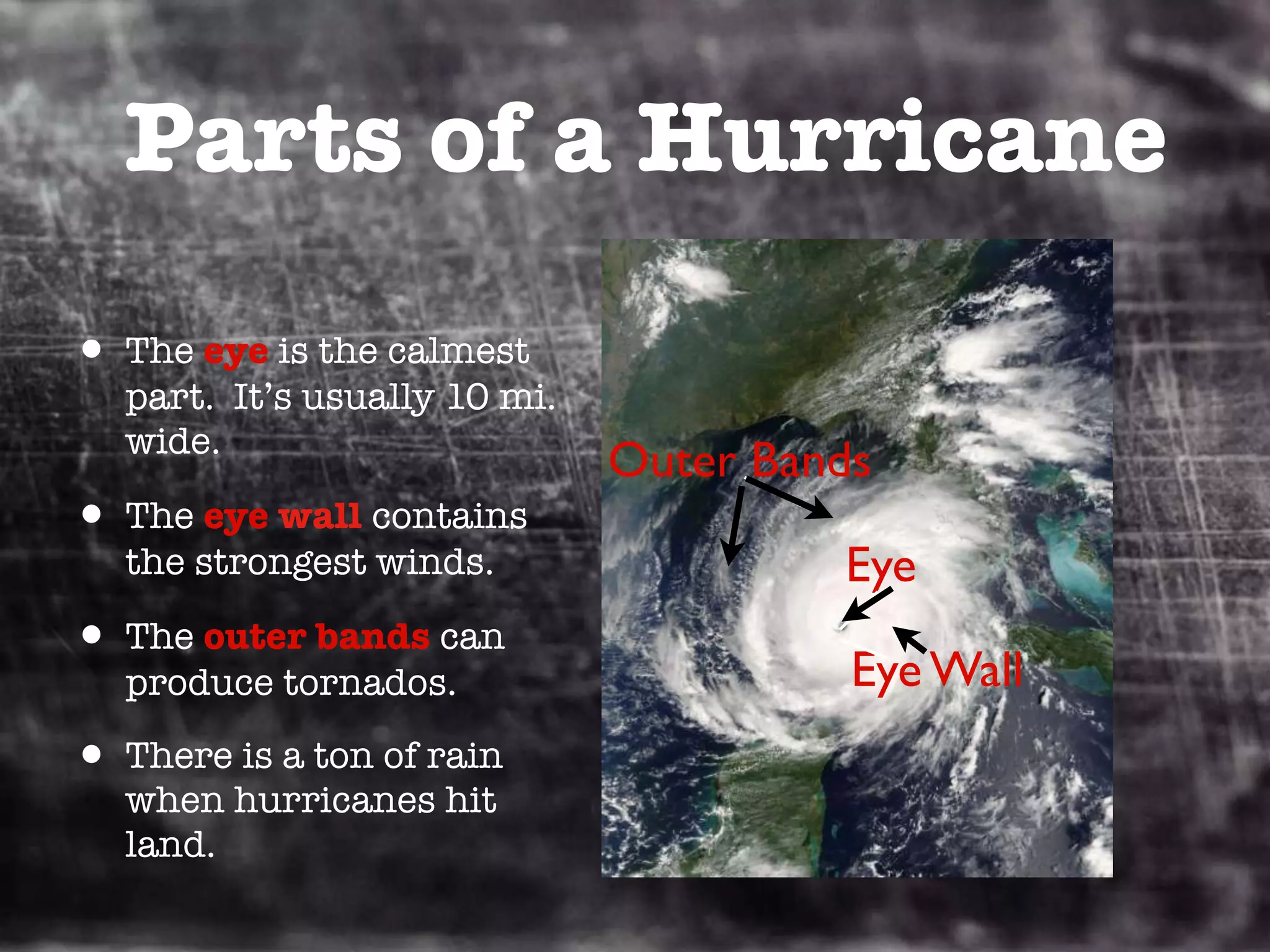
Parts of a hurricane
Hurricane watch vs. Hurricane warning
Hurricane Preparation
Good AdviceWhat Are Hurricanes & How Dow they Form?Large tropical storms with winds greater than 74 MPH.Rotate clockwise in the southern hemisphere.Counter-Clockwise in the northern.They form in water is 80°F and above.Hurricanes contain torrential rain and storm surge that can move into the land causing flooding.Warm water gives it its strength.  Land weakens the hurricane.
Saffir-Simpson ScaleMeasures the intensity of a hurricaneContains 5 categoriesCategory 1 = minor damageCategory 5 = major damage
Saffir-Simpson ScalePressure is 980 millibars (MB). Light DamagePressure is 965-979 MB. Moderate DamagePressure is 945-964 MB. Extensive DamagePressure is 920-944 MB. Extreme DamagePressure is <920 MB. Catastrophic DamageLower Pressure = Stronger Hurricane
Where Do Hurricanes Form?All hurricanes form near the equator.Atlantic, Pacific, and the Indian Ocean.They are not always called hurricanes:Atlantic and Eastern Pacific-HurricanesWestern Pacific-TyphoonsIndian Ocean-Cyclones
Map of FormationHurricanesTyphoonsHurricanesCyclones
How Are Hurricanes Named?Began in 1953.There are 21 names on the list.It’s numbered when it’s a T.D. (<39 MPH).It’s a named when it’s a T.S. (39-73 MPH).Hurricane winds are >73 MPH.The Greek alphabet (Link) is used when names run out. Occurred once in 2005.
How Are Hurricanes Named?On the list of names (Link), male and female names alternate.Male and female names were used starting in 1979.The same name is used every six years.When a storm does major damage, that name is never used again.

Hurricane Facts (Updated May 2011)