Dr. Mohamed Kutty Kakkakunnan
Associate Professor
Pg. Dept. Of Commerce
NAM College Kallikkandy
Kannur – Kerala - India
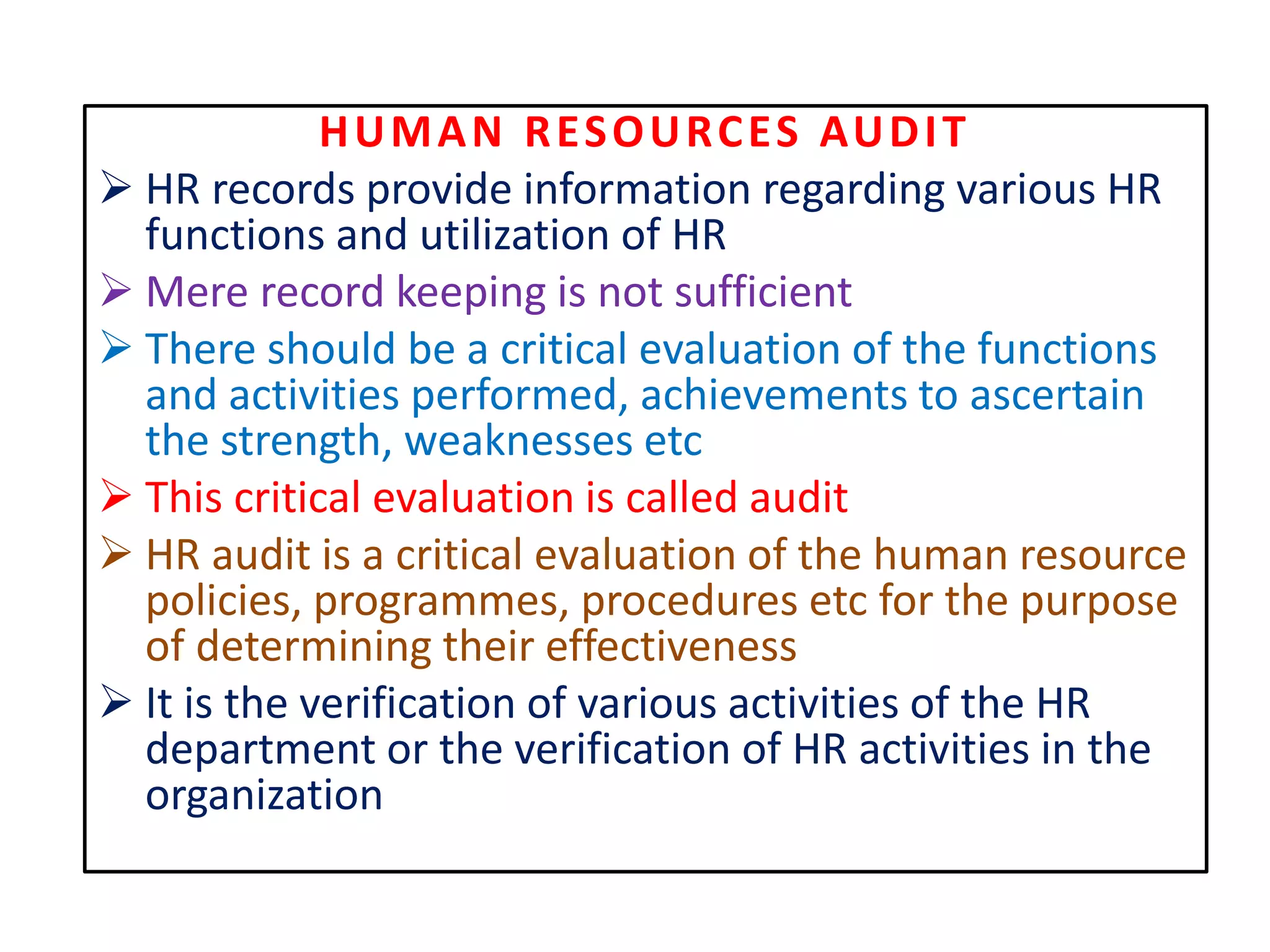
HUMAN RESOURCES AUDIT
 HR records provide information regarding various HR
functions and utilization of HR
 Mere record keeping is not sufficient
 There should be a critical evaluation of the functions
and activities performed, achievements to ascertain
the strength, weaknesses etc
 This critical evaluation is called audit
 HR audit is a critical evaluation of the human resource
policies, programmes, procedures etc for the purpose
of determining their effectiveness
 It is the verification of various activities of the HR
department or the verification of HR activities in the
organization
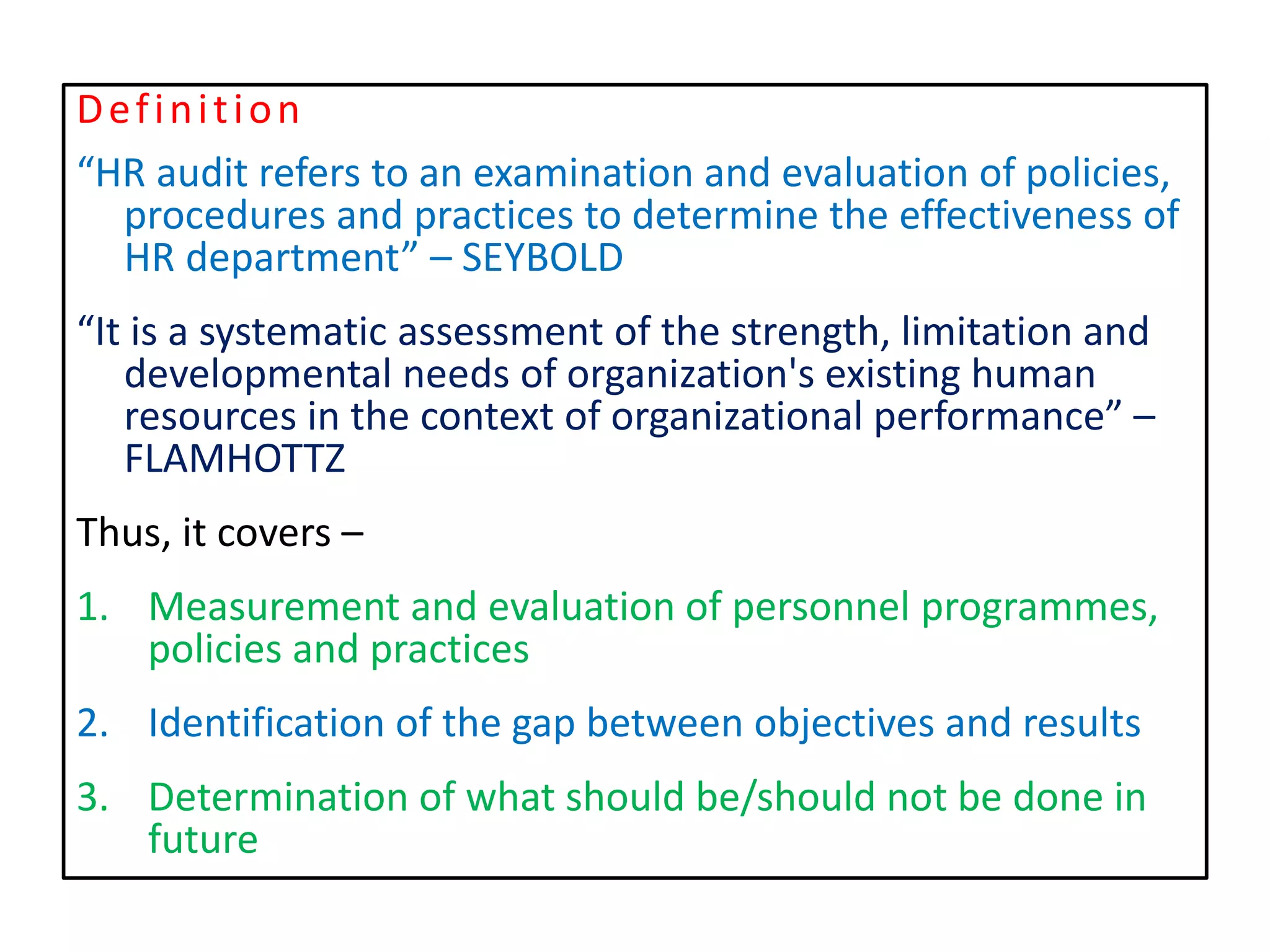
Definition
“HR audit refers to an examination and evaluation of policies,
procedures and practices to determine the effectiveness of
HR department” – SEYBOLD
“It is a systematic assessment of the strength, limitation and
developmental needs of organization's existing human
resources in the context of organizational performance” –
FLAMHOTTZ
Thus, it covers –
1. Measurement and evaluation of personnel programmes,
policies and practices
2. Identification of the gap between objectives and results
3. Determination of what should be/should not be done in
future
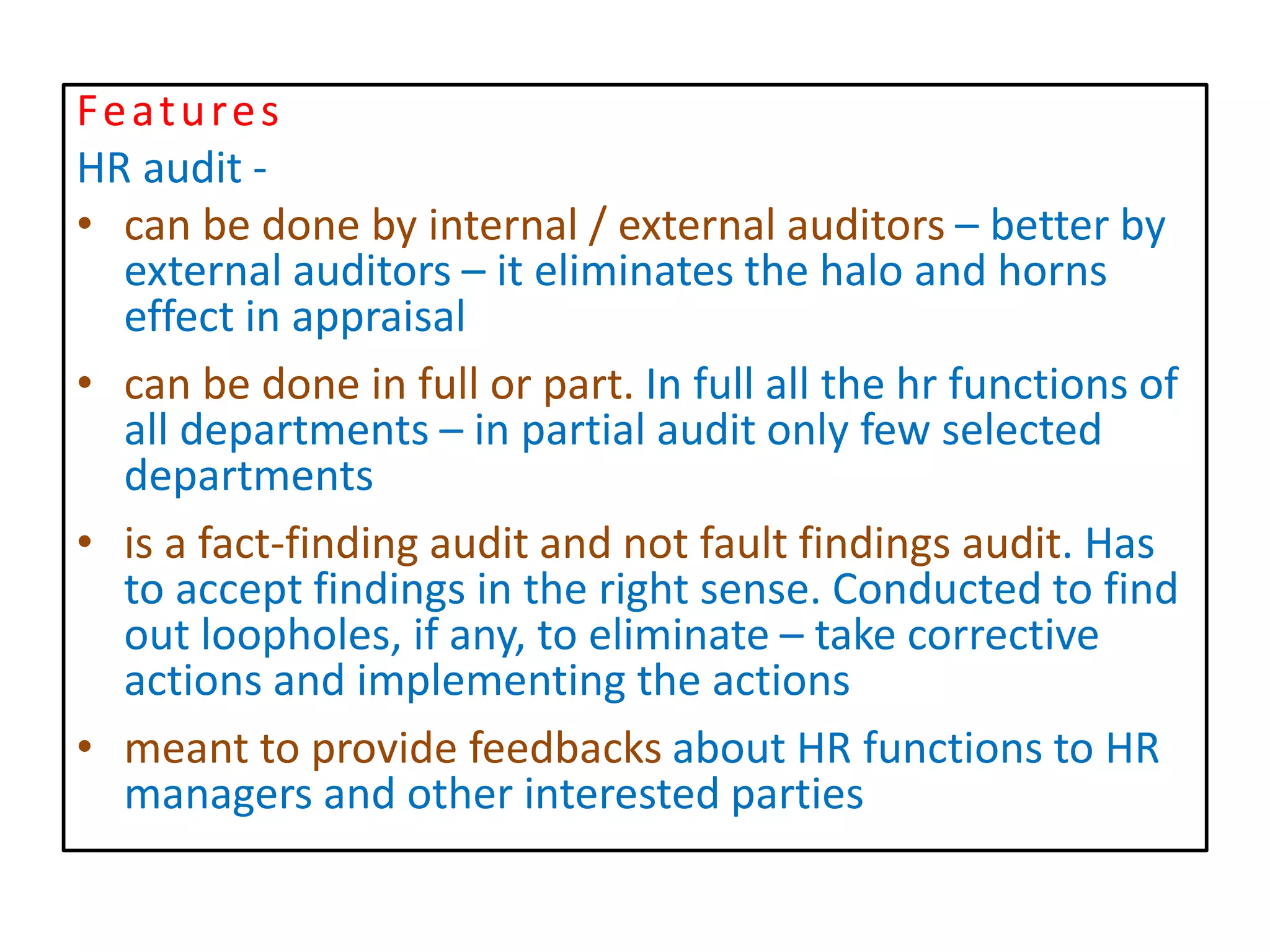
Features
HR audit -
• can be done by internal / external auditors – better by
external auditors – it eliminates the halo and horns
effect in appraisal
• can be done in full or part. In full all the hr functions of
all departments – in partial audit only few selected
departments
• is a fact-finding audit and not fault findings audit. Has
to accept findings in the right sense. Conducted to find
out loopholes, if any, to eliminate – take corrective
actions and implementing the actions
• meant to provide feedbacks about HR functions to HR
managers and other interested parties
Characteristics of HR Audit
1. Comprehensive – HR is essential for all activities-
thus, touches all areas - vision, mission,
objectives, policies, programme and procedures
– HR audit examines all plans short, medium and
long term plans, every function – finance
manufacturing, marketing etc.
2. Linkages with other systems
organization is a system – subsystems – HR is
related with all other systems – HR audit
evaluates the effectiveness of all the systems
3. Business driven – implemented for achieving the
objectives of the business
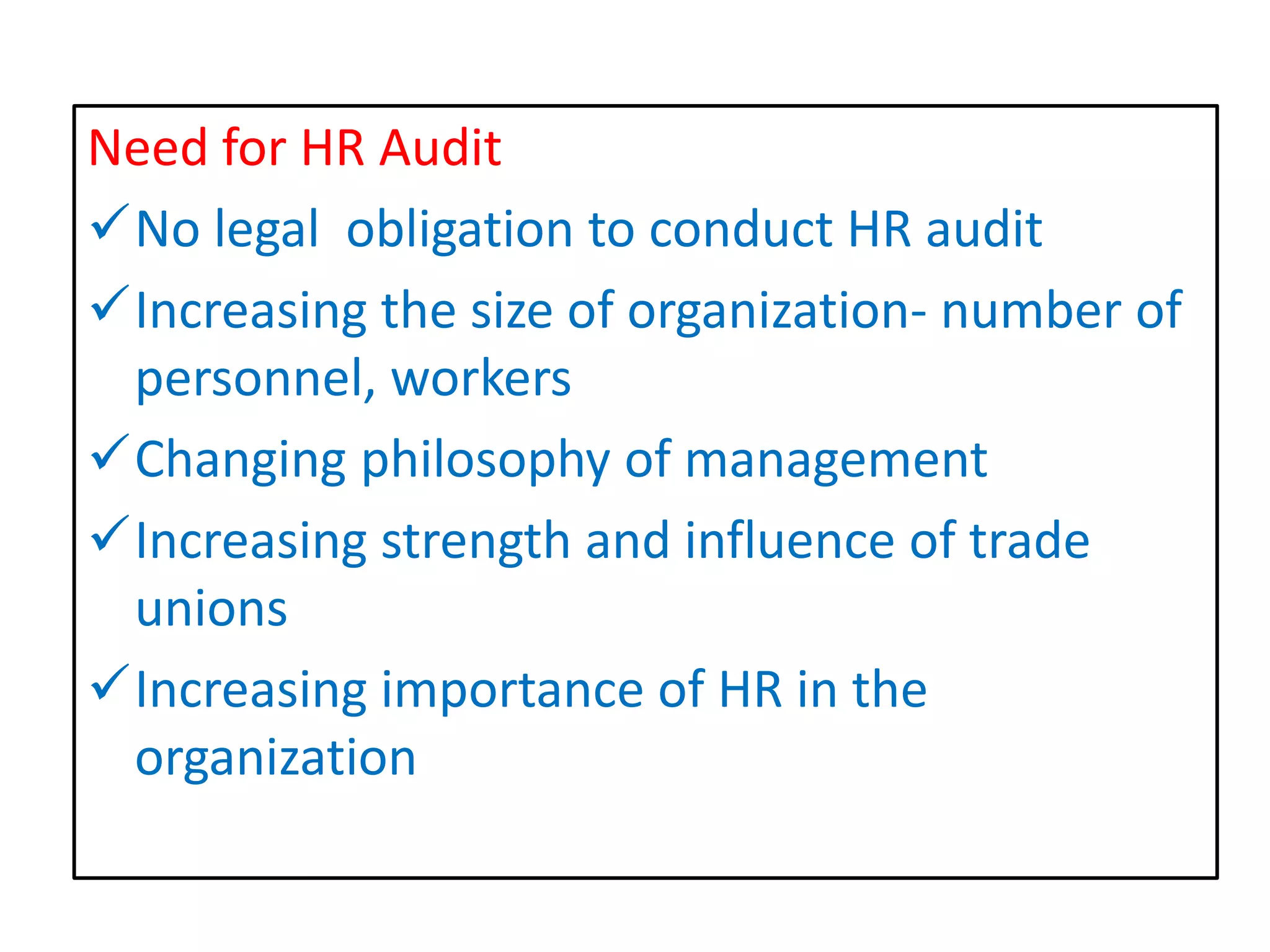
Need for HR Audit
No legal obligation to conduct HR audit
Increasing the size of organization- number of
personnel, workers
Changing philosophy of management
Increasing strength and influence of trade
unions
Increasing importance of HR in the
organization
Benefits of HR Audit
1. Identifies the contributions of HR department
2. Improves professional image of HR Department
3. Encourages greater responsibility and professionalization
among the embers of HR department
4. Classifies the HR duties and responsibilities
5. Stimulates and encourages uniformity of HR policies and
practices
6. Helps to find out critical HR problems
7. Ensure timely compliance with the legal requirements
8. Helps to reduce HR costs
Scope of Personnel (HR) Audit
• Very wide
• Covers the HR philosophy, policy, programmes,
practices and achievements
• Major areas include programming, forecasting, and
scheduling to meet organization personnel needs
• Scope includes:-
Human resource inventory
Current competency
Human resource development requirements
Organizational climate assessment
Human resource achievements
Scope extents to the following HR functions
• Procurement function
• Development function
• Compensation function
• Maintenance function
• Integration function
Following as p ects come u n d er th e s cop e of HR au d it
• Performance and potential appraisal
• Legal compliance
• Compensation, reward, incentives, salary administration
• Recruitment and selection
• Induction and placement
• Development and training
• Separation
• Employee retention
• Communication
• Files/record maintenance and technology
• Policies and procedures
Utility of Personnel Records
Very important in HR audit – verification of various records to
ascertain the efficiency and effectiveness of HR department
and Organization as a whole. Records provide the basis for
HR audit. Each and every record is very important
HR Audit Methodology
HR audit can be conducted in different ways by using different
methods
• Interviewing the concerned with a checklist
• Verify all books, records, documents related with HR
• Verify and analysis primary and secondary data generated
by the organization
• Evaluate policies, procedures, programmes, practices,
objectives, goals etc
HR Audit Techniques
• Interviewing different personnel related with
HR
• Questionnaire and checklists on relevant areas
• Observation of records and documents
• Analysis and verification of secondary data
• Evaluation of HR policies, programmes,
practices etc
HR Audit Process
• Varies from organization to organization
• Typical process includes
Preparation of audit plan and audit programmes
 Collection, scrutiny and analysis of material
information,
Surveying and interviewing employees,
Evaluation of current situation, identification of
issues and
Reporting the findings to the concerned
Thus, it includes-
• Determination of the scope of audit
• Developing checklists and questionnaires
• Collection of required data
• Scrutiny, analyze and evaluation of the data
• Calculation of different ratios, indices, percentages,
trends, averages etc
• Compare these figures with standards / benchmarks etc
• Draw conclusion
• Discussion of findings with concerned for removal of
ambiguities
• Preparation and submission of reports to the concerned
Frequency of HR Audit
• Generally conducted when HR problem arises
(strike, absenteeism, indiscipline etc)
• It is like a postmortem of the situation – thus
serve no purposes
• Conduct audit regularly and continuously
• Helps to detect defects, problems, limitations
etc in advance
Audit Report
• Conducted to report findings thereon to the
concerned
• Auditor has to submit his findings and
suggestions or recommendations to improve
HR functions in the form of a report
Contents of HR Audit Report
1. Table of contents
2. Preface
3. Statement of objective, methodology, scope and
techniques
4. A synopsis (Executive summary) containing summary
and conclusions of the audit
5. A clear, in-depth and detailed analysis of the data and
information furnished with proper classification
6. Evaluation, discussion and analysis (this part contain
the findings and suggestions / recommendations)
7. Appendix, including supporting data, information not
necessary in the main part
8. Bibliography
Problems / Limitations
• Absence of well-developed tools and techniques
methods, procedures etc as in the case of financial
audit
• Involves calculation of various ratios, percentages,
averages, trends etc and comparison thereof with
standards or benchmarked institutions, which may not
be cent percent perfect
• There are chances for misinterpreting the HR audit as
“fault finding” instead of “fact finding”. This may result
in buck-passing, problems and conflicts and troubles in
the organization

Human resource audit

  • 1.
    Dr. Mohamed KuttyKakkakunnan Associate Professor Pg. Dept. Of Commerce NAM College Kallikkandy Kannur – Kerala - India
  • 2.
    HUMAN RESOURCES AUDIT HR records provide information regarding various HR functions and utilization of HR  Mere record keeping is not sufficient  There should be a critical evaluation of the functions and activities performed, achievements to ascertain the strength, weaknesses etc  This critical evaluation is called audit  HR audit is a critical evaluation of the human resource policies, programmes, procedures etc for the purpose of determining their effectiveness  It is the verification of various activities of the HR department or the verification of HR activities in the organization
  • 3.
    Definition “HR audit refersto an examination and evaluation of policies, procedures and practices to determine the effectiveness of HR department” – SEYBOLD “It is a systematic assessment of the strength, limitation and developmental needs of organization's existing human resources in the context of organizational performance” – FLAMHOTTZ Thus, it covers – 1. Measurement and evaluation of personnel programmes, policies and practices 2. Identification of the gap between objectives and results 3. Determination of what should be/should not be done in future
  • 4.
    Features HR audit - •can be done by internal / external auditors – better by external auditors – it eliminates the halo and horns effect in appraisal • can be done in full or part. In full all the hr functions of all departments – in partial audit only few selected departments • is a fact-finding audit and not fault findings audit. Has to accept findings in the right sense. Conducted to find out loopholes, if any, to eliminate – take corrective actions and implementing the actions • meant to provide feedbacks about HR functions to HR managers and other interested parties
  • 5.
    Characteristics of HRAudit 1. Comprehensive – HR is essential for all activities- thus, touches all areas - vision, mission, objectives, policies, programme and procedures – HR audit examines all plans short, medium and long term plans, every function – finance manufacturing, marketing etc. 2. Linkages with other systems organization is a system – subsystems – HR is related with all other systems – HR audit evaluates the effectiveness of all the systems 3. Business driven – implemented for achieving the objectives of the business
  • 6.
    Need for HRAudit No legal obligation to conduct HR audit Increasing the size of organization- number of personnel, workers Changing philosophy of management Increasing strength and influence of trade unions Increasing importance of HR in the organization
  • 7.
    Benefits of HRAudit 1. Identifies the contributions of HR department 2. Improves professional image of HR Department 3. Encourages greater responsibility and professionalization among the embers of HR department 4. Classifies the HR duties and responsibilities 5. Stimulates and encourages uniformity of HR policies and practices 6. Helps to find out critical HR problems 7. Ensure timely compliance with the legal requirements 8. Helps to reduce HR costs
  • 8.
    Scope of Personnel(HR) Audit • Very wide • Covers the HR philosophy, policy, programmes, practices and achievements • Major areas include programming, forecasting, and scheduling to meet organization personnel needs • Scope includes:- Human resource inventory Current competency Human resource development requirements Organizational climate assessment Human resource achievements
  • 9.
    Scope extents tothe following HR functions • Procurement function • Development function • Compensation function • Maintenance function • Integration function Following as p ects come u n d er th e s cop e of HR au d it • Performance and potential appraisal • Legal compliance • Compensation, reward, incentives, salary administration • Recruitment and selection • Induction and placement • Development and training • Separation • Employee retention • Communication • Files/record maintenance and technology • Policies and procedures
  • 10.
    Utility of PersonnelRecords Very important in HR audit – verification of various records to ascertain the efficiency and effectiveness of HR department and Organization as a whole. Records provide the basis for HR audit. Each and every record is very important HR Audit Methodology HR audit can be conducted in different ways by using different methods • Interviewing the concerned with a checklist • Verify all books, records, documents related with HR • Verify and analysis primary and secondary data generated by the organization • Evaluate policies, procedures, programmes, practices, objectives, goals etc
  • 11.
    HR Audit Techniques •Interviewing different personnel related with HR • Questionnaire and checklists on relevant areas • Observation of records and documents • Analysis and verification of secondary data • Evaluation of HR policies, programmes, practices etc
  • 12.
    HR Audit Process •Varies from organization to organization • Typical process includes Preparation of audit plan and audit programmes  Collection, scrutiny and analysis of material information, Surveying and interviewing employees, Evaluation of current situation, identification of issues and Reporting the findings to the concerned
  • 13.
    Thus, it includes- •Determination of the scope of audit • Developing checklists and questionnaires • Collection of required data • Scrutiny, analyze and evaluation of the data • Calculation of different ratios, indices, percentages, trends, averages etc • Compare these figures with standards / benchmarks etc • Draw conclusion • Discussion of findings with concerned for removal of ambiguities • Preparation and submission of reports to the concerned
  • 14.
    Frequency of HRAudit • Generally conducted when HR problem arises (strike, absenteeism, indiscipline etc) • It is like a postmortem of the situation – thus serve no purposes • Conduct audit regularly and continuously • Helps to detect defects, problems, limitations etc in advance
  • 15.
    Audit Report • Conductedto report findings thereon to the concerned • Auditor has to submit his findings and suggestions or recommendations to improve HR functions in the form of a report
  • 16.
    Contents of HRAudit Report 1. Table of contents 2. Preface 3. Statement of objective, methodology, scope and techniques 4. A synopsis (Executive summary) containing summary and conclusions of the audit 5. A clear, in-depth and detailed analysis of the data and information furnished with proper classification 6. Evaluation, discussion and analysis (this part contain the findings and suggestions / recommendations) 7. Appendix, including supporting data, information not necessary in the main part 8. Bibliography
  • 17.
    Problems / Limitations •Absence of well-developed tools and techniques methods, procedures etc as in the case of financial audit • Involves calculation of various ratios, percentages, averages, trends etc and comparison thereof with standards or benchmarked institutions, which may not be cent percent perfect • There are chances for misinterpreting the HR audit as “fault finding” instead of “fact finding”. This may result in buck-passing, problems and conflicts and troubles in the organization