HR AUDIT
(An Early Evaluation System)
Jupiter Pemmaraju,IIM Shillong
HR AUDIT - Definition
• The Human Resources (HR) Audit is a
process of examining policies,
procedures, documentation, systems,
and practices with respect to an
organization’s HR functions
• It means, a systematic assessment
of the strengths, limitations, and
developmental needs of HR
management in the context of
organizational performance
HR AUDIT - OBJECTIVES
• To analyze and improve the HR
functions in the organization.
• To expose the strengths and
weaknesses in the HR function, and
any issues need resolution.
• To evaluate the efficiency and
effectiveness of HR functions.
• To ensure whether the HR function
is on the right path to achieve and
helping company to achieve its goal /
objectives or not.
HR AUDIT - Scope
• Audit of all the HR function.
• Audit of managerial compliance of personnel
• Policies, Procedures and Legal provisions.
• Audit of corporate strategy regarding HR
• Planning, Staffing, IRs, Remuneration and other HR
activities.
• Audit of the HR climate on employee motivation,
morale and job satisfaction.
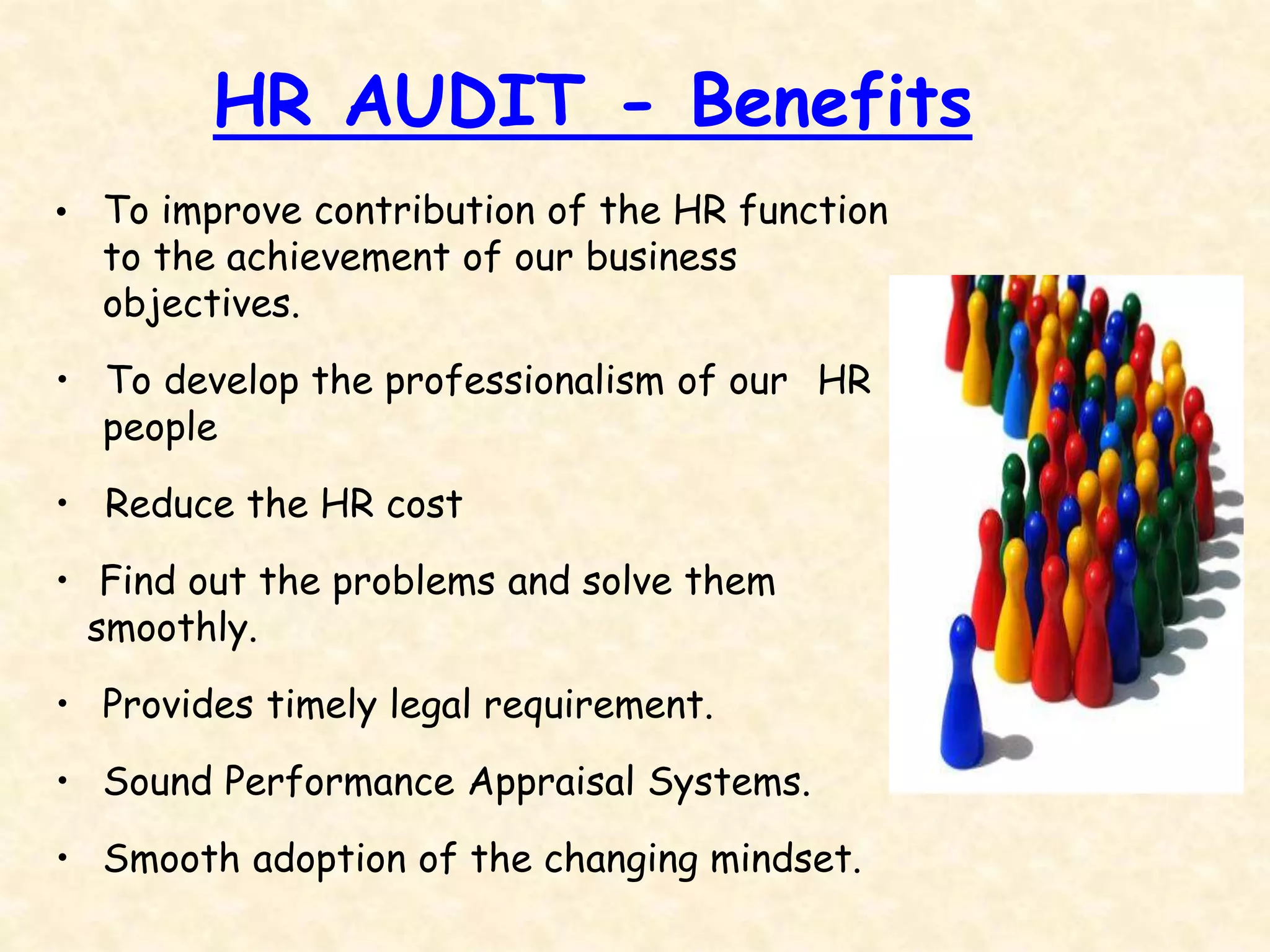
HR AUDIT - Benefits
• To improve contribution of the HR function
to the achievement of our business
objectives.
• To develop the professionalism of our HR
people
• Reduce the HR cost
• Find out the problems and solve them
smoothly.
• Provides timely legal requirement.
• Sound Performance Appraisal Systems.
• Smooth adoption of the changing mindset.
HR AUDIT - Tools
• Interview
• Document Review
• Questionnaire
• Sampling
The Audit should be
• Proactive
• Reactive
• Informative
• Developmental
HR AUDIT - Nature
An HR audit is a tool for evaluating the personnel
activities of an organization. The audit may include
one division or an entire company. It gives feedback
about the HR functions to operating managers and HR
specialists. It also provides feedback about how well
managers are meeting their HR duties.
In short, the audit is an overall quality control check
on HR activities in a division or company and an
evaluation of how these activities support the
organization's strategy.
Auditors may adopt any of the five approaches for the
purpose of evaluation:
• Comparative approach
• Outside authority approach
• Statistical approach
• Compliance approach
• Management by objective approach.
HR AUDIT - Approaches
• In the comparative approach, the auditors identify
another company as the model. The results of their
organization are compared with those of the model
company.
• In the outside authority approach, the auditors use
standards set by an outside consultant as benchmark
for comparison of own results.
• In the statistical approach, statistical measures of
performance are developed based on the company’s
existing information.
Contd..,
• In the compliance approach, auditors review past
actions to determine if those activities comply with
legal requirements and company policies and
procedures.
• The MBO approach creates specific goals against
which performance can be measured. Then the audit
team researches HR by MBO.
Contd..,
Who should conduct the audit?
• The team that is responsible for
the audit should represent a cross-
section of the organization’s staff,
including line staff, middle and
upper management, and those
responsible for HR functions. or you
may use an external consultant to
assist.
How it should be conducted?
• The audit process consists of a series of questions
covering the following primary components of the
HR function:
1. Roles and HR information systems (HRIS)
2. Recruitment
3. Documentation
4. Training and development
5. Compensation and benefits
6. Performance management system and evaluation
7. Termination and transition
8. Legal issues and personnel policies
9. Health / Welfare systems
10.Employee Relations and
11. Safety
• The main process is to collect information to
answer the HR audit questions in each of above
categories and all the relevant information.
• The focus is on how these activities and tasks are
actually performed in the organization.
• The process of getting information, in and of
itself, can be quite informative.
Contd..,
How are needed improvements
identified?
• Once information is gathered, the audit
team reviews each major section and notes
difference between paper and practice.
• This can then be compared to best practice
(what we should do to best support our
organization’s mission).
How is follow-up and correction
done?
• A work plan with a timeline, accountability, and
deliverables should be created after the team
reviews the completed audit and identifies
areas where improvement is needed.
• Follow-up and review should be a regular
management function, performed on an ongoing
basis.
The auditors always prepare and submit an audit
report to authority of the organization, which may be
clean / qualified. The clean report indicates the
appreciative of the department's function, but the
latter one represents the gaps in performance and
therefore contains remarks and remedial measures.
HR Audit is very much helpful to face the challenges
and to increase the potentiality of the HR personnel
in the organization.
Conclusion
WISHING YOU A LONG &
REWARDING CAREER !!!
Thank you

fdocuments.in_hr-audit-presentation-58a95eae7978b.ppt

  • 1.
    HR AUDIT (An EarlyEvaluation System) Jupiter Pemmaraju,IIM Shillong
  • 2.
    HR AUDIT -Definition • The Human Resources (HR) Audit is a process of examining policies, procedures, documentation, systems, and practices with respect to an organization’s HR functions • It means, a systematic assessment of the strengths, limitations, and developmental needs of HR management in the context of organizational performance
  • 3.
    HR AUDIT -OBJECTIVES • To analyze and improve the HR functions in the organization. • To expose the strengths and weaknesses in the HR function, and any issues need resolution. • To evaluate the efficiency and effectiveness of HR functions. • To ensure whether the HR function is on the right path to achieve and helping company to achieve its goal / objectives or not.
  • 4.
    HR AUDIT -Scope • Audit of all the HR function. • Audit of managerial compliance of personnel • Policies, Procedures and Legal provisions. • Audit of corporate strategy regarding HR • Planning, Staffing, IRs, Remuneration and other HR activities. • Audit of the HR climate on employee motivation, morale and job satisfaction.
  • 5.
    HR AUDIT -Benefits • To improve contribution of the HR function to the achievement of our business objectives. • To develop the professionalism of our HR people • Reduce the HR cost • Find out the problems and solve them smoothly. • Provides timely legal requirement. • Sound Performance Appraisal Systems. • Smooth adoption of the changing mindset.
  • 6.
    HR AUDIT -Tools • Interview • Document Review • Questionnaire • Sampling The Audit should be • Proactive • Reactive • Informative • Developmental
  • 7.
    HR AUDIT -Nature An HR audit is a tool for evaluating the personnel activities of an organization. The audit may include one division or an entire company. It gives feedback about the HR functions to operating managers and HR specialists. It also provides feedback about how well managers are meeting their HR duties. In short, the audit is an overall quality control check on HR activities in a division or company and an evaluation of how these activities support the organization's strategy.
  • 8.
    Auditors may adoptany of the five approaches for the purpose of evaluation: • Comparative approach • Outside authority approach • Statistical approach • Compliance approach • Management by objective approach. HR AUDIT - Approaches
  • 9.
    • In thecomparative approach, the auditors identify another company as the model. The results of their organization are compared with those of the model company. • In the outside authority approach, the auditors use standards set by an outside consultant as benchmark for comparison of own results. • In the statistical approach, statistical measures of performance are developed based on the company’s existing information. Contd..,
  • 10.
    • In thecompliance approach, auditors review past actions to determine if those activities comply with legal requirements and company policies and procedures. • The MBO approach creates specific goals against which performance can be measured. Then the audit team researches HR by MBO. Contd..,
  • 11.
    Who should conductthe audit? • The team that is responsible for the audit should represent a cross- section of the organization’s staff, including line staff, middle and upper management, and those responsible for HR functions. or you may use an external consultant to assist.
  • 12.
    How it shouldbe conducted? • The audit process consists of a series of questions covering the following primary components of the HR function: 1. Roles and HR information systems (HRIS) 2. Recruitment 3. Documentation 4. Training and development 5. Compensation and benefits 6. Performance management system and evaluation 7. Termination and transition 8. Legal issues and personnel policies 9. Health / Welfare systems 10.Employee Relations and 11. Safety
  • 13.
    • The mainprocess is to collect information to answer the HR audit questions in each of above categories and all the relevant information. • The focus is on how these activities and tasks are actually performed in the organization. • The process of getting information, in and of itself, can be quite informative. Contd..,
  • 14.
    How are neededimprovements identified? • Once information is gathered, the audit team reviews each major section and notes difference between paper and practice. • This can then be compared to best practice (what we should do to best support our organization’s mission).
  • 15.
    How is follow-upand correction done? • A work plan with a timeline, accountability, and deliverables should be created after the team reviews the completed audit and identifies areas where improvement is needed. • Follow-up and review should be a regular management function, performed on an ongoing basis.
  • 16.
    The auditors alwaysprepare and submit an audit report to authority of the organization, which may be clean / qualified. The clean report indicates the appreciative of the department's function, but the latter one represents the gaps in performance and therefore contains remarks and remedial measures. HR Audit is very much helpful to face the challenges and to increase the potentiality of the HR personnel in the organization. Conclusion
  • 17.
    WISHING YOU ALONG & REWARDING CAREER !!! Thank you