Human Reproduction
• Human beings are viviparous. The
reproduction always involves sexual method.
• Sexual reproduction: It is the reproduction
takes place by formation and fusion of
gametes.
• The gametes are develops in primary sex
organ testes and ovaries.
THE MALE REPRODUCTIVE SYSTEM.
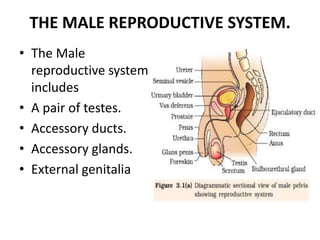
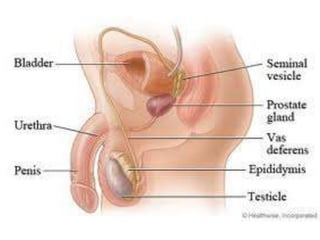
• The Male
reproductive system
includes
• A pair of testes.
• Accessory ducts.
• Accessory glands.
• External genitalia
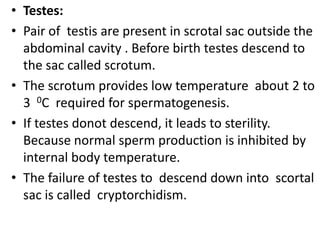
• Testes:
• Pair of testis are present in scrotal sac outside the
abdominal cavity . Before birth testes descend to
the sac called scrotum.
• The scrotum provides low temperature about 2 to
3 0C required for spermatogenesis.
• If testes donot descend, it leads to sterility.
Because normal sperm production is inhibited by
internal body temperature.
• The failure of testes to descend down into scortal
sac is called cryptorchidism.
• Each testis has about 250 compartments called
testicular lobules.. Each lobule contains coiled
seminiferous tubules.
• The inner wall of seminiferous tubules lined by
male germ cells and Sertoli cells.
• Male germ cell undergoes meiosis and produce
sperm.
• Sertoli cells provide nutrition to the developing
sperm.
• In between the seminiferous tubule interstitial
cell or Leydig cell are present.
• Leydig cells produce male hormones called
androgen (testosterone).
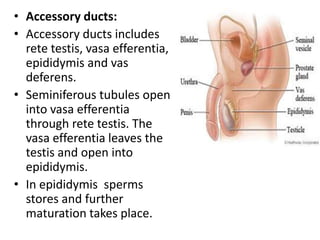
• Accessory ducts:
• Accessory ducts includes
rete testis, vasa efferentia,
epididymis and vas
deferens.
• Seminiferous tubules open
into vasa efferentia
through rete testis. The
vasa efferentia leaves the
testis and open into
epididymis.
• In epididymis sperms
stores and further
maturation takes place.
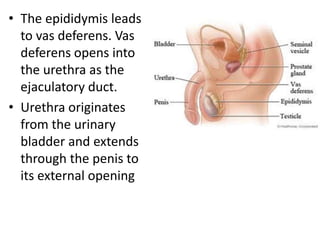
• The epididymis leads
to vas deferens. Vas
deferens opens into
the urethra as the
ejaculatory duct.
• Urethra originates
from the urinary
bladder and extends
through the penis to
its external opening
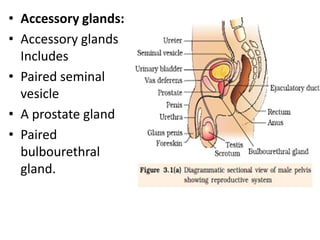
• Accessory glands:
• Accessory glands
Includes
• Paired seminal
vesicle
• A prostate gland
• Paired
bulbourethral
gland.
• These glands secretes the secretion called
seminal plasma.
• It rich in fructose, calcium, and certain enzyme.
Seminal plasma with sperm forms semen.
• After puberty millions of sperms matures every
day. Each ejaculation contains 300 million
sperms.
• External genitalia:
• Penis is the external genitalia.
• It is made of special tissue that helps in erection
of the penis to facilitate insemination.
Spermatogenesis:
• The process of formation of haploid male
gamete sperm in seminiferous tubules of
testis is called spermatogenesis.
• The inner wall of the seminiferous tubule
contains two types of cells as germ cells
(spermatogonial cells) and sertoli cells.
• germl cells divides and develops into sperms.
The sertoli cell nourishes the developing
sperms.
• The spermatogenesis takes place in two stages
as spermatidogenesis and spermiogenesis
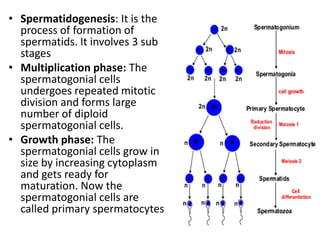
• Spermatidogenesis: It is the
process of formation of
spermatids. It involves 3 sub
stages
• Multiplication phase: The
spermatogonial cells
undergoes repeated mitotic
division and forms large
number of diploid
spermatogonial cells.
• Growth phase: The
spermatogonial cells grow in
size by increasing cytoplasm
and gets ready for
maturation. Now the
spermatogonial cells are
called primary spermatocytes
• Maturation phase: The diploid primary spermatocyte
undergoes first meiosis resulting in the formation of two
haploid cells called secondary spermatocyte. This later
undergoes second meiotic division to produce four
haploid spermatids.
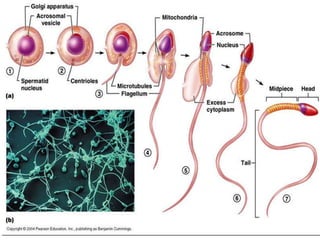
• Spermiogenesis: It is The process of formation of inactive
non-motile spermatid into active motile spermatozoa .
• The spermatid undergoes following structural changes.
1. The small vesicles of Golgi complex fuse to form a large
cup like acrosome anterior to the nucleus.
2. The two centrioles of spermatid moves towards the
nucleus and arrange beneath the nucleus as a proximal
and distal centriole.
3. The distal centriole elongates to form a tail.
4. The mitochondria forms a large mass at neck region.
5. The nucleus becomes elongated and forms a spherical
shape.
Structure of human sperm:
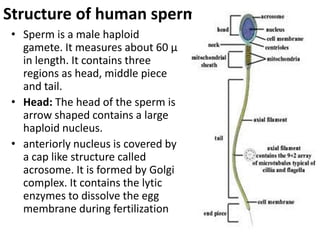
• Sperm is a male haploid
gamete. It measures about 60 μ
in length. It contains three
regions as head, middle piece
and tail.
• Head: The head of the sperm is
arrow shaped contains a large
haploid nucleus.
• anteriorly nucleus is covered by
a cap like structure called
acrosome. It is formed by Golgi
complex. It contains the lytic
enzymes to dissolve the egg
membrane during fertilization
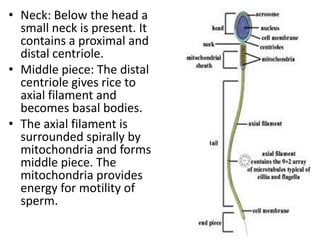
• Neck: Below the head a
small neck is present. It
contains a proximal and
distal centriole.
• Middle piece: The distal
centriole gives rice to
axial filament and
becomes basal bodies.
• The axial filament is
surrounded spirally by
mitochondria and forms
middle piece. The
mitochondria provides
energy for motility of
sperm.
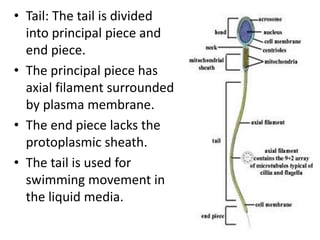
• Tail: The tail is divided
into principal piece and
end piece.
• The principal piece has
axial filament surrounded
by plasma membrane.
• The end piece lacks the
protoplasmic sheath.
• The tail is used for
swimming movement in
the liquid media.
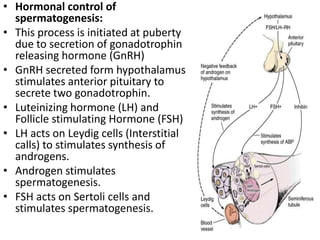
• Hormonal control of
spermatogenesis:
• This process is initiated at puberty
due to secretion of gonadotrophin
releasing hormone (GnRH)
• GnRH secreted form hypothalamus
stimulates anterior pituitary to
secrete two gonadotrophin.
• Luteinizing hormone (LH) and
Follicle stimulating Hormone (FSH)
• LH acts on Leydig cells (Interstitial
calls) to stimulates synthesis of
androgens.
• Androgen stimulates
spermatogenesis.
• FSH acts on Sertoli cells and
stimulates spermatogenesis.
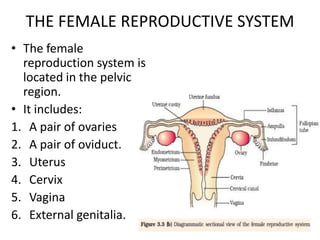
THE FEMALE REPRODUCTIVE SYSTEM
• The female
reproduction system is
located in the pelvic
region.
• It includes:
1. A pair of ovaries
2. A pair of oviduct.
3. Uterus
4. Cervix
5. Vagina
6. External genitalia.
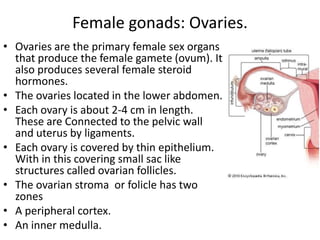
Female gonads: Ovaries.
• Ovaries are the primary female sex organs
that produce the female gamete (ovum). It
also produces several female steroid
hormones.
• The ovaries located in the lower abdomen.
• Each ovary is about 2-4 cm in length.
These are Connected to the pelvic wall
and uterus by ligaments.
• Each ovary is covered by thin epithelium.
With in this covering small sac like
structures called ovarian follicles.
• The ovarian stroma or folicle has two
zones
• A peripheral cortex.
• An inner medulla.
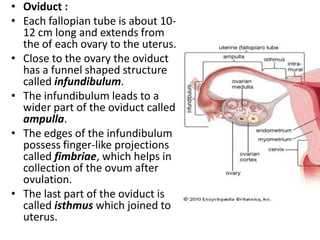
• Oviduct :
• Each fallopian tube is about 1012 cm long and extends from
the of each ovary to the uterus.
• Close to the ovary the oviduct
has a funnel shaped structure
called infundibulum.
• The infundibulum leads to a
wider part of the oviduct called
ampulla.
• The edges of the infundibulum
possess finger-like projections
called fimbriae, which helps in
collection of the ovum after
ovulation.
• The last part of the oviduct is
called isthmus which joined to
uterus.
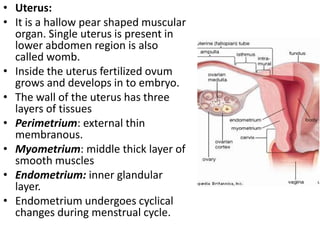
• Uterus:
• It is a hallow pear shaped muscular
organ. Single uterus is present in
lower abdomen region is also
called womb.
• Inside the uterus fertilized ovum
grows and develops in to embryo.
• The wall of the uterus has three
layers of tissues
• Perimetrium: external thin
membranous.
• Myometrium: middle thick layer of
smooth muscles
• Endometrium: inner glandular
layer.
• Endometrium undergoes cyclical
changes during menstrual cycle.
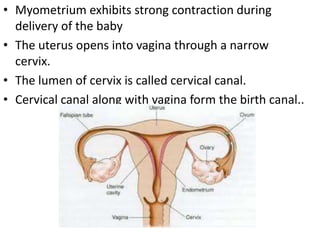
• Myometrium exhibits strong contraction during
delivery of the baby
• The uterus opens into vagina through a narrow
cervix.
• The lumen of cervix is called cervical canal.
• Cervical canal along with vagina form the birth canal..
•
•
•
•

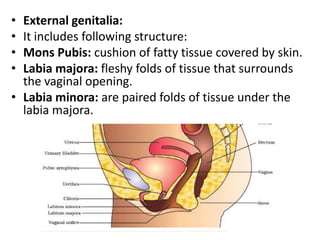
External genitalia:
It includes following structure:
Mons Pubis: cushion of fatty tissue covered by skin.
Labia majora: fleshy folds of tissue that surrounds
the vaginal opening.
• Labia minora: are paired folds of tissue under the
labia majora.
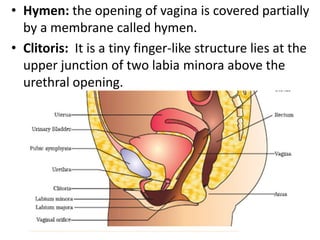
• Hymen: the opening of vagina is covered partially
by a membrane called hymen.
• Clitoris: It is a tiny finger-like structure lies at the
upper junction of two labia minora above the
urethral opening.
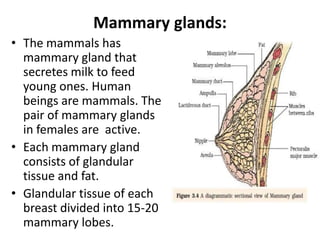
Mammary glands:
• The mammals has
mammary gland that
secretes milk to feed
young ones. Human
beings are mammals. The
pair of mammary glands
in females are active.
• Each mammary gland
consists of glandular
tissue and fat.
• Glandular tissue of each
breast divided into 15-20
mammary lobes.
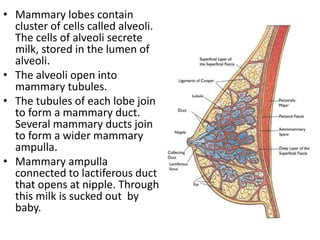
• Mammary lobes contain
cluster of cells called alveoli.
The cells of alveoli secrete
milk, stored in the lumen of
alveoli.
• The alveoli open into
mammary tubules.
• The tubules of each lobe join
to form a mammary duct.
Several mammary ducts join
to form a wider mammary
ampulla.
• Mammary ampulla
connected to lactiferous duct
that opens at nipple. Through
this milk is sucked out by
baby.
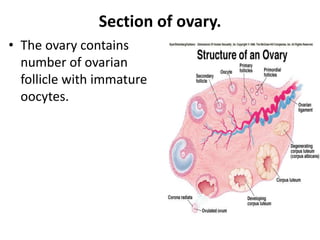
Section of ovary.
• The ovary contains
number of ovarian
follicle with immature
oocytes.
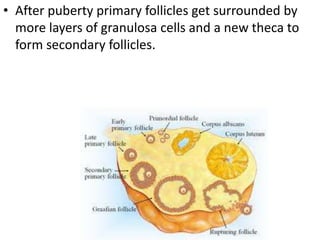
• After puberty primary follicles get surrounded by
more layers of granulosa cells and a new theca to
form secondary follicles.
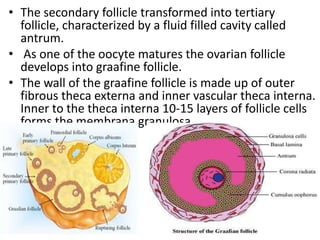
• The secondary follicle transformed into tertiary
follicle, characterized by a fluid filled cavity called
antrum.
• As one of the oocyte matures the ovarian follicle
develops into graafine follicle.
• The wall of the graafine follicle is made up of outer
fibrous theca externa and inner vascular theca interna.
Inner to the theca interna 10-15 layers of follicle cells
forms the membrana granulosa.
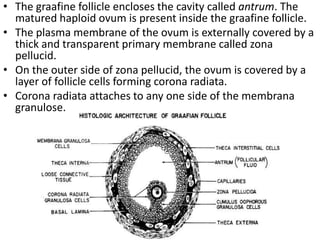
• The graafine follicle encloses the cavity called antrum. The
matured haploid ovum is present inside the graafine follicle.
• The plasma membrane of the ovum is externally covered by a
thick and transparent primary membrane called zona
pellucid.
• On the outer side of zona pellucid, the ovum is covered by a
layer of follicle cells forming corona radiata.
• Corona radiata attaches to any one side of the membrana
granulose.
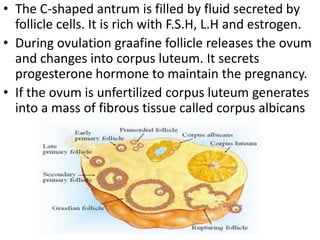
• The C-shaped antrum is filled by fluid secreted by
follicle cells. It is rich with F.S.H, L.H and estrogen.
• During ovulation graafine follicle releases the ovum
and changes into corpus luteum. It secrets
progesterone hormone to maintain the pregnancy.
• If the ovum is unfertilized corpus luteum generates
into a mass of fibrous tissue called corpus albicans
Oogenisis.
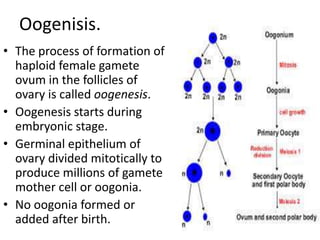
• The process of formation of
haploid female gamete
ovum in the follicles of
ovary is called oogenesis.
• Oogenesis starts during
embryonic stage.
• Germinal epithelium of
ovary divided mitotically to
produce millions of gamete
mother cell or oogonia.
• No oogonia formed or
added after birth.
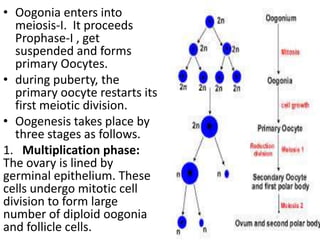
• Oogonia enters into
meiosis-I. It proceeds
Prophase-I , get
suspended and forms
primary Oocytes.
• during puberty, the
primary oocyte restarts its
first meiotic division.
• Oogenesis takes place by
three stages as follows.
1. Multiplication phase:
The ovary is lined by
germinal epithelium. These
cells undergo mitotic cell
division to form large
number of diploid oogonia
and follicle cells.
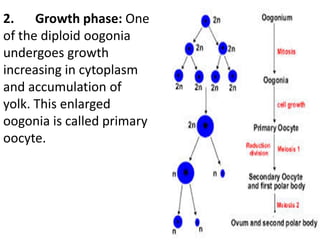
2. Growth phase: One
of the diploid oogonia
undergoes growth
increasing in cytoplasm
and accumulation of
yolk. This enlarged
oogonia is called primary
oocyte.
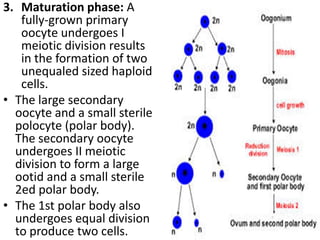
3. Maturation phase: A
fully-grown primary
oocyte undergoes I
meiotic division results
in the formation of two
unequaled sized haploid
cells.
• The large secondary
oocyte and a small sterile
polocyte (polar body).
The secondary oocyte
undergoes II meiotic
division to form a large
ootid and a small sterile
2ed polar body.
• The 1st polar body also
undergoes equal division
to produce two cells.
• Thus during oogenesis four cells are produced.
Among them one is functional ootid and three are
non-functional polar bodies. The ootid with very
little change becomes an ovum.
Menstrual cycle:
• Reproductive cycle of female primates is called
menstrual cycle.
• The menstrual cycle begins when a female reaches the
age of puberty. The first menstruation begins at
puberty is called Menarche.
• During the menstrual cycle the uterus endometrium
prepares itself for implantation of a fertilized egg. If
fertilization does not occur the uterus lining is shed
from the body. This is known as menstruation .
• Menstrual cycle repeated at an average interval of 28
days.
• One ovum is released in the middle usually 14th day of
each menstrual cycle.
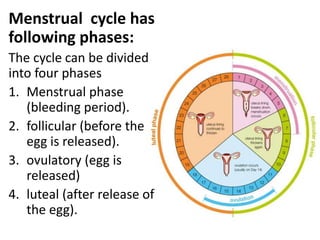
Menstrual cycle has
following phases:
The cycle can be divided
into four phases
1. Menstrual phase
(bleeding period).
2. follicular (before the
egg is released).
3. ovulatory (egg is
released)
4. luteal (after release of
the egg).
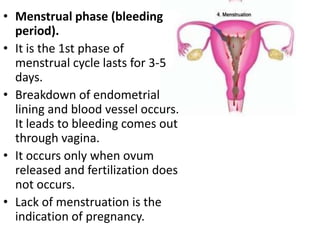
• Menstrual phase (bleeding
period).
• It is the 1st phase of
menstrual cycle lasts for 3-5
days.
• Breakdown of endometrial
lining and blood vessel occurs.
It leads to bleeding comes out
through vagina.
• It occurs only when ovum
released and fertilization does
not occurs.
• Lack of menstruation is the
indication of pregnancy.
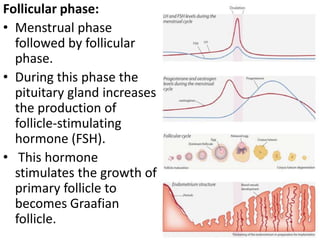
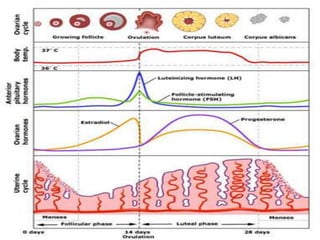
Follicular phase:
• Menstrual phase
followed by follicular
phase.
• During this phase the
pituitary gland increases
the production of
follicle-stimulating
hormone (FSH).
• This hormone
stimulates the growth of
primary follicle to
becomes Graafian
follicle.
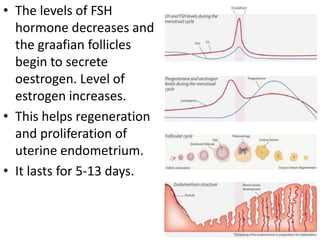
• The levels of FSH
hormone decreases and
the graafian follicles
begin to secrete
oestrogen. Level of
estrogen increases.
• This helps regeneration
and proliferation of
uterine endometrium.
• It lasts for 5-13 days.
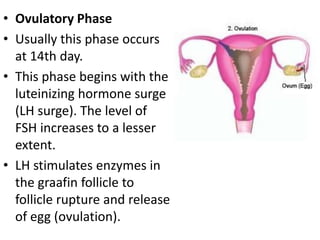
• Ovulatory Phase
• Usually this phase occurs
at 14th day.
• This phase begins with the
luteinizing hormone surge
(LH surge). The level of
FSH increases to a lesser
extent.
• LH stimulates enzymes in
the graafin follicle to
follicle rupture and release
of egg (ovulation).
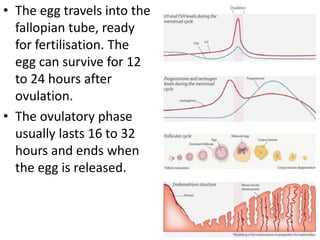
• The egg travels into the
fallopian tube, ready
for fertilisation. The
egg can survive for 12
to 24 hours after
ovulation.
• The ovulatory phase
usually lasts 16 to 32
hours and ends when
the egg is released.
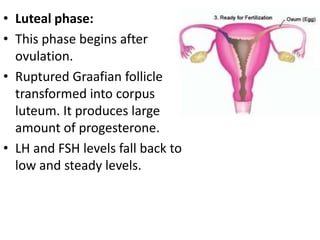
• Luteal phase:
• This phase begins after
ovulation.
• Ruptured Graafian follicle
transformed into corpus
luteum. It produces large
amount of progesterone.
• LH and FSH levels fall back to
low and steady levels.
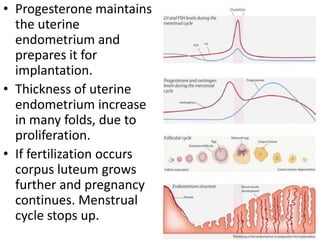
• Progesterone maintains
the uterine
endometrium and
prepares it for
implantation.
• Thickness of uterine
endometrium increase
in many folds, due to
proliferation.
• If fertilization occurs
corpus luteum grows
further and pregnancy
continues. Menstrual
cycle stops up.
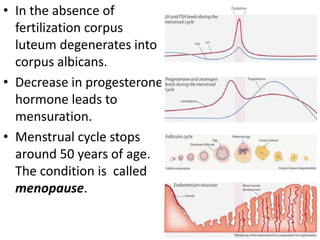
• In the absence of
fertilization corpus
luteum degenerates into
corpus albicans.
• Decrease in progesterone
hormone leads to
mensuration.
• Menstrual cycle stops
around 50 years of age.
The condition is called
menopause.
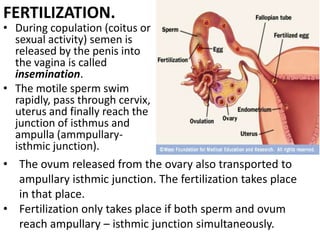
FERTILIZATION.

• During copulation (coitus or
sexual activity) semen is
released by the penis into
the vagina is called
insemination.
• The motile sperm swim
rapidly, pass through cervix,
uterus and finally reach the
junction of isthmus and
ampulla (ammpullaryisthmic junction).

• The ovum released from the ovary also transported to
ampullary isthmic junction. The fertilization takes place
in that place.
• Fertilization only takes place if both sperm and ovum
reach ampullary – isthmic junction simultaneously.
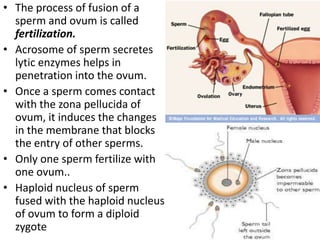
• The process of fusion of a
sperm and ovum is called
fertilization.
• Acrosome of sperm secretes
lytic enzymes helps in
penetration into the ovum.
• Once a sperm comes contact
with the zona pellucida of
ovum, it induces the changes
in the membrane that blocks
the entry of other sperms.
• Only one sperm fertilize with
one ovum..
• Haploid nucleus of sperm
fused with the haploid nucleus
of ovum to form a diploid
zygote
Sex determination:
Sex determination:

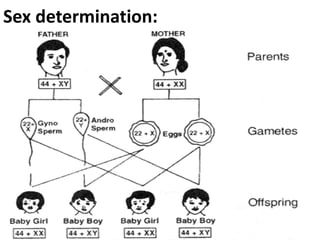
• Sex of a baby is determined during fertilization and
in the zygote.
• Sex is determined by the sex-chromosomes present
in zygote..
• Human female contain XX chromosomes and male
contain XY chromosomes.
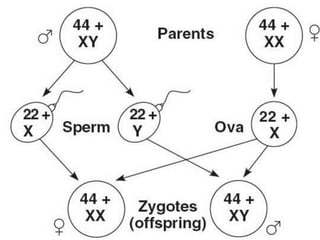
• All the female gametes produced has 22 autosome
and only ‘X’ chromosome. Hence are homogametic.
• Sperms produced by male, 50% has 22 autosome
with ‘X’ and 50 % has 22 autosome with ‘Y’
chromosome. Hence heterogametic.
• The fusion of androsperm (22+Y) with ovum
results in male baby.
• The fusion of gynosperm (22+X) with ovum
results in female baby.
• Zygote with XX chromosomes develop into
female and with XY chromosome develops
into male.
• Early embryonic development.
• The development of zygote in to full embryo is
called early embryonic development.
• It occurs by cleavage, blastulation, gastrulation and
organogenesis.
• Cleavage:
• Repeated mitotic division of the zygote without
growth resulting a multicellular ball is called
cleavage.
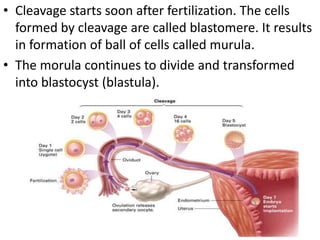
• Cleavage starts soon after fertilization. The cells
formed by cleavage are called blastomere. It results
in formation of ball of cells called murula.
• The morula continues to divide and transformed
into blastocyst (blastula).
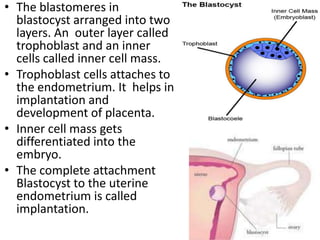
• The blastomeres in
blastocyst arranged into two
layers. An outer layer called
trophoblast and an inner
cells called inner cell mass.
• Trophoblast cells attaches to
the endometrium. It helps in
implantation and
development of placenta.
• Inner cell mass gets
differentiated into the
embryo.
• The complete attachment
Blastocyst to the uterine
endometrium is called
implantation.
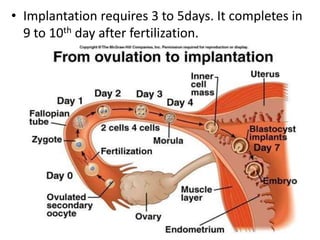
• Implantation requires 3 to 5days. It completes in
9 to 10th day after fertilization.
Pregnancy :
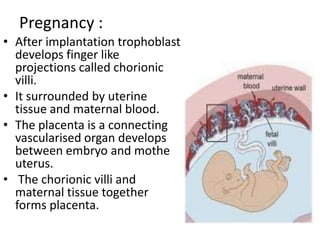
• After implantation trophoblast
develops finger like
projections called chorionic
villi.
• It surrounded by uterine
tissue and maternal blood.
• The placenta is a connecting
vascularised organ develops
between embryo and mothe
uterus.
• The chorionic villi and
maternal tissue together
forms placenta.
• Function of placenta:
• The embryo connected to the placenta by umbilical
cord.
• It facilitate transport of oxygen and nutrient from
mother to embryo.
• Removes CO2 and waste material from the embryo.
• It is barrier for number of pathogens.
• It acts as endocrine gland and produces several
hormones. Among them Imp are
a. Human chorionic gonadotrophins (hCG)
b. Human placental lactogen (hPL)
c. Estrogen.
d. Progesterone.
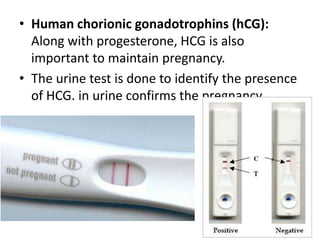
• Human chorionic gonadotrophins (hCG):
Along with progesterone, HCG is also
important to maintain pregnancy.
• The urine test is done to identify the presence
of HCG. in urine confirms the pregnancy.
• Embryonic development:
• The inner cell mass of blastula are called stem cells.
They had the potency to produce all types of cell,
tissues and organs by differentiation.
• After implantation the stem cells of blastocyst
differentiated into an outer layer ectoderm, inner layer
endoderm and middle mesoderm.
• Organogenesis:
• Formation of different organs in the embryo is called
organogenesis.
• After one month of pregnancy heart is formed in the
embryo.
• By the end of 2nd month the foetus develops limbs and
digits.
• By the end of 12 weeks (first trimester) most
of organ system is formed (limbs and external
genitalia are well developed).
• In the 5th month first movement of foetus and
appearance of hairs observed.
• By the end of 24th week (6th month or 2nd
trimesters) the body is covered with fine hairs,
eye-lids separate, and eyelashes are formed.
• By the end of 9 months the foetus is fully
developed and is ready for delivery.
• PARTURATION :
• The period of pregnancy is called gestation period. It
is 9 months in human.
• The delivery of foetus is called parturition. It occurs by
the contraction of uterine Myometrium.
• The signal of parturition is originated from the fully
developed foetus and the placenta. It induces mild
contraction of uterus called fetal ejection reflex.
• Fetal ejection reflex triggers the release of Oxytocin
from pituitary.
• Oxytocin induces stronger contraction of uterine
myometrium.
• After delivery the placenta is also expelled out of the
uterus.
• Lactation:
• Process of milk production in mammary gland is
called lactation.
• The mammary gland starts producing milk
towards the end of the pregnancy.
• Milk produced during initial days of lactation is
called colostrum.It contains several antibodies
which provide immunity to the new born baby.
• The milk production is controlled by Lacto trophic
or prolactin hormone secreted by pituitary.

Human reproduction by mohan bio

  • 1.
    Human Reproduction • Humanbeings are viviparous. The reproduction always involves sexual method. • Sexual reproduction: It is the reproduction takes place by formation and fusion of gametes. • The gametes are develops in primary sex organ testes and ovaries.
  • 2.
    THE MALE REPRODUCTIVESYSTEM. • The Male reproductive system includes • A pair of testes. • Accessory ducts. • Accessory glands. • External genitalia
  • 4.
    • Testes: • Pairof testis are present in scrotal sac outside the abdominal cavity . Before birth testes descend to the sac called scrotum. • The scrotum provides low temperature about 2 to 3 0C required for spermatogenesis. • If testes donot descend, it leads to sterility. Because normal sperm production is inhibited by internal body temperature. • The failure of testes to descend down into scortal sac is called cryptorchidism.
  • 5.
    • Each testishas about 250 compartments called testicular lobules.. Each lobule contains coiled seminiferous tubules. • The inner wall of seminiferous tubules lined by male germ cells and Sertoli cells. • Male germ cell undergoes meiosis and produce sperm. • Sertoli cells provide nutrition to the developing sperm. • In between the seminiferous tubule interstitial cell or Leydig cell are present. • Leydig cells produce male hormones called androgen (testosterone).
  • 6.
    • Accessory ducts: •Accessory ducts includes rete testis, vasa efferentia, epididymis and vas deferens. • Seminiferous tubules open into vasa efferentia through rete testis. The vasa efferentia leaves the testis and open into epididymis. • In epididymis sperms stores and further maturation takes place.
  • 7.
    • The epididymisleads to vas deferens. Vas deferens opens into the urethra as the ejaculatory duct. • Urethra originates from the urinary bladder and extends through the penis to its external opening
  • 8.
    • Accessory glands: •Accessory glands Includes • Paired seminal vesicle • A prostate gland • Paired bulbourethral gland.
  • 9.
    • These glandssecretes the secretion called seminal plasma. • It rich in fructose, calcium, and certain enzyme. Seminal plasma with sperm forms semen. • After puberty millions of sperms matures every day. Each ejaculation contains 300 million sperms. • External genitalia: • Penis is the external genitalia. • It is made of special tissue that helps in erection of the penis to facilitate insemination.
  • 10.
    Spermatogenesis: • The processof formation of haploid male gamete sperm in seminiferous tubules of testis is called spermatogenesis. • The inner wall of the seminiferous tubule contains two types of cells as germ cells (spermatogonial cells) and sertoli cells. • germl cells divides and develops into sperms. The sertoli cell nourishes the developing sperms. • The spermatogenesis takes place in two stages as spermatidogenesis and spermiogenesis
  • 11.
    • Spermatidogenesis: Itis the process of formation of spermatids. It involves 3 sub stages • Multiplication phase: The spermatogonial cells undergoes repeated mitotic division and forms large number of diploid spermatogonial cells. • Growth phase: The spermatogonial cells grow in size by increasing cytoplasm and gets ready for maturation. Now the spermatogonial cells are called primary spermatocytes
  • 12.
    • Maturation phase:The diploid primary spermatocyte undergoes first meiosis resulting in the formation of two haploid cells called secondary spermatocyte. This later undergoes second meiotic division to produce four haploid spermatids. • Spermiogenesis: It is The process of formation of inactive non-motile spermatid into active motile spermatozoa . • The spermatid undergoes following structural changes. 1. The small vesicles of Golgi complex fuse to form a large cup like acrosome anterior to the nucleus. 2. The two centrioles of spermatid moves towards the nucleus and arrange beneath the nucleus as a proximal and distal centriole. 3. The distal centriole elongates to form a tail. 4. The mitochondria forms a large mass at neck region. 5. The nucleus becomes elongated and forms a spherical shape.
  • 14.
    Structure of humansperm: • Sperm is a male haploid gamete. It measures about 60 μ in length. It contains three regions as head, middle piece and tail. • Head: The head of the sperm is arrow shaped contains a large haploid nucleus. • anteriorly nucleus is covered by a cap like structure called acrosome. It is formed by Golgi complex. It contains the lytic enzymes to dissolve the egg membrane during fertilization
  • 15.
    • Neck: Belowthe head a small neck is present. It contains a proximal and distal centriole. • Middle piece: The distal centriole gives rice to axial filament and becomes basal bodies. • The axial filament is surrounded spirally by mitochondria and forms middle piece. The mitochondria provides energy for motility of sperm.
  • 16.
    • Tail: Thetail is divided into principal piece and end piece. • The principal piece has axial filament surrounded by plasma membrane. • The end piece lacks the protoplasmic sheath. • The tail is used for swimming movement in the liquid media.
  • 17.
    • Hormonal controlof spermatogenesis: • This process is initiated at puberty due to secretion of gonadotrophin releasing hormone (GnRH) • GnRH secreted form hypothalamus stimulates anterior pituitary to secrete two gonadotrophin. • Luteinizing hormone (LH) and Follicle stimulating Hormone (FSH) • LH acts on Leydig cells (Interstitial calls) to stimulates synthesis of androgens. • Androgen stimulates spermatogenesis. • FSH acts on Sertoli cells and stimulates spermatogenesis.
  • 18.
    THE FEMALE REPRODUCTIVESYSTEM • The female reproduction system is located in the pelvic region. • It includes: 1. A pair of ovaries 2. A pair of oviduct. 3. Uterus 4. Cervix 5. Vagina 6. External genitalia.
  • 19.
    Female gonads: Ovaries. •Ovaries are the primary female sex organs that produce the female gamete (ovum). It also produces several female steroid hormones. • The ovaries located in the lower abdomen. • Each ovary is about 2-4 cm in length. These are Connected to the pelvic wall and uterus by ligaments. • Each ovary is covered by thin epithelium. With in this covering small sac like structures called ovarian follicles. • The ovarian stroma or folicle has two zones • A peripheral cortex. • An inner medulla.
  • 20.
    • Oviduct : •Each fallopian tube is about 1012 cm long and extends from the of each ovary to the uterus. • Close to the ovary the oviduct has a funnel shaped structure called infundibulum. • The infundibulum leads to a wider part of the oviduct called ampulla. • The edges of the infundibulum possess finger-like projections called fimbriae, which helps in collection of the ovum after ovulation. • The last part of the oviduct is called isthmus which joined to uterus.
  • 21.
    • Uterus: • Itis a hallow pear shaped muscular organ. Single uterus is present in lower abdomen region is also called womb. • Inside the uterus fertilized ovum grows and develops in to embryo. • The wall of the uterus has three layers of tissues • Perimetrium: external thin membranous. • Myometrium: middle thick layer of smooth muscles • Endometrium: inner glandular layer. • Endometrium undergoes cyclical changes during menstrual cycle.
  • 22.
    • Myometrium exhibitsstrong contraction during delivery of the baby • The uterus opens into vagina through a narrow cervix. • The lumen of cervix is called cervical canal. • Cervical canal along with vagina form the birth canal..
  • 23.
    • • • • External genitalia: It includesfollowing structure: Mons Pubis: cushion of fatty tissue covered by skin. Labia majora: fleshy folds of tissue that surrounds the vaginal opening. • Labia minora: are paired folds of tissue under the labia majora.
  • 24.
    • Hymen: theopening of vagina is covered partially by a membrane called hymen. • Clitoris: It is a tiny finger-like structure lies at the upper junction of two labia minora above the urethral opening.
  • 25.
    Mammary glands: • Themammals has mammary gland that secretes milk to feed young ones. Human beings are mammals. The pair of mammary glands in females are active. • Each mammary gland consists of glandular tissue and fat. • Glandular tissue of each breast divided into 15-20 mammary lobes.
  • 26.
    • Mammary lobescontain cluster of cells called alveoli. The cells of alveoli secrete milk, stored in the lumen of alveoli. • The alveoli open into mammary tubules. • The tubules of each lobe join to form a mammary duct. Several mammary ducts join to form a wider mammary ampulla. • Mammary ampulla connected to lactiferous duct that opens at nipple. Through this milk is sucked out by baby.
  • 27.
    Section of ovary. •The ovary contains number of ovarian follicle with immature oocytes.
  • 28.
    • After pubertyprimary follicles get surrounded by more layers of granulosa cells and a new theca to form secondary follicles.
  • 29.
    • The secondaryfollicle transformed into tertiary follicle, characterized by a fluid filled cavity called antrum. • As one of the oocyte matures the ovarian follicle develops into graafine follicle. • The wall of the graafine follicle is made up of outer fibrous theca externa and inner vascular theca interna. Inner to the theca interna 10-15 layers of follicle cells forms the membrana granulosa.
  • 30.
    • The graafinefollicle encloses the cavity called antrum. The matured haploid ovum is present inside the graafine follicle. • The plasma membrane of the ovum is externally covered by a thick and transparent primary membrane called zona pellucid. • On the outer side of zona pellucid, the ovum is covered by a layer of follicle cells forming corona radiata. • Corona radiata attaches to any one side of the membrana granulose.
  • 31.
    • The C-shapedantrum is filled by fluid secreted by follicle cells. It is rich with F.S.H, L.H and estrogen. • During ovulation graafine follicle releases the ovum and changes into corpus luteum. It secrets progesterone hormone to maintain the pregnancy. • If the ovum is unfertilized corpus luteum generates into a mass of fibrous tissue called corpus albicans
  • 32.
    Oogenisis. • The processof formation of haploid female gamete ovum in the follicles of ovary is called oogenesis. • Oogenesis starts during embryonic stage. • Germinal epithelium of ovary divided mitotically to produce millions of gamete mother cell or oogonia. • No oogonia formed or added after birth.
  • 33.
    • Oogonia entersinto meiosis-I. It proceeds Prophase-I , get suspended and forms primary Oocytes. • during puberty, the primary oocyte restarts its first meiotic division. • Oogenesis takes place by three stages as follows. 1. Multiplication phase: The ovary is lined by germinal epithelium. These cells undergo mitotic cell division to form large number of diploid oogonia and follicle cells.
  • 34.
    2. Growth phase:One of the diploid oogonia undergoes growth increasing in cytoplasm and accumulation of yolk. This enlarged oogonia is called primary oocyte.
  • 35.
    3. Maturation phase:A fully-grown primary oocyte undergoes I meiotic division results in the formation of two unequaled sized haploid cells. • The large secondary oocyte and a small sterile polocyte (polar body). The secondary oocyte undergoes II meiotic division to form a large ootid and a small sterile 2ed polar body. • The 1st polar body also undergoes equal division to produce two cells.
  • 36.
    • Thus duringoogenesis four cells are produced. Among them one is functional ootid and three are non-functional polar bodies. The ootid with very little change becomes an ovum.
  • 37.
    Menstrual cycle: • Reproductivecycle of female primates is called menstrual cycle. • The menstrual cycle begins when a female reaches the age of puberty. The first menstruation begins at puberty is called Menarche. • During the menstrual cycle the uterus endometrium prepares itself for implantation of a fertilized egg. If fertilization does not occur the uterus lining is shed from the body. This is known as menstruation . • Menstrual cycle repeated at an average interval of 28 days. • One ovum is released in the middle usually 14th day of each menstrual cycle.
  • 38.
    Menstrual cycle has followingphases: The cycle can be divided into four phases 1. Menstrual phase (bleeding period). 2. follicular (before the egg is released). 3. ovulatory (egg is released) 4. luteal (after release of the egg).
  • 40.
    • Menstrual phase(bleeding period). • It is the 1st phase of menstrual cycle lasts for 3-5 days. • Breakdown of endometrial lining and blood vessel occurs. It leads to bleeding comes out through vagina. • It occurs only when ovum released and fertilization does not occurs. • Lack of menstruation is the indication of pregnancy.
  • 41.
    Follicular phase: • Menstrualphase followed by follicular phase. • During this phase the pituitary gland increases the production of follicle-stimulating hormone (FSH). • This hormone stimulates the growth of primary follicle to becomes Graafian follicle.
  • 42.
    • The levelsof FSH hormone decreases and the graafian follicles begin to secrete oestrogen. Level of estrogen increases. • This helps regeneration and proliferation of uterine endometrium. • It lasts for 5-13 days.
  • 43.
    • Ovulatory Phase •Usually this phase occurs at 14th day. • This phase begins with the luteinizing hormone surge (LH surge). The level of FSH increases to a lesser extent. • LH stimulates enzymes in the graafin follicle to follicle rupture and release of egg (ovulation).
  • 44.
    • The eggtravels into the fallopian tube, ready for fertilisation. The egg can survive for 12 to 24 hours after ovulation. • The ovulatory phase usually lasts 16 to 32 hours and ends when the egg is released.
  • 45.
    • Luteal phase: •This phase begins after ovulation. • Ruptured Graafian follicle transformed into corpus luteum. It produces large amount of progesterone. • LH and FSH levels fall back to low and steady levels.
  • 46.
    • Progesterone maintains theuterine endometrium and prepares it for implantation. • Thickness of uterine endometrium increase in many folds, due to proliferation. • If fertilization occurs corpus luteum grows further and pregnancy continues. Menstrual cycle stops up.
  • 47.
    • In theabsence of fertilization corpus luteum degenerates into corpus albicans. • Decrease in progesterone hormone leads to mensuration. • Menstrual cycle stops around 50 years of age. The condition is called menopause.
  • 48.
    FERTILIZATION. • During copulation(coitus or sexual activity) semen is released by the penis into the vagina is called insemination. • The motile sperm swim rapidly, pass through cervix, uterus and finally reach the junction of isthmus and ampulla (ammpullaryisthmic junction). • The ovum released from the ovary also transported to ampullary isthmic junction. The fertilization takes place in that place. • Fertilization only takes place if both sperm and ovum reach ampullary – isthmic junction simultaneously.
  • 49.
    • The processof fusion of a sperm and ovum is called fertilization. • Acrosome of sperm secretes lytic enzymes helps in penetration into the ovum. • Once a sperm comes contact with the zona pellucida of ovum, it induces the changes in the membrane that blocks the entry of other sperms. • Only one sperm fertilize with one ovum.. • Haploid nucleus of sperm fused with the haploid nucleus of ovum to form a diploid zygote
  • 50.
  • 52.
    Sex determination: • Sexof a baby is determined during fertilization and in the zygote. • Sex is determined by the sex-chromosomes present in zygote.. • Human female contain XX chromosomes and male contain XY chromosomes. • All the female gametes produced has 22 autosome and only ‘X’ chromosome. Hence are homogametic. • Sperms produced by male, 50% has 22 autosome with ‘X’ and 50 % has 22 autosome with ‘Y’ chromosome. Hence heterogametic.
  • 53.
    • The fusionof androsperm (22+Y) with ovum results in male baby. • The fusion of gynosperm (22+X) with ovum results in female baby. • Zygote with XX chromosomes develop into female and with XY chromosome develops into male.
  • 54.
    • Early embryonicdevelopment. • The development of zygote in to full embryo is called early embryonic development. • It occurs by cleavage, blastulation, gastrulation and organogenesis. • Cleavage: • Repeated mitotic division of the zygote without growth resulting a multicellular ball is called cleavage.
  • 55.
    • Cleavage startssoon after fertilization. The cells formed by cleavage are called blastomere. It results in formation of ball of cells called murula. • The morula continues to divide and transformed into blastocyst (blastula).
  • 56.
    • The blastomeresin blastocyst arranged into two layers. An outer layer called trophoblast and an inner cells called inner cell mass. • Trophoblast cells attaches to the endometrium. It helps in implantation and development of placenta. • Inner cell mass gets differentiated into the embryo. • The complete attachment Blastocyst to the uterine endometrium is called implantation.
  • 57.
    • Implantation requires3 to 5days. It completes in 9 to 10th day after fertilization.
  • 58.
    Pregnancy : • Afterimplantation trophoblast develops finger like projections called chorionic villi. • It surrounded by uterine tissue and maternal blood. • The placenta is a connecting vascularised organ develops between embryo and mothe uterus. • The chorionic villi and maternal tissue together forms placenta.
  • 59.
    • Function ofplacenta: • The embryo connected to the placenta by umbilical cord. • It facilitate transport of oxygen and nutrient from mother to embryo. • Removes CO2 and waste material from the embryo. • It is barrier for number of pathogens. • It acts as endocrine gland and produces several hormones. Among them Imp are a. Human chorionic gonadotrophins (hCG) b. Human placental lactogen (hPL) c. Estrogen. d. Progesterone.
  • 60.
    • Human chorionicgonadotrophins (hCG): Along with progesterone, HCG is also important to maintain pregnancy. • The urine test is done to identify the presence of HCG. in urine confirms the pregnancy.
  • 61.
    • Embryonic development: •The inner cell mass of blastula are called stem cells. They had the potency to produce all types of cell, tissues and organs by differentiation. • After implantation the stem cells of blastocyst differentiated into an outer layer ectoderm, inner layer endoderm and middle mesoderm. • Organogenesis: • Formation of different organs in the embryo is called organogenesis. • After one month of pregnancy heart is formed in the embryo. • By the end of 2nd month the foetus develops limbs and digits.
  • 62.
    • By theend of 12 weeks (first trimester) most of organ system is formed (limbs and external genitalia are well developed). • In the 5th month first movement of foetus and appearance of hairs observed. • By the end of 24th week (6th month or 2nd trimesters) the body is covered with fine hairs, eye-lids separate, and eyelashes are formed. • By the end of 9 months the foetus is fully developed and is ready for delivery.
  • 63.
    • PARTURATION : •The period of pregnancy is called gestation period. It is 9 months in human. • The delivery of foetus is called parturition. It occurs by the contraction of uterine Myometrium. • The signal of parturition is originated from the fully developed foetus and the placenta. It induces mild contraction of uterus called fetal ejection reflex. • Fetal ejection reflex triggers the release of Oxytocin from pituitary. • Oxytocin induces stronger contraction of uterine myometrium. • After delivery the placenta is also expelled out of the uterus.
  • 64.
    • Lactation: • Processof milk production in mammary gland is called lactation. • The mammary gland starts producing milk towards the end of the pregnancy. • Milk produced during initial days of lactation is called colostrum.It contains several antibodies which provide immunity to the new born baby. • The milk production is controlled by Lacto trophic or prolactin hormone secreted by pituitary.