Personality
 Some definitions of personality:
 An individual’s unique pattern of thoughts, feelings,
and behaviors that persists over time and across
situations.
 The dynamic and organized set of characteristics
possessed by a person that uniquely influences his or
her cognitions, motivations, and behaviors in various
situations.
 An organized combinations of attitudes, motives,
values and behaviors unique to each individual.
Personality
 Personalities are often described in terms of relatively
enduring personality traits such as sociability, independence,
dominance, reserved, etc..
 Personality consists of all the relatively “stable” and
“distinctive” styles of thought, behavior and emotional
response that characterize a person’s adaptations to
surrounding circumstances.
 Trait is a characteristic of an individual, describing a habitual
way of behaving, thinking, and feeling (shy, outgoing,
ambitious, lazy, easy-going, confident, grumpy, happy, friendly,
etc..
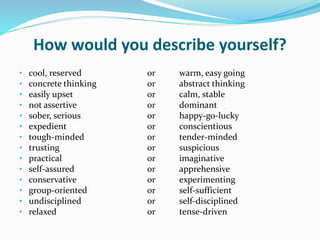
How would you describe yourself?
• cool, reserved or warm, easy going
• concrete thinking or abstract thinking
• easily upset or calm, stable
• not assertive or dominant
• sober, serious or happy-go-lucky
• expedient or conscientious
• tough-minded or tender-minded
• trusting or suspicious
• practical or imaginative
• self-assured or apprehensive
• conservative or experimenting
• group-oriented or self-sufficient
• undisciplined or self-disciplined
• relaxed or tense-driven
Personality
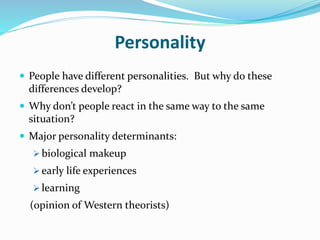
 People have different personalities. But why do these
differences develop?
 Why don’t people react in the same way to the same
situation?
 Major personality determinants:
 biological makeup
 early life experiences
 learning
(opinion of Western theorists)
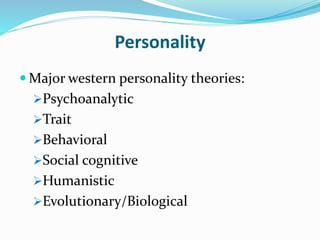
Personality
 Major western personality theories:
Psychoanalytic
Trait
Behavioral
Social cognitive
Humanistic
Evolutionary/Biological

Human Personality Intro

  • 2.
    Personality  Some definitionsof personality:  An individual’s unique pattern of thoughts, feelings, and behaviors that persists over time and across situations.  The dynamic and organized set of characteristics possessed by a person that uniquely influences his or her cognitions, motivations, and behaviors in various situations.  An organized combinations of attitudes, motives, values and behaviors unique to each individual.
  • 3.
    Personality  Personalities areoften described in terms of relatively enduring personality traits such as sociability, independence, dominance, reserved, etc..  Personality consists of all the relatively “stable” and “distinctive” styles of thought, behavior and emotional response that characterize a person’s adaptations to surrounding circumstances.  Trait is a characteristic of an individual, describing a habitual way of behaving, thinking, and feeling (shy, outgoing, ambitious, lazy, easy-going, confident, grumpy, happy, friendly, etc..
  • 4.
    How would youdescribe yourself? • cool, reserved or warm, easy going • concrete thinking or abstract thinking • easily upset or calm, stable • not assertive or dominant • sober, serious or happy-go-lucky • expedient or conscientious • tough-minded or tender-minded • trusting or suspicious • practical or imaginative • self-assured or apprehensive • conservative or experimenting • group-oriented or self-sufficient • undisciplined or self-disciplined • relaxed or tense-driven
  • 5.
    Personality  People havedifferent personalities. But why do these differences develop?  Why don’t people react in the same way to the same situation?  Major personality determinants:  biological makeup  early life experiences  learning (opinion of Western theorists)
  • 6.
    Personality  Major westernpersonality theories: Psychoanalytic Trait Behavioral Social cognitive Humanistic Evolutionary/Biological