Anti-Infective Agents
                                          Antibiotics:
                                           Sulfonamides
                                              Penicillins
                                         Cephalosporins
                                           Tetracyclines
                                        Aminoglycosides
                                             Quinolones
                                              Macrolides
Copyright © 2002, 1998, Elsevier Science (USA). All rights reserved.
Antibiotics

  • Medications used to treat bacterial infections
  • Ideally, before beginning antibiotic therapy,
    the suspected areas of infection should be
    cultured to identify the causative organism
    and potential antibiotic susceptibilities.


Copyright © 2002, 1998, Elsevier Science (USA). All rights reserved.
Antibiotics

  • Empiric therapy: treatment of an infection
    before specific culture information has been
    reported or obtained
  • Prophylactic therapy: treatment with
    antibiotics to prevent an infection, as in intra-
    abdominal surgery


Copyright © 2002, 1998, Elsevier Science (USA). All rights reserved.
Antibiotics

  • Bactericidal: kill bacteria
  • Bacteriostatic: inhibit growth of susceptible
    bacteria, rather than killing them immediately;
    will eventually lead to bacterial death


Copyright © 2002, 1998, Elsevier Science (USA). All rights reserved.
Antibiotics: Sulfonamides

  One of the first groups of antibiotics
  • sulfadiazine
  • sulfamethizole
  • sulfamethoxazole
  • sulfisoxazole


Copyright © 2002, 1998, Elsevier Science (USA). All rights reserved.
Sulfonamides: Mechanism of Action

  • Bacteriostatic action
  • Prevent synthesis of folic acid required for
    synthesis of purines and nucleic acid
  • Does not affect human cells or certain
    bacteria—they can use preformed folic acid


Copyright © 2002, 1998, Elsevier Science (USA). All rights reserved.
Sulfonamides: sulfamethoxazole
  Therapeutic Uses
  Azo-Gantanol
  • Combined with phenazopyridine
    (an analgesic-anesthetic that affects the mucosa
    of the urinary tract).
  • Used to treat urinary tract infections (UTIs) and to
    reduce the pain associated with UTIs.
  Bactrim
  • Combined with trimethoprim.
  • Used to treat UTIs, Pneumocystis carinii pneumonia,
    ear infections, bronchitis, gonorrhea, etc.
Copyright © 2002, 1998, Elsevier Science (USA). All rights reserved.
Sulfonamides: sulfisoxazole
  Therapeutic Uses
  Azo-Gantrisin
  • Combined with phenazopyridine
  • Used for UTIs


  Pediazole
  • Combined with erythromycin
  • Used to treat otitis media
Copyright © 2002, 1998, Elsevier Science (USA). All rights reserved.
Sulfonamides: Side Effects

  Body System                                       Effect
  Blood                                             Hemolytic and aplastic
                                                    anemia, thrombocytopenia
  Integumentary                                     Photosensitivity, exfoliative
                                                    dermatitis, Stevens-Johnson
                                                    syndrome, epidermal
                                                    necrolysis


Copyright © 2002, 1998, Elsevier Science (USA). All rights reserved.
Sulfonamides: Side Effects

  Body System                                           Effect
  GI                                                    Nausea, vomiting, diarrhea,
                                                        pancreatitis
  Other                                                 Convulsions, crystalluria,
                                                        toxic nephrosis, headache,
                                                        peripheral neuritis, urticaria


Copyright © 2002, 1998, Elsevier Science (USA). All rights reserved.
Antibiotics: Penicillins

  • Natural penicillins
  • Penicillinase-resistant penicillins
  • Aminopenicillins
  • Extended-spectrum penicillins


Copyright © 2002, 1998, Elsevier Science (USA). All rights reserved.
Antibiotics: Penicillins

  Natural penicillins
  • penicillin G, penicillin V potassium


  Penicillinase-resistant penicillins
  • cloxacillin, dicloxacillin, methicillin, nafcillin, oxacillin


Copyright © 2002, 1998, Elsevier Science (USA). All rights reserved.
Antibiotics: Penicillins

  Aminopenicillins
  • amoxicillin, ampicillin, bacampicillin


  Extended-spectrum penicillins
  • piperacillin, ticarcillin, carbenicillin, mezlocillin


Copyright © 2002, 1998, Elsevier Science (USA). All rights reserved.
Antibiotics: Penicillins

  • First introduced in the 1940s
  • Bactericidal: inhibit cell wall synthesis
  • Kill a wide variety of bacteria
  • Also called “beta-lactams”


Copyright © 2002, 1998, Elsevier Science (USA). All rights reserved.
Antibiotics: Penicillins

  • Bacteria produce enzymes capable of
    destroying penicillins.

  • These enzymes are known as
    beta-lactamases.

  • As a result, the medication is not effective.


Copyright © 2002, 1998, Elsevier Science (USA). All rights reserved.
Antibiotics: Penicillins

  • Chemicals have been developed to inhibit
    these enzymes:
         – clavulanic acid
         – tazobactam
         – sulbactam

  • These chemicals bind with beta-lactamase
    and prevent the enzyme from breaking down
    the penicillin
Copyright © 2002, 1998, Elsevier Science (USA). All rights reserved.
Antibiotics: Penicillins

  • Penicillin-beta-lactamase inhibitor
    combination drugs:
         – ampicillin + sulbactam = Unasyn

         – amoxicillin + clavulanic acid = Augmentin

         – ticarcillin + clavulanic acid = Timentin

         – piperacillin + tazobactam = Zosyn


Copyright © 2002, 1998, Elsevier Science (USA). All rights reserved.
Penicillins: Mechanism of Action

  • Penicillins enter the bacteria via the cell wall.

  • Inside the cell, they bind to penicillin-binding protein.

  • Once bound, normal cell wall synthesis is disrupted.

  • Result: bacteria cells die from cell lysis.

  • Penicillins do not kill other cells in the body.


Copyright © 2002, 1998, Elsevier Science (USA). All rights reserved.
Penicillins: Therapeutic Uses

  • Prevention and treatment of infections
    caused by susceptible bacteria, such as:
         – gram-positive bacteria
         – Streptococcus, Enterococcus, Staphylococcus
           species


Copyright © 2002, 1998, Elsevier Science (USA). All rights reserved.
Penicillins: Adverse Effects

  • Allergic reactions occur in 0.7% – 8% of
    treatments
         – urticaria, pruritus, angioedema

  • 10% of allergic reactions are life-threatening

  and
  • 10% of these are fatal


Copyright © 2002, 1998, Elsevier Science (USA). All rights reserved.
Penicillins: Side Effects

  • Common side effects:

         – nausea, vomiting, diarrhea, abdominal pain

  • Other side effects are less common


Copyright © 2002, 1998, Elsevier Science (USA). All rights reserved.
Antibiotics: Cephalosporins

  • First Generation
  • Second Generation
  • Third Generation
  • Fourth Generation


Copyright © 2002, 1998, Elsevier Science (USA). All rights reserved.
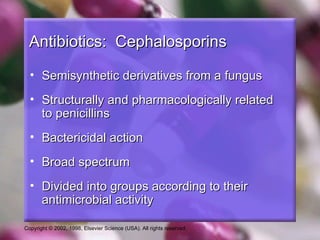
Antibiotics: Cephalosporins

  • Semisynthetic derivatives from a fungus
  • Structurally and pharmacologically related
    to penicillins
  • Bactericidal action
  • Broad spectrum
  • Divided into groups according to their
    antimicrobial activity

Copyright © 2002, 1998, Elsevier Science (USA). All rights reserved.
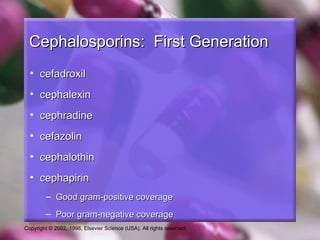
Cephalosporins: First Generation
  • cefadroxil
  • cephalexin
  • cephradine
  • cefazolin
  • cephalothin
  • cephapirin
         – Good gram-positive coverage
         – Poor gram-negative coverage
Copyright © 2002, 1998, Elsevier Science (USA). All rights reserved.
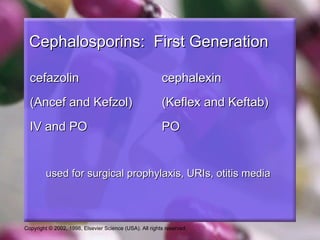
Cephalosporins: First Generation

  cefazolin                                              cephalexin
  (Ancef and Kefzol)                                     (Keflex and Keftab)
  IV and PO                                              PO


         used for surgical prophylaxis, URIs, otitis media


Copyright © 2002, 1998, Elsevier Science (USA). All rights reserved.
Cephalosporins: Second Generation
  • cefaclor                                         • cefonicid
  • cefprozil                                        • ceforanide
  • cefamandole                                      • cefmetazole
  • cefoxitin                                        • cefotetan
  • cefuroxime

         – Good gram-positive coverage
         – Better gram-negative coverage than first generation

Copyright © 2002, 1998, Elsevier Science (USA). All rights reserved.
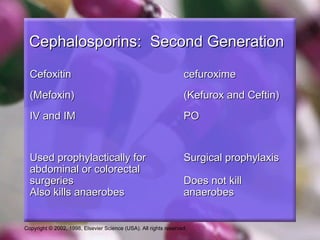
Cephalosporins: Second Generation
  Cefoxitin                                                       cefuroxime
  (Mefoxin)                                                       (Kefurox and Ceftin)
  IV and IM                                                       PO


  Used prophylactically for                                       Surgical prophylaxis
  abdominal or colorectal
  surgeries                                                       Does not kill
  Also kills anaerobes                                            anaerobes


Copyright © 2002, 1998, Elsevier Science (USA). All rights reserved.
Cephalosporins: Third Generation
  • cefixime                                                   • ceftizoxime
  • cefpodoxime proxetil                                       • ceftriaxone
  • cefoperazone                                               • ceftazidime
  • cefotaxime                                                 • moxalactam
         – Most potent group against gram-negative
         – Less active against gram-positive


Copyright © 2002, 1998, Elsevier Science (USA). All rights reserved.
Cephalosporins: Third Generation
  cefixime (Suprax)
  • Only oral third-generation agent
  • Best of available oral cephalosporins against
    gram-negative
  • Tablet and suspension

  ceftriaxone (Rocephin)
  • IV and IM, long half-life, once-a-day dosing
  • Easily passes meninges and diffused into CSF
    to treat CNS infections
Copyright © 2002, 1998, Elsevier Science (USA). All rights reserved.
Cephalosporins: Third Generation

  ceftazidime (Ceptaz, Fortaz, Tazidime, Tazicef)
  • IV and IM

  • Excellent gram-negative coverage

  • Used for difficult-to-treat organisms such as
    Pseudomonas spp.

  • Eliminated renally instead of biliary route

  • Excellent spectrum of coverage
Copyright © 2002, 1998, Elsevier Science (USA). All rights reserved.
Cephalosporins: Fourth Generation

  cefepime (Maxipime)
  • Newest cephalosporin agents.
  • Broader spectrum of antibacterial activity than
    third generation, especially against gram-positive
    bacteria.


Copyright © 2002, 1998, Elsevier Science (USA). All rights reserved.
Cephalosporins: Side Effects

  • similar to penicillins


Copyright © 2002, 1998, Elsevier Science (USA). All rights reserved.
Antibiotics: Tetracyclines

  • demeclocycline (Declomycin)
  • oxytetracycline
  • tetracycline
  • doxycycline (Doryx, Doxy-Caps, Vibramycin)
  • minocycline


Copyright © 2002, 1998, Elsevier Science (USA). All rights reserved.
Antibiotics: Tetracyclines

  • Natural and semi-synthetic
  • Obtained from cultures of Streptomyces
  • Bacteriostatic—inhibit bacterial growth
  • Inhibit protein synthesis
  • Stop many essential functions of the bacteria


Copyright © 2002, 1998, Elsevier Science (USA). All rights reserved.
Antibiotics: Tetracyclines

  • Bind to Ca2+ and Mg2+ and Al3+ ions to
    form insoluble complexes
  • Thus, dairy products, antacids, and iron
    salts reduce absorption of tetracyclines


Copyright © 2002, 1998, Elsevier Science (USA). All rights reserved.
Tetracyclines: Therapeutic Uses

  • Wide spectrum:
         – gram-negative, gram-positive, protozoa,
           Mycoplasma, Rickettsia, Chlamydia, syphilis,
           Lyme disease

  • Demeclocycline is also used to treat SIADH,
    and pleural and pericardial effusions


Copyright © 2002, 1998, Elsevier Science (USA). All rights reserved.
Tetracyclines: Side Effects

  Strong affinity for calcium
  • Discoloration of permanent teeth and tooth
    enamel in fetuses and children
  • May retard fetal skeletal development if taken
    during pregnancy


Copyright © 2002, 1998, Elsevier Science (USA). All rights reserved.
Tetracyclines: Side Effects

  Alteration in intestinal flora may result in:
  • Superinfection (overgrowth of nonsusceptible
    organisms such as Candida)
  • Diarrhea
  • Pseudomembranous colitis


Copyright © 2002, 1998, Elsevier Science (USA). All rights reserved.
Tetracyclines: Side Effects

  May also cause:
  • Vaginal moniliasis
  • Gastric upset
  • Enterocolitis
  • Maculopapular rash


Copyright © 2002, 1998, Elsevier Science (USA). All rights reserved.
Antibiotics: Aminoglycosides
  • gentamicin (Garamycin)
  • kanamycin
  • neomycin
  • streptomycin
  • tobramycin
  • amikacin (Amikin)
  • netilmicin
Copyright © 2002, 1998, Elsevier Science (USA). All rights reserved.
Aminoglycosides
  • Natural and semi-synthetic
  • Produced from Streptomyces
  • Poor oral absorption; no PO forms
  • Very potent antibiotics with serious toxicities
  • Bactericidal
  • Kill mostly gram-negative; some
    gram-positive also
Copyright © 2002, 1998, Elsevier Science (USA). All rights reserved.
Aminoglycosides
  • Used to kill gram-negative bacteria such as
    Pseudomonas spp., E. coli, Proteus spp.,
     Klebsiella spp., Serratia spp.
  • Often used in combination with other
    antibiotics for synergistic effect.


Copyright © 2002, 1998, Elsevier Science (USA). All rights reserved.
Aminoglycosides
  • Three most common (systemic): gentamicin,
    tobramycin, amikacin

  • Cause serious toxicities:

         – Nephrotoxicity (renal failure)

         – Ototoxicity (auditory impairment and vestibular
           [eighth cranial nerve])

  • Must monitor drug levels to prevent toxicities

Copyright © 2002, 1998, Elsevier Science (USA). All rights reserved.
Aminoglycosides: Side Effects
  Ototoxicity and nephrotoxicity are
   the most significant
  •   Headache
  •   Paresthesia
  •   Neuromuscular blockade
  •   Dizziness
  •   Vertigo
  •   Skin rash
  •   Fever
  •   Superinfections
Copyright © 2002, 1998, Elsevier Science (USA). All rights reserved.
Antibiotics: Quinolones
  • ciprofloxacin (Cipro)
  • enoxacin (Penetrex)
  • lomefloxacin (Maxaquin)
  • norfloxacin (Noroxin)
  • ofloxacin (Floxin)


Copyright © 2002, 1998, Elsevier Science (USA). All rights reserved.
Quinolones
  • Excellent oral absorption
  • Absorption reduced by antacids
  • First oral antibiotics effective against
    gram-negative bacteria


Copyright © 2002, 1998, Elsevier Science (USA). All rights reserved.
Quinolones: Mechanism of Action
  • Bactericidal
  • Effective against gram-negative organisms
    and some gram-positive organisms
  • Alter DNA of bacteria, causing death
  • Do not affect human DNA


Copyright © 2002, 1998, Elsevier Science (USA). All rights reserved.
Quinolones: Therapeutic Uses
  • Lower respiratory tract infections
  • Bone and joint infections
  • Infectious diarrhea
  • Urinary tract infections
  • Skin infections
  • Sexually transmitted diseases

Copyright © 2002, 1998, Elsevier Science (USA). All rights reserved.
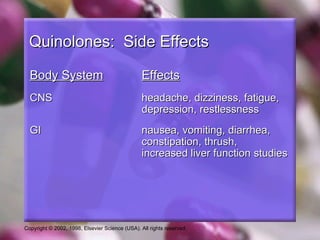
Quinolones: Side Effects

  Body System                                    Effects
  CNS                                            headache, dizziness, fatigue,
                                                 depression, restlessness
  GI                                             nausea, vomiting, diarrhea,
                                                 constipation, thrush,
                                                 increased liver function studies


Copyright © 2002, 1998, Elsevier Science (USA). All rights reserved.
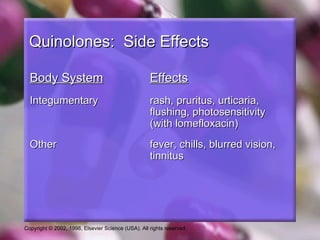
Quinolones: Side Effects

  Body System                                       Effects
  Integumentary                                     rash, pruritus, urticaria,
                                                    flushing, photosensitivity
                                                    (with lomefloxacin)
  Other                                             fever, chills, blurred vision,
                                                    tinnitus


Copyright © 2002, 1998, Elsevier Science (USA). All rights reserved.
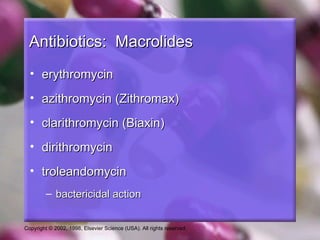
Antibiotics: Macrolides
  • erythromycin
  • azithromycin (Zithromax)
  • clarithromycin (Biaxin)
  • dirithromycin
  • troleandomycin
         – bactericidal action


Copyright © 2002, 1998, Elsevier Science (USA). All rights reserved.
Instructors may wish to insert
                       EIC Image #102:

                     Erythromycin Formulations


Copyright © 2002, 1998, Elsevier Science (USA). All rights reserved.
Macrolides: Therapeutic Uses
  Strep infections
  • Streptococcus pyogenes
    (group A beta-hemolytic streptococci)

  Mild to moderate URI
  • Haemophilus influenzae

  Spirochetal infections
  • Syphilis and Lyme disease

  Gonorrhea, Chlamydia, Mycoplasma
Copyright © 2002, 1998, Elsevier Science (USA). All rights reserved.
Macrolides: Side Effects

 GI effects, primarily with erythromycin:

 • nausea, vomiting, diarrhea, hepatotoxicity,
   flatulence, jaundice, anorexia

 • Newer agents, azithromycin and clarithromycin:
   fewer side effects, longer duration of action,
   better efficacy, better tissue penetration


Copyright © 2002, 1998, Elsevier Science (USA). All rights reserved.
Antibiotics: Nursing Implications
  • Before beginning therapy, assess drug allergies;
    hepatic, liver, and cardiac function; and other lab
    studies.

  • Be sure to obtain thorough patient health history,
    including immune status.

  • Assess for conditions that may be contraindications
    to antibiotic use, or that may indicate cautious use.

  • Assess for potential drug interactions.

Copyright © 2002, 1998, Elsevier Science (USA). All rights reserved.
Antibiotics: Nursing Implications
  • It is ESSENTIAL to obtain cultures from
    appropriate sites BEFORE beginning
    antibiotic therapy.


Copyright © 2002, 1998, Elsevier Science (USA). All rights reserved.
Antibiotics: Nursing Implications
  • Patients should be instructed to take antibiotics
    exactly as prescribed and for the length of time
    prescribed; they should not stop taking the
    medication early when they feel better.

  • Assess for signs and symptoms of superinfection:
    fever, perineal itching, cough, lethargy, or any
    unusual discharge.


Copyright © 2002, 1998, Elsevier Science (USA). All rights reserved.
Antibiotics: Nursing Implications

  • For safety reasons, check the name of the
    medication carefully since there are many
    agents that sound alike or have similar
    spellings.


Copyright © 2002, 1998, Elsevier Science (USA). All rights reserved.
Antibiotics: Nursing Implications

  • Each class of antibiotics has specific side
    effects and drug interactions that must be
    carefully assessed and monitored.

  • The most common side effects of antibiotics
    are nausea, vomiting, and diarrhea.

  • All oral antibiotics are absorbed better if
    taken with at least 6 to 8 ounces of water.

Copyright © 2002, 1998, Elsevier Science (USA). All rights reserved.
Antibiotics: Nursing Implications

  Sulfonamides
  • Should be taken with at least 2400 mL of fluid
    per day, unless contraindicated.
  • Due to photosensitivity, avoid sunlight and
    tanning beds.
  • These agents reduce the effectiveness of
    oral contraceptives.


Copyright © 2002, 1998, Elsevier Science (USA). All rights reserved.
Antibiotics: Nursing Implications

  Penicillins
  • Any patient taking a penicillin should be carefully
    monitored for an allergic reaction for at least 30
    minutes after its administration.

  • The effectiveness of oral penicillins is decreased
    when taken with caffeine, citrus fruit, cola beverages,
    fruit juices, or tomato juice.


Copyright © 2002, 1998, Elsevier Science (USA). All rights reserved.
Antibiotics: Nursing Implications

  Cephalosporins
  • Orally administered forms should be given with food
    to decrease GI upset, even though this will delay
    absorption.

  • Some of these agents may cause an Antabuse-like
    reaction when taken with alcohol.


Copyright © 2002, 1998, Elsevier Science (USA). All rights reserved.
Antibiotics: Nursing Implications
  Tetracyclines
  • Milk products, iron preparations, antacids, and other
    dairy products should be avoided because of the
    chelation and drug-binding that occurs.
  • All medications should be taken with 6 to 8 ounces
    of fluid, preferably water.
  • Due to photosensitivity, avoid sunlight and
    tanning beds.


Copyright © 2002, 1998, Elsevier Science (USA). All rights reserved.
Antibiotics: Nursing Implications

  Aminoglycosides
  • Monitor peak and trough blood levels of these
    agents to prevent nephrotoxicity and ototoxicity.
  • Symptoms of ototoxicity include dizziness, tinnitus,
    and hearing loss.
  • Symptoms of nephrotoxicity include urinary casts,
    proteinuria, and increased BUN and serum
    creatinine levels.


Copyright © 2002, 1998, Elsevier Science (USA). All rights reserved.
Antibiotics: Nursing Implications

  Quinolones
  • Should be taken with at least 3 L of fluid per day,
    unless otherwise specified


Copyright © 2002, 1998, Elsevier Science (USA). All rights reserved.
Antibiotics: Nursing Implications

  Macrolides
  • These agents are highly protein-bound and will
    cause severe interactions with other protein-bound
    drugs.
  • The absorption of oral erythromycin is enhanced
    when taken on an empty stomach, but because
    of the high incidence of GI upset, many agents
    are taken after a meal or snack.


Copyright © 2002, 1998, Elsevier Science (USA). All rights reserved.
Antibiotics: Nursing Implications

  Monitor for therapeutic effects:
  • Disappearance of fever, lethargy, drainage,
    and redness


Copyright © 2002, 1998, Elsevier Science (USA). All rights reserved.

Antibiotics

  • 1.
    Anti-Infective Agents Antibiotics: Sulfonamides Penicillins Cephalosporins Tetracyclines Aminoglycosides Quinolones Macrolides Copyright © 2002, 1998, Elsevier Science (USA). All rights reserved.
  • 2.
    Antibiotics •Medications used to treat bacterial infections • Ideally, before beginning antibiotic therapy, the suspected areas of infection should be cultured to identify the causative organism and potential antibiotic susceptibilities. Copyright © 2002, 1998, Elsevier Science (USA). All rights reserved.
  • 3.
    Antibiotics •Empiric therapy: treatment of an infection before specific culture information has been reported or obtained • Prophylactic therapy: treatment with antibiotics to prevent an infection, as in intra- abdominal surgery Copyright © 2002, 1998, Elsevier Science (USA). All rights reserved.
  • 4.
    Antibiotics •Bactericidal: kill bacteria • Bacteriostatic: inhibit growth of susceptible bacteria, rather than killing them immediately; will eventually lead to bacterial death Copyright © 2002, 1998, Elsevier Science (USA). All rights reserved.
  • 5.
    Antibiotics: Sulfonamides One of the first groups of antibiotics • sulfadiazine • sulfamethizole • sulfamethoxazole • sulfisoxazole Copyright © 2002, 1998, Elsevier Science (USA). All rights reserved.
  • 6.
    Sulfonamides: Mechanism ofAction • Bacteriostatic action • Prevent synthesis of folic acid required for synthesis of purines and nucleic acid • Does not affect human cells or certain bacteria—they can use preformed folic acid Copyright © 2002, 1998, Elsevier Science (USA). All rights reserved.
  • 7.
    Sulfonamides: sulfamethoxazole Therapeutic Uses Azo-Gantanol • Combined with phenazopyridine (an analgesic-anesthetic that affects the mucosa of the urinary tract). • Used to treat urinary tract infections (UTIs) and to reduce the pain associated with UTIs. Bactrim • Combined with trimethoprim. • Used to treat UTIs, Pneumocystis carinii pneumonia, ear infections, bronchitis, gonorrhea, etc. Copyright © 2002, 1998, Elsevier Science (USA). All rights reserved.
  • 8.
    Sulfonamides: sulfisoxazole Therapeutic Uses Azo-Gantrisin • Combined with phenazopyridine • Used for UTIs Pediazole • Combined with erythromycin • Used to treat otitis media Copyright © 2002, 1998, Elsevier Science (USA). All rights reserved.
  • 9.
    Sulfonamides: Side Effects Body System Effect Blood Hemolytic and aplastic anemia, thrombocytopenia Integumentary Photosensitivity, exfoliative dermatitis, Stevens-Johnson syndrome, epidermal necrolysis Copyright © 2002, 1998, Elsevier Science (USA). All rights reserved.
  • 10.
    Sulfonamides: Side Effects Body System Effect GI Nausea, vomiting, diarrhea, pancreatitis Other Convulsions, crystalluria, toxic nephrosis, headache, peripheral neuritis, urticaria Copyright © 2002, 1998, Elsevier Science (USA). All rights reserved.
  • 11.
    Antibiotics: Penicillins • Natural penicillins • Penicillinase-resistant penicillins • Aminopenicillins • Extended-spectrum penicillins Copyright © 2002, 1998, Elsevier Science (USA). All rights reserved.
  • 12.
    Antibiotics: Penicillins Natural penicillins • penicillin G, penicillin V potassium Penicillinase-resistant penicillins • cloxacillin, dicloxacillin, methicillin, nafcillin, oxacillin Copyright © 2002, 1998, Elsevier Science (USA). All rights reserved.
  • 13.
    Antibiotics: Penicillins Aminopenicillins • amoxicillin, ampicillin, bacampicillin Extended-spectrum penicillins • piperacillin, ticarcillin, carbenicillin, mezlocillin Copyright © 2002, 1998, Elsevier Science (USA). All rights reserved.
  • 14.
    Antibiotics: Penicillins • First introduced in the 1940s • Bactericidal: inhibit cell wall synthesis • Kill a wide variety of bacteria • Also called “beta-lactams” Copyright © 2002, 1998, Elsevier Science (USA). All rights reserved.
  • 15.
    Antibiotics: Penicillins • Bacteria produce enzymes capable of destroying penicillins. • These enzymes are known as beta-lactamases. • As a result, the medication is not effective. Copyright © 2002, 1998, Elsevier Science (USA). All rights reserved.
  • 16.
    Antibiotics: Penicillins • Chemicals have been developed to inhibit these enzymes: – clavulanic acid – tazobactam – sulbactam • These chemicals bind with beta-lactamase and prevent the enzyme from breaking down the penicillin Copyright © 2002, 1998, Elsevier Science (USA). All rights reserved.
  • 17.
    Antibiotics: Penicillins • Penicillin-beta-lactamase inhibitor combination drugs: – ampicillin + sulbactam = Unasyn – amoxicillin + clavulanic acid = Augmentin – ticarcillin + clavulanic acid = Timentin – piperacillin + tazobactam = Zosyn Copyright © 2002, 1998, Elsevier Science (USA). All rights reserved.
  • 18.
    Penicillins: Mechanism ofAction • Penicillins enter the bacteria via the cell wall. • Inside the cell, they bind to penicillin-binding protein. • Once bound, normal cell wall synthesis is disrupted. • Result: bacteria cells die from cell lysis. • Penicillins do not kill other cells in the body. Copyright © 2002, 1998, Elsevier Science (USA). All rights reserved.
  • 19.
    Penicillins: Therapeutic Uses • Prevention and treatment of infections caused by susceptible bacteria, such as: – gram-positive bacteria – Streptococcus, Enterococcus, Staphylococcus species Copyright © 2002, 1998, Elsevier Science (USA). All rights reserved.
  • 20.
    Penicillins: Adverse Effects • Allergic reactions occur in 0.7% – 8% of treatments – urticaria, pruritus, angioedema • 10% of allergic reactions are life-threatening and • 10% of these are fatal Copyright © 2002, 1998, Elsevier Science (USA). All rights reserved.
  • 21.
    Penicillins: Side Effects • Common side effects: – nausea, vomiting, diarrhea, abdominal pain • Other side effects are less common Copyright © 2002, 1998, Elsevier Science (USA). All rights reserved.
  • 22.
    Antibiotics: Cephalosporins • First Generation • Second Generation • Third Generation • Fourth Generation Copyright © 2002, 1998, Elsevier Science (USA). All rights reserved.
  • 23.
    Antibiotics: Cephalosporins • Semisynthetic derivatives from a fungus • Structurally and pharmacologically related to penicillins • Bactericidal action • Broad spectrum • Divided into groups according to their antimicrobial activity Copyright © 2002, 1998, Elsevier Science (USA). All rights reserved.
  • 24.
    Cephalosporins: First Generation • cefadroxil • cephalexin • cephradine • cefazolin • cephalothin • cephapirin – Good gram-positive coverage – Poor gram-negative coverage Copyright © 2002, 1998, Elsevier Science (USA). All rights reserved.
  • 25.
    Cephalosporins: First Generation cefazolin cephalexin (Ancef and Kefzol) (Keflex and Keftab) IV and PO PO used for surgical prophylaxis, URIs, otitis media Copyright © 2002, 1998, Elsevier Science (USA). All rights reserved.
  • 26.
    Cephalosporins: Second Generation • cefaclor • cefonicid • cefprozil • ceforanide • cefamandole • cefmetazole • cefoxitin • cefotetan • cefuroxime – Good gram-positive coverage – Better gram-negative coverage than first generation Copyright © 2002, 1998, Elsevier Science (USA). All rights reserved.
  • 27.
    Cephalosporins: Second Generation Cefoxitin cefuroxime (Mefoxin) (Kefurox and Ceftin) IV and IM PO Used prophylactically for Surgical prophylaxis abdominal or colorectal surgeries Does not kill Also kills anaerobes anaerobes Copyright © 2002, 1998, Elsevier Science (USA). All rights reserved.
  • 28.
    Cephalosporins: Third Generation • cefixime • ceftizoxime • cefpodoxime proxetil • ceftriaxone • cefoperazone • ceftazidime • cefotaxime • moxalactam – Most potent group against gram-negative – Less active against gram-positive Copyright © 2002, 1998, Elsevier Science (USA). All rights reserved.
  • 29.
    Cephalosporins: Third Generation cefixime (Suprax) • Only oral third-generation agent • Best of available oral cephalosporins against gram-negative • Tablet and suspension ceftriaxone (Rocephin) • IV and IM, long half-life, once-a-day dosing • Easily passes meninges and diffused into CSF to treat CNS infections Copyright © 2002, 1998, Elsevier Science (USA). All rights reserved.
  • 30.
    Cephalosporins: Third Generation ceftazidime (Ceptaz, Fortaz, Tazidime, Tazicef) • IV and IM • Excellent gram-negative coverage • Used for difficult-to-treat organisms such as Pseudomonas spp. • Eliminated renally instead of biliary route • Excellent spectrum of coverage Copyright © 2002, 1998, Elsevier Science (USA). All rights reserved.
  • 31.
    Cephalosporins: Fourth Generation cefepime (Maxipime) • Newest cephalosporin agents. • Broader spectrum of antibacterial activity than third generation, especially against gram-positive bacteria. Copyright © 2002, 1998, Elsevier Science (USA). All rights reserved.
  • 32.
    Cephalosporins: Side Effects • similar to penicillins Copyright © 2002, 1998, Elsevier Science (USA). All rights reserved.
  • 33.
    Antibiotics: Tetracyclines • demeclocycline (Declomycin) • oxytetracycline • tetracycline • doxycycline (Doryx, Doxy-Caps, Vibramycin) • minocycline Copyright © 2002, 1998, Elsevier Science (USA). All rights reserved.
  • 34.
    Antibiotics: Tetracyclines • Natural and semi-synthetic • Obtained from cultures of Streptomyces • Bacteriostatic—inhibit bacterial growth • Inhibit protein synthesis • Stop many essential functions of the bacteria Copyright © 2002, 1998, Elsevier Science (USA). All rights reserved.
  • 35.
    Antibiotics: Tetracyclines • Bind to Ca2+ and Mg2+ and Al3+ ions to form insoluble complexes • Thus, dairy products, antacids, and iron salts reduce absorption of tetracyclines Copyright © 2002, 1998, Elsevier Science (USA). All rights reserved.
  • 36.
    Tetracyclines: Therapeutic Uses • Wide spectrum: – gram-negative, gram-positive, protozoa, Mycoplasma, Rickettsia, Chlamydia, syphilis, Lyme disease • Demeclocycline is also used to treat SIADH, and pleural and pericardial effusions Copyright © 2002, 1998, Elsevier Science (USA). All rights reserved.
  • 37.
    Tetracyclines: Side Effects Strong affinity for calcium • Discoloration of permanent teeth and tooth enamel in fetuses and children • May retard fetal skeletal development if taken during pregnancy Copyright © 2002, 1998, Elsevier Science (USA). All rights reserved.
  • 38.
    Tetracyclines: Side Effects Alteration in intestinal flora may result in: • Superinfection (overgrowth of nonsusceptible organisms such as Candida) • Diarrhea • Pseudomembranous colitis Copyright © 2002, 1998, Elsevier Science (USA). All rights reserved.
  • 39.
    Tetracyclines: Side Effects May also cause: • Vaginal moniliasis • Gastric upset • Enterocolitis • Maculopapular rash Copyright © 2002, 1998, Elsevier Science (USA). All rights reserved.
  • 40.
    Antibiotics: Aminoglycosides • gentamicin (Garamycin) • kanamycin • neomycin • streptomycin • tobramycin • amikacin (Amikin) • netilmicin Copyright © 2002, 1998, Elsevier Science (USA). All rights reserved.
  • 41.
    Aminoglycosides •Natural and semi-synthetic • Produced from Streptomyces • Poor oral absorption; no PO forms • Very potent antibiotics with serious toxicities • Bactericidal • Kill mostly gram-negative; some gram-positive also Copyright © 2002, 1998, Elsevier Science (USA). All rights reserved.
  • 42.
    Aminoglycosides •Used to kill gram-negative bacteria such as Pseudomonas spp., E. coli, Proteus spp., Klebsiella spp., Serratia spp. • Often used in combination with other antibiotics for synergistic effect. Copyright © 2002, 1998, Elsevier Science (USA). All rights reserved.
  • 43.
    Aminoglycosides •Three most common (systemic): gentamicin, tobramycin, amikacin • Cause serious toxicities: – Nephrotoxicity (renal failure) – Ototoxicity (auditory impairment and vestibular [eighth cranial nerve]) • Must monitor drug levels to prevent toxicities Copyright © 2002, 1998, Elsevier Science (USA). All rights reserved.
  • 44.
    Aminoglycosides: Side Effects Ototoxicity and nephrotoxicity are the most significant • Headache • Paresthesia • Neuromuscular blockade • Dizziness • Vertigo • Skin rash • Fever • Superinfections Copyright © 2002, 1998, Elsevier Science (USA). All rights reserved.
  • 45.
    Antibiotics: Quinolones • ciprofloxacin (Cipro) • enoxacin (Penetrex) • lomefloxacin (Maxaquin) • norfloxacin (Noroxin) • ofloxacin (Floxin) Copyright © 2002, 1998, Elsevier Science (USA). All rights reserved.
  • 46.
    Quinolones •Excellent oral absorption • Absorption reduced by antacids • First oral antibiotics effective against gram-negative bacteria Copyright © 2002, 1998, Elsevier Science (USA). All rights reserved.
  • 47.
    Quinolones: Mechanism ofAction • Bactericidal • Effective against gram-negative organisms and some gram-positive organisms • Alter DNA of bacteria, causing death • Do not affect human DNA Copyright © 2002, 1998, Elsevier Science (USA). All rights reserved.
  • 48.
    Quinolones: Therapeutic Uses • Lower respiratory tract infections • Bone and joint infections • Infectious diarrhea • Urinary tract infections • Skin infections • Sexually transmitted diseases Copyright © 2002, 1998, Elsevier Science (USA). All rights reserved.
  • 49.
    Quinolones: Side Effects Body System Effects CNS headache, dizziness, fatigue, depression, restlessness GI nausea, vomiting, diarrhea, constipation, thrush, increased liver function studies Copyright © 2002, 1998, Elsevier Science (USA). All rights reserved.
  • 50.
    Quinolones: Side Effects Body System Effects Integumentary rash, pruritus, urticaria, flushing, photosensitivity (with lomefloxacin) Other fever, chills, blurred vision, tinnitus Copyright © 2002, 1998, Elsevier Science (USA). All rights reserved.
  • 51.
    Antibiotics: Macrolides • erythromycin • azithromycin (Zithromax) • clarithromycin (Biaxin) • dirithromycin • troleandomycin – bactericidal action Copyright © 2002, 1998, Elsevier Science (USA). All rights reserved.
  • 52.
    Instructors may wishto insert EIC Image #102: Erythromycin Formulations Copyright © 2002, 1998, Elsevier Science (USA). All rights reserved.
  • 53.
    Macrolides: Therapeutic Uses Strep infections • Streptococcus pyogenes (group A beta-hemolytic streptococci) Mild to moderate URI • Haemophilus influenzae Spirochetal infections • Syphilis and Lyme disease Gonorrhea, Chlamydia, Mycoplasma Copyright © 2002, 1998, Elsevier Science (USA). All rights reserved.
  • 54.
    Macrolides: Side Effects GI effects, primarily with erythromycin: • nausea, vomiting, diarrhea, hepatotoxicity, flatulence, jaundice, anorexia • Newer agents, azithromycin and clarithromycin: fewer side effects, longer duration of action, better efficacy, better tissue penetration Copyright © 2002, 1998, Elsevier Science (USA). All rights reserved.
  • 55.
    Antibiotics: Nursing Implications • Before beginning therapy, assess drug allergies; hepatic, liver, and cardiac function; and other lab studies. • Be sure to obtain thorough patient health history, including immune status. • Assess for conditions that may be contraindications to antibiotic use, or that may indicate cautious use. • Assess for potential drug interactions. Copyright © 2002, 1998, Elsevier Science (USA). All rights reserved.
  • 56.
    Antibiotics: Nursing Implications • It is ESSENTIAL to obtain cultures from appropriate sites BEFORE beginning antibiotic therapy. Copyright © 2002, 1998, Elsevier Science (USA). All rights reserved.
  • 57.
    Antibiotics: Nursing Implications • Patients should be instructed to take antibiotics exactly as prescribed and for the length of time prescribed; they should not stop taking the medication early when they feel better. • Assess for signs and symptoms of superinfection: fever, perineal itching, cough, lethargy, or any unusual discharge. Copyright © 2002, 1998, Elsevier Science (USA). All rights reserved.
  • 58.
    Antibiotics: Nursing Implications • For safety reasons, check the name of the medication carefully since there are many agents that sound alike or have similar spellings. Copyright © 2002, 1998, Elsevier Science (USA). All rights reserved.
  • 59.
    Antibiotics: Nursing Implications • Each class of antibiotics has specific side effects and drug interactions that must be carefully assessed and monitored. • The most common side effects of antibiotics are nausea, vomiting, and diarrhea. • All oral antibiotics are absorbed better if taken with at least 6 to 8 ounces of water. Copyright © 2002, 1998, Elsevier Science (USA). All rights reserved.
  • 60.
    Antibiotics: Nursing Implications Sulfonamides • Should be taken with at least 2400 mL of fluid per day, unless contraindicated. • Due to photosensitivity, avoid sunlight and tanning beds. • These agents reduce the effectiveness of oral contraceptives. Copyright © 2002, 1998, Elsevier Science (USA). All rights reserved.
  • 61.
    Antibiotics: Nursing Implications Penicillins • Any patient taking a penicillin should be carefully monitored for an allergic reaction for at least 30 minutes after its administration. • The effectiveness of oral penicillins is decreased when taken with caffeine, citrus fruit, cola beverages, fruit juices, or tomato juice. Copyright © 2002, 1998, Elsevier Science (USA). All rights reserved.
  • 62.
    Antibiotics: Nursing Implications Cephalosporins • Orally administered forms should be given with food to decrease GI upset, even though this will delay absorption. • Some of these agents may cause an Antabuse-like reaction when taken with alcohol. Copyright © 2002, 1998, Elsevier Science (USA). All rights reserved.
  • 63.
    Antibiotics: Nursing Implications Tetracyclines • Milk products, iron preparations, antacids, and other dairy products should be avoided because of the chelation and drug-binding that occurs. • All medications should be taken with 6 to 8 ounces of fluid, preferably water. • Due to photosensitivity, avoid sunlight and tanning beds. Copyright © 2002, 1998, Elsevier Science (USA). All rights reserved.
  • 64.
    Antibiotics: Nursing Implications Aminoglycosides • Monitor peak and trough blood levels of these agents to prevent nephrotoxicity and ototoxicity. • Symptoms of ototoxicity include dizziness, tinnitus, and hearing loss. • Symptoms of nephrotoxicity include urinary casts, proteinuria, and increased BUN and serum creatinine levels. Copyright © 2002, 1998, Elsevier Science (USA). All rights reserved.
  • 65.
    Antibiotics: Nursing Implications Quinolones • Should be taken with at least 3 L of fluid per day, unless otherwise specified Copyright © 2002, 1998, Elsevier Science (USA). All rights reserved.
  • 66.
    Antibiotics: Nursing Implications Macrolides • These agents are highly protein-bound and will cause severe interactions with other protein-bound drugs. • The absorption of oral erythromycin is enhanced when taken on an empty stomach, but because of the high incidence of GI upset, many agents are taken after a meal or snack. Copyright © 2002, 1998, Elsevier Science (USA). All rights reserved.
  • 67.
    Antibiotics: Nursing Implications Monitor for therapeutic effects: • Disappearance of fever, lethargy, drainage, and redness Copyright © 2002, 1998, Elsevier Science (USA). All rights reserved.