1) Introduction to Human Growth & Development :
❑ Growth
❑ Development
2) Difference between Growth & Development
3) 10 Stages of Life.
4) References
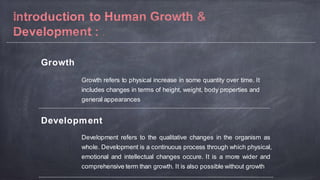
Growth
Growth refers to physical increase in some quantity over time. It
includes changes in terms of height, weight, body properties and
general appearances
Development
Development refers to the qualitative changes in the organism as
whole. Development is a continuous process through which physical,
emotional and intellectual changes occure. It is a more wider and
comprehensive term than growth. It is also possible without growth
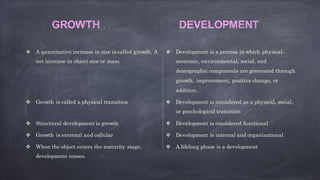
❖ A quantitative increase in size is called growth. A
net increase in object size or mass.
❖ Development is a process in which physical-
economic, environmental, social, and
demographic components are generated through
growth, improvement, positive change, or
addition.
❖ Growth is called a physical transition ❖ Development is considered as a physical, social,
or psychological transition
❖ Structural development is growth ❖ Development is considered functional
❖ Growth is external and cellular ❖ Development is internal and organizational
❖ When the object enters the maturity stage,
development ceases.
❖ A lifelong phase is a development
1 2 3 4 5
Prenatal Period
Period of Human Life before
taking the birth, divided into
three parts :
1) Germinal Period
2) Embryonical Period
3) Fetus Period
Infancy Period
(Birth to One Year of Age)
The term ‘infant’ is typically
applied to young children under
one year of age.
Babyhood
Babyhood is a time w hen
babies are totally dependent
upon their parents for their
protection and care.
Early Childhood
(One Year to Six Years of Age)
Early childhood is a stage of
human development, It
generally includes toddlerhood
and sometimes afterwards.
Late Childhood
(Six to Tw elve Years of Age)
It is a period in w hich first sign
of puberty usually begin to
appear. A lot of grow th is
experienced by boys and girls
during late childhood.
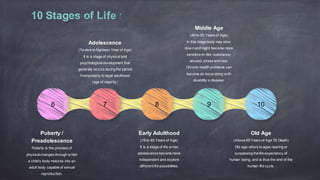
6 7 8 9 10
Puberty /
Preadolescence
Puberty is the process of
physicalchanges through w hich
a child’s body matures into an
adult body capable of sexual
reproduction.
Adolescence
(Tw elve to Eighteen Year of Age)
It is a stage of physicaland
psychologicaldevelopment that
generally occurs during the period
frompuberty to legal adulthood
(age of majority)
Early Adulthood
(19 to 40 Years of Age)
It is a stage of life w hen
adolescence become more
independent and explore
different life possibilities.
Middle Age
(40 to 65 Years of Age)
In this stage body may slow
dow n and might become more
sensitive to diet, substance,
abused, stress and rest.
Chronic health problems can
become an issue along w ith
disability o disease.
Old Age
(Above 65 Years of Age Till Death)
Old age refers to ages nearing or
surpassing the life expectancy of
human being, and is thus the end of the
human life cycle.
Dr. Pratima Kumari Mishra
GopikaI. G.
Human Growth and Development-
Developmental Psychology
Human Growth and Principles of
Development
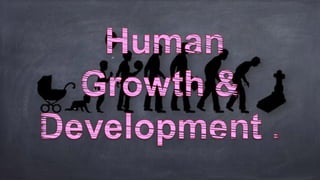
Human Growth & Development

Human Growth & Development

  • 3.
    1) Introduction toHuman Growth & Development : ❑ Growth ❑ Development 2) Difference between Growth & Development 3) 10 Stages of Life. 4) References
  • 4.
    Growth Growth refers tophysical increase in some quantity over time. It includes changes in terms of height, weight, body properties and general appearances Development Development refers to the qualitative changes in the organism as whole. Development is a continuous process through which physical, emotional and intellectual changes occure. It is a more wider and comprehensive term than growth. It is also possible without growth
  • 6.
    ❖ A quantitativeincrease in size is called growth. A net increase in object size or mass. ❖ Development is a process in which physical- economic, environmental, social, and demographic components are generated through growth, improvement, positive change, or addition. ❖ Growth is called a physical transition ❖ Development is considered as a physical, social, or psychological transition ❖ Structural development is growth ❖ Development is considered functional ❖ Growth is external and cellular ❖ Development is internal and organizational ❖ When the object enters the maturity stage, development ceases. ❖ A lifelong phase is a development
  • 8.
    1 2 34 5 Prenatal Period Period of Human Life before taking the birth, divided into three parts : 1) Germinal Period 2) Embryonical Period 3) Fetus Period Infancy Period (Birth to One Year of Age) The term ‘infant’ is typically applied to young children under one year of age. Babyhood Babyhood is a time w hen babies are totally dependent upon their parents for their protection and care. Early Childhood (One Year to Six Years of Age) Early childhood is a stage of human development, It generally includes toddlerhood and sometimes afterwards. Late Childhood (Six to Tw elve Years of Age) It is a period in w hich first sign of puberty usually begin to appear. A lot of grow th is experienced by boys and girls during late childhood.
  • 9.
    6 7 89 10 Puberty / Preadolescence Puberty is the process of physicalchanges through w hich a child’s body matures into an adult body capable of sexual reproduction. Adolescence (Tw elve to Eighteen Year of Age) It is a stage of physicaland psychologicaldevelopment that generally occurs during the period frompuberty to legal adulthood (age of majority) Early Adulthood (19 to 40 Years of Age) It is a stage of life w hen adolescence become more independent and explore different life possibilities. Middle Age (40 to 65 Years of Age) In this stage body may slow dow n and might become more sensitive to diet, substance, abused, stress and rest. Chronic health problems can become an issue along w ith disability o disease. Old Age (Above 65 Years of Age Till Death) Old age refers to ages nearing or surpassing the life expectancy of human being, and is thus the end of the human life cycle.
  • 10.
    Dr. Pratima KumariMishra GopikaI. G. Human Growth and Development- Developmental Psychology Human Growth and Principles of Development