HTTP Requests Proxying
Alexander Krizhanovsky
Tempesta Technologies, Inc.
ak@tempesta-tech.com
Who am I?
CEO & CTO at Tempesta Technologies
Developing Tempesta FW – open source Linux
Application Delivery Controller (ADC)
Custom software development in:
● high performance network traffic processing
e.g. WAF mentioned in Gartner magic quadrant
● Databases
e.g. MariaDB SQL System Versioning
https://github.com/tempesta-tech/mariadb
https://m17.mariadb.com/session/technical-preview-temporal-queryi
ng-asof
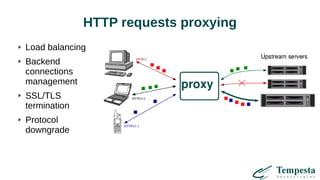
HTTP requests proxying
Load balancing
Backend
connections
management
SSL/TLS
termination
Protocol
downgrade
HTTP proxying issues
How many server connections?
What to do if an upstream resets a connection?
How to manage HTTP message queues?
Is it safe to resend a request to another upstream?
TLS is expensive
Sockets proxying is expensive
HTTP multiplexing - HTTP/2?
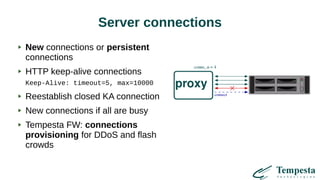
Server connections
New connections or persistent
connections
HTTP keep-alive connections
Keep-Alive: timeout=5, max=10000
Reestablish closed KA connection
New connections if all are busy
Tempesta FW: connections
provisioning for DDoS and flash
crowds
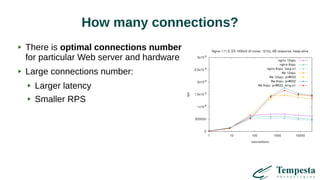
How many connections?
There is optimal connections number
for particular Web server and hardware
Large connections number:
Larger latency
Smaller RPS
Connection resets & server failure
Default for Apache HTTPD & Nginx: reset each 100 requests
Dirty hack for messy dynamics
Server failure
● Connection reset or I/O timeout
● HTTP error responses
● Backend healthcheck
• TCP connection
• HTTP response code
• HTTP response body
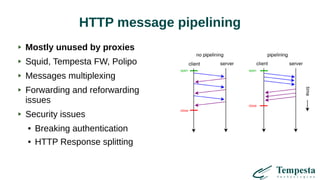
HTTP message pipelining
Mostly unused by proxies
Squid, Tempesta FW, Polipo
Messages multiplexing
Forwarding and reforwarding
issues
Security issues
● Breaking authentication
● HTTP Response splitting
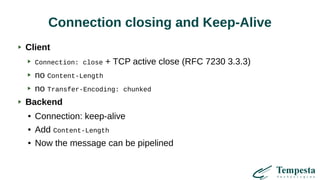
Connection closing and Keep-Alive
Client
Connection: close + TCP active close (RFC 7230 3.3.3)
no Content-Length
no Transfer-Encoding: chunked
Backend
● Connection: keep-alive
● Add Content-Length
● Now the message can be pipelined
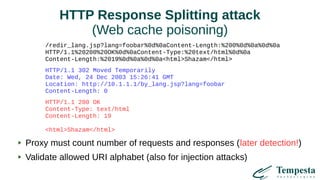
HTTP Response Splitting attack
(Web cache poisoning)
/redir_lang.jsp?lang=foobar%0d%0aContent-Length:%200%0d%0a%0d%0a
HTTP/1.1%20200%20OK%0d%0aContent-Type:%20text/html%0d%0a
Content-Length:%2019%0d%0a%0d%0a<html>Shazam</html>
HTTP/1.1 302 Moved Temporarily
Date: Wed, 24 Dec 2003 15:26:41 GMT
Location: http://10.1.1.1/by_lang.jsp?lang=foobar
Content-Length: 0
HTTP/1.1 200 OK
Content-Type: text/html
Content-Length: 19
<html>Shazam</html>
Proxy must count number of requests and responses (later detection!)
Validate allowed URI alphabet (also for injection attacks)
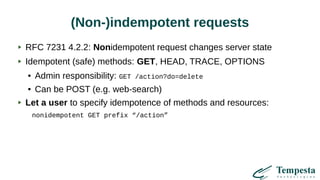
(Non-)indempotent requests
RFC 7231 4.2.2: Nonidempotent request changes server state
Idempotent (safe) methods: GET, HEAD, TRACE, OPTIONS
● Admin responsibility: GET /action?do=delete
● Can be POST (e.g. web-search)
Let a user to specify idempotence of methods and resources:
nonidempotent GET prefix “/action”
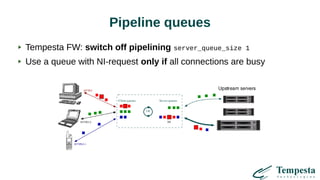
Pipeline queues
Tempesta FW: switch off pipelining server_queue_size 1
Use a queue with NI-request only if all connections are busy
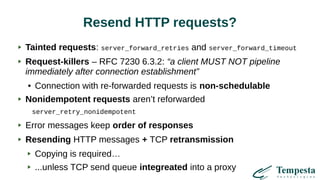
Resend HTTP requests?
Tainted requests: server_forward_retries and server_forward_timeout
Request-killers – RFC 7230 6.3.2: “a client MUST NOT pipeline
immediately after connection establishment”
● Connection with re-forwarded requests is non-schedulable
Nonidempotent requests aren’t reforwarded
server_retry_nonidempotent
Error messages keep order of responses
Resending HTTP messages + TCP retransmission
Copying is required…
...unless TCP send queue integreated into a proxy
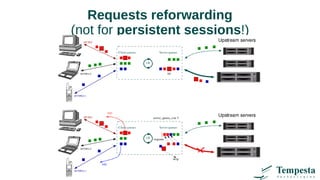
Requests reforwarding
(not for persistent sessions!)
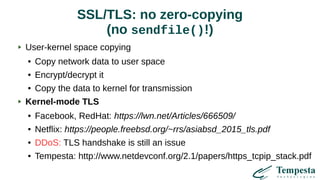
SSL/TLS: no zero-copying
(no sendfile()!)
User-kernel space copying
● Copy network data to user space
● Encrypt/decrypt it
● Copy the data to kernel for transmission
Kernel-mode TLS
● Facebook, RedHat: https://lwn.net/Articles/666509/
● Netflix: https://people.freebsd.org/~rrs/asiabsd_2015_tls.pdf
● DDoS: TLS handshake is still an issue
● Tempesta: http://www.netdevconf.org/2.1/papers/https_tcpip_stack.pdf
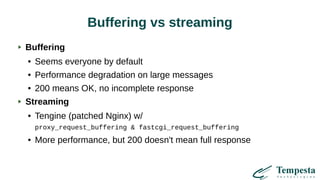
Buffering vs streaming
Buffering
● Seems everyone by default
● Performance degradation on large messages
● 200 means OK, no incomplete response
Streaming
● Tengine (patched Nginx) w/
proxy_request_buffering & fastcgi_request_buffering
● More performance, but 200 doesn't mean full response
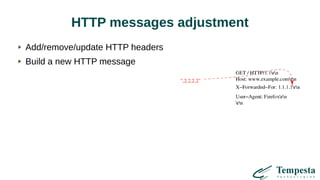
HTTP messages adjustment
Add/remove/update HTTP headers
Build a new HTTP message
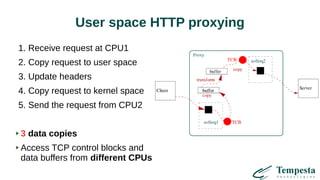
User space HTTP proxying
1. Receive request at CPU1
2. Copy request to user space
3. Update headers
4. Copy request to kernel space
5. Send the request from CPU2
3 data copies
Access TCP control blocks and
data buffers from different CPUs
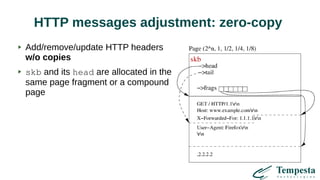
HTTP messages adjustment: zero-copy
Add/remove/update HTTP headers
w/o copies
skb and its head are allocated in the
same page fragment or a compound
page
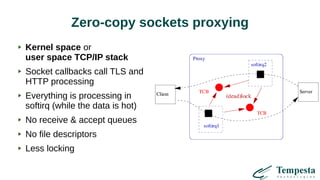
Zero-copy sockets proxying
Kernel space or
user space TCP/IP stack
Socket callbacks call TLS and
HTTP processing
Everything is processing in
softirq (while the data is hot)
No receive & accept queues
No file descriptors
Less locking
Tempesta FW: kernel HTTPS/TCP/IP stack
Alternative to user space TCP/IP stacks
HTTPS is built into TCP/IP stack
L7 DDoS mitigation and simple WAF out of the box
Very fast HTTP parser and strings processing using AVX2
TODO
HTTP QoS for asymmetric DDoS mitigation
DSL for multi-layer filter rules
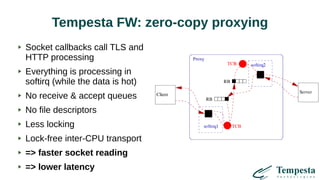
Tempesta FW: zero-copy proxying
Socket callbacks call TLS and
HTTP processing
Everything is processing in
softirq (while the data is hot)
No receive & accept queues
No file descriptors
Less locking
Lock-free inter-CPU transport
=> faster socket reading
=> lower latency
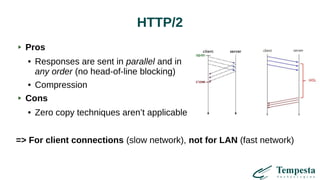
HTTP/2
Pros
● Responses are sent in parallel and in
any order (no head-of-line blocking)
● Compression
Cons
● Zero copy techniques aren’t applicable
=> For client connections (slow network), not for LAN (fast network)
Thanks!
Web-site: http://tempesta-tech.com (Powered by Tempesta FW)
Availability: https://github.com/tempesta-tech/tempesta
Blog: http://natsys-lab.blogspot.com
E-mail: ak@tempesta-tech.com

Проксирование HTTP-запросов web-акселератором / Александр Крижановский (Tempesta Technologies)

  • 1.
    HTTP Requests Proxying AlexanderKrizhanovsky Tempesta Technologies, Inc. ak@tempesta-tech.com
  • 2.
    Who am I? CEO& CTO at Tempesta Technologies Developing Tempesta FW – open source Linux Application Delivery Controller (ADC) Custom software development in: ● high performance network traffic processing e.g. WAF mentioned in Gartner magic quadrant ● Databases e.g. MariaDB SQL System Versioning https://github.com/tempesta-tech/mariadb https://m17.mariadb.com/session/technical-preview-temporal-queryi ng-asof
  • 3.
    HTTP requests proxying Loadbalancing Backend connections management SSL/TLS termination Protocol downgrade
  • 4.
    HTTP proxying issues Howmany server connections? What to do if an upstream resets a connection? How to manage HTTP message queues? Is it safe to resend a request to another upstream? TLS is expensive Sockets proxying is expensive HTTP multiplexing - HTTP/2?
  • 5.
    Server connections New connectionsor persistent connections HTTP keep-alive connections Keep-Alive: timeout=5, max=10000 Reestablish closed KA connection New connections if all are busy Tempesta FW: connections provisioning for DDoS and flash crowds
  • 6.
    How many connections? Thereis optimal connections number for particular Web server and hardware Large connections number: Larger latency Smaller RPS
  • 7.
    Connection resets &server failure Default for Apache HTTPD & Nginx: reset each 100 requests Dirty hack for messy dynamics Server failure ● Connection reset or I/O timeout ● HTTP error responses ● Backend healthcheck • TCP connection • HTTP response code • HTTP response body
  • 8.
    HTTP message pipelining Mostlyunused by proxies Squid, Tempesta FW, Polipo Messages multiplexing Forwarding and reforwarding issues Security issues ● Breaking authentication ● HTTP Response splitting
  • 9.
    Connection closing andKeep-Alive Client Connection: close + TCP active close (RFC 7230 3.3.3) no Content-Length no Transfer-Encoding: chunked Backend ● Connection: keep-alive ● Add Content-Length ● Now the message can be pipelined
  • 10.
    HTTP Response Splittingattack (Web cache poisoning) /redir_lang.jsp?lang=foobar%0d%0aContent-Length:%200%0d%0a%0d%0a HTTP/1.1%20200%20OK%0d%0aContent-Type:%20text/html%0d%0a Content-Length:%2019%0d%0a%0d%0a<html>Shazam</html> HTTP/1.1 302 Moved Temporarily Date: Wed, 24 Dec 2003 15:26:41 GMT Location: http://10.1.1.1/by_lang.jsp?lang=foobar Content-Length: 0 HTTP/1.1 200 OK Content-Type: text/html Content-Length: 19 <html>Shazam</html> Proxy must count number of requests and responses (later detection!) Validate allowed URI alphabet (also for injection attacks)
  • 11.
    (Non-)indempotent requests RFC 72314.2.2: Nonidempotent request changes server state Idempotent (safe) methods: GET, HEAD, TRACE, OPTIONS ● Admin responsibility: GET /action?do=delete ● Can be POST (e.g. web-search) Let a user to specify idempotence of methods and resources: nonidempotent GET prefix “/action”
  • 12.
    Pipeline queues Tempesta FW:switch off pipelining server_queue_size 1 Use a queue with NI-request only if all connections are busy
  • 13.
    Resend HTTP requests? Taintedrequests: server_forward_retries and server_forward_timeout Request-killers – RFC 7230 6.3.2: “a client MUST NOT pipeline immediately after connection establishment” ● Connection with re-forwarded requests is non-schedulable Nonidempotent requests aren’t reforwarded server_retry_nonidempotent Error messages keep order of responses Resending HTTP messages + TCP retransmission Copying is required… ...unless TCP send queue integreated into a proxy
  • 14.
    Requests reforwarding (not forpersistent sessions!)
  • 15.
    SSL/TLS: no zero-copying (nosendfile()!) User-kernel space copying ● Copy network data to user space ● Encrypt/decrypt it ● Copy the data to kernel for transmission Kernel-mode TLS ● Facebook, RedHat: https://lwn.net/Articles/666509/ ● Netflix: https://people.freebsd.org/~rrs/asiabsd_2015_tls.pdf ● DDoS: TLS handshake is still an issue ● Tempesta: http://www.netdevconf.org/2.1/papers/https_tcpip_stack.pdf
  • 16.
    Buffering vs streaming Buffering ●Seems everyone by default ● Performance degradation on large messages ● 200 means OK, no incomplete response Streaming ● Tengine (patched Nginx) w/ proxy_request_buffering & fastcgi_request_buffering ● More performance, but 200 doesn't mean full response
  • 17.
    HTTP messages adjustment Add/remove/updateHTTP headers Build a new HTTP message
  • 18.
    User space HTTPproxying 1. Receive request at CPU1 2. Copy request to user space 3. Update headers 4. Copy request to kernel space 5. Send the request from CPU2 3 data copies Access TCP control blocks and data buffers from different CPUs
  • 19.
    HTTP messages adjustment:zero-copy Add/remove/update HTTP headers w/o copies skb and its head are allocated in the same page fragment or a compound page
  • 20.
    Zero-copy sockets proxying Kernelspace or user space TCP/IP stack Socket callbacks call TLS and HTTP processing Everything is processing in softirq (while the data is hot) No receive & accept queues No file descriptors Less locking
  • 21.
    Tempesta FW: kernelHTTPS/TCP/IP stack Alternative to user space TCP/IP stacks HTTPS is built into TCP/IP stack L7 DDoS mitigation and simple WAF out of the box Very fast HTTP parser and strings processing using AVX2 TODO HTTP QoS for asymmetric DDoS mitigation DSL for multi-layer filter rules
  • 22.
    Tempesta FW: zero-copyproxying Socket callbacks call TLS and HTTP processing Everything is processing in softirq (while the data is hot) No receive & accept queues No file descriptors Less locking Lock-free inter-CPU transport => faster socket reading => lower latency
  • 23.
    HTTP/2 Pros ● Responses aresent in parallel and in any order (no head-of-line blocking) ● Compression Cons ● Zero copy techniques aren’t applicable => For client connections (slow network), not for LAN (fast network)
  • 24.
    Thanks! Web-site: http://tempesta-tech.com (Poweredby Tempesta FW) Availability: https://github.com/tempesta-tech/tempesta Blog: http://natsys-lab.blogspot.com E-mail: ak@tempesta-tech.com