High Throughput Screening
Dr Ranjita Santra (Dhali)
Assistant Professor
Department of Clinical & Experimental Pharmacology
STM, Kolkata
What is High Throughput Screening (HTS) ?
• The last two decades have seen astonishing
innovations in technology that have helped the
manual low speed screening to evolve into an
automated, microprocessor controlled robotic
process called High Throughput Screening (HTS)
• HTS - A synergy of chemistry, biology,
engineering and informatics
• Screening of over 50,000-1,00,000
compounds/week
• Screening against the validated biological target
Source: Velpandian T, Sharma HP. In: SK Gupta, editor. Drug Sreening Mrthods. 3rd
edn. New Delhi :The Health Sciences;2016
Goals
1. Identify a molecular structure that:
• Selectively binds to and modulates the
activity of a biological target (e.g., a
protein) of interest [target-based]
• Selectively induces a desired
phenotype in a cell population or
organism of interest [phenotype-based]
Goals
2. Identify hits serve as starting points
for:
• Drug discovery programs
• Medicinal chemistry
• Pharmacology
• Chemical biology programs
• Target identification
• Target validation and mechanism of action
Applications of HTS
• Drug discovery
• Toxicology (in silico toxicology methods)
• Screening of different types of libraries
• Combinatorial Chemistry
• Genomics
• Protein libraries (Antibodies, secreted
soluble protiens)
• Peptide libraries
HTS in Drug Discovery
• Accelerates drug discovery by screening large
compound libraries at a rate that may exceed a
few thousand compounds per day or per week
• Parallel and combinatorial chemical synthesis
generates a vast number of novel compounds
• Characterization of metabolic, pharmacokinetic
and toxicological data about new drugs
General Steps
• Target identification and purification
• Target validation
• Assay development (screening of potential
compounds against target identified)
• High-throughput library (HTL) screening
General Steps
• Lead optimization
• Confirmation of ‘hits’
Hit = A molecule with confirmed activity from primary
HTS assay with a good profile in secondary assays
and with confirmed structure
Lead = Hit series exhibiting the Structure Activity
Relationship(SAR) and demonstrating activities
both in vitro and in vivo
The Array
• Polycarbonate base
film, 0.5-mm thick
• 6x8 array of
coatings
• each sample is 2-5-
μm thick and 10-mm
in diameter
• Flexible silicon
rubber template to
create wells
In Vitro interaction studies
• Chemical microarray
• Chemical -protein interactions
• Enzyme activity inhibition
• Target identification
• Signal pathway elucidation
• Chip based microarray
• Microfluidics helps in mixing of samples
with the targets bound in the chip
• Final signals read by analyzers
(Fluoroscent/simple UV/visible signals)
Other microarrays
• Cytokine based kits
• Angiogenesis responsive biomolecular kits
• Transcription factor analysis kits
Common principle: Biological samples bind to
the Abs bound to the array membrane,
incubation, binding to the secondary Abs and
final tagging of secondary Abs with the signal
emitting molecules (e.g. dyes)
Fluorescence tecniques in HTS
• Fluorescence (FU) based detection of the compounds,
analytes or genetic materials
• Luminescence-based binding assays - core of
interaction of ligand with the biological compartment
• Detection systems - Multimode readers(screening a
single reaction well for different modes e.g. UV, visible
to FU etc.)
• FU microscopes - Identification:
• Entry of fluorescent tagged compound at desired site
• Drug effect on a biomolecule / cellular component
Fluorescent techniques in drug
discovery
• Fluorescence Anisotropy(FA)/
Fluorescence Polarization(FP)
• Time Resolved FA (TRFA)
• Fluorescence Correlation
Spectroscopy(FCS)
• Fluorescence Resonance Energy
Transfer(FRET)
• TR-FRET
• Fluorescence microscopy
Areas of Application
• Receptor-ligand binding assay
• Screening of chemical compounds
• Drug -receptor, drug-enzyme interaction
• Tissue structural analysis
• Gene expression analysis
• Cellular component analysis
Thermal Shift Analysis for HTS
• Identifies ligand interaction with the
proteins
• Fluorescent dye (e.g. sypro orange)
associates and dissociates from the
protein with change in the temperature of
the reaction
• Principle: Binding of ligand to protein,
stabilizing or destabilizing its structure,
final change in the Tm of the protein
Thermal Shift Analysis for HTS
Assessment of:
1.Role of inhibitor in the binding affinity of
ligand with protein
2.Stability of the protein at various pH and salt
conditions
3.Ligand screening for lead identification
Examples: Identification of CA enzyme inhibitors in
glaucoma/AD/PD/Epilepsy)
ER antagonists(Toremefine,tamoxifen) in Cryptococcal
infections
MAP2K4 inhibitor in CA Prostate
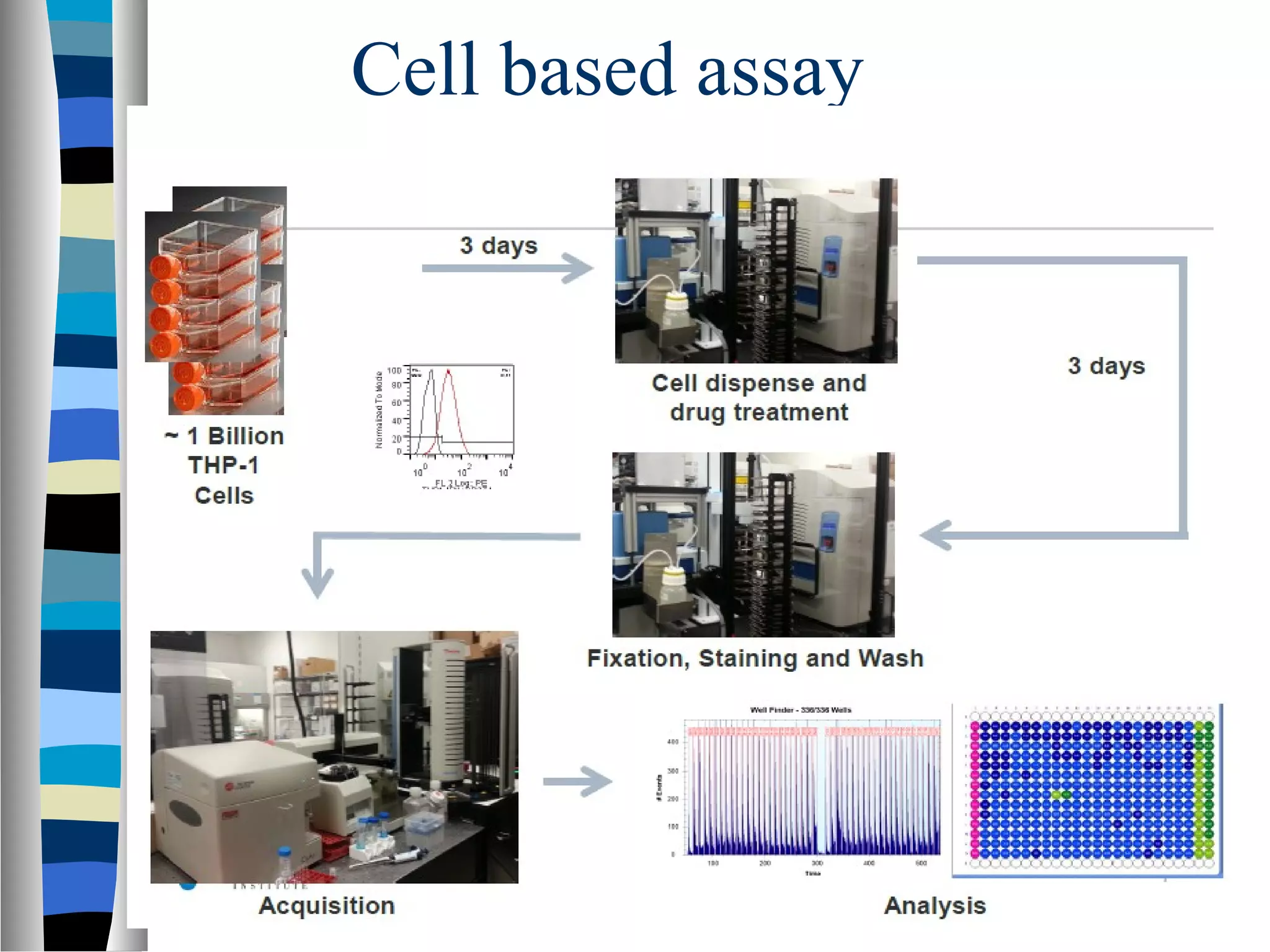
Cell based assay
In Vivo Techniques
• Vascular mapping
• Tissue perfusion studies
• Imaging vasculature of brain
• Angiograms of eye
• GIT imaging using endoscopic optics
• Imaging tumours, atherosclerosis,
apoptosis, osteoblastosis
Virtual screening/In Silico drug
development
• Indirect approach using advanced
computer technology to screen newer
compounds based on virtual
coordinates of receptors and signals by
CAMD
• 3D molecular structure of the receptor
and the ligands for docking
• For lead optimization
Unconventional rapid pharmacological
and toxicity testing models
• Zebrafish (angiogenic and anti-
angiogenic effects, heart regeneration)
and Gold fish
• Chick (Anti-cataract activity on lens)
• Nematode C. elegans (growth
retardation with caffeine)
Others
• HTS PK Studies
• HTS-Absorption studies
• HTS-Metabolism studies
• HTS-CYP Inhibition and Induction studies
• HTS Toxicity studies
HTS in the analysis of toxins
• Identification of Marine toxins :
Palytoxins, ciguatoxins, cyclic amines
and tetrodotoxins
• Concern for sea food and sea water
• Steps by EC and EFSA in this regard
Data Acquisition Programs
• Programs constructed using LabView
• Kaleidagraph
• Synergy Software
• Programs constructed using MatLab
• The Mathworks Inc.
Combinatorial Chemistry
• Miniaturization and automation yield high-
throughput experimentation
• Decreased sample size
• Processes almost completely automated
• Quantitative analysis of data
• All steps linked to central database
• Self-updating processes
• Easy to use
• Reliable and versatile
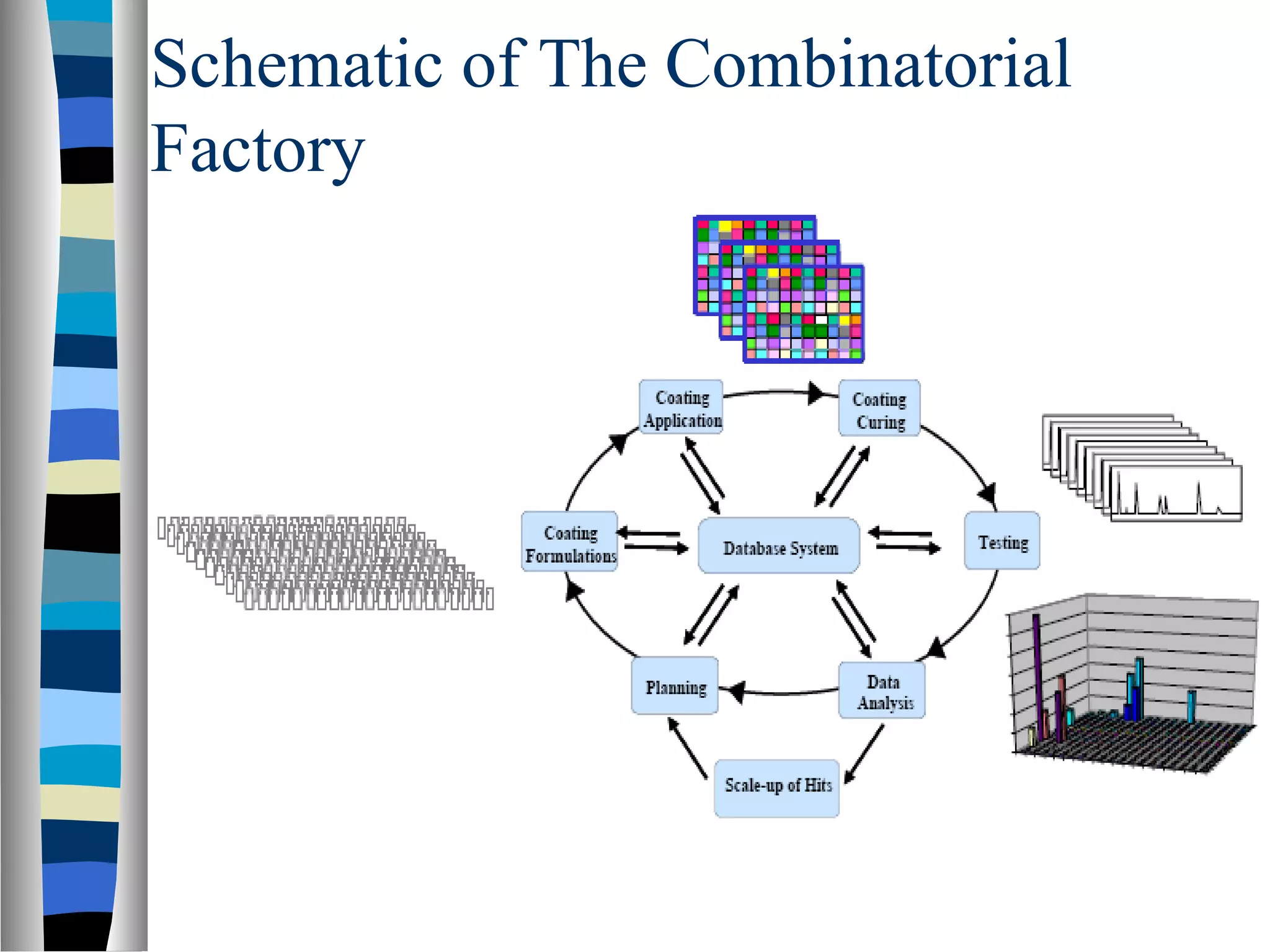
• Combinatorial factory: Larger scale testing to
meet industry specifications
Schematic of The Combinatorial
Factory
Advantages of Combi Chem and
High-Throughput Methods
• Automated, reliable processes
• Quantitative analysis
• Comprehensive database
Advantages of Combi Chem and
High-Throughput Methods
• Automated, reliable processes
• Quantitative analysis
• Comprehensive database
• Test more samples in shorter period of
time
• Minimize cost per sample
• Faster
Thank you!
Questions or
comments?

HTS

  • 1.
    High Throughput Screening DrRanjita Santra (Dhali) Assistant Professor Department of Clinical & Experimental Pharmacology STM, Kolkata
  • 2.
    What is HighThroughput Screening (HTS) ? • The last two decades have seen astonishing innovations in technology that have helped the manual low speed screening to evolve into an automated, microprocessor controlled robotic process called High Throughput Screening (HTS) • HTS - A synergy of chemistry, biology, engineering and informatics • Screening of over 50,000-1,00,000 compounds/week • Screening against the validated biological target Source: Velpandian T, Sharma HP. In: SK Gupta, editor. Drug Sreening Mrthods. 3rd edn. New Delhi :The Health Sciences;2016
  • 3.
    Goals 1. Identify amolecular structure that: • Selectively binds to and modulates the activity of a biological target (e.g., a protein) of interest [target-based] • Selectively induces a desired phenotype in a cell population or organism of interest [phenotype-based]
  • 4.
    Goals 2. Identify hitsserve as starting points for: • Drug discovery programs • Medicinal chemistry • Pharmacology • Chemical biology programs • Target identification • Target validation and mechanism of action
  • 5.
    Applications of HTS •Drug discovery • Toxicology (in silico toxicology methods) • Screening of different types of libraries • Combinatorial Chemistry • Genomics • Protein libraries (Antibodies, secreted soluble protiens) • Peptide libraries
  • 6.
    HTS in DrugDiscovery • Accelerates drug discovery by screening large compound libraries at a rate that may exceed a few thousand compounds per day or per week • Parallel and combinatorial chemical synthesis generates a vast number of novel compounds • Characterization of metabolic, pharmacokinetic and toxicological data about new drugs
  • 7.
    General Steps • Targetidentification and purification • Target validation • Assay development (screening of potential compounds against target identified) • High-throughput library (HTL) screening
  • 8.
    General Steps • Leadoptimization • Confirmation of ‘hits’ Hit = A molecule with confirmed activity from primary HTS assay with a good profile in secondary assays and with confirmed structure Lead = Hit series exhibiting the Structure Activity Relationship(SAR) and demonstrating activities both in vitro and in vivo
  • 9.
    The Array • Polycarbonatebase film, 0.5-mm thick • 6x8 array of coatings • each sample is 2-5- μm thick and 10-mm in diameter • Flexible silicon rubber template to create wells
  • 10.
    In Vitro interactionstudies • Chemical microarray • Chemical -protein interactions • Enzyme activity inhibition • Target identification • Signal pathway elucidation • Chip based microarray • Microfluidics helps in mixing of samples with the targets bound in the chip • Final signals read by analyzers (Fluoroscent/simple UV/visible signals)
  • 11.
    Other microarrays • Cytokinebased kits • Angiogenesis responsive biomolecular kits • Transcription factor analysis kits Common principle: Biological samples bind to the Abs bound to the array membrane, incubation, binding to the secondary Abs and final tagging of secondary Abs with the signal emitting molecules (e.g. dyes)
  • 12.
    Fluorescence tecniques inHTS • Fluorescence (FU) based detection of the compounds, analytes or genetic materials • Luminescence-based binding assays - core of interaction of ligand with the biological compartment • Detection systems - Multimode readers(screening a single reaction well for different modes e.g. UV, visible to FU etc.) • FU microscopes - Identification: • Entry of fluorescent tagged compound at desired site • Drug effect on a biomolecule / cellular component
  • 13.
    Fluorescent techniques indrug discovery • Fluorescence Anisotropy(FA)/ Fluorescence Polarization(FP) • Time Resolved FA (TRFA) • Fluorescence Correlation Spectroscopy(FCS) • Fluorescence Resonance Energy Transfer(FRET) • TR-FRET • Fluorescence microscopy
  • 14.
    Areas of Application •Receptor-ligand binding assay • Screening of chemical compounds • Drug -receptor, drug-enzyme interaction • Tissue structural analysis • Gene expression analysis • Cellular component analysis
  • 15.
    Thermal Shift Analysisfor HTS • Identifies ligand interaction with the proteins • Fluorescent dye (e.g. sypro orange) associates and dissociates from the protein with change in the temperature of the reaction • Principle: Binding of ligand to protein, stabilizing or destabilizing its structure, final change in the Tm of the protein
  • 16.
    Thermal Shift Analysisfor HTS Assessment of: 1.Role of inhibitor in the binding affinity of ligand with protein 2.Stability of the protein at various pH and salt conditions 3.Ligand screening for lead identification Examples: Identification of CA enzyme inhibitors in glaucoma/AD/PD/Epilepsy) ER antagonists(Toremefine,tamoxifen) in Cryptococcal infections MAP2K4 inhibitor in CA Prostate
  • 17.
  • 18.
    In Vivo Techniques •Vascular mapping • Tissue perfusion studies • Imaging vasculature of brain • Angiograms of eye • GIT imaging using endoscopic optics • Imaging tumours, atherosclerosis, apoptosis, osteoblastosis
  • 19.
    Virtual screening/In Silicodrug development • Indirect approach using advanced computer technology to screen newer compounds based on virtual coordinates of receptors and signals by CAMD • 3D molecular structure of the receptor and the ligands for docking • For lead optimization
  • 20.
    Unconventional rapid pharmacological andtoxicity testing models • Zebrafish (angiogenic and anti- angiogenic effects, heart regeneration) and Gold fish • Chick (Anti-cataract activity on lens) • Nematode C. elegans (growth retardation with caffeine)
  • 21.
    Others • HTS PKStudies • HTS-Absorption studies • HTS-Metabolism studies • HTS-CYP Inhibition and Induction studies • HTS Toxicity studies
  • 22.
    HTS in theanalysis of toxins • Identification of Marine toxins : Palytoxins, ciguatoxins, cyclic amines and tetrodotoxins • Concern for sea food and sea water • Steps by EC and EFSA in this regard
  • 23.
    Data Acquisition Programs •Programs constructed using LabView • Kaleidagraph • Synergy Software • Programs constructed using MatLab • The Mathworks Inc.
  • 24.
    Combinatorial Chemistry • Miniaturizationand automation yield high- throughput experimentation • Decreased sample size • Processes almost completely automated • Quantitative analysis of data • All steps linked to central database • Self-updating processes • Easy to use • Reliable and versatile • Combinatorial factory: Larger scale testing to meet industry specifications
  • 25.
    Schematic of TheCombinatorial Factory
  • 26.
    Advantages of CombiChem and High-Throughput Methods • Automated, reliable processes • Quantitative analysis • Comprehensive database
  • 27.
    Advantages of CombiChem and High-Throughput Methods • Automated, reliable processes • Quantitative analysis • Comprehensive database • Test more samples in shorter period of time • Minimize cost per sample • Faster
  • 28.